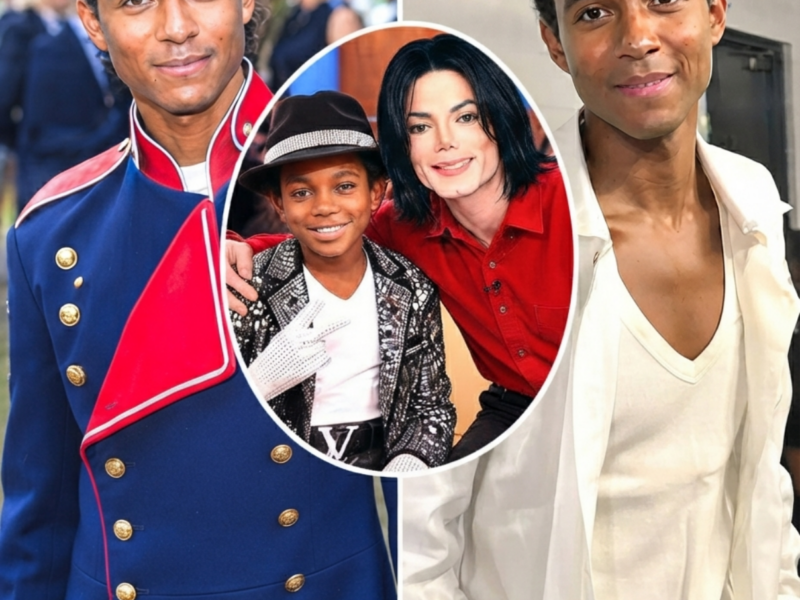
Jaafar Jackson turns 30 today, and the internet can’t stop asking one shocking question: is Michael Jackson’s nephew actually the next King of Pop, or something far more haunting?
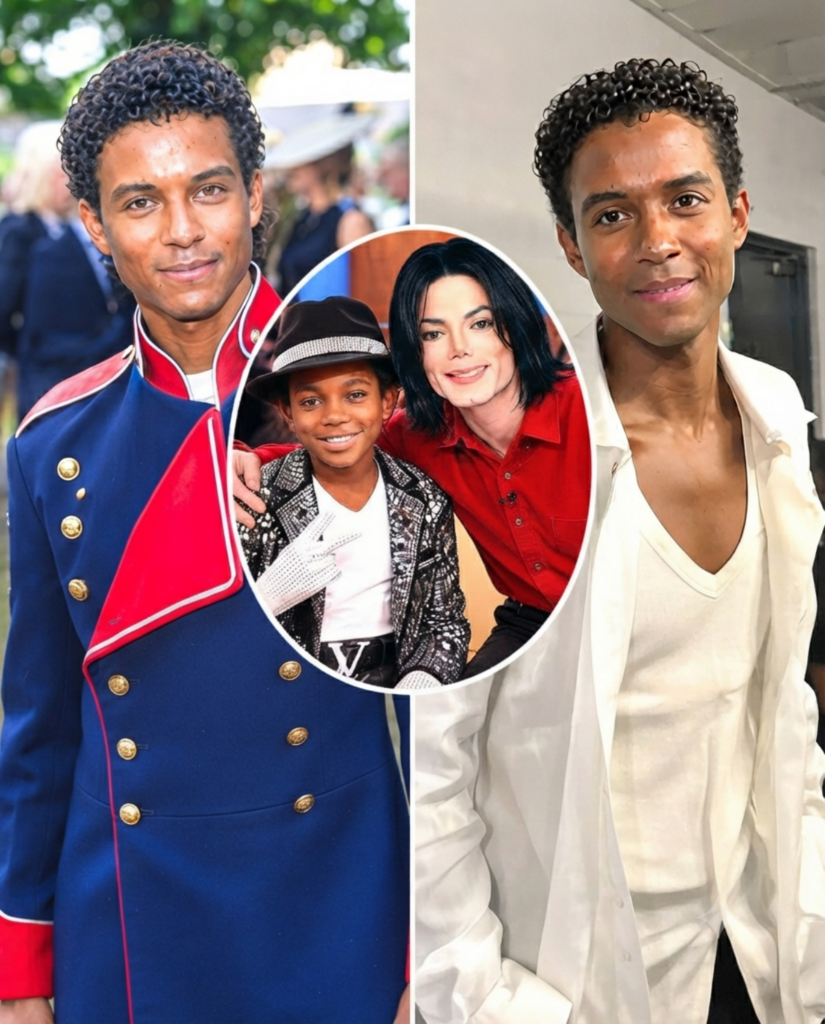
There is a name going around this week that people cannot stop saying.
And every time they say it, they find themselves staring at a photograph of a young man in a black velvet suit and wondering if they are looking at a ghost.
It was published on the morning of Saturday, July 25th, 2026—the day Jaafar Jackson turned thirty years old.
And it belongs to a young man who was born into the most famous musical family in history but spent most of his life invisible.
In the versions being shared, a photograph of Jaafar in character as Michael Jackson appears at the top—the fedora pulled low, the single white glove, the silhouette that the whole world recognizes.
Below it, a caption that runs for several paragraphs.
In some retellings, the writer mentions that he kept his casting a secret from his own family for a full year.
In others, he quotes a single sentence from an interview—something about carrying the weight of a legacy.
In others again, he uses a phrase that has sent people back to their screens trying to figure out what it actually means to be the next Michael Jackson.
The comments all ask the same thing. Is he really that good?
And people are certain. They are telling each other it was the most astonishing debut any actor has made in years—and that of course Jaafar Jackson would be the one to step into the moonwalking shoes of his legendary uncle.
I have spent this week going through every angle of it, and I will put every piece of it in front of you before the end.
But there is something you need first, because it changes what that performance even means.
And almost nobody sharing it has heard the part that happened before the cameras ever started rolling.
Before we move on, we want to spotlight a comment from our last video that caught our attention. Thanks for sharing your thoughts with us.
What do you admire most about Jaafar’s journey so far? Let us know what you think in the comments, and one comment could be featured in our next video.
Now, let’s get back to his story.
A young man once sat in a room with director Antoine Fuqua and told him he wanted to play the most famous man in music history.
And then he went home and told absolutely nobody.
Not his father. Not his mother. Not his brothers or sisters.
He kept it quiet for an entire year because he knew that if he told them too soon, he might never get the chance to prove he could do it.
That is where this story begins. Not with a red carpet. Not with a premiere.
With a secret kept in the dark, while a young man rehearsed in front of a mirror trying to become someone who had been gone for seventeen years.
Stay with me and take this in order, because the last few minutes are why I made this.
First, though—the morning everybody is arguing about.
One photograph, a few hundred words, and a question that has become the subject of intense debate.
Jaafar Jeremiah Jackson was born on July 25th, 1996, in Los Angeles, California.
He is the son of Jermaine Jackson, the fourth-oldest child of Joe and Katherine Jackson and a founding member of the Jackson 5.
His mother is Alejandra Genevieve Oaziaza, a Colombian-born entrepreneur and fashion designer.
The pair married in 1995 and divorced in 2008. They also share a younger son, Jermajesty Jermaine Jackson, born in October 2000.
And here is where the family tree gets complicated.
His mother had previously been in a relationship with his uncle Randy Jackson before marrying Jermaine.
His cousins are also his siblings. His half-siblings from his mother’s relationship with Randy are simultaneously his cousins.
The Jackson family has always been a dynasty, but it is also a knot that only the people inside it can untangle.
Growing up in the Jackson family meant growing up in the shadow of greatness.
His uncle Michael was already the most famous entertainer in the world when Jaafar was born.
His father Jermaine had been a star in his own right. His grandmother Katherine held the family together.
His grandfather Joe was the architect of it all—the man who had pushed his children to greatness and sometimes beyond.
Jaafar grew up hearing stories about the Jackson 5, about the Motown years, about the transformation of his uncle from a child star into a global icon.
He grew up watching footage, listening to the music, absorbing the legacy through osmosis.
He did not choose the Jackson name. It was given to him.
But he chose what to do with it.
Jaafar has been singing and dancing since the age of twelve. He played piano. He studied the greats—Sam Cooke, Marvin Gaye, the artists who came before him.
In 2019, he released his first single, “Got Me Singing,” along with a music video that showcased his talents.
He appeared in several family-centered projects, including the 2015 reality show *The Jacksons: Next Generation*.
He was building a career slowly, quietly—the way people do when they know their last name opens doors but also comes with expectations that could crush them.
He was not trying to be Michael. He was trying to be himself.
But the world had other ideas.
Then came the call that changed everything.
In January 2023, it was announced that Jaafar Jackson would play his uncle Michael Jackson in the biopic *Michael*, directed by Antoine Fuqua.
The film would trace Jackson’s journey from his early days with the Jackson 5 to his meteoric rise as a solo artist who would redefine global pop culture.
Jaafar was twenty-six years old. He had no previous acting experience. He had never carried a film.
And he was about to step into the shoes of the most famous performer in music history.
The announcement was met with skepticism.
How could a young man with no acting credits play the most famous man in music history? How could he capture the voice, the movement, the presence, the soul of someone who had been gone for years?
Director Antoine Fuqua said of the casting: “It’s incredibly exciting to watch Jaafar bring Michael to life. There was such a spiritual connection when I first met Jaafar, who has a natural ability to emulate Michael and such a great chemistry with the camera.”
Fuqua had directed *Training Day*, *The Equalizer*, and other major films. He knew talent when he saw it—and he saw something in Jaafar that convinced him to take a risk.
But here is the part that stops people.
Jaafar kept the casting a secret from his own family for an entire year.
“No one in my family knew for a full year,” he told Miles Teller for *Interview* magazine. “I kept it pretty quiet until I felt comfortable enough to share it.”
He did not tell his father, Jermaine, who had been in the Jackson 5 with Michael. He did not tell his mother, Alejandra. He did not tell his brother, Jermajesty.
He held it alone in the dark, rehearsing in front of a mirror, trying to become someone who had been gone for seventeen years.
“When my mom saw it on screen, it blew her away,” he said.
Think about what that means. A full year of training, of rehearsing, of becoming someone else—and he told nobody.
He carried the weight of his uncle’s legacy alone, in his own head, in his own body, waiting until he was ready to show the world what he had done.
That takes courage. That takes discipline. That takes the kind of focus that runs in the Jackson blood.
Quick one before we go on. If you are still here, hit the like button. It genuinely helps this channel more than you would guess.
And drop a comment telling us what you think it would be like to play your own uncle on screen, because the gap between Jaafar Jackson and the rest of us is the whole point of this video.
The film *Michael* premiered on April 24th, 2026.
It was directed by Antoine Fuqua, written by John Logan, and produced by Graham King—the same team behind *Bohemian Rhapsody*.
It starred Jaafar Jackson as Michael, Colman Domingo as Joe Jackson, Nia Long as Katherine Jackson, and Miles Teller as attorney John Branca.
The film ended in 1988, leaving a potential sequel to address the more controversial chapters of Michael’s life.
The production had been enormous, spanning multiple countries and involving thousands of extras.
The costume department had recreated Michael’s most iconic looks. The choreography team had worked for months to perfect every move.
And at the center of it all was Jaafar—a young man who had never acted before, carrying the weight of an entire legacy on his shoulders.
And the reviews? They came in like a storm.
Critics praised Jaafar’s performance with language usually reserved for seasoned veterans.
*The Telegraph India* called it an Oscar-worthy performance, saying, “There are moments where the line between actor and icon genuinely blurs. Jaafar captures not just the voice and the physicality, but the elusive aura of Jackson’s stage presence.”
*Newsday* described his dancing as electrifying. “Every pivot, pirouette, and pop-lock is executed with ferocious grace.”
*The Detroit News* wrote that he “plays Michael with saintly purity and innocence, and he nails the singer’s kind-hearted essence.”
*People* magazine reported that critics called his portrayal perfection.
*Variety* said he “embodies the King of Pop with uncanny accuracy, channeling both his vulnerability and his power in a performance that will leave audiences breathless.”
*The Hollywood Reporter* noted that “Jaafar Jackson does not merely impersonate Michael Jackson. He inhabits him. This is the kind of performance that makes you forget you are watching an actor at all.”
But the film itself received mixed reviews. Some called it a sanitized, surface-level portrait of a complicated genius.
*The Telegraph India* noted that the script “treats Jackson less as a complex individual and more as an infallible protagonist gliding from one triumph to the next.”
*Newsday* described it as “a soggy musical biopic that’s often jolted to life by its electrifying star.”
The film avoided the more troubling aspects of Jackson’s life—the opioid addiction, the plastic surgeries, the child allegations. It ended in 1988, before any of those controversies erupted.
Some critics felt that this was a missed opportunity—a chance to tell the full story of a complicated man reduced to a hagiography.
Others defended the decision, arguing that the film was about the music, not the scandal.
But the one thing everyone agreed on was Jaafar.
He was the reason to watch. He was the electricity in the room. He was, in the words of one critic, “the film’s greatest strength, without question.”
Even the harshest reviews of the film’s script or direction made sure to praise the man at the center of it all.
He had done what nobody thought he could do. He had become Michael Jackson on screen.
The film became one of the highest-grossing biopics ever, crossing more than a billion dollars at the box office.
Lionsgate has confirmed plans to begin production on a sequel sometime in late 2026 or early 2027.
Jaafar will reprise his role as Michael Jackson, and he has already started talking about what he wants the sequel to address.
The first film ended in 1988—before the allegations, before the trials, before the final years of Michael’s life.
The sequel will have to confront those years head-on, and Jaafar has said he is ready for that challenge.
Speaking with *GQ Middle East*, Jaafar—now thirty—clarified that he does not have direct control over how future storylines will be handled, but he expressed hope that a sequel would give more insight into Michael Jackson’s own perspective.
His statement especially pointed to how the sequel may address the past child allegations against his uncle.
“I think the second film will give even more insight from his point of view, because at the end of the day, the allegations are always from someone else’s,” he said. “It’s someone else’s story. It’s someone else’s idea of what it is, and it’s mainly driven by an agenda.”
Adding that the family has often felt Michael’s own voice has not been fully represented, he said he hopes the sequel captures who his uncle truly was as a person, saying Michael “always tried to see the good in others, even during difficult times.”
That is a heavy burden for a thirty-year-old to carry.
To defend a dead man’s reputation while trying to build your own career. To step into the spotlight and have the world ask not who you are, but who you remind them of.
Jaafar has had to navigate questions about his uncle’s legacy that would make most people retreat.
He has had to answer questions about allegations that he was not alive to witness, that he only knows through secondhand accounts and family stories.
He has had to balance his loyalty to his family with his desire to tell an honest story.
And he has done it with grace, humility, and a clear sense of purpose.
Now, let’s talk about the man behind the performance.
Jaafar Jackson’s net worth is estimated at around $500,000—modest by Jackson family standards.
For context, his uncle Michael’s estate has been valued in the hundreds of millions.
Jaafar has made most of his earnings from modeling gigs, as well as through his music and acting career.
He is not rich by Jackson standards. He is a working artist who happened to land the role of a lifetime.
He has built his career slowly, deliberately, without relying on the family name to open doors that he was not ready to walk through.
He has been with his fiancée, singer Madie Simpson, since 2016. They celebrated their engagement in February 2025.
He proposed with a yellow-cut diamond, celebrating the milestone with family and friends.
The couple made their red-carpet debut in April 2026 at the Berlin premiere of *Michael*, the biopic in which Jaafar portrays his uncle.
In July 2026, just days after his thirtieth birthday, Jaafar and Madie were spotted on a private yacht in Capri, Italy.
He was living the life that his uncle once lived—the glamour, the attention, the cameras following his every move.
But he is also trying to live his own life on his own terms. He has been careful to build a relationship that is separate from the Jackson legacy—a partnership that is his own.
In May 2026, Jaafar made his Met Gala debut.
He wore a black velvet Ralph Lauren suit with gold detailing. The look was a tribute to his uncle—a classic style often associated with Michael Jackson’s iconic stage looks.
Speaking to *Vogue* on the red carpet, he said, “I portray Michael Jackson in the new film *Michael*, and it just felt right when I had it on,” noting that the look even earned the approval of his fiancée.
The Met Gala debut came shortly after the release of his film, which had been keeping the cash register ringing at the box office.
It was a moment of triumph—a young man stepping into the world’s most exclusive party and holding his own.
But here is the part that people are still arguing about.
Is Jaafar Jackson the next Michael Jackson?
The question is loaded. It is unfair. It is impossible.
Michael Jackson was a once-in-a-generation talent—a man who changed music, dance, fashion, and culture in ways that are still being felt decades after his death.
No one can be the next Michael Jackson. Not even his own nephew.
But the question keeps getting asked because Jaafar looks like him, moves like him, sounds like him, and has now played him on screen in a way that has made audiences gasp.
He has the same bone structure, the same intense eyes, the same presence that his uncle had.
And when he moves on screen, he moves like Michael did—with that fluid grace that seemed to defy gravity.
And Jaafar himself seems to understand the weight of the comparison.
He is not trying to be Michael. He is trying to honor him.
He told *People* at the film’s Los Angeles premiere, “I knew I had to make my family proud. I knew I would have to have a work ethic that was incredible and really take on everything the way Michael would take it on.”
He trained for two years—dancing constantly, perfecting every gesture, every movement, every glance.
He did not just learn the choreography. He learned the soul of the man he was portraying.
He studied the way Michael tilted his head, the way he held his hands, the way he breathed before a performance.
He became obsessed with the details, because he knew that the details were what made Michael, Michael.
One detail that stopped me cold.
In May 2026, Jaafar posted a photograph on Instagram from the set of *Michael*. He was holding an iconic Grammy Award.
The award he held on camera actually belonged to Michael Jackson himself.
He was recreating one of the King of Pop’s biggest career moments—holding his uncle’s actual Grammy.
That is not just acting. That is communion. That is a young man reaching across the seventeen years since his uncle died and touching something that was once his.
The photograph was simple—just Jaafar holding the award, looking down at it with an expression that was hard to read. But the symbolism was overwhelming.
He was holding a piece of his uncle’s legacy in his hands, and he was carrying it forward.
Another detail.
In April 2026, the film premiered in Berlin—the same city where, in November 2002, Michael Jackson held his nine-month-old son over a hotel balcony railing with a cloth over his face.
Twenty-three years later, his nephew walked the red carpet in that same city in a jacket with a gold crown, wearing his father’s feet on his arm.
The Jacksons do not forget where they have been. They carry it with them—in their blood, in their bones, in the way they move.
That red carpet was not just a premiere. It was a return. A reclamation. A young man stepping back into a city that had once been the site of his uncle’s most infamous moment and making it his own.
The photograph is still there. The post is still up. The film is still playing in theaters.
And somewhere in the gap between a young man who kept a secret for a year and a world that cannot stop comparing him to his uncle, the truth landed exactly where it was supposed to.
Not on a stage. In the quiet. In the moment after you finish reading. In the part that nobody shares—because the part that nobody shares is the part that actually matters.
Jaafar taught us that.
And in the end, that is what he left behind. Not the comparison. Not the expectation.
The beauty that comes after you stop trying to be someone else and start being yourself.
The beauty that Jaafar Jackson finally found in the year he turned thirty—when he stepped out of his uncle’s shadow and into his own light.









