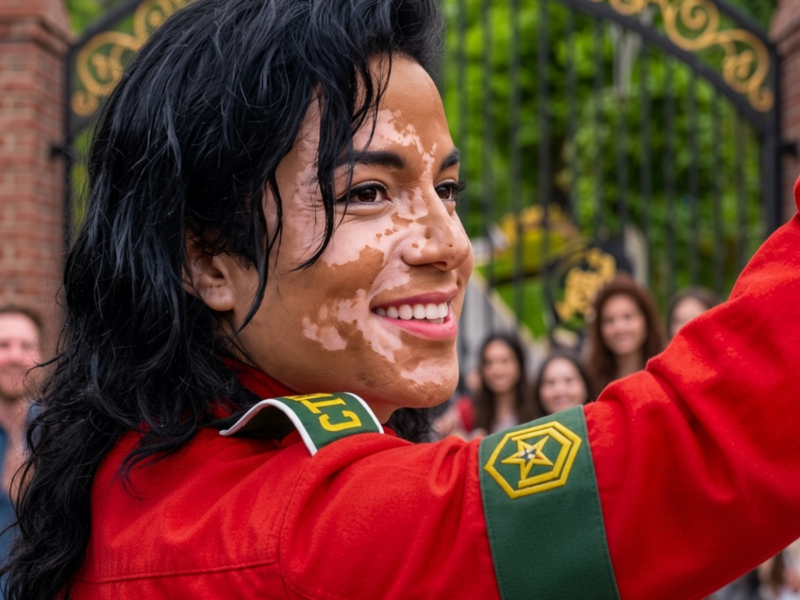
Jaafar Jackson Reveals NEW LOOK For Michael 2 Movie and It’s shocking.
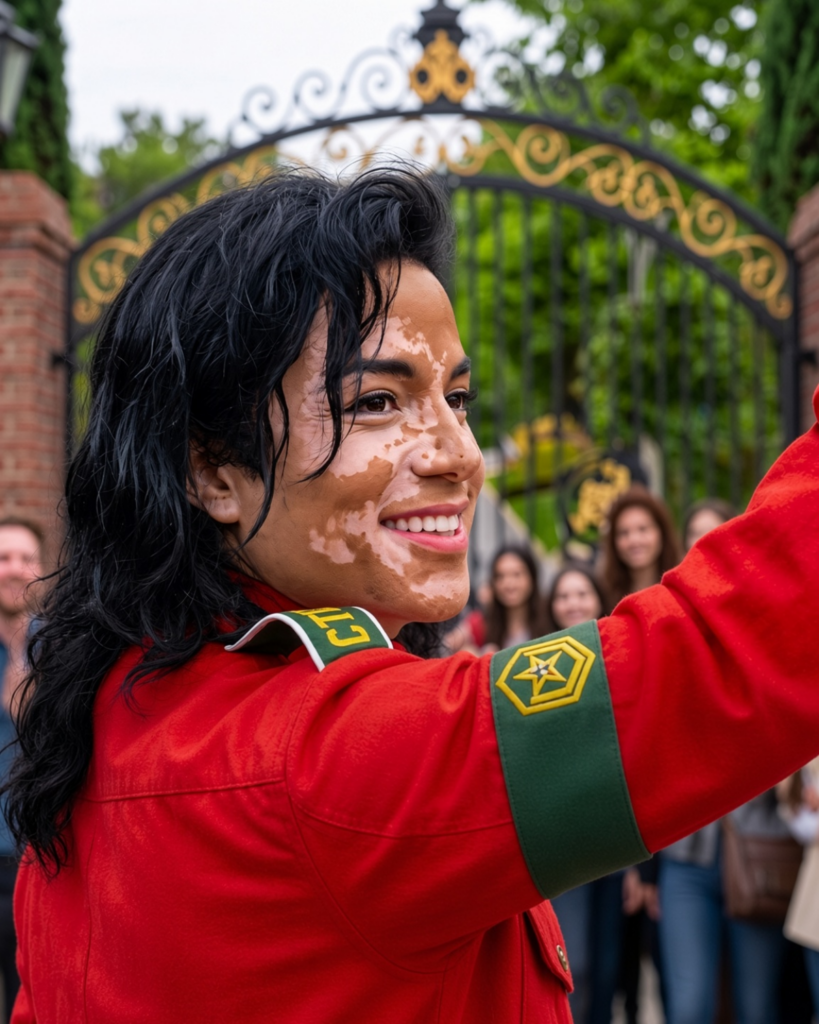
The heavy, pungent scent of prosthetic foam clung tightly to the bridge of his nose under the dim, sickly yellow lights of the dressing room.
Jaafar Jackson stood frozen before the full-length mirror, where every coiled strand of hair and every inch of skintight black fabric were steadily transmuting him into an entirely different entity.
Surrounding him, hundreds of photographs of Michael Jackson covered all four walls, silently scrutinizing his every micro-movement.
He recalled the grueling months of exile deep within the Hayvenhurst basement.
There, nothing existed save for the hollow sound of ragged breathing, feet bleeding and bruised after twenty days and nights of pushing the body to absolute collapse, and scraps of handwritten notes plastered across the walls.
“Doing well is nothing. Tomorrow must be twice as ferocious.”
When night descended upon the haunted remnants of the Thriller set, Jaafar stood among a horde of rotting ghouls beneath the freezing moonlight.
Looking down at the sequined glove glistening on his hand, he understood that this was no longer mere acting.
It was an irreversible descent into the haunting, labyrinthine world of his uncle.
When Jaafar ceased to be an actor playing Michael, there was a moment so breathtakingly surreal, a boundary so fragile, that it shattered space and time into jagged shards, plunging reality into a feverish dreamscape.
It was the precise instant Jaafar Jackson silently approached the towering mirror inside the desolate dressing room, where sickly yellow lights cast flickering shadows like entities from another dimension.
Standing directly before the glass, he was no longer himself.
Adorned in synthetic flesh meticulously sculpted down to every single pore, with curly locks precisely molded after historical blueprints, the iconic sleek black leather suit, a glittering sequined glove, and a chilling cascade of metallic buckled straps running down his arms—Jaafar emerged like a wax figure resurrected straight from the abyss of death.
With merely a few sharp structural alterations across his facial architecture, he systematically erased every trace of his own real-world identity.
Yet what made this flesh-and-blood transmutation deeply haunting extended far beyond superficial disguise.
Deep beneath the cascading hair, the synthetic prosthetics, and the dazzling garments lay a microscopic, exhaustive engineering project orchestrated by an entire crew.
A desperate, unrelenting crusade to bend and reconstruct Jaafar into successive eras of his legendary uncle’s life.
Bill Corso, the film’s legendary hair and makeup designer, a cinematic veteran who has walked alongside the ghosts of silver screen history, revealed a staggering statistic.
Jaafar underwent roughly thirty distinct physical incarnations distributed across the film’s sweeping narrative.
These were not merely thirty superficial variations of the same face, but thirty radical overhauls of prosthetic bone structure spanning hairstyles, brow arches, skin pigmentation, nasal elevation, chin angles, beauty marks, and period-accurate cosmetic styling.
That dressing room throughout months of nightmarish filming remained perpetually enveloped by hundreds of thousands of archival photographs capturing Michael Jackson across precise historical epics, transforming the space into a genuine laboratory of memory and spirit.
The most brutal trial did not stem from asking Jaafar to pose like a static mannequin for the cameras.
He was forced to contort, to dance frantically, to scream, and to sweat profusely beneath the scorching intensity of studio floodlights while executing explosive, high-amplitude choreography.
Corso exercised such fanatical caution that he hauled his entire professional kit straight to Jaafar’s private home, applied the prosthetics by hand, and forced the young actor to leap and thrash for hours on end simply to test the durability of the materials against human heat and kinetic friction.
Ultimately, the choice settled upon traditional foam latex fused with tenacious grease paint, as only this combination could survive the frantic, sweat-drenched physical choreography that would instantly dissolve and destroy modern silicone.
The miraculous—or rather violently fateful—twist lay in the fact that Bill Corso was himself a lifelong fanatical devotee of Michael since his youth.
He was once a teenage boy who earned his very first wages by clumsily applying makeup for a high school Thriller tribute.
Utterly hypnotized by Rick Baker’s sorcery in the classic Making Michael Jackson’s Thriller, now the cruel and magnificent wheel of destiny had thrust him directly before Jaafar, tasked with reconstructing the exact Thriller universe he had worshiped as a child.
A karmic circle closed beneath the flickering lights of a movie set saturated with bone-chilling nostalgia and reverent dread.
Yet for Jaafar, the true agonizing moment of awakening did not arrive via studio applause or professional validation.
It struck when he was left entirely alone to confront his own reflection within the fathomless depths of the mirror.
Following hours of paralyzed stillness beneath the meticulous hands of the makeup artists, once the final layer of armor settled into place, Jaafar lifted his eyes to the glass and froze dead in his tracks, overtaken by a surreal wave of profound spiritual vertigo.
For the very first time in his life, he no longer saw a nephew borrowing his uncle’s guise.
He stood face to face with the towering, formidable, and haunting presence of Michael Jackson in the flesh.
Few could fathom that this grotesque odyssey began entirely from a vacuum of absolute ignorance.
When producer Graham King first placed that fateful call to Jaafar, the young man had never set foot in an acting class, nor ever entertained a passing fantasy of entering the cinematic realm.
He existed entirely within his own sanctuary, a quiet music producer quietly drowning in the low-end frequencies of audio mixing boards and lonely studio sessions.
His initial reaction was not blind confidence or burning ambition, but an insurmountable wall of skepticism.
A full year of grueling, teeth-gritting basic acting lessons followed, succeeded by thousands of hours swallowed whole by historical archives, unreleased private home videos, lyric sheets, and hundreds of vintage interviews.
Jaafar did not study how to mimic iconic gestures.
He studied how to possess.
Makeup was never merely the final cosmetic touch to polish an external facade.
It was a brutal spiritual armor.
Jaafar gradually came to understand that the studded leather jacket, the battered fedora, and the singular sequined glove were never lifeless accessories.
They carried a synchronized torrent of dark energy and blinding luminance, transforming him into a fundamentally altered performance entity, a vessel manipulated by the soul of the departed.
That fateful armor became the ruthless springboard driving him onward into the purgatory of rehearsal studios, where soul and flesh were squeezed dry to the final drop of blood, initiating an existential war against the absolute limits of human endurance.
An outsider might naively romanticize that Jaafar was chosen simply for sharing the Jackson bloodline, a fortunate lottery ticket bestowed by DNA.
But the brutal reality beneath those freezing rehearsal basements was a suffocating purgatory soaked in sweat, tears, and raw blood.
Rich and Tone Talauega, the legendary choreographic duo who stood shoulder-to-shoulder with Michael during the golden apex of the History era, initially surveyed Jaafar with icy, cynical, and guarded eyes.
They understood better than anyone that the pop prince’s surreal kinetics could never be replicated by a casual amateur relying on superficial charm.
Yet Jaafar offered no excuses and uttered no pleas.
He silently begged them for time—time enough to drain his physical vitality to the bone.
The inaugural trial by fire bore the title of the legendary Billie Jean performance at Motown 25, bound by a terrifyingly merciless deadline: a mere twenty days.
Exactly twenty days for a complete outsider to swallow whole, digest, and regenerate an overwhelmingly complex choreographic universe that had once shaken and reshaped global musical history.
And he forced the impossible into reality through bone-aching, agonizing torment.
There were nights when Jaafar’s feet bled profusely, growing completely numb against the freezing rehearsal floor while sweat soaked straight through his garments.
When his body crashed against total exhaustion and his will shattered upon waking to the shrill alarm at dawn, a singular macabre mantra echoed relentlessly within his skull.
“What would Michael do if he stood where I stand?”
And instantly, like a machine programmed by obsession, he dragged his broken body back onto the floor.
He dragged the profound darkness and isolation of his character straight back to the haunted estate of Hayvenhurst, where the Jackson family had once imprisoned themselves amidst gargantuan ambitions and unhealed psychological scars.
Jaafar locked himself away in that chilling, memory-drenched sanctuary, replaying vintage tapes hundreds of times, drilling every single blink, every sharp shift of his gaze, even sitting in meditation before massive mirrors for hours to strip away his ego and hollow out his spirit.
Across the moldering rehearsal walls, scribbled sticky notes and frantic handwriting laid down the unyielding steel ethos of his uncle.
“Doing well is nothing. Tomorrow must be twice as insane.”
Perfection is never a stopping point.
Beyond physical exhaustion and vocal drainage, Jaafar had to confront a brutal psychological excavation alongside specialized acting and speech coaches.
He patiently unraveled every shifting vocal register, every fractured breath, and every melancholic whisper defining Michael’s speech.
Mattie Simpson later recalled that haunting, otherworldly period with a chilling phrase: “An ultimate spiritual journey to shed his own skin and usurp the physical vessel of Michael.”
Jaafar himself would later confess in sheer disbelief that during moments of suffocating solitude inside the darkened room, when the shadows swallowed the mirror, he genuinely felt the freezing breath and towering presence of his late uncle pressing against his shoulder.
Bill Corso once stepped into Hayvenhurst during those tense preparations and caught Jaafar violently thrashing and dancing entirely alone in a chillingly silent room.
The sight left such an indelible scar that Corso later confessed he adopted those heartbreaking sticky notes as the supreme guiding commandment of his own artistic life.
Parallel to this stood the looming, unshakable shadow of his father, Jermaine Jackson.
Jermaine, a man who had shared stages with Michael since their impoverished childhood days in Gary, Indiana, delivered a ruthless yet absolute truth.
“Raw talent is merely a fragile spark. Unyielding iron discipline is the only fuel capable of forging that flame into eternity.”
Jaafar clenched his fists, swearing before his father that he would push every physical boundary to the absolute precipice of clinical collapse.
Then arrived the fateful day of filming.
Stripped of all gentle introductions or forgiving warm-up scenes, Jaafar was hurled straight into the abyss, forced to shoot the explosive Bad recreation within the first two weeks of production.
Standing paralyzed before the mirror in full frizzy wig and flawless prosthetics, he understood the escape hatches had been permanently welded shut.
The apex of where the macabre intertwined with the sacred arrived when the film crew stepped onto the authentic, meticulously preserved original grounds of the historic Thriller video shoot.
Jaafar stood frozen stiff amid a sea of meticulously styled ghouls beneath the blinding full harvest moon of a midnight outdoor shoot.
He had never existed within the hazy grit of the 1980s.
Yet staring into the reflective glass capturing a decomposing zombie bearing Michael’s visage, he felt as though he were truly slipstreaming across parallel dimensions of time.
Even legendary drummer Jonathan Moffett, who had anchored the rhythm for Michael across the most ferocious battlefields of the globe, stepped into the rehearsal studio, watched Jaafar resurrect those immortal steps, and broke down, sobbing uncontrollably like a child entirely convinced that the ghost of his beloved brother in rhythm had materialized before his very eyes.
That agonizing crucible of transformation ultimately guided Jaafar through the narrow gate, leading him straight toward the most terrifying, merciless trial of his entire existence: facing the supreme tribunal of the Jackson family itself.
No court on earth possessed the crushing gravity, the unforgiving strictness, or the ruthless discernment required to judge Jaafar Jackson, save for his own bloodline.
They were no naive, easily manipulated spectators susceptible to the illusion of a frizzy wig or synthetic foam under glowing studio lights.
They had breathed the very same suffocating air alongside Michael, had witnessed his fleeting quiet smiles, his exhausted sighs, his weightless strides across corridors, and the most microscopic idiosyncrasies that cold cinema cameras had never captured.
Consequently, the private phone calls placed directly to Jaafar immediately following the closed-door screening carried the terrifying weight of life-and-death verdicts echoing from the grave.
One by one, family members lifted the receiver, and every single one of them collapsed into helpless, shattered tears.
La Toya Jackson sat paralyzed, her hands dropping limply as she confessed to weeping uncontrollably through the screening three separate times.
Not because of grand choreographic spectacles, but because the harrowing childhood segments depicting the oppressive shadow and whiplash of patriarch Joe Jackson tore open ancient scars, dragging her backward across the river of time into the agonizing prison of her past.
Yet the supreme psychological shockwave striking La Toya arrived the moment she lifted her tear-drenched eyes to look at Jaafar.
“I genuinely thought I was looking at my younger brother.”
That bone-chilling alignment, a departed soul reincarnating through the physical vessel of her nephew, transformed the screening into an eerie, haunting spiritual séance.
Marlon Jackson similarly drowned within a tempest of bittersweet memories spanning the Jackson 5 era in Gary, Indiana, ultimately whispering in stunned disbelief that Jaafar was far beyond a mere actor.
He was an unbelievable supernatural entity, a solitary vessel chosen across the earth to serve as a sacred bridge allowing Michael to return to the mortal realm.
Jackie Jackson, who stood side by side with Michael through every seismic storm of destiny since their earliest dawn, utterly lost his emotional composure upon witnessing Jaafar’s total metamorphosis.
Amidst unceasing tears, he recognized that his once fragile nephew had been entirely hollowed out and superseded by the authentic spirit and foundational love of his departed younger brother, now breathing vividly across the screen.
Even Jermaine Jackson, the biological father who had agonizingly watched his son bleed out his vitality in underground rehearsal cells, sat utterly paralyzed in Berlin during the premiere screening.
Lacking any words to breach his parched throat, he simply stood in silence, fixing his red-rimmed eyes upon his son with a gaze overflowing with pride so fierce it choked him.
Prince Jackson, holding dual titles as the legendary artist’s biological son and the film’s executive producer, having grown up alongside Jaafar at Hayvenhurst, was forced to bolt out of the screening room to regain his breath following an overwhelming emotional tremor.
Confronting Jaafar, clad in Michael’s visage, felt akin to a dagger piercing his consciousness, forcing him to face the ghost of his own father, resurrected within a suspended fracture of time.
He quietly sat through the film fourteen separate times, entirely consumed by the hypnotic gravity of micro-gestures so hauntingly precise that every subsequent viewing tore his heart anew.
And finally, when matriarch Katherine Jackson approached the premiere, offering an expression overflowing with profound fulfillment alongside an absolute nod of validation, Jaafar understood that his mission had forever transcended the boundaries of a standard biographical motion picture.
This was no longer acting.
It was a tears-soaked spiritual salvation for an entire family starving to the point of desperation for the living shadow of the son, brother, and father they had lost forever.
That immense gravitational pull of familial validation hurled the film toward the summit of glory, yet simultaneously ignited the most savage tempests waiting in the wings to devour them all from the outside world.
Yet with cruel irony, right on the precipice where the global silver screen prepared to ignite, toxic poisons and tabloid shadows from the underworld of Hollywood descended to encircle them, laying down lethal traps.
TMZ and Page Six simultaneously detonated media bombshells that shook the industry to its core following a private, tightly sealed family screening in Los Angeles.
Janet Jackson allegedly flew into a blind fury, unleashing scathing critiques spanning prosthetics, acting, and even the character’s gait.
The malicious rumor mill dug deeper, fabricating a violent, blood-soaked clan feud between Janet and her older brother, Jermaine, claiming Jermaine had verbally lacerated his sister for petty jealousy and sabotaging a historic cinematic milestone.
Mainstream media swarmed, weaving thick veils of fog via anonymous phantom sources.
Yet amid the hurricane of slander threatening to shred a legendary dynasty’s honor, La Toya Jackson stepped forward like a monolith, shattering the wall of deception with a single sledgehammer blow in a statement that was cold, razor-sharp, and absolute to its core.
La Toya severed all whispering dissent lurking in the dark.
“There is completely no issue whatsoever.”
She comprehensively dismantled the fabricated clan war, demanding absolute silence and urging the world to trust the unvarnished truth uttered straight from their own blood.
Truth naturally has never traced a straight path.
The Jackson family never was and never could be a monolith of blind consensus.
Janet harbored private, guarded reasons for declining participation in the project, while Paris Jackson openly stepped outside the ring after offering initial notes on early drafts.
Such divergent perspectives and independent boundaries remained an absolute inevitability, a reflection of personal autonomy within a colossal artistic dynasty that had weathered far too many historic storms.
Yet twisting those varied viewpoints into a bloody purge, transforming creative disagreements into a mutual extermination pact among kin, was nothing more than a diseased product churned out by gutter journalism.
Jackie and Marlon stood tall before press cameras, beaming with uncontainable pride for their talented nephew.
Matriarch Katherine continued to smile quietly and serenely within the sacred hush of the screening room amidst the howling tempest of curses, market gossip, and malicious fabrications.
Jaafar stood unwavering at the epicenter.
He remained the ultimate irrefutable proof, requiring no arguments and offering no justifications—that regardless of familial divisions in perspective, every single one of them ultimately bowed before the blood, sweat, and soul he had permanently sacrificed to forge the performance of a lifetime.
That seismic shockwave delivered by the film’s first chapter, shattering every tabloid trap in its path, effectively unlocked the iron gates leading toward an even darker, more monumental chapter entitled Michael 2.
Antoine Fuqua once casually dropped a statement that shook the entire cinematic empire to its foundations, sending tremors through studio boardrooms and fandoms alike.
“There are simply too many stories, too many bottomless chasms to ever cram into a single motion picture.”
And the reality breathing behind the scenes, hidden far away from the polished promotional clips and studio press releases, proved to be far more extreme, far more labyrinthine than public imagination ever dared fathom.
During the grueling principal photography of the first installment, Lionsgate’s colossal production engine did something unprecedented.
Driven by an insatiable hunger for authenticity and an awareness of the massive canvas they were painting, the crew quietly swallowed ground through and locked down roughly twenty-five to thirty percent of the runtime intended specifically for Michael 2.
This was never a hasty, opportunistic afterthought, whipped up overnight after box office triumphs proved the financial viability of the project.
It was a buried treasure, deliberately, meticulously sealed away beforehand.
Deep within classified digital vaults rested unreleased dark footage capturing raw emotional breakdowns, jagged angles of vulnerability yet unexposed to human eyes, and a massive arsenal of legendary late-era chart-toppers recorded live on set, waiting silently in the dark.
Fandom hysteria erupted into open, uncontainable flames when leaked images surfaced of Jaafar sporting his fully realized Bad era aesthetic.
The signature wild, frizzy curls framing a hardened, intense gaze; the defiant, dangerous energy wrapped tightly in solid black leather covered in metallic hardware; and the gleaming silver-buckled glove serving as the ultimate talisman.
That precise visual wasn’t just a costume test.
It was a direct portal dragging audiences by the throat into the next terrifying chapter of a life that the first film had only just begun to unearth.
Jaafar himself never concealed his most feverish lifelong obsession: executing a faithful, blood-and-sweat live-action resurrection of the masterpiece Smooth Criminal.
As a young boy transfixed before television screens, he had sat paralyzed, utterly petrified by his uncle’s impossible gravity-defying 45-degree lean, wondering what dark sorcery could permit a human body to cheat physics without snapping its spine.
Now the boy who stared in awe was destined to step onto the silver screen to decode, master, and reincarnate that exact sorcery with his own battered flesh.
Yet Smooth Criminal merely represented the tip of an iceberg submerged in blood and psychological wreckage.
The sequel threatened to drag viewers headfirst into the suffocating, paranoid labyrinth of the Dangerous era.
Colossal, cathedral-like stages designed to swallow light whole; the agonizingly visible and heartbreaking shifts in his physical appearance under the merciless gaze of the world; and above all, the brutal, unyielding human toll exacted by absolute, inescapable global fame.
Most notably, during an explosive, industry-shaking interview with GQ Middle East in August 2026, Jaafar stepped boldly onto forbidden soil.
He publicly voiced his fervent, unapologetic hope that the sequel would grant Michael the long-overdue agency to voice his own perspective, tearing open the raw, unadulterated truth behind the suffocating legal battles, the vicious media assassinations, and the unrelenting controversies that poisoned his final lonely years.
That remained Jaafar’s deeply personal aspiration, even as he readily acknowledged he held no veto power over the ultimate screenplay.
Yet visionary director Antoine Fuqua heavily reinforced the stance during subsequent roundtables.
Should Michael 2 materialize into reality, it must proceed with ruthless, unfiltered honesty, refusing cheap sensationalism while staring unblinkingly into the fractured, bleeding human being hiding behind the marble monument of global pop culture.
If the opening film served as a dazzling, majestic overture designed to remind a cynical world who Michael truly was before the noise took over, the sequel would conversely emerge as a chilling, tragic verdict regarding the price exacted when humanity deifies a mortal soul only to tear him limb from limb for sport.
The crushing weight of that tragic verdict once again plummeted directly, mercilessly onto the shoulders of Jaafar Jackson—a man who had already dared mortgage his own sanity to tread a path that permitted no retreat, no redemption, and no turning back.
When the final cut echoed across the nocturnal sound stage, slicing through the heavy, electrically charged midnight air, Jaafar Jackson did not erupt into triumphant celebration or joyous tears.
Instead, he plunged headfirst into a chilling, hollow void.
He realized then that he had nearly sacrificed his mind, his ego, and his very identity permanently to the eternal netherworld of Michael’s universe.
There were moments so unearthly, so psychologically fracturing during those months of production that he entirely lost the capacity to distinguish whether he was Jaafar of flesh and blood or merely an empty vessel currently being mercilessly manipulated by the ghost of a legend.
Jaafar’s preparation had long transcended the academic textbook research of a conventional Hollywood actor.
He had grown up inside that very haunted estate of Hayvenhurst, had paced those identical aging corridors in the dead of night, and had even slept within chambers still heavy with the lingering, melancholic atmosphere of his departed uncle.
This was never acting in the traditional sense.
It was a haunting biological transmigration deeply rooted in bloodline, shared DNA, and inherited familial memory.
Following the global seismic shockwave of the first film, clearing the historic billion-dollar threshold, Lionsgate officially flashed the green light for Michael 2, aggressively targeting principal photography for late 2026 or early 2027.
Yet the genuine, terrifying dilemma hanging in the smoky air of the studio offices was never whether Jaafar would return to the folding chair.
It was whether he possessed the psychological fortitude to voluntarily execute his own ego once more, plunging back into that haunting, feverish dreamscape.
He craved it.
That dark, obsessive hunger burned fiercely within his chest, refusing to be extinguished.
Yet the pressure had multiplied a thousandfold, crushing the absolute limits of human endurance under its heel.
The first time, he was forced to prove to a skeptical world how closely he resembled Michael physically and kinetically.
The second time, humanity would demand nothing less than the flaying open of the most deeply buried, agonizing soul of a fallen icon.
Audiences were already screaming for Smooth Criminal, demanding the frenzied, volatile intensity of the Dangerous years, and most mercilessly of all, demanding uncompromising answers to the darkest, most repulsive secrets that had sought to drag Michael Jackson’s legacy into the dirt.
Jaafar understood the stakes.
Antoine Fuqua understood the abyss.
Following every layer of sweat-soaked prosthetics, thousands of hours of battered flesh inside underground rehearsal cells, and the tears-soaked silent faces of the Jackson family standing on premier red carpets, Jaafar had indeed conquered the highest peak of part one, forcing humanity to look up at the widescreen and gasp in sheer, unadulterated terror that Michael had truly risen.
Yet the next mountain ascending within the horizon of Michael 2 assumed the terrifying geometry of an endless abyss.
He would no longer merely recreate a flawless replica of Michael on stage.
He would be tasked with forcing the world to comprehend the shattered, utterly isolated, and excruciatingly tortured soul screaming behind the immortal mask.
A task that demanded bleeding from the inside out.
And when the widescreen of Michael 2 officially opens, amidst the roaring applause of millions of global spectators, the most merciless question of our time still hovers between reality and illusion.
Will Jaafar Jackson continue to set the stage ablaze with the radiant, untouchable glory of a god?
Or will he be utterly swallowed whole by that phantom soul, vanishing forever into the shadows of the legend he sought to resurrect?









