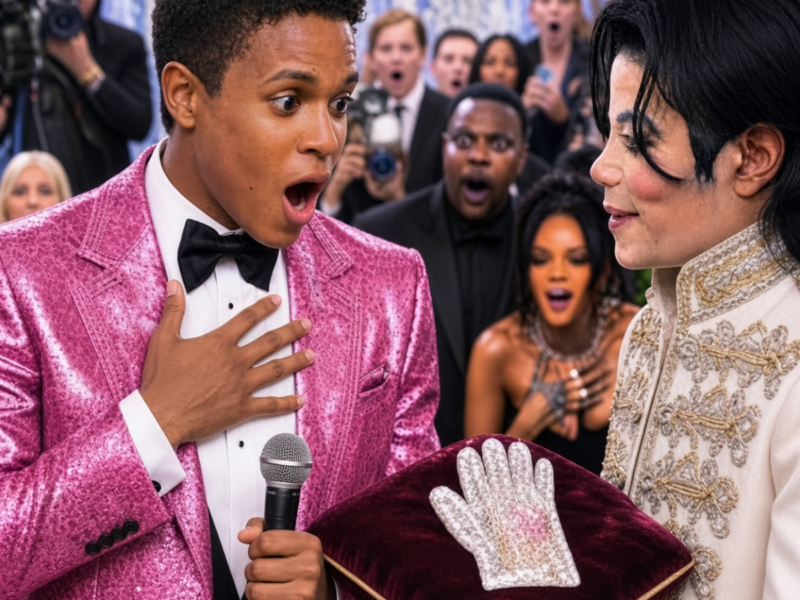
Jaafar Jackson Gets an Unexpected Surprise On Cam.
Some names don’t just identify a person.
They come with a set of expectations attached before that person has done anything at all to earn or deserve them.
Jaafar Jackson has lived under a name like that for nearly three decades.
And for most of that time, the world watched him with a curiosity that was really a question in disguise.
Would he be anything like the man whose face he shared?
The real answer never showed up in a press release or a trailer.
It showed up in a handful of small, unscripted moments, the kind nobody plans for and nobody can fake.
And once you line them up, they tell you more about who Jaafar Jackson actually is than any single interview ever could.
Here’s the one worth starting with.
At the AFI Life Achievement Award gala in Los Angeles, the crowd was expecting the usual parade of celebrities.
What they got instead was something closer to a hallucination.
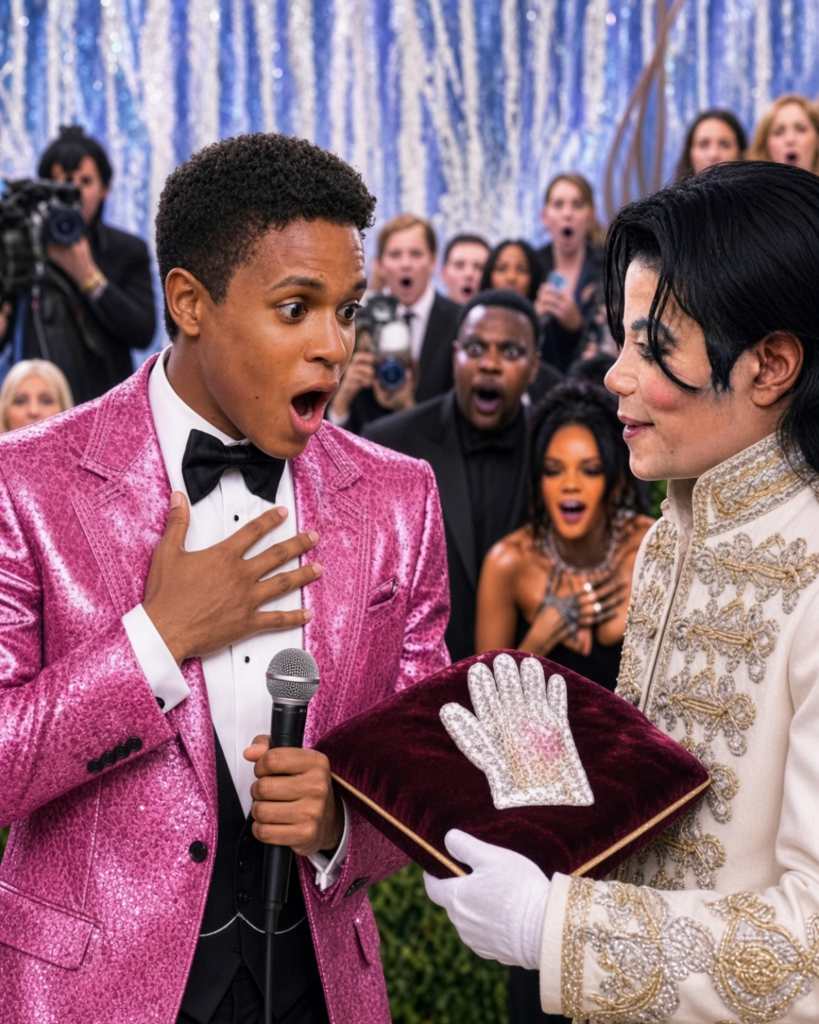
A Michael Jackson impersonator named Fabio Jackson arrived in full Thriller regalia.
The resemblance so exact that conversations actually stopped mid-sentence around him.
Cameras swung immediately toward Jaafar, whose own face has spent years being described as an echo of his famous uncle’s.
It was the kind of moment that could easily have curdled into spectacle or, worse, embarrassment for everyone involved.
Instead, Jaafar shook the man’s hand, stayed completely composed, and let the whole thing play out without turning it into a bit.
No visible discomfort.
No arrogance.
No attempt to steal the moment for himself.
When the footage made its way online, millions of people watched two Michaels standing side by side.
But the real story in that clip was never the resemblance.
It was the temperament of the younger man standing there.
A temperament that had clearly been built long before any camera ever found him.
Stay with me, because that same temperament gets tested again and again across the rest of this story in rooms with a lot more at stake than a gala red carpet.
Here’s the ground most people don’t know before the rest of this makes sense.
Jaafar Jeremiah Jackson was born on the 25th of July, 1996, in Los Angeles.
The son of Jermaine Jackson, one of the original Jackson 5 brothers, he grew up inside a surname that is functionally synonymous with popular music itself.
Home videos from that childhood, including footage of Jermaine mentoring his sons Jaafar and Jermajesty, show basketball games, baseball afternoons, holiday gatherings, impromptu music lessons.
They also show, if you look closely, the quiet weight of carrying that particular last name into a room.
The world assumed another Jackson would leap into the spotlight the moment he turned 18.
He didn’t.
He stayed almost entirely out of the headlines for years, cultivating something that’s genuinely rare for someone with his name.
Patience.
The spotlight was always sitting there waiting for him.
He simply refused to step into it until it actually felt like his own.
When he finally did move, he moved on his own terms and not toward acting at all.
In 2019, he released his debut single, “Got Me Singing,” a smooth R&B track that introduced the world to his own sound rather than anyone else’s.
While plenty of young artists around him were chasing viral moments and overnight breaks, Jaafar spent those years doing the unglamorous work.
Writing.
Recording.
Refining.
Mostly out of public view.
None of those early songs became major hits.
He kept going anyway.
Each one functioned as another rung on a long, quiet ladder.
And that patient apprenticeship turned out to be preparation for something far bigger than a music career.
Even though nobody, including him, knew it yet.
That something arrived as a proposition almost nobody in his position would have had the nerve to accept.
He would set music aside entirely to portray Michael Jackson in a major biopic simply titled Michael.
Taking on the job of resurrecting one of the most recognizable entertainers in human history, he traded recording sessions for punishing rehearsals, studying every gesture and expression with something closer to forensic attention than ordinary craft.
Because literally everyone watching already knew the man he was playing.
Intimately.
Every single choice he made on screen would carry real consequences.
In choosing the harder road, he turned himself from a musician quietly building a catalog into an actor staring down the largest spotlight of his life, fully aware the world was ready to judge every second of it.
And that role was never simply handed to him because of his last name, whatever people assumed.
According to reporting around the production, nearly 2,000 hopefuls pursued the part, many of them convinced that careful study of old interviews and choreography might be enough to set them apart.
Jaafar auditioned like everyone else and had to prove on merit that he could actually carry the weight of playing one of the most celebrated performers who ever lived.
Antoine Fuqua was announced as director in January of 2023.
And it was in that process that Jaafar was formally cast.
Once he stood in front of the camera for real, the conversation around him changed completely.
He stopped being simply Michael’s nephew.
He became the person tasked with bringing a legend back to life on screen.
Hold on to that shift, because it’s the hinge the rest of this story turns on.
Preparation for a role like that doesn’t stay confined to a rehearsal hall, and his didn’t.
To understand his uncle more fully, Jaafar spent time living and training inside Michael’s former bedroom at Hayvenhurst, the family’s estate in Encino.
This wasn’t a set dressed up for cameras.
It was a genuine lived-in residence saturated with real personal history.
Rather than studying old performances from a comfortable distance, he immersed himself directly in the environment that had shaped the man he was now responsible for playing.
And that immersion became part of his actual daily routine.
Even once formal rehearsals wrapped for the day, the work didn’t stop.
And the line between practice and reality started to blur in a way that would eventually unsettle him badly.
The months that followed were a kind of relentless cumulative strain that’s easy to describe in a sentence and genuinely hard to live through.
Accepting the role had been the easy part.
Actually becoming Michael Jackson physically and vocally proved to be something else entirely.
His life narrowed into an unbroken cycle of training.
Studying vocal inflections, emotional cadence, and the dozens of tiny unconscious habits that made the real man unmistakable on stage.
Some of it felt unnatural at first, and progress didn’t always arrive on schedule.
He kept working through it anyway, because his goal was never a passable imitation.
He wanted something audiences would experience as genuinely real, not performed.
What actually separated his approach from a simpler tribute act was a refusal to treat replication as understanding.
Copying the choreography was never the real challenge in front of him, because famous steps alone were never going to be enough.
He wanted the source of their power.
The emotion sitting underneath each performance.
The rhythm and intention that turned an ordinary movement into something iconic.
The balance he was chasing was genuinely delicate.
Lean too hard into technical precision, and the performance goes cold.
Lean too hard into raw emotion, and you lose the specific stage presence audiences actually remember.
He needed both at once.
Simultaneously.
Every single take.
His aim was never to assemble a highlight reel of famous scenes.
It was to expose whatever was underneath the image the world already had memorized.
That kind of pressure has broken performers with far more experience than he had.
He absorbed it anyway, understanding that the real test wasn’t resemblance.
It was persuasion.
Making an audience that already knew every move believe they were watching the real thing happen again in front of them.
That persuasion came down to detail, and talent alone was never going to get him there.
With guidance from vocal and movement coaches, he broke down the smallest components of his uncle’s performance style, recognizing that every pause and gesture had once served an actual purpose rather than existing for its own sake.
The voice was the hardest obstacle of all.
That soft, instantly recognizable delivery couldn’t be reproduced overnight.
So he spent countless hours on breathing, timing, and vocal control until the sound finally started to feel like it belonged to him rather than something he was forcing.
He wanted to understand the emotion behind every word and movement.
How feeling shaped a performance before it ever reached an audience.
Slowly, the role began to change him.
He wasn’t simply replicating what people had seen on a stage decades earlier.
He was absorbing a way of thinking, and with it, a kind of depth that’s very hard to fake on camera.
Eventually, the private rehearsals ended, and the public examination began.
He now had to recreate some of the single most celebrated performances in music history in front of an audience that had already memorized every beat of them.
Among the hardest was the 1988 performance of “Human Nature” at Wembley Stadium, a moment fans had rewatched so many times that the margin for error was essentially zero.
He couldn’t lean on his surname or on surface-level mimicry here.
Every movement had to feel sincere, respectful of a performance already carved permanently into music history.
He wanted to capture the feeling that made the original extraordinary and make it live again in a new body, in a new moment, for people who already knew exactly what they were supposed to be looking at.
Among every sequence he rehearsed, nothing carried more weight than the moonwalk.
It wasn’t simply a dance step.
It was a cultural artifact, first introduced to a massive television audience during the “Billie Jean” performance on the Motown 25 special back in 1983, etched permanently into the memory of millions of people who’d never even seen Michael Jackson perform live.
Jaafar treated the routine as the supreme test of everything he’d learned.
He broke it down into its individual components.
The transfer of weight.
The glide.
The exact timing between each motion, knowing every piece had to look effortless despite the enormous labor hidden underneath it.
There was no room for casual imitation here.
Fans worldwide already knew precisely how the original move looked and felt.
So he practiced it relentlessly, refining each repetition until it stopped feeling forced, aiming not to copy his uncle’s presence outright, but to recreate the actual sensation that had made the original moment unforgettable in the first place.
Real quick, drop a comment telling me the first Michael Jackson performance you ever saw, the one that actually stopped you in your tracks.
I want to see how far back some of you go.
Physical movement was only one half of the transformation.
The other half was entirely visual, and it began with his first complete makeup test, one of the most intense single days of the entire process.
The session ran for hours while the team applied prosthetics, styled his hair, and adjusted minute details to build a credible likeness.
Led by Oscar-winning makeup designer Bill Corso, the team focused on enhancing Jaafar’s natural resemblance rather than burying his own face under heavy effects.
Then came the moment that actually mattered, when he finally emerged in full costume.
The room around him changed instantly.
The combination of makeup, styling, and his own underlying features produced something that genuinely stunned the people standing there.
After that, the ritual simply became routine.
Hours in the makeup chair before every single day of filming, until walking onto set started to feel like stepping directly into Michael’s world rather than performing a version of it.
Even a flawless transformation can’t carry a film on its own, though, without the confidence of the person steering it.
For director Antoine Fuqua, bringing this particular life to the screen carried enormous pressure, because expectations were already sky-high and every single scene was going to be dissected by fans around the world the moment it premiered.
A single lingering doubt in his lead actor could have unraveled the entire project.
Over time, though, Fuqua noticed something specific in Jaafar.
Commitment that went far past memorizing lines or reproducing famous moments on cue.
He was demonstrating a discipline that pushed him to understand every facet of the role, not just perform it.
As filming went on, what was on screen stopped resembling an impression and started suggesting something closer to genuine understanding of the man underneath the legend.
Doubt slowly gave way to confidence, and Fuqua later said he watched a transformation happen that went well beyond acting technique.
Some of the most useful clues about who Michael actually was, it turned out, weren’t found on a stage at all.
They were on paper.
While promoting the film in April of 2026 on The Jennifer Hudson Show, Jaafar revealed an unexpected part of his research.
Alongside the rehearsals and archival footage, he’d studied his uncle’s private writings.
Journals.
Handwritten notes.
Poems.
Daily affirmations.
Those documents gave him a completely different kind of insight, one that revealed the discipline, creativity, and sheer determination driving the artist from the inside rather than the outside.
Speaking alongside co-stars Colman Domingo and Juliano Valdi, he also described the sheer labor required to rebuild some of Michael’s most iconic moments, each one carrying the added weight of total audience familiarity.
For Jaafar, the role had by that point become something larger than a performance.
It had genuinely changed how he saw his uncle and the legacy his uncle had actually left behind.
Then finally came the verdict, and it wasn’t delivered by critics.
It was delivered by ticket buyers.
Michael opened in theaters on the 24th of April, 2026, and the numbers suggested that skepticism had quietly given way to real enthusiasm somewhere along the way.
The film opened with $97 million domestically and $217 million globally.
The best opening weekend ever recorded for a musical biopic, helped considerably by strong IMAX turnout.
By July, it had crossed a billion dollars worldwide, becoming the first biopic in history to hit that number and surpassing Bohemian Rhapsody as the highest-grossing musical biopic ever made.
All the early doubts about the casting, every comparison and criticism that had followed the announcement, struggled to compete with the reaction of audiences who’d actually sat in a theater and watched it for themselves.
Rather than letting outside opinion settle the question, millions of people simply made their own call with their wallets.
For Jaafar, that achievement meant something well beyond the arithmetic of a box office chart.
Perhaps the most meaningful reaction of all, though, came from the people who’d actually known Michael personally, not as an icon, but as a brother and a son.
When the Jackson family watched Jaafar fully transformed for the first time, their response went far past the usual supportive relative line.
These were people remembering a man, not a superstar, and the resemblance clearly provoked something real in them.
Marlon Jackson said Jaafar had done more than simply portray Michael, that he’d captured something closer to the actual person the family remembered behind closed doors.
Tito Jackson described how difficult it was to sit with the transformation, because watching Jaafar felt uncannily, almost uncomfortably familiar.
For Prince Jackson, Michael’s own son, the whole project carried a particular emotional weight and a real sense of responsibility that went beyond anything a typical film role could hold.
In that moment, the performance stopped being purely a cinematic achievement.
It became something closer to a bridge between the past and the present, where memory and legacy actually met in the same room.
What the family was picking up on underneath all of it was an ease that simply can’t be manufactured overnight, no matter how talented someone is.
The most demanding performances are the ones that eventually stop looking like performances at all.
Appearing later on The Kelly Clarkson Show, Jaafar explained that his real ambition was never just to remember every step or line correctly.
It was to internalize the voice, the habits, the small expressions until they stopped requiring conscious effort entirely.
That familiarity was the product of a long selection process and relentless rehearsal, during which he built not just the stage presence and vocal style, but the tiny personal details that made the original performer singular in the first place.
He also absorbed something more like a philosophy.
Michael’s own belief that a goal pursued with relentless focus eventually simply becomes real.
By the time cameras started rolling for real, Jaafar wasn’t searching anymore.
Years of preparation had let him finally just be there.
His most sophisticated insight in the end had nothing to do with movement at all.
It was about motivation.
He came to understand that repeating famous steps would never be enough on its own, that the far more valuable work was understanding the reasoning that had produced them in the first place.
Describing his method in one interview, he explained that he focused on his uncle’s actual creative thinking rather than purely on what audiences had already witnessed a thousand times.
He listened closely to Michael’s own descriptions of his performances and discovered just how much deliberate thought sat underneath every single detail people assumed was pure instinct.
Because that’s really the through line underneath everything in this story.
Jaafar Jackson didn’t become convincing as Michael Jackson by copying him.
He became convincing by refusing to rush, by studying the reasoning underneath the choreography instead of just the choreography itself, and by letting the people who actually knew his uncle best be the ones to tell him finally that he’d gotten it right.
From an awkward handshake at a gala to a billion-dollar opening weekend, every piece of this points back to the same quiet discipline.
A man who was handed an enormous name at birth and spent nearly 30 years deciding exactly what he wanted to do with it.









