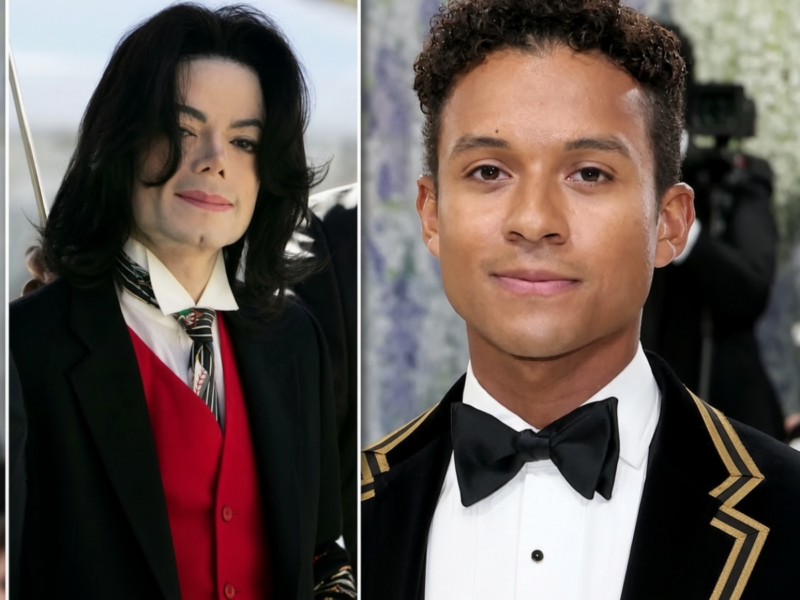
Jaafar Jackson DEFENDS Michael Jackson After Interviewer Gets Disrespectful.

Think of a young man in a chair with bright lights above him and a microphone clipped to his shirt.
And the first few questions are friendly.
Then one comes that feels different.
It does not ask about dancing or songs.
It treats his uncle’s life like a topic to argue about.
What would you say?
Jaafar Jackson has faced moments like this many times.
And he has a way of answering that surprises people.
He does not raise his voice.
He tells a story instead.
And the story is usually small, warm, and true.
Let’s start at the beginning.
Jaafar Jeremiah Jackson was born on July 25th, 1996, in Los Angeles.
His father, Jermaine, had been singing with his brothers since the Jackson 5 hit the radio.
His mother, Alejandra, is a fashion designer born in Bogotá, Colombia.
You might guess a child in that house grew up dreaming of a stage.
He did not.
He dreamed of a golf course.
He played in tournaments as a kid and has said golf was the one thing he wanted to do.
But a different kind of music was already working on him.
When he was very small, he would stand in front of the television and watch his uncle dance.
He tried to put his feet where his uncle’s feet went, long before he knew what he was looking at.
He has described one afternoon at his grandmother’s house when he was around four.
A song came on, and a man glided across the screen.
The little boy turned to his mother and asked who that was.
She said it was his uncle.
He did not believe her.
How could someone in his own family move like that?
He has said that day taught him what the Jackson name could mean.
Not a heavy weight, but a door left open.
His real memories of Michael are the memories of a child, which means they are wonderfully ordinary.
There was a ranch with a train, animals, candy, and rides that never seemed to end.
There was hide-and-seek.
Jaafar has said it was all fun.
Then at twelve, his father played him an old Jackson 5 song, and something clicked inside him.
He started singing.
He sat down at a piano.
He pictured himself writing and producing songs from behind the glass, far from the cameras.
In April of 2009, the family gathered in Beverly Hills for an evening he has never forgotten.
Jaafar sat across from his father and his uncle, and the two brothers began to sing together without any instruments, just for the joy of it.
Jaafar said he simply watched and that it felt special.
When the night ended, Michael looked at his nephew and said five words.
“See you in July.”
He was planning to take the family to London for his concerts.
That summer, on June 25th, Michael Jackson died.
A twelve-year-old boy lost the chance to see his uncle again.
Jaafar has never spoken of that loss lightly, and neither should we.
What he did next was keep making music.
He wrote, produced, and released his own single in 2019.
He was building a life on his own terms.
Then in 2020, a phone call arrived.
Producer Graham King was working on the official film about Michael’s life, and the search for the lead role had gone around the world.
Finding the right person was the biggest worry of all.
Jaafar had read about the project online and was just curious.
He had no plan to be in it.
When King asked whether he had ever acted, Jaafar told the truth.
No.
And he had never wanted to.
He asked for time.
This was not a hobby he could try out and put down.
If he said yes, he wanted to give it everything.
And that meant thinking hard.
He has said he took weeks, maybe longer.
He knew every frame would be compared to the real thing.
But he also felt that if anyone was going to do this, it should be someone who loved Michael as family.
Someone who knew things no book could teach.
How Michael moved when he was tired.
How his voice softened around children.
The quiet moments between the big ones.
Weeks went by with no word.
So Jaafar did something brave.
He recorded a voice note and sent it to King.
In it, he spoke in Michael’s soft, higher voice and sang a lullaby, a song Michael had never released.
King called right back.
He told Jaafar he was getting him an acting coach the very next day.
But here is the part people often skip.
Getting a coach was not the same as getting the job.
King and the casting director told him plainly that the search would go on.
He would have to earn it.
For about two years, he went through auditions, callbacks, and rehearsals.
He studied acting with a coach named Angela Gibbs for a whole year before he even tried to step into his uncle’s shoes.
He trained with choreographers who had worked with Michael himself.
And he did something special with his space.
He turned a room at Hayvenhurst, the Jackson family home in Encino, into what he called a research room.
Every wall was covered.
Michael’s handwriting, his mantras, a record of his achievements, a timeline of what was happening in the world during each part of his life.
It was a map of one person’s mind.
He gathered every scrap of dance footage he could find.
He read books aloud in Michael’s voice until the pitch and rhythm settled in.
He rehearsed for hours until a single move felt right.
One move gave him real trouble.
Michael spun to the left, and Jaafar’s body had always spun to the right.
That tiny difference asked his muscles to forget a lifetime of habit, and it took years of practice.
Through all of this, he kept a secret.
For a full year after he was cast, nobody in his family knew.
Not his parents, not anyone.
He wanted to feel ready before he shared it.
When the news finally came out, some people asked a hard question.
Did he get the part just because of his last name?
The film’s director, Antoine Fuqua, answered it head-on.
He said it was not a nepotism pick.
He described a chemistry read so powerful that people in the room were moved to tears.
The goal, he explained, was never to find a lookalike.
It was to find someone who could carry Michael’s spirit.
Jaafar’s own answer to that kind of doubt was simple.
He did not argue.
He kept working.
That brings us to the questions he has faced during the long press tour for the film, which opened on April 24th, 2026.
Some were warm, some were curious, and some, as you can imagine, were sharper.
A few critics even used strong words about the film, calling it a whitewash.
When people reduce a man to a headline, how do you answer?
Jaafar’s answer again and again has been to describe the person he actually knew.
Ask him what people get wrong about Michael, and he says it quickly.
The work.
People see the shine and assume it was easy.
But from his relatives, he heard about a man who rehearsed until his body gave out and stayed in the studio until the sun came up.
Michael demanded perfection from himself before he ever asked it of anyone else.
In Jaafar’s view, the smoothness was the proof of how hard he worked.
That idea became his own fuel.
When his body ached and he wanted to stop, he asked himself what Michael would do.
The answer was always the same.
Keep going.
And going was not easy.
Jaafar has talked about wearing out many pairs of shoes in the dance scenes.
He has described taping his toes and soaking his feet in ice water at night, then waking up sore to do it again.
He chose to do the big dance moments himself because anything less would have felt like cheating his uncle’s memory.
A move like that is not just a step.
It is a promise.
Then there are the tiny details, the ones that only family would spot.
Which mannerism was hardest?
The head tilt.
Michael tilted his head when he listened in a way that was natural to him and strange to everyone else.
Jaafar practiced in front of a mirror for weeks and kept looking stiff.
The secret he found was to relax, which is tricky when you are trying so hard.
It finally clicked during an ordinary chat on set, and a crew member noticed before he did.
Even a pair of loafers and bright socks carried meaning.
At his first costume fitting, he stood in front of the mirror for a long time, not to admire himself, but to feel worthy.
He came to see those clothes as a kind of armor.
His uncle used them to control what the world saw.
And wearing them taught Jaafar things that reading never could.
Now, you might be wondering what the real Michael was like when the armor came off.
Jaafar has an answer for that, too.
And it may surprise you.
He was funny.
Really funny.
Michael loved pranks and water balloons and jumping out from behind a door to make someone shout.
Jaafar remembers one afternoon when his uncle taught the younger cousins how to fake a trip and fall so well that it looked real.
Michael showed them step by step, patiently, then laughed harder than anyone when they finally nailed it.
He was also a devoted son.
Jaafar says Michael adored his mother, Katherine, and always drifted toward her at family events.
They would sit together while the room buzzed around them, and he would speak softly to her.
To Jaafar, that was gratitude, and it never faded.
While filming, he thought about that bond and about his own mother, and those thoughts gave certain scenes their tenderness.
He was a caring father, too.
Jaafar chose his words carefully on this one, saying he could only speak about what he saw.
What he saw was a man who put Prince, Paris, and Blanket first, who wanted them to have the ordinary childhood he never had, and who stayed fully present when he was with them.
Michael’s son, Prince, has said that watching Jaafar on screen felt like seeing his dad again.
Few compliments could weigh more.
And he was a man of faith.
Jaafar says Michael believed his talent was a gift, something given to him to share.
On set, before some of the most emotional takes, Jaafar prayed for guidance, too.
It made him feel close to his uncle in a way acting alone could not.
Do you see what is happening here?
The sharp questions keep getting answered with soft memories.
A prank lesson.
A held hand.
A father paying attention.
Each one is a tiny reply to the idea that Michael was only a symbol.
Jaafar also speaks about music itself.
He has talked about watching old concert footage from countries where the crowds did not speak English but sang every word.
To him, that is the point.
Music can cross places where speeches and borders cannot.
Fans from Brazil, Japan, and South Africa have told him that Michael’s songs reached them when nothing else could.
He says the same thing about “Heal the World.”
He thinks it matters even more today than when it was written.
Michael had seen how broken the world could be and wrote the song anyway.
What Jaafar admires most is not the hope itself, but the choice to keep hoping.
Then came the stage.
When he finally stood on the set of the Bad tour with lights hitting him from every side, Jaafar felt something he had only heard about.
His uncle had loved being in front of an audience.
And for a few minutes, Jaafar understood why.
The doubts and the lonely feelings melted away.
He has called it the closest he ever felt to Michael during the whole process.
That scene was shot on the very first day of filming in front of about 500 extras, and the crew was nervous.
Director Fuqua has said that when Jaafar hit his first moves, the doubt in the room disappeared.
The extras began cheering as though they had stopped acting and started attending a concert.
Jaafar even sang live during the performance scenes, blending his voice with Michael’s original recordings.
But not every lesson came from the stage.
Some came from quiet.
Jaafar has said that old family videos taught him more than any famous performance.
In those clips, Michael was not performing.
He was relaxing with his relatives, laughing and speaking softly.
And Jaafar noticed something small.
Michael often paused before he answered a question, giving his whole attention to whoever was talking.
So on set, Jaafar slowed down and really listened to the other actors, and the scenes grew more natural.
There is another family memory he treasures.
One Thanksgiving, he watched Michael and his brothers sit at a table and argue playfully about who sang which part on an old Jackson 5 record.
Decades had passed, yet for a moment they were boys again, bickering in a living room in Gary, Indiana.
Jaafar has said that those moments showed him how deep family history can run.
Of course, being part of this family means carrying a famous name, and Jaafar has been honest about how that feels.
Is it a gift or a heavy load?
He says both.
The name opens doors, but it also makes people assume things about you.
For a while in his youth, he tried to step away from it and prove himself on his own.
In time, he realized you cannot run from your own blood.
The question was never whether to carry it.
It was how.
He decided to carry it with hard work and respect.
When asked if he feels protective of his uncle’s legacy, he answered with one word.
“Absolutely.”
He has said he pushed for honesty over legend during production because he wanted to show a human being, not a statue.
He knew his family was trusting him, and he has called that trust sacred.
In addition, he accepted the fact that he would be compared to the original, which was something that was unavoidable.
He claims that he would have been unsuccessful if no one had compared him to others.
However, it is impossible for anyone to completely replicate another person.
It was possible for him to learn the steps, the voice, and the look.
But Michael was the one who possessed the soul.
His duty was to uphold the honor.
Therefore, he decided to no longer pursue perfection, but rather pursue truth.
The first trailer arrived, and Jaafar was too nervous to watch it.
His phone buzzed with messages from friends and family, but he left it alone.
When he finally pressed play on his laptop, he saw himself as Michael for the first time, and he knew millions of people were watching at that very moment.
Pride, fear, and emotion hit him all at once.
Afterward, he called his mother, and the two of them cried together.
Then came the reaction from fans.
Clips of the “Billie Jean” performance spread online within hours, and people lined them up beside the 1983 Motown 25 original, comparing every spin and every glide.
Many said they were stunned.
Others said they were waiting to judge for themselves.
Jaafar has said he understood both reactions.
Strong feelings, he felt, were proof that people truly cared about Michael.
When filming ended, the feeling was just as mixed.
Relief, tiredness, sadness, and pride all arrived together.
He sat in his trailer for a long while because after months of thinking and moving like his uncle, letting go felt a little like saying goodbye again.
He needed something ordinary to bring him back to himself.
So he did nothing special at all.
He rested, and he slept for almost two full days.
What followed was on a much larger scale than anyone had anticipated.
The movie had a record-breaking opening weekend for a biopic, and it has since surpassed $1 billion in revenue all over the world.
A number of awards, including the Astra Award for Best Actor, were bestowed upon him as a result of his performance, which was praised by both viewers and critics.
However, the review that he cared about the most was the one that came from his own home.
After watching the completed movie, his grandmother, Katherine, shared with him that there were times when she was unable to determine whether she was looking at her son or her grandson simultaneously.
That was all Jaafar needed to hear, according to what he said.
Before the release, when asked what would come next, he said he did not know.
He wanted to make his own music again and find his own voice.
He did say, though, that playing Michael had changed him for good and that carrying the torch no longer felt like a burden.
It made him feel like he was lucky.
Since then, the studio has confirmed that a sequel is planned with Jaafar returning in the lead role, and production is expected to begin in late 2026 or early 2027.
The next film would explore the years after the first one ended.
He has even shared what he hopes it will carry.
Michael, he says, kept his kind heart even when life hurt him, and he hopes that feeling comes through.
Here is where we should pause and be honest with you.
The stories in this video come from Jaafar’s interviews and from reports about them.
Many are retellings, not word-for-word transcripts, and some have been shortened or paraphrased.
We have not found a verified record of one particular interviewer being rude to him on camera.
What we can say is that critics have used strong words about the film, that tough questions have come with the attention, and that Jaafar’s responses have been consistently thoughtful.
The title describes a pattern, not a single moment.
A few things have been decided upon, including the release date of the movie, its success at the box office, the awards, and the announcement of a sequel.
There are some things that are Jaafar’s own recollections, such as his memories of family get-togethers and his feelings while filming.
There are also some things that continue to be a matter of opinion, such as whether or not the movie tells the entire story.
That is something that people are free to feel differently about.
So what can we take from all this?
Maybe it is that defending someone does not always mean fighting for them.
Sometimes it means showing who they were, one small story at a time.
Maybe it is also that the best way to honor someone is to do the work yourself.
He did not borrow a famous name and coast.
He sat in a research room, practiced until his feet hurt, and earned his place across two long years.
And maybe it is that everyone carries something from the people who came before them.
A last name, a song, a way of laughing.
The real question is what we do with it.
Do we hide from it, or do we make it our own?
Somewhere right now, a child is watching an old video of a man gliding across a stage and asking who that is.
Someone who loves them is smiling and saying, “That’s family.”
The music is still playing, and the story is still being handed down.









