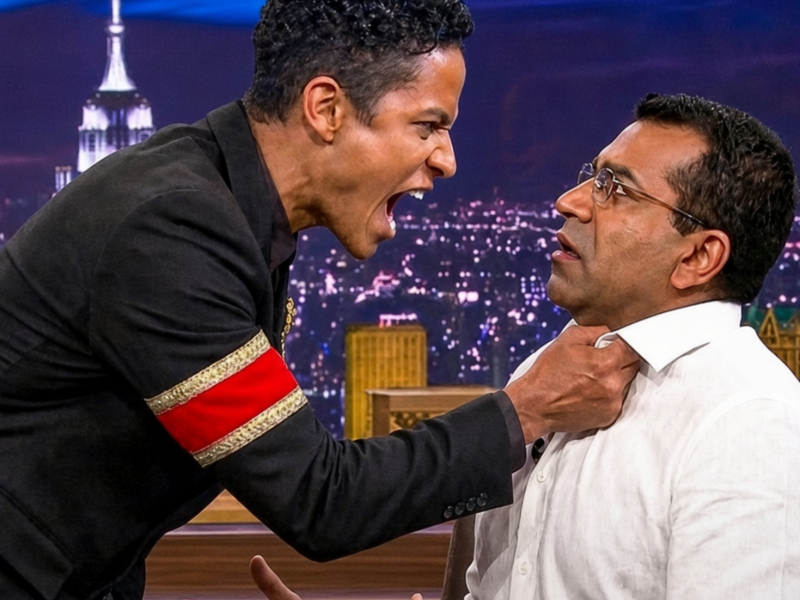
Jaafar Jackson Crashes Out LIVE Against Michael Jackson Haters!
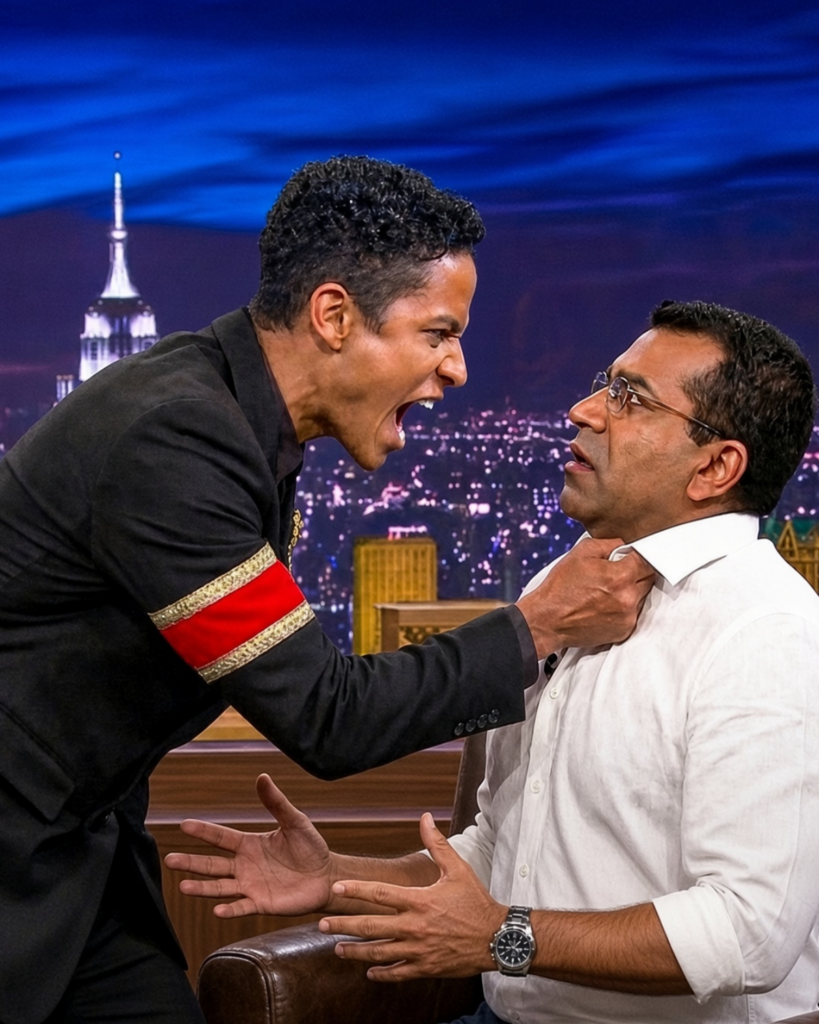
What happens when Jaafar Jackson stops staying silent and goes completely live to dismantle decades of media lies?
In this absolute crash out, Jaafar sets the record straight about his uncle Michael Jackson, tearing down tabloid rumors, industry haters, and revisionist history with raw, unfiltered family truth.
You cannot miss this.
The weight of the bloodline.
When Jaafar Jackson accepted the lead role in the biographical film “Michael,” he understood that the assignment extended far beyond learning dynamic choreography or matching distinct vocal timbres.
As the son of Jermaine Jackson and nephew to the King of Pop, Jaafar carried a unique responsibility that external actors could never fully comprehend.
Public skepticism emerged immediately, with online commentators writing off his casting as pure nepotism.
Jaafar addressed these critics directly, explaining that his connection to the subject was grounded in lived reality rather than opportunistic ambition.
Growing up around Michael provided him with an intimate, unvarnished perspective on the human being behind the global phenomenon.
For Jaafar, taking on the role was not about chasing Hollywood fame.
It was about protecting a deeply personal legacy against decades of sensationalized media framing.
He argued that approaching the role as a family member allowed him to capture authentic emotional nuances that external performers often missed.
His objective was clear from day one: strip away the cartoonish tabloid caricatures and present his uncle with the dignity, vulnerability, and respect he was continuously denied during his lifetime.
Before continuing, we have this red carpet image that takes a disturbing turn when you notice what’s happening just behind Michael Jackson.
Chris Tucker stands beside him with a warm smile while Michael poses calmly for the cameras.
But near Michael’s shoulder, a mysterious hand appears to be holding a metallic handgun pointed toward his head.
It’s certainly a shocking detail, but we don’t have any information about when or where this picture was taken, or whether the scene actually happened.
What do you make of this unusual picture?
Share your thoughts below.
Confronting the nepotism allegations.
As news of the production spread, online trolls and industry doubters heavily questioned whether Jaafar possessed the raw talent to execute such a demanding role.
Skeptics pointed out his lack of prior feature film acting experience, dismissing his casting as a marketing gimmick by the Jackson estate and major studios.
Rather than hiding from the commentary, Jaafar confronted the narrative head-on during press interactions.
He clarified that director Antoine Fuqua and producer Graham King put him through a rigorous, multi-month audition process alongside experienced actors worldwide.
Jaafar emphasized that no role of this magnitude is handed out freely, as hundreds of millions of dollars were at stake on the global box office stage.
He detailed the grueling physical screen tests, vocal evaluations, and dance sessions he had to pass to prove his capability.
Jaafar noted that while his last name opened the door for an audition, his relentless work ethic and organic physical mannerisms ultimately earned him the part.
By facing the nepotism narrative directly, he made it evident that he was prepared to work twice as hard to silence the initial doubters.
Now, we want to take a moment to highlight this comment from our last video.
After watching today’s video, do you think Jaafar did a good job honoring Michael’s legacy?
Let us know what you think in the comments, and one comment could be featured in our next video.
Now, let’s get back to Jaafar’s story.
Sleeping on the floor at Hayvenhurst.
To prepare for the role and counter claims that he was merely imitating his uncle, Jaafar undertook extreme measures to immerse himself in Michael’s psychological and physical world.
He made the deliberate choice to move into the historic Jackson family estate at Hayvenhurst in Encino, California.
Rather than staying in luxury, Jaafar slept on a thin mattress placed directly on the hardwood floors, mirroring the bare, unfurnished environment his uncle preferred during intensive creative periods.
Jaafar utilized the exact private dance studio where Michael spent countless hours perfecting the moonwalk and refining iconic stage routines.
By spending late nights alone in those historic rooms, Jaafar sought to absorb the natural energy of the home without artificial distractions.
When production executives offered to furnish comfortable accommodations, Jaafar declined, insisting that physical discomfort was necessary to connect with Michael’s relentless, uncompromising discipline.
This deep level of commitment demonstrated to harsh critics that Jaafar was treating the project not as a commercial acting job, but as a solemn, spiritual, and artistic pilgrimage.
Reading the private journals.
One of Jaafar’s strongest counterarguments against media critics who framed Michael solely through public controversies was the intimate access he gained to his uncle’s private written archives.
Jaafar spent months studying Michael’s personal journals, handwritten poetry, private notes, and daily self-affirmations.
These documents revealed a side of Michael that mainstream media outlets routinely ignored: a deeply reflective, vulnerable, and disciplined artist obsessively committed to his craft.
Jaafar pointed out that the public narrative was constantly shaped by external journalists who never knew Michael personally, whereas his private writings proved his gentle nature and relentless drive.
By studying these personal entries, Jaafar learned how Michael processed intense media scrutiny, personal loneliness, and artistic pressure.
Jaafar used this knowledge to fuel his performance, ensuring that every line delivery reflected the genuine mindset of the artist.
He openly challenged commentators who reduced Michael’s life to sensationalized rumors, insisting that anyone who took the time to understand his private thoughts would see a completely different, profoundly human individual.
Shutting down sensationalist interviewers.
During promotional press tours, Jaafar frequently encountered junket interviewers who attempted to derail discussions about the film by bringing up long-standing tabloid rumors and sensationalized allegations.
Rather than taking the bait or offering passive corporate answers, Jaafar consistently held his ground with firm composure.
He called out journalists who prioritized clickbait over genuine artistic discussion, questioning why the media remained obsessed with repeating unverified stories decades later.
Jaafar reminded interviewers that the film was crafted to provide the comprehensive perspective that Michael was denied during his life.
He asserted that media outlets had profited off tearing down his uncle for generations, making it hypocrisy to act as moral arbiters now.
By maintaining a calm, unwavering tone, Jaafar successfully shifted the focus back to the historical realities of Michael’s artistic accomplishments and philanthropic impact.
His sharp responses during live press sessions quickly circulated across social media, earning widespread praise from fans who had long waited for a Jackson family member to directly challenge hostile media lines of questioning.
Dismantling the smoke and mirrors media machine.
In a widely cited interview discussing the intense public scrutiny surrounding the biopic and his uncle’s legacy, Jaafar offered a sharp critique of modern celebrity culture and tabloid journalism.
He stated plainly, “Do not take anything too seriously. Everything is all smoke and mirrors. They build you up and just keep your foundation. Keep people around that you trust.”
Jaafar explained that the media industry operates on creating manufactured drama, building public figures up only to systematically tear them down for profit.
He noted that his uncle was the ultimate victim of this cycle, as news outlets prioritized inflated narratives over objective truth.
Jaafar emphasized that navigating this toxic environment required staying grounded in personal values and surrounding oneself with trusted family.
By identifying the media’s tactics as mere smoke and mirrors, Jaafar urged fans and viewers to look beyond sensational headlines.
His message was a direct challenge to the army of online critics, proving that he possessed the psychological maturity to rise above organized hate campaigns.
Vocal reconstruction versus imitation.
Critics initially predicted that Jaafar would rely on lip-syncing or fail to replicate Michael’s distinct vocal range, using this expectation to diminish his efforts before the film was even released.
Jaafar responded by detailing the exhaustive vocal training he underwent to authenticize his performance.
He worked daily with top vocal coaches to reconstruct not just Michael’s singing voice, but also his gentle, rhythmic speaking cadence.
Jaafar clarified that his goal was not to deliver a cheap impersonation like a Vegas tribute act, but to capture the emotional resonance and breath control that defined Michael’s live vocal deliveries.
He explained the technical mechanics behind Michael’s vocal hiccups, staccato phrasing, and upper-register power, showing deep respect for the physical demands of the music.
When early footage demonstrated Jaafar executing live vocal takes on set, skeptics were forced to reconsider their assumptions.
Jaafar used this technical triumph to demonstrate that his performance was grounded in rigorous vocal discipline, completely disproving the belief that an organic family connection was his only asset.
The physical armor of the stage costumes.
When internet commentators mocked early set photos and debated minor costume inaccuracies, Jaafar redirected the conversation toward the deeper psychological purpose of Michael’s wardrobe.
He explained that for Michael, his iconic stage outfits—the military jackets, single white glove, fedora, and armbands—were far more than fashion statements.
Jaafar described the wardrobe as a protective armor that Michael donned to transform from a quiet, introverted individual into an invincible global performer.
While wearing these precise historical recreations on set, Jaafar experienced firsthand how the weight and structure of the clothes altered his posture, confidence, and physical presence.
He argued that critics who focused on trivial seam details missed the entire point of how visual identity empowered an artist who felt constantly hunted by the outside world.
By reframing the discussion around the functional purpose of the costuming, Jaafar demonstrated an advanced artistic understanding of his uncle’s stagecraft, effectively shutting down pedantic online nitpicking.
If you’ve made it this far, please hit the like button and subscribe.
It really helps the channel.
Now, back to the next one.
Clarifying Janet Jackson’s film absence.
After the film’s release, media outlets and online agitators tried to create a narrative of family division by pointing to Janet Jackson’s total absence from the storyline.
Speculation mounted that Janet disapproved of the project or was at odds with Jaafar and the production team.
Jaafar directly squashed these rumors during an international interview with GQ, handling the sensitive subject with remarkable diplomacy and respect.
He revealed that Janet was privately developing creative concepts for her own biographical project, stating, “I don’t want to speak too early, but Janet has ideas of maybe doing her own film. So, having someone portrayed in this and then choosing a different actor for her own is just—”
Jaafar confirmed that Janet graciously declined to be included in “Michael” to preserve her upcoming narrative independence while offering full personal support throughout production.
His candid statement dismantled the media’s manufactured family feud narrative instantly.
The three-year physical transformation.
To silence those who argued he was physically unsuited to represent Michael across different eras of his life, Jaafar revealed the immense physical toll the production required over a three-year preparation period.
Transforming from a recording artist with no formal dance background into a performer capable of executing complex routines required rigorous daily conditioning.
Jaafar spent five to six hours every day in intensive dance rehearsals, working alongside Michael’s original choreographers to master precise body mechanics.
He underwent strict nutritional monitoring and endurance training to match the lean, highly muscular physique Michael maintained during demanding world tours.
Jaafar pointed out that critics sitting behind keyboards had no concept of the physical exhaustion required to perform “Smooth Criminal” or “Thriller” repeatedly across sixteen-hour filming days.
His dedication resulted in a seamless physical transformation that impressed even the most critical industry observers, proving that his resolve to honor his uncle’s memory far surpassed the hostility of his detractors.
Reclaiming the narrative from revisionist historians.
Throughout the film’s promotional campaign, Jaafar persistently addressed how modern media platforms engage in revisionist history regarding Michael Jackson’s artistic and cultural legacy.
He pointed out that contemporary commentators often attempt to evaluate Michael’s life through hypercritical modern lenses while completely ignoring the historical context of his unprecedented global impact.
Jaafar emphasized that Michael broke down racial barriers across global television networks, revolutionized the music video medium, and set humanitarian standards that remain unmatched by modern artists.
He criticized modern pop culture writers who attempt to minimize these colossal achievements due to personal biases or click-driven agendas.
Jaafar argued that the biopic was necessary to restore historical accuracy, ensuring that future generations understand the magnitude of Michael’s genius rather than a watered-down, tabloid-skewed version.
By positioning the film as a corrective historical document, Jaafar asserted that facts and artistic influence will always outlast the noise of temporary online hatred.
Addressing the facial similarity obsession.
One of the most persistent online complaints prior to the film’s release centered on Jaafar’s physical facial appearance, with detractors arguing he looked more like his father, Jermaine, than Michael.
Jaafar addressed these complaints directly, pointing out the absurdity of expecting any human being to look like an exact genetic clone of Michael Jackson.
He explained that cinema is built on essence, emotional truth, and performance rather than superficial prosthetics alone.
Jaafar emphasized that focusing solely on static side-by-side photo comparisons ignores the fluid power of movement, eye contact, and stage charisma.
He noted that once audiences saw him in motion, capturing Michael’s exact body language, nervous habits, and explosive stage energy, the superficial face comparisons evaporated instantly.
Jaafar’s practical perspective called out the superficiality of modern fan culture, proving that a performance grounded in soul and technical accuracy creates a far more convincing portrayal than cosmetic imitation.
Standing up for Katherine Jackson’s memory.
Jaafar took a fierce public stance when discussing his grandmother, Katherine Jackson, and the constant legal and media battle she endured while trying to preserve her son’s legacy.
He called out media outlets that depicted the Jackson family matriarch as an opportunistic figure, setting the record straight about her unwavering love and protection over Michael throughout his life.
Jaafar shared intimate stories of Katherine’s presence on set, describing how her quiet strength gave him the emotional foundation needed to carry the film’s heaviest emotional scenes.
He slammed critics who attacked the family’s motives, reminding the public that Katherine raised Michael from a child prodigy in Gary, Indiana, to a global icon.
For Jaafar, defending Katherine against disrespectful media commentary was non-negotiable.
He insisted that her devotion to protecting Michael’s children and preserving his true character deserved absolute respect, calling out commentators who callously targeted an aging matriarch who lost her son under devastating public circumstances.
Unmasking the hypocrisy of the music industry.
In several candid discussions, Jaafar highlighted the sharp contrast between how the corporate music industry treated Michael during his final years and how it capitalized on his catalog after his passing.
He called out record label executives and industry insiders who turned their backs on Michael during periods of intense media persecution, only to celebrate his commercial dominance once he was gone.
Jaafar noted that Michael fought relentlessly for ownership of his publishing rights and master recordings, a struggle that made him a prime target for industry smear campaigns.
He argued that much of the hostility directed at Michael stemmed from his refusal to be controlled by corporate interests.
Jaafar made it clear that the film did not shy away from exposing these behind-the-scenes power dynamics.
By exposing the financial motives behind Michael’s public isolation, Jaafar challenged viewers to question who truly benefited from tearing down the King of Pop during his lifetime.
The mental health reality behind the stardom.
Jaafar used his public platform to address the severe mental health toll that relentless media hostility took on his uncle, challenging critics who treated Michael’s eccentricities as public entertainment.
He explained that living under 24-hour camera surveillance, legal persecution, and fabricated tabloid stories created an environment of extreme paranoia and isolation for Michael.
Jaafar urged commentators to exercise basic human empathy, asking how any individual could remain psychologically unaffected by decades of global slander.
He emphasized that the film explicitly explored Michael’s emotional pain, showing the heartbreaking reality of a man who gave everything to his audience while receiving relentless cruelty in return.
Jaafar called out modern social media users who continue to perpetuate toxic rumors, drawing parallels between the historical bullying of Michael and contemporary digital harassment.
By framing Michael’s struggles through the lens of mental health and human vulnerability, Jaafar forced critics to confront the real human cost of their entertainment.
Recreating Thriller under national oversight.
Restaging the legendary “Thriller” music video presented one of the highest-pressure moments of Jaafar’s career, attracting massive public interest and severe scrutiny from hardcore fans and media critics alike.
Before a single frame was shot, online commentators claimed that recreating the most famous dance routine in entertainment history was an impossible, foolhardy endeavor.
Jaafar answered this skepticism by approaching the scene with near-obsessive precision, rehearsing the complex zombie choreography alongside original cast members and contemporary dancers for months.
On set, every tilt of the head, foot placement, and facial expression was cross-referenced with Michael’s original 1983 master tape.
Jaafar explained that he did not view the scene as an opportunity to showcase himself but as a sacred historical preservation exercise.
When early studio previews revealed the astonishing accuracy of the recreation, critics were silenced.
Jaafar proved that through sheer discipline and respect for the source material, he could recreate history without dishonoring his uncle’s monumental benchmark.
Prince Jackson’s on-set validation.
Throughout the intense production process, media outlets speculated whether Michael’s children—Prince, Paris, and Bigi—supported Jaafar taking on the role of their father.
Jaafar silenced these rumors by speaking about the profound emotional validation he received directly from Prince Jackson, who spent extensive time on set during filming.
Jaafar recounted emotional moments when Prince watched playback footage of his nephew portraying Michael during peak career eras.
Prince’s tears and unconditional approval served as ultimate proof that Jaafar was capturing the authentic spirit of their father.
Jaafar emphasized that no opinion from an online troll, film critic, or media pundit held any weight compared to the blessing of Michael’s direct heirs.
Having Prince present to offer immediate feedback created an impenetrable protective barrier against external media noise.
Jaafar made it clear that the family was completely united behind the film, rendering external attempts to create conflict entirely irrelevant.
Pushing back against Hollywood skepticism.
Beyond tabloid media, Jaafar faced quiet skepticism within executive Hollywood circles regarding whether an all-Black production team and family-led narrative could deliver a balanced, commercially viable blockbuster.
Doubters questioned whether director Antoine Fuqua and producer Graham King were giving the Jackson family too much creative oversight.
Jaafar addressed these industry whispers firmly, asserting that telling an authentic Black American success story required creators who actually understood the context of the Jackson family journey.
He pointed out that mainstream Hollywood had historically sensationalized Black icons while stripping away their cultural roots.
Jaafar argued that collaborating closely with the family ensured emotional truth and historical accuracy, preventing the film from falling into the trap of tragic exploitation.
His confident defense of the film’s creative leadership proved that he was not only an actor defending his uncle, but a vocal advocate for authentic Black storytelling in cinema.
Jaafar just proved that blood, truth, and real legacy will always silence the noise.









