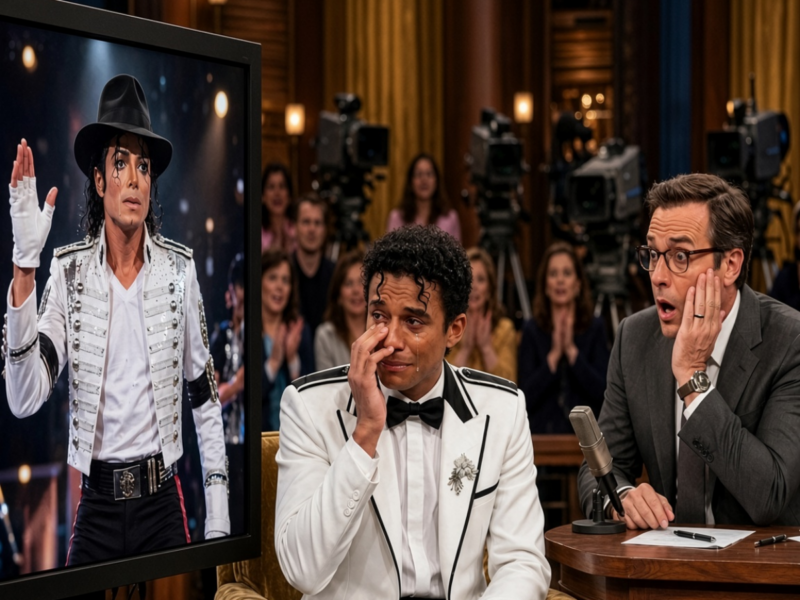
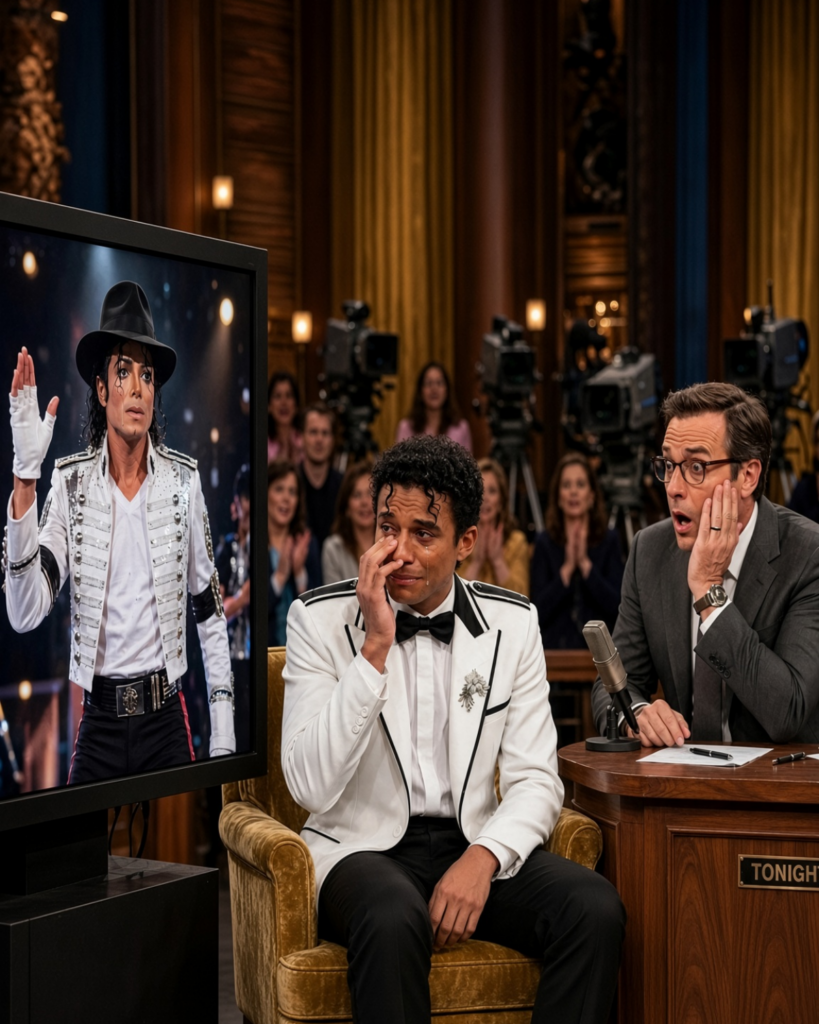
Jaafar Jackson BREAKS DOWN After Seeing Himself Become Michael For The First Time.
He knew the songs.
He knew the movements.
He knew the pressure that came with portraying the most famous member of his own family.
Then the makeup team finished their work.
The Bad-era clothes went on.
And Jaafar walked into a bathroom, looked in the mirror, and stopped.
He stayed there for several minutes because for the first time, he wasn’t looking at himself anymore.
He was looking at a face, a silhouette, and a version of Michael Jackson he had known his entire life. not as a fan, but as a nephew.
What happened next in front of five or 600 extras under the pressure of recreating one of the most scrutinized performances in music history on his very first day of filming is one of the most extraordinary first days any actor has ever survived.
If you enjoy discovering what really happens behind the moments that look effortless on screen, like the video and subscribe because Jaafar’s transformation didn’t begin in the makeup chair.
It began years earlier with a phone call he never expected, a role he never planned to take, and one question the filmmakers themselves weren’t sure they could answer.
Could Michael Jackson’s own nephew actually become Michael without looking like an impersonator?
The strangest thing about Jaafar Jackson becoming Michael Jackson is that at first, Jaafar wasn’t trying to become an actor at all.
He was making music, producing, thinking about his own creative direction.
And when he first heard that producer Graeme King was developing a Michael Jackson movie, Jaafar didn’t immediately think that should be me.
Quite the opposite.
He later explained that acting had never really been the plan.
He loved movies, but his interest leaned more toward music and even film scoring.
Then Graham King called him.
At that stage, the project was still early.
There wasn’t yet a director attached.
The script wasn’t finished.
The giant production audiences eventually saw did not yet exist.
There was simply an idea. tell Michael Jackson’s life on a scale big enough to match the man himself.
And King wanted to know something very basic had Jaafar ever acted.
The answer was no.
That should have been the first warning.
Michael Jackson was not an easy first role.
This wasn’t a supporting character or 5 minutes in a television episode.
This was one of the most studied human beings in modern popular culture.
Millions of people know Michael’s walk, his posture, his voice, the angle of his head, the way he held a microphone, the way he stood before a song began.
Fans can identify different Michael eras from a hairstyle or jacket.
They know the difference between Off the Wall Michael and bad Michael.
They know Motown 25.
They know Thriller.
They know the glove and the loafers.
Some fans know performances almost frame by frame, which means Jaafar had an advantage that could instantly become a disadvantage.
Yes, he was family.
Yes, there was a physical resemblance.
Yes, he had grown up around Michael.
But that also meant there was nowhere to hide.
If he got Michael wrong, the criticism wouldn’t simply be the actor wasn’t convincing.
It would become, “How could Michael Jackson’s own nephew not understand Michael Jackson?
That is a brutal standard, and Jaafar seemed to understand it.” He later said the role was something he felt he had to earn, not something he automatically deserved because his surname was Jackson.
That distinction matters because family resemblance could get him into the conversation.
It could not carry a two-hour movie and the filmmakers knew it.
Antoan Fuqua would later describe the uncertainty surrounding the decision in unusually direct terms.
Could Jaafar actually do this?
Could someone who had never carried a major film performance suddenly become one of the most demanding screen portrayals imaginable?
There was only one way to find out.
They had to test him.
And what happened in that room changed the entire project.
Antoine Fuqua didn’t simply look at Jaafar and decide the resemblance was enough.
He tested him.
And according to Fuqua, there was real uncertainty.
He and the people around the film were asking the same question everyone else eventually would.
Can this kid pull it off?
Then Fuqua pushed him.
Jaafar began speaking as Michael.
And suddenly the atmosphere changed.
Fuqua later recalled that there were tears around the room.
He looked across and saw cinematographer Dion Beebe affected too.
That was the moment Fuqua said he knew he had to make the movie.
That story tells you something important.
The breakthrough wasn’t simply Jaafar doing a moonwalk.
It wasn’t a costume test.
It wasn’t somebody comparing photographs and saying their faces look similar.
It was behavior, voice, presence.
The thing that can’t be measured with a side-by-side image because an impersonation can reproduce surfaces.
But a convincing performance needs something underneath them.
And Jaafar had an unusual problem there, too.
He didn’t know Michael only from television. he had actually known him.
Jaafar was 12 when Michael died in 2009.
His childhood memories weren’t only stadium concerts or music videos.
They included family days, Michael coming to Havenhurst, relatives spending time together, the ordinary rhythm of a family that happened to contain one of the most famous people who ever lived.
Jaafar later remembered family game days and visits to Neverland where the children would play hideand seek, go on rides, watch movies, and eat as much candy as they could get away with.
He laughed that when Michael was alive, he wasn’t even particularly focused on asking him for music advice.
At one point, young Jaafar was more interested in golf.
That almost makes the story more powerful.
The details he needed years later had not been collected as research.
They were simply memories.
An uncle, a family member, someone at dinner, someone playing games, someone at Neverland.
But those memories only covered one Michael, the private one. to play the public Michael the artist who had been performing since childhood.
Jaafar had to build an entirely different archive.
That creates a very different acting problem than almost any biographical role.
Most actors playing a real celebrity have to discover the person behind the icon.
Jaafar had the opposite task.
He already remembered the uncle.
Now he had to understand the icon.
As a child, he didn’t sit across from Michael thinking I should memorize the way he moves his fingers.
I should study how his speaking voice changes when he becomes serious.
I should remember exactly how he enters a room because one day I may portray him in a movie.
So, how do you bridge that gap?
How do you take childhood memories and turn them into a professional performance?
Jaafar’s answer was obsessive, methodical, and slightly unnerving.
He built a room.
Jaafar spent roughly two years researching and preparing for the role.
He worked with an acting coach because acting itself was new to him.
But he also knew technical acting lessons weren’t enough.
Michael’s life stretched from Gary Indiana through Motown, The Jackson 5, Off the Wall, Thriller, Bad, and decades of extraordinary public attention.
So Jaafar started from the beginning archival footage, interviews, performances, music, personal writings.
He wanted to understand not just what Michael did, but what was happening around him when he did it.
Then he went somewhere almost no other actor could have gone.
Havenhurst, the Jackson family’s longtime property in Encino, a place Michael himself had lived, a place Jaafar had also known growing up.
Jaafar returned there and created what he described as a research room.
The walls filled with information Michael’s handwritten material, mantras, facts, achievements, a timeline connecting Michael’s life to events happening in the wider world.
Instead of reducing Michael to famous clips, Jaafar was trying to rebuild context around him.
And then he went further.
He trained in a room where Michael had practiced.
He slept at Havenhurst, not in some luxury production setup, but on a thin Japanese-style mattress, moving between rooms in the house because he wanted to absorb the atmosphere rather than visit the place like a tourist.
Jaafar had lived at Havenhurst for years himself.
Now he was returning with a completely different purpose.
He told Miles Teller that without that access, he didn’t believe his performance would have become what it eventually was.
There is something almost disorienting about that image.
Jaafar sleeping inside a family home that belongs to his own childhood memories while researching a man who belongs to the world.
One hallway is childhood.
Another room is preparation.
A dance space becomes evidence.
A handwritten page becomes a clue.
And slowly the familiar house changes meaning.
Jaafar also discovered that Michael’s private writings surprised him.
They revealed sensitivity and intention that Jaafar believed audiences didn’t always see when they looked only at the superstar.
Producer Graeme King explained why he wanted the movie simply called Michael, not King of Pop, not Thriller, not some grand title built around celebrity, just Michael.
Because the public already knew Michael Jackson, the phenomenon, the film wanted access to the person underneath it.
But before Jaafar could convince anyone of Michael’s humanity on screen, he had to survive the part every viewer would judge immediately, the dancing.
And this is where family resemblance became almost useless.
Michael Jackson’s dancing creates a trap.
From a distance, many of the moves look familiar enough to imitate a spin, a kick, a towand, a weight shift, a moonwalk.
But familiarity is not accuracy.
The closer you get, the more dangerous it becomes.
Michael’s movement had timing inside timing.
He could move slightly before the beat, then stop exactly where your eye expected movement to continue.
He could shift his weight in a way that made the next step look lighter than it really was.
His arms weren’t doing the same thing as his feet.
His shoulders had their own rhythm.
Even his stillness had structure.
Jaafar understood very quickly that casually copying the shape would not be enough.
He put it simply, “Every move mattered.” So production brought in rich and tone Taloa choreographers with a real connection to Michael’s performance world including work with him during the HIStory era and even they initially had doubts.
Producer Graeme King recalled rich and tone questioning whether Jaafar could actually reach the level required.
Michael’s movements were too recognizable, too specific, too unforgiving.
When King told Jaafar about the concern, Jaafar didn’t argue.
He asked for time.
Then he started working hours then more hours, one movement at a time.
Not one routine, one move again, again, again, until it felt right.
Jaafar later described rehearsing until his feet would bleed or become numb.
Some mornings he would wake up sore and wonder whether his body needed rest.
Then another thought would interrupt him.
What would Michael do?
And he would go back.
That detail matters because it reveals where the role could have gone wrong.
Jaafar did not need to become the best dancer in the cast.
He needed to create the illusion that Michael Jackson’s movement had become instinctive.
The audience cannot see you counting.
They cannot see you remembering instructions.
They cannot see the choreographer in your head.
The moment viewers think he learned that move.
The illusion breaks.
Michael never looked like somebody remembering Michael Jackson choreography because he was Michael Jackson.
Jaafar had to remove the visible effort.
That is much harder.
And the challenge extended far beyond famous dance steps.
There was posture, how Michael walked off stage, how he carried his chest, where he placed his hands during interviews, how he moved when performing versus how he moved when speaking quietly.
Michael could seem delicate in conversation, then become almost explosive once a performance began.
If Jaafar played only the softness, the concerts wouldn’t work.
If he played only the superstar, the private scenes wouldn’t work.
He needed both.
If you’re enjoying this story, like the video and subscribe because this is the point where all that preparation finally collided with reality and the first collision was more intense than anyone expected.
The first real test of whether those two Michaels could exist inside one performance came much sooner than Jaafar expected.
Day one, no gentle first scene, no quiet conversation, no easy close-up.
The production threw him directly into one of Michael Jackson’s most powerful eras.
But before he walked onto the stage, there was the mirror.
The transformation took hours.
Makeup designer Bill Corso and his team worked on Jaafar until the familiar features began to emerge.
Then came the wardrobe, the bad jacket, the pants, the loafers, and Jaafar walked back toward his trailer.
Before going to set, he stepped into the bathroom, looked into the mirror, and stayed there for several minutes just staring.
Jaafar later described the experience as surreal, emotional, and spiritual.
Not because he had never seen himself resemble Michael before they were family, and the resemblance had always been part of the conversation.
This was different.
This was the full construction.
The hair, the makeup, the clothes, the body he had trained for years to control.
The familiar visual language all appearing at once on the face of someone who had known the original, not as an icon, but as an uncle.
And then reality hit.
He wasn’t about to take publicity photographs.
He had to perform.
That first day, Jaafar was thrown directly into recreating Bad-era.
Michael Fuqua later described the decision almost like testing whether somebody could wear a superhero costume and actually become convincing inside it.
There were hundreds of extras.
Fuqua estimated roughly five or 600 people creating the feeling of a real concert.
Cameras everywhere, angles to repeat, movement to reproduce at the same level over and over.
And Jaafar had never made a movie before.
There is a huge difference between learning choreography in rehearsal and performing it under production conditions.
In rehearsal, you make a mistake and stop.
On a film set, there are lenses, lighting, continuity, crowd reactions, marks on the floor, costume, makeup, playback, a director watching, producers watching, hundreds of extras watching, and eventually millions of Michael Jackson fans waiting.
Fuqua said seeing Jaafar perform bad that first day became a pivotal moment for him because suddenly the gamble looked real.
Jaafar could carry the performance, but there was almost no time to celebrate.
Jaafar revealed that the major performance material was concentrated right at the beginning of production the first two weeks.
Imagine that scheduling choice.
You cast a firsttime film actor as Michael Jackson and instead of letting him grow slowly into the performance scenes, you start with them.
It sounds cruel, but there may have been an advantage.
Jaafar had spent so long training that the physical work was fresh.
He wasn’t exhausted by months of dramatic filming yet.
The choreography was sitting at the front of his body and the pressure forced him to commit completely.
There was nowhere to retreat.
Some film sets are recreations.
You build walls, paint backgrounds, dress a street, use visual effects.
Then there are locations that carry their own memory.
For the Thriller recreation, production went back to the actual Los Angeles location associated with Michael Jackson’s original 1983 short film.
Jaafar stood where Michael had stood.
The production worked through the night and during one of those nights there was a full moon overhead.
You could not design a more obvious piece of symbolism if you tried.
A nephew portraying his uncle recreating Thriller at the original location at night under a full moon.
But the important part is what those authentic locations did to the performance.
Fuqua made a deliberate choice to use real spaces wherever possible.
Havenhurst studios connected to Michael’s recording history. the Thriller location places where the production could stop pretending history had happened there because history actually had.
That created a brutal creative limitation.
In 1983, Michael Jackson had been creating something nobody knew would become permanent.
He was not recreating an icon he was making one.
Decades later, Jaafar’s job was the opposite.
He had to enter an image that millions already knew.
Every detail had already been judged by history.
The jacket, the night, the zombies, the choreography, the atmosphere change too much and fans complain it’s inaccurate.
Copy too.
Exactly.
And you risk creating a lifeless imitation.
Jaafar had to stand inside a familiar shape and somehow make the camera believe there was still a person in it.
The answer could not be do it exactly like Michael because no one can.
The real answer was closer to understand why Michael did it that way than let the understanding drive the copy.
That is why the two years of research mattered.
The dancing without the research would be imitation.
The research without the dancing would be biography.
The movie needed both.
And Jaafar had access to one resource no movement coach could give him.
He remembered what Michael was like when there was no stage at all.
There is a detail in this story more emotional than Jaafar’s mirror moment.
A fan sees a convincing actor and thinks he really looks like Michael.
But Jermaine Jackson is not a fan.
He is Michael’s brother.
And the person underneath the makeup was his own son.
When Jermaine first saw Jaafar transformed into Michael, he said he thought he was looking at Michael and then he cried.
That reaction changes the meaning of all those makeup tests.
For one second, identities that should never overlap.
Collided son and brother, present and past, Jaafar and Michael.
Think about how strange that must be for both of them.
Jaafar is trying to prove that the performance works.
Jermaine is watching a familiar face from his childhood appear inside his child.
That is not a normal review.
And Jermaine was not the only family member paying attention.
Marlon Jackson later told Jaafar he was unbelievable.
According to Marlon, Jaafar himself had been worried.
Could he capture enough?
Could he satisfy the family?
Marlon reassured him that he had.
Jackie Jackson also praised the portrayal around the film’s Berlin premiere with reporting describing the family’s reaction as if Michael had come back through Jaafar’s performance.
Then there were Michael’s children, Prince and Biggie, the people for whom Michael wasn’t an uncle or brother, but father.
They joined family members during the film’s premiere period.
Jaafar later said having his cousins and other relatives there meant everything to him.
That may be the hardest audience any biographical actor has ever faced.
Not because they are professional critics because they knew what the world didn’t.
The private rhythms, the ordinary moments, the parts of Michael that exist nowhere on YouTube.
A fan knows Michael through records and footage.
Michael’s brothers knew him before any of that.
They knew the child, the teenager, the brother.
They knew mannerisms no camera ever documented.
You can fool a viewer for 5 seconds.
You cannot easily fool Jermaine Jackson into believing he is looking at his brother and Jermaine believed it enough to cry.
When Michael arrived in theaters in April 2026, the reaction to the film itself was divided.
Some critics felt it was too safe, too polished, too protective.
Others praised the scale, the musical recreations, and the experience of seeing Michael’s performance world rebuilt for the big screen.
Rotten Tomatoes ultimately reflected that split sharply the critical score sat far below the verified audience score.
But one element kept receiving attention across both sides.
Jaafar Jackson’s performance.
Even the site’s critical consensus singled out his ability to bring Michael’s movement convincingly to life.
That is important because Jaafar had been vulnerable to the easiest criticism imaginable.
He only got the role because he’s family.
If the performance had failed, the accusation would have followed him everywhere.
Instead, the conversation increasingly moved toward how much work had gone into the transformation.
Former child Michael actor Jason Weaver, who played young Michael in the Jacksons, an American dream, later praised Jaafar’s commitment and said he had exceeded expectations and then the film did something unusual at the end.
It didn’t pretend the story was finished.
The film stops around the Bad-era, then essentially tells the audience there is more.
By August 2026, Lionsgate was openly discussing production on a second film, targeting a start around late 2026 or early 2027.
Even more interesting, the studio said some major musical material for that continuation had already been shot during production on the first film.
So, Jaafar may have already performed pieces of Michael Jackson history the audience hasn’t even seen yet.
Which means that first mirror moment may eventually become only chapter 1.
The next transformation will cover a later Michael bigger fame, more pressure, more scrutiny, a completely different era.
And Jaafar will have to do something even harder than becoming Michael the first time.
He will have to become him again after the world has already judged the first performance.
There is one mistake that’s easy to make when looking at Jaafar Jackson in costume.
You see the face, the hair, the clothes, and you think the transformation happened in the makeup chair.
It didn’t.
The makeup chair was simply where everything became visible.
The real transformation happened when Jaafar asked for time after the choreographers doubted him.
When one move took hours.
When his feet bled.
When he woke up sore and went back anyway.
When he slept inside his family’s home on a thin mattress.
Not as a grandson visiting, but as an actor absorbing a life.
When he read his uncle’s handwritten words and discovered sensitivity the public never saw.
And the reason the mirror overwhelmed him is that he knew more than the audience would ever know from one photograph.
He knew what it took to get there.
He knew who the man in the reflection had been to him before the world called him the King of Pop.
That is what separated Jaafar’s performance from impersonation.
He wasn’t discovering Michael Jackson.
He was rediscovering someone familiar through the eyes of the world and then standing on a stage under lights in front of cameras and letting the audience believe.









