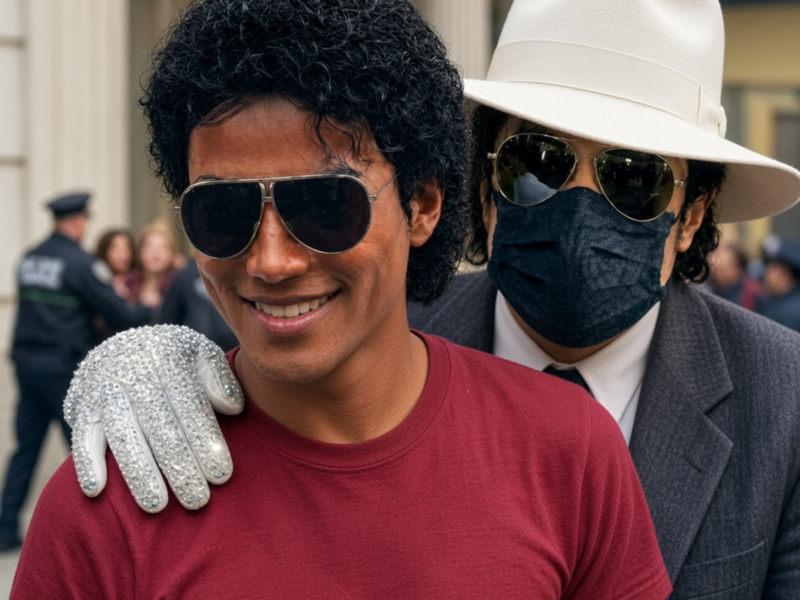
Jaafar and Michael Jackson Unseen Footage Broke the Internet.
On the first morning of filming, a room full of professionals went quiet.
The cameras were ready, the lights were set, hundreds of extras stood in position waiting, and one question moved silently from person to person.
A question nobody wanted to say out loud because the answer could decide the fate of a film that had taken years to build.
Could he really do it?
What happened in the next few minutes was recorded.
Months later, a rehearsal version of that same performance would escape onto the internet and stop millions of people mid-scroll.
Weeks after that, film shot more than two decades earlier would surface and reveal a gentler side of a legend.
Two pieces of footage.
Two generations.
One family.
But the real story begins long before that morning.
It begins with a boy who did not want the spotlight at all, a farewell he never expected to be his last, and a young man who decided that looking like his uncle would never be enough.
He would have to understand him.
To understand what Jaafar Jackson stepped into, you have to start with the man whose life he would portray.
Michael Jackson was born on August 29, 1958, the eighth of ten children.
His home was full of music.
Brothers harmonizing, radios playing, and evenings of rehearsal.
His mother, Katherine, anchored the household.
His father, Joe, managed the brothers as they began working toward a professional career.
Among them were Jackie, Tito, Jermaine, and Marlon, and Jermaine would one day become the father of the young man at the center of this film.
In 1968, the brothers signed with Motown.
The following year, “I Want You Back” climbed the charts.
Then came “ABC,” “The Love You Save,” and “I’ll Be There.”
All four of their first singles for the label reached number one, a run very few groups have matched.
At the front stood a young lead singer whose voice carried both playfulness and an emotional depth that surprised listeners.
He grew into a solo artist who kept expanding what a performer could be.
With producer Quincy Jones, he made “Off the Wall” in 1979 and “Thriller” in 1982, an album often cited as the best-selling of all time.
“Beat It” carried a celebrated guitar solo by Eddie Van Halen.
“The Girl Is Mine” paired him with Paul McCartney, and the two reunited for “Say Say Say.”
On a 1983 television special celebrating Motown, he glided backward across a stage the world came to know as the moonwalk.
A year later, he collected eight Grammy Awards in a single night.
The late 1980s stretched his imagination further.
He starred in “Captain EO,” a 3D science fiction short film made for Disney’s theme parks, with Francis Ford Coppola directing and George Lucas producing.
In 1988, he published his autobiography “Moonwalk” and released a feature film called “Moonwalker.”
His album “Bad” delivered five number one singles on the American pop chart, a first for any album.
“Man in the Mirror” turned a personal call for change into one of his most enduring songs, and a world tour included enormous concerts at London’s Wembley Stadium.
His heart ran toward giving, too.
He co-wrote “We Are the World” with Lionel Richie to raise money for famine relief, and in 1992, he founded the Heal the World Foundation to help children in need.
The Jackson 5 entered the Rock and Roll Hall of Fame in 1997, and he was inducted as a solo artist in 2001, one of the few performers honored both ways.
That was the legacy waiting for a nephew who, as a child, had no intention of going anywhere near it.
Jaafar Jeremiah Jackson was born on July 25, 1996, in Los Angeles.
His mother, Alejandra Genevieve Oaziaza, is a fashion designer born in Bogota, Colombia.
His father, Jermaine, had been there since the first Jackson 5 hits.
You might assume a boy with that last name dreamed of a stage.
He dreamed of a golf course.
“Golf was my only passion, and it was all I ever wanted to do,” he has said.
He competed in tournaments as a child, spent hours on the green, and pictured fairways and trophies.
The spotlight was not something he chased.
If anything, it was something to walk around.
Then at twelve, his father played him a Jackson 5 song, and something shifted.
He started to sing.
He started to play piano.
The music that had always drifted through his family’s life finally reached him.
Even then, acting never crossed his mind.
He wanted to write songs and produce them, to shape sound from behind the glass.
A quiet habit had started even earlier.
At around three years old, he was already watching his uncle’s movements, not deliberately, just naturally.
He would stand in front of the television and try to place his feet where Michael’s feet went, long before he understood what he was looking at.
He only knew that when his uncle danced, everything else seemed to pause.
His memories of Michael are the memories of a child, which is to say they are gloriously ordinary.
He remembers visiting Neverland, hide-and-seek, pockets stuffed with candy, rides, and movies.
In his words, it was all fun.
One evening stayed with him more than any other.
In April of 2009, the family gathered in Beverly Hills.
Jaafar was twelve.
He sat across the table from his father and his uncle, and the two brothers began to sing a cappella, spontaneously, the way people do when music is simply how their family talks.
“I was just observing,” Jaafar recalled.
“It was special.”
As the evening ended, Michael said five words to his nephew.
“See you in July.”
He was planning to bring the family to London for his “This Is It” concerts.
He was looking forward to it.
Michael Jackson died on June 25, 2009.
A family lost a son, a brother, and an uncle, and a twelve-year-old boy lost the chance to see him again that summer.
Grief does not follow a schedule.
What Jaafar did next was keep making music.
He grew up, wrote, and produced.
In 2019, he released a single called “Got Me Singing” with a video shot in Rio de Janeiro.
And in 2021, he appeared in a music video for his uncle Tito.
He was building a career on his own terms and finding that the family’s music was something he could carry without being swallowed by it.
Then, in 2020, a phone call changed the direction of his life.
Producer Graham King, the man behind “Bohemian Rhapsody,” was developing the official Michael Jackson biopic with a worldwide casting search underway.
By many accounts, finding the lead was the single biggest worry hanging over the project.
If audiences looked at the screen and thought, “That’s not Michael,” nothing else in the film could save it.
Jaafar had read an article about the project online.
At that point, he was deep in his music, producing constantly.
“I didn’t have any thoughts of, ‘Oh, let me play him,'” he said.
He was simply curious where the filmmakers would take the story.
Then King called and asked whether he had ever acted.
Jaafar answered honestly, “No,” and he had never wanted to.
King asked him to think it over.
Jaafar asked for time.
He did not want to treat a role like this as a hobby.
If he said yes, he wanted to give it everything.
Weeks passed with no word, so Jaafar did something bold.
He recorded a voice note and sent it to King.
In it, he spoke as Michael, with the higher pitch and the soft, distinctive tone.
He sang a Peter Pan song like a lullaby.
It was not a recording Michael had ever released.
It simply felt right.
King called back immediately.
“I’m getting you a coach tomorrow,” he said.
That was the starting line, not the finish.
King and casting director Kimberly Hardin told Jaafar plainly that the global search would continue regardless.
The part would be earned, not inherited.
He would have to prove himself with no acting experience, no formal training, and a family’s legacy on his shoulders.
So he went to work.
For two years, there were auditions, callbacks, and rehearsals.
He studied with acting coach Angela Gibbs for a full year before he even attempted to step into his uncle’s shoes.
“It was a two-year process,” he said.
“It was something new each month, so I set goals for myself.”
He trained with Rich and Tone Talauega, who had choreographed for Michael on the History Tour, and he gained access to something rare.
Michael’s own writings, journals, poems, mantras, and affirmations.
For Jaafar, those pages were a turning point.
He began writing affirmations of his own and placing them on walls and mirrors.
The voice came first, then the mannerisms, then the movement.
For his training ground, he chose the one place that made sense.
Hayvenhurst, the Jackson family estate in Encino.
It was where relatives had gathered for family game days when he was small, where the brothers had once rehearsed, and where early versions of “Off the Wall,” “Thriller,” and “Bad” had taken shape.
“It felt crucial to be in that same energy that Michael had been in,” he explained.
“I have personal memories of Michael there, so there were many emotions.”
Inside, he built what he called a research room.
Every inch of the walls was filled.
Michael’s mantras, samples of his handwriting, records of his achievements, and a timeline of what was happening in the world during each stage of his life.
It was a map of a mind and an era.
He gathered any footage he could find of Michael dancing, learned how Michael used his costume as part of a move, and read books aloud in Michael’s voice until the pitch and rhythm settled in.
The work was demanding by any measure.
He has described the rehearsals as grueling, pushing his body to its limit.
At times, he said, he danced until his feet went numb.
“I started to rehearse for hours and hours upon hours until one single move was right,” he recalled.
On mornings when his body ached, a voice in his mind asked a simple question.
“What would Michael do?”
One move gave him particular trouble.
Michael spun to the left.
Jaafar’s body had always spun to the right.
It sounds like a small difference, but it asks the muscles to unlearn what they have practiced for a lifetime.
Mastering it, according to Jaafar, took years of patient repetition.
And through all of it, he kept a secret.
For a full year, no one in his family knew he had been cast.
Not his father.
Not his mother.
Not anyone.
“I kept it pretty quiet until I felt comfortable enough to share it,” he said.
Naturally, some people wondered whether the role had simply gone to a relative.
The film’s director, Antoine Fuqua, addressed the question directly.
“It wasn’t a nepotism pick,” he said.
He described a chemistry read so strong that it left the room in tears.
The aim, he explained, was never to find a look-alike.
It was to find someone who could transmit Michael’s spirit.
King reached the same conclusion.
After a global search, Jaafar was the only person who could take on the part.
Which brings us back to that silent room.
Jaafar’s introduction to the camera was a recreation of the Bad tour at Wembley Stadium, staged in front of five hundred extras.
Fuqua had chosen to film it on the very first day of principal photography.
A bold bet that tackling one of the trickiest performances right away would build confidence for everything that followed.
Hair and makeup were complete.
The costume was on.
The stage was lit.
Jaafar would later say the production threw him in at the deep end, with the first weeks devoted to Michael’s most famous performances.
According to Fuqua, the crew arrived with honest doubt.
In a moment like that, doubt was not an insult.
It came from people who understood how hard the task was.
Then the music started.
As Fuqua remembered it, when Jaafar hit those first few moves, he killed it.
The uncertainty in the room dissolved.
According to reports, the crowd began screaming the moment he walked on stage, and the extras reacted spontaneously as if they had stopped working on a film and begun attending a real concert.
That was the answer.
A few months later, a piece of that day’s preparation reached the public.
Around July 13 and 14, 2026, unedited rehearsal footage of the same routine began circulating online, shared heavily by fan accounts and picked up by media within days.
It was a single take with a live band, with no edit to hide a stumble.
Fans lined it up beside Michael’s 1988 originals, and one viewer wrote that Jaafar didn’t impersonate his uncle, he channeled him.
Then the story took a quieter turn.
Every family has a place where its stories live.
For the Jacksons, that place began in a small house in Gary, Indiana, where a crowded set of brothers once shared bunk beds and big dreams.
According to reporting by The Sun on Sunday in mid-August, a camera had once wandered back to that childhood home with Michael himself, walking the rooms and pointing out where he and his brothers slept.
The footage was filmed between 2000 and 2003 by his friend and producer Mark Schaffel for a three-part series that was never finished.
Schaffel has said he owns the material and that it shows the real Michael.
Other moments described in the reporting include a phone call with a then nineteen-year-old Beyoncé about a possible collaboration, a few photo albums, and relaxed conversation among friends.
These clips have not been widely released, and their full context is not confirmed.
Schaffel has spoken about a possible documentary under the working title “The Real Michael,” but even a few glimpses carry a particular warmth.
A man at ease in the place where his story started.
Fan channels began pairing the two pieces, a nephew in rehearsal and an uncle at home, often under titles promising they would make viewers cry.
For many people, the tears were less about sadness than recognition.
The sight of a family’s creative thread running from one generation to the next.
The film itself opened on April 24, 2026.
It follows Michael’s life from his early days with the Jackson 5 through the release of the “Bad” album in 1988.
According to reported figures, it opened to ninety-seven million dollars domestically and two hundred seventeen million globally, a record for a biopic opening.
And it has since passed one billion dollars worldwide.
Critics and audiences singled out Jaafar’s performance, and some called it perfection.
He went on to win awards for Best Actor, along with a British National Film Award for Best Newcomer and Outstanding Performance.
There was one more layer many viewers did not notice at first.
Jaafar was singing in the film.
During the performance scenes, he sang live into the microphone over Michael’s track.
So what audiences hear is a blend of the two voices.
In some moments, there is no backing track at all.
“It’s actually me,” he said, “which was really fun to do.”
But the review he cared about most came from home.
His grandmother, Katherine Jackson, saw the film, and she told him how well he had done and how fully he embodied Michael.
“There were moments,” he said, “when she could not tell whether she was watching her grandson or her son.”
“To me, that’s all I needed to hear,” Jaafar said.
“It’s definitely the highest compliment that I could get.”
The approval had begun earlier.
In a statement released by Lionsgate before production, Katherine Jackson said that Jaafar embodies her son.
When King heard her reaction to the finished film, he was stunned.
“She was so moved,” he said.
“To think they had achieved that for Michael’s own mother,” he added, “was incredible.”
The story does not end there.
Lionsgate has confirmed plans for a sequel, widely called “Michael 2,” with production expected to begin in late 2026 or early 2027 and Jaafar returning in the lead role.
The first film closed in 1988.
A second would explore the decades that followed.
Jaafar has spoken about what he hopes that next chapter will carry.
“Michael,” he has said, “never lost his kindness and kept looking for the good in other people.”
“Even though he was broken, his heart still stayed the same,” Jaafar said.
“I hope that this is felt in the second movie.”
Lionsgate Motion Picture chair Adam Shankman has said that previously shot material, including several large musical sequences, is almost certain to appear in the sequel.
In other words, footage the public has not seen may finally reach a screen, and audiences will get to enjoy performances that were filmed for the first movie but did not fit its final cut.
For Jaafar, none of this was ever only choreography.
Every costume, every melody, every familiar gesture connected to someone he had known personally and lost.
The sequel may ask even more of him, because the emotional range required to portray a global superstar across later years is something else entirely.
We tend to treat talent as something that arrives complete.
We see the last spin, the final pose, and the note held at precisely the right moment, and we call it a gift.
What we rarely witness is the stubbornness underneath.
The early mornings.
The aching legs.
The choice to try once more.
A gift gets someone to the starting line.
Repetition carries them across it.
There is something worth noticing too in how Jaafar approached the role.
He could have leaned on a famous surname and let resemblance do the work.
Instead, he treated the part as an apprenticeship and cast himself as the student.
Humility, it turns out, can be its own kind of ambition.
Most of us will never stand beneath stadium lights, but all of us carry something we fear getting wrong.
A task that feels too large.
A standard that seems out of reach.
Watching someone approach that fear patiently, without shortcuts, makes our own version feel a little more possible.
Some inheritances come with a name.
The most valuable ones come with a way of working handed down quietly, one honest attempt at a time.
What does it mean to carry a legacy well?
Perhaps it means treating it as a conversation rather than a costume.
Perhaps it means listening closely to those who came before and then answering in your own voice.
The best tributes do not freeze the past in place.
They hand it forward a little warmer than they found it.
Michael Jackson gave the world songs that people still sing at weddings, in cars, in kitchens, on dance floors.
He gave dancers a vocabulary and young performers proof that a childhood dream can become a life’s work.
Jaafar Jackson gave that story a new voice, and in doing so gave a new generation a reason to press play.
Somewhere tonight, a child will find an old recording, stand up in the middle of a room, and try a step for the first time.









