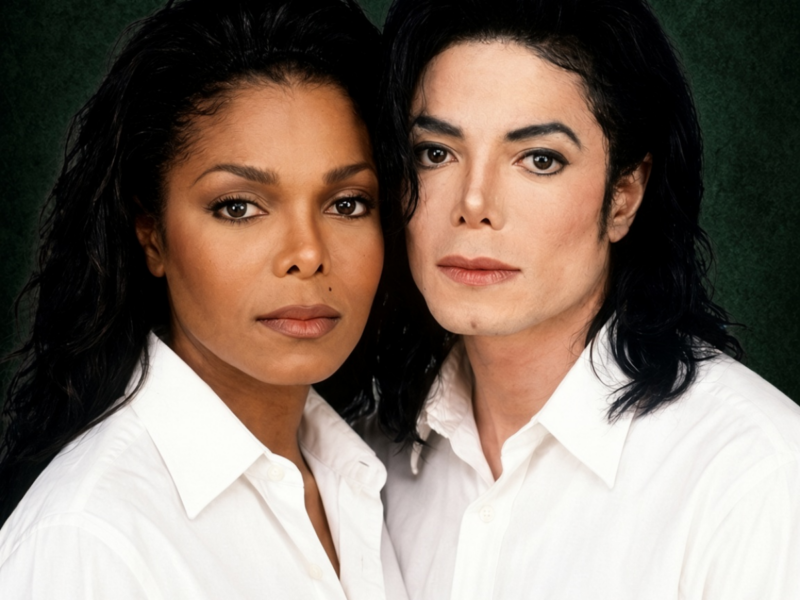
Inside the Jackson Family Home — The Childhood Janet Jackson Could Never Forget.

In April of 2026, the movie *Michael* opened in theaters and pulled in $217 million around the world in its first weekend.
Joseph is in it.
Katherine is in it.
La Toya, Jermaine, Tito, Jackie, and Marlon are all in it.
But the most famous Jackson after Michael isn’t.
At the Hollywood premiere, La Toya told *Variety* that her baby sister had been asked and that she kindly declined.
Janet said no to the biggest Jackson story ever filmed.
To understand why, you have to go back through a father who refused to be called Dad, a wedding her family learned about from the news, a husband she hid for nine years, and a letter signed in July of 2012 with her name at the bottom.
It started with a question her father asked a seven-year-old.
Here’s the version most of us carried around for forty years.
The Jacksons had nine children, and Janet Damita Jo Jackson, born on the 16th of May, 1966, in Gary, Indiana, was the last of them.
Her brothers signed with Motown when she was a toddler.
She told *Rolling Stone* she remembered sitting in her pajamas on the floor of her mother’s bedroom on a Saturday morning, waiting for her brothers to come on as cartoons and screaming when they finally did.
Then, at seven, she joined the act.
She and Randy worked the family’s Las Vegas show, singing “Sunny” and “I Got You Babe,” and she did impressions of Mae West.
The room stood up.
Those impressions got her onto the family’s summer variety specials, and the specials caught the eye of Norman Lear, who cast her as Penny Gordon on *Good Times*.
After that came a new kind of family, *Diff’rent Strokes*, and *Fame*.
And then the part we all remember best.
A shy girl in the shadow of the biggest star on Earth went to Minneapolis, made an album called *Control*, and walked out a superstar in her own right.
It sold millions.
*Rhythm Nation* followed.
In 1990, she told *Rolling Stone* that she and Michael were the closest of all the brothers and sisters, and that he’d told her the two of them thought most alike.
The baby of the family.
Sweet.
Private.
Loyal.
Untouched by the mess.
Decades later, Tito said on camera that she would always be his baby sister.
It’s a lovely story.
Almost every piece of it is true.
It just leaves out what the baby of the family was watching the whole time.
Start with the house.
Before the money, it was a two-bedroom house in Gary with two parents and nine children inside.
In her 2022 documentary, Janet went back to that little house with Randy and stood in front of it.
Their father worked at a steel mill.
She said he did whatever it took to feed his children and that he didn’t want them on the streets.
What he didn’t want was to be their dad.
In February of 2011, Piers Morgan asked Janet on CNN what she called her father growing up.
“Joseph,” she said.
One time, she tried calling him Dad.
In her words, he told her, “You call me Joseph. I’m Joseph to you.”
She said that as a girl, she’d go to friends’ houses when her mother allowed it and watch other girls sit in their father’s laps and call them Dad.
She saw something else in that house—something she has never described in detail and probably never will.
Her brother did.
On the 10th of February, 1993, in what was then the most-watched interview in television history, Michael told Oprah Winfrey that his father had beaten him and called him ugly, and that he’d sometimes get sick when Joseph came to see him.
Then he said, “I love my father, but I don’t know him.”
Joseph denied it for the rest of his life.
In 2003, he told the BBC’s Louis Theroux that he had used a switch and a belt, and then drew his own line.
“I never beat him. You beat someone with a stick.”
This year’s movie made that fight its spine.
Colman Domingo, who plays Joseph, said the story evolved to center on the friction between Joe and Michael.
Janet, who lived in that house too, has mostly stayed out of it.
In her documentary, she called her father tough.
She said that growing up, she didn’t really experience her father the way she wanted to—the way she saw other kids experience theirs.
And then she defended him, which tells you as much as anything she could have said against him.
There’s one more detail from her childhood.
Janet said she’d planned to go to college and study entertainment law.
Then Joseph came across a tape from the family’s home studio with his daughter singing a song she’d written just for fun.
As she tells it, that settled her future.
So the little girl who watched everything learned the first rule of that house early.
You didn’t argue with Joseph.
You found a door.
That’s where most biographies jump straight to Minneapolis.
They skip the years when the door was locked from the inside.
After *A New Kind of Family* was cancelled, Janet was fourteen and starting on *Diff’rent Strokes*.
She wanted to study acting seriously.
Joseph asked if she wanted to sing again.
She told *Rolling Stone* her answer was yes.
“Okay, that’s fine.”
She said she didn’t mind, but she wasn’t into it.
She did it anyway.
Joseph negotiated her contract with A&M Records, and in 1982, her first album, *Janet Jackson*, came out.
Joseph oversaw the production.
Two years later came *Dream Street*, with her brothers Marlon and Michael helping out.
Neither record did much.
Years later, *Rolling Stone* dismissed the first one as “sugary and forgettable,” which is the kind of review that stings when your brother is Michael Jackson.
In those same years, Michael released *Thriller*.
Janet admitted in 1990 that she was so envious it hurt.
She was happy for him, she said.
But part of her kept asking why it couldn’t be her.
Here’s what you need to see about her position at seventeen.
Her father was her manager.
Her father ran her recording sessions.
She lived in her parents’ house in Encino, where, as she later described it, La Toya’s bedroom was right across the hall from hers.
She was being steered into a career she hadn’t picked by a man she couldn’t call Dad.
In her documentary, she put it plainly.
Her father was in charge of her life and her career.
And, quote, “It’s hard to say no to my father.”
So she didn’t say no.
She found another way out.
His name was James.
That should have been the escape.
It turned into the most painful year of her young life.
James DeBarge was one of the singing DeBarge siblings from Grand Rapids, Michigan—a family group that *Rolling Stone* described as modeled on the Jacksons.
Janet told *Rolling Stone* she’d known him since she was ten, only over the telephone, because his family was friendly with Jermaine and La Toya.
They finally met in person at *Soul Train* when she was fifteen.
She said he asked if she remembered him, and she said, “My goodness, you got so big.”
By the time of *Dream Street*, she admitted she was far more into him than into her music.
In September of 1984, while her brothers were caught up in the turmoil of the Victory Tour, Janet, eighteen years old, eloped with James in Grand Rapids.
According to *Rolling Stone*, the Jackson family learned about the marriage through the media.
Their youngest daughter was married, and they found out like everybody else in America.
John McClain, a family friend at A&M Records, said in a 1986 *People* interview that he’d advised her not to do it.
Why marry at all?
Janet answered that nearly forty years later in her documentary.
She said she wanted to stand on her own feet and that at that time she couldn’t see any other way to get her own life.
Quote, “Unless I got married.”
It came apart almost at once.
She recalled that on their wedding night back at the hotel, James said, “Okay, I’ll be right back,” and didn’t come back for hours.
She has spoken about his struggle with drugs and how she tried to help him.
Her family had disapproved from the start.
Within months, she’d left him, and less than a year after the wedding, the marriage was annulled.
There’s one more piece, and it’s still argued about.
For decades, rumors have said Janet secretly had a child with James.
James himself said on a reality show in 2016 that he believed the child existed.
Janet has denied it.
“I could never keep a child away from James,” she said.
In 2022, her *Fame* co-star Debbie Allen backed her, saying, “Janet was with the cast all day, every day.”
Two people.
One marriage.
Two completely different memories.
You can decide which one you believe.
Janet told the cameras she was just incredibly innocent.
Then she told the producer she didn’t want to talk about it anymore, and she went home—back to Encino, to the house where Michael and La Toya were still living under Joseph’s roof and Joseph’s management.
Right back where she’d started.
Remember that family friend at A&M who told her not to marry James?
He’s about to change her life.
Years later, he’ll be on the other side of one of the most bitter fights her family ever had in public.
His name was John McClain.
He’d gone to high school with Jermaine.
And Janet told *Rolling Stone* she’d known him since she was two.
In 1985, he was running urban music at A&M, and most of the label didn’t care much about a third Janet Jackson record.
McClain did.
He thought the quiet girl had something she’d never been allowed to show.
So he called Jimmy Jam and Terry Lewis—two former members of The Time, the funk band from Prince’s circle, who were writing and producing out of a studio called Flyte Tyme in Minneapolis.
Joseph was still her manager, and he signed off.
He just had one warning, and *Rolling Stone* printed it.
“I know you guys are from Minneapolis. I don’t want my daughter sounding like Prince.”
Jam and Lewis insisted she record in Minneapolis, far from Hollywood.
Janet showed up with her friend Melanie Andrews.
No limousines.
No bodyguards.
She borrowed Jimmy Jam’s Chevy Blazer, and the two young women drove themselves around a strange city, sometimes getting lost.
For the first week, they didn’t record anything.
She just told them her whole story.
That story became the album.
The title song is a young woman announcing that she used to do what her father said and doesn’t anymore.
The second verse is about falling in love too young.
And if you listen closely, you’ll hear a car crash in the middle of it.
*Control* came out in 1986.
It went five times platinum.
“What Have You Done for Me Lately” became her first top-five hit.
Then came the move her brothers had made before her.
She fired her father as her manager.
Her explanation to *Rolling Stone* was careful and polite.
She said she needed to grow and do things herself, and that it’s hard to have family in your business because you can’t get after them when something goes wrong.
Now here’s where the legend and the record part ways.
The legend says *Control* was the sound of a girl breaking free alone.
*Rolling Stone* in 1990 put it differently.
It called it “no small irony that so many hands shaped an album about one young woman’s liberation.”
“A new self was carved out for her,” the magazine said, “and she learned to live in it.”
The hands belonged to Jam, to Lewis, and above all to McClain, who quietly acted as her adviser while he was also an officer of her record label.
McClain’s own version was simple.
“I never managed Janet,” he said.
She was like his sister.
She traded one powerful man in her career for another.
This one, at least, she could call by his first name, because she wanted to.
She’d finally stopped hiding from her father.
Now she started hiding something else.
On the set of the “Nasty” video, she got close to a young man named René Elizondo Jr.
Within a few years, he was beside her at nearly every shoot, helping shape her videos, holding her hand between takes.
In 1990, *Rolling Stone* noticed and asked about it.
Janet bristled.
She said she hated that everyone thought he managed her, and that he didn’t in any fashion, shape, or form.
She wouldn’t let him give an interview.
She did confirm they lived together.
What she didn’t say was that she was planning to marry him.
On the 31st of March, 1991, in San Diego, she did exactly that.
No announcement.
No magazine cover.
Her sister Rebbie later said she was blindsided.
Think about how hard that was to pull off.
This was the most photographed family in American show business.
Janet signed a record deal with Virgin, released the album *Janet*, starred in *Poetic Justice*, recorded “Scream” with Michael, and released *The Velvet Rope*.
And the whole time, she was a married woman.
Elizondo co-wrote songs with her and directed several of her videos.
*Rolling Stone* had called him the boyfriend.
Nobody printed the word husband for nine years.
They separated in January of 1999.
And in May of 2000, Elizondo filed a petition for divorce in Los Angeles Superior Court.
That’s how the world found out—not from Janet, from a court clerk.
The petition listed the date of the marriage, the 31st of March, 1991, and noted no children.
Janet released a statement that day.
She said she’d kept it private, quote, “to have a normal family life,” and added, “Since I was a child, my personal life has been lived in the public eye.”
It got harder from there.
They’d signed a prenuptial agreement before the wedding, and according to court records reported at the time, Elizondo now claimed he’d signed it under pressure without reading it.
He also claimed Janet had talked him into giving up songwriting credit on thirty-seven tracks, telling him his involvement had to stay secret to protect her image.
Those are his claims, made in a divorce case.
Janet’s lawyers wouldn’t comment.
The case dragged on for more than three years, and the divorce became final in October of 2003.
The terms were never made public.
The girl who grew up being watched had learned how to keep a secret better than anyone in her family.
The trouble with secrets is that someone else always holds the other half of the paperwork.
Six years later, it was her family’s turn to discover what a piece of paper could do.
On the 25th of June, 2009, Michael died in Los Angeles at fifty.
Three days later, at the BET Awards, Janet walked on stage near the end of the broadcast.
She said her whole family had wanted to come, but it was too painful, so they’d chosen her to speak.
Then she said the line most of us still remember.
“To you, Michael is an icon. To us, Michael is family.”
Family.
Hold on to that word.
On the 1st of July, the will was filed in Los Angeles Superior Court.
It was five pages long, signed on the 7th of July, 2002.
It put Michael’s entire estate into the Michael Jackson Family Trust.
According to details that came out in court, the trust split everything three ways: 40% to his mother, 40% to his three children, 20% to children’s charities.
The will named Katherine as guardian of the kids, with Diana Ross as backup.
His father wasn’t a beneficiary.
Neither were any of his eight brothers and sisters.
Not Jermaine.
Not La Toya.
Not the sister who’d said she was closest to him of all.
And Janet would have spotted one name faster than any lawyer in that courtroom.
The will named two executives to run the estate.
One was Michael’s longtime attorney, John Branca.
The other was John McClain.
The man who’d known Janet since she was two.
The man who’d helped build *Control*.
The man who’d told her not to marry James.
He now held the keys to her brother’s fortune, and the court confirmed him in the job.
At first, there were objections to Branca, but the will held, and the estate—reportedly hundreds of millions of dollars in debt when Michael died—began to make money.
By the end of May 2012, court filings showed gross earnings of more than $475 million.
Three years of quiet.
Then a letter.
Everything you’ve heard so far is the public record of a woman who spent her life getting away.
This is the document that pulled her back in.
On the 17th of July, 2012, a letter went to the executives of Michael’s estate.
It was signed by five of his siblings: Jermaine, Tito, Randy, Rebbie, and Janet.
It demanded that John Branca and John McClain resign.
It accused them of taking advantage of a grieving mother.
And it went after the will itself.
The letter called it, word for word, “fake, flawed, and fraudulent.”
It claimed Michael wasn’t even in California on the day he supposedly signed it.
Janet Jackson had put her name on a letter accusing John McClain of knowing the will was a fraud.
The estate answered fast.
A statement to ABC News said every doubt about the will had been thoroughly debunked and that challenges had been rejected by California courts all the way up to the state supreme court.
It said the executives were protecting the only family members Michael had named: his mother and his three children.
Then the week turned strange.
Katherine Jackson had left for Arizona on the 15th of July with Rebbie and other relatives, and by that weekend, she was reported missing.
She wasn’t.
On the 23rd, sheriff’s deputies were called to a family disturbance at the Calabasas house where Katherine lived with Michael’s children.
The Associated Press reported that video appeared to show Janet, Randy, and Jermaine in the driveway.
Randy said they’d come to invite the kids to see their grandmother.
Within days, a judge named Tito’s son TJ temporary guardian of the children.
Tito withdrew his signature first.
At the start of August, Jermaine withdrew his, saying the letter should never have gone public.
That left three names: Randy, Rebbie, Janet.
The youngest—the one who’d always kept her family business out of the papers—didn’t take her name off.
According to reports at the time, a statement issued for Janet, Randy, and Rebbie through her attorney called the kidnapping reports false and blamed the executives for a negative media campaign.
No court ever found the will to be fake.
So here’s the question I keep coming back to.
If the man who helped you escape your father ended up guarding your brother’s fortune against the rest of your family, whose side would you stand on?
Janet chose her mother’s side and her blood.
She’d spent her late teens and twenties getting out from under one man’s control.
In her forties, she found herself fighting the man who’d helped her do it.
Joseph Jackson died in Las Vegas on the 27th of June, 2018.
He was eighty-nine and had been battling cancer.
Janet posted a childhood photograph of herself sitting on his knee with a single blue heart.
Four years later, in her own documentary, she said she owed her career to him.
The money went where Michael wrote it would go—to Katherine, to his three children, and to charity—and the estate has reportedly earned more than $3 billion since.
His brothers and sisters never got a share.
In April of 2026, the estate’s movie told the family story without Janet in it, because she declined to take part.
And on the 26th of May, 2026, John McClain died at seventy-one from complications of a fall.
Whatever passed between him and the girl he’d known since she was two, neither of them ever told us.
Janet still holds the rest of it.
She was the one in the house who watched everything.
She’s also the one who never told it all.









