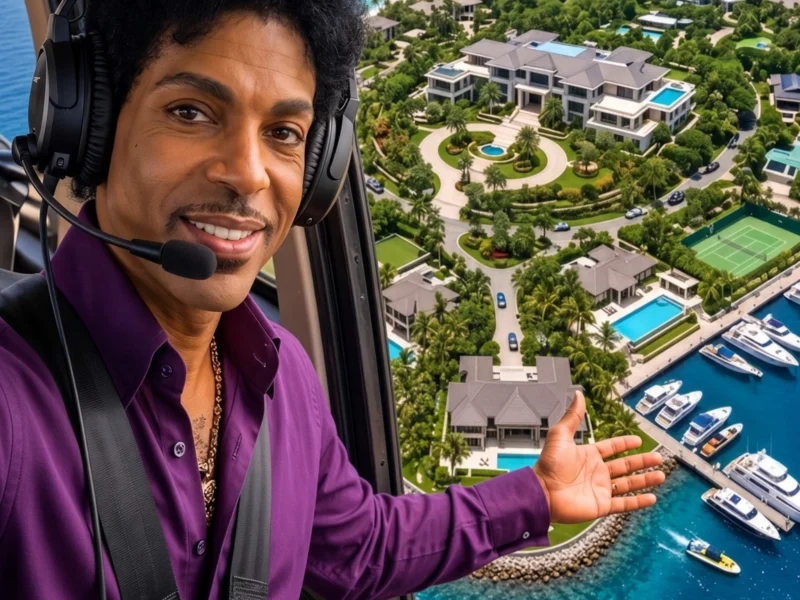
Inside Prince’s MASSIVE Private Island — He OWNS His Own Country.
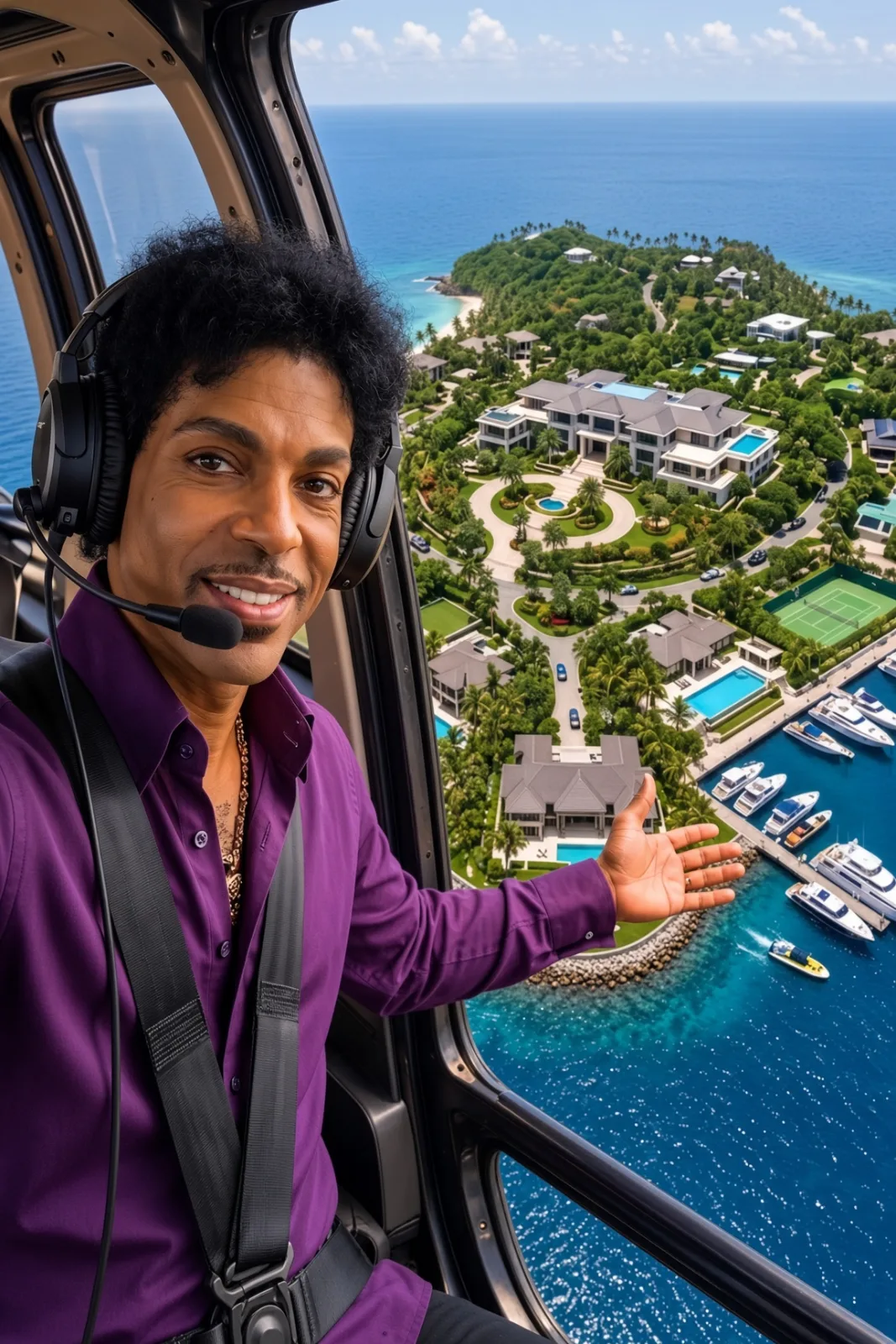
Prince owned an island, somewhere in the Caribbean, away from every camera and every person who did not have his specific permission to be there.
The most private man in the history of popular music had his own piece of the earth, water on all sides, his own dock, his own beach, his own rules, his own country in every sense that mattered to a man who spent his entire career fighting for the right to own everything he touched.
He named things.
He named his studio Paisley Park.
He named his creative philosophy the New Power Generation.
He would have named the island, too, and whatever he named it, it would have been his, completely, unconditionally, the way everything Prince ever touched eventually became his.
And the island is just where the story starts.
Let us start with a number that most people still have not fully processed.
$1 billion.
That is the current estimated value of Prince’s estate in October 2026, 10 years after his death on April 21st, 2016 at Paisley Park in Chanhassen, Minnesota at the age of 57.
He left no will.
The most legally sophisticated and financially protective artist in the history of popular music, a man who wrote the word slave on his face rather than record under a name a corporation owned, a man who held a symbol rather than a name to protect his identity from trademark claims, a man who built his own recording studio rather than pay a label for studio time, died without a single document specifying what should happen to any of it.
The estate that followed his death has been one of the most complicated and most valuable probate proceedings in entertainment history.
Six years of legal dispute, siblings selling their interests to investment funds, competing claims about asset values, arguments about catalog management strategies, and sitting at the center of all of it, the vault.
500 unreleased songs locked beneath Paisley Park, the most valuable unreleased music library in the history of recorded music, the bomb at the middle of a billion-dollar estate that has been ticking since April 21st, 2016.
The island, his own country.
The island sits in the Caribbean in that specific band of water between Florida and the northern coast of South America where the Atlantic meets the warm currents that make the Caribbean the most desirable private island market on Earth.
Prince acquired it in the way that Prince acquired everything, quietly, through intermediaries, without a press release or a public announcement.
The transaction happened the way his best decisions always happened, without the world watching.
The island is not large by the standards of private island ownership in the Bahamas or the Caribbean, but size was never the point for Prince.
Control was the point.
Privacy was the point.
The ability to exist without interference was the point.
On the island, there are no journalists, no photographers, no fans pressing against a barrier hoping for a photograph, no industry people who need something from him, no television cameras, no interview requests, no one who knows who he is or cares.
There is water, there is sky, there is the sound of the Caribbean, which is a specific sound that does not exist anywhere else on Earth.
And there is the music he was always making in his head regardless of where his body was located.
He brought instruments.
Of course he brought instruments.
Prince without instruments is not Prince.
The island had a recording setup, not Paisley Park’s professional infrastructure, but enough to capture the ideas that arrived in the Caribbean silence, the melodies that came when the world’s noise finally stopped and his own internal music could be heard clearly.
He brought Mayte when they were together.
He brought people he trusted when he wanted company and nobody when he did not.
The island’s guest list was his to determine completely.
The specific legal structure of the island ownership, the corporate entities, the trust arrangements, the Caribbean jurisdiction’s favorable tax treatment reflected the same financial intelligence that had characterized every major business decision of his career.
He did not own it in his name.
He owned it through structures that protected the asset from the various legal and financial pressures that followed him through the latter decades of his career.
When he died in 2016, the island became part of the estate question that had no will to answer it.
Like everything else he left behind, it sat in the complicated middle ground of a billion-dollar proceeding that took years to navigate.
The island was Prince at his most essentially himself, a man who wanted to own everything he touched in a place where nobody could reach him with the ocean as his fence and the Caribbean sky as his roof.
His own island, his own country, where the most private man in music finally had silence.
But the island is where he went to escape what he owned on land, and what he owned on land was something genuinely extraordinary.
Paisley Park, the city he built in Minnesota.
In 1987, Prince built Paisley Park, not a recording studio, a campus, a 55,000-sq-ft building in Chanhassen, Minnesota, a suburb of Minneapolis that contained professional recording studios, rehearsal spaces, a concert venue, his personal residence, a production facility, and the operational headquarters of every business he ran.
The building cost approximately $10 million to construct in 1987, which is equivalent to approximately $27 million in 2026 money.
He paid for it himself.
He did not borrow.
He did not take a label advance to fund the construction.
He used the commercial success of Purple Rain and the albums that followed it to build a facility that he owned outright and it gave him permanent independence from every recording studio, rehearsal space, and production facility that he had previously been paying to use.
The strategic logic was exactly the same as Tyler Perry buying Fort McPherson or Steve Harvey building his production infrastructure.
You pay to use someone else’s facility for a year, or you build your own facility and never pay again.
Over a 50-year career, the math is not close.
Paisley Park has state-of-the-art recording studios, Studio A and Studio B, capable of capturing any size of recording project at professional quality.
He recorded his albums there from the moment it opened.
He rehearsed tours there.
He produced other artists there.
He recorded the 500 unreleased songs that sit in the vault beneath the building there.
The concert venue inside Paisley Park held approximately 1,000 people and hosted private shows, industry events, and the legendary late-night Paisley Park parties that became the most sought-after invitations in the entertainment industry for two decades.
If you were at a Prince show on any given night and he felt like playing for another 3 hours after the official performance ended, sometimes the audience was invited to Paisley Park.
Sometimes the party started at midnight and ran until sunrise.
He lived in the building.
His apartment was inside Paisley Park.
He woke up and walked downstairs to the recording studio.
He finished a show and walked across the campus to the rehearsal space to try something new.
His creative practice and his physical life were housed in the same building because separating them had always seemed arbitrary to him.
Paisley Park is now a museum.
It opened to the public in October 2016, 6 months after his death.
Visitors walk through the recording studios where the greatest catalog in the history of funk was produced.
They see the vault where 500 unreleased songs are stored.
They experience the space where the most privately lived public life in music happened.
The museum generates several million dollars annually from ticket sales, merchandise, and the special events that continue making Paisley Park an active destination rather than simply a historical site.
The celebration events held every April around the anniversary of his death draw fans from around the world who pay significant ticket prices to be in the building where he lived and worked.
He built Paisley Park as a creative headquarters.
It has become a pilgrimage site.
Both functions are generating commercial value for the estate that he could not have anticipated, but that reflect exactly the kind of asset building that characterized his entire career.
The vault, 500 unreleased songs.
Beneath Paisley Park, in a climate-controlled storage facility, there are 500 songs that the world has never heard.
500 complete recordings.
Some from the 1980s, some from the 90s, some from the last months of his life.
Recorded on reel-to-reel tape, on digital formats spanning multiple generations of recording technology, in the specific quality that only Prince, recording in his own studio with his own musicians, in his own time, could produce.
He recorded constantly.
Not for albums, not for commercial release, because recording was how he thought.
Because the act of capturing music on tape was as natural and as continuous for him as breathing.
He put ideas down and moved to the next idea without stopping to decide whether the previous idea was finished or whether it would ever be heard.
The result of four decades of that practice is 500 songs that no commercial artist in history has produced and withheld at the same scale.
What is in those recordings?
Nobody outside the estate’s inner circle knows the full answer, but what has come out in the authorized releases since his death gives some indication.
Welcome 2 America, the posthumous album released in 2021, was recorded in 2010 and sat in the vault for 11 years.
The album debuted at number seven on the Billboard 200.
It received critical acclaim as a genuinely strong piece of work, rather than as a sentimental tribute to a deceased artist.
The vault delivered.
The Sign of the Times Super Deluxe Edition, released in 2020, contained over 60 previously unreleased tracks from the 1987 recording sessions.
60 tracks from a single album’s recording period.
The musical productivity those numbers represent is genuinely staggering.
At the pace the estate has been releasing vault material, one or two significant projects per year, the vault has enough material to sustain commercial releases for decades.
The estate has explicitly said it is not flooding the market.
Strategic scarcity, one release at a time, keep each one a cultural event rather than a catalog dump.
Prince himself understood this strategy because he invented it.
He held music back deliberately throughout his career.
He gave away songs to other artists, most famously Nothing Compares 2 U to Sinead O’Connor in 1990 rather than releasing them himself, ensuring that his catalog of unreleased material stayed deep while other artists carried his compositions to commercial success.
The vault is not just a financial asset.
It is a deliberate artistic strategy that Prince designed and that the estate is now executing.
Every release from it is new Prince music.
New Prince music generates streaming spikes, media coverage, critical engagement, and the specific kind of cultural renewal that keeps a catalog commercially vital rather than simply historically significant.
500 songs.
At current catalog valuation multiples, the unreleased vault is estimated to be worth between $100 and $200 as a standalone asset.
500 unreleased songs sitting beneath Paisley Park.
Each one a new release.
Each one worth millions.
But the vault is not even the biggest financial asset in the estate.
If you are a Prince fan and you want more stories about what he actually built, subscribe to the channel.
We go this deep every week.
The masters, why he fought and why he won.
Prince’s battle with Warner Brothers over his master recordings is one of the most significant stories in the history of the music industry.
Not because of the drama, because of the outcome.
In 1993, he walked out of Warner Brothers and wrote the word slave on his face in black marker.
He changed his name to an unpronounceable symbol.
He appeared at public events with the word visible.
He gave interviews about it.
He refused to record new material under the name Prince because Warner Brothers owned the trademark.
The entertainment industry thought he had lost his mind.
He had not lost his mind.
He had correctly identified the central financial injustice of the record label business model, and he was protesting it in the most visible way available to him.
Warner Brothers owned his master recordings, the actual recordings of the music he had made.
Every time those recordings were licensed, played, sold, or streamed, Warner Brothers collected the primary revenue, and Prince collected a royalty.
He made the music, they owned it.
He received a percentage, they received everything else.
He renegotiated his deal in 1996 and regained ownership of his masters.
He spent the following 20 years operating as a fully independent artist who owned everything he recorded.
Every album he released after that point was his, every recording, every session, every take, completely his.
The commercial and financial implication of that ownership became fully visible after his death.
The estate controls both the master recordings and the publishing rights to the post-Warner catalog, two income streams from every song.
Two royalty payments from every stream, every license, every commercial use.
On streaming alone, 40 million monthly Spotify listeners, additional millions on Apple Music and every other platform, the dual ownership generates millions of dollars monthly.
Publishing royalties plus master royalties, both on every stream.
He was right in 1993.
He was right to endure the public mockery of writing slave on his face and changing his name to a symbol.
He was right to sacrifice years of his commercial peak to win a battle that most of the industry told him he could not win.
The estate’s billion-dollar valuation is partly built on that specific stubbornness.
The masters he reclaimed are worth hundreds of millions of dollars.
The alternative, letting Warner Brothers retain ownership through whatever deal they would have offered to make him stop fighting, would have generated a fraction of that value for his estate.
Taylor Swift lost her early catalog to Scooter Braun and re-recorded her albums to reclaim commercial control.
The entire culture celebrated it as a revolutionary act.
Prince did the same thing, fought for and won his masters 20 years earlier.
He did not have social media to amplify it.
He had a symbol and a word written in marker on his cheekbone.
The catalog, Purple Rain and 40 years of music.
Purple Rain was released on June 25th, 1984.
It has been 42 years.
It is still streaming millions of times per month globally.
It is still being licensed for film, television, advertising, and every other commercial application regularly.
It is still generating tens of millions of dollars in royalty income annually from a single album released before most of the people streaming it were born.
The catalog runs deeper than Purple Rain, way deeper.
1999, Dirty Mind, Controversy, Sign of the Times, which many music critics consider the greatest album ever made in the rock and pop tradition, Around the World in a Day, Parade, Lovesexy, Batman, Diamonds and Pearls, The Symbol album, Gold, Emancipation, Rave unto the Joy Fantastic, and the post-Warner catalog spanning the 2000s and 2010s.
Over three dozen officially released studio albums.
A catalog of commercial singles that generated some of the most recognizable music in the history of popular recording.
When Doves Cry, Kiss, Little Red Corvette, Raspberry Beret, Let’s Go Crazy, Cream, Diamonds and Pearls, 7, Gold.
Every one of these songs generates income continuously.
Streaming, radio play in markets around the world, licensing for commercial use, synchronization licensing for film and television.
The catalog never sleeps.
It generates revenue around the clock from every corner of the planet where the music has reached, and it has reached everywhere.
The total catalog value across all released material, the pre-Warner recordings whose master rights are held by Universal through the acquisition of Warner Brothers music, the post Warner recordings, whose masters Prince owned outright, and the publishing rights, runs into the hundreds of millions of dollars.
At current catalog acquisition multiples, which have been running at 20 to 30 times annual royalty earnings, as investment funds and music companies compete for proven catalogs, Purple Rain alone is worth between 50 and 100 million dollars as a standalone asset.
One album, 42 years old, worth up to 100 million dollars.
He made 30 plus more.
The sync licensing, where the real money flows.
Here is the revenue stream from the Prince catalog that most casual observers do not track, and that represents some of the largest individual transactions in the estate’s annual income.
Synchronization licensing, the fees paid when his music is used in film, television, commercials, streaming content, video games, and any other audio-visual media.
A major film that wants to use Purple Rain or When Doves Cry in a significant scene pays between 500,000 and 5 million dollars for the synchronization license, depending on the scene’s prominence, the film’s budget, and the negotiating position of both parties.
A major television commercial that wants to use a Prince track pays between 200,000 and 2 million dollars, depending on duration, market, and the specific song’s commercial recognition.
A prestige streaming drama that wants to build a scene around a Prince recording pays between 300,000 and 1 million dollars for the license.
Prince during his life was notoriously selective about synchronization licensing.
He refused many commercial uses that other artists accepted routinely.
The estate has maintained that selectivity, while operating with more commercial flexibility than the artist himself imposed.
The combination of selectivity, ensuring that each placement reflects the catalog’s dignity, rather than cheapening it through overexposure, and active commercial engagement, generates sync licensing income estimated at tens of millions of dollars annually.
Every film set in the 1980s that wants period authentic music considers Purple Rain.
Every commercial targeting a consumer demographic that grew up in that era evaluates what a Prince placement would cost.
Every streaming drama that wants to convey the specific emotional register of the mid-80s has When Doves Cry in the brief.
The catalog is a default reference point for a decade of American cultural history.
That default status has commercial value that compounds rather than depletes over time.
The sync licensing alone generates tens of millions annually.
Every film set in the 80s thinks about Purple Rain.
Every commercial wants When Doves Cry.
The catalog is not declining.
It is compounding.
The publishing, two sides of every song.
Prince wrote virtually everything he ever recorded.
This sounds like an artistic statement.
It is a financial one.
Most commercial artists record songs written by professional songwriters.
The publishing rights to those songs, the compositional rights that generate income from every use of the underlying melody and lyrics, belong to the songwriters and their publishers, not to the recording artist.
Prince was both.
He wrote the music.
He recorded it.
He owned the publishing and the masters simultaneously.
On every stream, every license, every commercial use of a Prince song from the post-Warner catalog, the estate collects twice.
Once as the master owner, the recording royalty, once as the publisher, the compositional royalty.
Both checks on every transaction.
This double ownership structure is financially rare at the commercial level Prince operated at.
Most artists of his commercial stature had surrendered publishing rights either at signing or through various renegotiations as their careers developed.
Prince held his.
The publishing portfolio, the compositional rights to hundreds of commercially released songs, plus the rights to vault material as it is released, is estimated to be worth between 100 and 150 million dollars as a standalone asset.
Add the master recording values and you have the foundation of a billion-dollar estate built entirely on the specific stubbornness of a musician who refused to let anyone own what he created.
Nothing compares to you giving away a masterpiece.
In 1985, Prince wrote a song called Nothing Compares 2 U and gave it to a group called The Family.
The Family recorded it.
It was released.
It went nowhere particularly notable.
Prince moved on.
In 1990, Sinead O’Connor recorded her version.
The music video, her face filling the frame, tears running down her cheeks, became one of the most iconic images in the history of music video.
The song reached number one in numerous countries simultaneously.
It was one of the most commercially successful singles of the year globally.
O’Connor received the fame.
Prince received the publishing royalties.
Every time Nothing Compares 2 U was sold, streamed, licensed, covered, or commercially used anywhere in the world, Prince collected as the songwriter.
His name is on the composition.
His publishing company holds the rights.
Every stream of O’Connor’s version generates income for Prince’s estate, not for O’Connor.
He gave away a masterpiece and kept the financial interest in it, not by accident, by design.
He did this multiple times across his career.
He wrote songs for other artists.
He gave away recordings that became major hits for their performers.
Each time, he retained the publishing.
Each time, the hit generated income for his catalog while the performer’s career generated attention that eventually led listeners back to Prince’s own recordings.
The strategy was sophisticated enough that most of the industry only understood it fully in retrospect.
He was not being generous.
He was planting commercial seeds in other people’s careers that would bear financial fruit for his estate indefinitely.
He gave away Nothing Compares 2 U and kept the publishing.
Every stream of Sinead O’Connor’s version pays Prince’s estate.
Every cover version pays his estate.
Every film or commercial that uses it pays his estate, forever.
The Paisley Park Museum, the physical empire.
Paisley Park opened as a museum in October 2016 and has been operating continuously since then as one of the most significant music pilgrimage sites in the world.
The museum generates revenue from multiple sources simultaneously.
Ticket sales.
Regular tours give visitors access to the recording studios, the rehearsal spaces, the vault area, the performance venues, and the personal spaces within the building.
Ticket prices reflect the premium of a once-in-a-lifetime experience.
Adult tickets run in the range of $40 to $75 depending on the tour type.
The celebration events in April command significantly higher prices for multi-day access.
Merchandise.
The gift shop at Paisley Park generates significant revenue from the specific consumer who has traveled from another state or another country to visit the building.
The emotional state of a Prince fan standing in the studio where Sign of the Times was recorded is one of the most commercially favorable conditions for merchandise purchasing that a retail environment can create.
The celebration events.
Every April, around the anniversary of his death, the estate hosts multi-day events at Paisley Park that draw fans from around the world.
These events include live performances by artists who were close to Prince, screenings of rare footage, access to parts of the museum not normally open to the public, and the specific energy of thousands of Prince fans gathered in the building where he lived and worked.
Event revenue from celebration, ticket sales, travel packages, merchandise add several million dollars annually to the museum’s direct income.
Special events.
The building is available for private events, album release parties, industry gatherings, and other commercial occasions that want the specific prestige of the Paisley Park association.
These private events command premium rental fees that reflect the cultural weight of the venue.
The museum generates an estimated five to 10 million dollars annually across all revenue streams.
It is not the largest commercial activity in the estate’s portfolio, but it is the one that maintains the living, breathing physical presence of Prince’s world in a way that catalog streaming and licensing cannot.
The estate battle and how it resolved.
Prince died on April 21st, 2016 without a will.
He was 57.
He had been recording at Paisley Park until the final weeks of his life.
He was preparing new material.
The death came from an accidental fentanyl overdose, a prescription painkiller that had been managing chronic pain from decades of extraordinary physical performance as a live performer.
He left six surviving siblings, no spouse, no surviving children.
His son Amir Nelson lived only one week after birth in 1996, a loss that Prince absorbed privately and rarely spoke about publicly.
Minnesota’s intestacy law directed the estate to the siblings in equal shares.
The probate proceedings ran for approximately six years.
The estate’s value was disputed.
The siblings’ representatives and the estate administrators argued about how to value the Sony/ATV interest, the vault, the Paisley Park building, and the ongoing commercial operations.
The dispute was not primarily about the money.
It was about who had the authority to make decisions about how the legacy was managed.
Multiple siblings sold their interests during the proceedings to investment funds, to companies that specialized in acquiring celebrity estate interests from family members who wanted liquidity rather than ongoing involvement in complex estate management.
The result was a fractured ownership structure with various parties holding interests in different aspects of the estate managed through the formal estate administration structure while the probate concluded.
The Legacy Recordings deal with Sony Music in 2021, giving Legacy Recordings the distribution rights to the Warner era catalog, came during this period and demonstrated that even through the legal complexity, the commercial operations were moving forward.
The estate reached a resolution in 2022 that established the distribution of assets and the management structure going forward.
Primary Entertainment took on the commercial management of the estate’s activities.
The vault releases accelerated.
The Paisley Park Museum continued operating.
10 years after his death, the estate is generating tens of millions of dollars annually, and the management structure is stable enough to execute the long-term commercial strategy that the vault and the catalog require.
He did not plan for this outcome.
He died without a will and left a complex and extraordinary set of assets for a legal system and a family to figure out.
But the assets were strong enough to survive the complexity and to emerge into a stable commercial future that will generate value for decades.
The anniversary campaigns, the perpetual revenue machine.
Every major anniversary of a Prince album release is a commercial event.
Purple Rain’s 40th anniversary in 2024 produced a comprehensive commercial campaign.
Anniversary vinyl pressings, limited edition packaging, streaming campaigns that push the album back to chart positions in multiple countries, increased sync licensing activity as the anniversary created natural media coverage, merchandise tied to the anniversary aesthetic.
The anniversary campaign for a single album generates tens of millions of dollars in combined revenue across all channels.
At one or two major anniversary campaigns per year, Prince has enough major album releases to sustain anniversary campaigns indefinitely.
The estate has a predictable commercial calendar that generates significant income without requiring any new creative work.
The catalog is large enough and artistically significant enough that every anniversary creates genuine cultural conversation rather than simply a commercial sales push.
When music critics sit down to evaluate the 40th anniversary of Sign o’ the Times, they are engaging with music they consider genuinely great.
That genuine critical engagement drives media coverage that money cannot purchase.
Every anniversary of a Prince album is also a streaming event.
The coverage drives listeners to the catalog.
New listeners discover work they have never heard.
Existing fans return to recordings they have not played in years.
Both behaviors generate streaming royalties.
The anniversary machine runs continuously.
Every year multiple Prince recordings have significant anniversaries.
Every anniversary is an opportunity for commercial engagement.
Every commercial engagement generates income for an estate that does not need any new creative activity to sustain it.
He built a catalog deep enough and extraordinary enough to run these campaigns indefinitely.
The estate is executing that capability with increasing sophistication each year.
The island, what it meant.
Back to the island because the island is not just a piece of real estate.
It is the clearest possible expression of what everything else Prince built was in service of.
He built Paisley Park so he could record without asking anyone’s permission.
He fought Warner Brothers so he could own what he made without owing anyone a percentage.
He held 500 songs in a vault so he could release music on his own timeline rather than a label’s commercial schedule.
He performed the greatest live shows in the history of rock music on a touring schedule that he controlled completely.
Everything was in service of the same thing.
Complete ownership, complete control, complete freedom from anyone else’s authority over what he created and how he lived.
The island was the geographic expression of that philosophy.
On the island, there were no corporate entities that needed his signatures, no label representatives who needed his approval, no touring promoters who needed his commitment, no journalists who needed his comment.
There was music, there was privacy, there was the specific freedom of being somewhere that nobody could reach him unless he specifically allowed it.
He lived his entire life fighting for that freedom in his professional world.
The island was where that freedom was geographic and absolute.
He earned it through 30 years of the most extraordinary creative output in the history of popular music.
Through the fights with labels, through the vault of 500 songs he built as insurance against anyone ever having leverage over him again, through the masters he reclaimed and the publishing he protected and the studio he built with his own money.
He earned an island.
The island was freedom made geographic.
Everything else he built was freedom made financial.
Both were the same thing.
Both were Prince being exactly who he insisted on being.
Like this video if Prince’s story is bigger than you realized.
Hit subscribe and we will keep going deeper.
The 300 million picture.
Let us put the complete empire together honestly.
The released catalog masters, post Warner recordings owned outright by the estate.
Current estimated value between 80 and 150 million dollars.
The publishing portfolio, compositional rights to hundreds of commercially released songs.
Estimated value between 100 and 150 million dollars.
The unreleased vault, 500 unreleased songs and hundreds of hours of concert footage.
Conservative estimated value between 100 and 200 million dollars.
Paisley Park, the building, the museum operations, the annual celebration events, the ongoing commercial activity.
Estimated combined value between 30 and 50 million dollars.
Annual income, streaming royalties, sync licensing, anniversary campaigns, museum revenue and ongoing distribution income.
Estimated between 20 and 40 million dollars annually.
The island, held outside the probate proceedings through corporate structures that reflect his characteristic financial sophistication.
Value, depending on location, size and development level, consistent with Caribbean private island markets, between 15 and 50 million dollars.
Total estate value, approximately 800 million to 1.1 billion dollars, depending on valuation methodology applied to the vault.
The 300 million dollar figure sometimes cited in estate coverage reflects earlier estimates that predate the catalog valuation boom of the early 2020s.
The billion dollar figure reflects current catalog market multiples applied to an annual royalty income that has been growing rather than declining.
He is worth more in 2026 than he was in 2016.
The estate’s value has been compounding rather than depleting since his death.
What the legacy actually is.
Here is the thing about Prince that the financial summary above does not capture.
The billion dollars is real.
The island is real.
The vault is real.
The catalog is real.
But the legacy is not a billion dollars.
The legacy is a body of work so extraordinary that a music critic who has spent 30 years evaluating recorded music will tell you without hesitation that Sign of the Times is the greatest album ever made.
That Purple Rain changed what a film soundtrack could be.
That the live concert performances from the 1990s represent the highest level of physical musicianship any performer has ever brought to a stage.
The commercial value tracks the artistic value because the artistic value is genuine.
Purple Rain earns a hundred million dollars because it is genuinely one of the greatest albums ever recorded.
When Doves Cry licenses for millions because it is genuinely one of the most distinctive and emotionally resonant recordings in the history of popular music.
He earned the island by being exactly as good as he believed he was.
Most people who believe they are as good as Prince believed he was are wrong.
He was not wrong.
The evidence is in the catalog.
It is in the vault.
500 songs that the world has never heard that are reportedly as strong as what he released.
It is in the performances that people who saw them still talk about with the specific reverence that only genuinely transformative experiences produce.
He built an empire worth a billion dollars because he was genuinely that good at the thing he did.
The business intelligence followed the artistic intelligence.
The ownership fights followed the quality that made the ownership worth fighting for.
The island was his reward for being right about himself when most of the industry told him he was wrong.
From a child prodigy in Minneapolis who taught himself every instrument in the house before he was 10 years old to an island in the Caribbean where nobody could reach him without his permission.
From a record label that owned his name to a vault of 500 songs that nobody owns except his estate.
From writing slave on his face to a catalog worth hundreds of millions that he owns completely.
From Purple Rain to a $300 estate that has been growing every year since he died.
Prince did not build an empire by wanting to be rich.
He built it by refusing to be controlled.
The island was freedom.
The vault was insurance.
Paisley Park was independence.
The masters fight was the battle that made all of it possible.
He won.









