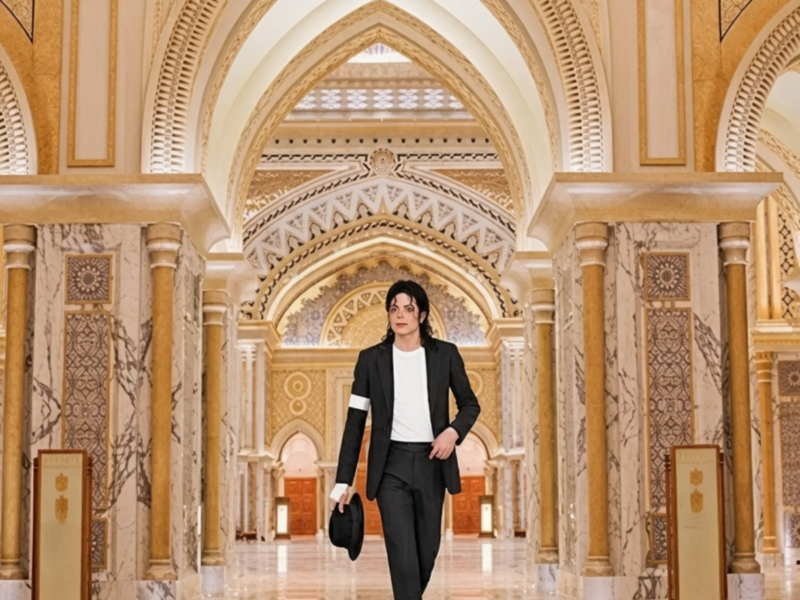
Inside Michael Jackson $1 Billion Mega Palace.
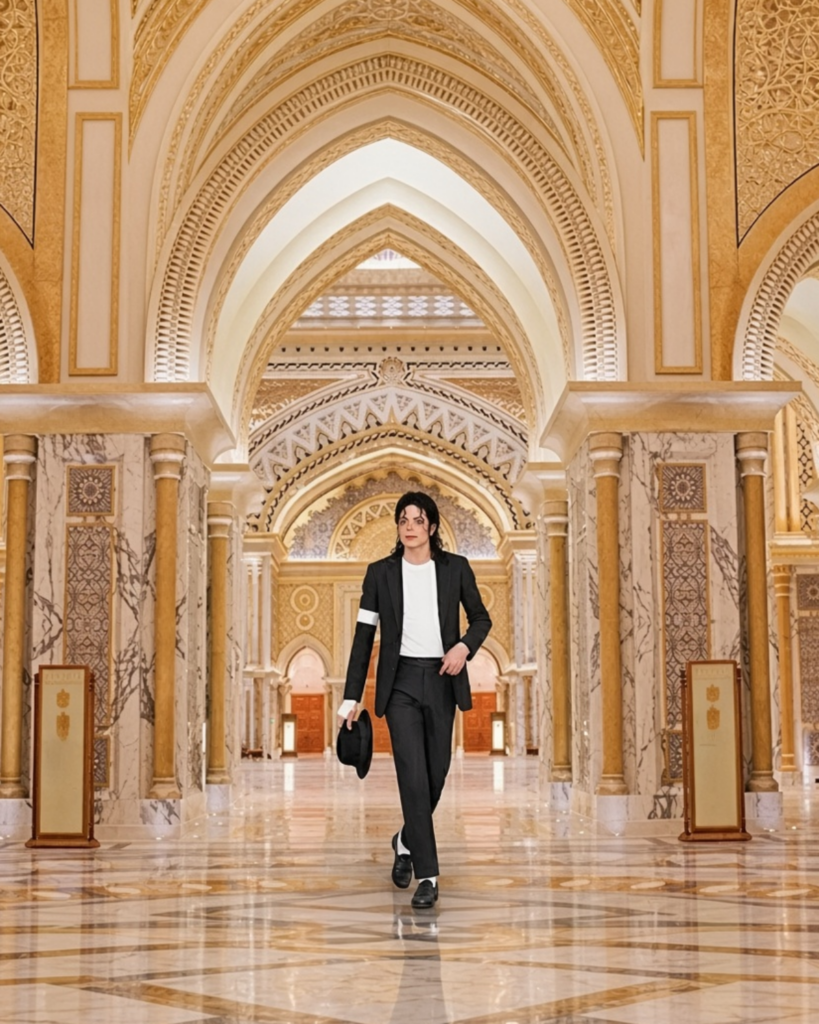
From a tiny Midwestern room to a billion-dollar fantasy world, Michael Jackson spent his life building the ultimate escapes.
Behind high walls and golden gates, the King of Pop turned his wildest childhood dreams into unbelievable reality.
But were these famous mega-mansions safe havens or golden cages?
Step inside the secret palaces that defined the life, luxury, and lonely world of the greatest entertainer on Earth.
Instead of just existing within Neverland, Michael Jackson transformed the landscape of Santa Barbara in such a way that it was completely rebuilt into a wonderland for the home.
He built a full-sized amusement park, complete with a Ferris wheel, carousel, and roller coasters.
Additionally, he built an animal kingdom with elephants, giraffes, and rare animals, along with two railroad tracks that ran on the steam engine called Katherine.
Not only did he use his private playground for leisure, but Michael Jackson was also kind enough to allow thousands of disadvantaged and ill children into the park for free.
Such elaborate structures were deliberately and expensively put in place in order to recreate the innocence of childhood that he lost by being a child star.
This massive playground cost almost $10 million annually to run.
Situated right in the middle of Neverland, the 13,000-square-foot French Normandy main house provided an impressive contrast to the exterior fantasy.
Being inherently elegant, the interior featured dark wooden paneling, the original 18th-century French parquet flooring, and a collection of fine art and bronze statues.
Hidden behind the bookshelf of the library, there was the secret room—the personal sanctuary in the already secure abode.
With the multi-level master suite, spacious wardrobes, and luxurious bathrooms, it represented the ultimate level of comfort.
Unlike the amusement park, the grandeur of which operated on the outside, this house served as the peaceful and very personal sanctuary.
For more than fifteen years, the place was used by Jackson, who tried to find normality among the gravity of international celebrity.
Unlike the showroom, this house was the real home of Neverland.
Desiring artistic solitude during his 1997 tour of Europe, Michael Jackson found himself drawn to Montreux, Switzerland, successfully balancing the difficult dual existence of luxurious fame and artistic solitude.
In contrast to staying in a secluded location, Michael Jackson decided to reside in the luxurious tower suite of the five-star Fairmont Le Montreux Palace.
In order to escape the attention of his fans that were swarming around the building and constantly staring at him, Jackson had to rely on secret underground passages, service elevators, and darkened vehicles to reach his sessions.
The place of his artistic endeavors was none other than Mountain Studios, which is legendary for being associated with the band Queen.
In this technological oasis, Michael Jackson recorded essential songs for his album Blood on the Dance Floor: History in the Mix.
The Swiss environment became a crucial component, providing an ideal mixture of luxurious comfort and professional isolation.
While the conclusion of the trial led to legal exoneration, it was the end of Michael Jackson’s connection to Neverland.
Through the invasive actions of the police officers, Michael’s personal sanctuary had been irretrievably corrupted.
Announcing that the estate no longer retained the sanctity of a domestic sanctuary, he abandoned the place for good, leaving its attractions static and silent.
Reforming himself into an evasive global wanderer, Michael took off to a series of destinations across Bahrain and Ireland, where he could find peace for his family away from environments carrying painful memories.
The frozen monument to a past era was left behind at Neverland, standing silent due to the loss of sanctuary it once represented.
Such a tragic parting signified the ultimate destruction of his sanctuary.
The former would never return to the property anymore, thus ending the era of sanctuary in the form of architecture for him.
Later that year, Michael Jackson turned to the Gulf Kingdom of Bahrain in an effort to find asylum under the patronage of Sheikh Abdullah bin Hamad Al Khalifa.
Running from intense global media attention after undergoing his trial in court, Jackson found temporary asylum in the royal villas of Bahrain, free from Western media attention.
Here was created the perfect atmosphere for physical and mental recuperation.
Free from constant public pressure, Jackson was able to spend several months parenting his three children and making music.
For an artist who had been under the pressures of performance from early childhood, this was a rare chance for simple living.
While the cultural shift brought instant relief, the island of Bahrain proved to be only a temporary asylum.
Acknowledging the fact that he was forever connected to the world of global entertainment, Jackson finally left the island, continuing his quest for peace of mind.
Situated in Gary, Indiana, within a limited 672 square feet of space, is 2300 Jackson Street, where the Jackson musical legacy was born.
Constructed in 1949 and comprising a simple two-bedroom house, the cramped space held a total of ten family members before the family moved to California in 1969.
The limited space turned the house into a breeding ground of rhythms, harmonies, and ambitions.
It was in such meager confines that young Michael Jackson spent his first eleven years of life, learning flawless vocalization and choreography, among other things.
Even though the family later moved after achieving worldwide fame, the house still retains its status as a strong historical landmark—a representation of how remarkable cultural success can arise from the most limited of beginnings.
Currently, the preserved house functions as a pilgrimage spot for fans, proving the remarkable fact that great art histories are often created in the most minimal of places.
The Jacksons’ decision to sign with Motown Records in 1969 brought about an instant transformation and necessitated their immediate move away from the harsh realities of Gary toward the sunny possibilities of Los Angeles.
Following temporary stays in hotels and Michael’s own initial exposure to celebrity life through his stay with Diana Ross in her Beverly Hills home, as well as brief rentals along Lamita Drive, the family found themselves settling into temporary accommodations at 1601 Queens Road, a luxurious Mediterranean abode situated in West Hollywood.
It must have come as a huge surprise to young Michael to move from the suffocating environs of their Midwestern bungalow to the much larger rented home, which offered some breathing space to the growing dynasty amidst all its newfound fame.
Indeed, the home served as a vital link between their modest roots and their upcoming star-making journey.
It was essentially a bridge between past and future, between who they once were and who they were meant to become.
In May 1971, the Jackson family marked their momentous transition by purchasing the sprawling two-acre Hayvenhurst Estate in Encino, California.
Much more than just a simple residence, this isolated retreat was a clear proclamation of their reign and provided all that was necessary to create their legacy.
Hayvenhurst played a key role as the critical incubator of Michael’s transformational teenage years and peak creativity during both the time of the Jackson 5 and Off the Wall fame.
Hayvenhurst had a secret wooden dance floor installed in the house, which Michael would use to hone his routines and distinctive dancing style out of sight of the recording studios.
This was achieved under the strict control of Joseph and the grounded nature of Katherine.
The property was eventually purchased from his father in the early 1980s, thus providing Michael with independence and stability.
Considered by many as the true emotional center of the Jackson family empire, Hayvenhurst became the place where Michael’s deep humanity and unparalleled talent truly met.
However, by 1982, due to the overwhelming popularity that the superstar enjoyed, an architectural revolution became necessary for his residence, and he began remodeling the building with the intention of demolishing old confines and creating something much better.
The revamped English Tudor-style mansion saw the rise of an upper floor consisting of private rooms featuring all the necessary luxuries combined with artistic freedom.
The mansion came equipped with a 32-seat movie theater, a fitness center, and a gallery where he could show his legendary awards.
Most importantly, it saw the emergence of an innovative on-site recording studio.
In such an isolated soundproof studio, Michael Jackson created the basic demos for the album Thriller, which would become the best-selling record in history.
Thus, through the renovation process, a significant metamorphosis took place, changing the common family house into an imperious fortress built exclusively for the King of Pop.
In March 1988, Michael Jackson made a revolutionary purchase in acquiring the large 2,700-acre Sycamore Valley Ranch in Santa Barbara County, paying a reported sum of between $17 million and $30 million.
Naming his new ranch Neverland Valley Ranch, Jackson called on the Peter Pan mythos of the ideal land in which one never grows up.
This wasn’t just imagination.
It was a deeply personal manifesto.
Having discovered the beautiful oak-dotted landscape in 1983 on a visit with Paul McCartney when filming their video for “Say Say Say,” Jackson felt a deep, visceral connection to the land.
More importantly, however, this purchase represented a liberating act of empowerment.
Moving beyond the familiarity of Hayvenhurst, this twenty-nine-year-old star decisively broke his dependence on the family unit.
With his life spent in the public eye and constant performing, Neverland came to represent the final expression of his freedom.
In the end, this wonderful sanctuary became the most legendary—but also most misunderstood—private retreat on the face of the earth, mirroring the mysterious nature of its solitary creator.
Upon his return to the US in late 2006, Michael Jackson moved to Las Vegas and rented a 17,000-square-foot Mediterranean-style mansion located on Monte Cristo Way for $50,000 per month.
Surrounded by towering walls on all sides, the highly secure mansion suited Jackson’s desire to create a safe environment that would allow him to make a comeback in his professional life.
Moving to Las Vegas made sense, as it was appropriate for a show-business legend who would use the city to explore the option of establishing a concert residency.
The mansion served as a center where Michael intended to make a comeback without having to travel abroad physically.
Nonetheless, Jackson’s first move to Las Vegas was marked by certain logistic problems and a highly secured environment.
In order to keep Jackson absolutely isolated from the outside world, a special underground access to his property had been arranged, along with security guards who were supposed to clear retail stores for family trips at night.
Michael Jackson found a place of refuge in the Irish countryside in County Westmeath in 2006, staying first at Coolatore House and later moving to the vicinity of Grouse Lodge Studios.
The remote and rainy Irish countryside was an excellent place for Jackson to take time out to heal emotionally and creatively.
No crowds.
No paparazzi.
Jackson had rare experiences of anonymous life.
Jackson was walking around the countryside, and his three children could play freely outdoors.
Even in his self-enforced isolation, Jackson did not stop creating, as he continued writing songs at Grouse Lodge.
The unpretentious and unprotected location was quite the opposite of luxurious Neverland.
Ireland was a crucial place of refuge where Jackson could enjoy ordinary life.
In an effort to gain a strategic base for business venture negotiations and engagements in New York City, Michael Jackson obtained unique leases of suites on upper floors in luxury hotels and buildings such as the Trump International Hotel and Tower, situated above the skyline of Manhattan.
Such a sophisticated urban home was absolutely essential to him in terms of providing sanctuary on the East Coast.
Characterized by floor-to-ceiling windows, high-security private elevators, and modern luxury design, such a leased property offered Jackson a unique balance of luxury and privacy.
It became his main staging point for meetings with other executives, musicians, and artists outside his West Coast property.
While Neverland provided him with huge geographical spread and seclusion, the Manhattan suites became the place where he could link up to the center of global culture and trade.
This private retreat became an ideal hideaway during busy media times and urban travel.
Michael Jackson’s next move came in 2007 when he moved to a magnificent 1.7-acre Mediterranean-style mansion on Palomino Lane, which earned him the nickname of “Thriller Villa.”
The lavish property comprised over 24,000 square feet of living quarters that had its own chapel, a movie theater with large capacity, and vaults below ground level that were created to house Jackson’s fine art collection.
With elaborate gold trimmings, crystal chandeliers, and red velvet, the inside of the mansion exuded royal grandeur at all times.
With elevated walls surrounding the mansion and strict security arrangements, the property turned into an impregnable fortress protecting Jackson and his three kids from any public scrutiny.
This luxurious villa provided Jackson with the needed shelter for almost two years.
It was one of the most significant steps made by Jackson toward establishing himself in the United States permanently.
With its three vast floors, thirteen bathrooms, and twelve decorative fireplaces, the chateau in Holmby Hills resembled a luxurious hotel built specifically for a giant star.
There was an atmosphere of tension in the entire house because of the preparation for the concert tour, This Is It.
The environment in the house operated as a technical and medical center.
Jackson used medical rooms on the upper floor of the house, whereas the grand wood-paneled library in the house served as a place where he held confidential meetings with the production and lawyers of the show.
Oxygen machines and lighting were installed in the personal quarters to help him recover from rehearsals in the arena late at night.
Despite all of Jackson’s efforts to add a humane touch to this sterile place by his personal books, films, and music collection, the house remained clearly a transit zone.
In December 2008, Michael Jackson moved into 100 North Carolwood Drive, a luxurious French-style chateau in the exclusive neighborhood of Holmby Hills in California.
Designed by Richard Landry, the lavish seven-bedroom house required a monthly rental of $100,000.
Apart from being a majestic building, the property served as a vital epicenter of the pop music star.
With his fifty-show This Is It residency at London’s O2 Arena coming up, the international spotlight increased and created immense psychological and physical stress.
To be closer to his practice area, he converted his private mirror-lined rooms into a dance studio and practiced intensively after the closing down of public spaces.
Though he filled the lavish home with personal relics, a family movie theater, and art of his children to create a homely environment, he could not find any comfort in his rented property, which was a sanctuary to him.
Little did he know that he was crossing the threshold of his last performance.
Buried deep inside the expansive collection that is Michael Jackson’s California archive, the appraisers found something infinitely more valuable than anything glittery: a piece of tattered paper from 1979.
A statement written by the young twenty-one-year-old about to be thrust into the limelight, this manifesto detailed a strikingly accurate prophecy for the man he would one day become.
It was no mere statement of idealistic dreams of stardom.
Rather, the document served as an uncompromising blueprint for cultural dominance.
Every carefully articulated detail of perfectionism, innovation, and unparalleled mastery of performance was to become a reality in his remarkable career, to a frightening degree of accuracy.
What frightened the archivists more than the ambitious statement was its uncanny accuracy.
It proved that the transformation of Michael Jackson was not just an occurrence, but a carefully orchestrated series of events based on a premeditated master plan.
Five massive California warehouses, totaling an amazing 20,000 square feet each, concealed a confidential archive of Michael Jackson’s enormous legacy.
Stuffed floor to ceiling, these vaults contained invaluable artifacts like his famous $80,000 glittering Billie Jean glove, Grammy Awards, arcade games, customized limousines, and the original cast-iron gate entrance signage for Neverland Ranch.
In between all these priceless entertainment artifacts were antiques, boats, and personal souvenirs such as a carved rocking horse from Elizabeth Taylor.
Evaluators reviewing the extensive collection were astounded at the sheer size and historical importance of the inventory.
Defying any financial evaluation, this remarkable collection transcended monetary assessment.
This extensive archive was more than just a collection of luxury property.
It was an invaluable physical storage facility—a tangible reminder of an unmatched empire that continues to intrigue and confound as the mystifying legacy of the King of Pop.
From tiny rooms to billion-dollar fantasy worlds, Michael Jackson built some of the most insane escapes on Earth.









