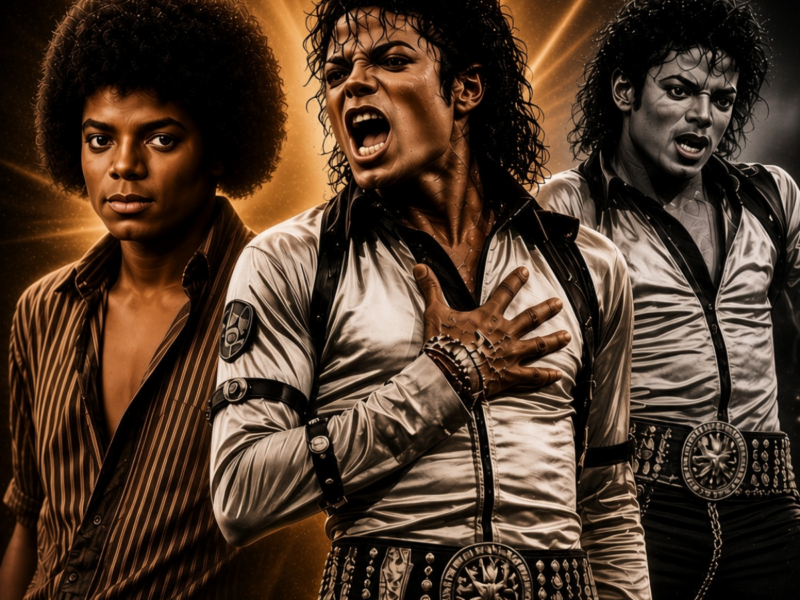
How One Song — and One Dance Move — Made Michael Jackson Immortal.
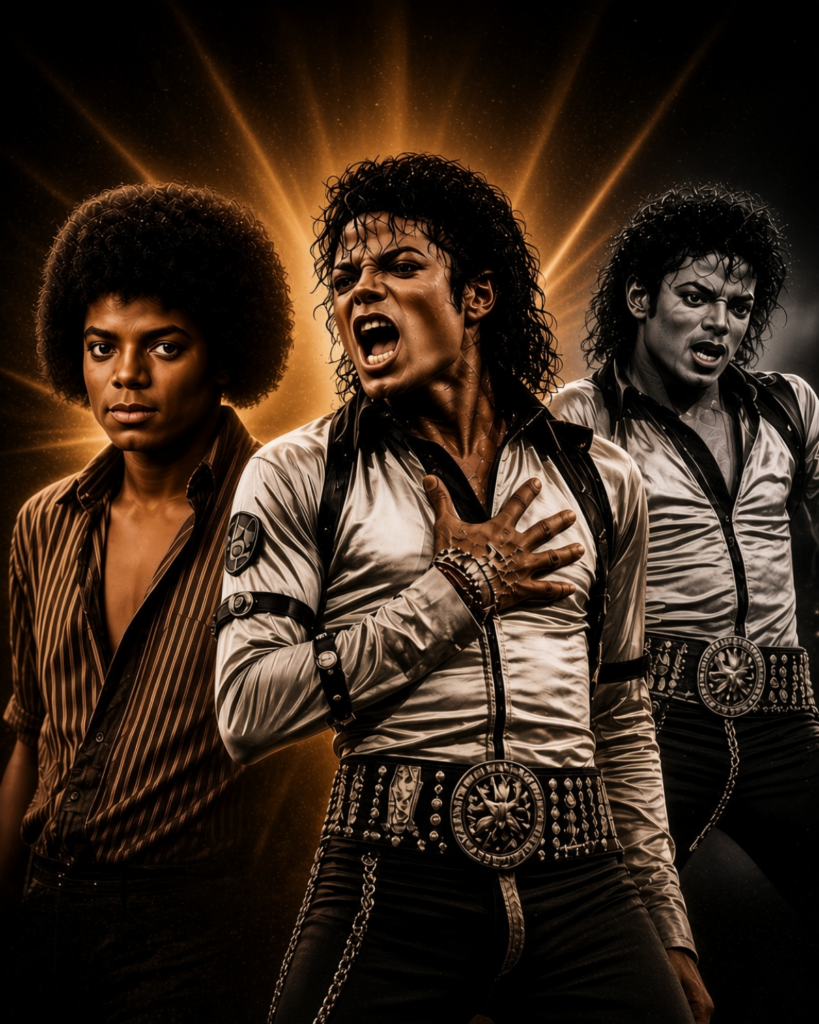
March 25th, 1983, a young man steps into a single spotlight and for four minutes, music history splits into a before and an after.
He glides backward across the stage and the laws of physics seem to bend with him.
By the time the lights come up, the world has a new name for the future of pop music, and it isn’t a name anyone expected.
Long before the world called him the King of Pop, Michael Jackson possessed a terrifying level of raw talent, an obsessive work ethic, and a hypnotic presence that shattered the limits of entertainment.
He was a once-in-a-generation force of nature who could command the attention of the entire planet with a single look or a solitary snap of his fingers.
But even for a supernatural genius, there was a specific, explosive turning point.
A moment where the performer became a myth, and the myth became immortal.
To understand the making of this cultural deity, we have to go back to where the fire was first lit, to a cramped house in Gary, Indiana, where a five-year-old boy was already singing for his life.
Michael Joseph Jackson was born on August 29th, 1958, the eighth of ten children in a working-class Black family in Gary, Indiana, a steel town just outside Chicago that offered factory work and very little else.
His father, Joseph Jackson, worked as a crane operator at a steel mill.
In his off hours, he played guitar in a local R&B band called the Falcons, a band that never quite broke through.
That disappointment, by Michael’s own later account, hardened into something else entirely, a fierce, often unforgiving determination to make sure his sons would succeed where he hadn’t.
Joseph’s discipline was strict, at times by Michael’s own description in later interviews and in his 1988 memoir Moonwalk, painfully so.
But it also produced something undeniable.
By the mid-1960s, several of the Jackson brothers were rehearsing for hours after school, sharpening harmonies, drilling choreography, competing in local talent shows around Gary and Chicago.
Here’s the detail most people miss.
Michael wasn’t even the group’s first lead singer.
That was Jermaine.
But as the brothers performed more, something became obvious to everyone in the room.
The smallest Jackson, barely out of grade school, could out-sing and out-dance performers twice his age.
In 1967, the Jackson Brothers, soon renamed the Jackson 5, won talent competitions at Chicago’s Regal Theater and the following year at the legendary Apollo Theater in Harlem.
They recorded a single called Big Boy for the small Gary-based label Steeltown Records in early 1968.
It went nowhere nationally, but it was enough to get noticed.
Later that year, the group opened for Bobby Taylor and the Vancouvers, a Motown act, at the Regal Theater in Chicago.
Taylor was floored.
He arranged for the brothers to audition at Motown’s Hitsville USA studio in Detroit.
Berry Gordy, who had initially been hesitant to sign child performers, watched the audition tape and changed his mind almost instantly.
On March 11th, 1969, the Jackson 5 officially signed with Motown Records.
Michael was ten years old.
To launch the group, Motown built a story almost as catchy as the music, that Diana Ross herself had personally discovered the Jackson 5.
It wasn’t quite true.
That credit really belonged to Bobby Taylor.
But it didn’t matter.
The label released the group’s debut album, titled simply Diana Ross Presents the Jackson 5, in December 1969.
The timing could not have been better.
Their first single, I Want You Back, wasn’t just a hit, it was a phenomenon.
Then came ABC, then The Love You Save, then I’ll Be There.
Four singles, four number-one records on the Billboard Hot 100, making the Jackson 5 the first group in American chart history to send their first four singles straight to the top.
At the center of it all was an eleven-year-old boy with a voice that sounded like it belonged to someone twice his age and a stage presence that even seasoned Motown veterans found startling.
The Jackson 5 became more than a band.
They became a cultural event.
A Saturday morning cartoon, a string of Ed Sullivan Show appearances, a poster on the wall of nearly every American kid’s bedroom.
Michael, still a child, was already carrying a level of fame that most adult performers never reach in a lifetime.
But behind the matching outfits and the synchronized choreography, the group was approaching a problem no amount of rehearsal could fix.
Puberty.
As Michael’s voice began to change and the brothers got older, Motown’s hitmaking formula, built for the sound of children, started to strain.
And just as that tension was building, a much bigger one was forming behind the scenes.
The Jackson 5 were Motown’s brightest stars.
So why were they about to walk away from the only label they’d ever known?
By the mid-1970s, the cracks were impossible to ignore.
The Jackson family felt Motown wasn’t giving the brothers creative control.
They weren’t allowed to write or produce their own material, and royalty terms had become a constant source of friction.
In 1975, the Jackson brothers made the leap.
They left Motown for Epic Records, a division of CBS.
It was a risk.
Motown owned the name Jackson 5.
So the group had to rebrand entirely.
They became simply the Jacksons.
Jermaine, married to Berry Gordy’s daughter, chose to stay behind at Motown and was replaced by younger brother Randy.
For Michael personally, the Epic years opened a door that had never existed for him before.
The chance to write, to produce, to have a real hand in shaping his own sound, both with his brothers and increasingly on his own.
Then in 1977 came an unexpected detour, a film role.
Michael was cast as the Scarecrow in The Wiz, a big-budget musical retelling of The Wizard of Oz starring Diana Ross.
The film itself underperformed at the box office, but it gave Michael something far more valuable than ticket sales.
On that set, he met the film’s musical supervisor, a veteran producer, composer, and arranger named Quincy Jones.
The two clicked immediately.
Jones agreed to produce Michael’s next solo album.
Nobody, including Jones himself, fully understood yet what that partnership was about to unleash.
Released on August 10th, 1979, Off the Wall arrived just before Michael’s twenty-first birthday.
And it didn’t just succeed, it rewrote the rules.
It became the first solo album in history to generate four top-ten singles on the Billboard Hot 100, including two number-one hits in Don’t Stop ‘Til You Get Enough and Rock with You.
It went on to sell more than twenty million copies worldwide and became, for a time, the bestselling album ever released by a Black artist.
And yet at the 1980 Grammy Awards, Off the Wall was shut out of the major categories.
Michael won only one award that night, Best Male R&B Vocal Performance, a category many in the industry considered a consolation prize for an album that critics and fans alike were calling one of the best of the decade.
Michael later said the snub devastated him.
Friends and biographers have described it as a turning point.
The moment he privately resolved that his next album would be so undeniable, so massive, that it could not be overlooked or boxed into a single category ever again.
He had already proven he could make hits.
Now he wanted to make history.
Recording sessions for what would become Michael’s sixth solo album began in April 1982 at Westlake Recording Studios in Los Angeles, with Quincy Jones producing and a budget of roughly seven hundred fifty thousand dollars.
Substantial for the era, but nothing close to what later albums would command.
The album was Thriller, and tucked among its nine tracks was a song with a moody bass line and an unusually personal backstory.
Michael wrote Billie Jean entirely on his own.
Music, lyrics, arrangement, working for weeks in his home studio in Encino.
By several accounts, he spent nearly three weeks on the bass line alone before he was satisfied with it.
The inspiration traced back to the Jackson 5 touring years.
Michael and his brothers had grown used to a particular kind of fan.
Women who lingered outside stage doors, who wrote letters, who sometimes claimed a far deeper connection to the brothers than actually existed.
Among themselves, the brothers had a private, half-joking shorthand for these women.
They called them Billie Jean.
But there was something heavier underneath the song, too.
According to Michael’s longtime biographer J. Randy Taraborrelli, in 1981, Jackson began receiving disturbing letters from a woman who insisted he had fathered one of her twins, a woman he had never met.
The letters didn’t stop.
Eventually, according to the same account, a package arrived containing a photograph, a gun, and an instruction for a kind of shared fatal pact.
It rattled him badly enough to cause nightmares.
Michael always denied the song was about one specific person.
In his 1988 memoir, he wrote plainly, There never was a real Billie Jean.
The girl in the song is a composite of people my brothers have been plagued with over the years.
Whatever the exact balance between the literal and the imagined, the emotional charge in the song was real.
A song about fame’s strange, sometimes frightening cost, dressed up as a slinky dance track.
When Michael played an early version for Quincy Jones, Jones wasn’t sold.
He didn’t love the title.
He worried audiences would think of tennis star Billie Jean King.
He wanted to retitle it Not My Lover.
He also wanted to trim Jackson’s extended instrumental introduction, which ran nearly thirty seconds long, even by the standards of the day.
Michael pushed back on both counts.
He kept the title.
He kept the intro.
Quincy Jones had already produced more hit records than almost anyone alive, and he was about to be proven wrong by a twenty-three-year-old who simply knew in his gut that he’d written something undeniable.
To bring Billie Jean to life, the team assembled some of the best session musicians in Los Angeles.
Bassist Louis Johnson of the funk duo the Brothers Johnson was brought in to play the part Michael had spent weeks composing.
Johnson reportedly tried nearly every bass guitar he owned in the studio before settling on a Yamaha, chasing the exact tone Michael had heard in his head.
On drums sat Leon Ndugu Chancler, layering a live kick and snare over a foundation Michael had already sketched on a Roland TR-808 drum machine, blending machine precision with human groove years before that combination became a pop standard.
The real architect of the song’s sound, though, was engineer Bruce Swedien.
Producer Quincy Jones gave him a strange, almost impossible brief.
Build a drum sound with what Jones called sonic personality.
Something so distinct that listeners could identify the song from its first three or four beats alone, before a single lyric played.
Swedien’s solution was almost theatrical in its precision.
He built a custom platform for the drum kit.
He stuffed cinder blocks inside the bass drum to deaden it, then fitted a special cover and threaded a microphone through a slit.
He wedged a flat piece of wood between the snare and the hi-hat mic to stop the sounds from bleeding into each other.
For Michael’s vocal, Swedien had him sing through a six-foot cardboard tube to shape the tone, and the final lead vocal performance, take after take of rehearsal behind it, was recorded in a single take.
Then came the mixing, and one of the strangest stories in pop production history.
Swedien typically mixed a song once.
For Billie Jean, he mixed it ninety-one times.
Each pass theoretically refining the balance further.
But somewhere along the way, the mixes actually started getting worse, not better.
Jones made the call to go back, all the way back to the second mix, the one made almost at the very start of the process.
That second mix is the Billie Jean the entire world would come to know.
By the time the song was finished, almost no one outside the studio had heard it.
Quincy Jones still had his doubts.
Nobody, not Jones, not the record label, not even Michael himself, could have predicted what was about to happen next.
Thriller was released on November 30th, 1982.
Its first single, The Girl Is Mine, a duet with Paul McCartney, performed respectably but unremarkably.
Then on January 2nd, 1983, Epic released Billie Jean as the second single.
It didn’t just hit, it detonated.
The song climbed to number one on the Billboard Hot 100 and stayed there for seven weeks.
Jackson’s fastest-rising single since his Jackson 5 days.
Behind the scenes, though, one major obstacle remained.
Getting the song’s striking new music video, directed by Steve Barron, onto the one channel that mattered most for visibility, MTV.
According to multiple accounts later compiled by industry journalists, MTV programmers initially balked, believing the song didn’t fit the network’s rock-oriented format, and that at the time, no Black artist had yet appeared in regular rotation on the channel.
CBS Records president Walter Yetnikoff was reportedly furious, threatening to pull every CBS artist’s video off the network and, by some accounts, to publicly accuse MTV of racial bias unless they aired it.
MTV executives at the time disputed that race played any role in the decision.
Whatever the precise mix of pressure and persuasion, the video began airing on March 10th, 1983, and the floodgates opened.
MTV’s ratings climbed.
Thriller sales climbed faster.
But the song’s true coronation hadn’t happened yet.
It was about to happen live in front of the entire country.
In early 1983, Motown’s longtime executive Suzanne de Passe pitched a network special to celebrate the label’s twenty-fifth anniversary, a reunion of Motown’s greatest acts taped for NBC.
Michael agreed to reunite with his brothers for a medley of Jackson 5 classics, the first time the original lineup had shared a stage since 1975.
But Michael wanted something more.
He pushed producers to let him also perform a solo number.
Something brand new, never performed live before.
Billie Jean.
Producer Don Mischer worried about the politics of it.
If Michael got to debut a new song, what would he say to Marvin Gaye or any other legend on the bill who didn’t get the same privilege?
Then Mischer watched Michael’s near-empty rehearsal.
The hat, the sequin jacket, the single rhinestone glove, the white socks.
And near the song’s instrumental break, a backward glide that didn’t look like anything Mischer had ever seen on stage.
The argument was over before it started.
In preparing the routine, Michael had quietly reached out to street dancers Cooley and Casper, two performers credited as originators of a popping move called the backslide.
For roughly a week, they worked privately with him on the mechanics of the move.
By his own account in Moonwalk, Michael didn’t fully lock in the choreography until the night before the taping.
He simply let the music play and let the movement find itself.
On March 25th, 1983, in front of a live audience at the Pasadena Civic Auditorium, Michael Jackson performed Billie Jean alone under a single spotlight.
He spun, he posed, he hit a toe stand, and during the instrumental break, he slid backward across the stage in a move the world had simply never had a name for.
When the special aired on NBC on May 16th, 1983, an estimated forty-seven million viewers watched it happen.
Almost overnight, the backslide became the moonwalk, a name the media coined, not Michael himself.
Famously, Michael wasn’t satisfied with his own performance.
He told Oprah Winfrey years later that he went backstage afterward and cried, certain he’d underperformed, until a young boy stopped him outside and told him it was the most amazing thing he’d ever seen.
For the first time, Michael said, I thought I did a good job, because children don’t lie.
The day after the broadcast, dance legend Fred Astaire personally called Michael to tell him how much he admired the performance, a moment Michael later called one of the proudest of his life.
The cultural shockwave was immediate.
Thriller, already a hit, became something else entirely, eventually spending thirty-seven non-consecutive weeks at number one on the Billboard 200, a modern-era record.
A song born from anxious letters and late nightmares had just become the most talked-about four minutes on American television.
And the man who wrote it was no longer just a pop star.
He was becoming a legend.
The momentum from that single performance carried Thriller to heights no album had ever reached.
By the end of 1983, it had sold over thirty-two million copies.
It would go on to be certified the bestselling album in American recording history at the time and remains, by most global estimates, the bestselling album in the world.
Then came February 28th, 1984, the night the Grammy Awards turned into a coronation.
Michael Jackson walked in with a record twelve nominations and walked out with eight wins, including Album of the Year, Record of the Year for Beat It, and Producer of the Year, shared with Quincy Jones.
No artist had ever won eight Grammys in a single night.
The broadcast itself drew over fifty-one million viewers, still decades later one of the most-watched Grammy telecasts ever aired.
This was the artist who, four years earlier, had been handed a single lesser award for an album many critics considered one of the best of its decade.
Now he stood, arms full of trophies, as the undisputed biggest star on the planet.
What made the moment more than just a commercial triumph was what it represented.
Billie Jean and its MTV breakthrough helped dismantle one of the music industry’s most rigid unspoken color lines, opening the door for a wave of Black artists, from Prince to Lionel Richie, to gain meaningful access to MTV’s massive audience in the years that followed.
Michael Jackson hadn’t just become famous.
He had become a force that reshaped the industry around him.
And the moonwalk was the single image the entire world would use to mark the moment it happened.
More than four decades later, Billie Jean still functions the way it did in 1983, as a kind of cultural shorthand for the exact moment an artist becomes untouchable.
The bass line Michael spent three weeks perfecting in his home studio remains one of the most sampled, studied, and instantly recognizable rhythm sections in pop history.
Musicians from Flea of the Red Hot Chili Peppers to generations of producers have pointed to it as a masterclass in doing more with less.
The moonwalk itself outlived the song that introduced it.
It became shorthand for Jackson’s entire career, the title of his 1988 autobiography, and a move studied and imitated by dancers who weren’t even born when he first performed it.
Documentaries on Quincy Jones’s career and Michael’s broader catalog keep circling back to the same conclusion.
Billie Jean wasn’t just another hit on an extraordinary album.
It was the hinge point.
Before it, Michael Jackson was an enormously talented former child star trying to prove he could carry an album on his own.
After it, he was something the music industry didn’t yet have a category for.
That’s the real reason this song still matters.
Not just because it was catchy, or because the dance move was iconic, but because it captured in real time the precise instant an artist’s private anxieties, late-night studio obsessions, and years of preparation collided with a single televised performance, and the world simply couldn’t look away.
In the end, Billie Jean was never really about a woman who may or may not have existed.
It was about everything that comes crashing toward a person the moment the whole world decides to watch them.
Michael Jackson wrote it from nightmares, built it from three weeks of obsession over a single bass line, and then, in four unscripted minutes on stage, turned it into the moment he stopped being merely famous and became legendary.
The nightmares faded.
The letters stopped.
But the bass line and the image of a man gliding backward into history never did.









