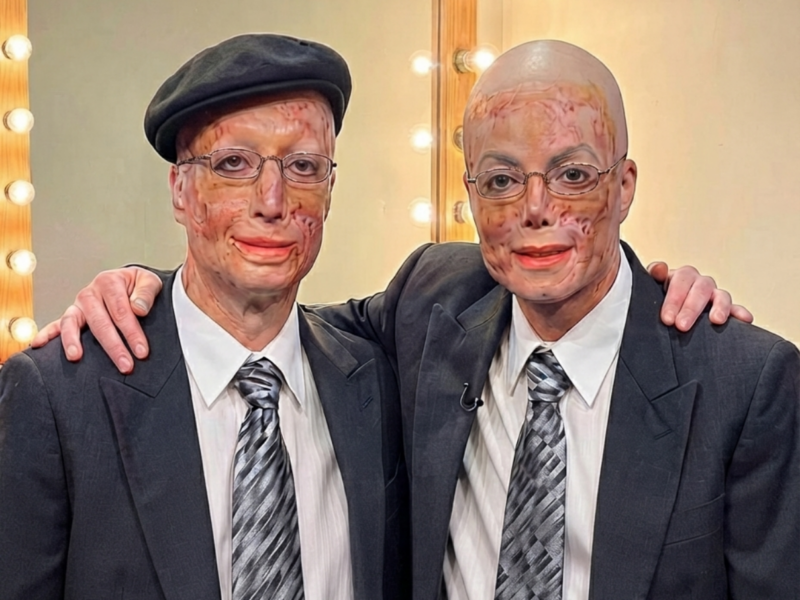
How Did Michael Jackson Disguise Himself as Dave Dave?
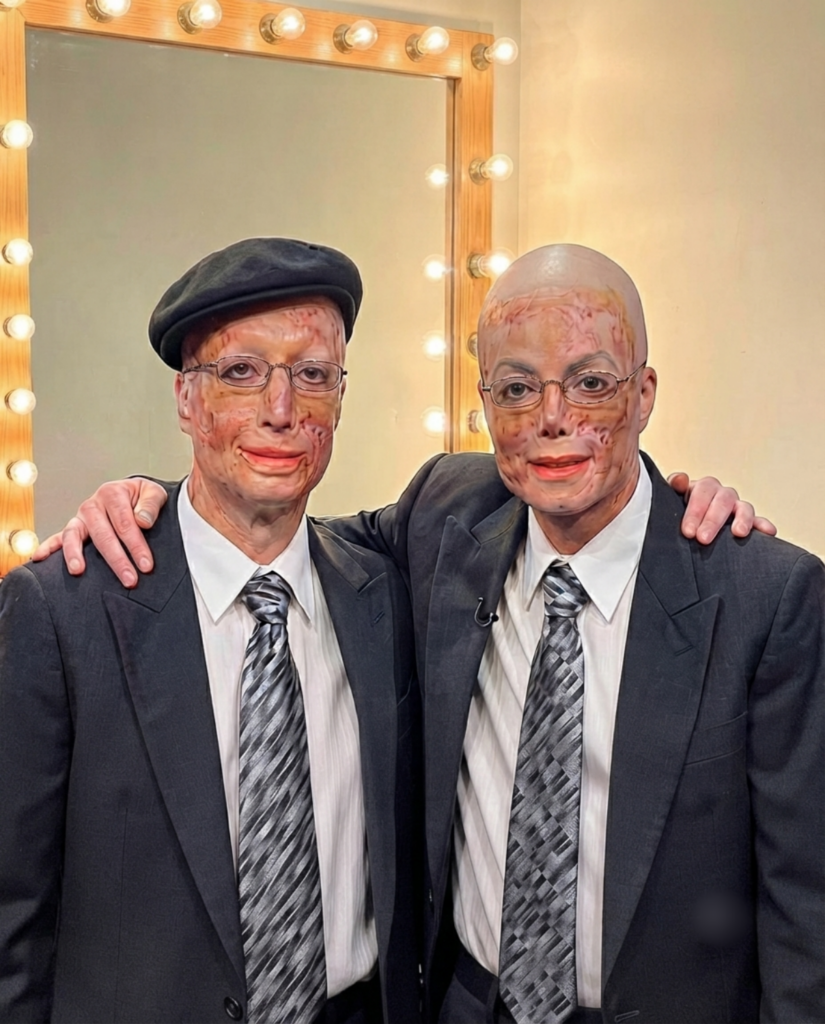
September 3rd, 2009.
The world had already spent ten weeks in mourning. Michael Jackson had been dead since June. His memorial at the Staples Center was already a piece of history, watched by hundreds of millions.
But on this specific afternoon, as Jackson’s casket was finally lowered into the ground at Forest Lawn Memorial Park, something strange happened on live national television.
A man stepped in front of the cameras on *Larry King Live* to pay tribute to his friend.
His face was heavily scarred. His voice was raspy, halting—unlike anything viewers had heard before.
His name was Dave Dave.
Within hours, the internet did not see a grieving friend. It saw a mystery.
Message boards lit up. Clips spread across early social media. And a theory took hold that refused to die.
Michael Jackson had never died at all. And the burned, hooded man on television was Jackson himself in disguise.
Before we move on, we want to spotlight a comment from our video. Now, after seeing today’s video, do you think the Dave Dave theory was believable at first? Tell us what you think in the comments, and one comment could be highlighted in our next video.
With that said, let’s get back to the story.
The truth is far stranger than the rumor—and far more human.
Behind the theory was a real person: a six-year-old boy named David Rothenberg, who survived one of the most horrific acts of parental violence in American memory, and a friendship with the King of Pop that saved his life in ways the tabloids never fully understood.
Long before he was a viral mystery, he was a burned survivor rebuilding a childhood taken from him in a single monstrous act.
This is the story of two narratives colliding head-on. One, a genuine tale of survival, resilience, and quiet compassion between two wounded souls. The other, one of the internet’s most persistent—and, to those who actually knew Dave, most painful—conspiracy theories.
Both begin on the same day. Only one of them is true.
David Charles Rothenberg was born on June 18th, 1976, into a family already fracturing.
His parents, Charles and Marie Rothenberg, had divorced, and David lived with his mother in the Carroll Gardens neighborhood of Brooklyn, New York.
Custody battles like theirs rarely make headlines. This one would—for the worst possible reason.
In March of 1983, Charles took his six-year-old son on what he promised would be a dream trip to California, full of theme parks and adventure.
Instead, on the evening of March 3rd, after a bitter phone argument with Marie over custody, Charles checked the two of them into a motel room in Buena Park, just miles from Disneyland.
He gave David a sleeping pill.
Once the boy was unconscious, Charles poured kerosene across the bed, set it ablaze, and walked out of the room.
He crossed the street to a pay phone and watched the motel burn from a distance, later claiming he had intended to die alongside his son.
Other guests at the motel heard the commotion and pulled David from the flames, saving his life in the process.
What they found was almost unimaginable. A small boy burned over 90% of his body. Third-degree burns covering nearly everything but the soles of his feet.
He was rushed into emergency care, beginning what would become one of the longest and most agonizing recoveries a child has ever endured—including the eventual amputation of several fingers and toes, and more than 100 separate skin graft surgeries over the following years.
During one operation, David’s brain swelled dangerously, triggering seizures that nearly killed him a second time.
The case became a national sensation almost overnight. Newspapers across the country ran David’s story, horrified by the cruelty of it and captivated by his will to survive.
His mother, Marie, refused to let her son fade into anonymity or shame. She stayed at his bedside through years of surgeries and later wrote a book about their ordeal, which was adapted into the 1988 ABC television movie *David*, introducing his story to millions of Americans who had never heard his name.
Charles Rothenberg, meanwhile, was convicted of attempted murder and sentenced to thirteen years—the maximum the law allowed at the time. A sentence so widely seen as inadequate that it helped push lawmakers to toughen future guidelines for crimes against children.
He would ultimately serve less than seven years before his release. And rather than reforming, he went on to accumulate a long criminal record, eventually receiving a twenty-five-years-to-life sentence in 2007 for unrelated offenses.
Justice, in other words, came late and incomplete.
For young David, meanwhile, the real story was only beginning.
Fame arrived not through achievement but through tragedy, and it came with a price. Strangers stared. Children recoiled. Cameras followed a boy who simply wanted to heal.
Doctors warned that his recovery would be lifelong—a process measured not in months but in decades.
What he needed most was not sympathy from strangers, but a place where he could simply be a child again.
That place, and that friendship, was about to find him.
Michael Jackson was, by 1983, already the most famous entertainer on the planet—fresh off the release of *Thriller* and living a life almost entirely removed from ordinary experience.
But when he saw coverage of David Rothenberg’s story on the news, something in it stopped him cold.
Here was a child who had endured unimaginable pain, who had been stared at and pitied by the entire country, and who was still somehow fighting to be seen as more than his scars.
Jackson, who had spoken openly for years about feeling robbed of a normal childhood himself, saw something of his own isolation reflected back at him.
Rather than issue a public statement or send a donation through a publicist, Jackson reached out privately.
In December of 1983, seven-year-old David met Michael Jackson for the first time—and the meeting sparked what would become a genuine, lasting friendship rather than a celebrity photo opportunity.
Jackson began inviting David to Neverland Ranch, the sprawling estate in Santa Barbara County that Jackson had built, in part, as a refuge from a world that could not stop looking at him.
For David, Neverland offered something he could find almost nowhere else: a place where the rides, the animals, and the wide-open grounds mattered more than the shape of his face.
Away from cameras and headlines, Jackson quietly took on a role few people knew about for years.
He helped arrange and fund extensive reconstructive surgeries for David, easing a financial burden that could easily have overwhelmed the Rothenberg family—and he did so without press releases or public credit.
Friends and family members who witnessed the relationship up close described Jackson as attentive and consistent, checking in on David’s recovery long after the news cameras had moved on to other stories.
It was not charity performed for an audience. It was one wounded, hyper-scrutinized human being extending real, sustained care to another, at exactly the age when David needed it most.
The friendship endured well beyond David’s childhood, stretching across decades and surviving Jackson’s own turbulent, headline-dominated life.
Photographs of the two together—taken quietly and rarely publicized—would later surface, spanning from the 1980s into the 2000s, evidence of a bond far deeper than a single well-publicized visit.
For David, Neverland was never about the rides or the exotic animals that fascinated the tabloids. It was about being somewhere his scars were part of him rather than the entire conversation.
Somewhere an adult he trusted treated him as a person with a future, rather than a case study in tragedy.
For Jackson, the friendship seems to have offered something rarer still: a relationship uncomplicated by fame, built on mutual recognition of what it felt like to be watched, judged, and reduced to a single image by a public that thought it already knew the whole story.
Both had lost the ordinary anonymity most people take for granted before they were old enough to understand what they were losing.
That quiet, shared understanding became the true foundation of their bond—one that would eventually place David Rothenberg at the center of one of the strangest chapters in Michael Jackson’s posthumous legacy.
As David grew into adulthood, he made a decision that spoke louder than any interview ever could.
He legally changed his name.
The boy the newspapers had christened “David Rothenberg, burn victim” no longer wanted to carry a surname tied permanently to the worst day of his life. He became known publicly as Dave Dave—and at various points in his adult life, he also went by David Jordan Robinson, a deliberate act of reinvention that let him step outside the identity the press had assigned him decades earlier.
It was not an erasure of his history. It was a refusal to let that history be the only chapter anyone ever read.
He pursued formal training in the arts, studying at the Art Center College of Design, and went on to build a career as a conceptual artist and painter, eventually settling in Las Vegas—a city built on reinvention itself.
His work reflected a mind shaped by both trauma and resilience, exploring identity and perception in ways that moved past the tabloid framing that had defined him since childhood.
He did not shy from creative ambition. Despite the physical challenges his injuries presented, the same hands that had undergone amputations and countless grafts learned to paint, design, and build.
Those who knew him in Las Vegas described a man determined to define himself on his own terms, refusing pity while still speaking candidly, when he chose to, about what he had survived.
He once told the *Las Vegas Review-Journal* that the things that happen in a person’s life do not have to define who they are as a human being. Instead, he said, they can make a person stronger.
Despite the finger and toe amputations he had endured as a child, Dave lived largely on his own terms, navigating daily life in a body that required constant adaptation.
And friends noted he seemed almost allergic to being framed solely as a survivor of violence.
This chapter of reinvention mattered enormously to how the rest of his story would later be misread.
The man who eventually appeared on national television to honor Michael Jackson was not some mysterious figure emerging from nowhere. He was an established artist with a documented public and creative life stretching back years—one who had spent his adulthood deliberately building an identity distinct from the six-year-old burn victim splashed across newspapers in 1983.
That distinction would matter a great deal once the conspiracy theories began.
September 3rd, 2009.
Michael Jackson’s memorial service had already taken place weeks earlier at the Staples Center, but this was the day his body was finally laid to rest at Forest Lawn Memorial Park in Glendale.
It was a day already thick with grief and spectacle.
And into that atmosphere stepped Dave Dave, appearing on *Larry King Live* to honor the friend who had shaped so much of his life.
He wore a garment that obscured much of his scarred face, and his voice—altered permanently by decades-old burn injuries—carried a distinctive rasp that many viewers had simply never heard before.
For an audience grieving a death many still found hard to accept, the appearance landed like a spark on dry brush.
Online forums and early social media platforms—still relatively new territory for viral rumors in 2009—seized on the moment almost instantly.
Commenters pointed to Dave’s voice cadence, insisting it echoed Jackson’s own speech patterns. Others zeroed in on the visible portion of his eyes, claiming the shape looked eerily familiar. Still others focused on posture and the general structure of his face, building an entire case out of fragments of a heavily obscured appearance.
The theory that emerged was audacious, even by conspiracy theory standards.
That Michael Jackson had faked his own death, orchestrating one final, elaborate act of stagecraft—and that he had chosen this exact moment, the day of his own burial, to appear to the public one last time in disguise as Dave Dave.
It ignored the years of documented history between the two men, treating a lifelong friendship as though it were simply a costume Jackson had invented for a single television segment.
Clips of the interview spread rapidly, stripped of context, shared and re-shared by users who had no idea who Dave Dave actually was or what he had actually survived.
What began as a strange coincidence of timing hardened, for a dedicated corner of the internet, into an article of faith—one that has resurfaced repeatedly in the years since, each time old footage recirculates on a new platform.
Part of what fueled the theory was simple unfamiliarity.
Most viewers had never seen Dave Dave before that night. They had no context for his childhood, no memory of the 1988 television movie about his ordeal, no awareness of the friendship that had quietly existed between him and Jackson since 1983.
Without that history, a scarred, hooded man speaking through a damaged voice seemed less like a burn survivor honoring a friend and more like a puzzle to be solved.
The less an audience knew about David Rothenberg’s real life, the easier it became to project an entirely different identity onto him.
It did not help that Jackson’s death had already generated a swirl of speculation—from questions about his physician’s role to rumors about his finances and final tour.
Into that atmosphere of disbelief, Dave’s raw, obscured appearance offered exactly the kind of ambiguous visual evidence conspiracy theories thrive on.
The theory would go on to survive far longer than most internet rumors of its era, resurfacing in edited clips on TikTok and YouTube Shorts more than a decade later, introducing an entirely new generation to the claim without ever introducing them to the real man behind it.
Stripped of viral editing and viewed against the actual historical record, the theory collapses almost immediately.
The relationship between Michael Jackson and Dave Dave was not a single television appearance invented for effect. It was a documented friendship stretching back to 1983, supported by decades of medical history, public records, and photographic evidence that predates the entire conspiracy by more than twenty-five years.
Photographs of the two together exist from throughout the 1980s, 1990s, and 2000s—long before anyone imagined a reason to fabricate a connection between them.
David Rothenberg’s hospitalization, his surgeries, his court case against his father, and his mother’s book and subsequent television movie were all covered extensively by mainstream news outlets years before Jackson’s death, leaving a public paper trail that a last-minute disguise could never have created retroactively.
Medical and biographical records confirm that Dave Dave’s distinctive voice and appearance were the direct, well-documented result of the 1983 burns and the more than 100 surgeries that followed—not the product of makeup or prosthetics applied for a single broadcast.
Researchers and journalists who examined the claim repeatedly found no credible evidence connecting Dave Dave’s identity to Jackson’s, beyond surface-level, subjective visual impressions drawn from a brief, low-quality clip.
Fans who had actually followed Jackson’s life closely—including those who had met Dave Dave in person over the years—pushed back forcefully against the theory, pointing out how easily it erased a real person’s entire lived history.
That pushback mattered, because the theory was not simply a harmless internet curiosity.
It required treating an actual burn survivor—a man who had endured childhood trauma most people cannot fathom—as nothing more than a costume for a celebrity hoax.
Advocates for burn survivors and disability communities noted how the rumor reduced Dave’s visible scars and altered speech, both permanent markers of real suffering, into props in someone else’s story.
For those who understood the facts, the theory was not just false. It was a quiet act of erasure against a man who had spent his entire adult life fighting to be seen as himself.
Interviews conducted with Dave Dave both before and after 2009 further undercut the claim, showing consistent biographical details, a stable career as an artist, and a life fully independent of Michael Jackson’s schedule and whereabouts throughout the years the two were supposedly indistinguishable.
Journalists who later revisited the case—particularly after the theory resurfaced in viral clips more than a decade later—pointed to the same conclusion: no credible evidence, medical, photographic, or testimonial, ever supported the claim, and every piece of documentation pointed toward two entirely separate men who happened to share a rare and genuine bond.
Ultimately, the debunking was less about winning an argument online and more about restoring dignity to a story that deserved to be told accurately.
David Rothenberg had already survived being set on fire by his own father. He should not have also had to survive being erased from his own biography by strangers online who preferred a more sensational version of events than the painful, remarkable truth.
In the years following the *Larry King* appearance and the conspiracy theory it spawned, Dave Dave continued building his life in Las Vegas, largely out of the spotlight that had periodically found him since childhood.
He kept working as an artist, remained connected to the small circle of people who had known both him and Michael Jackson personally, and continued to speak, when asked, about the friendship that had shaped so much of who he became.
Those who crossed paths with him in his final years described someone who had made peace with an unusual life—one built from tragedy but never confined by it.
He avoided the trap of becoming a professional survivor, someone whose entire public identity revolved around retelling a single horrific night. Instead, his art and his day-to-day independence spoke for him.
What deserves to be remembered instead is simpler and more human.
Two people who each knew, in their own way, what it meant to live entirely exposed to public judgment found something real in each other.
One offered shelter behind Neverland’s gates and the quiet cost of surgeries never publicized.
The other offered friendship, honesty, and eventually—on the hardest day of all—a final public tribute that the world mistook for a magic trick.
Behind every outlandish headline was simply a man honoring the friend who had helped save his life.









