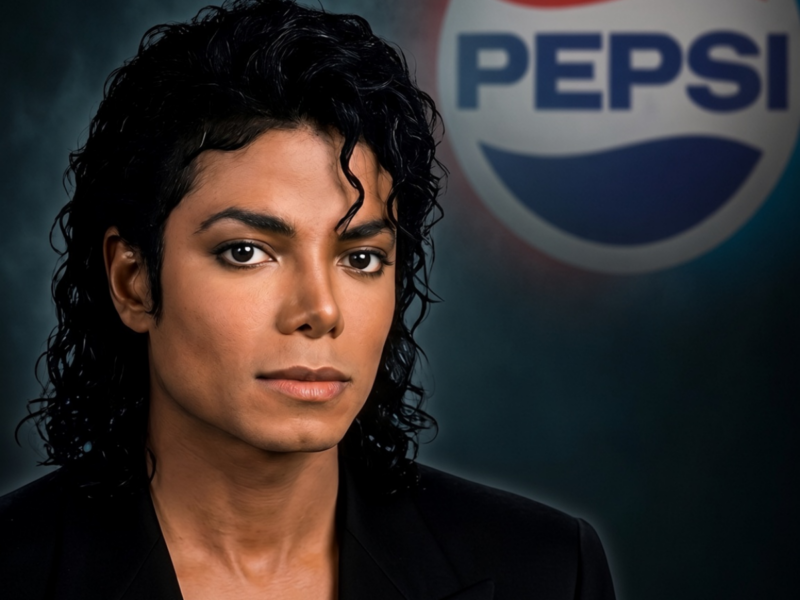
How A Pepsi Commercial Started Michael Jackson’s Addiction. That was Nasty…
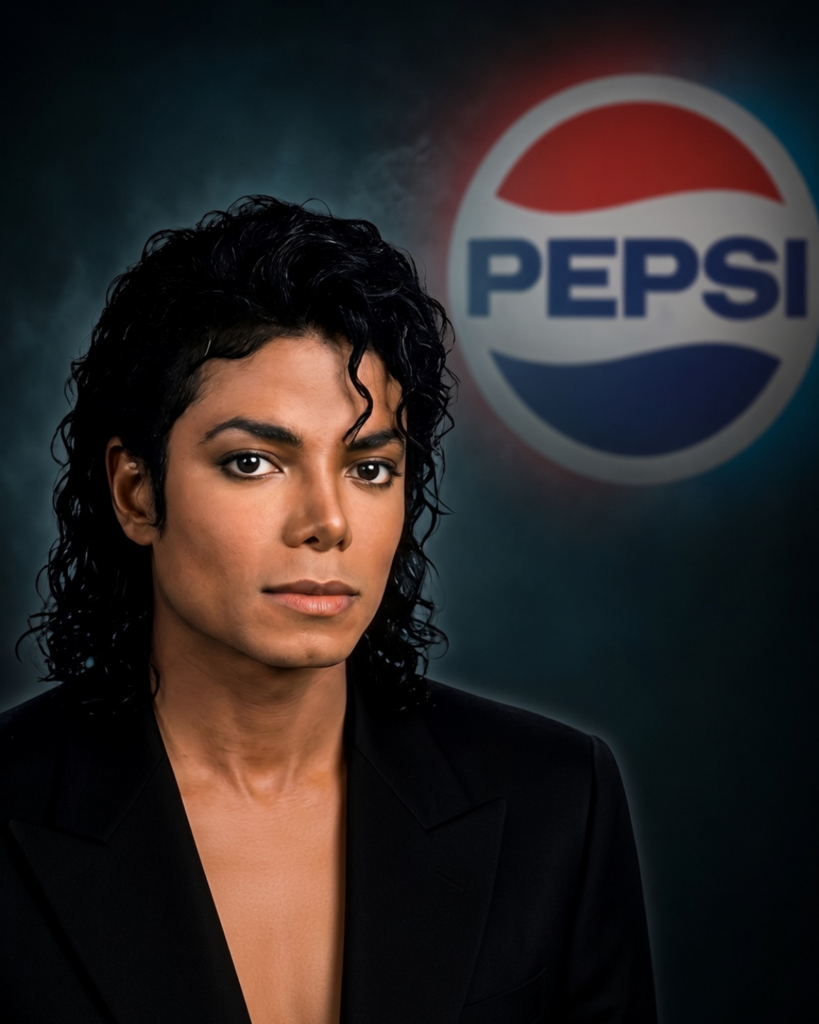
Here’s a number for you.
Two feet.
That’s how close Michael Jackson said the flashbombs were to his head on the night of January 27th, 1984.
Two feet on each side.
Thousands of fans were there.
His hair caught fire and he kept dancing until people on the set tackled him to put it out.
Pepsi settled out of court and Michael donated the $1.5 million settlement to Brotman Medical Center.
That’s the part many of us remember.
But there’s a second part that most people forget.
Nine years later, Michael himself said the habit took hold after that burn when he explained why he was canceling the rest of a world tour.
So, what did he say?
What does a friend who was on that set say, and where did it lead?
Let’s rewind to the fall of 1983.
The Jacksons sign with PepsiCo.
The reported price tag, $5 million.
Five million for a soda commercial.
Back then, that was the kind of number that made other stars stop mid-sentence.
Pepsi gets the biggest family in pop.
The family gets a fortune.
Everybody shakes hands.
Everybody smiles for the photographers.
Nobody is thinking about fire.
And why would they?
This is the safest bet in advertising.
Put the Jacksons in front of a camera, add some music, and watch the product fly off the shelves.
Can’t lose.
Quick pause before we go on.
If you’re enjoying this one, hit subscribe because there’s a lot more of the Jackson story still to come.
Now, the commercial is being filmed at the Shrine Auditorium in Los Angeles.
This is not a quiet sound stage with a few crew members drinking coffee.
There are thousands of fans in the building.
A real crowd, real noise, and a pyrotechnics display built to make the whole thing look enormous.
And remember what’s on the line here.
That fall, the Jacksons had signed a reported $5 million deal.
And the whole point of this shoot was to deliver the footage that justified it.
So, nobody is hunting for reasons to slow down.
Pepsi wants the shot.
The crowd wants a show.
And the star in the middle of it all wants to give them both.
That’s a lot of people leaning in the same direction.
And it’s exactly the kind of room where one take too many gets made without anyone really deciding it.
That’s how these shoots work.
You do it once, then you do it again, then you keep going until everybody gets what they want from the footage.
By the time they get to the sixth take, the routine feels familiar.
The fans know the moment.
The crew knows the moment.
Michael certainly knows the moment.
Take six.
And this time, the routine breaks.
It’s January 27th, 1984.
On that sixth take, Michael comes too close to the pyrotechnics display.
Not a little close.
Close enough that by his own account later, the flashbombs went off only two feet from either side of his head.
That’s the number I opened with.
And it still sounds small when you say it out loud.
Two feet is nothing.
That’s the length of your arm, more or less.
And a pyrotechnics display is designed to look dramatic from the cheap seats, not to be stood inside of.
So the effects fire, the lights, the sparks, the whole spectacle goes off right on cue.
And Michael’s hair catches fire.
Remember, this is a performer in the middle of a routine.
Music is going, the crowd is watching, and the whole point of that moment is to look flawless.
And Michael keeps dancing.
He doesn’t realize his hair is on fire.
People on the set have to tackle him to put the fire out.
Everything that matters about this story starts in that one split second on Take Six.
A night that was supposed to be a paycheck and a pretty commercial becomes the night that changes his body, his career, and by his own telling years later, a whole lot more.
Footage of the accident was later obtained by US Weekly, never released before.
In it, you can see Miko Brando rushing to help.
Remember that name because he comes back later in our story and he has something important to say.
I’ll tell you, watching that kind of footage makes my stomach drop.
It’s the dancing that gets me.
Michael just keeps going.
And everybody else in the room understands something he doesn’t yet.
Thousands of fans saw it happen.
Those who were in the building that day must have gone home with a picture in their heads that never left.
And there is a moment in those frames where a pop star becomes a patient.
One second he’s the entertainer.
The next he’s on the ground with people scrambling around him trying to put out the flames.
I want you to picture the building for a second.
Thousands of fans all there to watch something joyful.
Then a stretch of seconds where the joy turns into confusion and then into something worse.
Those fans weren’t watching a movie.
They saw a real man with real fire on his head, and they saw people on the set tackle him to put it out.
Most people only know the story as a headline.
For the folks in that auditorium, it was a live event that nobody had bought a ticket to see.
A Pepsi executive later wrote about that day, and the wording was blunt.
Not “an accident occurred,” not “there was an incident on set.”
In effect, he wrote that they set his hair on fire.
That’s how bluntly a Pepsi executive later put it.
For corporate language, that’s refreshingly honest and about as dry a summary as you could ask for.
So, what actually happened to Michael’s head?
Here’s where the story gets a little tricky.
The hospital said he had second-degree burns on his skull, but Michael himself said something different.
He said he had third-degree burns on the back of his head.
Second degree, third degree.
That’s not a small gap.
Third degree is the more severe kind, the kind that goes deeper.
So depending on whose description you trust, this was either a serious injury or a very serious one.
What nobody disputes is that it was bad enough for hospital care.
Michael was transferred to the Brotman Medical Center special burn unit, a special burn unit for a man who hours earlier had been standing in front of thousands of fans making a soft drink commercial.
And that’s the order of events that gets lost when people tell this story in a hurry.
First the take, then the flames, then the tackle that puts them out, then the transfer to the burn unit.
Each step happens fast, and each one is bigger than the last.
By the time Michael is at Brotman, the commercial is the least important thing in his life.
Whatever the contract said, whatever the schedule was, the only question now is how badly a young man’s scalp has been hurt and how long it will take to heal.
Think of how fast that turn happened.
One take, one flash, a few seconds of fire, then the crowd is gone, the cameras are off, and he’s lying in a burn unit.
That hospital name is going to matter, too, because what Michael did there after the dust settled is one of the parts of this story most people still remember fondly.
But the burns were only the beginning of what this accident put his body through.
Pepsi settled out of court.
And here’s where Michael did something that still stands out.
He took the settlement, $1.5 million, and donated it to Brotman Medical Center, the same hospital that had treated him.
The hospital didn’t forget it.
The burn center there was named the Michael Jackson Burn Center in his honor.
Think about the timeline.
He’s the one who got hurt.
He’s the one with the claim.
And the check goes straight to the place that helped him heal so it can help other people who walk in with burns of their own.
It’s a small thing to say out loud, but I love that part of the story.
Whatever else you believe about Michael, that one is simply good.
Now, you’d figure that after all this, Michael and Pepsi would be done.
Lawsuit settled, hair burned, bad memories on both sides.
But here’s the twist.
Despite the accident, he later signed another Pepsi deal, a reported $10 million this time, double the first one.
So, let’s get this straight.
Pepsi sets his hair on fire, and the reward is a bigger contract, only in show business.
The soda company clearly decided Michael was too valuable to lose.
And Michael, for his part, went back to the same brand that had put him in that burn unit.
Cheeky, sure, but that’s the business.
Ten million dollars can smooth over a lot of awkward feelings.
Still, I can’t shake how strange that second deal looks from where we’re standing.
The reported $10 million wasn’t just money.
It was a message that the burn wasn’t going to end the partnership.
Pepsi stayed in his corner, at least for a while, and Michael stayed in theirs.
Yet, the cost of that first night kept showing up on his body long after the contract talks were over.
A check can fix a business relationship.
It can’t stretch scalp tissue or grow back hair.
Meanwhile, the real aftermath was happening on his own head, and it wasn’t smooth at all.
Over several years, balloon implants were inserted to stretch the damaged scalp.
Think about what that means.
Doctors place something under the skin and it slowly expands the skin around it.
So there’s enough healthy tissue to cover what was lost.
Not one procedure, not one weekend in a hospital bed, years of it.
And the efforts to restore his hair, they failed.
So Michael turned to wigs.
I can’t imagine going through that for so long.
And all the while, the world expected the same flawless performer to show up and look like nothing had ever happened.
That’s the part people skip when they talk about the 1980s Michael.
The videos, the awards, the tours, all of it was happening while his scalp was being stretched, repaired, and stretched again.
There’s something almost unfair about that.
The public saw the finished product, the sequins, the music, the choreography.
What they didn’t see were the stretches in between, the balloons under the skin, the slow waiting while the tissue gave way a little at a time, the attempts to bring his hair back, and the wigs that came when those attempts failed.
It’s easy to look at an icon and see only the shine.
I’d say the more honest picture includes the years of patient, uncomfortable repair that happened out of view.
And pain like that doesn’t just stay in a hospital.
It follows you into your daily life.
Years after the fire, the Associated Press wrote that the accident began a thread of pain that made painkillers all too accessible.
Read that line again.
A thread of pain.
Not one bad night, but a thread that runs through the years that come after.
And accessible is the key word.
Not forced on him, not hidden from him, just there within reach for a man who was hurting.
And that’s a good place to slow down and be fair about what the AP actually said.
It didn’t say one doctor did one thing wrong on one specific day.
It described a thread, a long line of pain that made painkillers easy to reach.
That’s a careful way to put it, and it’s worth respecting.
It points toward a pattern, not a single moment.
It tells us that when someone lives with pain year after year, the question of what’s within reach becomes a very serious one.
Then there’s the testimony of Debbie Rowe.
In 2013, she testified in court that his pain was, in her words, more begging for relief than anything.
Begging for relief.
That’s not a pop star in a spotlight.
That’s a person who hurts and wants it to stop.
Now, I want to be careful here because we’re about to get to what Michael himself said, and it matters whose voice we’re hearing.
But those two pieces, the AP’s thread and Debbie Rowe’s words, set the stage for everything that comes next.
Because for years, this pain was private.
Behind closed doors, behind wigs, behind the polish of a global superstar.
Michael Jackson was selling out stadiums while living with something the audience couldn’t see.
And then came 1993.
The Dangerous World Tour was rolling across the world, the biggest star on the planet doing what he did best in front of enormous crowds.
But somewhere inside that tour, the private pain was about to stop being private.
It would take one statement from Michael himself to blow the whole thing wide open.
Think about the strain of that schedule.
A world tour means city after city, stage after stage, and an audience expecting the same man they saw on television.
Michael was giving them that.
Meanwhile, behind the curtain, he was dealing with everything we’ve just walked through.
The burn, the surgeries, the wigs, the pain.
A tour doesn’t pause because a performer is hurting.
It keeps rolling.
And the only way to stop it is to stand up and say so.
That’s exactly what he was about to do.
And what he said that November would link the stage lights of 1993 right back to the flames of 1984.
In November 1993, Michael Jackson canceled the rest of the Dangerous World Tour.
Not a few dates, the rest of it.
He said he must cancel the remaining dates.
And he told the world why.
Dependence on painkillers.
The biggest star on the planet had canceled the rest of the Dangerous World Tour.
And the reason he gave wasn’t a scheduling problem.
He cited his dependence on painkillers.
And he said it out loud in his own statement for the whole world to read.
For years, the pain had been private.
The wigs, the surgeries, the polish.
Now, the curtain was pulled back by the one person who could pull it.
And the details of how he said it matter.
So, let’s go through them.
In his own statement, Michael said the painkillers had been prescribed after recent reconstructive scalp surgery.
Prescribed.
That word is doing a lot of work.
This wasn’t a story about a man chasing something in the shadows.
By his telling, it started with doctors after a procedure for a reason.
Then he said he had become increasingly dependent on them.
Increasingly, that’s a word that moves in one direction.
He also named someone who stood by him.
He credited Elizabeth Taylor with advising him to cancel and repair his health.
Elizabeth Taylor.
Of course, it was her.
If anybody in Hollywood understood what it meant to be a legend who needed rescuing from the legend business, it was her.
So he stopped.
He was treated overseas and he returned to the United States in December 1993.
I find it striking that he put it in writing.
He could have simply postponed something or let a vague excuse do the talking.
Instead, he cited dependence on painkillers, tied it to the surgery that had prescribed them, and told the world he had to cancel the remaining dates.
That takes nerve for any celebrity and more so for one whose image was so carefully guarded.
And he didn’t do it alone.
He had Elizabeth Taylor’s advice and he had treatment overseas waiting for him.
A world tour ended, a star in treatment, and a statement that tied everything together.
Because there was one more piece to his account and it takes us right back to the beginning of this video.
Jackson himself said the habit took hold after the 1984 Pepsi burn.
Notice how I’m saying that.
This is his account, his words in his statement nine years after the fire.
He drew the line from the flames on that stage to the dependence he was now admitting to.
And the response from the soda company.
Two days later, Pepsi ended its relationship with him.
Two days.
The same company that had signed him, burned him, settled with him, and then handed him a bigger deal.
Done.
Just like that.
Whatever you think of the timing, it tells you how fast the ground can move under a brand name superstar.
Now, I promised you the other side of this, and here it is.
Miko Brando was on that set.
You’ll remember him rushing to help in the footage.
He called the claim that the accident caused the addiction speculation, his words.
“It’s hard to say.”
I think that’s worth keeping next to what Michael himself said in 1993.
Michael told the world the habit took hold after the burn.
His friend who was there wouldn’t go that far.
What we can say is this.
The fire was real.
The burns were real.
The years of surgery were real.
And in 1993, Michael himself said the painkillers were real, too.
Then there’s one more voice and it comes from a courtroom.
Dr. Stuart Finkelstein testified that he first suspected a painkiller dependence in 1993.
Same year, same year as the statement, same year as the canceled tour.
It doesn’t settle the question of where it all began.
But it shows that the year Michael spoke up was the year a doctor was starting to wonder too.
So where does that leave us?
On one side, Michael’s own statement drawing a line from the 1984 burn to the dependence.
On the other, a friend who was on that set and says, “It’s hard to say.”
And in between, a doctor who testified in court that he first suspected a painkiller dependence in 1993.
Those voices don’t perfectly agree, and I don’t think they have to.
Together they give you the shape of the story, which is a long stretch of pain that one man finally decided to talk about in public.
So that’s the stretch of road, a commercial shoot, a pyrotechnics display, a burn unit, years of stretched skin and wigs, a thread of pain, and a tour that ended in November 1993.
But the story doesn’t stop there, and the ending is the hardest part.
In 2009, Michael told a nurse that all he wanted was to be able to sleep.
All he wanted, not a comeback, not a number one record, not another stadium full of screaming fans, sleep.
And in 2009, he died from an overdose of propofol given by his personal physician.
I keep coming back to how small that wish sounds next to everything he’d built.
The most famous entertainer alive.
And the thing he wanted most was rest.
Back on a January night in 1984, there were thousands of people, a roaring crowd, and sparks lighting up the dark.
He was supposed to look flawless.
He was just trying to get through take six.
Whether those flames were where it all began, only Michael could have told us.
And he did tell us in his own way in 1993.









