Horrifying Medical Secrets Michael Jackson Had That You Never Saw.
There was something deeply disturbing about Michael Jackson’s body that the public rarely saw.
Beneath the makeup, beneath the wigs, beneath the sunglasses and carefully constructed image of the King of Pop, the autopsy revealed a man whose appearance had become a daily battle against his own body.
His eyebrows were tattooed.
His lips were tattooed.
Even his scalp carried a tattoo designed to disguise his hairline.
These weren’t simply cosmetic choices made for the spotlight.
They were clues to a much more complicated story, one involving illness, pain, surgeries, medications, and a man who had spent decades trying to hide what was happening beneath the surface.
But the most disturbing part wasn’t what the autopsy revealed about Michael Jackson’s appearance.
It was what it revealed about the condition of his body when he died.
Behind the legendary voice, the impossible dance moves, and the millions of fans was a 50-year-old man whose relationship with pain and medication had become increasingly dangerous.
And in the final hours of his life, that desperation would lead to a decision that changed everything.
A powerful surgical anesthetic would be administered to a man who desperately wanted to sleep inside a bedroom that was never meant to function as an operating room.
What happened next shocked the world.
These are the medical secrets surrounding Michael Jackson’s final years, the hidden details revealed after his death, and the disturbing chain of events that ultimately led to the final night of the King of Pop.
Michael Joseph Jackson was born on August 29th, 1958, in Gary, Indiana.
He was the seventh of nine children.
His father, Joe Jackson, worked in a steel mill and drove a crane at night.
His mother, Katherine, raised nine children on almost nothing.
The family was poor.
The house was small.
But the music was everywhere.
By age 5, he was performing with his brothers.
By age 11, he was a national sensation.
By the time he was 25, he had released Thriller, the bestselling album of all time.
He had sold more than 400 million records, won 13 Grammy Awards, and become the most famous entertainer on the planet.
He was also a man in pain.
And that pain started early.
His father beat him.
Joe Jackson would whip his children with cords, throw them against walls, lock them in closets.
Michael said he would come home from school and be sick to his stomach at the thought of seeing his father.
He said his father never told him he loved him.
He said his father never told him he was handsome.
The abuse was physical and emotional, and it left scars that never healed.
There were also rumors about what Joe Jackson did to his sons medically.
A doctor later claimed that Joe Jackson forced Michael to take hormone injections starting at age 12 to cure his acne and prevent his voice from changing.
The doctor said Michael was deprived not only of his childhood but of his natural development.
Whether or not that specific claim is true, the pattern was clear.
Michael Jackson’s body was never entirely his own.
From the time he was a child, it was being shaped and controlled by the people around him.
The first major medical catastrophe of Michael Jackson’s life came on January 27th, 1984.
He was 25 years old.
He was filming a commercial for Pepsi at the Shrine Auditorium in Los Angeles.
He was at the height of his fame.
Thriller had been released in 1982.
He was the biggest star on the planet.
The Pepsi deal was worth millions.
The commercial was supposed to be simple.
Michael was descending a staircase surrounded by fans, singing and dancing.
And then at the end, he was supposed to turn around and be revealed to the crowd.
But something went wrong.
The pyrotechnics on the stage misfired.
The fireworks were set off too early.
They exploded while Michael was still on the staircase, and the sparks went directly into his hair.
He didn’t scream.
He didn’t panic.
He kept dancing.
He continued the performance, but his hair was on fire.
He had third-degree burns on his scalp.
His glove had melted onto his hand.
He was in agony.
He was rushed to Cedars-Sinai Medical Center.
He had a hole in his head.
He had to undergo skin grafts.
He had to have surgeries to restore his hairline.
The burn was so severe that it damaged his scalp permanently.
He never grew hair in that area again.
He had to wear a piece.
He had to wear wigs.
He had to cover the scar.
Pepsi paid Jackson a settlement of $1.5 million, which he donated to a medical center in California.
The money was used to set up a burns clinic named after Jackson.
But the damage was already done.
The agony Jackson found himself in after the incident kickstarted the prescription painkiller addiction that eventually killed him.
His makeup artist, Karen Faye, gave testimony in his wrongful death suit that Jackson suffered debilitating migraines in the wake of the accident, for which he required strong pain medication.
“I never saw anything like that in my life,” she said. “This was someone I knew, and he was on fire.”
He was also secretly living with baldness.
After his death, a coroner found Jackson’s head hair was sparse and connected to a wig, which he’d worn for years to cover up his bald spot.
The public never knew.
The wigs became part of the image, but they were also a medical necessity.
But the burns were only the beginning.
Around the same time, Michael Jackson began to notice that his skin was changing.
He was losing pigment.
He was developing white patches on his arms, his hands, his face.
He didn’t know what was happening.
He was scared.
He was confused.
And he was eventually diagnosed with vitiligo.
It is an autoimmune disorder that causes the skin to lose its pigment-producing cells.
There is no cure.
It is not contagious.
It is not caused by anything the patient does.
It just happens.
The vitiligo spread across Michael Jackson’s body.
His skin became a patchwork of dark and light.
Dr. Arnold Klein, his dermatologist of more than 20 years, said the pigment condition made Jackson look like a leopard with speckles all over.
He said Jackson had to even out his skin tone.
He also developed discoid lupus erythematosus, a type of lupus that can worsen pigment loss and result in extreme sensitivity to sunlight.
Dr. Klein said he diagnosed Jackson with lupus.
“It blew me away because here I’m diagnosing the most famous person in the world with a very serious ailment,” he said.
Dr. Deepak Chopra, a longtime friend of Jackson’s, confirmed that he suffered from lupus and vitiligo and had been known to use strong pain medication to deal with the effects of these skin diseases.
He said Jackson had huge white patches all over his body.
Michael Jackson addressed the issue himself in his 1993 interview with Oprah Winfrey.
“I have a skin disorder that destroys the pigmentation of my skin,” he said. “It’s something that I cannot help.”
He also strongly dismissed claims that he was trying to change his racial identity.
“I’m a Black American. I’m proud to be a Black American. I am proud of my race. I am proud of who I am.”
But the world didn’t believe him.
The world accused him of bleaching his skin.
The world said he wanted to be white.
The world laughed at him.
The world called him Wacko Jacko.
They didn’t understand.
They didn’t understand that he was losing his identity.
They didn’t understand that he was watching his own body betray him.
They didn’t understand that he was fighting a battle that no one could see.
Following Jackson’s death in 2009, investigators discovered multiple medical creams at his residence, including hydroquinone and Benoquin, both commonly prescribed in the treatment of vitiligo.
The findings supported what he had maintained publicly for years.
His appearance was the result of a medical condition, not a personal preference.
And then there was the plastic surgery.
Michael Jackson had more than a dozen cosmetic procedures over the course of his life.
He had multiple nose surgeries.
He had a facelift.
He had surgery around his eyes.
He had liposuction.
He had excess skin removal.
He had collagen in his lips.
He had Botox.
He had fillers.
He had skin grafts.
He had scalp reductions.
He had tattoos to hide his receding hairline.
He had tattoos on his eyebrows and around his lips because his hair was gone.
Dr. Arnold Klein, his dermatologist, said Jackson was in the hands of plastic surgeons who didn’t know when to stop their work.
He said his efforts to steer Jackson away from plastic surgeons were complicated because the pop star felt he was a piece of art, that his face was a piece of art, that he wanted it to be really thrilling for people to view it.
Klein said Jackson saw his own face as a canvas.
The autopsy later revealed the extent of the damage.
There were cosmetic surgery scars behind his ears and nostrils, as well as scars on his neck, wrists, arms, and stomach.
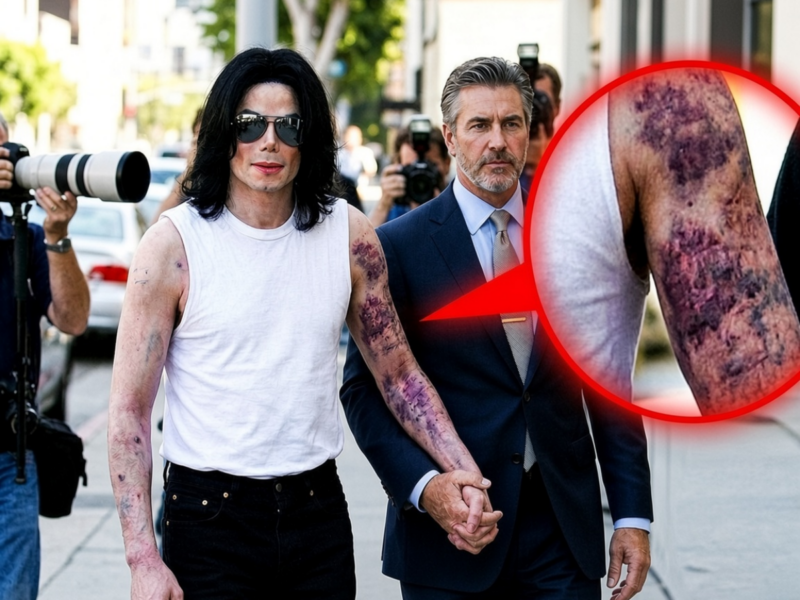
His arms were covered in multiple needle marks.
His knees had several puncture marks, signs that he had knee surgery and received shots to reduce joint inflammation.
He had arthritis in his lower spine and some fingers.
He had mild plaque buildup in his leg arteries.
His lungs were chronically inflamed and had reduced capacity.
He was 136 pounds at 5’9″.
He was free of major illnesses or serious organ damage, but he was not the picture of health that the tabloids had portrayed.
He was a man who had been through decades of medical trauma.
But the most horrifying medical secret of Michael Jackson’s life was not his skin, his surgeries, or his burns.
It was his insomnia.
He could not sleep.
He had not been able to sleep properly for decades.
He would stay up for days at a time.
He would try everything.
Meditation.
Medication.
Isolation.
Darkness.
Nothing worked.
Sources close to Jackson revealed that during the HIStory tour in 1996 and 1997, Jackson was actually traveling with what looked like a mini-clinic, including an IV pole, drips, and what looked like a rack with lights and monitors.
Sources who had the opportunity to see Jackson at various points during the tour said Jackson was traveling with at least two doctors, one of whom was anesthesiologist Dr. Neil Ratner.
One source said he asked Ratner about all this elaborate equipment, and Ratner said he was there because Michael simply couldn’t sleep.
“I take him down at night,” Ratner said, referring to Jackson, “and I bring him back up in the morning.”
Ratner would keep the equipment in his hotel room, which would be next to Jackson’s, and he would use that for monitoring Jackson’s vital signs when he was asleep or under, as the source put it.
The painkillers were the problem.
He had become addicted to painkillers after the Pepsi burn.
He had become addicted to sedatives.
He had become addicted to anything that would help him sleep.
A confidential document from the Santa Barbara County Sheriff’s Department revealed that Jackson took more than 10 Xanax pills a night.
He asked his employees to get the prescription medicine under their names.
He personally traveled to doctors’ offices in other states to obtain them.
One security guard said he expressed his concern about Jackson’s use of 10-plus pills a night to another staffer.
The second staffer replied that Jackson was doing better because he was down from 30 to 40 Xanax pills a night.
The amount of Xanax that Jackson allegedly took surprised CNN chief medical correspondent Sanjay Gupta.
“No matter how you cut it, this is an extremely high dosage of Xanax,” Gupta said. “It’s a huge red flag. Even with the tolerance that I was talking about, this dosage is exceedingly high for any human being.”
He had been in and out of treatment for addiction.
In 1993, he was treated for a painkiller addiction.
In 2002, he wanted off of the painkiller Demerol.
Dr. Alimorad Farshchian said Jackson wanted off of it.
“Blanket was just born, and that was why he wanted to—what he phrased—a monkey on his back. He wanted to just not deal with it anymore,” Farshchian said.
Farshchian described implanting Michael Jackson with a type of Demerol antidote.
Naltrexone, also known as Narcan, is a tiny tube inserted under the skin to block the euphoric effect of opiates.
The doctor said he implanted Jackson five times over nine months.
He said he personally witnessed Mrs. Jackson examining her son’s incision.
“I remember that was in Neverland. Michael did show the implant to his mother. Just his mother was there. She was very happy,” said Farshchian.
But the addiction never fully went away.
It was resolved and then resurfaced and was resolved and then resurfaced.
Jackson’s family had been very concerned recently about his use of painkillers, which had started up again a few months before his death.
The narcotic Demerol had been one of the concerns for a long time, said Stacy Brown, co-author of a Jackson biography.
He said Jackson was receiving one injection per day.
He always had a doctor give it to him.
“The doctors were legitimate,” Brown said. “But at the same time, no one was ever in a position to say no to Jackson.”
And that was the problem.
Nobody could say no.
Michael Jackson was the most famous man on the planet.
He had more money than he could spend.
He had a team of doctors who were paid to keep him healthy, who were paid to keep him alive, but they were also paid to keep him happy.
And what made Michael Jackson happy was sleep.
What made Michael Jackson sleep was Propofol.
Propofol is a powerful surgical anesthetic.
It is used to put patients under for surgery.
It is supposed to be administered in a hospital setting, with monitoring equipment, with a breathing tube, with an anesthesiologist present.
Dr. Conrad Murray was giving it to Jackson in a bedroom, alone, without proper equipment, without proper monitoring.
He had been giving Jackson Propofol every night for six weeks to help him sleep.
Murray later told police that he had been giving Jackson Propofol frequently for a month before his death, saying the singer wanted to sleep for 15 to 18 hours a day.
On the morning of June 25th, 2009, Murray gave Jackson Propofol at around 11:00 a.m.
He left the room to go to the bathroom.
When he returned, Jackson was not breathing.
He tried to revive him.
He called for help.
But by then it was too late.
Jackson’s last words were a plea for more Propofol, because that was the only thing that would put him to sleep, Murray said in an interview aired on NBC’s Today Show.
“It was probably when he was pleading and begging me to please, please let him have some milk, because that was the only thing that would work,” Murray said.
Jackson’s nickname for Propofol was “milk.”
Murray said Jackson was a desperate man.
Desperate.
The coroner’s report revealed the horrifying truth.
Michael Jackson’s death was a homicide.
The cause was acute Propofol intoxication.
The manner was homicide.
Along with Propofol and lorazepam, Jackson had several other drugs in his system.
Midazolam.
Diazepam, or Valium.
Lidocaine.
Ephedrine.
He had been given three different benzodiazepines in the six hours before receiving Propofol.
The coroner’s summary said the standard of care for administering Propofol was not met, and the recommended equipment for patient monitoring, precision dosing, and resuscitation was missing.
The autopsy report revealed that Jackson’s most serious health problem was his chronically inflamed lungs, but this was not serious enough to be a contributing factor to his death.
His heart was strong, with no sign of plaque buildup.
His kidneys and most other major organs were normal.
He had arthritis in the lower spine and some fingers.
He had mild plaque buildup in his leg arteries.
He had reduced lung capacity due to chronic inflammation.
“It’s an unusual finding,” Dr. Zeev Kain said. “It looked like from the pathology report that he had this condition for years, but it’s very hard to know what the reason was.”
Dr. Conrad Murray was charged with involuntary manslaughter.
The trial began in September 2011.
It lasted six weeks.
It was televised.
The prosecution argued that Murray had been grossly negligent.
The defense argued that Jackson had caused his own death.
The jury didn’t believe them.
On November 7th, 2011, after nine hours of deliberation, the jury found Conrad Murray guilty of involuntary manslaughter.
On November 29th, 2011, he was sentenced to four years in the Los Angeles County Jail, the maximum sentence allowed under the law.
The judge, Superior Court Judge Michael Pastor, called it “a cycle of horrible medicine.”
He said Murray’s pattern of deceit and lies intended to forward his own interests had contributed to his decision to sentence him to four years.
The family’s reaction was one of relief mixed with grief.
Michael Jackson’s mother, Katherine, and his father, Joe, had been in the courtroom.
His siblings had been there.
His children had been there.
And when the verdict was read, they wept.
They had waited two years for justice.
Prior to sentencing, a lawyer for Jackson’s family read a statement.
“We respectfully request you impose a sentence that reminds physicians they cannot sell their services to the highest bidder.”
Katherine Jackson said her son was being pressured before his death.
He asked for his father, she said.
“My son was sick. Nobody said anything.”
She said she was aware her son took medications for pain in his back and scalp after he sustained injuries over his career.
His father, Joe Jackson, slammed the grueling 50-day schedule drawn up for his son’s comeback, saying he was not capable of completing the series of sold-out concerts.
“I was worried about his health,” he said.
He said his son was riddled with needle marks and had several collapsed veins.
Prince Jackson, Michael’s eldest son, later spoke about his father’s condition during an appearance on Hotboxin’ with Mike Tyson.
“When I was younger, he was always explaining to me, speaking about that,” Prince said.
He had a skin condition called vitiligo.
He also spoke about how the condition affected his father emotionally.
“He had a lot of insecurity around looking blotchy in his appearance. So he wanted to see if he could smooth out his appearance.”
Prince added that there were discussions around possible contributing factors.
“I think the cause of it, it’s either vitiligo or some form of lupus that contributed to the vitiligo.”
The horrifying medical secrets of Michael Jackson are not just a list of diagnoses and procedures.
They are a window into a life that was defined by pain.
He was burned on stage.
He was diagnosed with diseases that destroyed his skin.
He was addicted to painkillers.
He couldn’t sleep.
He was surrounded by doctors who were paid to keep him happy, not to keep him healthy.
And he died because he was so desperate for rest that he let a doctor give him surgical anesthesia in a bedroom.
He spent his entire life in physical agony, and he hid it from the world.
He smiled for the cameras.
He danced for the fans.
He sang for the ages.
And underneath it all, he was falling apart.
His arms were covered in needle marks.
His face was covered in scars.
His hair was gone.
His skin was patchy.
His lungs were inflamed.
His spine was arthritic.
His body was breaking down.
And nobody could save him.
Michael Jackson was 50 years old when he died.
He was the greatest entertainer who ever lived.
He was also a man who never got to rest.
And that is the most horrifying secret of all.









