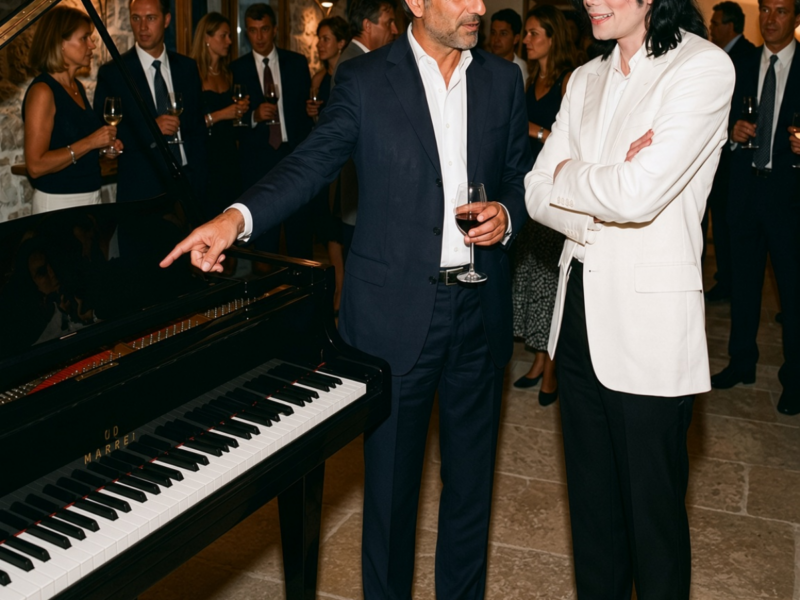
He mocked Michael Jackson at a piano—5 seconds later, the arrogant pianist broke down in tears.
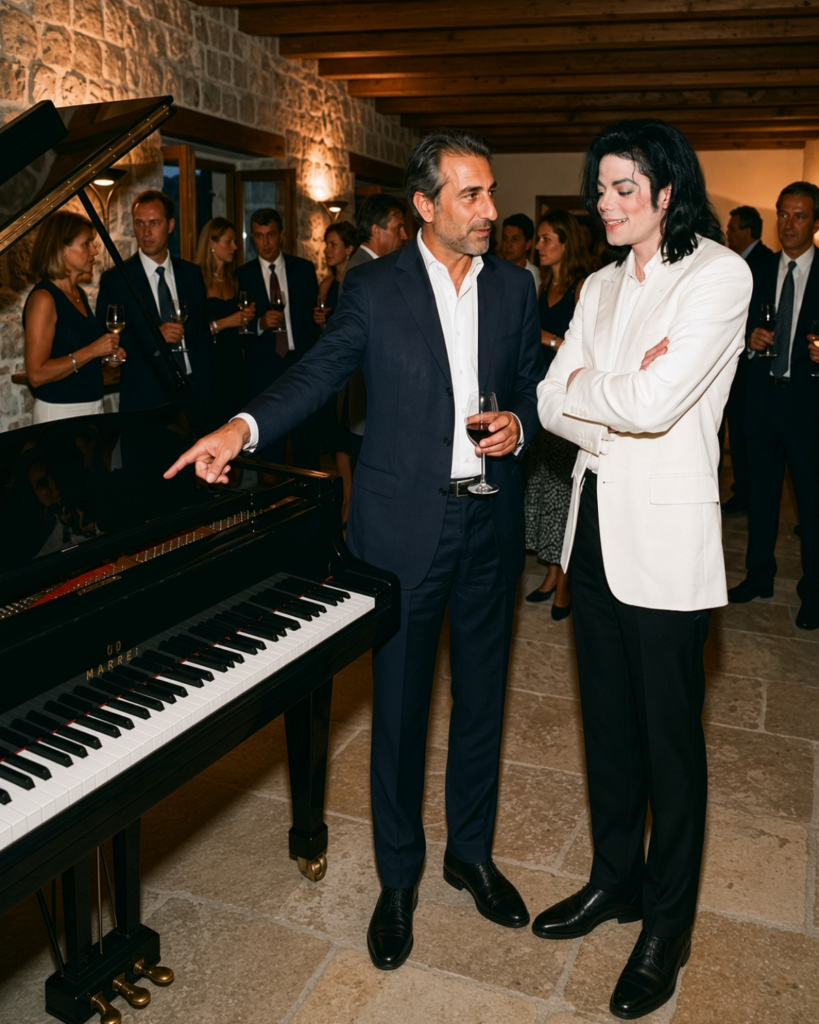
Vittorio Marchetti pointed at the piano the way a man points at a dog that has just made a mess on the carpet.
One long finger held out at the end of a straight arm aimed at the keys.
In his other hand, he held a glass of red wine, and he hadn’t spilled a drop of it all night.
“There,” he said.
“It is right there. It doesn’t bite.”
Michael Jackson folded his arms across the front of his white jacket and smiled at the floor.
About sixty people were standing in that room, and every one of them had stopped talking.
A minute earlier, there’d been the usual party sound, glasses and laughter and somebody’s story about a golf course in Palm Springs.
Now there was just the hum of the air conditioning and somewhere out on the terrace, a sprinkler ticking across the lawn.
“I’m not a piano player,” Michael said quietly.
“No,” Vittorio said.
“That much, I believe.”
A man near the fireplace laughed.
It was a short, ugly laugh, the laugh of somebody who thinks he’s supposed to, and he stopped it halfway through when nobody joined him.
Vittorio turned to the room, wine glass lifted a little, like a man about to give a toast.
“You know, in Naples, where I grew up, we had a man on our street who sang at weddings. Very popular. Big voice. Every bride wanted him. But if you sat him in front of a piano, he could not find his own nose.”
He shrugged.
“So I am only curious. That is all. A man sells a hundred million records. I would like to hear what he can do with ten fingers and no machine helping him.”
He looked back at Michael.
“Thirty seconds. Anything you want. Then I promise I leave you alone, and you can go back to the lemonade.”
Michael Jackson looked at the piano for a long moment.
It was a nine-foot Steinway, black, with the lid propped all the way open, and it had been played for most of the last hour by the man now pointing at it, one of the most celebrated concert pianists in Europe.
Then Michael unfolded his arms.
What happened over the next few minutes was told and retold by the people in that room for the rest of their lives.
Some of them got the details wrong.
Some of them added things.
But on one point, every single version agrees: Vittorio Marchetti was the one who cried, and it took about five seconds.
To understand why, you have to go back to the beginning of that evening and then a great deal further back than that, to a narrow street in Naples, a sewing machine, and a song that a little boy was told to stop playing.
It was the summer of 1998.
July.
A Saturday.
The house belonged to a film producer named Leonard Ashby and his wife Margaret, and it sat at the top of a long private drive in Bel Air, behind a gate and a row of tall Italian cypress trees.
Leonard Ashby had made his money in the eighties on two cop movies and a submarine picture, and he had spent a good portion of it on this house.
He’d gone to Tuscany on a honeymoon in 1971 and had never really come back, at least not in his head.
So when he built, he built a farmhouse.
Stone walls, rough and pale, hauled in from a quarry outside Santa Barbara.
Ceiling beams of old dark oak that he swore had come out of a barn in Umbria, though Margaret liked to tell guests they’d come out of a lumberyard in Van Nuys.
Terracotta floors.
Iron lamps on the walls that threw soft yellow light up across the stone.
A lemon tree in a pot by every door.
Margaret Ashby threw a party in that house every July.
It was never too big.
Sixty, maybe seventy people.
Studio people.
A couple of directors.
A senator’s wife.
One year, a famous chef.
Another year, a famous conductor who drank too much and fell asleep in the garden.
And every year, Margaret found one piece of entertainment that nobody else in Los Angeles could get.
This year, it was Vittorio Marchetti.
If you followed classical music in the nineties, you knew the name.
If you didn’t, you probably heard him anyway, on the soundtrack of some movie where a man in a tuxedo stares out a rainy window.
Marchetti was fifty-one years old that summer.
He’d been born in Naples, trained at the Conservatorio di San Pietro a Majella, won a big international competition in his twenties, and then spent the next quarter of a century traveling the world playing the hardest music ever written for the piano.
Liszt.
Rachmaninoff.
Pieces that made other pianists sweat just reading them.
He was also, by reputation, one of the most difficult men in the business.
Stories followed him around.
He’d once stopped a concert in Vienna in the middle of a sonata because a woman in the third row was unwrapping a cough drop, and he sat with his hands in his lap, perfectly still, until she put it away.
He told a newspaper in London that most pop music was furniture for elevators.
He’d walked out of a recording session in New York because the producer asked him to play it a little warmer, and he’d said on his way out the door that warmth was for people who couldn’t play it correctly.
People forgave him for all of it because when he sat down at a piano, he was extraordinary.
His hands were big and quick and could do things that didn’t look physically possible.
Critics used words like volcanic and surgical, sometimes in the same review.
Margaret Ashby had met him at a dinner in New York in the spring.
He was in town that July to play two concerts at the Dorothy Chandler Pavilion downtown, and she’d asked him, almost as a joke, whether he’d play a few pieces at her party.
To her great surprise, he said yes.
Later, she found out why.
Her husband had agreed to let a young composer Vittorio was fond of score his next film.
It was a trade.
Hollywood was full of them.
So that was the plan for the evening.
Cocktails on the terrace at seven.
Dinner at eight.
And at nine-thirty, in the great room with the stone walls and the oak beams, Vittorio Marchetti would play for forty minutes on the Steinway that Leonard had bought specifically for the occasion and would, Margaret predicted, never touch again.
The other guest of honor was a secret.
Margaret had told almost nobody.
Her husband knew.
The head of security knew.
The caterer knew because she needed to know which plates not to put shellfish on.
But when the cars started coming up the drive at seven, nobody else at that party had any idea that Michael Jackson was coming.
He was, at that point in his life, a man who mostly didn’t go to parties.
The summer of 1998 was a quiet one for Michael.
The HIStory World Tour had finished the previous October, after more than eighty shows across five continents.
He had a little boy who was about a year and a half old and a baby daughter who’d been born in April.
He was spending a lot of time at Neverland, up in the Santa Ynez Valley.
And when he came down to Los Angeles, it was usually for meetings, for recording, or for doctors.
He’d been famous for nearly thirty years by then, since he was eleven years old, and he’d long ago stopped believing that walking into a room full of strangers could ever be a casual thing.
But Leonard Ashby had done him a kindness once.
Years earlier, when a story about Michael had been running in every tabloid in the country, Leonard had pulled a cheap joke about him out of a script before the movie was shot.
He hadn’t told anybody he’d done it.
Michael found out anyway, the way he usually found things out, and he never forgot it.
So when Margaret’s invitation came, handwritten on heavy cream paper, he surprised his own staff by saying yes.
He arrived at 8:15, after everybody had sat down to dinner, because he’d learned a long time ago that it was easier to come in once a room had settled.
He came in through the kitchen.
One bodyguard walked a few steps behind him.
He was wearing black trousers, a white shirt open at the collar, and a white jacket, and his hair fell in dark waves past his shoulders.
The kitchen staff saw him first.
A young waiter dropped a serving spoon.
A woman arranging bread on a tray put her hand over her mouth.
Michael smiled at all of them and said, “Hi. I’m sorry. I didn’t mean to scare anybody.”
And then, before he went anywhere near the dining room, he asked the head chef what was on the menu and listened to the whole answer and asked her what her favorite thing to cook was when nobody was paying her to do it.
Her name was Rosa.
She was from Guadalajara.
She told him it was her grandmother’s pozole.
He told her his mother made a sweet potato pie that he’d fly across the country for.
They talked for four minutes while sixty people in the next room ate their salads with no idea.
Then Margaret came through the swinging door, saw him, and gave a little cry of happiness.
And the evening changed.
Michael didn’t make an entrance.
Margaret had wanted him to, a little.
She’d pictured standing up at the head of the table and introducing him.
He asked her very gently not to.
So instead, he simply slipped into the empty chair she’d saved for him halfway down the long table, between a casting director named Ellen and a retired cardiologist who was Leonard’s oldest friend from college.
It took about fifteen seconds for the whole table to notice.
You could watch it move, Ellen said later.
It went down the table like a wave going through a stadium.
A fork stopped halfway to somebody’s mouth.
A woman nudged her husband.
A man at the far end actually stood up, then realized he was standing up and sat back down.
And at the head of the table, at Margaret’s right hand, Vittorio Marchetti looked down the long row of candles and silverware and frowned.
He knew who it was.
Of course he did.
Everybody on Earth knew who it was.
But nobody had told him.
He’d been seated as the guest of honor at the hostess’s right hand, and for the first hour of the evening, every conversation at that table had come back around to him.
Where was he playing next?
What was it like to play in Moscow?
Was it true he practiced eight hours a day?
He’d answered all of it with a kind of weary charm, the way a man answers questions he’s been answered a thousand times.
He’d been enjoying himself, even if he would never have admitted it.
And now, nobody was looking at him at all.
He leaned over to Margaret and said in his low, accented English, “You didn’t tell me there would be a circus.”
Margaret laughed because she thought he was joking.
He wasn’t.
Dinner went on.
Michael ate very little.
He asked the cardiologist about his grandchildren and listened.
He asked Ellen what the hardest thing about her job was.
And when she told him it was turning down kids who’d flown in from Ohio with all their savings to audition, he was quiet for a moment and said, “That’s the worst part of every business. Telling somebody no when they gave you everything.”
Every so often, someone would come around from the other side of the table, crouch next to his chair, and ask for something.
A photograph.
An autograph for a daughter.
A word for a nephew who could do the moonwalk.
Michael said yes to every one of them, signed every napkin, and never once looked toward the head of the table.
Vittorio watched all of it.
He was a man who had spent his whole life believing that there was a right way and a wrong way to be loved by an audience.
The right way was what happened in a concert hall.
You sat down at the instrument.
You played something that took you thirty years to learn.
You showed them the inside of it.
And when they applauded, you knew exactly what they were applauding.
The wrong way, in his opinion, was this.
A man walks into a room and people go crazy before he’s done anything at all.
He said as much out loud over dessert to the people sitting nearest him.
“In my business,” he said, stirring his espresso, “nobody claps until you play.”
“In his business, they clap when you arrive, and then they pay to watch you dance in front of fireworks.”
He smiled a thin little smile.
“This is why I prefer my business.”
Margaret laughed again, but she glanced down the table and she didn’t laugh as long this time.
At 9:30, everyone moved into the great room.
Leonard had arranged the chairs and couches in a loose half circle around the piano, but most people stood, glasses in hand, against the stone walls and under the iron lamps.
The French doors to the terrace were open, and the night air came in, smelling of cut grass and jasmine.
Out past the terrace, the lights of the city spread all the way down the hills to the ocean.
Michael found a spot near the back by the doors, beside a tall potted lemon tree.
His bodyguard stood outside on the terrace with his hands folded.
Margaret introduced Vittorio.
She did it beautifully.
She talked about his concerts, his recordings, the time he’d played for the pope.
The room applauded.
Vittorio walked to the piano, adjusted the bench by about half an inch, flexed his fingers once, and sat.
And for forty minutes, he was magnificent.
He opened with Chopin, a ballad to settle the room.
Then he played a Rachmaninoff prelude that started so softly people leaned forward to hear it and ended so loudly that a woman near the front pressed herself back into her chair.
Then Liszt.
The piece everyone knows, called La Campanella, with that little bell-like note that jumps all over the top of the keyboard, played so fast his right hand seemed to blur.
Even the people who didn’t know a thing about classical music understood they were watching something rare.
When he finished the Liszt, the room exploded.
People whistled.
A studio executive named Donnuit shouted, “Bravo!” in a voice that suggested he’d never shouted it before.
Michael Jackson applauded, too.
He applauded as hard as anyone in the room.
And at one point during the Rachmaninoff, Ellen looked over at him and saw that his eyes were closed and he was moving his head very slightly with the music, the way a person does when he’s following every single note.
Vittorio didn’t see that.
He didn’t look toward the back of the room once.
When the applause finally died down and Vittorio stood and gave a short, stiff bow, and Margaret came forward to thank him, Donnuit, still red in the face from shouting, said loudly, “Well, I don’t know how anybody follows that.”
And then, because he’d had three glasses of wine and thought it would be funny, he turned to the back of the room and said, “Michael, you want to give it a shot?”
A few people laughed.
It was the nervous kind of laugh, the kind that hopes it’s going to be okay.
Michael smiled and shook his head and held up both hands, palms out.
“No, no, I couldn’t.”
And that might have been the end of it.
It should have been.
Margaret was already opening her mouth to move everyone toward the terrace for more drinks.
But Vittorio Marchetti had been watching people look away from him all night.
He’d been the guest of honor at a party where he wasn’t the guest of honor anymore.
And he’d just played forty minutes of the most difficult music in the world, beautifully, for a room that had still spent most of the evening sneaking glances at a man by the door.
He picked up his wine glass from the top of the piano.
“No, please,” he said.
“I think this is a very good idea.”
The room turned.
“Mr. Jackson,” Vittorio said, and he said it with a little bow of his head that was polite on the surface and something else underneath.
“Come. Sit. I am very curious.”
Michael was still smiling, but it had gone smaller.
“I really don’t play,” he said.
“Not like you. Not like anybody in this room should have to listen to.”
“Ah, but you write songs. Yes? Very famous songs. So you must use something.”
Vittorio spread his hands.
“A piano. A guitar. Or maybe a computer that does it for you.”
Somebody laughed at that.
It was Donnuit again, and he regretted it the moment he heard himself.
Margaret said, “Vittorio,” in a low, warning voice.
But he’d started now, and men like Vittorio Marchetti don’t stop once they’ve started.
He walked a few steps away from the piano bench toward the middle of the room and stood there with the wine glass between Michael and the instrument.
“I’m asking only one small thing,” he said to the room.
“Everybody here knows what I can do. They have now heard it. I sat down. I played. That is all. No lights. No dancers. No microphone. Nothing to hide behind.”
He turned back to Michael.
“Thirty seconds. Anything. Show us.”
Nobody said anything.
Leonard Ashby, standing by the fireplace, looked at his shoes.
Ellen, the casting director, said later that she wanted to throw her drink at him, and she’d never wanted to throw a drink at anybody in her life.
Michael didn’t move at first.
He stood by the lemon tree, arms loose at his sides, looking at the piano.
And then he walked toward it.
He didn’t walk fast.
He walked across that terracotta floor the way he did everything offstage.
Quietly.
Almost shyly.
His shoulders a little rounded.
When he reached the piano, Vittorio was standing right beside it.
He lifted his arm and pointed.
One long finger aimed down at the keys.
“There,” he said again, slower this time.
“Right there. It won’t bite you.”
Michael folded his arms and smiled at the floor.
“I’m not a piano player,” he said.
“No,” Vittorio said, and a few people laughed.
“That much, I believe.”
Michael sat down on the bench.
He didn’t adjust it the way Vittorio had.
He just sat a little forward, his hands resting on his knees.
He looked at the keys for a long moment, the way you’d look at the face of somebody you haven’t seen in years.
Then he lifted his right hand and played one note.
Just one.
With one finger.
Someone in the back snorted.
It was the sound of a person trying very hard not to laugh and failing.
Vittorio raised his eyebrows and took a sip of wine.
Michael played another note, then another, slowly, like a child picking out something he’d heard on the radio.
And then his left hand came up off his knee and settled onto the lower keys very lightly, and pressed down a chord.
A soft one.
Hardly anything.
And the melody that came out of that piano was one every person in that room knew, whether they could have named it or not.
It was “Smile.”
The old Charlie Chaplin song.
Chaplin wrote the melody himself for his film Modern Times back in 1936, the one where he’s the little tramp caught in the gears of a giant factory machine.
Years later, someone added words to it, and it became one of the most recorded songs of the century.
Nat King Cole sang it.
Tony Bennett.
Judy Garland.
And in 1995, on his HIStory album, Michael Jackson had sung it, too, very simply, with an orchestra, as the last song on the first disc of new music.
Most people skipped past it to get to the hits.
But Michael wasn’t singing now.
He was just playing it.
The melody in his right hand, plain and slow, every note given a little extra space.
The left hand barely there.
A few soft chords underneath, like somebody keeping a hand on your back in a crowd.
He played it the way you’d play something for one person in a dark room.
He didn’t play it for sixty people.
One.
Two.
Three.
Four.
Five seconds.
And Vittorio Marchetti’s wine glass began to shake.
Ellen saw it first because she was looking right at him.
The red wine in the glass trembled, and then sloshed a little, and he set it down on the lid of the piano very carefully, the way someone sets something down when he doesn’t trust his own hands.
He put his hand flat on the black lacquer as if he needed something to hold him up.
And then his face just came apart.
There’s no other way to say it.
The man who had stopped a concert in Vienna over a cough drop.
The man who had called pop music furniture for elevators.
He stood beside that piano with his mouth pressed shut and his chin trembling and tears running down both sides of his face, and he didn’t wipe them away.
He didn’t seem to know they were there.
Michael didn’t see it at first.
His eyes were on the keys.
He played through the first line of the melody and into the second.
And somewhere in the middle of the second line, he glanced up.
The way you’d glance up to check that the people around you are still there.
He saw Vittorio’s face, and he stopped playing.
The last chord hung in the air for a second, then faded.
“I’m sorry,” Michael said softly.
“Did I play it wrong?”
The whole room heard it.
You could have heard a napkin hit the floor.
Vittorio shook his head.
He tried to say something, and nothing came out.
He tried again.
“No,” he finally managed, and his voice cracked right down the middle of the word.
“No. Not wrong.”
He took a breath.
“Who told you?”
Michael looked confused.
“Told me what?”
“Who told you to play that one?”
Vittorio’s voice was rising now.
Not in anger, but in something closer to fear.
“Margaret? Did someone tell you?”
Margaret, near the fireplace, shook her head, bewildered.
“Vittorio, I don’t know what you mean. Nobody told him anything.”
Michael looked up at the pianist, and his voice was as gentle as anybody in that room had ever heard a voice.
“Nobody told me anything,” he said.
“It’s just the one I know best. It’s the one I play when I can’t sleep.”
Vittorio Marchetti put both hands over his face, and sixty of the most powerful, most cynical people in Hollywood stood under those old oak beams and watched one of the greatest pianists in the world cry like a little boy.
To understand what happened to Vittorio Marchetti in that moment, you have to go back to 1952, to a street in Naples called Vico dei Panettieri.
It was so narrow that a woman could hang laundry from her window to the window across the way, and most women did.
It ran downhill toward the old harbor, and it smelled of bread in the morning and fried fish in the evening and always of wet stone.
Vittorio was five years old.
He lived on the third floor of a building with a cracked marble staircase, in two rooms, with his mother.
His father had been a sailor on a merchant ship, and he’d gone out on a voyage to Buenos Aires when Vittorio was a baby and had simply never come back.
Nobody ever found out whether he’d died or just decided to stay.
Vittorio’s mother, whose name was Assunta, never talked about it.
She had a photograph of him in a drawer, and once a year, on the day they’d married, she took it out and looked at it for a minute and put it back.
Assunta Marchetti was a seamstress.
She worked at home on a black Singer sewing machine with a foot treadle and gold lettering on its side that had mostly worn off.
She took in hems.
Repairs.
Wedding dresses for girls in the neighborhood.
School uniforms in September.
She worked from early morning until long after dark.
And the sound of that treadle, chunk-chunk-chunk-chunk, was the sound Vittorio fell asleep to every night of his childhood.
And while she sewed, she hummed.
She only hummed one song.
Not always.
But whenever she was tired, whenever the money was short, whenever the landlord had been by.
Vittorio didn’t know what it was called.
He didn’t know where it came from.
He only knew it was soft and slow, a little sad and a little hopeful at the same time, and that when his mother hummed it, he knew things were bad, but that she was going to keep going anyway.
He found out where it came from when he was seven.
There was a cinema at the bottom of the hill, a crumbling old movie house with a painted ceiling, and one winter it showed a run of old Charlie Chaplin pictures.
His mother took him to Modern Times on a Sunday afternoon.
It cost her money she didn’t have.
She sat in the dark beside him and held his hand.
And near the end of the film, when the little tramp and the girl walk off down the long road toward the horizon, the music swelled.
It was her song.
Vittorio turned and looked at his mother in the flickering light of the screen and saw that she was crying and smiling at the same time.
He never asked her why.
He figured it out later, the way children figure things out.
She’d seen that film as a girl, before the war, before the bombs fell on the harbor, before her husband sailed away.
That song was the only thing she’d kept from the life she’d thought she was going to have.
There was an old upright piano in the back room of the bakery at the bottom of their street.
It belonged to the baker’s dead father, and nobody played it anymore.
It was out of tune, and two of its keys didn’t work at all.
But the baker’s wife let Vittorio sit at it in the afternoons while his mother delivered finished dresses.
And one day, when he was eight years old, he picked out the melody of his mother’s song, note by note, with one finger.
Then with two hands.
He ran up the three flights of that cracked staircase and pulled his mother down to the bakery by her wrist and made her sit on a sack of flour while he played it for her.
And Assunta Marchetti listened to her eight-year-old son play her song on a broken piano in the back of a bakery, and she put her hand over her heart and couldn’t speak.
Two weeks later, she sold the sewing machine.
She never told him how much she got for it.
She told him she’d found a teacher, an old man on the Via Toledo who’d once played in the orchestra at the San Carlo Opera House and would give him lessons twice a week.
She told him that a boy who could hear a song once and play it with both hands shouldn’t spend his life delivering hems.
And for the next year, she sewed everything by hand, by lamplight, with a needle, until her fingers bled and her eyes got so bad she needed glasses she couldn’t afford.
Vittorio didn’t understand what she’d given up until years later.
At the time, he only knew that the chunk-chunk-chunk of the treadle was gone and that his mother sat closer to the lamp.
He was good.
He was more than good.
By ten, his teacher was taking him to play for people who mattered.
By twelve, he’d been admitted to the conservatory at San Pietro a Majella, one of the oldest music schools in the world, where the hallways were lined with portraits of composers who’d studied there two hundred years before.
And there, in his first month, something happened that he never told anyone about.
Not his wife.
Not his manager.
Not a single interviewer in forty years.
He had a professor at the conservatory, a severe silver-haired man who wore a black suit every day of the year and had a reputation for breaking students.
One afternoon, waiting for his lesson to begin, twelve-year-old Vittorio sat at the practice room piano and, without thinking, began to play his mother’s song.
The professor came in halfway through.
He stood in the doorway and listened for a moment.
Then he walked over and closed the lid of the piano.
Not hard.
Just firmly enough that Vittorio had to pull his hands back to keep from having them caught.
“That,” the professor said, “is music for barber shops and weddings. You are not here to play for barber shops and weddings. You are here to become a serious musician. If I ever hear you play that again in this building, you can go back to whatever street you came from.”
Vittorio never played it again.
Not in the building.
Not at home.
Not anywhere.
He was a boy, and he was terrified of being sent back, and his mother had sold her sewing machine to get him there.
So he buried it.
He played Bach and Beethoven and Chopin and Liszt, and he got better and better, and he won the competitions and played the great halls and became the famous Vittorio Marchetti, the volcanic, surgical, difficult genius of the piano.
And somewhere along the way, he decided the professor had been right.
That there was serious music and there was everything else.
That simple meant cheap.
That sentiment was for people who couldn’t play correctly.
His mother came to hear him play.
She came to Milan when he made his debut at La Scala, wearing a dress she’d sewn herself, sitting in a box she’d never have been allowed into otherwise.
She came to Rome.
To Paris, once.
After every concert, she would hug him backstage and say how proud she was.
And then, every time, smiling, she would ask him the same thing.
“And when are you going to play my song?”
And every time, he’d laugh and kiss her forehead and say, “Mama, they don’t want Chaplin at La Scala.”
He thought there’d always be another concert to put her off until.
In March of 1991, Vittorio Marchetti was in Tokyo, in the middle of a three-week tour of Japan, when the phone in his hotel room rang at four in the morning.
It was a neighbor from Naples.
His mother had had a stroke.
She was in the hospital, and it didn’t look good.
He got on the first plane he could.
Tokyo to Rome, then Rome to Naples.
Nearly twenty hours in all.
She died while he was somewhere over Siberia.
The neighbor told him at the hospital that his mother had been awake for a little while before the end.
She couldn’t speak much, but she’d hummed, very softly.
The neighbor didn’t know the tune.
Vittorio knew it.
He buried his mother in Naples, and he went back on tour two weeks later, and he never said a word about any of it to anyone.
Over the next seven years, the people around him noticed he’d gotten harder.
Sharper.
The cough drop in Vienna happened in 1993.
The furniture for elevators remark happened in 1995.
The people who worked for him said he’d always been difficult, but now there was something different, something angry underneath, like a man who was punishing everybody else for something he couldn’t forgive himself for.
He hadn’t heard that song in seven years.
He’d walked out of restaurants when a pianist started playing it.
He’d changed radio stations in cars.
He’d even skipped past it, without knowing who was singing, on a CD a friend had given him.
And now, in a stone room in Bel Air, the one person on earth he decided he could openly look down on had sat at a piano and, with no idea in the world what he was doing, played his mother’s song.
Not brilliantly.
Not with any special technique.
Just the way an eight-year-old boy had once played it, on a broken piano in the back of a bakery.
Plain.
Slow.
Meaning every note.
Back in the great room, nobody knew any of that yet.
They only saw what was in front of them.
Vittorio stood with his hands over his face.
Michael sat on the bench looking up at him, and everybody else stood frozen, holding their drinks, not sure whether to look or look away.
It was Michael who moved first.
He got up off the bench slowly, and he took one step toward Vittorio and stopped, the way you’d approach a frightened animal.
He didn’t touch him.
He just stood close.
“Hey,” Michael said quietly.
“Hey. It’s okay.”
Vittorio lowered his hands.
His eyes were red.
He looked at Michael Jackson as if he were seeing him for the first time all evening.
And in a way, he was.
“My mother,” he said.
His voice was very low.
Only the people closest to the piano could hear him.
“My mother used to hum that song every day at her sewing machine.”
Michael didn’t say anything.
He just nodded slowly.
“I haven’t heard it in seven years,” Vittorio said.
“Since she died.”
Michael looked down at the floor for a second, and then back up.
“I’m so sorry,” he said.
“I didn’t know. I wouldn’t have—”
“No,” Vittorio said, and he shook his head hard.
“No. Don’t be sorry.”
He laughed, a broken, wet laugh.
“I asked you to show us what you could do with nothing to hide behind. And you did.”
He wiped his face with the back of his hand.
“I’m the one who’s been hiding.”
The room was so quiet, you could hear the sprinkler on the lawn again.
Then Vittorio did something nobody in that room expected.
He looked at the piano bench, and he looked at Michael, and he said, “Will you play it again? From the beginning?”
Michael hesitated.
“You sure?”
“I’m sure.”
So Michael sat back down.
And after a second, Vittorio Marchetti sat down on the bench beside him, on the left side, down by the low notes.
Two men on one piano bench.
The one in the dark suit and the one in the white jacket, their shoulders almost touching.
“You play the melody,” Vittorio said.
“Exactly the way you did. Don’t change anything.”
Michael began again.
One finger, then the whole right hand.
The slow, simple tune.
And underneath it, very quietly, Vittorio began to play.
He didn’t show off.
That’s what everybody remembered afterward.
He could have filled that song with a thousand notes.
He could have turned it into a concert piece.
He didn’t.
He played a low, soft line beneath Michael’s melody, a few notes at a time, moving like a slow walk.
It was the harmony his mother used to hum when she got to the end of the tune and started it over.
The part underneath the melody that only she seemed to hear.
Ellen said it sounded like two people walking down a long road together, like the end of the Chaplin picture.
Margaret Ashby had her hand pressed against her mouth.
Leonard had moved over beside her and put an arm around her.
Donnuit, the studio executive who’d started all of it with his joke, stood by the fireplace with his eyes shut.
Rosa, the chef from Guadalajara, had come out of the kitchen when the room went quiet.
She stood in the doorway in her white jacket with a dish towel over her shoulder, and she was crying, too.
And she said later that she didn’t even know why, only that it felt like being in church.
Michael and Vittorio played it through once.
Then, without either of them saying anything, they went around a second time.
On the second time, Vittorio let his part grow a little warmer, a little fuller.
Michael didn’t change a thing.
He just kept playing that simple melody, steady and gentle, like a man holding a lantern so somebody else could find his way home.
When the last note faded, neither of them moved.
Their hands stayed on the keys.
Then Vittorio took his hands off the piano and put his right hand on Michael’s shoulder and left it there.
“Grazie,” he said.
And then, quieter, something else in Italian that nobody in the room understood except one older woman near the window whose family was from Calabria.
She told Margaret later what it meant.
It meant, “Thank you for giving her back to me.”
The applause, when it came, wasn’t like the applause for the Liszt.
Nobody whistled.
Nobody shouted bravo.
It started slowly from the back of the room, and it grew, and it went on for a long time, and most people were wiping their eyes while they clapped.
Michael stood up, and he did the one thing everybody who ever met him remembers him doing.
He put his hand over his heart and bowed his head, just slightly, toward the people in the room.
Then he turned and bowed it toward Vittorio.
Margaret Ashby had planned for the party to wind down around eleven.
It didn’t.
People didn’t want to leave.
They drifted out to the terrace and stood around in small groups talking quietly, the way people talk after a wedding or a funeral, when something has happened that they don’t want to let go of yet.
The caterers brought out more coffee.
Somebody opened another bottle of wine.
The city lights glittered all the way down to the black line of the ocean.
And at the far end of the terrace, past the last lemon tree, where the stone wall looked out over the canyon, Michael Jackson and Vittorio Marchetti sat side by side on a low bench and talked.
Margaret kept an eye on them from a distance.
So did Michael’s bodyguard.
Nobody went over there.
Later, Vittorio told the story of that conversation to exactly one person, a music journalist in Milan, in an interview he gave in 2010.
The interview ran in an Italian magazine and was never translated.
What follows is what he told her.
He said the first thing Michael asked him was about his mother.
Not about the song.
Not about the tears.
About her.
What she was like.
What her name was.
What she sewed.
So Vittorio told him.
He told him about the two rooms on Vico dei Panettieri and the treadle and the cinema with the painted ceiling and the broken piano in the bakery.
He told him about the sewing machine she sold.
When he got to that part, Michael was quiet for a long time.
Then he said, “My mother gave things up, too. She never says what, but I know.”
And then Michael told him about Gary, Indiana.
He told him about the little house on Jackson Street.
Two bedrooms.
Nine kids.
He told him about the rehearsals that went on for hours after school every day in the living room, while the other kids on the street played outside.
He told him there was a park across from a studio they’d worked in years later, and he used to stand at the window between takes and watch children on the swings, and he’d want so badly to be out there that it hurt.
“People think I had everything,” Michael said.
“And I did have a lot. I’m not complaining. But there were things I never got to have. Just ordinary things. I think that’s why I’m the way I am about some things. People laugh at me for it. That’s okay.”
Vittorio told the journalist that he felt ashamed sitting there, because he’d done exactly that.
He’d laughed all night, in his head and out loud.
He’d laughed at this man.
So he said it.
He said, “I was very rude to you tonight. At dinner. At the piano. I was jealous, and I was cruel, and I’m sorry.”
And Michael smiled and said, “I’ve had worse. A lot worse.”
Then he said, “But thank you for saying it. Most people don’t.”
Then Vittorio asked him the question he’d been wanting to ask since the piano.
Why that song, of all the songs?
You could have played one of your own.
Everybody in that room would have known it.
Why Chaplin?
Michael told him that Charlie Chaplin was his hero.
Had been since he was a little boy.
He’d seen the films over and over.
He said Chaplin had grown up so poor in London that his mother had been taken to an asylum and he’d ended up in a workhouse, and that somehow he’d taken all of that sadness and turned it into something that made the whole world laugh.
“That’s what I’ve always wanted to do,” Michael said.
“Take the hurt and make it into something that helps somebody.”
He told Vittorio that he’d recorded “Smile” a few years before, and that it had meant more to him than almost anything else he’d done, even though hardly anybody ever mentioned it.
He said that when he was on tour, in hotel rooms in cities where he couldn’t go outside because of the crowds, he’d sometimes sit at whatever piano was there at three in the morning and pick out that melody very softly with one finger until he felt like he could sleep.
“I’m not a real piano player,” he said again, smiling.
“I told you that. I just know the ones I need.”
And Vittorio said something then that he told the journalist he’d thought about every day for the rest of his life.
He said, “I spent forty years learning every hard piece ever written for the piano, and I forgot how to play the one easy song that mattered.”
Michael looked at him and said, “The hard part was never the notes. The hard part is letting people see you mean it.”
Vittorio didn’t answer for a while.
Then he said, “My mother would have liked you very much.”
“I think I would have liked her, too,” Michael said.
“Anybody who’d sell her sewing machine for her little boy—that’s a real person.”
Then, Vittorio said, Michael asked him one last question.
He asked if his mother had ever heard him play the song.
Her song.
In a concert.
Anywhere.
And Vittorio told him the truth.
That she’d asked him after every concert for twenty years, and he’d always said no.
That the last time she’d hummed it was in a hospital bed in Naples, while her son was in an airplane somewhere over Siberia.
Michael put a hand on his arm.
He didn’t say anything clever.
He didn’t try to fix it.
He just said, “Then play it for her now. Every chance you get. She’ll hear it.”
They sat out there on that bench until nearly two in the morning.
When Michael finally stood up to go, he hugged Vittorio.
And Vittorio, who by his own admission had not hugged anyone except his wife in years, held on for a long time.
At the door, on his way out through the kitchen the same way he’d come in, Michael stopped to thank Rosa for the dinner.
She told him she’d never heard music like that in her life.
He told her that someday he’d like to try her grandmother’s pozole, and then the car went down the long drive between the cypress trees and he was gone.
Three nights later, Vittorio Marchetti walked onto the stage of the Dorothy Chandler Pavilion in downtown Los Angeles in front of more than three thousand people.
The program was Beethoven, Schumann, and Liszt.
He played all of it, and by every account he played it as well as he’d ever played anything.
The reviews the next morning called it a triumph.
But it was the encore people talked about.
He came back out to a standing ovation.
And instead of sitting down to the usual fireworks, a Chopin etude or one of his famous Liszt showpieces, he stood beside the piano and did something he’d never done in twenty-five years of concerts.
He spoke to the audience.
“This next piece,” he said, “is not on the program. It is not difficult. My professor told me once that it was music for barber shops and weddings.”
He paused.
“It was my mother’s favorite song. She asked me to play it for her for twenty years, and I never did. She died seven years ago. A friend reminded me the other night that it is not too late.”
He sat down and he played “Smile.”
He played it simply.
No flourishes.
Nothing to show off.
Just the melody, and underneath it, that low walking harmony his mother used to hum.
It took a little over two minutes.
The critic from the Los Angeles Times wrote that he’d never heard three thousand people go so quiet.
He wrote that a number of people in the orchestra seats were openly weeping, and that he was, in the interest of honesty, one of them.
He also wrote that he had no idea who the friend was.
Vittorio never said.
Not in that review.
Not in any interview for years.
People asked.
He’d smile and say, “Someone who knows more about music than I do,” and leave it there.
From that night on, until he retired from the concert stage in 2011, Vittorio Marchetti ended every single recital he gave with that song.
In Vienna.
In Moscow.
In Tokyo.
In Carnegie Hall.
Nearly five hundred concerts.
Critics complained about it at first.
One called it “a strange concession to sentiment from a pianist who once despised sentiment.”
Vittorio framed that review and hung it in his studio.
The people who worked with him noticed something else, too.
He got kinder.
Not soft.
He was still demanding, still exacting, still capable of stopping a rehearsal to fix a single wrong note.
But the cruelty went out of him.
He started teaching young pianists for free on Sunday afternoons in Milan.
Kids who couldn’t afford lessons.
And he never once closed the lid of a piano on a child who was playing something simple.
That October, when the concert season paused for two weeks, Vittorio did something else he hadn’t done in seven years.
He went home to Naples.
He didn’t tell anyone he was coming.
He took the train down from Milan, five hours along the coast, and he got off at the central station with one small bag and walked.
His manager would have been horrified.
The great Vittorio Marchetti, walking through the old quarter with his jacket over his shoulder like a tourist who’d lost his hotel.
The neighborhood had changed, and it hadn’t.
There were scooters now, everywhere, buzzing up the narrow lanes like angry bees.
There were satellite dishes bolted to the balconies.
But the laundry still hung across from window to window, and the stone was still wet in the shade.
And when he turned into Vico dei Panettieri, the smell of bread hit him so hard he had to stop and put a hand on the wall.
The bakery was still there.
The sign had been repainted, and the man behind the counter was the grandson of the baker Vittorio remembered, a heavy, cheerful man in his forties with flour up to his elbows.
He didn’t recognize the famous pianist.
Why would he?
To him, Vittorio was just a man in a good jacket buying two rolls.
Vittorio paid for his bread.
Then, a little awkwardly, he asked whether there was still an old piano in the back room.
The baker laughed.
“That thing? It’s still there. Nobody can lift it. My grandmother says it’s bad luck to throw it away. She’s ninety-one, so we do what she says.”
“Your grandmother,” Vittorio said slowly.
“Is her name Lucia?”
The baker stopped laughing.
Lucia Esposito was sitting in a wooden chair in the courtyard behind the shop, shelling peas into a bowl in her lap, a black shawl over her shoulders even though it was warm.
She was very small and very old, and her eyes were cloudy.
When her grandson brought the stranger out and said his name, she put the bowl down on the ground beside her.
“Vittorio,” she said.
“Assunta’s boy.”
He knelt down beside her chair on the stones of the courtyard.
This man who had played for kings and presidents, and she put both of her hands on his face, the way you touch something to make sure it’s real.
“You got old,” she said.
“So did you.”
“I was always old.”
She laughed, a dry little cackle.
“Your mother, she used to come here every Friday after you went to Milan. She’d buy one roll and sit right there where you are and tell me everything. Every concert. Every city. She kept the newspaper clippings in a biscuit tin. Did you know that?”
He hadn’t known that.
“She was so proud of you,” Lucia said.
“But she always said the same thing at the end. ‘One day he’ll play my song again, Lucia. One day he’ll remember.'”
Vittorio bowed his head.
“I remembered,” he said quietly.
“I was late, but I remembered.”
The old woman studied his face with her cloudy eyes for a long moment.
Then she pointed a crooked finger at the back door of the bakery.
“Then go in there and show me.”
The piano was exactly where it had always been, against the back wall, between the flour sacks and a stack of wooden crates.
It was dusty and scarred.
Somebody had used the top of it as a shelf for decades.
Two keys still didn’t work.
When he lifted the lid and pressed middle C, the sound that came out was so far out of tune it was almost funny.
He didn’t care.
The baker carried his grandmother’s chair inside and set it near the door.
A couple of the women who worked the front counter came to stand behind her, wiping their hands on their aprons.
A boy from the street who’d come in for bread stood in the doorway with the coins still in his fist.
And Vittorio Marchetti sat down on a flour sack, because there was no bench, and played his mother’s song on the same broken piano where he’d first found it forty-three years before.
He played it badly.
He couldn’t help it.
The out-of-tune strings and the dead keys turned the melody lopsided.
He had to skip notes.
A man who had played Liszt at Carnegie Hall stumbled through Charlie Chaplin like a child.
He said later that it was the best he’d ever played in his life.
When he finished, Lucia Esposito was crying, and so was her grandson.
And the boy in the doorway was looking at all these weeping grown-ups with complete bewilderment.
Before he left, Vittorio paid to have the old piano restored properly.
New strings.
New hammers.
The two dead keys brought back to life.
And he made the baker promise one thing: that any child on Vico dei Panettieri who wanted to sit at it in the afternoons would be allowed to.
The baker kept that promise.
The piano is still there in the back of that bakery.
And if you walk past on a weekday afternoon, people in the neighborhood say you can sometimes hear a child picking out a tune on it with one finger.
He and Michael didn’t see each other often after that night.
Their worlds were very far apart.
But they wrote.
Vittorio sent a Christmas card to Neverland every December, always with a postcard of the Bay of Naples tucked inside.
And every year, a card came back, signed in Michael’s careful handwriting, usually with one line, and usually the same one.
“Keep smiling. —M.”
In the autumn of 2001, when Michael’s album Invincible came out, Vittorio bought a copy in a record shop in Milan.
The first pop album he’d bought in his life.
The young man behind the counter didn’t recognize him and asked if it was a gift for a grandchild.
Vittorio said, “No. It’s for me. He’s a friend of mine.”
On June 25th, 2009, Vittorio Marchetti was at home in his apartment in Milan when his wife came in from the other room with the television news playing behind her, and her face told him before her words did.
He was sixty-two years old.
His wife said later that he didn’t say anything.
He went into his studio and closed the door, and a few minutes later, through the door, she heard the piano.
One finger at first.
Then both hands.
That same slow, simple melody, played the way Michael had played it on that night in Bel Air.
Not the way Vittorio would have played it.
The way Michael had.
He played it over and over, she said, for most of an hour.
And then he opened the window of the studio, which looked out over the rooftops toward the cathedral, and he played it one last time with the window open, so that it went out over the city.
A year later, in that interview with the journalist in Milan, she asked him the question everybody had been asking him for twelve years.
Who was the friend?
Who reminded you it wasn’t too late?
And for the first time, he told her.
He told her about the party and the piano and the five seconds.
He told her about the bench on the terrace and the conversation that went until two in the morning.
And at the end, she asked him what he thought, after all those years, Michael Jackson had really been.
Vittorio thought about it for a long time.
Then he said, “People will argue about that man forever. They will talk about the records, the dancing, the money, the strange things in the newspapers. Let them. I can only tell you what I saw. I saw a man sit down at a piano he could barely play, in front of a man who was trying to humiliate him, and choose to be gentle. He could have made me look like a fool. Instead, he gave me back my mother.”
He paused, and then he added one more thing.
“I spent my whole life believing that the hardest music was the music with the most notes. He showed me, in five seconds, that I had it backwards. The hardest thing is to play something simple and mean every word of it. My mother knew that. She knew it at a sewing machine in Naples. It took Michael Jackson to remind me.”
Vittorio Marchetti died in 2019 in Milan at the age of seventy-two.
At his funeral, at his own request, there was only one piece of music.
A young pianist, one of the kids he taught for free on Sunday afternoons, sat down at the piano at the front of the church and played Charlie Chaplin’s “Smile.”
Slowly.
Simply.
With nothing to hide behind.
And on the lid of the piano, someone had placed a single white postcard of the Bay of Naples, signed in careful handwriting, with just two words.
“Keep smiling.”









