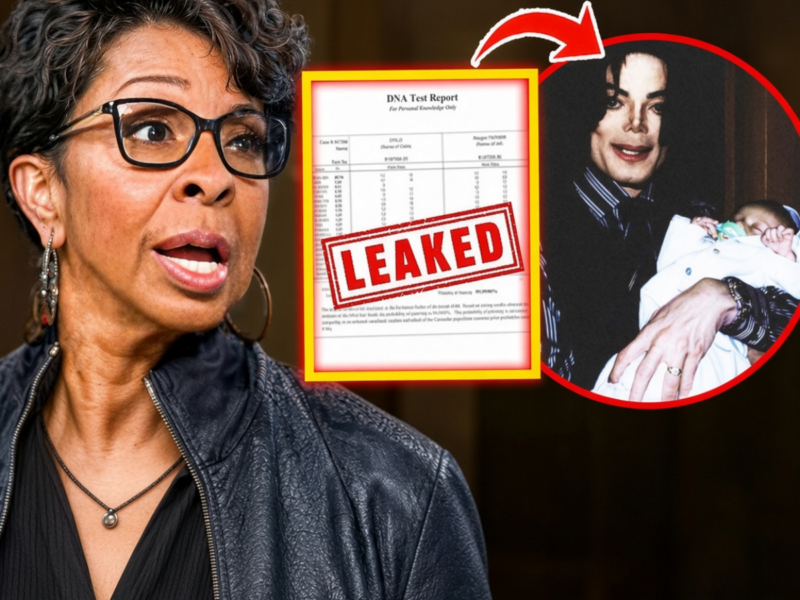
Gladys Knight FINALLY Breaks Her Silence On Michael Jackson’s Secret DNA Test.
That kind of thing—and not just saying, “Oh, I hope he go to jail.”
This isn’t merely an entertaining story.
It’s an emotional earthquake.
After years buried in obscurity, the secret of Michael Jackson’s DNA test—a matter that once captivated the world with obsessive curiosity—has finally been unveiled by the only woman brave enough to speak: Gladys Knight.
Not the media, not his family, but the one who witnessed both Michael’s brilliance and his vulnerabilities.
From the stage to backstage, from the revered icon to the wounded soul.
Gladys didn’t speak to vindicate.
She spoke to put an end to an endless pursuit—one that distorted a human being into an unending string of rumors.
And the truth she carries is unlike anything you’ve ever heard.
This isn’t just about Michael.
It’s about how society confronts belief, vulnerability, and human dignity.
Keep watching to understand why she waited until now.
And don’t forget to like, comment, and subscribe if this resonates with you.
She didn’t want to speak, but they compelled her to.
For decades, she lived by a principle: what doesn’t belong to the public, keep it private.
But now everything has spiraled out of control.
They dissect even blood relatives, then force the rest to bear witness to things they had no part in creating.
Gladys Knight sat silently by the window, the late afternoon sun filtering through the curtain, illuminating her age-spotted hands.
Outside, the press was buzzing again about a test result—some young boy.
An old rumor dusted off, gilded, made to seem real.
They claimed he had 99.9% DNA matching Michael’s.
A number, a name, a news article.
But for her, it was a sharp pang that echoed back to the past.
The name Brandon Howard—a young singer, someone who once stood backstage, looking at Michael with a gaze she would never forget.
There was something in that look, not mere admiration, but a kind of searching, as if he was trying to fit his life into a frame already poised to shatter.
The press didn’t care if it was true or not.
They just needed a headline.
And he tragically was caught between fragile hope and the emptiness of rumors.
Michael once told her one night in Vegas when everyone else had left, leaving just the two of them with a cold pot of tea on the table: “They don’t see me, Gladys. They see a story, not a soul.”
She never forgot that line.
He was thin, pale then, his voice tired, but his eyes bright.
No one saw him as a person anymore, but as a symbol to scrutinize, to discuss, to write more things that weren’t in the script of his life.
People often called her the Empress of Soul and Michael the King of Pop.
But to her, those two titles were never strong enough to conceal the true loneliness of two young brown children from long ago, standing in the Motown studio trying to sing loud enough to be heard, to be seen.
There were boardrooms where the voices of people like them had to be filtered through two or three layers of white glass.
And then when someone like Michael reached the pinnacle, he was dragged down by stories about who was father and who was child—as if all he left behind was genetic material.
People told her that silence was wise, but silence was also a wound.
For years, she avoided all questions, not out of fear, but because she knew any answer would be interpreted in ways no one could foresee.
She once received an anonymous letter stating that if she spoke, someone would send her an audio recording from the lab in Beverly Hills.
But in the end, there was nothing but a deep male voice reading the number 99%.
The DNA test rumor began around 2006 when Brandon was unexpectedly mentioned on a talk show, and an anonymous source—of course, close to the family—claimed a secret test had been performed years earlier.
In fact, Brandon himself had once denied being Michael’s son, but the press wouldn’t let it rest.
A young man with light skin, similar features, and a voice with some comparable ranges—that was enough to construct a storyline.
Gladys knew Michael well enough not to need a DNA test.
She had seen how he worried about each of his children, sometimes even too cautious, too reserved, as if fearing that life would take them away as it had taken away his own private life.
Michael didn’t talk about bloodlines.
He talked about love, about care, about responsibility.
“DNA is not love,” she remembered him saying during their last phone conversation.
What troubled her wasn’t the rumor, but the way everything repeated over and over again.
A person of color, rising amidst a wall of prejudice, just reaching the peak, only to be pulled down by questions a white person would never have to answer.
If Brandon were someone’s child, would he need 99.9% to be believed?
Or was it just because the name he carried was too heavy?
In the long shadow of history, people like her and Michael understood that sometimes the truth isn’t enough to be acknowledged.
They needed more proof, a certification, a number.
And then those very things were doubted, distorted—just like how people once viewed her.
A Black artist couldn’t sing soul like that unless she’d been through something intense.
They didn’t understand.
Music doesn’t come from pain, but from endurance.
She didn’t know the truth about Brandon.
And she didn’t need to know, because she knew Michael.
She knew he wasn’t the type of person to seek tests to prove anything.
If he had known, he probably would have chosen silence as she once did.
But this time she spoke out not to confirm, but to remind that some things should be kept in silence, because not every story needs a clear ending.
Not every secret should be exposed just to satisfy the curiosity of strangers.
She knew there would be doubters again.
But she also knew there were people—those who grew up amidst doubt, who had their very existence questioned—who would understand.
She didn’t lift her head when she walked onto the stage that day, not because she feared the crowd, but because she knew their eyes were anticipating something else.
Not a song, but a confirmation.
But Gladys Knight wasn’t a bearer of news.
She carried memories, and for the first time in years, she decided to share them.
In many people’s eyes, this was a symbolic statement.
But for her, it was simply a moment when silence was no longer possible.
She wasn’t young anymore.
Her old friends were falling away like late autumn leaves.
And Michael’s name, like a ripple in her chest, always made her choke up whenever someone mentioned him with a look of suspicion, not affection.
She wouldn’t accept that.
Michael once called her an anchor in the media storm.
And in 1993, that fateful year, fraught with so much doubt, she was the one Michael turned to.
Not for help, not for legal advice, but to simply sit still, to breathe.
In a world where every inhale he took could be interpreted as a motive.
They didn’t talk much, but Michael’s eyes then said it all.
A person slowly wasting away because he had to prove who he was.
Even after giving everything he had.
She once sat in Michael’s kitchen.
His hands trembled as he poured tea—not from cold, but from being put in a position where he had to clarify what shouldn’t have needed clarifying.
Was he truly the father?
No one prepares for such questions, especially a soul that had been fragile since childhood.
In her eyes, he was no longer a superstar, but a boy standing between two worlds—on one side, immense expectations; on the other, invisible boundaries preventing someone like him from being simply believed and loved.
And that’s why Gladys chose silence all these years.
Not because she didn’t know, but because she didn’t want to contribute to the public’s callousness.
A single drop can overflow the cup when people are too thirsty for rumors.
She had witnessed many Motown children crushed in that entertainment machine where skin color sometimes made you have to say more, explain more, prove more—for the same action, the same mistake.
This time she spoke, not to defend, but to remind.
She stated clearly: “Michael was not the type to fight paternity battles in public or use DNA as a tool for validation.”
She didn’t need scientific validation, no official stamp of approval.
She knew from Michael’s eyes when he spoke of his children.
No need to call them by name—just saying “the kids” was enough.
The way he adjusted Prince’s sleeve before going out.
The way he watched Paris silently sing a tune.
And the tight hug he gave Blanket whenever the boy was startled by the crowd of cameras.
Only those who have lived on the same frequency realize love is not in the genetic code.
It’s in the memory, in the way he sacrificed personal moments for his children’s peace.
People can argue their whole lives about a piece of DNA, but they will never understand the feeling of raising children under the spotlight where every smile is analyzed as evidence.
Gladys is not a loud person, but the words she spoke that day—softly, without raising her voice—calmed so many waves.
The hall was silent when she finished.
No one stood up to applaud.
They didn’t need to, because what had just happened wasn’t a speech, but a gesture from a loved one, someone within the circle, someone who knew what the world didn’t.
The rumor might still continue.
Brandon Howard might still be named whenever a story about Michael surfaces in the news.
But from that day on, one thing changed.
The focus was no longer on the authenticity of a test sample, but on the silent question in the audience’s heart: whether we ever forgot the true person behind the legend.
Because Michael didn’t need to be vindicated by numbers.
And she, Gladys Knight, who holds a piece of Motown history in her heart, didn’t need people to agree.
She just needed to speak out just once—that some truths don’t need verification because they have been lived by breath, by heart, by sleepless nights beside the child one considers their entire world.
There is a kind of silence that doesn’t come from fear, nor from indifference, but from a choice.
The kind of choice that can only come from those who have lived long enough, experienced enough pain to understand that not everything needs to be said.
Gladys Knight belongs to that kind of person.
People often equate silence with avoidance.
But for Gladys, it was a different kind of voice—deeper, profound, and sometimes more powerful than noisy answers.
They didn’t understand that every time she refused to comment, it wasn’t because she knew nothing, but because she didn’t want Michael Jackson’s name to be once again dragged into the cycle of doubt and judgment.
She had seen it consume him, like an inescapable loop.
Every time he tried to prove something, he was pulled deeper into a vortex of loss.
Gladys didn’t need to prove she was a confidant.
She lived with Michael during the years when fame was just a veneer covering a boy drained by the very things people admired him for.
She once heard him whisper in a darkened studio after an overly long performance: “I just want peace.”
And she understood, because there are some people—especially people of color from the Motown era—who are never truly left in peace, always standing on the boundary between recognition and suspicion, especially when they succeed beyond the stereotypes others impose.
The rumors about DNA tests, about Brandon Howard’s identity, about vague relationships—none of it was unfamiliar to Gladys.
She had heard them for a long time.
Every article, every phone call, every subtly probing inquiry.
There were whispers backstage, and once an old friend in the industry even stated definitively, “You know that test really exists.”
But Gladys remained silent.
Not because she didn’t believe in the truth, but because she didn’t believe in the way truth was consumed like fast food for a public hungry for news.
In some ways, she also carried a sense of guilt—not because she had hidden anything, but because she couldn’t stop the world from hurting someone who was already so vulnerable.
The price of fame for Michael wasn’t public scrutiny, but the fact that he no longer had the right to keep anything private, even the matter of fatherhood.
She knew very well Michael never wanted to make any test public.
If there was one, it would have been something he kept to himself—an act born of love, not to prove anything to the world.
For him, love didn’t come from a drop of blood, but from sleepless nights, from a comforting embrace when a child had nightmares, from an unconditional presence.
She once saw him lull his children to sleep himself without asking for help—just a lullaby and hands that were no longer steady.
These things, she believed, could not be measured by a test result.
When she finally spoke, Gladys didn’t choose to correct or refute.
She simply spoke gently, as if conversing with a long-lost friend.
“His legacy is not defined by rumors, but by his choices and his love for his children.”
A simple sentence.
Yet it contained a lifetime—both faith and forgiveness, both light and shadows.
The audience listened, and many wept—not because they received an answer, but because they realized that the truth doesn’t always need to be exposed.
Sometimes quietness is the only way to preserve the dignity of a person who was once laid bare amidst so many rumors.
For Gladys, speaking out wasn’t about seeking attention.
She only wanted one thing: for people to pause for a moment, think carefully, and remember that after all, Michael was not a symbol, not a victim, nor a suspect of any rumor.
He was a father, and that is something no one has the right to question.
Gladys Knight once made a concise statement—not recorded, no television cameras present, just during an afternoon tea with a respected elder journalist: “What isn’t real, if repeated enough, becomes real to the masses.”
People didn’t hear that quote because it wasn’t a headline, but it perfectly reflected why she always chose silence.
Because the truth, once molded by the media, ceases to be the truth.
It transforms into something else—a fabrication tailored to curiosity, to the public’s insatiable thirst.
The story of Michael Jackson’s secret DNA test exemplifies this distorted truth.
It wasn’t news.
No documents verified it.
No one took responsibility.
Yet it persisted, spread, and took root—as if its very ambiguity made it plausible.
The rumor claimed Brandon Howard was Michael’s son.
A 99.9% DNA match was splashed across covers.
With no clear source, a clipped speech video, a sensational headline, and just like that, a story was born.
No proof needed—just enough public fascination to keep it alive.
Brandon, a young singer who simply wished to pursue his craft in peace, unexpectedly became an unwilling focal point.
He never made any such claims.
He himself denied it.
But no one remembered his words, because the public isn’t interested in denials.
They only remember what’s shocking.
What makes them feel they’re in on a secret no one else knows.
Brandon wasn’t a star, but the fabricated story helped the media create the image they needed: a secret child, a hidden truth, a cover-up by those closest.
That narrative sounded far more captivating than simply nothing at all.
And when that story began airing on television, sweeping across online headlines, it transformed into a kind of dogma.
Anyone who contradicted it was deemed to be defending or hiding.
Gladys Knight was also grilled once.
A young reporter thrust a microphone close to her face, asking, “You know Brandon is Michael’s son, don’t you? Did you ever talk to Michael about it?”
She simply smiled gently.
“I talked to Michael more than you’d imagine, but not to share with you.”
She didn’t evade, but she also didn’t pander to the media, and for her, that was enough.
Not everyone is strong enough to stand outside the media’s snare.
Some who were colleagues, even friends of Michael, chose to leverage his name for attention.
They mentioned rumors, hinted at secrets, even vaguely recounted unverified conversations.
They knew they had no proof, but the media didn’t need proof.
They needed views, prominent headlines.
Every ambiguous statement was enough to turn into an entire article.
And so the cycle continued.
Truth—which should have been protected—was replaced by collective emotion.
When too many people believe something, even if it’s never been confirmed, it’s potent enough to create pressure.
That pressure didn’t come from authorities nor from insiders, but from the public—those who constantly declared, “I have a right to know.”
While forgetting that sometimes they don’t need to know everything.
Gladys Knight chose to stand outside that vortex.
She didn’t speak to deny or confirm.
She didn’t try to reclaim the truth by shouting.
Instead, she maintained silence as a form of defiance.
For her, the most precious thing one could preserve for another—especially someone no longer here to defend themselves—is respect.
And that respect, in today’s media landscape, is the rarest commodity.
It’s difficult to say whether the story of the DNA test will ever cease.
Perhaps it will resurface whenever social media stirs, whenever someone needs a new headline.
But at the very least, Gladys’s voice, though gentle, remains a landmark to remind us that some things should be left undisturbed.
Not because they are secrets, but because they are the last remnants of privacy a person who was so profoundly exposed could ever retain.
The media trap isn’t about fake news.
It’s about how readily people believe what they want to believe.
It’s about how someone, perhaps a person like Brandon, has to bear the consequences for a story that was never truly theirs.
And most painfully, it’s when people like Michael, even after leaving this world, are still not allowed to rest peacefully in memory.
Gladys knew that.
And that’s why even now she finally decided to speak.
Not to speak for Michael, but to preserve a space of quietude for him in a world that has been far too loud.
A quietude he should have had long ago.
Once, amidst the soft late afternoon light in Atlanta, Gladys Knight leaned back in an old wooden chair on her porch, recalling old times not with flowery words, but with a deep, contemplative melancholy.
“People knew Michael as the king, but few ever saw Michael as a child who needed a hug.”
That statement wasn’t meant to reclaim anything from the media.
It was like an act of cleansing—restoring the image of a human being long obscured by prejudice, speculation, and boundless curiosity.
Gladys never viewed Michael as just a phenomenon.
To her, he was a boy whose eyes always held something unspoken.
The way he would huddle beside his mother backstage at performances.
The way he would ask her about family life, about raising children, about how to ensure his children wouldn’t grow up under the shadow of fame.
All these things no one else knew because no cameras were present.
But Gladys remembered.
She remembered because that was the part of Michael the media never wrote about.
“He was more than an icon,” she said, her voice trembling not from age but from recalling fragments of memories long suppressed by the clamor.
“He was a person who just wanted peace.”
One day, Michael once confided in her that if it weren’t for music, he might have lived in some rural area, raising his children, planting trees, and baking bread every Sunday morning.
It sounded like a jest, but Gladys knew he was sincere.
With his children, Michael was a remarkably gentle father.
He never raised his voice, never scolded, and always spoke to his children as two friends.
She once witnessed Michael bend down listening to his child tell a story for ten minutes without interrupting.
“I saw love in his eyes,” Gladys recounted.
“A love that needed no verbal explanation.”
The rumors—from DNA tests to never-confirmed conspiracy theories—failed to capture the true essence of the man.
And Gladys understood that every time she remained silent, it wasn’t because she had nothing to say, but because she didn’t want anyone to exploit her words to continue harming him.
It’s difficult to protect someone when the whole world feels entitled to dissect them.
But that’s why she had to choose the right moment, the right way, and the right sentiment to speak out.
People might describe Michael by his titles, awards, sold-out concerts, but few mention that he was a man who often cried.
He once called Gladys just to say he felt weary that day because too many people wanted him to be something he wasn’t.
He never cried on stage, but in those unseen nights, he became so fragile it made one feel tender.
Gladys recalled a time when Michael had just finished a major tour.
Instead of throwing a party or celebrating, he sat quietly in a darkened room, playing soft jazz and listening alone.
When she arrived, he simply said, “I just want one day where no one calls my name.”
That’s when she realized that behind the dazzling stage lights, Michael wasn’t seeking adulation—he sought peace.
Something that seemed simple but was a luxury for him.
We, the audience, are accustomed to viewing public figures as symbols rather than as human beings with emotions and limitations.
But it’s these small stories, these unfilmed moments, that reveal the real person behind the brilliance.
For Michael, fame was a glittering cloak that sometimes became too heavy.
And only those like Gladys, who walked with him through the quiet journeys, truly knew this.
She once said, “The saddest thing for an artist isn’t when people forget them, but when they only remember a part they never were.”
For Michael, his legacy isn’t in rumors, nor in DNA tests, but in every tender gesture he gave his children.
Every song he wrote when the world was asleep.
Every time he remained silent instead of arguing.
That’s the Michael Gladys Knight wants people to remember.
A human being, not a character.
And if she had to recount it, she would only tell it in the gentlest voice, like humming an old song, without ostentation.
Because she believed that kindness and compassion, though not in the news, not in headlines, would endure longer than any rumor.
Michael, in Gladys’s eyes, was never perfect, but he was kind.
And in a world where kindness is increasingly difficult to preserve, that is perhaps the greatest legacy he left behind.
Not in a laboratory, not on a tabloid cover, but in the silent memories of those who genuinely cared for him.
She didn’t cry, nor did her voice tremble.
Only her gaze was distant, both warm and profound.
At her age, Gladys Knight no longer needed to explain or defend anything.
What she had seen, heard, and lived with Michael Jackson was perhaps enough for her to understand.
Sometimes speaking out isn’t liberation, but an ending.
And sometimes choosing to remain silent is also a way to offer a final expression of love.
No one forced her to speak, but no one was patient enough to wait for her to utter a word.
For two decades, generation after generation, scandal after scandal, Michael’s name kept resurfacing amidst an unending series of questions.
From his skin color, face, voice, and gender, to the most unsettling aspect—his lineage.
DNA tests, real or fake.
Half-hearted declarations.
Persistent rumors that no one confirmed.
All of these things.
For someone who was a friend, a confidant like Gladys, surprisingly, weren’t what troubled her.
Rather, it was how easily a human being was transformed into an endless subject of entertainment.
“Some truths, if they are truly truths, perhaps shouldn’t even be made public. Not out of fear, but out of respect,” Gladys said.
Her words were as soft as a whisper.
Yet they left a deeper impression than any accusation.
She didn’t criticize Brandon, the alleged secret son of Michael, nor did she mock the media.
But she couldn’t hide her weariness.
As if, after all those years witnessing her friend being dragged into meaningless spirals, she finally needed to say something.
Not to protect a truth, but to affirm a boundary.
People might not understand Gladys, but anyone who lived through the years when people of color were viewed with apprehension—anyone who stood on the sidelines of the stage simply for not being bright enough—would understand why she cherished Michael’s privacy so deeply.
Because for people of color, not every spotlight brings glory.
Some lights only expose vulnerability and make one a target for attack.
And Michael, who always lived amidst a dazzling glare, was also the one who had to learn to retreat into the shadows to protect his family’s peace.
Gladys recalled, “Michael once told me, ‘I don’t want my children to grow up having to explain me.'”
Those words, seemingly gentle, turned out to be the ultimate declaration of a father.
A man who once sang for the whole world, but never truly sang for himself.
A man who brought laughter to millions but struggled to find a moment of quiet in his own home.
For a long time, Gladys chose to stay out of the fray.
She didn’t comment, didn’t speak out, didn’t agree, nor did she refute.
As an artist who witnessed the Motown era being twisted into mere amusement, she understood clearly: the more one spoke, the more the truth was elongated.
And when the media could no longer distinguish between truth and rumor, silence was the only way to preserve dignity.
This isn’t the first time a friend of Michael’s has spoken out.
But perhaps this is a rare instance where the words carry no controversy—only a message that Michael is no longer here to answer, but that doesn’t permit anyone to define his truth for him.
That human beings, even famous ones, have a right to not be constantly mentioned.
And that not all secrets are wrong.
Some things are kept not to conceal, but to preserve.
Gladys took no sides.
She didn’t defend Michael, nor did she judge Brandon or the public.
But she stated plainly: “We need to learn to treat famous people as human beings, with hearts, with a desire for peace.”
At an age where she has nearly completed her journey, Gladys had no reason to speak out other than one kindness—a sentiment that transcends career, transcends fame, and even transcends unending rumors.
For her, protecting her friend wasn’t about revealing secrets, but about maintaining the necessary quietude so they could rest in peace, both when alive and after.
And when that plea was made, no one applauded.
There was no sensationalism, only a profound silence—a silence that anyone who heard Michael sing “You Are Not Alone” understands.
Sometimes the greatest thing a person leaves behind isn’t music, but the way they are preserved by others, even after all the stages have gone dark.
Every song must eventually conclude.
But the way we lay down the instrument, the way we allow the final echo to linger—that is the most beautiful farewell.
And that, too, is what Gladys Knight chose.
A message not for the media, not for scandal, but for hearts still gentle enough to listen.
Because when all the noise has passed, what ultimately remains is not the truth, but how we treated each other.
Gladys Knight broke her silence not to satisfy curiosity, but to remind us of something more crucial than any rumor: kindness and respect for a person who lived, loved, and contributed in this noisy world.
Choosing to listen instead of rushing to judgment is perhaps the most humane act.
Michael Jackson’s legacy doesn’t lie in sensational articles, but in the love he held for his children, for his music, and for life itself—quietly yet profoundly.
And Gladys’s gentle statement is a reminder that not every secret needs to be revealed.
And not everyone has an obligation to answer the public’s curiosity.









