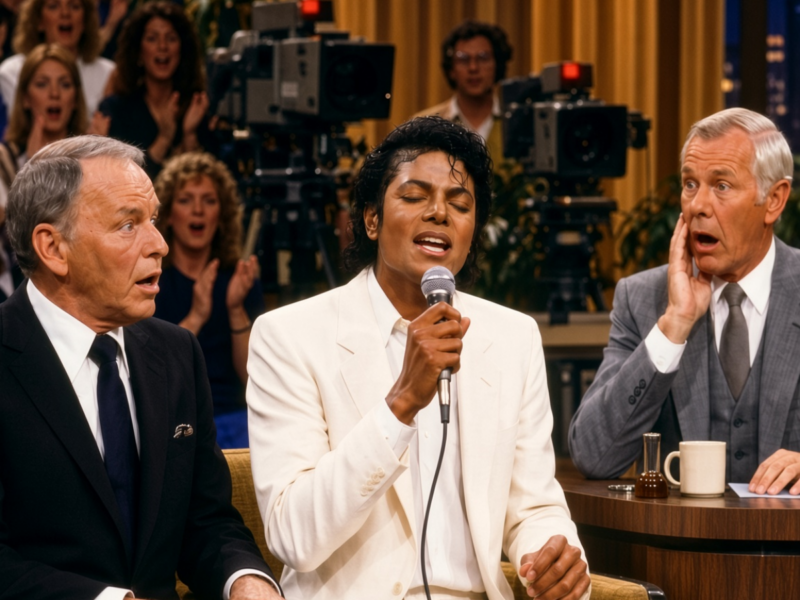
Frank Sinatra Dared Michael Jackson to Sing ‘My Way’ Live — Her Broken Voice Left Him Frozen.
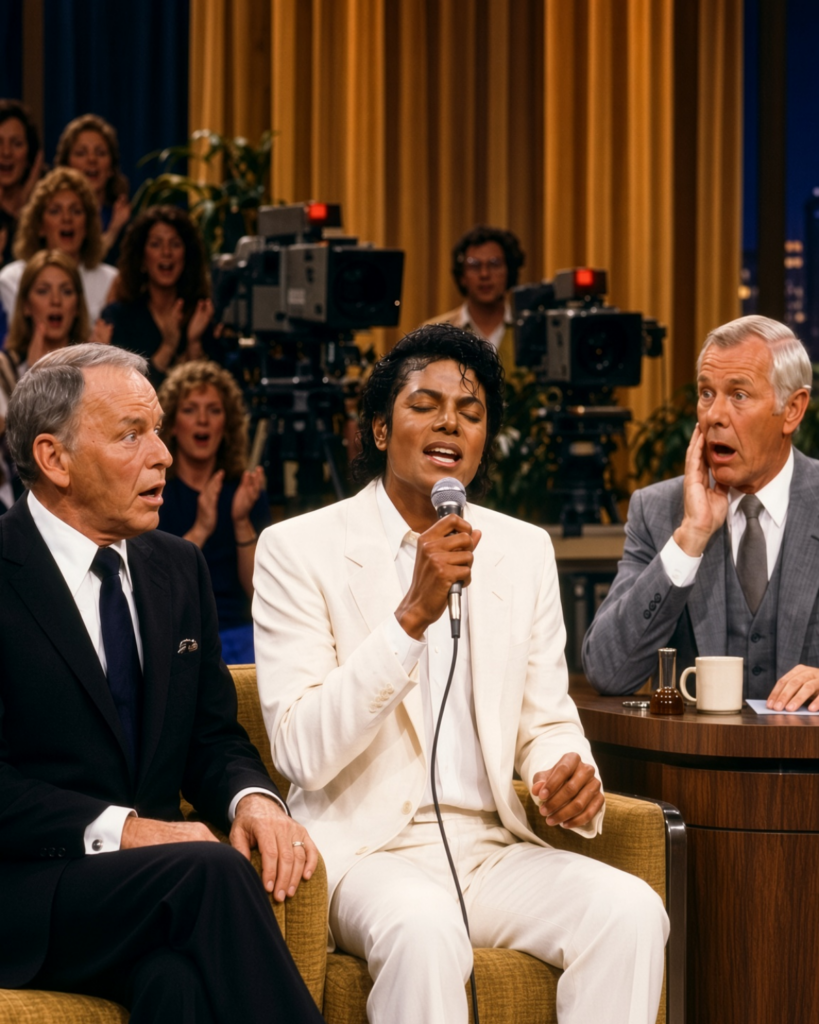
Frank Sinatra held the microphone out across the couch like a man offering somebody the last cigarette in the pack.
“You sing everybody’s songs, kid,” he said.
“Let’s hear you sing mine.”
Michael Jackson looked at the microphone.
He didn’t take it.
The studio laughed because Frank had said it with that little tilt of the head, and because it was Frank, and when Frank Sinatra teased somebody on television, you laughed.
That was the rule.
Ed McMahon laughed the loudest, a big round sound from the end of the couch.
Doc Severinsen’s band gave a quick brassy sting, the kind they used when a joke landed.
But Frank wasn’t joking.
Not all the way.
“Which one?” Michael asked.
His voice was so soft that the boom microphone overhead had to dip a few inches to find it.
Frank smiled.
“You know which one.”
Three hundred people in the audience at NBC Studio 1 in Burbank knew which one, too.
A sound moved through the seats.
Half a gasp and half a giggle.
The sound of a crowd that has just realized it might be watching something it’ll be talking about at breakfast for the next thirty years.
Johnny Carson had a pencil in his right hand.
He’d been tapping the eraser against his desk all night the way he always did.
The tapping stopped.
“Frank,” Johnny said.
“The young man came here to talk about his tour.”
“The tour’s over,” Frank said.
“He told us himself, so he’s got the night off. Let’s hear him do something with it.”
More laughter, bigger this time.
Relieved.
Frank leaned back into the gold couch and crossed one leg over the other, his dark suit perfect, the white pocket square folded just so.
He was sixty-nine years old.
He had turned sixty-nine only a few days earlier, and someone in the audience had shouted, “Happy birthday, Frank,” when he walked out, and he’d pointed at them and winked like they were old friends.
Michael sat on the next cushion over in a white suit with his hands folded together on his knee.
He was twenty-six.
He had sold more records that year than anyone alive.
His album Thriller had been sitting on top of the world for so long that people had stopped being surprised by it.
He’d won eight Grammys in a single night that February.
He danced on a television special and changed how an entire generation of kids walk down a hallway.
And right now, in front of America, he looked like a boy who had been called on in class and didn’t know the answer.
“Mr. Sinatra,” Michael said, “that’s your song. I couldn’t.”
“Sure you could. Nobody sings that song but you.”
“Plenty of people sing it,” Frank said.
“Every drunk in every bar from here to Jersey sings it. I’m asking you to sing it like you mean it.”
There it was.
The room got quieter.
Johnny looked over at Ed.
Ed looked down at his hands.
Up in the control booth, the director leaned toward his monitors and said something to the camera operators through their headsets.
Something like, “Stay on Michael. Stay on Michael. Don’t you dare cut away.”
Because everybody who worked on that show knew the difference between Frank kidding and Frank serious.
And this was the serious one, dressed up as the kidding one.
Michael finally reached out.
He took the microphone from Frank’s hand.
His fingers were long and very thin.
And Johnny noticed the way a man who’d sat behind that desk for twenty-two years noticed everything.
That they weren’t quite steady.
Then Michael did something nobody expected.
He didn’t laugh it off.
He didn’t make a joke.
He turned and looked off to the side of the stage toward the dark wing where the guests come in, as if he was checking whether somebody was standing there.
Nobody was.
He looked back at Frank.
“Okay,” he said quietly.
“But I’m going to sing it the only way I know how.”
Frank shrugged.
“That’s all I’m asking.”
Neither of them knew yet that this was not true.
Frank was asking for a great deal more than that.
And Michael was about to give him something he had never given anybody.
Not on a stage, not in a studio, not even in a room alone with his own mother.
The night had started like any other big night at the Tonight Show.
It was December of 1984.
Outside in Burbank, the air was cool and dry and smelled faintly of the eucalyptus trees along the studio lot.
Inside, the place was buzzing because the guest list had leaked to the newspapers a day early, and people had lined up along the sidewalk on Alameda Avenue since before lunch.
Frank Sinatra and Michael Jackson on the same couch.
Nobody could quite picture it.
Frank was the old world.
He was tuxedos in Las Vegas and smoke curling up from a cigarette under a single spotlight.
He was the voice that had come out of every kitchen radio in America during the Second World War.
He’d outlasted bobby-soxers, rock and roll, the Beatles, disco, and three or four people who had announced in print that his career was finished.
Michael was the new world.
He was the glove and the moonwalk and the music videos that MTV played every hour.
He was a young man who had been famous since he was eleven years old, the little one at the front of the Jackson 5, the kid with the big voice and the bigger smile, standing in front of his four older brothers on the Ed Sullivan Show in 1969.
Johnny had booked them for different reasons.
Frank was there because Frank had a new album and because Frank at sixty-nine was still selling out every room he played.
Michael was there because the Victory Tour had just ended.
That tour had been the biggest thing in music all year.
Michael and his brothers, all six of them together in football stadiums from Kansas City to Philadelphia to Dallas.
Fifty-five shows, more than two million tickets.
The papers had written about it every week, about the money, about the arguments over ticket prices, about the fights among the business people around the family.
And then, less than two weeks earlier, on the very last night of the tour at Dodger Stadium in Los Angeles, Michael had walked to the front of the stage and said something that made forty thousand people go quiet.
He said this was their final farewell, that this was the last time the brothers would perform together like this.
His brothers had found out the same way the audience did, standing behind him under the lights.
The papers had a field day.
Some said he was cold.
Some said he was brave.
Some said he was finally a grown man stepping out on his own.
Michael hadn’t said a word to any of them.
He hadn’t given a single interview since that night until Johnny Carson called.
Johnny introduced him at the top of the second half.
The band played a few bars of “Billie Jean,” and Michael walked out from behind the curtain, and the audience lost its mind.
People stood up on their seats.
A girl in the third row screamed so loud that Doc’s trumpet player lowered his horn and laughed.
Michael gave a little wave and a smaller bow and sat down on the couch next to Frank, who had been introduced first and who now leaned over and shook his hand.
“Nice to meet you, kid,” Frank said, loud enough for the microphones.
“It’s an honor, sir,” Michael answered.
Frank seemed to like the sir.
He patted Michael’s knee.
For the first fifteen minutes, it was lovely television.
Johnny asked Michael about the tour, and Michael talked about the stage they’d built, how big it was, how they’d had to drive it from city to city on dozens of trucks.
He told a funny story about a pet snake he kept at home, a boa constrictor named Muscles, and Johnny pretended to climb up on his desk in horror.
The audience laughed.
Frank laughed.
Then Johnny asked about the last night.
The farewell.
Michael’s smile changed.
It didn’t go away, but it went somewhere further back.
“It was time,” was all he said.
“Was it hard?” Johnny asked.
Michael looked at his hands.
“Everything that’s worth anything is hard, I think.”
And that was when Frank Sinatra leaned forward.
“You know what you need, kid?” Frank said.
“You need a song for nights like that. A song for when you walk away from something and everybody’s watching you do it.”
The audience knew what was coming.
You could feel it.
A few people started clapping before Frank had even said it.
“I got just the one,” Frank said, and he reached across Michael’s lap, took the hand microphone off the little table where a stagehand had left it during the break, and held it out.
What happened backstage before the show is the part nobody in that audience knew about.
About an hour before taping, Frank Sinatra had been walking down the long beige hallway behind Studio 1, the one with the framed photos of old guests along both walls.
He liked to walk before a show.
He said it settled his stomach.
Two of his people walked a few steps behind him, quiet the way they always did.
At the end of the hall, outside dressing room number four, he saw a young man sitting on the floor.
Not on a chair.
On the floor, with his back against the wall and his knees pulled up.
He wasn’t wearing his white jacket yet, just a plain shirt and a hat pulled down low.
It took Frank a second to recognize him.
Michael Jackson was sitting on the floor of a hallway at NBC with a little transistor radio held against his ear.
The volume was so low that Frank couldn’t make out what was playing.
Michael’s eyes were closed, his lips were moving very slightly, as if he were singing along without any sound at all.
Frank stopped.
He watched for a moment.
Then Michael opened his eyes, saw who it was, and scrambled to his feet so fast he nearly dropped the radio.
“Mr. Sinatra, I’m sorry, I didn’t—”
“Sit down. Sit down,” Frank said.
“You’re fine. What are you listening to?”
Michael hesitated.
Then he turned the radio around so Frank could see it, like that would explain something.
It was an old thing.
The plastic yellowed, a crack running across the dial that somebody had mended with tape.
“Just a station,” Michael said.
“It’s an old radio. I’ve had it since I was little.”
Frank looked at it.
He looked at the tape.
He looked at the young man holding it.
The most famous entertainer on earth, standing in a hallway in his socks.
“Where’s your people?” Frank asked.
“In the dressing room. I just wanted to be someplace quiet for a minute.”
Frank nodded slowly.
He knew all about wanting to be someplace quiet.
He’d spent forty years trying to find one.
“I read what you did at the ballpark,” Frank said.
“The farewell thing.”
Michael’s whole body went still.
“Took guts,” Frank said.
“Or something.”
“Or something,” Michael repeated very softly.
Frank studied him for another long moment.
He was a man who had made his living reading rooms, reading audiences, reading the faces of bandleaders and studio bosses and men across poker tables who were deciding whether or not to call.
And what he read on Michael Jackson’s face that night was something he recognized all the way down in his bones.
It was the face of somebody who had just walked away from the only thing he had ever known and who wasn’t sure at all that he’d done the right thing.
Frank had worn that face once, a long time ago, in 1942.
He didn’t say anything else.
He just tapped the old radio with one finger, nodded, and kept walking down the hall.
But by the time he reached his own dressing room, he had already decided what he was going to do on the show that night.
He was going to hand that kid a microphone and make him sing “My Way.”
Not to embarrass him.
That’s what everybody in the studio would think, and Frank knew it.
He was going to do it because a song like that is a test.
Either you can stand up and sing it and believe every word, or you can’t.
And if you can’t, Frank figured, then you’d better find out now at twenty-six instead of at sixty-nine.
What he didn’t know, standing in that dressing room adjusting his cuff links, was what was playing on that little radio.
And he had no idea what it meant to Michael.
Back on the couch, Michael held the microphone in his lap for a moment without lifting it.
Johnny leaned across the desk.
“You don’t have to do this, Michael,” he said, and the audience laughed again, but more nervously now.
“Frank’s been doing this to people since the Truman administration.”
“Eisenhower,” Frank corrected him.
The laugh was bigger.
Frank was good at that.
He could let the air out of a room with one word and then pump it back up with the next.
Michael smiled a little at that.
Then he leaned toward Doc Severinsen, who was standing at the front of the band with his trumpet tucked under his arm and a glittering jacket that looked like it had been sewn together out of a disco ball.
“Doc,” Michael said.
“Could you have the piano play it slow? Just piano. And lower. Much lower than Mr. Sinatra does it.”
Doc raised his eyebrows.
“How low?”
Michael thought about it.
“Low enough that I can’t hide.”
Doc didn’t laugh.
He looked at Michael for a second, nodded, and walked back to the piano player, a gray-haired man named Ross, who had been with the band for years.
They talked quietly.
Ross nodded and moved his hands over the keys without pressing them, finding the place.
Frank watched all this with a small frown.
It wasn’t what he expected.
He’d expected the kid to make a joke, maybe do a little dance, sing the first line in a funny voice, and toss the microphone back.
That’s what most people did when Frank pushed them.
He’d seen grown men with Oscars on their mantles do exactly that.
Michael didn’t do any of it.
He sat up straight on the couch.
He set his feet flat on the floor.
He closed his eyes.
“Ready?” Doc asked.
“No,” Michael said.
That got a laugh, too.
A small one.
But Michael wasn’t joking.
And after a second, the laughter faded out on its own.
“But go ahead,” he said.
Ross played the opening.
It didn’t sound like the record.
On Frank’s version, there’s a bigness to the beginning, strings and a kind of grand sweep, like the curtain going up on a man’s whole life.
What Ross played was quieter than that, just a few soft chords, low and slow, with space between them.
It sounded like somebody sitting alone at a kitchen table late at night.
Michael lifted the microphone.
The first notes he sang were almost a whisper.
People who were there that night said later that they had to lean forward in their seats to hear him.
He didn’t sound like Michael Jackson.
He didn’t sound like the kid with the hiccup and the shout and the high-flying voice from the radio.
He sounded younger than that somehow, and older at the same time.
The pitch Doc had chosen sat right at the bottom of his range, where his voice was thin and a little husky, and he didn’t try to push it into anything bigger than it was.
He sang the first verse like he was telling a story to somebody in a hospital bed.
About the end coming near.
About facing the final curtain.
About a friend he wanted to explain something to.
Frank’s eyebrows went up.
He had heard “My Way” sung a thousand times by a thousand people.
He’d heard it at weddings and funerals and retirement parties.
He’d heard it in Japanese and Spanish and Italian.
He’d heard Elvis do it in a white jumpsuit with a full orchestra blasting behind him.
Most people who sang that song sang it like a victory lap.
Chest out.
Big finish.
Look at me.
Look at what I did.
Michael was singing it like a confession.
Johnny put his pencil down on the desk.
Ed McMahon, who usually filled every silence on that show with a chuckle or a hi-yo, sat perfectly still with his big hands on his knees.
Michael moved into the second verse.
His voice was finding its footing now, rising just a little.
And there was something so careful about how he handled each word that it was almost painful to listen to.
He wasn’t performing.
There were no moves.
There was no dancing.
He sat on a couch in a white suit and sang with his eyes closed and his free hand pressed flat against his chest.
The audience, which had been buzzing and giggling five minutes earlier, was now completely silent.
Not a cough, not a whisper.
A woman in the second row had her hand over her mouth.
Frank shifted on the couch.
He was watching Michael’s face very closely now.
The little smile he’d been wearing when he handed over the microphone was gone.
Then Michael reached the part of the song about regrets.
Everybody knows the line, the one where the man says he’s had a few, but too few to bother talking about.
Frank had sung it ten thousand times with a shrug in his voice, like a man brushing a speck of dust off his sleeve.
Michael started that line, and his voice cracked right down the middle.
It wasn’t a small crack.
It wasn’t the kind of wobble a singer covers with a breath or a little run.
It broke the way a dish breaks when you drop it on a tile floor.
The note just came apart in his throat.
He stopped.
Ross kept playing for one more bar, not sure what to do, then let his hands fall still on the keys.
Michael opened his mouth to try again.
Nothing came out.
He shut his eyes tighter.
His hand was still pressed against his chest, and now everyone could see it was trembling.
He tried once more.
He got two words out.
On the third, his voice cracked again.
Worse this time, a high, broken sound that the microphone caught and sent right out over the speakers and into ten million living rooms across America.
Then he lowered the microphone into his lap and sat there with his head down.
Nobody moved.
That’s the moment everyone who was in that studio still talks about.
Not the singing.
The silence after it.
Johnny Carson, who had handled every kind of live disaster you could imagine, drunk guests and wild animals and a man who once set fire to his own sleeve, sat behind his desk without saying a word.
The red light on camera 2 stayed on.
In the control booth, the director had his hand hovering over the button for a commercial break, and he didn’t press it.
And Frank Sinatra, who had started all this, who had grinned and held out that microphone like a dare, sat on that gold couch, completely frozen.
He wasn’t looking at the audience.
He wasn’t looking at Johnny.
He was looking at the young man next to him, and the expression on his face was one that people who’d known Frank for decades said they had only seen on him a handful of times in his whole life.
He looked scared.
Not for himself.
For the kid.
Michael was breathing in short little pulls, like someone trying very hard not to cry in public and losing.
“Hey,” Frank said quietly.
It came out rough.
He cleared his throat.
“Hey, kid.”
Michael didn’t look up.
Frank leaned closer, so close their shoulders nearly touched.
The boom microphone above them dipped down.
The sound man in the booth would say later that he thought about pulling it away, giving them privacy, and then decided that whatever was about to be said, it should be heard.
“What is it?” Frank asked.
“What happened?”
For a long moment, Michael didn’t answer.
When he did, his voice was so small that Johnny had to lean across his desk to catch it.
“I can’t sing that part,” Michael said.
“Because it isn’t true.”
“What isn’t true?”
Michael lifted his head.
His eyes were wet.
He looked at Frank.
Not at the cameras, not at the crowd.
Just at the old man beside him.
“The whole song is about a man who did it his way,” Michael said.
“Every choice, every mistake, all his own. And I was sitting here singing it, and I realized—”
He stopped and swallowed.
“I don’t think I’ve ever done anything my way. Not once. Not in my whole life.”
Frank didn’t say anything.
He just waited.
“I was five years old the first time I sang in front of people,” Michael said.
“I didn’t choose that. I was eight when we started rehearsing every day after school. I didn’t choose that either. I didn’t choose the songs. I didn’t choose the steps. I didn’t choose the clothes or the cities or the hotels. Somebody always chose for me.”
The audience was so quiet you could hear the hum of the studio lights.
“Last week at Dodger Stadium,” Michael went on, “that was the first time I ever decided something big all on my own. And I did it in front of forty thousand people. And I didn’t even tell my brothers first, because I knew if I told them first, somebody would talk me out of it. Somebody always talks me out of it.”
He looked down at the microphone in his lap.
“And I’ve been waiting all week to feel like it was mine. Like I’d done it my way. And I don’t feel that. I just feel like I heard everybody.”
Frank Sinatra closed his eyes for a second.
When he opened them, he didn’t look like the Chairman of the Board anymore.
He looked like what he was underneath all of it, a sixty-nine-year-old man from Hoboken, New Jersey, who had made a great many decisions in his life and who knew exactly how much some of them had cost.
“Kid,” he said, “can I tell you something nobody knows?”
But before Frank could say another word, Michael said something else.
Something about that little radio in the hallway.
And it would leave Frank Sinatra speechless in front of the whole country.
“You saw my radio,” Michael said.
“Backstage.”
Frank nodded.
“You asked what I was listening to.”
Michael gave a tiny, embarrassed laugh through his tears.
“I wasn’t listening to the station. There’s a tape player in the side. It’s broken, but it still plays one tape. It’s been in there since I was a little boy.”
He reached into the inside pocket of his white jacket.
Everybody watched.
He pulled out the old radio, the cracked yellow one with the tape across the dial.
He’d had it on him the whole time.
He held it in both hands.
“When we lived in Gary, Indiana,” Michael said, “we had a little house. Two bedrooms, nine kids. My father worked at the steel mill, running a crane. And when he came home, we rehearsed every day. Hours. If we missed a step, we started over. If we sang a note wrong, we started over.”
He turned the radio over in his hands.
“Across the street, there was a park with a baseball field. And in the summer, I could see the other kids playing out there from our front window while we rehearsed. I used to watch them. I’d be singing and dancing, and I’d be looking out the window at them running the bases. And sometimes I cried, because I wanted to be out there so bad.”
A woman in the audience made a soft sound, and the man next to her put his arm around her.
“My mother knew,” Michael said.
“She always knew. And at night, after everybody was asleep, she used to come and sit by the bed I shared with my brothers, and she’d let me listen to this radio with one earphone in. She said, ‘You pick whatever you want to hear. It’s your turn to pick.'”
He held up the radio a little.
“That was the only thing in my whole childhood that I got to pick,” Michael said.
“And what did you pick?” Frank asked.
He looked at Frank.
“And what I picked most nights was you.”
Frank Sinatra didn’t move.
“My mother had one of your records,” Michael said.
“I don’t know where she got it. She didn’t have much money for records. It was an old one from the ’50s. She taped it onto a cassette so I could listen in bed. And this is the tape.”
He tapped the radio gently.
“This is what I was listening to in the hallway tonight. That same tape. I’ve had it since I was seven.”
Johnny Carson had taken off his glasses.
He was holding them in one hand on the desk.
“I used to lie there and listen to you,” Michael said.
“And I used to think, that man gets to sing whatever he wants. Nobody tells him the steps. Nobody tells him start over. He just stands there and sings, and everybody listens. And I thought, that must be the freest person in the whole world.”
His voice wobbled again, and he steadied it.
“So when you handed me that microphone tonight,” Michael said, “I wasn’t scared of the song. I was scared because it was you. Because you were the man on the tape, and I didn’t want you to find out that I’ve never been free at all.”
Nobody in that studio breathed.
Frank stared at the little yellow radio in Michael’s hands.
For several seconds, he didn’t seem able to look away from it.
Then something happened that the crew members would talk about for years afterward.
Frank Sinatra’s eyes filled up.
He put one hand over his face, just for a moment, pressing his fingers against his eyelids.
When he took it away, his jaw was tight.
“Well,” he said, and his voice was rough.
“Now I got to tell you something, since we’re doing this.”
Frank leaned back against the couch.
He looked up at the lights for a second, as if they might help him find the words.
“That song,” he said.
“‘My Way.’ You know how many times I’ve sung it?”
Michael shook his head.
“Neither do I. Thousands. Every show, every night. People expect it. If I don’t sing it, they think somebody’s sick.”
A few people in the audience laughed softly, gratefully, because it gave them something to do with all that held breath.
“And you want to know a secret? I can’t stand it.”
Johnny actually turned in his chair.
“Frank, it’s true,” Frank said.
“I’ve told my kids. I’ve told my piano player. I’m telling America now. I hate that song. Everybody thinks it’s my life story. And every time I sing it, I feel like a liar.”
Michael was looking at him now.
Really looking.
His own tears forgotten for the moment.
“That line,” Frank said.
“The one you couldn’t get through. About regrets. About only having a few. Too few to talk about.”
He laughed, but there was no fun in it.
“Kid, I’ve got more regrets than this whole studio’s got seats. I just learned to sing that line fast so nobody would notice.”
The audience had gone completely still again.
“You know what I did in 1942?” Frank asked.
“I was singing with Tommy Dorsey. Best band in the country. Tommy took me in when I was a skinny nobody from Hoboken. Taught me how to breathe. Taught me how to hold a note so long people thought I had a third lung. Everything I know about phrasing, I learned standing next to that man, watching him play the trombone.”
He shook his head slowly.
“And then I walked out on him. I wanted to go out on my own, and he didn’t want to let me go, and it got ugly. Lawyers. Money. A lot of money. Things got said that couldn’t be unsaid. Everybody wrote that I was brave, that I was a big shot. Frankie going solo. Frankie doing it his way.”
He looked down at his own hands, the big gold ring on his pinky catching the light.
“I wasn’t brave,” Frank said.
“I was twenty-six and I was scared to death, and I heard a man who’d been good to me. And I spent years telling myself it was the right thing so I wouldn’t have to feel that.”
“Twenty-six,” Michael whispered.
“Same as you,” Frank said.
“Same exact age.”
The two of them looked at each other.
Something passed between them that the cameras could see but couldn’t quite capture.
Something like recognition.
“So when I saw you in that hallway tonight,” Frank said, “sitting on the floor with your little radio, I saw that face, and I knew it. I knew it because I wore it. And I thought, I’m going to hand this kid the song and see if he can sing it. Because if he can sing it straight and mean it, then he’s okay. Then he’s got something I didn’t have.”
He paused.
“And you couldn’t sing it,” Frank said.
“And that’s the best thing you could have done.”
Michael frowned, confused.
“Why?”
“Because you’re honest,” Frank said.
“I sang it for fifteen years and never had the guts to stop in the middle and tell the truth. You did it in front of the whole country on your first try.”
He reached over and put his hand on Michael’s shoulder.
It was a big, heavy hand, an old man’s hand, and Michael didn’t pull away.
“Let me tell you about another regret,” Frank said more quietly.
“Since we’re telling the truth tonight.”
He took a breath.
“My mother,” Frank said.
“Her name was Dolly. Everybody in Hoboken knew her. She was a tough little woman, about this tall.”
He held his hand at the height of the couch arm.
“She ran the whole neighborhood. Ran my father. Ran me. When I was a kid, she was the one who pushed. She wanted me to be an engineer, go to college, do something respectable. And when I said I wanted to sing, she threw a shoe at me.”
The audience laughed, and Frank smiled a little, his eyes far away.
“Then when she saw I meant it, she pushed the other way. Pushed me harder than anybody. Got me into every club, every contest, every radio show she could find. She never let me quit. Never.”
Michael was nodding slowly.
He understood that kind of mother.
He understood that kind of pushing from both sides.
“In January of 1977,” Frank said, “I was opening at Caesars Palace in Las Vegas, and I wanted her there. She didn’t like to fly. She was scared of airplanes her whole life, and I talked her into it anyway. I chartered a little jet to take her from Palm Springs to Vegas. Twenty minutes in the air. I told her, ‘Ma, it’s nothing. You’ll be there before you know it.'”
His voice dropped.
“The plane went into a mountain in a snowstorm. They didn’t find it for three days.”
Nobody in the studio made a sound.
“Every night since then,” Frank said, “I go out on a stage and somebody in the band starts playing that song, and I got to stand there and sing about how I did it all my way. And you know what my way did? My way put my mother on that airplane.”
His hand tightened on Michael’s shoulder.
“So don’t you sit here and think you’re the only one who can’t sing that line,” he said.
“I can’t sing it either. I just never stopped long enough to let anybody see.”
Johnny Carson turned slightly away from the camera.
Ed McMahon reached into his breast pocket for a handkerchief and didn’t bother hiding it.
Michael looked at Frank for a long, long time.
Then he did something nobody expected.
He reached up and put his own hand over Frank’s, the one on his shoulder, and held it there.
“I’m sorry about your mother,” Michael said.
“Yeah,” Frank said.
“Me too, kid. Me too.”
For a while, neither of them said anything at all.
The band sat still.
The audience sat still.
Up in the booth, a producer named Fred de Cordova, who had been running that show for over a decade and had seen just about everything, was standing with his arms crossed and his headset pushed back, and he said to nobody in particular, “Leave it. Leave it running. Nobody touch anything.”
So they left it running.
Finally, Frank took a breath and sat up straighter on the couch.
When he spoke again, some of the old Sinatra had come back into his voice, the gravel and the snap.
“All right,” he said.
“Here’s what we’re going to do.”
Michael looked at him.
“You’re going to sing it again.”
Michael shook his head immediately.
“Mr. Sinatra, I can’t.”
“Not my way,” Frank said.
“I’m done with my way. My way has been sung to death. Sing it your way.”
“I don’t have a way,” Michael said.
“That’s what I’m trying to tell you.”
“Sure you do,” Frank said.
“You had it when you were seven years old in that bed in Gary, Indiana, with one earphone in, picking what you wanted to hear. That kid had a way. Nobody took it from him. He just hasn’t been allowed to use it in a while.”
Michael was quiet.
“Change the words if you want,” Frank said.
“Change the key. Change the tempo. Sing it backwards for all I care. But whatever comes out of your mouth this time, make it yours. Not mine. Not your father’s. Not the record companies’. Yours.”
He nodded at the radio still sitting in Michael’s lap.
“For that kid,” Frank said.
“The one watching the ball game out the window.”
Michael sat with the microphone for a long time.
He looked down at it, then out at the dark audience, then at Doc Severinsen’s band, then he turned to Ross at the piano.
“Could you start over?” he asked.
“But this time, don’t play the chords from the record. Just play one note low and keep playing it, and I’ll come in when I’m ready.”
Ross looked at Doc.
Doc nodded.
Ross pressed a single low key and held it.
Let it ring out, then pressed it again.
And again.
Steady, slow, like a heartbeat, like someone knocking very gently on a door.
Michael stood up.
The audience gasped just a little.
He hadn’t stood up the first time.
He walked a few steps out from the couch toward the front of the stage until he was standing alone on the open floor between Johnny’s desk and the audience, in his white suit, under the lights.
He held the microphone in one hand and the old yellow radio in the other.
He listened to Ross’s note four or five times.
Then he started to sing.
He didn’t start with the first verse.
That was the first thing people noticed.
He started somewhere in the middle, with a line about the man saying he planned each step along the way.
And he didn’t sing it like a statement.
He sang it like a question, as if he were asking himself whether that was true, whether anybody ever really plans each step.
His voice was still thin, still low, still bruised from cracking a few minutes earlier.
But it didn’t wobble now.
It just sounded tired and honest, like a person speaking at three in the morning after the house has finally gone to sleep.
Ross at the piano started adding chords under the note very softly, following him instead of leading.
Michael went back to the beginning.
Then he sang the opening verse again, but he changed things as he went.
Small things.
He slowed down on words Frank had always rushed past.
He stretched out a phrase in a way that made it sound almost like a gospel hymn, the kind of slow rising line you’d hear at a little Baptist church in Gary on a Sunday morning.
He took a part that Frank always belted and sang it so softly that the boom microphone barely caught it.
And the strange thing was, it worked.
It worked better than anybody in that room would have believed.
The song stopped sounding like a rich old man looking back on his triumphs.
It started sounding like a young man standing at the very beginning, trying to figure out how to become someone he could live with.
Frank sat on the couch and watched him.
His hands were clasped between his knees.
He didn’t move a muscle.
Michael came to the regrets part again.
Everyone in that studio held their breath.
Johnny’s hand was flat on the desk.
Ed had stopped dabbing his eyes with the handkerchief and was just holding it.
Michael stopped walking.
He closed his eyes.
Ross held a chord under him and waited.
And then Michael did something that made Frank Sinatra lean forward on the couch as if someone had pulled him by a string.
He changed the line.
He didn’t sing that he’d had a few regrets.
He didn’t sing that they were too few to mention.
He sang, very slowly, in his own words, that he’d had more than he could count, and that he was going to mention every single one of them, and that he wasn’t afraid of them anymore.
His voice cracked again on the last word.
But this time, he didn’t stop.
He let it crack.
He sang right through the crack, and the broken note came out raw and real and somehow more beautiful than any perfect note could have been.
Somebody in the audience let out a sob.
It echoed in the quiet.
Michael kept going.
He sang about facing things alone.
He sang about standing tall.
But every time the original song puffed its chest out, he took the air back out of it.
Every place where Frank would have punched a note, Michael held it gently, like something that might break.
By the time he came to the last verse, he had made the whole song into something else entirely.
It wasn’t a victory anymore.
It was a promise.
A young man promising a little boy in a window that someday, somehow, things would be different.
He reached the very last line, the big one, the one where Frank always threw his arm out wide and the orchestra hit like thunder.
Michael didn’t sing it.
He stopped.
Ross stopped.
The whole room seemed to stop, and Michael Jackson turned around and looked at Frank Sinatra on the couch and held out the microphone.
It took Frank a second to understand.
Then Michael said quietly, “Will you sing the end with me? But not the way you always do. The way you would have if nobody was watching.”
Frank Sinatra stood up.
He was sixty-nine years old and his knees weren’t what they used to be, and he took a second to straighten up.
Then he walked across the stage, the band watching, the cameras following, and stood next to Michael in the middle of the floor.
He didn’t take the microphone.
He put his hand on top of Michael’s, and they held it together between them.
Ross played the last few chords again, very slowly.
And for the first time in fifteen years, Frank Sinatra sang the last line of “My Way” without any fight in his voice.
He sang it soft.
He sang it low.
He let Michael carry the melody, and he sang a harmony underneath it, the way Tommy Dorsey had taught him to sit underneath a trombone line back in 1940.
His voice, which by then had gotten rough and dark with age, wrapped around Michael’s thin, young voice and held it up from below.
It wasn’t loud.
There was no big finish, no arm thrown out, no orchestra.
Just two men from two completely different worlds, one at the end of his road and one at the beginning of his, holding the same microphone and singing the same words in a way that neither of them had ever sung anything before.
The last note faded out.
Nobody clapped.
For five full seconds, the entire studio sat in silence.
Then the silence went on to ten.
Then fifteen.
Johnny Carson would say years later that in all his time hosting that show, he never once heard an audience that quiet after a song.
Then a woman in the very back row stood up.
She didn’t clap.
She just stood.
Then the man beside her stood.
Then a whole row.
Then the next row.
And still nobody was clapping.
They were just standing there, three hundred people on their feet in absolute silence, looking at the two men in the middle of the stage.
And then, all at once, as if somebody had opened a dam, the applause came.
It came like a wave.
It went on and on.
People were crying and clapping at the same time.
Doc’s band was on its feet.
The camera operators had stepped out from behind their cameras.
Ed McMahon was standing up at the end of the couch with his handkerchief in one hand, clapping against his own leg with the other.
Frank put his arm around Michael’s shoulders.
Michael put his head down for a moment against Frank’s shoulder, just for a second, like a tired kid.
Then he straightened up and gave the audience a small, shy bow.
Frank leaned toward him and said something that the boom mic didn’t catch, but a stagehand standing right behind them did.
And years later, he said Frank’s words were, “That one was yours, kid. All yours. Don’t ever let anybody take that back.”
The applause was still going when one of the producers came hurrying out from behind the curtain on the left side of the stage.
That never happened during a taping.
Producers stayed in the booth.
But this one was half running, holding a small piece of paper, and he went straight to Johnny’s desk and handed it to him.
Johnny read it, then he read it again.
He looked up at Michael.
“Michael,” Johnny said, “there’s a phone call for you in the booth. They want to know if you’ll take it on the air.”
Michael looked confused.
“Who is it?”
Johnny looked at the paper one more time.
“It’s your mother.”
The audience made a sound.
Michael’s hands went to his face.
Katherine Jackson had been watching the show at home.
The family had a big house in Encino by then, on a street called Havenhurst, behind a gate, a long way from the two-bedroom house in Gary.
She had been sitting in the den in front of the television set when her son broke down on that couch.
And when he pulled out that little yellow radio, she had stood up and walked straight to the telephone in the kitchen and started calling NBC.
It took her four tries to get past the switchboard.
The operator at the network hadn’t believed her at first.
Johnny looked at the control booth.
Fred de Cordova, up behind the glass, held up one hand, then gave a thumbs up.
“Put her through,” Johnny said.
There was a crackle over the studio speakers, a pause, then a woman’s voice, soft and warm, with the gentle drawl of someone who’d grown up in Alabama and spent her life in Indiana.
“Michael.”
Michael stood very still in the middle of the stage.
“Mother,” he said.
“Hi.”
The audience went quiet again.
“I saw you, baby,” Katherine said.
“I saw the whole thing.”
“I’m sorry,” Michael said quickly.
“I didn’t mean to talk about all that on TV. I didn’t mean to—”
“Hush,” his mother said.
“You don’t apologize to me. Not for that.”
Michael lowered his head.
“I’m calling,” Katherine said, “because there’s something you don’t know about that tape. And Mr. Sinatra should hear it, too, if he’s there.”
Frank stepped closer to the speaker.
“I’m here, ma’am.”
There was a pause on the line.
When Katherine spoke again, her voice was shaking just a little.
“Mr. Sinatra, I want you to know that record didn’t come from a store.”
Frank frowned.
“In 1965,” Katherine said, “we had nothing. Joseph was working at the steel mill and playing guitar on weekends, and we had eight children in two bedrooms. I couldn’t buy records. But there was a church rummage sale in Gary on a Saturday, and they had a box of old records for a nickel apiece. Most of them were scratched up. And I found one of yours at the very bottom of the box. An old one. It didn’t even have a sleeve.”
Frank was listening very hard.
“I bought it for a nickel,” Katherine said.
“I hid it, because Joseph only wanted the children listening to the music he picked for them. He said it was business, and I understood that. I did. But I wanted my children to have one thing that was just for them. So I borrowed a friend’s tape recorder, and I taped your record onto a cassette, and I gave it to Michael with that radio. He was the youngest one at the time who couldn’t sleep. He’d lie awake. He always had so much going on in his head.”
Michael wiped his face with the back of his hand.
“And I want to tell you what he said to me,” Katherine went on.
“The first night he listened to it, he was seven. I came to take the earphone out because I thought he’d fallen asleep, and he grabbed my hand and he said, ‘Mama, does that man get to pick his own songs?'”
Frank put one hand over his mouth.
“And I told him, ‘Yes,'” Katherine said.
“I told him, ‘Yes, baby. That man picks his own songs.’ And Michael said, ‘Then when I grow up, I want to pick mine.'”
The studio was dead silent.
“So you see, Mr. Sinatra,” Katherine said, and now her voice did break.
“My son has been trying to sing your way since he was seven years old. Not your song. Your way. The way you picked. That’s what he wanted his whole life. And tonight, when you told him to sing it his own way—”
She stopped.
When she went on, it was barely a whisper.
“Tonight’s the first time I ever heard him do it.”
Michael turned away from the cameras and pressed both hands over his eyes.
Frank stood there in the middle of Johnny Carson’s stage, an old man in a beautiful suit, and couldn’t say anything at all.
He tried once.
He opened his mouth and nothing came.
He closed it and looked at the floor.
Finally, he cleared his throat.
“Mrs. Jackson,” he said.
“You raised a good man.”
“I know,” Katherine said, and some of the audience laughed through their tears at how simply she said it.
“But thank you for saying it on national television. His father might be watching.”
That got a bigger laugh, a warm one.
Even Michael laughed, a small wet sound behind his hands.
“Michael,” his mother said.
“Yes?”
“Your brothers called me tonight before the show. All of them.”
Michael lowered his hands.
“They’re not angry anymore,” Katherine said.
“Jermaine said to tell you he understands. Tito said to tell you to eat something. And Marlon said—”
She paused, and you could hear her smiling.
“Marlon said to tell you that he’s proud of you. That somebody in this family had to be the first one to pick his own song.”
Michael didn’t say anything for a while.
He just stood there nodding, over and over, with his eyes closed.
“I love you, Mother,” he said finally.
“I love you, too, baby. Now, let the man finish his show.”
The line clicked off.
Johnny Carson sat behind his desk for a few seconds without saying anything.
Then he looked straight into camera 2, the way he did at the end of every show when he said good night.
But this time, he didn’t say good night.
He said, “I’ve been sitting at this desk for twenty-two years, and I don’t think I’ve got a single joke for this. So we’ll take a break, and when we come back, well, I don’t know what happens when we come back. Stick around.”
The band played softly into the commercial, and for the next three minutes, while the network ran ads for dish soap and cars, nobody in Studio 1 said a word.
After the taping, the hallway behind Studio 1 filled up the way it always did.
Assistants with clipboards, security guards, network people in nice suits trying to look like they hadn’t been crying.
Somebody had already called the newspapers.
Frank Sinatra walked down the same beige hallway he’d walked before the show.
His two men walked behind him.
When he got to dressing room number four, he stopped.
The door was open a crack.
He knocked.
“Come in,” a soft voice said.
Michael was sitting on the floor again.
Same spot, same position, back against the wall.
Except this time, he was inside the dressing room, on the carpet beside the makeup mirror, still in his white suit, with the old yellow radio in his lap.
Frank looked at him.
Then, slowly, with a little grunt, he lowered himself down and sat on the floor beside him.
One of Frank’s men looked at the other one.
In twenty years, neither of them had ever seen Frank Sinatra sit on a floor.
Frank waved them away.
They closed the door.
The two of them sat side by side in silence for a minute or two.
The only sound was the buzz of the lights around the mirror.
“How old’s that radio?” Frank asked.
“Nineteen years,” Michael said.
“Older than some of the guys in Doc’s band.”
Michael laughed a little.
“Can I hear it?” Frank asked.
“The tape?”
Michael looked at him in surprise.
Then he nodded and pressed the cracked button on the side of the radio.
There was a whir, a hiss, and then, very faint and scratchy, through a tiny speaker that rattled on the low notes, came a voice from a long time ago.
A young Frank Sinatra, thirty-some years old, singing a slow ballad from the ’50s.
The needle hissing on the old nickel record underneath.
The tape stretched and wobbly from being played too many thousands of times.
Frank sat and listened to his own voice from thirty years earlier, coming out of a dented radio in the hands of a young man who had grown up on it.
He didn’t say anything until the song was over.
Then he reached over and pressed stop.
“I don’t sound that good anymore,” he said.
“You sounded good tonight,” Michael said.
“Tonight I sounded honest,” Frank said.
“That’s different. Took me sixty-nine years.”
They sat for a while longer.
“Can I ask you something?” Michael said.
“Shoot.”
“When you left Tommy Dorsey, did it ever get better with him?”
Frank was quiet for a long time.
“Some,” he said finally.
“Not all the way. We worked together again a few times. Shook hands. Smiled for the pictures. But I never sat down with him and said I was sorry. I kept thinking there’d be time. And then he was gone. Choked in his sleep in 1956. I was on a movie set when I heard.”
He looked over at Michael.
“Don’t do that,” Frank said.
“With your brothers. Don’t wait. You can walk away from the act. That’s your right. That’s your business. But don’t walk away from them. Those are two different things. I didn’t know that at your age. I’m telling you so you don’t have to learn it the way I did.”
Michael nodded slowly.
“And one more thing,” Frank said, and his voice changed.
It got a little harder, more businesslike.
“You know what I did in 1960?”
Michael gave a small shake of his head.
“I started my own record company,” Frank said.
“Reprise. You know why? Because I got tired of men in offices telling me what to sing. Which songs. Which arrangements. Which band. So I got my own label. After that, nobody picked my songs but me.”
He tapped the floor with one finger for emphasis.
“Your mother told you that man picks his own songs. Well, here’s how he does it. He owns them. You hear me? It’s not enough to write them. It’s not enough to sing them. You got to own them. The songs, the masters, the paper. Whoever owns the paper owns your way. Don’t you ever forget that.”
Michael was looking at him with an expression Frank couldn’t quite read.
Then Michael smiled.
It was a strange, private smile.
“I’ve been thinking about that, actually,” he said.
“Yeah?”
“There’s a catalog of songs,” Michael said.
“A big one. A lot of old songs I love. I’ve been told it might be for sale next year. Everybody says it’s too much money. Everybody says I’m crazy.”
Frank grinned for the first time since the song.
A real Sinatra grin.
The one that had been melting people since 1943.
“Kid,” he said.
“Everybody said I was crazy, too. Buy it.”
Michael laughed out loud.
It was the first time all night he’d laughed like that, all the way, without holding anything back.
Then Frank reached into his jacket pocket and pulled out something small and folded.
It was a single sheet of paper, creased many times, the edges soft and gray.
“Here,” he said.
“I want you to have this.”
Michael unfolded it carefully.
It was a piece of sheet music.
“My Way.”
The original arrangement, the piano part, with pencil marks all over it.
Little notes in the margins.
Breath marks.
Arrows.
And at the line about regrets, somebody had drawn a hard, dark circle in pencil, pressed so hard it had nearly torn the paper.
“That’s my copy,” Frank said.
“From the first session in ’68. I’ve carried it to every show since. It’s my lucky piece. Superstition, I guess.”
Michael touched the dark circle around the regrets line.
“What’s this?”
“That,” Frank said, “is where I always remind myself to sing fast so nobody notices I’m lying.”
Michael just stared at him.
“I don’t need it anymore,” Frank said.
“You fixed that part tonight.”
Michael held the paper in both hands for a long time.
Then he reached for a pen from the makeup table.
He looked at Frank as if asking permission.
Frank nodded.
Underneath the dark circle, in small, careful handwriting, Michael wrote one word.
“All.”
Then he folded the sheet back up and handed it back to Frank.
“No,” Michael said.
“You keep it. But now when you get to that part, you’ll see that, and you won’t have to sing it fast.”
Frank unfolded the paper and looked at the word for a long moment.
All.
As in, I’ve had them all.
I’ll mention them all.
Every regret.
Every one.
He folded it again and put it back in his pocket, right over his heart, and patted it once.
“Deal,” he said.
They got up off the floor together.
Frank’s knees cracked.
Michael laughed and offered him a hand, and Frank took it.
At the door, Frank stopped and turned around.
“Hey, kid.”
“Yes, sir?”
“That baseball park across the street in Gary.”
Michael’s face went still.
“You’re twenty-six,” Frank said.
“You got more money than God. You could build yourself a whole ball field. A whole park. Merry-go-round, train, whatever you want.”
Michael looked at him for a moment.
Then he smiled.
“Maybe I will.”
“Do it,” Frank said.
“And then go outside and play in it. That’s an order from the Chairman of the Board.”
And he walked out into the hallway, and the door swung shut behind him.
What happened after that night is part of history now.
The clip was never officially rebroadcast.
For years, people who’d been in the audience described it to their friends and their children and couldn’t quite make anyone believe it.
A few people had recorded it off the television on their home VCRs, and copies of copies were passed around, grainy and flickering, among fans in both camps.
In August of 1985, less than a year later, Michael Jackson bought the ATV music catalog for more than $47 million.
It held thousands of songs, including most of the Beatles catalog.
Almost everybody in the music business told him it was too much money.
He bought it anyway.
When a reporter asked him why, he said only that he had learned from someone he admired that a man should own his own songs.
He never said who.
In 1987, he released Bad.
It was the first album of his career on which he wrote most of the songs himself.
He picked them.
He picked the arrangements.
He picked the videos and the dancers and the cities on the tour.
For the first time, from top to bottom, it was his.
And in 1988, Michael Jackson bought a ranch in the Santa Ynez Valley, up in the hills north of Santa Barbara.
He called it Neverland.
He put in a train, a Ferris wheel, a merry-go-round, a zoo, a movie theater.
He invited children there by the busload.
Sick kids and poor kids and kids from children’s hospitals, and he let them play all day long.
In later years, Michael explained in interviews that he’d built it because he never had a childhood, that he’d watched other kids play through a window, that he wanted a place where the window was gone.
People who knew him said that in his private office at Neverland, on a shelf behind his desk, there sat an old cracked yellow transistor radio with tape across the dial.
Nobody was allowed to touch it.
As for his brothers, the Jacksons did reunite.
Not every year, not all the time, but there were dinners and birthdays and holidays at the house on Havenhurst.
In 2001, all six brothers stood together onstage again at Madison Square Garden in New York.
Michael had insisted on it.
Frank Sinatra kept singing “My Way” until the very end of his career.
But the musicians who played behind him in his last years noticed something.
Somewhere in the late 1980s, Frank started singing the regrets line differently.
He slowed down on it.
He stopped rushing.
He would let it sit there in the air for a second, sometimes two, and he’d close his eyes.
And sometimes he’d put his hand on his chest, just over the inside pocket of his tuxedo jacket.
A piano player who toured with him for years said once that Frank always carried a folded piece of old sheet music in that pocket.
The piano player asked about it one night in a hotel bar.
Frank pulled it out, unfolded it, and showed him one small word written in pencil in somebody else’s handwriting under a dark circle.
Just that one word.
“All.”
“What’s that mean?” the piano player asked.
Frank folded it back up.
“It means a kid taught me how to sing my own song,” he said.
“Took me sixty-nine years to learn it.”
Frank Sinatra died on May 14th, 1998, in Los Angeles.
He was eighty-two years old.
Sometime after the funeral, a reporter asked Michael Jackson about him.
Michael didn’t talk about the music or the records or the movies.
He talked about one night on a television couch.
“He handed me a microphone,” Michael said.
“And I thought he was trying to embarrass me. He wasn’t. He was trying to give me something. He was trying to give me permission. Nobody had ever done that. Not like that.”
He stopped for a moment.
“People think ‘My Way’ is a song about winning,” Michael said.
“It isn’t. It’s a song about being honest about what it cost you. Mr. Sinatra didn’t teach me that with his voice. He taught me that by letting me see him cry.”
That night in Burbank began as a dare, an old legend testing a young one in front of the whole country, the way old legends always have.
Frank expected a laugh, a joke, maybe a clumsy little verse.
What he got was a young man’s broken voice and the truth behind it.
And when that voice cracked, Frank Sinatra didn’t laugh.
He didn’t take back the microphone.
He didn’t sing over the silence to save the moment.
He sat down beside it.
He told his own truth.
And then he stood up and sang underneath that young man, low and quiet, so the young man could finally be heard.









