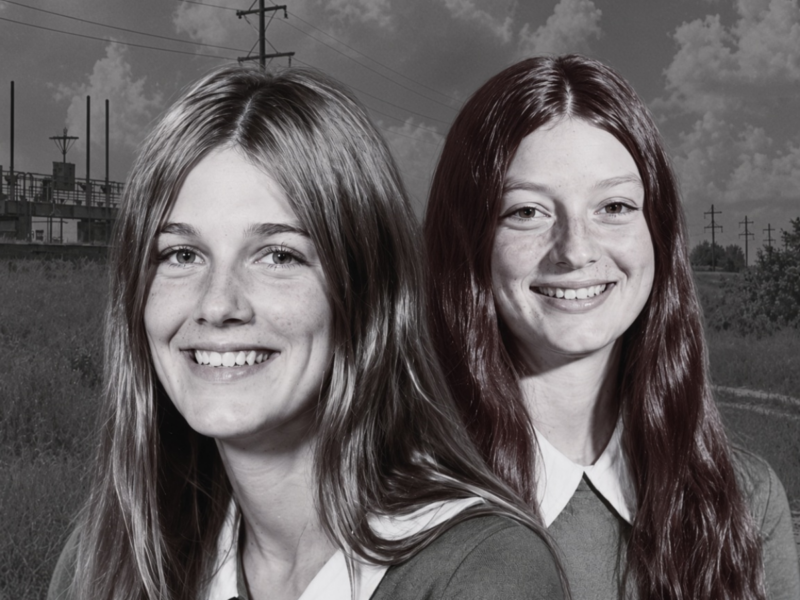
Florida 1975 Cold Case Solved — They Didn’t Make It to Their 15th Birthday.
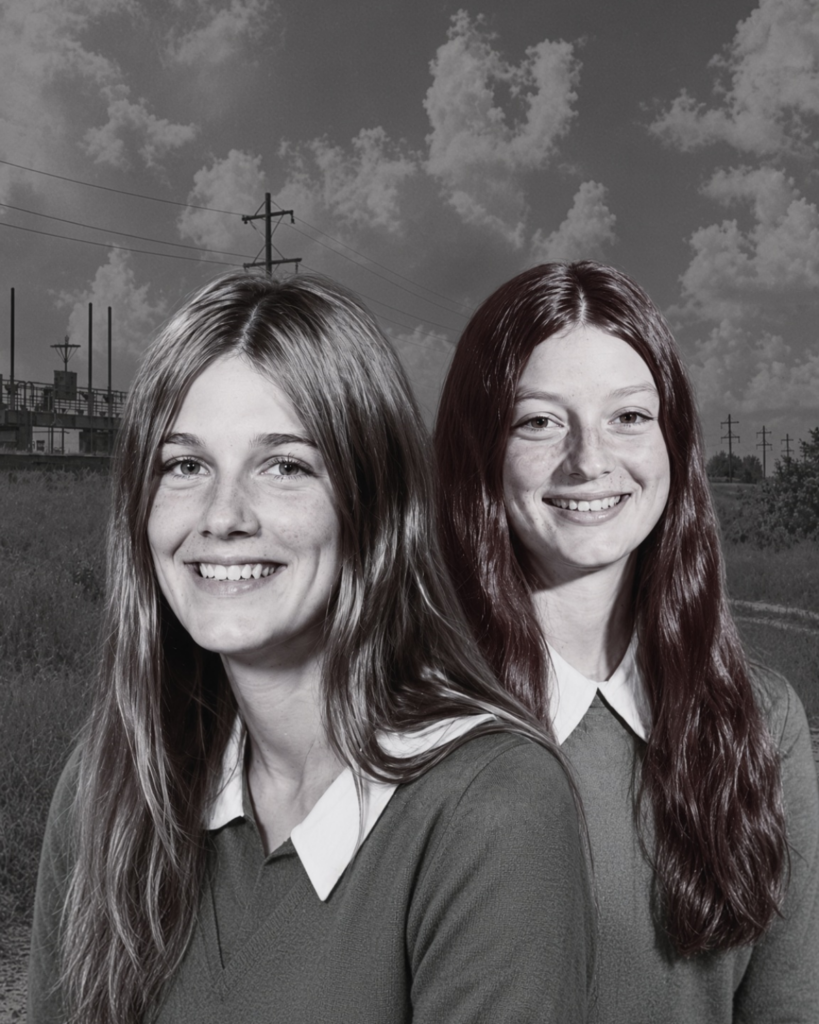
On a June day in 1975, Barbara Schriber and Darlene Zetterower, both 14 years old, sat on a bench on a busy street in Hollywood, Florida.
The girls were inseparable and they were in the middle of a carefree summer getting ready for their first year of high school together.
Like a lot of teenagers that summer, the girls weren’t shy about taking a ride from someone they didn’t know.
That evening, one came along.
No one could have imagined that neither girl would live to see their 15th birthday.
The next morning, their lifeless bodies were discovered by a family on a fishing outing in a remote area near the Everglades known as Andytown.
Over the years that followed, Broward Sheriff’s Office detectives, deputies, crime scene investigators, and crime lab personnel dedicated time and resources to finding whoever had taken Barbara and Darlene’s futures from them.
There were few answers.
Decades passed and the case grew colder than almost any other in Broward County’s history.
This is the story of what happened to two best friends on an ordinary summer evening and the case that outlived nearly everyone who first tried to solve it.
Before we continue, remember that Barbara and Darlene were only 14.
They had their lives ahead of them, families waiting for them, and people who loved them.
Today, we’re telling their story because they deserve to be remembered as more than a cold case.
If you stay with us, share your thoughts in the comments or subscribe, you’re helping make sure their names aren’t forgotten.
Let’s remember them.
Barbara Susan Schriber, Barbie to the people who knew her, was born March 21st, 1961.
Her best friend, Belinda Darlene Zetterower, was born just a couple of months earlier on January 24th of that same year.
In the summer of 1975, both girls were 14 and both had just finished eighth grade together at Attucks Middle School in Hollywood.
By every account, they spent that summer the way they’d spent a lot of time before it, together without much of an agenda, counting down toward a high school year they’d already decided they were starting side by side.
People who knew them used a specific word for how close they were, inseparable.
Barbara had a little sister Kimberly, who was only 5 years old that summer.
Kimberly’s memories of Barbara are understandably limited by age, but they’re warm ones.
She described her older sister and Darlene putting music on and dancing around the house, playing with the younger Schriber kids the way older girls do when they still find little siblings more amusing than annoying.
It’s a small, ordinary image and one of the only windows left into who Barbara actually was outside of what happened to her.
Barbara’s mother, Joyce Tate, carried the loss for the rest of her life.
In a 1979 interview with the Miami Herald, four years after the murders, Tate spoke about how profoundly her daughter’s death had changed her.
According to Kimberly, that change went beyond grief.
She has said Barbara’s murder contributed to the breakdown of her parents’ marriage.
It’s worth naming because it’s easy, decades later, to talk about a cold case as if it only involves the people on the ground.
It doesn’t.
By the time the case was finally resolved in 2025, both of Barbara’s parents and her brother had died without ever learning who was responsible.
Darlene’s family carried a version of that same weight.
Her parents, Robert and Joyce Zetterower, had roots in Savannah, Georgia before the family settled in South Florida.
Robert died in 2005, Joyce in 2001, both of them gone, like Barbara’s parents, decades before anyone could tell them a name.
Darlene herself was remembered by friends as fun-loving, full of personality, the kind of presence that filled up a room.
One of those friends, Gail Kovac, remembered Darlene clearly and remembered seeing her with Barbara on the bench that day not long before the van pulled up.
Kovac also remembered something else.
Darlene had invited her to come along with them.
Kovac’s father said no.
That’s the entire hinge point.
Not a premonition, not a warning, just an ordinary father in an ordinary house saying no to his daughter for reasons that had nothing to do with what was waiting down the road.
Decades later, once the case resurfaced publicly, Kovac described the fear she felt looking back on how close she’d come to going with them.
It’s a detail that doesn’t resolve into anything neat.
It just sits there, a reminder of how close this case came to being about three girls instead of two.
Neither Barbara nor Darlene made it to their 15th birthday.
Barbara’s would have come the following March, Darlene’s that January.
They’re buried separately today, Barbara at Fred Hunter’s Hollywood Memorial Gardens West, Darlene at Forest Lawn Memorial Gardens South in Fort Lauderdale, a few miles apart in the same county where they grew up inseparable.
That county, Broward, looked almost like two different places at once in the summer of 1975, depending on which direction you were facing from that cemetery gate.
Hollywood, where Barbara and Darlene had grown up, was in the middle of celebrating its 50th anniversary that very year, a fast-growing coastal suburb between Miami and Fort Lauderdale that had swelled past 120,000 people and taken to calling itself the Diamond of the Gold Coast.
New subdivisions were going up, retirees were moving down from the north, and on ordinary residential streets like the one near Sterling Road, kids were still outside after dinner, riding bikes, sitting on benches, not thinking twice about who might drive past.
It’s worth noting that 1975 was a different era in how casually teenagers moved around a city like that.
According to people who knew them, Barbara and Darlene hitchhiked frequently that summer, enough that it reportedly worried their parents, but not so unusual for the time that anyone would have thought to put a stop to it.
Western Broward County, on the other hand, looked almost unrecognizable as the same county.
Drive inland from Hollywood in 1975, and within a few miles, the subdivisions gave way to canals, sawgrass, and long isolated stretches of US Highway 27 running along the edge of the Everglades.
The only real landmark out there was a small highway waypoint called Andytown, little more than a gas station and a few buildings where truckers and fishermen passing through might stop.
It wasn’t the kind of place anyone from Hollywood would have had a reason to visit.
It was in that remote stretch, near Andytown, that the girls’ bodies were discovered the next morning.
That contrast, a busy, growing suburban street on one end, a nearly empty highway waypoint on the other, is the geography of this entire case.
Somewhere in the miles between those two points, two 14-year-olds’ lives ended.
By most accounts, June 18th, 1975 started like any other day that summer.
Barbara and Darlene had just received their eighth grade report cards.
According to Detective Andrew Giannino, who investigated this case decades later, the two of them were looking forward to starting high school together that fall.
Accounts differ about exactly where the girls intended to go that evening.
Some reports say they left the Schriber home telling Barbara’s mother they were going to spend the night at the house of a friend.
Some accounts mention this friend as a girl called Valerie, though little else about her is recorded.
Other reporting, drawing on Detective Giannino’s account, describes the girls as expected at a gathering that evening in Fort Lauderdale.
I’m not going to guess which version is more accurate or invent an explanation for the discrepancy.
What is clear is that wherever they were actually headed, they never got there.
At some point that evening, Barbara and Darlene were seen sitting on a bench near Sterling Road.
A white van, which some accounts describe as more of a work van or truck, pulled up with two men inside it.
Authorities believe the girls entered the van willingly, apparently accepting a ride consistent with how often they were known to hitchhike that summer.
And then they were gone.
Whatever anyone in Hollywood knew that night, it wasn’t yet that anything was wrong, just two girls who hadn’t come home when expected on a night when a lot of parents in a lot of houses assumed their kids were simply staying somewhere else.
That assumption didn’t survive the next morning.
On June 19th, 1975, a family out on a fishing trip near US Highway 27 in the stretch of wilderness a few miles north of Andytown found the girls’ bodies near a canal in that area.
Whatever the previous night had been about, a missing person’s worry, a misunderstanding about whose house they were staying at, it ended there, on a canal bank with two answers no parent wants.
The girls had been shot.
Some secondary accounts describe additional physical details of the scene, but those details aren’t established with enough confidence in the sourcing available to state as fact here, so I’ll be leaving them out rather than guess.
On the question of sexual assault, current reporting drawing on the Broward Sheriff’s Office’s modern investigation states that the girls were sexually assaulted and shot.
Some older accounts from closer to 1975 describe the physical evidence as inconclusive, and it’s worth a brief mention that the certainty of that detail has shifted somewhat over the decades.
But we won’t dwell on it.
The current official account is that they were sexually assaulted and murdered.
What was never in dispute from the very first morning was this.
Two 14-year-old girls last seen getting into a stranger’s van on a residential street were now dead in the Everglades, and whoever had done it had already vanished with nothing left behind that anyone in 1975 could use to find them.
That’s the cruelest part of working a murder in 1975, and it’s almost impossible to fully explain to anyone who’s grown up since.
It’s not that investigators lacked effort.
It’s that an entire category of evidence simply couldn’t be read yet.
DNA testing as an investigative tool didn’t exist.
If a killer left biological material behind, there was no scientific process in 1975 that could turn that material into an identity.
Investigators had a description of a van and two unidentified men, but no identified perpetrator and no clear way to get one.
What they also had though, its value wouldn’t become clear for another forty-eight years, was the girls’ clothing, carefully preserved and placed into evidence storage.
Over the decades that followed, the case moved through the hands of numerous Broward Sheriff’s Office detectives and crime lab personnel.
Each one picking the file back up, working what they could, and eventually setting it back down again.
In 2019, the Broward Sheriff’s Office established a full-time cold case unit, and Barbara and Darlene’s file was one of the ones investigators pulled back out.
It would take four more years and a piece of equipment nobody working this case in 1975 could have imagined before that clothing finally had something to say.
In 2023, forty-eight years after the murders, BSO crime scene detective Roberto Caceres used a piece of equipment called the M-Vac on Darlene’s preserved clothing.
The M-Vac uses a controlled wet vacuum process, spraying a sterile solution onto a surface while simultaneously drawing it back off to recover biological material that can be trapped in fabric long after a standard swab would come back empty.
It’s proven particularly useful for recovering trace male DNA left on clothing worn by female victims and for working with evidence that’s been sitting untouched for decades.
The testing on Darlene’s clothing produced a complete DNA profile for one man and a partial profile for a second unidentified man.
The complete profile was matched to Robert Clark Keebler.
It was the first real break the case had ever had.
It also wasn’t the end of it.
The problem revealed itself almost immediately.
Robert Clark Keebler had died in 2019, four years before his DNA would ever mean anything to investigators looking at this file.
Detectives began reconstructing who he had been.
Authorities described his criminal history as including armed robbery, sexual assault, and aggravated assault.
A documented pattern of serious violence that predated any connection to this specific case.
Investigators also learned that Keebler had been driving a white van when he came to South Florida from California and that he was arrested in a white van during a road rage incident just seven days after the girls disappeared.
It’s worth being precise about what this does and doesn’t prove.
A van and a violent record aren’t by themselves proof that a specific man committed a specific murder.
What they gave investigators was something they hadn’t had in 1975, a name that could actually be investigated, and a secondary detail, the vehicle that lined up with what the DNA was already suggesting.
Giannino wasn’t satisfied that Keebler had acted alone.
There was still that second partial DNA profile belonging, as of 2023, to no one.
Giannino spoke publicly at the time asking for any information connecting Keebler to a possible second man or to the girls themselves.
He also described how difficult it is to reconstruct a moment that occurred nearly half a century earlier, trying to work out how Keebler’s life and the girls’ lives could have crossed paths at all with almost nothing solid connecting them beyond the clothing itself.
During the renewed investigation, detectives located a witness who had never previously been interviewed in connection with this case.
That person remembered seeing the girls get into a white van or work vehicle.
This witness is a separate person from Gail Kovac, the friend who had turned down the invitation to go along that day.
Kovac has spoken publicly about the case as well, describing the fear she felt once she understood decades later how close she’d come to being there.
But it was this other previously unquestioned witness whose account gave investigators something the DNA alone hadn’t provided, direct confirmation of how that evening actually began.
She could describe how the girls disappeared.
She couldn’t tell investigators who the second man was.
That answer was still almost two years away.
By May of 2025, investigators finally had it.
The second partial DNA profile from the girls’ clothing was identified as Lawrence Stein.
Like Keebler, Stein was already dead.
He had died in 2005, twenty years before his name would be connected to this case.
Investigators said the two men had extensive criminal histories and had been suspected or charged at various points in other sexual assaults and violent crimes in Florida, California, and Arizona with a pattern reportedly dating back to approximately 1972.
Some secondary reporting has described the two men as associates.
That detail is reported rather than fully documented in what’s publicly available, so it’s worth holding loosely.
What was confirmed by the Broward Sheriff’s Office was the conclusion that mattered most.
Two men, both already dead, both tied by DNA evidence to the deaths of two 14-year-old girls in 1975.
Before we get to how this case actually ended, there’s one question worth closing off because the timeline all but demands it.
Barbara and Darlene’s murders happened during the same general period as a string of killings across Broward and what was then Dade County.
Later nicknamed the Flat Tire Murders, a series of unsolved cases involving young women and girls found dead in or near South Florida’s canals between February of 1975 and January of the following year.
Detective Giannino has said directly that he does not believe Keebler and Stein were responsible for those killings, describing the modus operandi in that series as fundamentally different from what investigators established in Barbara and Darlene’s case.
So, we won’t link the two here.
The timing overlaps.
The cases, according to the detective who investigated both, do not.
With that settled, we can go back to where this case actually ends.
On May 22nd, 2025, Broward Sheriff Gregory Tony stood in front of reporters and announced that the murders of Barbara Schriber and Darlene Zetterower had finally been solved.
Sheriff Tony’s message that day was direct.
Justice, he said, doesn’t have an expiration date, not in his organization and not in this community.
Detective Giannino described the two girls in plain terms.
They had just finished eighth grade, received their report cards, and were looking forward to high school together.
Countless dreams, he said, had been lost to senseless violence.
The Broward State Attorney’s Office reviewed the case alongside investigators and agreed with their conclusion.
Had Keebler and Stein been alive, the evidence assembled would have supported criminal prosecution.
They weren’t alive, so there would be no arrest, no trial, no courtroom moment of any kind.
The case was formally closed under a designation known as exceptionally cleared, law enforcement’s way of saying, “We know who did this and we can prove it even though no one will ever answer for it in front of a judge.”
For one family in the room that day, the announcement meant something far more personal than a legal designation.
Kimberly Schriber, the 5-year-old who once danced around the living room with her big sister, was in the room when Sheriff Tony made that announcement.
She was no longer a child.
She was a woman who had spent essentially her entire adult life without an answer and without either of her parents or her brother still alive to hear the news beside her.
At the podium, she thanked the investigators directly for not giving up and not forgetting.
She was also given something smaller and in its own way just as significant.
Among the evidence the Broward Sheriff’s Office had held for nearly five decades were two pieces of Barbara’s jewelry, a cross necklace and a ring.
After forty-nine years in an evidence room, they were finally returned to Kimberly.
Darlene’s own parents did not live to see this day, but surviving relatives were informed of what investigators had found.
That was more or less the last chapter of the case file.
But it isn’t quite the last word on what this story actually means.
It would be easy to wrap this case up as a straightforward story of opportunity.
Two teenagers, a passing van, a crime with no planning behind it at all.
That’s a tempting shape for this kind of story.
It’s also more certainty than the evidence actually supports.
There is no established evidence that Robert Clark Keebler or Lawrence Stein had a prior relationship with Barbara or Darlene.
But investigators haven’t established the opposite either, whether the encounter was planned in some way or arose in the moment.
What is clear is that the girls’ routine that summer, hitchhiking, spending unsupervised time in their neighborhood, created a situation in which two men with a documented history of violence were able to get close to them, whatever the men’s intentions were when they pulled up that evening.
The opportunity is clear.
The full intention behind it isn’t, and we won’t pretend otherwise.
It’s also worth saying plainly what this case is not.
It is not evidence that Barbara and Darlene did anything wrong by hitchhiking, or by being out that evening, or by trusting two strangers in a van the way many teenagers did in that era without incident.
Their routine explains how the opportunity existed.
It says nothing about who bears responsibility for what was done with it.









