Elvis Pulled Over at the Roadside Stand Every Car Ignored — The Blind Old Man Knew Who He Was.
Elvis Presley pulled his pickup truck off the road at a roadside stand that every other car on that road was driving straight past.
The man sitting behind it was seventy-one years old.
He had been sitting there since a little after sunrise.
By eleven in the morning, he had not sold a single thing.
Elvis watched the stand for a while from the cab of the truck with the engine still running and his cousin sitting beside him asking what in the world they had stopped for.
And then he saw it.
The one thing that was costing that old man every car that went by.
He did not know yet that it was not the only thing.
And he did not know that before he pulled back onto that road, the old man would say five words to him that would make his cousin put both hands flat on the dashboard and stare.
It was a Tuesday in March 1967, on a two-lane county road a few miles south of the Tennessee line in the flat, wide farm country of North Mississippi, where the land runs out toward the river like a tablecloth somebody has smoothed with both hands.
Elvis had owned a ranch down there for about three weeks.
He had found it by accident.
He had been driving south out of Memphis one afternoon in February and had seen a big white cross standing on a hill above a cattle pasture, and something about it made him pull over.
There was a little lake and a stone house and 160 acres of rolling grass and a for-sale sign.
By the end of that week, he owned it.
He named it the Circle G after Graceland.
That winter, Elvis was thirty-two years old.
He was about to be married.
In six weeks, he would fly to Las Vegas and marry Priscilla in a small room at the Aladdin Hotel.
But on that particular morning, all of that felt very far away.
He had spent most of the decade in Hollywood making three movies a year.
Movies with the same plot and the same songs and the same kind of ending.
Movies he had stopped believing in a long time ago.
He had come home tired in a way that sleep did not fix.
The ranch fixed it a little.
Out there, he could ride a horse all morning across the pasture with nobody watching.
He could eat breakfast on the porch of a trailer.
He could drive a pickup truck down a dirt road with the window down, wearing an old work jacket and a cowboy hat, and for a few minutes at a time be the boy who had driven a delivery truck for Crown Electric in Memphis thirteen years earlier and had never dreamed of any of the rest of it.
He had gone a little wild buying pickup trucks that month.
He bought one for himself and then one for every man who worked for him and then a few more, until his father, Vernon, sat at the kitchen table with the checkbook and put his head in his hands.
Elvis didn’t care.
He liked the trucks.
He liked the way nobody looked twice at a man in a pickup truck on a country road.
That morning, he had driven out early with his cousin Billy Smith to look at a horse trailer at a farm twenty miles south.
They had looked at it, and Elvis had bought it, of course, and now they were heading back to the ranch the long way on the county road that ran past the cotton fields and the little white churches and the mailboxes on posts.
They were about four miles from the ranch when Elvis slowed down.
Billy looked up from the map he had been pretending to read. “What is it?”
Elvis didn’t answer.
He was looking through the windshield at something on the right side of the road.
It wasn’t much.
That was the first thing anyone would have noticed.
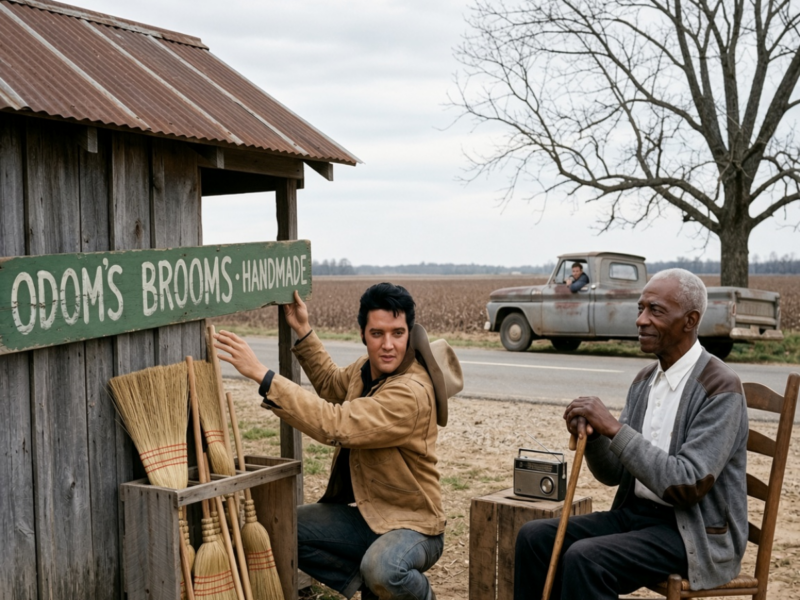
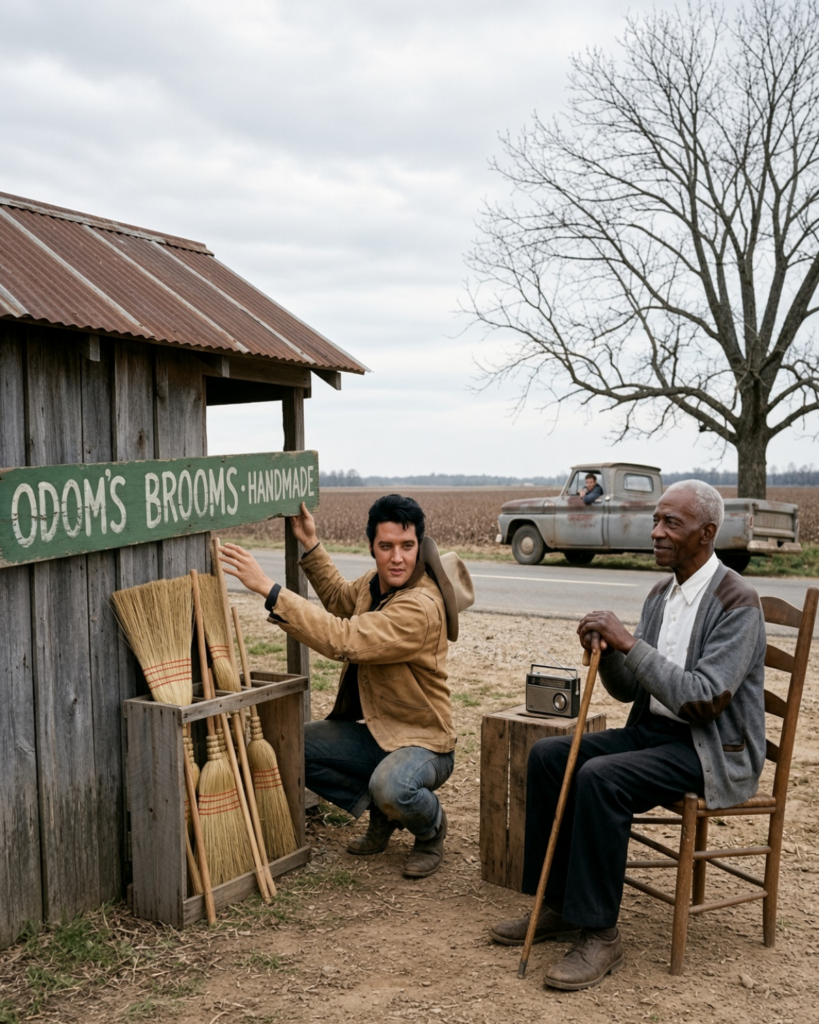
A little lean-to stand built out of old barn boards and tin, set back about fifteen feet from the shoulder under a big pecan tree that had not leafed out yet.
A wooden chair beside it, an old man in the chair, a cardboard box at his feet, a transistor radio on an upturned crate playing something too quiet to hear from the road.
Cars went past it at fifty miles an hour.
A grain truck, a station wagon full of children, a pickup with two hound dogs in the bed.
Not one of them slowed down.
Elvis pulled the truck onto the shoulder about fifty yards past the stand, put it in park, and sat there with the engine running, looking back over his shoulder.
“E,” Billy said, “we got a horse trailer to hitch.”
“Give me a minute.”
“For what?”
“I don’t know yet,” Elvis said.
Billy had known his cousin his whole life.
He had grown up with him in Tupelo and in Memphis.
He knew that tone.
It was the tone Elvis used in the recording studio when a song was wrong and he couldn’t say why, and he was going to sit there until he figured it out, and there was no point in anybody arguing.
Billy sighed and lit a cigarette and rolled down his window.
Elvis kept looking.
What he was looking at, really looking at, was not the old man.
It was the stand—the way it sat on the land, the way a person going fifty miles an hour would see it or wouldn’t.
And the longer he looked at it, the more he felt that particular itch he got when something was wrong without being obviously wrong.
He had learned to see things that way from the strangest teacher in the world.
Colonel Tom Parker had not always been a manager.
Before he ever heard of Elvis Presley, the Colonel had worked the traveling carnivals.
He had been a barker, a promoter, a man who sold candy apples and sideshow tickets in dusty Southern towns.
And the one thing the Colonel had said to Elvis more than any other thing in all the years they had been together was this: “Son, people decide in the time it takes to read a billboard. If they can’t see it from the road, it ain’t there.”
The Colonel said it about posters.
He said it about record covers.
He said it about the way Elvis stood on a stage.
Elvis had heard it so many times he had stopped hearing it.
But sitting in that pickup truck on a county road in Mississippi, looking at an old man’s stand that every car on earth was driving past, he heard it again.
“If they can’t see it from the road, it ain’t there.”
He opened the truck door.
“Stay here,” he said to Billy.
“E, somebody’s going to know you.”
“Out here?” Elvis said.
He looked up and down the empty road at the cotton fields stretching away flat and brown on both sides.
“Billy, there ain’t nobody out here but cows.”
And he walked back down the shoulder toward the stand.
He did not go straight to the stand.
He stopped about twenty feet short of it on the edge of the shoulder where the gravel turned to grass, and stood there with his hands in the pockets of his work jacket, the way a man stands when he is waiting for a ride or thinking about nothing in particular.
He stood there for about four minutes, and in those four minutes he saw everything.
The first thing he saw was the sign.
There was a sign.
That surprised him, because from the truck he had thought there wasn’t one.
It was a good sign, too, painted by somebody who had taken real care over it.
A long flat board, white letters on dark green with a little picture of a broom painted in one corner.
“Odom’s Brooms, Handmade.”
Somebody had gone over the letters twice so they would stand out, but the sign was not on the stand.
It was lying in the grass behind it, face up, where the wind had knocked it down from the two nails it had once hung on.
You could see the nails still sticking out of the barn board, bent a little.
From the road, at fifty miles an hour, there was no sign at all.
The second thing he saw was the brooms.
There were a lot of them, more than he had expected.
They were good brooms, too.
Even from twenty feet away, Elvis could see that.
Real broom corn, tied tight in five rows of stitching, the handles sanded smooth and pale.
There were long kitchen brooms and short hearth brooms and little whisk brooms no bigger than a man’s hand.
A few of them had red thread worked into the stitching in a pattern.
The kind of small, unnecessary, beautiful thing that somebody does only because they care about the work.
But they were not where anyone could see them.
They were lying flat in the cardboard box at the old man’s feet, piled up like firewood in the deep shade of the pecan tree.
From the road, the box was just a box.
The third thing he saw was that there were no prices anywhere.
And the fourth thing he saw, which he almost didn’t notice because it was so small, was that the old man’s chair was facing the wrong way.
It was not facing the road.
It was turned a little sideways, toward the field, toward the morning sun, so that the old man’s face was tilted up into the light, and his back was half turned to every car that came by.
A car would come along the road.
The driver would glance right, and what he would see, in the two or three seconds that a driver has to glance at anything, was an old man sitting under a tree with his back to him next to a box.
Nothing to stop for.
Nothing at all.
Elvis stood there in the grass and felt the Colonel’s voice in the back of his head.
If they can’t see it from the road, it ain’t there.
He walked over to the stand.
The old man heard him coming.
Elvis saw his head turn a little at the sound of the gravel.
The way an old dog’s ears turn.
“Morning,” Elvis said.
“Morning,” the old man said. “Well, nearly afternoon. Help you, mister?”
He was a Black man, thin and straight-backed, with close-cut white hair and a face that the sun had been working on for seventy years.
He was wearing pressed khaki trousers and a white shirt buttoned all the way to the collar and a gray cardigan with leather patches on the elbows, the way some men of his generation dressed for any day they would be seen by the public.
There was a cane leaning against the arm of his chair.
On the crate beside the radio sat a tin cup with a few coins in the bottom.
Nothing else.
“Those your brooms?” Elvis asked.
“Every one,” the old man said, and there was a little pride in it. “I tie them myself. Been tying brooms going on fifteen years now. Name’s Silas Odom.”
“Pleased to meet you, Mr. Odom.”
“And who might you be?”
There was a short pause.
“Just a fella passing by,” Elvis said. “Folks call me E.”
It was what the people closest to him called him.
It was also, he figured, about as close to nobody as he could get on short notice.
“Well, E,” Silas Odom said. “You looking for a broom or just looking?”
“Thinking about it,” Elvis said.
He crouched down beside the cardboard box and picked up one of the kitchen brooms.
It was heavier than store brooms.
The broom corn was packed so tight it barely gave when he pressed his thumb into it.
He turned it over.
On the end of the handle, burned into the wood with something hot, were two small letters: S.O.
“This is good work,” he said.
“It ought to be,” Silas said. “It’s the only work I got left.”
Elvis looked up at him, and that was when he understood.
The old man was not looking at him.
He had not been looking at him the whole time.
His face was turned toward Elvis’s voice, close enough that you could almost believe he was, but his eyes were fixed on a point somewhere just past Elvis’s left shoulder, and they did not move.
And they had a faint milky cloudiness in them that you could only see up close in the light.
Silas Odom was blind.
That was why the chair faced the sun.
He couldn’t see it, but he could feel it on his face, and on a cold March morning, it was the only warm thing on that road.
That was why the sign was lying in the grass.
He did not know it had fallen.
That was why the brooms were in a box in the shade.
Somebody had set them down there that morning, and he could not see where they had gone.
That was why there were no prices.
He had been sitting at the side of that road since sunrise, in his pressed shirt and his good cardigan, listening to car after car after car go by without slowing down, and he did not know why.
Elvis stayed crouched there beside the box for a long moment, holding the broom, not saying anything.
He had expected to find a problem he could fix in five minutes.
He had found a man.
“You still there, E?” Silas said.
“Yes, sir. I’m here.”
“You gone quiet. Folks go quiet when they figure out I can’t see them.”
He said it without any bitterness at all, the way a man mentions the weather.
“Don’t trouble yourself about it. I’ve been blind fifteen years. I’m used to it. It’s other folks that ain’t.”
Elvis set the broom back in the box.
“Mind if I sit a minute?” he said.
“Ain’t but the one chair. Ground’s fine.”
He sat down in the grass beside the old man’s chair with his back against the trunk of the pecan tree, his knees up, his cowboy hat pushed back on his head.
Fifty yards up the road in the pickup, Billy Smith watched his cousin—who owned a mansion and a ranch and a Rolls-Royce and twenty-something brand-new pickup trucks—sit down in the dirt beside a man’s chair and decided he did not understand anything about anything.
“How’d it happen?” Elvis asked. “If you don’t mind me asking.”
Silas didn’t mind.
He had worked at a sawmill near Olive Branch for most of his life, he said.
Good work, hard work.
Stacking green lumber, then running the edger, then running the whole yard.
In 1952, a belt came off a pulley and a piece of oak came off the saw.
And when he woke up in the hospital in Memphis, the world was gone.
Just like that.
He was fifty-six years old.
“What did you do?”
“Sat in a chair for about a year feeling sorry for myself,” Silas said. “Then my wife, Hattie, got tired of looking at me. She found out about a place down in Jackson, a school where they teach blind folks a trade. Took the bus down there with me and sat with me the first week, because I was too proud to go by myself. And they put a bundle of broom corn in my hands and said, ‘Mr. Odom, feel that. That’s straw. You’re going to make something out of it.'”
He held up his hands.
They were large and steady, with deep calluses across the palms and thin white scars across the fingers where the twine had cut him years ago before he learned.
“Fifteen years,” he said. “I can tie a kitchen broom in forty minutes now.”
“Hattie used to say I was the only man in Mississippi who got better at something after he went blind.”
“She sounds like a smart woman.”
“Smartest I ever knew. Passed in ’63.”
He nodded toward the box. “The red thread was hers. She said a broom spends its whole life in the dirt. It ought to have something pretty about it. I keep doing it. I can’t see it anymore, but I know it’s there.”
Elvis didn’t say anything for a while.
On the crate, the little transistor radio was tuned to a gospel station out of Memphis.
A quartet was singing, faint and scratchy, and Silas tapped one finger on his knee in time.
“Who sets it up?” Elvis asked finally. “The stand, of a morning.”
And for the first time, something in the old man’s face changed.
“My granddaughter did,” he said. “Ruth. She painted that sign. Made me a rack for the brooms. Stood them up nice in a row along the front so folks could see the colors. Wrote the prices out on a card. Every morning before she went to work, she’d walk me down here and set it all up. And every evening, she’d come get me. We did all right. We did real all right.”
“What happened?”
“She got a job in Chicago. Good job. Telephone company. Lot better than anything Mississippi was ever going to give a girl like her. I’ll tell you that.”
He smiled a little.
“I told her go. I made her go. She cried the whole way to the bus station. She’s been gone two weeks.”
“And now?”
“Now the Dawson boy from down the road walks me here before school, sets down my box, and goes on. He’s twelve. He’s a good boy. He’s in a hurry.”
Silas shrugged.
“I don’t tell him how Ruth did it. Feels like asking too much.”
He turned his face toward the road, where a car went by, not slowing, the sound rising and falling and gone.
“Two weeks,” he said very quietly. “I ain’t sold a broom in two weeks, E. Not one. I sit here and I listen to them go by, and I keep thinking it’s me. Folks don’t want to buy from a blind old man, or the brooms ain’t good no more, or something I can’t see.”
He laughed a little, not happily.
“Well, everything’s something I can’t see.”
Elvis looked at the sign lying face up in the grass, ten feet behind the old man’s chair, at the box of beautiful brooms in the shade, at the bent nails.
It wasn’t him.
It wasn’t the brooms.
It was a sign that had fallen down in the wind, and nobody had told him.
He opened his mouth to say so, and that was when the radio changed songs.
The quartet finished.
There was a little crackle, and then a piano, slow and deep, and then a voice that Elvis Presley knew better than any voice in the world, because it was his own.
“How Great Thou Art.”
He had recorded it the year before in Nashville at two in the morning, in the dark, with the Imperials and the Jordanaires around him, and it had come out only a few weeks before.
It was the record he was proudest of in his whole life.
Nobody in Hollywood cared about it.
The Colonel didn’t understand it.
But he had sung it for his mother, nine years gone, and he knew that.
Elvis sat very still in the grass.
Silas Odom stopped tapping his finger.
He turned his head toward the radio, and he listened, and his face changed into something soft and private.
And for the whole length of the first verse, neither of them said a single word.
Then the old man said, “You know who that is?”
Elvis swallowed. “Yes, sir.”
“That’s that Presley boy,” Silas said. “Folks at my church say he’s no good. Say he’s the devil’s music, all that shaking around. I tell them, I can’t see him shake. All I can do is hear him.”
He shook his head slowly.
“And I’ll tell you what I hear, E. I hear a man who’s been on his knees about something. A man don’t sing a hymn like that unless he’s lost somebody he can’t get over.”
Elvis looked down at his hands.
“Yes, sir,” he said very quietly. “I expect that’s right.”
The song built to the chorus, the big one, the one where the voice opens up and the whole room is supposed to stand.
The little radio buzzed and crackled trying to hold it.
And out on that empty county road in Mississippi, the man who was singing it sat in the dirt with his hat in his hands, listening to it beside a blind stranger, and did not trust himself to say anything at all.
When it ended, Silas let out a long breath.
“Lord,” he said. “Hattie loved that one.”
Then he turned his face back toward the sound of Elvis’s breathing.
“Now, you was about to tell me something before. I heard you take a breath for it.”
Elvis put his hat back on.
“Mr. Odom,” he said, “can I buy all them brooms off you?”
Silas Odom was quiet for a moment.
“All of them?”
“All of them. Whatever you say they’re worth. I got a ranch up the road. Lot of floors.”
It was what Elvis always did.
It was what he had done that whole month with the pickup trucks and the horses and the trailers.
Somebody needed something, and he had money, and the money made the problem go away, and for a little while everybody felt good.
It was the easiest thing in the world for him.
It was, he sometimes thought late at night, the only thing anybody ever wanted from him anymore.
The old man shook his head.
“No, sir,” he said.
Elvis blinked. “No?”
“No.” Silas folded his hands on top of his cane. “That’s kind of you. I can hear that it’s kind. But you buy every broom in that box and tomorrow morning the Dawson boy’s going to set me back down here with a new box, and I’m going to sit here all day again listening to the cars go by, and I still won’t know why, and you won’t be here.”
He turned his face toward Elvis.
“I don’t need a man to buy my brooms, E. I need folks to see them.”
Elvis sat there in the grass and something turned over inside him that he could not have explained to anybody.
Not to Billy, not to the Colonel, not to Priscilla.
For a long time, people had needed one thing from him, and he had given it over and over until he wasn’t sure there was anything else in him to give.
This old man did not want his money.
He wanted his eyes.
“All right,” Elvis said slowly. “Then I’m going to tell you what I see, and then we’re going to fix it together, and then you’re going to know how to tell that Dawson boy to set it up every morning the right way. That sound fair?”
Silas was quiet for a moment. “What do you see?”
So Elvis told him.
He told him about the sign lying face up in the grass behind his chair where the wind had put it.
He told him about the box of brooms in the shade where a man driving by could not see a single one.
He told him there were no prices, and he told him as gently as he knew how that his chair was turned toward the sun, and so every car that came down that road saw an old man with his back to them.
Silas listened to all of it without moving.
When Elvis was finished, the old man let out a long, slow breath, and his shoulders came down about an inch, as if he had been carrying something heavy for two weeks and had just been told he could set it down.
“So it ain’t me,” he said.
“No, sir.”
“And it ain’t the brooms.”
“No, sir. It’s the best brooms I ever held in my life. Folks just can’t see them from the road.”
Silas Odom laughed.
It was the first real laugh Elvis had heard from him, deep and surprised, and it went on for a while.
“Lord have mercy,” he said. “Two weeks. Two weeks I’ve been sitting here thinking the Lord was punishing me for something, and it was the wind.”
Elvis stood up and brushed off his jeans.
“Billy,” he called up the road, “bring the toolbox.”
It took about half an hour.
Billy brought the toolbox from the truck and a coffee can of roofing nails and a look on his face that said he was going to be telling this story for the rest of his life, and nobody was ever going to believe him.
Elvis found Ruth’s old broom rack, the one she had built, leaning behind the stand where somebody had stacked it out of the way.
It was a long, simple thing, a board with holes drilled in it so the brooms could stand up straight in a row like soldiers.
But he did not just set it up.
Before he put up anything, he took the old man’s hand and put it on the rack and walked him along it from one end to the other.
“This is the front,” he said. “This faces the road. Feel that? Twelve holes.”
“Twelve holes,” Silas repeated.
“Kitchen brooms on the left end, the long ones. That’s what folks are going to want most, so they see them first coming south.”
He put a broom in Silas’s hands and guided it into the first hole.
“Then the hearth brooms in the middle. Then the little whisk brooms at the right end, because they’re the cheapest and folks will grab one on the way back to their car.”
“And the red ones?”
Elvis smiled. “The red ones go right in the middle of the front, right where the sun hits. Mr. Odom, from the road, that red thread is the prettiest thing for five miles in any direction.”
Silas’s hand found a broom with Hattie’s red stitching on it.
He held it for a moment.
Then he set it in the center of the rack himself.
They hung the sign together.
Elvis held it up against the stand, and Silas ran his hands over the old bent nails, and Elvis straightened them with the hammer and drove two new ones beside them.
And then he took the old man’s hand and laid it flat on the painted letters so he could feel exactly where it hung.
High, facing the road.
“Odom’s Brooms, Handmade.”
“Tell the Dawson boy,” Elvis said, “that if he can’t read it from the road, it ain’t there.”
“If he can’t read it from the road, it ain’t there,” Silas said, and nodded. “I’ll tell him.”
Then the prices.
Silas named them, the same prices Ruth had written.
And Elvis borrowed a grease pencil from Billy and wrote them on the back of a piece of cardboard in big black numbers.
Kitchen broom. Hearth broom. Whisk broom.
He tacked it to the post right under the sign.
Then, last of all, the chair.
“Mr. Odom,” Elvis said, “I’m going to ask you a big favor.”
“I know what it is,” Silas said. “You want me to turn around.”
“Yes, sir.”
“Then I lose my sun.”
Elvis looked up at the sky.
He looked at the pecan tree.
He walked around the stand twice, slowly, the way he walked around a recording studio looking for the place where the sound was right.
And on the far side of the stand, by the corner post, he found it.
One square yard of ground where the sun came through the bare branches and fell straight down, and the road ran right in front of it.
He moved the chair there and helped Silas into it.
The old man sat back.
He tilted his face up.
The sun was on it, and the road was in front of him, and the brooms were beside him, and the sign was over his head.
“Well, now,” Silas said softly, “ain’t that something?”
Elvis walked back up the road to the place where he had first stood, twenty feet from the stand, on the edge of the shoulder.
And then he walked farther, all the way back to the truck, fifty yards, and turned around and looked at it the way a man driving south at fifty miles an hour would look at it, for two or three seconds, out of the corner of his eye.
A green sign with white letters, a row of brooms standing up straight in the sun with a flash of red in the middle, prices you could read, and an old man in a white shirt and a gray sweater sitting up tall, facing the road with the sun on his face.
It looked like a different place.
“Now what?” Billy said.
“Now we wait,” Elvis said.
They sat in the pickup truck with the windows down and waited.
A grain truck went by.
It did not slow down.
Billy looked at Elvis.
Elvis didn’t look back.
A pickup went by, an old Ford with a dented tailgate.
It didn’t slow down either.
Then a station wagon came down the road from the north, a tan Chevrolet with wood paneling on the side, a woman driving, two little girls in the backseat with their faces pressed to the window.
It was going the same fifty miles an hour as everything else.
And about thirty yards before the stand, its brake lights came on.
It didn’t stop, not right away.
It slowed.
The way a car slows when the driver has seen something out of the corner of her eye and isn’t sure yet whether it is worth stopping for.
It drifted past the stand at fifteen miles an hour, and then the brake lights came on again, hard, and the station wagon pulled onto the shoulder and backed up.
Billy said a word his mother would not have liked.
Elvis said nothing at all.
He was watching.
The woman got out.
She was in her forties, with her hair tied up in a scarf.
She walked over to the stand and stood in front of the rack of brooms and picked up the one with the red stitching in the center of the front row and turned it over in her hands.
They could not hear what she said from the truck.
They saw Silas Odom turn his face toward her voice and smile.
They saw him talk for a little while, his hands moving the way they moved when he talked about his work.
They saw the woman laugh.
They saw her point at the price card and open her pocketbook.
She bought the kitchen broom with the red thread.
Then she called the little girls out of the car, and each of them picked out a whisk broom, and she bought those, too.
The station wagon had not even pulled back onto the road when a farm truck coming the other way slowed down and stopped on the opposite shoulder, and a big man in overalls got out and crossed the road on foot.
Within twenty minutes, four cars had stopped.
Within an hour, nine.
People stopped because they saw the red thread from the road.
They stopped because the sign said “Handmade,” and they could read the price before they decided.
They stopped because an old man in a white shirt was sitting up straight in the sun facing them, and he looked like a man who was proud of what he made.
And when they got out and walked up to the stand, they stayed because Silas Odom, it turned out, could talk about broom corn for twenty minutes and make you feel like you had learned something important.
A preacher from a church down in Hernando bought six kitchen brooms for his fellowship hall.
A young couple on their way to Memphis bought a hearth broom for a house they had not moved into yet.
A truck driver bought a whisk broom for his cab and stood talking with Silas for half an hour about the sawmill at Olive Branch, where it turned out his own daddy had worked.
Up in the pickup, Billy Smith watched all of it in silence.
Finally, he said, “E, you didn’t sell nothing. You didn’t buy nothing. You didn’t even sing.”
“No,” Elvis said.
“Thirty minutes with a hammer.”
“Yeah.”
Billy shook his head slowly.
He had seen his cousin bring twenty-five thousand people to their feet.
He had seen him hand a stranger the keys to a brand-new car on the spot.
He had seen him give away more money in a single afternoon than Billy’s own daddy had made in his whole life.
He had never seen him look the way he looked right then, sitting in a pickup truck with his elbow out the window, watching an old blind man sell brooms.
“You look happy,” Billy said, a little surprised.
Elvis thought about it.
“I didn’t fix nothing that was broken in him,” he said at last. “He wasn’t broke. It was just the sign.”
By a quarter to three, the cardboard box was empty and there were only four brooms left on the rack.
Elvis started the truck.
“We going?”
“We’re going,” Elvis said. “But I want to say goodbye.”
He drove the pickup slowly down the shoulder and stopped it right beside the stand with the engine running and got out and walked over to the old man’s chair.
There was nobody else there.
For the first time in three hours, the road was empty.
“Mr. Odom,” he said, “I got to be getting on.”
Silas turned his face toward him and smiled.
“I heard,” he said. “I’d know that truck anywhere now. Runs a little rough in third gear.”
He reached out a hand, and Elvis took it.
The old man’s grip was very strong.
“I made more today than I made all last month,” Silas said. “Ruth’s going to think I made it up. I’m going to write her tonight. Well, the Dawson boy’s going to write it, and I’m going to say it.”
“You tell her the sign held up fine.”
“I’ll tell her.”
He held on to Elvis’s hand for a moment longer.
Then he let it go.
Elvis turned and walked back to the truck.
He opened the door.
He had one boot up on the running board, and behind him, the old man said five words.
“You mind the road, Elvis.”
In the cab of the truck, Billy Smith put both his hands flat on the dashboard and stared.
Elvis stood very still with one boot on the running board.
Then he took it down and turned around.
Silas Odom was sitting in his chair in the one square yard of sun with his hands folded on top of his cane and his face turned exactly toward him.
He was smiling.
Not a big smile.
The small, patient smile of a man who has been holding on to something for three hours and has finally been allowed to put it down.
“How long?” Elvis said quietly.
“Since morning,” Silas said.
Elvis walked back over to the chair. “You never said.”
“No, sir.”
“Why not?”
The old man thought about it.
“Son,” he said, “I lost my eyes in 1952. Couple years later, my wife bought a radio for the kitchen so I’d have something to keep me company while I worked. And I’ve been listening to that voice coming out of that radio ever since. Thirteen years. When a man can’t see, he learns voices the way other folks learn faces. I’d know yours in a coal mine at midnight.”
He tilted his head.
“And I knew it the second you said good morning. I just didn’t know what you wanted.”
“I didn’t want anything,” Elvis said.
“I know that now,” Silas said. “That’s why I didn’t say.”
He leaned forward a little on his cane.
“Everybody in the world wants something from you, I expect. I’d guess you can’t walk across a room without somebody wanting something. And you come walking down this road on a Tuesday morning in a work jacket, calling yourself E, sitting in the dirt next to an old man. You didn’t come out here to be Elvis Presley. You come out here to fix a blind man’s sign.”
He shrugged.
“Wasn’t my place to take that away from you.”
For a long moment, Elvis could not say anything.
Then he crouched down beside the chair, so that his face was level with the old man’s, the way he had crouched beside the box of brooms that morning.
“When the song came on,” he said, “on the radio. You knew it was me sitting right there.”
“I knew. And you still said all that about a man on his knees.”
“I said it because it was true,” Silas said. “Wasn’t going to stop being true just because you was sitting there.”
Elvis looked down at the ground.
“My mama,” he said very quietly, “she passed in ’58.”
Silas Odom reached out, felt for the young man’s shoulder, found it, and rested his big scarred hand there.
“I know, son,” he said. “I heard it. Every word.”
Up in the truck, Billy Smith turned his head and looked out the other window for a while.
They drove back to the Circle G without the horse trailer.
They had forgotten it.
Billy remembered about four miles later, and Elvis said they’d get it tomorrow, and neither of them said anything else for a long time.
Elvis went back to Hollywood that spring.
He married Priscilla in Las Vegas on the first of May.
He made more movies.
He sold the ranch two years later, the trucks and the horses and the trailers along with it.
And in the years that followed, he came roaring back onto the stage in a way nobody had expected, and the whole world turned to look at him again.
But Silas Odom had something to do first.
The next morning at a quarter to seven, the Dawson boy came to walk him down the road to the stand carrying a new box of brooms.
And on the way there, for the first time, Silas told him exactly how to set it up.
The rack along the front facing the road. Twelve holes. Kitchen brooms on the left end, hearth brooms in the middle, whisk brooms on the right. The red ones in the center of the front row where the sun hits. The sign high on the two nails so you can read it from a moving car. The price card on the post right under it. And the chair on the far side by the corner post in the one square yard of sun facing the road.
“Why’s it got to be that way?” the boy asked.
“Because if they can’t see it from the road,” Silas said, “it ain’t there.”
The boy thought about that. “Who told you that?”
Silas Odom smiled. “A fella named E,” he said.
He sold out by two o’clock that day, and the next day, and most days for the rest of that spring and summer, and the next one, and the one after that.
Other people set up stands on that road over the years.
A man selling watermelons across the way, a woman with tomatoes and peaches, a boy with a wagon full of firewood.
And sooner or later, every one of them would wander over to the old blind man under the pecan tree, the one who always sold out, and ask him how he did it.
And Silas would tell them: turn your sign to the road. Put your best thing in front where the sun hits it. Let folks see the price before they have to ask. Sit up and face the people coming toward you.
And then, every single time, he would add one more thing.
“And if a stranger ever stops and asks if he can help you,” he’d say, “you let him. Don’t be too proud. You never know who’s standing in front of you.”
Ruth Odom came home from Chicago that Christmas, and she walked down the county road with her grandfather on the first morning, the way she used to, and found the stand set up exactly the way she had always set it up—the rack and the sign and the red brooms in the middle.
And she stood there with her suitcase in her hand and asked him who had done it.
He told her it was the Dawson boy.
She asked him who had told the Dawson boy, and Silas just smiled up at the sun and said, “A friend of your grandmama’s.”
He never told her more than that.
He never told anybody, except once, years later, his pastor, who did not believe him and laughed, and who Silas forgave for it.
There was one more thing.
One Saturday that October, on a warm, still afternoon, Silas Odom was sitting in his square yard of sun beside the stand, listening to the cars go by, when he heard one that made him lift his head.
A pickup truck coming south.
The engine ran a little rough in third gear.
It did not stop.
It slowed just a little, the way a car slows when the driver wants to look at something without being seen looking.
It went by the stand at maybe twenty miles an hour.
Silas reached over to the rack, found the broom with the red thread in the center of the front row, and lifted it high in the air like a man raising a flag.
The pickup truck honked its horn twice, short and quick, and then it was gone down the road, the sound rising and falling and fading away into the flat Mississippi afternoon.
Silas set the broom back in its place in the center of the front row where the sun hits.
He sat back in his chair.
He tilted his face up into the light, and for the rest of that afternoon, every car that came down that county road slowed down.









