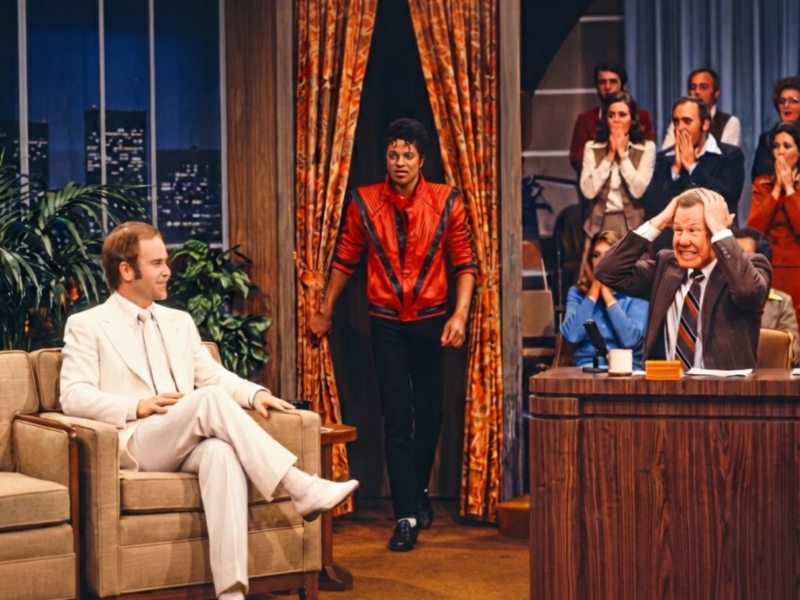
Elton Told the TRUTH About Michael Jackson on TV—Michael Walked On Stage and Nobody Expected THIS.
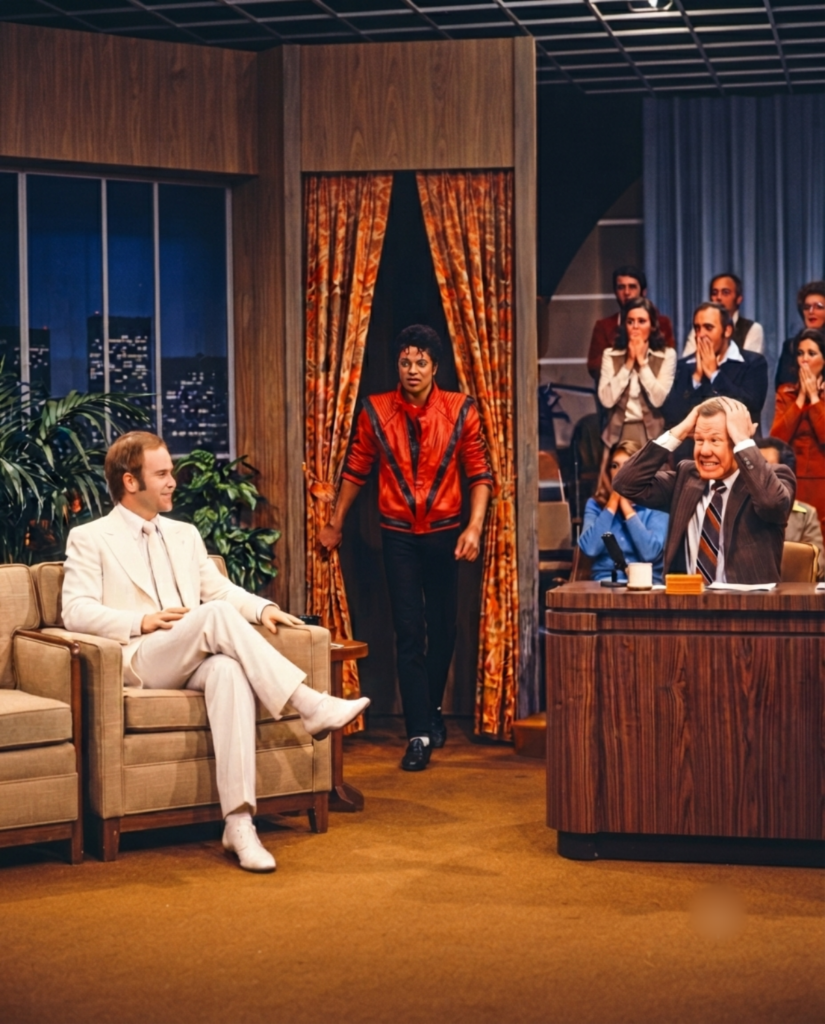
*The Tonight Show with Johnny Carson*. NBC Studios, Burbank. February 1983, 11:40 p.m. Pacific time.
Millions of people watching what they believed would be a routine Thursday night broadcast.
Elton John was there promoting a new record—a British pop legend well into his second decade of fame, comfortable enough in front of a camera to say almost anything without flinching.
Johnny Carson had his usual list of prepared questions. Everything felt entirely normal.
Nobody knew that two floors below the studio, in a private conference room reserved for network business, Michael Jackson was finishing a late meeting with a pair of NBC executives about a television special built around Motown’s 25th anniversary.
Nobody knew he’d asked for a small television to be brought in so he could catch part of the broadcast while the meeting wrapped up.
Nobody knew that within twenty minutes, one of the most talked-about moments in the show’s history was about to unfold.
If this story is already pulling you in, go ahead and hit that subscribe button right now.
Elton sat on the couch in a bright sequined jacket, relaxed in the particular way he always was in front of cameras—having done enough interviews by that point to understand exactly how the game worked.
Answer the questions. Promote the record. Keep things easy and pleasant. Get out before anyone asks something that requires more thought than a talk show segment was built to hold.
But Johnny liked to push a little when the moment felt right. And that record-breaking album everybody in music was talking about that winter made the moment feel very right indeed.
Elton had flown in from London two days earlier. Jet lag still sitting behind his eyes, though nothing in his manner on set that evening suggested it.
He’d spent the afternoon rehearsing a number for later in the show with the house band, cracking jokes with the crew between takes, signing a stack of records for a group of hospital staff who’d written in asking for something to raffle off at a children’s ward fundraiser.
He liked doing that kind of thing quietly, without much fuss made over it. A habit that had followed him since long before fame made such gestures newsworthy.
Two floors down, Michael’s meeting had been running long—the kind of dry, detail-heavy conversation about broadcast rights and rehearsal schedules that he tolerated well enough but never much enjoyed.
He’d asked for the television mostly out of restlessness. A way to keep part of his attention occupied while the executives worked through contract language that meant more to them than it did to him.
“Elton,” Johnny said, “I’ve got to ask you about the record everybody in this country is currently obsessed with. *Thriller*. Michael Jackson. Biggest thing in music right now. Maybe the biggest thing music’s ever seen.”
Elton considered the question, a small, thoughtful smile crossing his face.
“Extraordinary talent,” he said. “Best pure performer of his generation, without any real question about it. Nobody moves like him. Nobody sings quite like him. The whole package—the voice, the dancing, the whole presentation. It’s remarkable.”
“But?” Johnny prompted, sensing there might be more underneath the polite answer.
Elton paused for a moment.
“But there’s something about the whole enterprise—the whole machine around him—that worries me a little, if I’m honest,” he said. “Everything about him is so managed. So controlled. The interviews, the image, all of it curated within an inch of its life. I don’t think that’s confidence, personally. I think that’s fear dressed up very expensively as mystery.”
The audience chuckled, sensing something building but not yet certain.
“You think he’s hiding something?” Johnny asked directly.
“I think he’s hiding. Full stop,” Elton said. “Whether there’s a specific *something* underneath it, I couldn’t tell you. But a boy who’s been performing since he was five years old, managed every single day of his life by people with a great deal writing on how he’s presented to the public—I think that boy learns very early on that showing anybody the real version of himself is dangerous. Safer to build a persona and live entirely inside it.”
If you’re enjoying this story so far, hit that like button before we continue.
Johnny leaned forward slightly, sensing the temperature of the conversation shifting.
“That’s a fairly pointed thing to say about the biggest star in the world right now.”
Elton shrugged, unbothered. “It’s honest. He’s brilliant. Nobody’s arguing that. But sometimes I think the whole apparatus around him has become more about protecting an image than actually letting him exist as a person. Every appearance is so carefully arranged. Never an unguarded moment. Never a real slip. That’s not natural for anybody—let alone somebody that young.”
“That’s a strong statement,” Johnny said.
“It’s just true,” Elton said. “Look, I came up in this business wearing platform boots eight feet tall and glasses that lit up, screaming every insecurity I had straight into a microphone because hiding felt worse than embarrassing myself. Michael’s built the exact opposite approach. Total control. Total polish. Nothing left to chance. I understand why. I just don’t think it’s sustainable, and I don’t think it’s particularly healthy for a person to live that way indefinitely.”
The audience had gone quiet, sensing this had crossed from playful commentary into something with real edges.
“Have you spent much time with him?” Johnny asked.
“Some,” Elton said. “Lovely young man. Painfully polite. Almost formal, even in private. Never once seen him let his guard down completely. Not around me—and I’d like to think we’re friendly. Might be interesting to see what happens if he ever actually does.”
Someone in the audience gasped audibly. This story is about to take a turn nobody expected.
“You think he’s incapable of that? Letting his guard down?” Johnny asked, clearly trying to give Elton an opening to soften the statement.
“I think he’s been taught it’s not safe,” Elton said. “There’s a difference between being incapable and being frightened. He’s built an entire persona around being untouchable. Unknowable. This otherworldly figure who moonwalks across a stage and disappears the second the lights go down. That works if you want to be a myth. It doesn’t work if you actually want to be known by anybody—including yourself.”
Johnny sat back slightly. “That’s going to get some attention, Elton.”
“I’m not saying anything I haven’t thought for some time,” Elton said. “Just haven’t had anybody ask me directly before.”
Two floors down, in that quiet conference room, Michael sat with a cup of tea in his hand, half paying attention to the small television in the corner while the executives continued discussing scheduling details for the anniversary special.
Then he heard his own name mentioned, and his attention shifted entirely.
He watched as Elton continued, unbothered by the weight of what he was saying.
“You know what concerns me,” Elton continued, “is that people look at that level of control and mistake it for maturity. For professionalism. It’s not. It’s a very talented young man who’s terrified of what happens if the mask ever slips. Even for a moment.”
Michael’s hand tightened slightly around the teacup.
One of the executives noticed the shift in his expression. “Michael, you all right?”
Michael didn’t answer immediately. His eyes fixed on the small screen.
If this story is teaching you something already, don’t forget to hit that like button.
On screen, Johnny pressed further. “So if you’re saying his control doesn’t allow for anything real underneath it—what would you consider real, in a performer that famous?”
“Somebody who can actually be seen making a mistake,” Elton said. “Somebody who lets an audience catch him off guard once in a while, instead of arriving fully formed and departing exactly the same way. Michael’s characters—if you can call them that, the stage persona, the interview persona—they never really falter. That’s not how actual people work. Especially not people carrying that much weight since childhood.”
Michael set his teacup down on the table. The sound was sharp enough that both executives looked up.
“Michael,” one of them said carefully, “you want us to turn that off?”
“No,” Michael said—his voice quiet, but carrying an unmistakable edge. “I want to hear the rest of it.”
Back in the studio, Johnny continued pressing.
“You’re saying his approach to fame is essentially built on fear.”
“I’m saying there’s more than one way to survive this business,” Elton said. “And I think sometimes the people who’ve been doing it since childhood get so used to the armor that they forget it’s armor at all. Michael’s a genius. Nobody’s taking that away from him. But genius and a whole person aren’t always the same thing.”
“That’s a fine distinction,” Johnny said.
“It’s an important one,” Elton replied. “I’d rather be remembered as somebody who let people see me fall apart occasionally—even if it’s embarrassing—than somebody who kept the mask so perfectly in place that nobody ever really got to meet me at all.”
The audience had grown noticeably tense, several people exchanging uncertain glances, unsure whether to laugh or simply sit in stunned silence at the directness of what they were hearing.
If you’re gripped by this exchange, make sure you’ve already hit subscribe.
Two floors below, Michael stood up from the table entirely, his slight frame carrying an unmistakable tension.
“Get somebody from the production office down here.”
“Michael, what are you—”
“Get somebody down here,” Michael repeated, his voice carrying a quiet, unfamiliar weight. “That man upstairs wants to talk about me like I’m not capable of hearing it directly. I think it’s about time I gave him the chance to say it to my face.”
One of the executives hurried out of the room.
Back on stage, Johnny attempted to steer the conversation elsewhere, sensing they’d already generated more than enough for one segment.
“Well, let’s talk about the new record a little more—”
“Of course,” Elton said, settling back into the easier rhythm of straightforward promotion.
They talked for another few minutes about the album, about touring plans for the year ahead. The tension from moments earlier beginning to dissipate slightly, the audience relaxing back into the comfortable rhythm of a normal interview.
Then Johnny’s expression shifted, his eyes catching something happening near the production booth. He paused mid-sentence, listening to something coming through his earpiece.
“Well,” Johnny said slowly, “it appears we might be getting a response to some of what you said tonight sooner than expected.”
Elton raised an eyebrow. “What do you mean?”
“Michael Jackson is downstairs,” Johnny said. “And he’s asking to come out.”
The audience gasped audibly, a wave of excited murmurs sweeping through the studio.
If this story is moving you, please subscribe before we continue.
Elton’s expression didn’t change much, though something in his posture straightened slightly. “Is that right?”
“That’s what I’m being told. Right this moment,” Johnny said, clearly processing the reality of what was about to happen in real time. “Do you have any objection to that?”
“It’s your show,” Elton said evenly.
Twenty minutes earlier, Michael had stood in that small conference room watching the monitor with an intensity that had genuinely alarmed the executives present.
When Elton suggested his entire public life amounted to fear dressed up as mystery, something in Michael’s expression had hardened into a look neither man had seen from him in the meeting so far.
“He’s calling me frightened,” Michael said quietly, more to himself than to either executive in the room. “Says I’m hiding. Says the whole thing’s built on being scared.”
“Michael, it’s just an opinion on a talk show—” one executive offered carefully.
“It’s an opinion in front of millions of people,” Michael said. “That’s not the same as some writer saying something nobody reads in a magazine nobody buys.”
His assistant, a young man named Frank who’d worked with him for a couple of years, appeared in the doorway, having heard part of the conversation from the hallway.
“Michael, you’re not seriously thinking about actually going up there right now.”
“I am.”
“That’s live television. Whatever happens happens right there in front of everyone. No editing. No second take. No do-over.”
“I know.”
“Come tomorrow morning—”
Michael’s eyes remained fixed and steady. “That man just spent five minutes explaining to the entire country why everything I’ve built my whole life amounts to fear. I think I’ve earned the right to respond directly. And if it goes badly—if I say something I regret—then I’ll deal with that afterward. Right now, I intend to go up there and find out exactly what gives him the authority to make that judgment.”
He walked toward the door.
Johnny turned to face the camera directly.
“Ladies and gentlemen, something is happening tonight that I don’t believe has ever happened on this program before. Michael Jackson, who was in the building for an unrelated meeting, heard our conversation and has asked to join us. When we return, we’ll be joined by Mr. Jackson.”
They cut to commercial. The studio erupted into whispered conversation. Crew members exchanging wide-eyed glances. Several audience members visibly leaning forward in their seats, unable to believe what they were about to witness.
Johnny leaned toward Elton during the break. “You all right with this?”
“It’s your show,” Elton said again, his composure entirely unbothered.
“He’s going to be upset,” Johnny said. “You basically told the whole country he’s terrified of being seen. That the whole thing’s built on fear rather than genuine control.”
“If that’s how he wants to take it, that’s his choice,” Elton said. “I said what I think is true. Doesn’t mean I said it to be cruel.”
Johnny studied Elton’s expression, genuinely searching for any sign of nervousness and finding none.
“You’re not worried about a direct confrontation with Michael Jackson on live television.”
“Why would I be?” Elton asked simply. “I meant what I said. If he wants to argue the point, I’m happy to have that conversation.”
If you’re finding this story genuinely moving, please subscribe before we continue.
Backstage, Michael stood at the curtain, his heart rate elevated in a way that felt entirely unfamiliar to him.
He’d spent his whole life cultivating an image of composed, gentle certainty. And here he was, moments from walking onto live television with genuine hurt simmering beneath the surface.
No script. No prepared statement. Nothing but raw feeling, and the certainty that something needed to be said.
Frank stood beside him, still visibly concerned. “You don’t have to do this.”
“Yes, I do.”
“What exactly are you planning to say to him?”
“I’m going to ask him what gives a man who’s known me a handful of years the right to describe what’s actually happening inside me,” Michael said. “And if he’s got a real answer, I’ll listen to it. If he doesn’t, I intend to make that clear, too.”
Thirty seconds remained on the commercial break. Michael took a slow breath—something he rarely needed before any performance—the genuine unpredictability of the moment settling over him in a way that felt almost foreign after a lifetime of carefully controlled sets and stages.
The cameras came back on. Johnny faced the audience directly.
“Ladies and gentlemen, please welcome Michael Jackson.”
The curtain opened.
Michael walked out, and the energy in that studio shifted immediately. This wasn’t the soft-spoken, gracious figure audiences had come to expect from magazine covers and award show appearances.
This was something harder to read. Controlled hurt simmering just beneath a carefully maintained exterior.
Elton remained seated. Didn’t stand. Didn’t extend his hand right away. He simply watched as Michael crossed the stage and settled onto the couch—the two men now sitting close enough that the tension between them was almost palpable through the television screen.
Nobody spoke for a long moment. Millions of people watched in silence.
Johnny attempted to break the tension. “Michael, thank you for joining us.”
Michael didn’t look at Johnny. His eyes remained fixed on Elton.
“I was downstairs. Heard you were talking about me.”
“I was,” Elton said evenly.
“Heard some interesting things,” Michael continued. “Heard a man tell the entire country I’m frightened. That everything I’ve built is fear wearing a costume. Thought I should come see that for myself.”
If this story is teaching you something real, hit that like button right now.
The audience remained silent, several people visibly holding their breath.
Elton leaned back slightly. “I said what I said because I believe it’s true, Michael. Not to hurt you personally.”
“Didn’t feel personal to you,” Michael said, his voice carrying a controlled edge. “Felt fairly personal from where I was sitting.”
“Let’s talk about it plainly, then,” Elton continued, leaning forward now. “You’ve spent your entire life inside this business. Since you were five years old, by your own telling. More managed and more watched than almost anybody alive. You want to tell me that’s not built some kind of wall around you?”
“I’m not saying I haven’t built walls,” Michael said. “I’m questioning whether you’ve got any right to stand up there and name what’s behind them for me.”
“You think squinting for cameras and building a persona so tightly wound nobody’s ever seen a crack in it qualifies as living an honest life?” Elton shot back, his composure cracking slightly for the first time.
“I think it’s a different approach than yours,” Michael said, still calm despite the visible effort it took. “Doesn’t make it dishonest. Just makes it different.”
“You called it fear,” Michael said. “Said I’m hiding. Said none of it’s real.”
“I said your persona rarely shows real doubt,” Elton replied. “That’s an observation, not an attack.”
“It’s an insult,” Michael said, his voice rising slightly now—the studio audience shifting uncomfortably at the escalating tension. “You’re sitting there telling the whole world you understand something about my own fear that I haven’t even told myself.”
If you’re gripped by this exchange, make sure you’ve already hit subscribe.
“I never said I understood everything,” Elton said. “I said it’s comfortable, that armor. There’s a difference.”
“Comfortable,” Michael repeated—the word carrying visible pain now rather than anger. “You know what’s comfortable? Being able to walk into a room and say whatever you think without wondering if it’ll be printed in every paper by morning. Twisted into something that follows you for years. I don’t have that luxury. Haven’t had it since I was a child.”
“That’s exactly my point,” Elton said—something gentler entering his tone now. “You’ve never had the room to be anything less than perfect in public. And I think that’s cost you more than anybody around you has ever been honest enough to say out loud.”
The studio audience had gone completely silent now. The tension in the room thick enough that even the crew members near the cameras had stopped their usual quiet movement. Everyone fully absorbed in the unfolding confrontation.
Michael’s jaw was tight, his hands resting on his knees in a posture that suggested real effort at maintaining composure.
“You want to talk about cost,” Michael said. “I gave up an entire childhood to this business. I understand something about sacrifice you’re too comfortable to understand.”
“You never had a normal adolescence, Michael,” Elton said quietly. “We both know that.”
The room went dead silent. Michael’s face tightened—the direct observation landing harder than anything else said that evening.
“That’s not—”
“I’m not bringing it up to hurt you,” Elton continued, his voice still even. “I’m bringing it up because you’re suggesting your control represents some kind of strength that comes from lived wisdom. And I don’t think that’s entirely accurate. I think your control comes from the exact same place mine used to come from before I learned to let it go. Fear of what happens the moment people see something unpolished.”
If this story left an impact on you, please hit that like button before we finish.
Michael sat with that for a long moment, visibly working to control his response.
“That’s beside the point,” Michael finally said—though his voice had lost some of its earlier certainty.
“I don’t think it is,” Elton said. “I think it’s exactly the point. You’ve built an entire image around being untouchable. Unbothered. Gentle and perfect and above the noise. But at the end of the day, we’re both just men who found out very young that a stage would love us more reliably than almost anything else in our lives. The only real question is whether we’re honest with ourselves about that—or whether we start believing the version of ourselves we built to survive it.”
Johnny sat frozen behind his desk, genuinely uncertain whether to intervene, sensing that whatever was happening had moved beyond his usual ability to smoothly redirect a segment back toward safer ground.
Michael sat back slightly—something shifting in his expression. The hurt still present, but now mixed with something more complicated. Something closer to genuine reflection.
“You think I don’t know myself,” Michael said slowly.
“I think it’s easy not to, after a lifetime of people treating you like a symbol instead of a boy,” Elton said. “I’m not saying that to be cruel, Michael. I’m saying it because I think it’s worth actually considering. Rather than just getting hurt at me for bringing it up.”
Michael was quiet for a long moment—the studio holding its collective breath, waiting to see which direction this would break.
“You’ve got some nerve,” Michael finally said, though the heat had drained noticeably from his voice. “Sitting there telling me what I feel about myself.”
“You’re right,” Elton said. “I don’t know exactly what you feel about yourself. I only know what I’ve observed, being around you. And what I’ve observed is a young man who’s learned that showing anybody a crack in the surface feels more dangerous than almost anything else in his life.”
If this story about honesty is genuinely moving you, please subscribe before we continue.
Michael considered this for a long moment. Something in his posture shifted—the confrontational energy that had carried him onto that stage beginning to give way to something more thoughtful.
“You know,” Michael said finally, “when I was little, starting out with my brothers, everybody around us said the same thing. *Smile bigger. Don’t let them see you tired. Don’t let them see you upset.* No matter what’s happening backstage. I built a whole life on being exactly what people needed to see.”
“What did that cost you?” Elton asked—genuine curiosity entering his voice now for the first time.
Michael considered the question seriously.
“Almost everything ordinary,” he said. “Once you learn people expect a certain thing from you every single time you appear anywhere, it gets harder to risk showing them anything else. Easier to just keep giving them the version they already love.”
“That’s honest,” Elton said.
“Wasn’t planning on being honest tonight,” Michael admitted, a small, tired expression crossing his face. “Planned on coming up here and setting you straight.”
“Did I set you straight instead?” Elton asked—something almost gentle entering his tone now.
Michael was quiet for a moment. “Maybe partially. I still think you were harsh about it. Still think there’s real value in what I’ve built. Even if it means people don’t get to see all of me.”
“There is real value in it,” Elton said. “I never said there wasn’t. I said it’s costly. And costly isn’t always the wrong choice. Sometimes a person needs the armor just to get through the day intact. I just think there’s room for both approaches—mine and yours—without either one needing to invalidate the other.”
Michael sat with that for a long moment—the studio audience watching this transformation unfold with genuine fascination. The earlier tension gradually dissolving into something entirely different.
“You really believe that?” Michael asked. “That there’s room for both.”
“I do,” Elton said. “I think this business is big enough for people who want to be an open book and people who need to keep most of the pages closed just to survive it. Your control gives people something extraordinary to watch. Something flawless in a world that’s rarely that. Mine gives people permission to be a mess in public and still be loved for it. Neither one’s wrong.”
“That’s more generous than what you said fifteen minutes ago,” Michael said—though something like a genuine smile was beginning to form at the corner of his mouth.
“Fifteen minutes ago, I was answering a direct question about what worries me,” Elton said. “Wasn’t trying to hurt you. Was trying to be honest about what I actually see when I watch you work—and what I feel when I’m around you privately.”
If you’re enjoying this story so far, hit that like button before we continue.
Michael considered this. “I suppose I came up here expecting a fight and found something else instead.”
“What’d you find instead?” Johnny finally interjected, sensing the moment might allow him to safely re-engage with the conversation.
Michael thought about the question seriously.
“Somebody willing to actually explain himself,” he said. “Instead of just backing down out of politeness. That’s rarer than you’d think. In this business, or any other.”
The audience, sensing the genuine shift in the room’s energy, began to relax. Several people visibly moved by the unexpected direction the confrontation had taken.
“Can I ask you something?” Michael said.
“Go ahead,” Elton replied.
“Do you ever wish you’d kept a little more of yourself hidden? Just for your own protection?”
Elton was quiet for a long moment, genuinely considering the question rather than offering a rehearsed answer.
“Sometimes,” he admitted. “There have been nights I said something too honest to a reporter and paid for it for years afterward. I told myself it was worth it—being fully myself, no matter the cost. Might have partly been recklessness, if I’m being completely honest.”
“That takes courage to admit,” Michael said.
“Takes more courage than sitting here arguing with you,” Elton said—a genuine, tired smile crossing his face. “Came up here ready to explain a theory about a man half my energy level. Didn’t expect to end up questioning some of my own choices instead.”
If this story is teaching you something powerful, don’t forget to hit that subscribe button.
“For what it’s worth—and I mean this plainly,” Elton said, “I don’t think you need to completely change how you live. I think the mystery you carry matters to people. Gives them something to wonder about. Something to love from a careful distance. I just think it’s worth occasionally asking yourself whether you’re choosing that distance because it protects you—or because it’s the only thing you’ve ever known how to do.”
Michael nodded slowly. “That’s a fair question. Don’t know if I’ve got a clean answer for it.”
“Nobody does right away,” Elton said. “Might take some time to sit with it.”
“Can I ask you something else?” Michael said.
“Go on.”
“How’d you actually get to a place where you could just say things plain in front of a room full of strangers without worrying what it costs you afterward?”
Elton considered the question seriously.
“Practice, mostly,” he said. “And a fair number of nights early on where I said something too honest and regretted it terribly the next morning. You build the muscle slowly. Doesn’t happen all at once. And I still get it wrong plenty of times, even now. But I decided a long while back that being fully seen—even badly, even embarrassingly—beats spending a whole life being admired from behind glass.”
“Admired from behind glass,” Michael repeated quietly—something in the phrase clearly landing somewhere real.
“That’s what it looked like from where I was sitting tonight before you walked out here,” Elton said. “Didn’t mean it unkindly.”
“I know that now,” Michael said.
“Can I ask you one more thing?” Michael said.
“Anything.”
“Do you think a person can actually change that much at my age? After building a whole life around one way of being?”
Elton thought about it seriously.
“I think a person can start,” he said. “Doesn’t happen all at once, whatever they tell you in the magazines. But I’ve seen people begin. In small ways. A little more truth in one conversation. A little less armor in the next. Add enough of those together over enough years, and it does amount to something real. Even if it never looks dramatic from the outside.”
“Small ways,” Michael repeated—something settling in his expression.
“Smaller than you’d think,” Elton said. “Tonight was one of them. Whether either of us planned it or not.”
If this story is teaching you something you needed to hear, hit that subscribe button before we continue.
Johnny, watching this exchange with genuine amazement, leaned forward.
“I think what we’re witnessing here is something I genuinely didn’t expect when this segment started. Two men who came into this conversation from very different places, finding some kind of actual understanding.”
Michael looked at Johnny, then back at Elton.
“I owe you something of an apology, I think. Came up here upset, ready to defend myself against what felt like an attack. Instead, I got a genuine conversation I wasn’t expecting.”
“Don’t need an apology,” Elton said. “You had every right to come up here and challenge what I said. I’d have done the same thing in your position.”
“Would you have?” Michael asked—genuinely curious now. “If somebody said something like that about your life on national television, in front of this many people.”
“Absolutely,” Elton said. “Difference is I’d probably have come up here just as hurt as you did. Dressed a good deal more extravagantly about it.”
Michael laughed—a genuine, surprised sound. “I suppose we’re not as different as either of us assumed walking into this.”
If this story left an impact on you, please hit that like button before we finish.
The segment continued for several more minutes—the earlier hostility entirely transformed into something warmer, more genuinely engaged than either man had likely anticipated when the evening began.
Michael asked Elton about performing—genuinely curious now rather than defensive. Elton asked Michael about his early years in the business, about the specific moments that had shaped the persona audiences had come to know so well.
“You know,” Michael said at one point, “when I started, I wasn’t trying to build any kind of mystery. I was just trying to get through each show. Keep the crowd happy. Keep my father satisfied that we were worth the investment he’d made in us. The whole idea of *Michael Jackson* as this untouchable figure—that came later. Built up gradually by the label, by the press, by the fans themselves. I’m not sure I ever consciously decided to become that. It just sort of happened around me.”
“That’s an interesting thing to actually sit with,” Elton said. “Might be worth exploring someday. In the music itself. A person who’s become trapped inside an image he never fully chose for himself.”
Michael considered this seriously. “Might be something real to that.”
As the segment approached its final minutes, Johnny began the wrap—though it was Michael who spoke up first. Something unexpected in his tone.
“I want to say something,” Michael said. “About what happened here tonight.”
“Go ahead,” Elton said.
“I came up here ready for a fight,” Michael said. “And I think some part of me wanted that fight. Wanted an easy villain to be upset at, instead of actually sitting with anything uncomfortable you might have said. You didn’t give me that easy villain to fight against. You just kept explaining yourself calmly. Honestly. Even when I was clearly looking for a reason to stay upset.”
“Didn’t see the point in matching hurt with more hurt,” Elton said. “Seemed like it would just make things worse for both of us.”
Michael nodded slowly. “That’s more wisdom than I expected tonight.”
If this story about honesty and unexpected respect moved you, please hit that like button right now.
Elton extended his hand across the space between them on the couch—the same gesture that had been notably absent when Michael first walked out.
Michael looked at the extended hand for a moment. Then reached out and shook it firmly.
The audience erupted into applause—the specific kind that happens when a room understands something genuinely significant has just occurred. Not a manufactured reconciliation, but something that had required both men to be honest with each other in front of an enormous audience.
Johnny looked into the camera, visibly relieved and genuinely moved.
“Ladies and gentlemen, I have hosted this show for years, and I don’t think I’ve witnessed anything quite like what just happened on this couch tonight.”
Backstage, after the cameras had stopped rolling, Michael found Elton near the exit. Both men still processing the intensity of what had just unfolded in front of millions of viewers.
“I meant what I said out there,” Michael said. “About the apology.”
“I know,” Elton said. “Could tell it was genuine the moment you said it. Before you’d even finish the sentence properly.”
“You know what’s strange?” Michael said, shaking his head slightly. “I’ve spent my whole life keeping doubt off my face. On stage. Off camera. In interviews. Everywhere, really. Tonight, in front of the whole country, of all places, I ended up showing plenty of it. In real life, instead.”
“Might be the most honest thing you’ve done in years in front of that many people at once,” Elton said—a small, genuine smile crossing his face.
Michael laughed, the sound carrying real warmth now. “Might be right about that. Feels strange, saying that out loud to somebody I only really met properly about an hour ago.”
If this story is genuinely moving you, please subscribe before we continue.
“Can I ask you something?” Elton said.
“Go on.”
“That meeting you walked out of. The anniversary special. Are you going to go back down and finish it? Or has this whole thing put you off the rest of your evening entirely?”
Michael managed a small laugh. “I’ll finish it. Feels strange, honestly. Going back to talking about contracts and rehearsal times after all this. But that’s the job, too, I suppose. The unglamorous half nobody puts on the album cover.”
“Welcome to the trade,” Elton said, grinning. “Half glitter, half paperwork. And precious few people ever tell you which half is actually going to matter more in twenty years.”
“Which half do you think matters more?” Michael asked.
Elton considered it. “Depends on the day. Tonight, I’d say the conversation we just had matters a good deal more than either one.”
“For what it’s worth,” Elton added, “I think what you said about the image building up around you without you fully choosing it—that’s worth exploring properly. Might make for an extraordinary record someday. If you ever let yourself write it that plainly.”
“I’ll think about it,” Michael said. And for the first time all evening, the smile that crossed his face reached all the way to his eyes. Unguarded in a way the cameras rarely caught from him.
Michael considered this seriously. “Might well be right about that, too. Maybe we should talk sometime. Properly. Not on live television in front of an audience waiting to see who wins.”
“I’d like that very much,” Elton said—and meant it more plainly than he’d meant almost anything else he’d said in front of a camera that entire evening, sequins and all.
They didn’t know it yet, but that conversation would eventually lead to something neither man had anticipated walking into that studio that evening. Long afternoons at a piano together over the following years. A handful of unfinished songs that never saw an official release. And a friendship that would carry both of them through the harder decades still ahead—decades neither one could have fully imagined sitting on that couch under the studio lights that February night.
Stick around, because what came of that unlikely conversation years later is worth knowing, too.
The clip of that broadcast became one of the most discussed moments in the show’s history over the following weeks. Entertainment columns dissecting exactly what had happened and why it had resonated so deeply with viewers across the country.
Most initial coverage focused on the drama of the confrontation itself. Headlines running with phrases like *Jackson Confronts Elton on Live TV* and *Pop’s Two Biggest Stars Clash on Carson*.
But the deeper story that emerged in the days that followed centered on something more significant. The way both men had ultimately chosen genuine reflection over stubborn defensiveness—and how that willingness to actually listen had produced something far more meaningful than either the original criticism or a simple, empty reconciliation could have provided.
Michael, in an interview weeks later with a national magazine, was asked directly about the incident.
“People think I went up there to embarrass that man,” Michael said. “Truth is, I went up there hurt, looking for a fight. What I found instead was somebody willing to actually explain himself instead of backing down. And somebody willing to consider that maybe he’d said something true about me that I hadn’t been ready to hear from anybody else. That’s rarer than you’d think. Especially from somebody I’d only known a short while at the time.”
If this story about honesty and unexpected growth moved you, please hit that like button right now.
Elton, when asked about the same exchange in a separate interview, offered his own characteristically candid reflection.
“I said what I believed was true,” Elton said. “Didn’t expect him to actually come up there and confront me directly. Once he did, seemed like the only honest thing to do was keep explaining myself. Rather than either backing down or matching his hurt with defensiveness of my own.”
A few weeks after the broadcast, according to a longtime member of Elton’s touring band, Michael showed up unannounced at a studio in Los Angeles where Elton was working. Guitar case in hand—though he’d never learned to play it properly—more as a kind of peace offering than anything functional.
The two of them spent the better part of an afternoon at the piano together, working through fragments of melody neither one had planned in advance. Elton building chords underneath while Michael hummed variations. The same instinctive process that had built half his career—except this time with no label executive waiting on a finished product. No schedule pressing in on either of them.
“Neither one of us said much about the Carson thing that day,” the band member recalled years later. “Didn’t need to, I don’t think. You could just tell something had actually shifted between them. The way they worked together. Easy. Like men who’d already gotten the hard conversation out of the way and could just enjoy the music now.”
Over the years that followed, Elton and Michael’s relationship evolved considerably beyond that single unexpected television confrontation. Long conversations at Elton’s piano, according to people close to both men at the time, gradually gave way to a genuine, occasionally rocky friendship—one that survived long stretches of distance and, according to more than one account over the decades, at least a few real disagreements that echoed the very same tension that had first brought them together on that Carson stage.
Michael would later reference that appearance in his own reflections on fame, describing it as an uncomfortable but ultimately valuable turning point.
“There are moments in this business that force you to actually look at yourself honestly,” Michael said in a later interview. “That night with Elton—that’s one of mine. I went up there expecting to defend myself against an attack. What I found instead was a mirror I wasn’t quite ready to look into. Held up by somebody with more courage than I initially gave him credit for.”
The interviewer asked whether the confrontation had genuinely changed how Michael approached his subsequent work.
“I think it did. Gradually,” Michael said. “Didn’t happen overnight. But I started thinking more carefully about the choices I was making. About whether the walls I kept building were protecting something worth protecting—or just keeping people out of habit. That’s a question worth asking yourself, no matter how long you’ve been doing this work.”
If this story about respect, honesty, and genuine growth moved you, please hit that like button right now.
Years later, entertainment historians occasionally revisited that particular broadcast when discussing significant unscripted moments in television history. Noting how rare it was for two major stars from such different corners of popular music to work through genuine tension in real time—without producers cutting away or either man retreating into safe, rehearsed deflection.
“What made that moment significant,” one media historian noted in a retrospective piece years later, “wasn’t the initial confrontation itself. Plenty of talk show moments generate friction between guests. What made it remarkable was the resolution. Two enormously guarded, enormously famous men choosing to work through an honest disagreement about the cost of fame—without either one backing down from what actually mattered to them, and without either one refusing to acknowledge when they had something genuine to learn from the other.”
The clip was occasionally studied in later decades by students of media and celebrity culture. Held up as a rare example of an unscripted television moment that managed to say something true about fame itself—rather than simply generating a headline.
A professor who used the footage in her own coursework for a number of years explained her reasoning in a brief interview.
“I show my students this clip because it demonstrates something genuinely rare,” she said. “Two people whose entire public identities had been carefully constructed over decades, choosing in one unplanned moment to let an audience see something honest instead of the performance. You can’t manufacture that kind of vulnerability. You can only create the conditions where it might happen—and hope the people involved are brave enough to let it.”
When Michael passed away in 2009, Elton spoke about him publicly. And near the end of a longer reflection on their long, complicated history, he brought up that Carson appearance one more time.
“People forget we started as something close to adversaries in front of a live audience,” Elton said. “I said some things that night I still believe were true. And some things I probably could have said more gently. What I remember most, though, is watching a boy who’d never been allowed an unguarded moment in his entire life choose—right there, in front of everyone—to have one anyway. That took more courage than anybody watching at home probably understood at the time. I think about that a great deal more now that he’s gone than I think about anything either of us said that felt clever in the moment.”
That’s the real legacy of that February evening in 1983. A night that started as routine promotion for a new record and ended up, almost by accident, saying something true about the price of fame that neither man had planned to say out loud.
Not simply that two of the biggest names in music had an unexpected, tense confrontation on live television—but what happened afterward. Genuine reflection. Genuine growth. And eventually a friendship built from the unlikely foundation of one man’s uncomfortable truth and another man’s willingness to actually sit with it, instead of simply defending against it.
A foundation that outlasted both the headlines and, in the end, one of the two men who built it.









