Elton John Laughed and Handed Elvis the Piano — Then a Stranger Walked Up and Finished the Song.
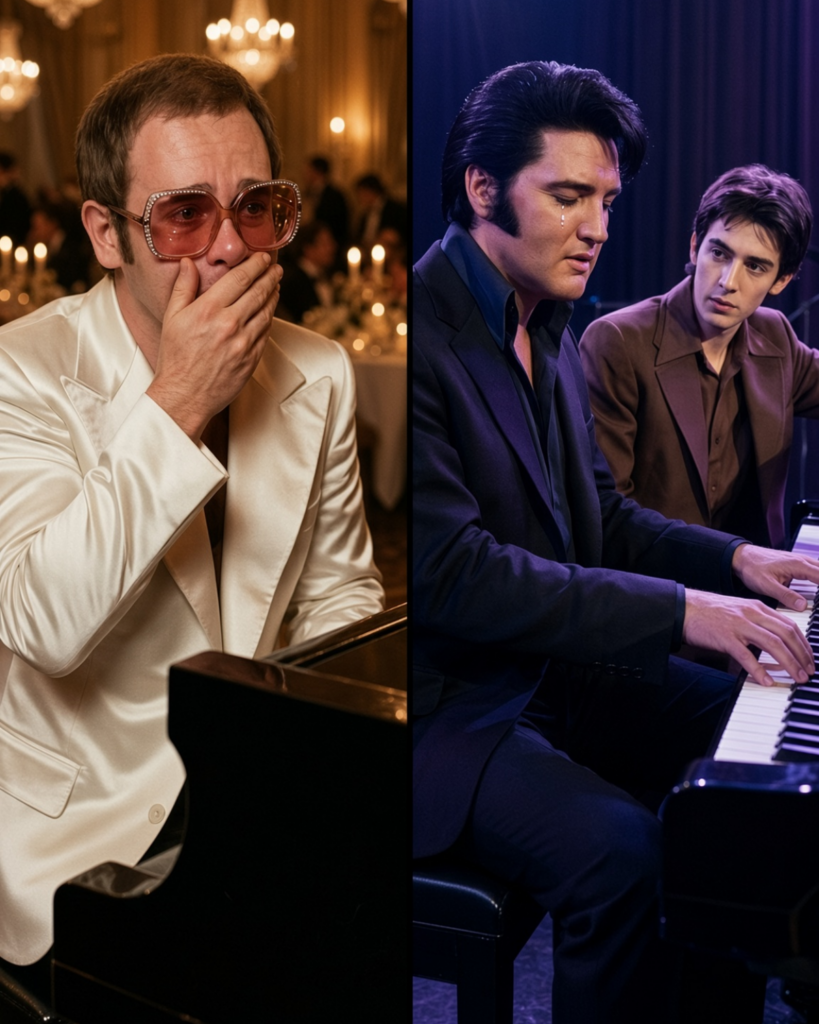
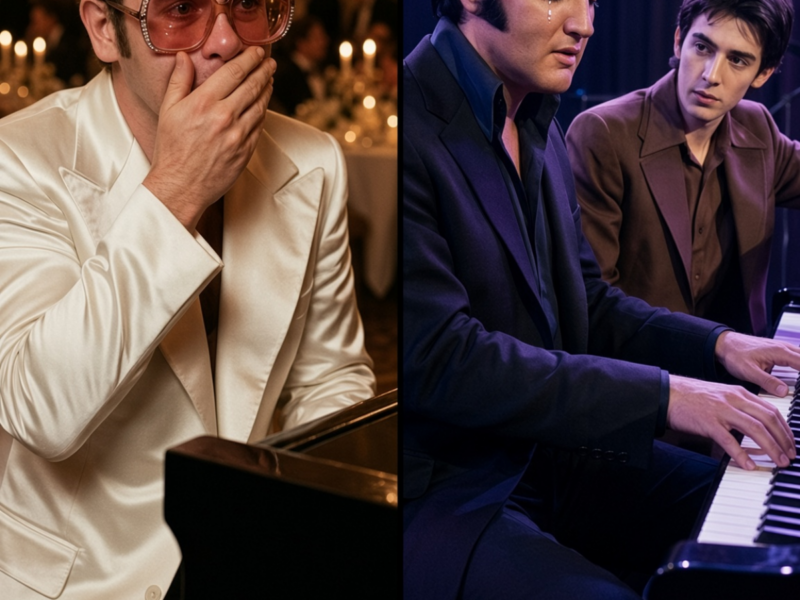
Elton John had just finished singing at a private charity dinner in Memphis when he turned to Elvis Presley and offered him the piano bench as a joke.
The whole room laughed.
Everybody knew Elvis played guitar more or less as a prop.
Nobody in that room had ever seen him play piano.
Elvis didn’t laugh.
He sat down.
And what he played in the next four minutes revealed a promise he had kept in secret every single night for thirteen years—to a little boy whose name he had never once said out loud.
He didn’t know if that boy was alive or dead.
Before the night was over, he would find out.
It was a warm night in the summer of 1976 in the ballroom of the Rivermont Hotel, high on the bluff above the Mississippi River in downtown Memphis.
This was not a concert.
There were no screaming crowds, no flashbulbs at the door, no security men in matching jackets.
It was a dinner.
Round tables with white cloths, candles in glass, about two hundred guests in suits and summer dresses—doctors and nurses, bankers and their wives, a few of the families whose children had been treated across town.
The evening was a benefit for St. Jude Children’s Research Hospital.
St. Jude was only fourteen years old that summer.
It had been built in North Memphis by an entertainer named Danny Thomas, who had prayed years before—when he was broke and frightened and didn’t know where his next meal was coming from—to St. Jude, the patron saint of hopeless causes.
He had promised that if his life ever turned around, he would build a shrine.
His life turned around.
He became one of the biggest television stars in America, and he kept his promise.
Not with a statue—with a hospital for children with cancer, where no family would ever be turned away because they could not pay.
When St. Jude opened its doors in 1962, almost every child who walked into it with leukemia died.
That was simply the truth of it, everywhere in the world.
Doctors had treatments that could buy a few months. They did not have cures.
By 1976, that was beginning to change—slowly, one child at a time.
And that change was what the people in that ballroom had come to celebrate and to pay for.
Danny Thomas was there that night—a big, warm, gray-haired man with an enormous nose and an enormous laugh, moving from table to table, shaking every hand in the room.
And sitting at a corner table near the back, trying very hard not to be noticed, was Elvis Presley.
It had taken a great deal to get him there.
He was forty-one years old that summer, and it had been a hard year.
He was heavier than he had ever been. He was tired in a way that sleep did not fix.
The newspapers had started writing about him the way you write about a man who is already in the past tense.
Most nights now, when he was not on tour, he did not leave Graceland at all.
But Danny Thomas had called him personally and asked him to come.
Not to perform. Just to be there.
Just to sit at a table and let the doctors and the nurses and the families see that he cared.
And Elvis, who could say no to almost anybody, had never once in his life said no to Danny Thomas.
So he came.
He wore a dark suit and tinted glasses and sat with his back to the wall, with Linda Thompson beside him and his cousin Billy Smith across the table.
He spoke quietly to the people who came over to shake his hand, and he did not eat very much.
Linda had been with him for almost four years by then.
She was a former beauty queen from Memphis—tall and funny and fiercely protective of him—and she knew things about him that almost nobody else alive knew.
She knew, for instance, what he did at night.
At the front of the ballroom, there was a small stage with a black grand piano on it, and the surprise guest of the evening was sitting at it.
Elton John was twenty-nine years old that summer, and one of the biggest stars on Earth.
He was in the middle of an American tour, playing stadiums, and he had a rare night off between shows in the South.
When Danny Thomas’s people heard he would be passing through Memphis, they had called his office—and Elton, who had grown up poor in a council house outside London, listening to Elvis records on a secondhand record player, had said yes before they finished asking.
He came out in a white suit and a pair of enormous rose-colored glasses with little rhinestones at the corners, and the room laughed and applauded, and he sat down at that piano and played for half an hour.
He played “Your Song,” and the room went quiet.
He played “Candle in the Wind,” and some of the nurses cried.
He told stories between the songs—funny ones, sharp ones, the kind of stories that made two hundred strangers feel like they were sitting in his living room.
And at the corner table near the back, Elvis watched him play.
Not the way a fan watches—the way a man watches somebody do a thing he loves and has never been able to do in front of anyone.
Linda noticed.
She noticed that his right hand, resting on the white tablecloth, was moving very slightly with the music.
His fingers were pressing down on the cloth, one after another, as if there were keys under them.
She put her hand on top of his. He stopped.
Elton finished his last song.
The room stood up for him.
He bowed, laughed, made a joke about his glasses, and then stood beside the piano and talked to the room for a while—thanking Danny Thomas, thanking the doctors, thanking everybody for their money, which made them laugh again.
And then his eyes, behind those rose-colored glasses, landed on the corner table at the back.
His whole face lit up with mischief.
“Well, now,” Elton said into the microphone, pointing across the room. “Ladies and gentlemen, I didn’t want to embarrass anybody, but I have just spotted the reason I ever touched a piano in the first place—hiding in the back, in sunglasses, indoors, at night.”
Two hundred heads turned.
“Elvis Presley, everybody.”
The room broke into applause. People stood up.
Elvis lifted one hand a few inches off the table, gave a small, embarrassed smile, and tried to sink lower in his chair.
But Elton wasn’t finished.
“Come up here, Elvis. Come on. Don’t be shy. Nobody’s going to make you sing.”
Elvis shook his head.
The room laughed and clapped harder.
A table of nurses near the front started chanting his name.
Billy Smith grinned at his cousin across the table and said, “You’re done for, E.”
Linda leaned over and said something in his ear—and whatever it was, he sighed and pushed back his chair and stood up.
The applause doubled.
He walked slowly to the front of the room, between the tables, nodding at people, shaking a few hands, and climbed the two steps onto the little stage.
Elton threw an arm around his shoulders—which was something almost nobody ever did to Elvis Presley—and Elvis let him.
“You know,” Elton said to the room, beaming, “when I was a boy in Pinner, I used to stand in front of the mirror with a tennis racket and pretend to be this man. Every kid in England did. And I’ve met him once before, and he was very kind to me, and I have never in my life seen him do one thing.”
He paused for timing.
“Elvis,” he said, “I have heard you sing. I have seen you dance. I have seen you strangle a guitar you clearly don’t know how to play.”
The room roared.
“But I have never once seen you play the piano.”
Elton swept his hand toward the empty bench. “So go on, then. Show us what you’ve got.”
The whole ballroom laughed.
It was a good joke.
Everybody knew Elvis Presley and the guitar he slung around his neck on stage and hardly played.
The idea of him sitting down at a grand piano after Elton John had just spent half an hour making it sound like an orchestra was ridiculous.
That was the point.
Elton was grinning. Danny Thomas at the front table was laughing so hard he had to take off his glasses.
And Elvis didn’t laugh.
He stood very still with Elton’s arm still around his shoulders.
Even through the tinted glasses, the people at the nearest tables could see something change in his face.
The polite smile went away.
Elton felt it. His own grin faltered. He took his arm down.
The laughter in the room died away unevenly—the way laughter does when people realize, one table at a time, that something is happening that they don’t understand.
Elvis turned and looked at the piano.
The long black lid was propped open. The lights from the chandelier were reflected in it.
Then he looked out across the room to the corner table at the back, where Linda Thompson was sitting very straight in her chair with both her hands pressed flat on the tablecloth.
Their eyes met.
Linda knew.
She was the only person in that room who did.
She knew that at Graceland, in the music room off the living room, there was a piano.
And she knew that almost every night, very late, after the house had gone quiet and the guards had gone to bed and the only lights still on were in the kitchen, Elvis went into that room by himself and shut the door and played one piece of music.
Always the same piece. Always alone.
She had lain awake and listened to it through the wall more nights than she could count.
And in four years, she had asked him about it exactly once.
He had told her.
And then he had asked her never to tell another living soul.
Now, across the ballroom, she looked at him—and very slowly, she nodded.
Elvis turned back to Elton.
“All right,” he said quietly. “I’ll play you something.”
Elton blinked. “Really?”
“Yeah,” Elvis said. “Really.”
He took off his tinted glasses, folded them, and put them in the inside pocket of his jacket.
Then he walked to the piano bench and sat down.
Elton stood beside the piano, no longer grinning.
He didn’t know why, but he felt suddenly that he ought to stand very still.
The room was silent now. Two hundred people.
You could hear a fork being set down very carefully on a plate at the back. You could hear the hum of the air conditioning.
Elvis put his hands on the keys.
He didn’t play anything yet.
He just sat there for a long moment with his fingers resting on the ivory, looking down at them.
They were trembling. Not much—but Elton, standing two feet away, could see it.
And what happened in the next four minutes would bring an old promise back into the light.
A promise Elvis had made in a hospital playroom thirteen years earlier, about two miles from where he was sitting, to a nine-year-old boy he had never seen again.
To understand it, you have to go back to the spring of 1963.
St. Jude Children’s Research Hospital had been open for about a year.
It was a small, star-shaped building in a poor part of North Memphis, and almost nobody in America had heard of it yet.
Danny Thomas was still flying around the country begging for money to keep the doors open.
The doctors were young and stubborn and frightened, because they were trying to do something that every expert in the world told them could not be done.
They were trying to cure childhood leukemia.
In 1963, when a child was diagnosed with acute leukemia, the doctors could usually buy that child some time.
Weeks. Months. Sometimes a year.
But in the end, nearly every one of those children died.
The doctors at St. Jude knew that. The parents knew it. And the children, most of them, knew it too—in the way children know things nobody tells them.
That spring, Danny Thomas telephoned Graceland.
Elvis was home between pictures. He had just finished one movie in Hollywood and had a few weeks before he went back to start another.
Danny Thomas did not ask him to do a concert. He did not ask him for money—though Elvis would give a great deal of it over the years.
He asked him for something much simpler.
“Come and see the kids,” Danny said. “Just come and see them. No reporters, no photographers, nobody has to know. Just come.”
So one afternoon in April, Elvis drove across Memphis in an ordinary car with one friend beside him and walked through the front doors of St. Jude.
He spent four hours there.
He went from room to room. He sat on the edges of beds. He signed casts and coloring books and the backs of get-well cards.
He sang a little, quietly, for a girl who asked him to—and her mother had to leave the room.
And late in the afternoon, a nurse took him down the hall to the playroom.
It was a bright room at the end of a corridor, with low tables and finger paintings taped to the walls and a big window that looked out over a parking lot.
Somebody had donated an old upright piano—battered and a little out of tune—and pushed it against the far wall.
And sitting on the bench in front of it, all by himself, was a small boy in pajamas.
He was about nine years old.
He was thin, the way the children on that floor were thin. He had no hair.
There was a tube taped to the back of his left hand, running up to a metal pole on wheels standing beside the bench.
And he was bent over the keyboard with his whole face screwed up in concentration, playing something very slowly with his right hand.
Three notes, over and over. Low and rocking and sad.
Elvis stopped in the doorway.
He knew that music. Everybody knew that music—even people who said they didn’t know anything about classical music.
It was the beginning of the Moonlight Sonata by Beethoven—the slow, rocking, haunted first movement that sounds like somebody walking alone by a lake in the middle of the night.
And Elvis Presley, who had never had a single piano lesson in his life, loved that piece more than almost any other music in the world.
He had a record of it at Graceland that he played when he couldn’t sleep.
He had never told anybody that, either.
The nurse started to say something. Elvis held up his hand to stop her.
He walked across the room very quietly and stood behind the boy and listened.
The boy played the three notes again.
Then he tried to add the next part with his left hand—the deep, slow notes underneath—and got it wrong, and stopped, and said a word that a nine-year-old is not supposed to know.
Elvis laughed out loud.
The boy turned around on the bench, scowling, and looked up at him.
He did not look impressed. He looked, if anything, a little annoyed at being interrupted.
“You’re Elvis,” he said.
“Yes, sir.”
“My mama likes you.”
“Well, I’m glad somebody does. What’s your name?”
“Jimmy,” the boy said. “Jimmy Caldwell.”
He was from a little town outside Clarksdale, in the Mississippi Delta.
His daddy farmed cotton on shares for another man. His mama had come up to Memphis with him on the bus, and she was staying at a boarding house across town and coming to see him every day, and his daddy came on Sundays when he could get away.
A lady came to St. Jude two afternoons a week to teach music to any child who wanted to learn.
Most of the children wanted to play with the drums.
Jimmy had wanted the piano.
And the very first day, the music lady had played him that piece—the moonlight one—and he had asked her to play it again and again, and she had finally written out the first part for him in big black notes on a piece of cardboard, and he had been trying to learn it ever since.
“Why that one?” Elvis asked.
Jimmy thought about it.
“‘Cause it’s sad,” he said, “but it ain’t scared. It sounds like the moon’s lonesome, but it knows it’s going to be all right in the morning.”
Elvis didn’t say anything for a while.
Then he sat down on the end of the bench next to the boy.
“Show me,” he said.
So Jimmy showed him. The three notes in the right hand, rocking. The low notes in the left hand underneath that he couldn’t get right.
Elvis watched his hands very carefully.
Then he put his own big hands on the keys, down at the low end, and found the bass notes—slowly, one by one, by ear, the way he had found everything in his life.
And for about two minutes in a playroom at St. Jude, a nine-year-old boy and Elvis Presley played the first few bars of the Moonlight Sonata together, badly, on an out-of-tune piano.
The boy on the top. Elvis on the bottom.
The nurse in the doorway had her hand over her mouth.
When they stopped, Jimmy looked up at him.
“You ain’t very good,” he said.
“No, sir,” Elvis agreed. “I ain’t.”
“I’m going to learn the whole thing,” Jimmy said. “The whole first part. When I get out of here, I’m going to learn every note.”
He said it the way children say things they have decided to be true.
“I believe you,” Elvis said.
Jimmy looked at him for a long, serious moment. Then he said, “You should learn it, too.”
“Me?”
“You learn the bottom part. All of it. And I’ll learn the top. And when I get better, we’ll play it together. The whole thing. All the way to the end.”
Elvis looked down at the boy—at the tube taped to the back of his hand, at the metal pole beside the bench, at the bald head and the thin wrists.
He knew what the doctors knew. Danny Thomas had told him in the car on the way over, as plainly as he could.
Most of these children were not going to get better.
“All right,” Elvis said. “It’s a deal.”
Jimmy held out his hand—the one without the tube. Elvis shook it.
“And you can’t tell nobody,” Jimmy said.
“Why not?”
“‘Cause it’s like a wish,” the boy said, as if this was obvious. “If you tell it, it don’t come true.”
Elvis nodded very seriously. “I won’t tell a soul,” he said.
He did not tell a soul. Not for years.
The next morning, he sent Billy Smith downtown to a music store on Union Avenue to buy the sheet music for the Moonlight Sonata.
Billy came back with it—and a look on his face—and Elvis took it into the music room at Graceland and shut the door.
He could not read music, not properly. He had never needed to.
So he sat at that piano for hours every night, working it out note by note—the way he had worked out everything else in his life, by ear and by stubbornness, with the sheet music propped up in front of him like a map in a foreign language.
It took him almost two months to learn the first movement. The whole thing. Both hands. All the way to the end.
And at the beginning of July, before he flew back to Hollywood, he drove across Memphis to St. Jude again—by himself this time—to tell Jimmy Caldwell he had kept his half of the deal.
Jimmy wasn’t there.
The nurse at the front desk was a different nurse from the one in the spring.
She looked through a file. She looked up at Elvis, and then back down at the file, and her face did something very careful.
“I’m sorry, Mr. Presley,” she said. “James Caldwell isn’t with us anymore.”
Elvis waited for her to say something else. She didn’t. She wasn’t allowed to.
Patient records were private.
She couldn’t tell him whether the boy had gone home to the Delta, or been sent somewhere else, or whether he had died.
She could only tell him that he was not there.
Elvis stood at that desk for a long moment.
Then he thanked her and walked back out to his car and sat in the parking lot for almost an hour without starting the engine.
He never asked again.
He told Linda years later—the one time she asked about the music—that he had been afraid to.
That as long as he didn’t know, the boy might still be alive somewhere. Might still be learning the top part. Might still be coming.
“So I keep practicing the bottom,” he had said. “Every night. Just in case.”
That was thirteen years before the night at the Rivermont Hotel.
He had never played it for anyone. Not once. Not for Priscilla. Not for his father. Not for his own little girl.
Apart from Linda, he had never told a single person why.
And now he was sitting at a black grand piano in front of two hundred strangers, with Elton John standing beside him, and his hands were shaking.
In the ballroom of the Rivermont Hotel, Elvis took a long breath—the way he did backstage before he walked out in front of twenty thousand people.
Then he began to play.
Three notes in the right hand. Low, rocking, slow.
And underneath them, the deep notes in the left hand. The bottom part. The part a nine-year-old boy had not been able to get right.
The Moonlight Sonata.
A ripple went through the room.
Not a sound, exactly—more like two hundred people sitting up a little straighter at the same time.
Because it was not what anyone expected.
It was not a joke. It was not a rock-and-roll song played fast to get a laugh. It was not Elvis Presley clowning around at a piano to get out of an awkward moment.
It was Beethoven—slow and dark and careful.
And it was being played by a man who had clearly been playing it for a very long time.
It was not perfect.
Elton John, standing two feet away, could hear every flaw. A note in the left hand that came a fraction too late. A chord that was not quite voiced the way a trained pianist would voice it. The pedal held a little too long, so the notes blurred together.
But Elton said, many years later, that he did not care about any of that—not for one second—because there was something in the way Elvis played it that he had almost never heard from anybody. Not in concert halls. Not in conservatories. Not from the greatest pianists in the world.
He was not performing it. He was not trying to impress anybody.
He was playing it the way you would play it alone in a dark room at three in the morning, for one person who was not there.
Elton stood beside the piano with one hand slowly coming up to cover his mouth.
The room had gone completely still.
The nurses at the front table, the doctors, the bankers and their wives, the families whose children had been treated across town.
Danny Thomas at the head table had stopped laughing a long time ago. He was sitting very still with his big hands folded in front of him, watching Elvis’s face.
And Elvis played with his eyes half closed.
His lips moved a little every so often, without any sound. The people closest to the stage said afterward that it looked like he was counting—or talking to somebody.
At the back of the room, at the corner table, Linda Thompson had both hands pressed against her face.
Billy Smith was staring at his cousin as if he had never seen him before in his life.
Halfway through, Elvis lost his place.
His right hand stopped. The rocking notes broke off in the middle.
The room held its breath.
He sat there for a moment, his hands frozen above the keys. You could see his jaw working.
And then, very quietly, without looking up, he went back to the beginning of the phrase and started it again.
And this time, he got it.
He played the rest of it all the way through—the long, slow climb in the middle, where the music rises and rises like somebody trying to keep from crying; the deep, dark chords near the end; and finally the last few notes, so soft that the people at the back tables leaned forward in their chairs to hear them, fading down to almost nothing at all.
His hands rested on the final chord until it died away into the hum of the room.
Then he took them off the keys and put them in his lap.
And nobody clapped.
Nobody moved.
For five seconds. Ten seconds. Two hundred people sat in total silence, because nobody could quite bring themselves to break it.
Elvis sat on the bench with his head bowed.
Then his shoulders began to shake.
He was crying.
Elvis Presley—in front of two hundred strangers in a hotel ballroom in his own hometown—with his face in his hands.
Elton John moved first.
He crossed the two feet between them, sat down on the end of the piano bench, and put his arm around Elvis’s shoulders again.
This time, Elvis leaned into it.
“I’m sorry,” Elton said quietly, his own voice thick. “I’m so sorry, Elvis. I was only joking. I didn’t know.”
Elvis shook his head. “It’s all right,” he said. “Nobody knew.”
Somebody at a table near the front began, very softly, to clap.
Then somebody else. And then the whole room was on its feet.
It was not the kind of applause Elvis was used to. Nobody screamed. Nobody whistled.
It was slow and steady and long—the kind of applause people give at the end of a funeral, or a wedding, or a homecoming.
Elvis did not get up. He sat on the bench beside Elton and wiped his eyes with the back of his hand and waited for it to stop.
When it did, Elton gently reached over to the microphone stand and lowered it toward him.
“You don’t have to say anything,” Elton said. “But if you want to.”
Elvis looked at the microphone for a long moment. Then he leaned toward it.
“I learned that for a little boy,” he said.
His voice was rough. The room went still again.
“Thirteen years ago, over at St. Jude—Mr. Thomas took me over to see the kids, and there was a boy in the playroom trying to learn that piece on an old piano. Nine years old. Couldn’t get the left hand. And he told me if I learned the bottom part and he learned the top, when he got better, we’d play it together. All the way to the end.”
He stopped. He looked down at the keys.
“I went back that summer to show him I’d learned it,” he said. “And he wasn’t there. And they couldn’t tell me why. And I never—”
He stopped again.
“I never asked. I didn’t want to know. So I just kept playing it every night, in case—”
Nobody in the room breathed.
“I made him a promise I wouldn’t tell anybody,” Elvis said. “I guess I just broke it.”
He tried to smile and didn’t quite manage it.
“His name was Jimmy. Jimmy Caldwell, from down around Clarksdale. If anybody here ever knew him—”
He didn’t finish. He leaned back from the microphone and sat there on the bench, looking down at his hands, while two hundred people looked at him and did not know what to say.
And at the head table, Danny Thomas slowly stood up.
He did not walk to the stage.
He turned around and looked across the ballroom toward a table near the side wall, where a group of St. Jude doctors and nurses had been sitting all evening with a few of the hospital’s volunteers.
And at that table, a young man in a borrowed brown suit was already on his feet.
He was about twenty-two years old. Thin. Dark-haired.
He was standing perfectly still with one hand on the back of his chair, staring at the man on the piano bench with an expression that nobody at his table had ever seen on his face before.
He had been sitting there all night.
He had applauded politely for Elton John. He had glanced at the corner table at the back once or twice, the way everybody did, to look at Elvis Presley.
And then the famous man had sat down at the piano and played three notes—low, rocking, slow.
And the young man in the brown suit had put down his fork and had not moved since.
The nurse sitting next to him—an older woman who had worked at St. Jude since the day it opened—reached up and touched his arm.
“Go on, honey,” she said softly. “Go on.”
He walked between the tables toward the stage.
Heads turned to follow him, one table at a time. People didn’t understand yet.
Some of them thought he was a waiter. Some of them thought he was a doctor, coming to see if Elvis was all right.
Elvis didn’t see him at first. He was still looking down at the keys.
Elton saw him.
Elton watched this thin young stranger in a borrowed suit climb the two steps onto the stage and stop beside the piano.
And something in Elton’s face changed. And very quietly, without anybody telling him to, he got up off the bench and stepped back.
The young man stood there for a moment.
Then he said, in a voice that shook only a little, “You still ain’t very good.”
Elvis Presley looked up.
He looked at the young man’s face for a long time.
The thin cheeks. The dark hair—thick now—that had not been there thirteen years before. The eyes, which had not changed at all.
He didn’t say anything. He couldn’t.
“I’m Jimmy,” the young man said. “Jimmy Caldwell.”
He sat down on the end of the piano bench—right where Elton had been sitting, right where a nine-year-old boy in pajamas had once sat beside him.
“They sent me home in June,” he said quietly, so that only Elvis and Elton could hear. “Summer of ’63. My blood counts came back good, and they said I could go home and come back for treatment every month. My daddy came and got me in the truck. I wanted to leave you a note, but I didn’t know how to spell your name right.”
He laughed, shakily. “I was nine.”
Elvis was staring at him.
“I kept coming back,” Jimmy said. “Every month. Then every three months. Then every year. They kept giving me the medicine. They kept checking. And one year, when I was fourteen, the doctor sat me down and said they didn’t think it was coming back.”
He looked down at the keys.
“I was one of the first,” he said. “One of the first ones that made it. There’s lots more now. More every year.”
He nodded across the room toward the head table, where Danny Thomas was standing with tears running down his big face, not bothering to wipe them.
“I teach music over there now,” Jimmy said. “Two afternoons a week. Same as the lady who taught me. Most of the kids want the drums.”
He smiled. “But some of them want the piano.”
“And do you—” Elvis started, and his voice gave out. He tried again. “Did you ever learn it? The top part?”
Jimmy Caldwell looked at him like it was the strangest question in the world.
“Mr. Presley,” he said, “I promised.”
He put his right hand on the keys, high up, where the melody lives.
Elvis looked at him for one more long moment.
Then he put his left hand down at the bottom of the keyboard, on the deep, low notes.
The bottom part. The part he had played alone in a dark room at Graceland every night for thirteen years.
Neither of them said anything else.
They began to play.
The three rocking notes, high and clear, from the young man’s right hand. The deep notes underneath, from Elvis’s left.
Exactly the way they had played it once before—badly, on an out-of-tune upright in a playroom two miles away, with a metal pole on wheels standing beside the bench.
It was not badly now.
The two of them had been practicing it separately for thirteen years—each one in his own room, each one not knowing whether the other was still there.
And when they put their halves together on that black grand piano in the Rivermont Hotel, it fit.
Elton John said afterward that it was the most beautiful performance of that piece he had ever heard in his life—and he had heard it played by the greatest pianists in the world.
It wasn’t the playing, he said. It was the listening. Every note, one of them was waiting for the other. Like they’d been waiting for thirteen years.
In the ballroom, people were crying openly now.
Nurses who had spent fourteen years watching children die on that hospital’s wards. Doctors who had stayed up through ten thousand nights trying to find the thing that would save them.
Parents whose own children had not made it. Parents whose children had.
Danny Thomas was standing at the head table with his hand pressed flat over his heart.
At the corner table at the back, Linda Thompson was holding Billy Smith’s hand so hard that he had marks on it the next morning.
They played the long, slow climb in the middle together.
They played the dark chords near the end.
And when they came to the final notes—so soft they were barely there—they slowed down together, without looking at each other, without any signal at all, and let the last chord fade away into the room.
All the way to the end.
Nobody clapped. Not for a long time.
Elvis sat with his hands resting on the low keys. Jimmy sat with his hands resting on the high ones.
And then, very slowly, Elvis turned on the bench and put both his arms around the young man and held on to him.
And Jimmy Caldwell held on back.
That was when the room finally broke.
They stood up—all two hundred of them—and they did not stop.
Elton John stood at the side of the stage with tears running down under his rose-colored glasses and applauded until his hands hurt.
Somebody at the back shouted, “God bless St. Jude!”—and half the room shouted it back.
And through all of it, the two men on the piano bench just sat there, holding on to each other, while the whole ballroom roared around them.
What happened after that night, the people who were there told for the rest of their lives.
Elvis and Jimmy sat together in a quiet room off the ballroom for almost two hours after the dinner ended.
Nobody knows everything they talked about.
Billy Smith, who waited outside the door, said that at one point he heard both of them laughing so hard he thought something had fallen over.
Before he left the hotel, Elvis found Elton John in the lobby.
Elton started to apologize again for the joke. Elvis stopped him.
“Don’t you ever apologize for that,” he said. “If you hadn’t made fun of me, I’d have gone home and played it to an empty room again tonight, like always.”
He shook his head. “You gave me back the other half.”
Elton said later that he had made a great many jokes in his life, and that was the only one he would never want to take back.
And at Graceland, late at night, after the house had gone quiet, there was a new sound coming from the music room off the living room.
Not one person playing the bottom part alone, the way it had been for thirteen years.
Two people. One on the top. One on the bottom. Playing it together, all the way to the end.
Jimmy Caldwell drove out to Graceland on Sunday evenings for a long time after that.
He would sit down on the bench, and Elvis would sit down beside him, and they would play it once through without saying a word.
Then they would start again from the beginning—just to hear the boy on the top and the man on the bottom, still both there.









