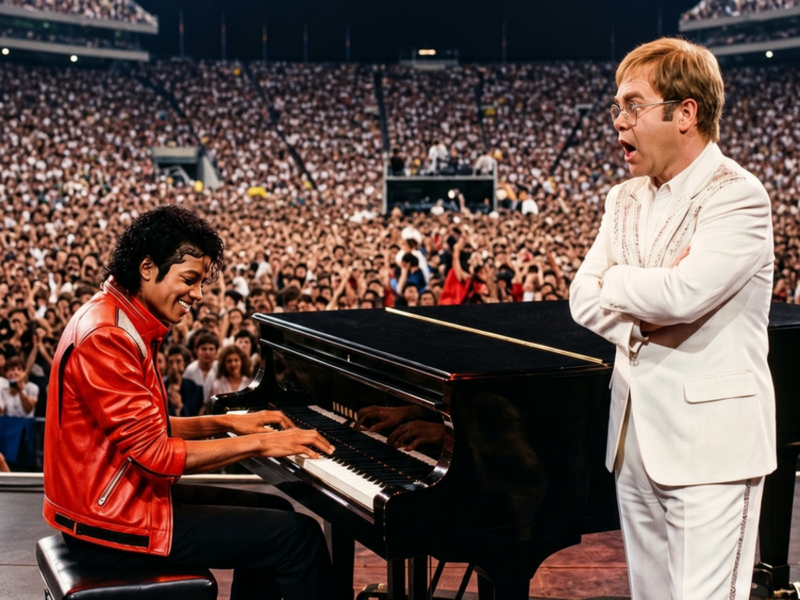
Elton John DARED Michael Jackson To Play Piano LIVE to Mock Him – Nobody Was Ready For What MJ Did.
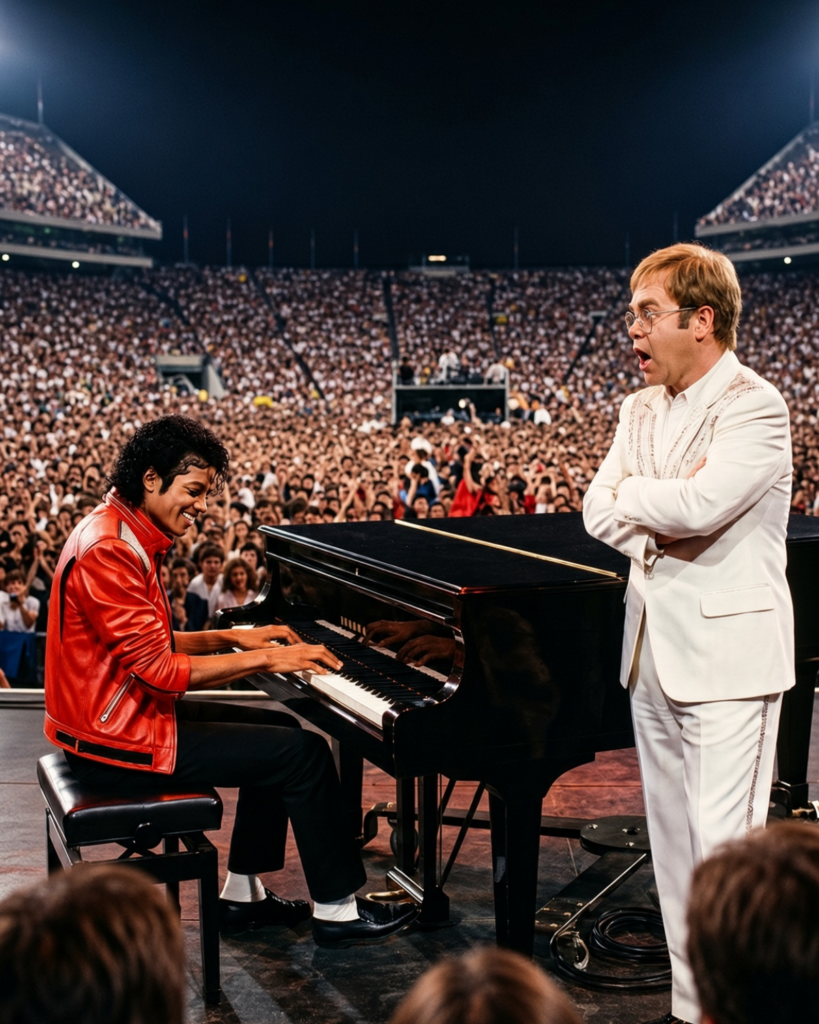
This is a work of fiction.
This imagined encounter did not happen.
Madison Square Garden, New York City, October 1988.
Twenty thousand people were packed into the building on a cold, wet Friday night, and every one of them had come to see one man sit down at a piano.
Elton John was in the middle of a run of shows that would break the all-time record for the most sold-out concerts ever played at the Garden.
The posters outside on Seventh Avenue were soaked from the rain.
The scalpers were asking three hundred dollars a ticket and getting it.
But the most famous person in the building that night was not on the stage.
He was standing in a dark corridor behind the stage curtain, next to a stack of empty road cases, wearing a black fedora pulled down over his eyes, a plain dark coat buttoned to the throat, and a single white surgical mask folded in his pocket in case anybody recognized him in the hallway.
He had come in through the loading dock on 33rd Street two hours earlier in the back of a gray van with one bodyguard and no announcement.
That man was Michael Jackson.
And in about forty minutes, Elton John was going to stop his own show, turn toward the side of the stage, and say something into his microphone that nobody in that building would ever forget.
He was going to call Michael Jackson out in front of twenty thousand people.
He was going to dare him to walk out and play the piano live, with no band, no backing track, no dancers, and no rehearsal.
And he was going to do it as a joke.
A joke with a sharp edge on it.
Because everybody in the music business knew that Michael Jackson could sing.
And everybody knew he could dance.
But nobody—not one person in that arena—believed Michael Jackson could play the piano.
They were about to find out how wrong they were.
To understand why Elton John would ever do something like this, you have to understand what kind of year 1988 had been for him.
From the outside, it looked like he was on top of the world.
The record at the Garden, a new album called Reg Strikes Back with a single climbing the charts, sold-out arenas all over America.
But the people close to Elton knew it had been one of the hardest stretches of his whole life.
In January of 1987, doctors in Sydney, Australia, had found growths on his vocal cords.
For a few terrible weeks, nobody knew if he would ever sing again.
He had surgery, and the surgery worked, but his voice came back lower and rougher than before.
Some critics noticed.
A few of them were cruel about it.
One London paper ran a review of his comeback that called him a man trying to sing through a mouthful of gravel.
Then, in September of 1988, just a few weeks before the Garden shows, Elton did something that shocked his fans.
He put almost everything he owned up for auction at Sotheby’s in London.
The costumes, the giant glasses, the feather boas, the platform boots, the paintings, the jukeboxes, the furniture from his house in Windsor.
Two thousand items, four days of bidding.
He told reporters he was clearing out the clutter.
The people who loved him quietly worried he was clearing out something else.
He was drinking hard in those days.
He wasn’t sleeping much.
He was forty-one years old, and he was scared that his best years might already be behind him.
And that fear had a face.
Everywhere Elton went in 1988, he saw the same face on magazine covers, on billboards, on the MTV screens, in every hotel bar.
Michael Jackson’s Bad Tour was the biggest concert tour in the history of the world.
His album was selling faster than anything anybody had ever seen.
Newspapers had started calling him the King of Pop.
And more than one of them had started writing the same kind of sentence: “The old guard is finished. Michael Jackson is the only star who matters now.”
Elton read those sentences.
He pretended not to care, but he cared.
Then, in August of 1988, a British tabloid printed a story that lit the fuse.
The headline ran across the top of page seven in thick black letters.
It claimed that Michael Jackson, speaking to a friend backstage at Wembley Stadium, had said something about Elton John.
According to the paper, Michael had said, “Elton John is yesterday’s news. Nobody under twenty even knows who he is.”
There was no name for the friend.
There was no recording.
There was just the quote sitting there in black ink, being read over breakfast tables all over England.
Elton read it on a Sunday morning in his kitchen in Windsor.
His assistant later remembered that he read it twice, folded the paper very carefully in half, set it down next to his teacup, and didn’t say a single word for almost ten minutes.
Then he got up, walked into the music room, sat down at his piano, and played scales.
Just scales, up and down, up and down, as hard and as fast as he could for over an hour, until his wrists ached.
Three weeks later, a reporter from a music magazine asked Elton about Michael Jackson during an interview in a hotel suite in Los Angeles.
And Elton, tired and sore and still stinging, gave an answer he would regret for a very long time.
“Michael’s a lovely dancer,” he said, with that dry little smile of his.
“Wonderful feet, lovely voice. But put him in front of a piano and he’d be as lost as a cat in a bathtub. There’s a difference between a performer and a musician, darling. One of them needs forty dancers and a smoke machine. The other one just needs eighty-eight keys.”
That quote traveled around the world in about a week.
What Elton didn’t know—what almost nobody on Earth knew—was that the Michael Jackson quote in the tabloid had never been said.
Michael had never spoken to any friend about Elton John at Wembley.
The whole thing had been invented by a freelance writer who needed a story to sell before the weekend.
And what Elton also didn’t know, what he could never in a thousand years have guessed, was that Michael Jackson had been playing the piano quietly, secretly, almost every night of his life for over twenty years.
To understand that secret, we have to go back to a small gray house on Jackson Street in Gary, Indiana, in the winter of 1966.
Michael was eight years old.
He was already singing with his brothers, already rehearsing for hours every night under the hard eye of his father, Joseph.
The house was tiny—two bedrooms for eleven people.
The boys slept three to a bed in a room barely bigger than a closet.
Outside, the steel mills pumped gray smoke into the sky from morning to night, and the snow on the sidewalks turned black before noon.
Three doors down from the Jackson house lived an old woman named Odessa Puit.
Mrs. Puit was seventy-one years old.
She was tiny and straight-backed and always wore a hat when she left the house, even to walk to the mailbox.
She had been a music teacher in the Gary public schools for thirty-eight years.
And before that, as a young woman in the 1920s, she had played piano in a church in Chicago where people said she could make grown men weep with a single chord.
She had buried her husband, and she had no children of her own.
She lived alone with an old upright piano in her front room, a cat named Deacon, and a kitchen that always smelled like cornbread and coffee.
The neighborhood kids were a little bit afraid of her.
She did not tolerate slamming gates, loud radios, or boys cutting across her lawn.
Michael met her because of her groceries.
One freezing afternoon in December, he saw her struggling up the icy sidewalk with two heavy paper bags from the corner store.
Without a word, he took one of the bags out of her arms and walked it to her front door.
She looked down at him for a long moment.
Then she said, “Well, at least somebody in this neighborhood was raised right.”
And she gave him a nickel.
He didn’t take the nickel, but he came back the next Saturday to carry her groceries again.
And the Saturday after that.
And on the third Saturday, while she was putting the milk in the icebox, Michael wandered into the front room and stood in front of the old upright piano.
He didn’t touch it.
He just stood there and stared at it the way other boys stared at bicycles in shop windows.
Mrs. Puit came in behind him and saw his face, and she understood something right away.
She had been a teacher for almost forty years.
She knew what hunger looked like.
“You want to touch it?” she asked him.
He nodded.
“Then wash your hands first. Nobody touches my piano with grocery on their fingers.”
He washed his hands at her kitchen sink.
He came back and sat on the bench, which was so tall his sneakers dangled a foot above the floor, and he pressed one key—a single middle C.
He kept his finger on it and listened to the sound until it disappeared completely.
Mrs. Puit told a friend from her church many years later that she knew everything she needed to know about that boy in that one moment.
“Most children bang on a piano like it owes them money,” she said.
“That child pushed down one key and then listened to it die. He wanted to hear where the sound went. You cannot teach that. The Lord either puts it in you or He doesn’t.”
She started teaching him that same afternoon.
It had to be a secret.
That was the first thing they agreed on.
Michael’s father ran the family rehearsals like a drill sergeant, and every minute of every day belonged to the group.
If Joseph found out his son was spending Saturday afternoons at an old woman’s house doing something that wasn’t making the Jackson 5 any money, those Saturdays would end.
So Michael told his family he was carrying groceries for Mrs. Puit—which was true.
He just didn’t mention the hour that came after the groceries.
She taught him the way she had been taught in Chicago in 1922.
Scales first, always scales first.
Then hymns, because hymns taught you how chords were built and how they moved from one to the next.
Then a little bit of classical music—Bach and Chopin, because she said Bach taught your hands to think and Chopin taught your heart to speak.
And then, on the good days, when he’d done all his work, she’d let him play gospel.
Real church gospel, the kind she’d grown up with, full of rolling left-hand rhythms and chords that leaned on each other like tired friends.
Michael was a strange student.
He hated reading the sheet music.
He’d stare at the page and his eyes would glaze over.
But if Mrs. Puit played a passage for him once—just once—he could play it back to her almost perfectly.
She’d never seen an ear like it.
She would play eight bars of a Chopin nocturne, and he would sit there with his eyes closed, and then he’d put his little hands on the keys and give it right back to her, every note in its place.
Sometimes even the little hesitations she’d put in without meaning to.
“You’re a parrot,” she’d tell him, pretending to be annoyed.
“A very talented parrot. But you are going to learn to read this music if it kills us both.”
He did learn, slowly, grudgingly, but he learned.
For almost three years, every Saturday that the Jackson 5 weren’t on the road, Michael carried Mrs. Puit’s groceries and then sat at that old upright piano in her front room while Deacon the cat slept on top of it and the radiators hissed and the steel mills smoked outside the window.
And in all that time, he never played for anyone else.
Not his brothers, not his mother, not a single living soul.
Because of the promise.
Mrs. Puit had made him promise on the very first day.
She’d put her hand on top of his little hand on the keys, and she’d looked at him with her sharp brown eyes, and she’d said, “Michael, listen to me. The whole world is going to want a piece of you. I can see it already. They’re going to want your voice and your feet and your face and your time. They’re going to take and take and take. So this one thing—this piano—you keep for yourself. You don’t show it off. You don’t use it to make money. You don’t play it for people who want to be impressed. You play it for the Lord and you play it for yourself. And one day, when somebody really needs to hear it, you’ll know. And that’s when you play it for them.”
He was eight years old.
He promised.
In 1969, the Jackson 5 signed with Motown Records, and the family moved to California.
Michael was eleven.
He ran down the street to say goodbye to Mrs. Puit the morning they left.
She didn’t cry.
She wasn’t the crying type.
She just held both his hands for a long time and said, “Keep your promise and keep practicing. I’ll know if you don’t.”
Then the whole world happened to him, exactly the way she’d said it would.
In January of 1971, the Jackson 5 came home to Gary, Indiana, for a homecoming concert.
They were the biggest group in America by then.
Their faces were on lunchboxes.
The city gave them keys to the city and a parade.
Thousands of people lined the streets in the freezing cold.
And on the afternoon before the concert, while the rest of the family was doing interviews at the hotel, twelve-year-old Michael Jackson slipped out a back door with one of the security men and had him drive to a small gray house on Jackson Street.
Mrs. Puit opened the door in her hat and her good coat, as if she’d been expecting him.
She probably had been.
She made him wash his hands.
She made him play his scales.
She told him his left hand had gotten lazy out in California and he ought to be ashamed.
And then she did something she had never done before.
She went to her old record player in the corner and put on an album she had bought just a few weeks earlier.
It was a record by a young Englishman that nobody in Gary, Indiana, had ever heard of.
It had a black-and-white cover with the man’s face half in shadow.
His name was Elton John.
She put the needle down on a song called “Your Song.”
And Michael sat on the piano bench and listened.
The simple, gentle piano introduction.
Those plain, lovely chords.
The way the young man’s playing was never showing off, never trying too hard, just carrying the song along underneath the voice like a hand under someone’s elbow.
When it was over, Mrs. Puit lifted the needle and looked at Michael.
“You hear that?” she said.
“That young man went to a proper music academy in London. He knows every trick there is. And listen to what he does with all those tricks. Nothing. He hides them. He plays like he’s praying. That is what I have been trying to teach you for three years. The best musicians don’t make you look at their hands. They make you forget there are hands at all.”
She played the song again.
And then again.
And then she sat down next to Michael on the bench and showed him the chords, one by one.
And they played it together.
The old woman and the little boy.
Four hands on an upright piano with a cat asleep on top.
While outside the window, the whole city of Gary was getting ready to throw him a parade.
Before he left that day, she took the record sleeve, and on the back of it, in her careful schoolteacher handwriting, she wrote a short note.
Then she slid the record back inside and pressed it into his hands.
“Don’t read that now,” she told him.
“Read it when you meet him.”
“Meet who?” Michael asked.
“Him,” she said, tapping the photograph of Elton John on the cover.
“You’ll meet him. Everybody meets everybody in that world of yours. And when you do, you read what I wrote.”
Michael carried that record home to California.
He put it in a cardboard box with his most private things.
And through all the years that followed—through Off the Wall and Thriller and the moonwalk and the most famous music video ever made—that record sat in that box with the note on the back of the sleeve, unread.
He did meet Elton John, of course.
Several times, in passing, at award shows, at parties.
They were polite to each other.
Once, at a party in Los Angeles in 1984, they spoke for about two minutes about nothing at all.
Michael had wanted to say something that night.
He had stood there with the words in his throat, but there were forty people around them and cameras, and his nerve failed him, and the moment passed.
He never read the note.
It never felt like the right time.
Odessa Puit died in her sleep in March of 1979, at the age of eighty-four.
Michael was on the road with his brothers when he got the news.
He couldn’t make it back for the funeral.
He sent flowers—so many flowers that the little church on 23rd Avenue couldn’t fit them all, and they lined the sidewalk outside.
That night, in a hotel room in Denver, Michael asked the front desk if there was a piano anywhere in the building.
There was—in an empty ballroom on the second floor.
He went down at two in the morning and played every hymn she had ever taught him, one after another, alone in the dark, until the sun came up.
He kept his promise.
For twenty-two years, Michael Jackson played the piano every week of his life.
In his bedroom, at the family home in Encino, in hotel ballrooms at three in the morning, on a battered upright he had shipped from city to city on tour, hidden in a road case marked “Wardrobe.”
He used it to work out melodies in private, but he never played it in public, never on a record, never on stage, never in front of a camera.
The musicians who worked with him knew he could find chords on a keyboard.
That was all they knew.
None of them had any idea what he could really do.
And then, in September of 1988, somebody showed Michael the magazine with Elton John’s quote in it.
He was at home in California between legs of the Bad Tour.
He read it standing up in his kitchen.
“Put him in front of a piano and he’d be as lost as a cat in a bathtub.”
The people who were around Michael that week remember that he didn’t get angry.
He didn’t sulk.
He did something stranger than either one of those things.
He went and found an old cardboard box.
He dug through it until he found a record with a black-and-white cover.
And he sat down on the floor with it in his lap and looked at it for a very long time.
He still didn’t read the note on the back.
But he made a decision.
Months earlier, before any of this, Elton John’s management office had sent Michael’s office an invitation—a standing offer of tickets to any show on the American tour.
It was the kind of courtesy that famous people send each other all the time.
Nobody expected Michael to actually use it.
In October of 1988, Michael had a free week between shows.
He called his office and asked them to find out which night Elton would be at Madison Square Garden, and he asked them to keep it quiet.
He didn’t want a scene.
He didn’t want the press.
He had one simple plan.
He would watch the show from the wings.
And then afterward, in private, he would go to Elton’s dressing room and tell him the truth.
That he had never said those words in the tabloid.
That he’d never said anything unkind about Elton John in his life.
That he had, in fact, learned to love the piano partly because of him.
That was the plan.
Quiet, private, simple.
The plan lasted about forty minutes.
Friday night at the Garden, the rain had turned to sleet by the time the doors opened.
Twenty thousand people shook the wet off their coats and packed into the arena.
And by 8:30, the place was so full and so hot that the air above the floor seats had turned hazy.
Elton came out at nine sharp in a sequin jacket the color of a fire engine and a straw boater hat covered in tiny mirrors.
The roar when he hit the first chords of the opening song was so loud that people on the street outside heard it through the walls.
He was in good form that night.
His voice was rougher than it had been in the seventies, but he’d learned to work with it, and on the ballads the gravel made him sound wiser, sadder, more lived in.
His playing was ferocious on the uptempo songs.
He pounded the keys so hard the whole grand piano rocked on its legs.
He kicked the bench away and played standing up.
He climbed up on the piano lid and waved his hat at the balconies.
The crowd adored him.
And standing in the dark behind the curtain at stage left, next to a stack of road cases, Michael Jackson watched every single note.
A young stagehand named Tommy Russo, twenty-two years old, was working the stage-left wing that night.
He’d been told by the production manager, very firmly, that there was a VIP guest in the wing and that he was not to look at him, not to talk to him, and absolutely not to ask him for an autograph.
Tommy had nodded and said, “Sure, no problem.”
Then he’d turned around and seen who the VIP guest was, and he’d had to sit down on a road case for a minute.
Tommy later described what Michael was like in the wing that night.
“He didn’t move,” Tommy said.
“I kept expecting him to, you know, dance a little, tap his foot, something. He was Michael Jackson. But he just stood there, totally still, with his hands folded in front of him, watching Elton’s hands on the keys. Not Elton’s face, not the lights—the hands. For forty minutes, like a student watching a teacher.”
Around a quarter to ten, Elton finished a big rocking number, and the band dropped out, and the lights went down to a single spotlight on him at the piano.
This was the part of the show where he usually talked to the crowd for a minute before the ballads.
He wiped the sweat off his face with a towel, took a swig from a water glass on the piano lid, and leaned into the microphone.
And that was when he glanced to his left and saw a thin figure in a black fedora standing in the shadows of his own wing.
Now, Elton had been told before the show that Michael might be coming.
His tour manager had mentioned it in passing, and Elton had rolled his eyes and said something like, “Well, how lovely. The King of Pop is coming to see how the peasants live.”
He had assumed Michael would never actually show up, and even if he did, he’d be in a private box, not twenty feet away from the piano.
But there he was.
People who were close to the stage that night say Elton’s face did several things at once.
First, surprise.
Then something that looked a lot like embarrassment.
Then, right on top of it, something sharper.
The tabloid quote.
The reviews about his voice.
The auction.
The long, hard, lonely year.
The fear of being yesterday’s news.
All of it seemed to come up into his throat at the same time.
And Elton John did what he always did when he felt cornered.
He got funny, and he got mean.
“Well, well, well,” he said into the microphone, drawing it out.
And the crowd laughed, because they didn’t know what was coming.
“Ladies and gentlemen, we seem to have a bit of royalty in the building tonight.”
He pointed toward the wing with his towel.
“The King of Pop himself is hiding in my wings. Hello, Michael. Darling, don’t be shy.”
Every head in the arena swung to the left.
A spotlight operator, not knowing what else to do, swung his light onto the edge of the curtain.
It caught the brim of a black fedora and the side of a very startled face.
The noise that went up from that crowd was unlike anything Tommy Russo had ever heard.
It wasn’t a cheer, exactly.
It was twenty thousand people gasping and screaming at the same time.
People stood on their seats.
People in the upper deck started pushing toward the aisles.
Somewhere, a woman shrieked his name so loudly it cut through everything else.
Michael took one small step backward into the dark.
But Elton wasn’t finished.
“Now, now. Don’t run away,” Elton said, and there was an edge in his voice now that his band recognized.
His bass player later said it was the voice Elton used right before he threw something.
“We’ve all read the papers, haven’t we? Michael’s the only star who matters now. The rest of us old dinosaurs are yesterday’s news. Isn’t that right, Michael?”
The crowd laughed, but it was a nervous laugh.
Some of them had read the tabloid story, some of them hadn’t, but everybody could feel that something real was happening.
Elton stood up from the piano bench.
He swept his mirrored hat off his head and made a big, exaggerated bow toward the wing, the way a courtier would bow to a king.
“So here’s what I propose,” he said.
“Your majesty, come on out. My piano is your piano. Show these lovely people what a real king can do on eighty-eight keys. No dancers, no smoke machine, no backing tape. Just you and the old Yamaha. Surely a king can manage a bit of Chopsticks.”
And he sat back down, crossed his arms, and grinned.
There were a few beats of silence while twenty thousand people tried to decide whether this was a bit, whether it was planned, whether they were supposed to laugh.
Then someone in the floor seats started chanting, and it spread like fire.
“Michael! Michael! Michael!”
In the wing, Tommy Russo was standing four feet away from Michael Jackson, and he saw his face very clearly in the spill from the spotlight.
“He looked hurt,” Tommy said years later.
“That was the first thing. He looked like a kid who’d been slapped at a birthday party. And then something changed. He closed his eyes for a second, and his lips moved a little, like he was talking to somebody, like he was asking somebody a question. And then he opened his eyes, and he took off his hat, and he handed it to me.”
Tommy still has that hat.
He keeps it in a glass box in his living room in New Jersey.
He has never sold it, though he’s been offered a great deal of money for it.
Michael’s bodyguard put a hand on his arm and said quietly, “You don’t have to do this.”
Michael patted the man’s hand, took it gently off his arm, and walked out onto the stage.
The arena exploded.
The sound was so enormous that the band members on stage later said they felt it in their chests like a bass drum.
Flashbulbs went off all over the building like a thunderstorm.
Michael walked slowly across the stage in his dark coat, with his head a little bit bowed.
And he looked very small against the huge black backdrop.
He didn’t wave.
He didn’t pose.
He didn’t do a single dance step.
He just walked the way a person walks into a church.
Elton stayed where he was, sitting on the bench with his arms crossed, still wearing that grin.
But his guitarist, standing a few feet away, said that as Michael got closer, the grin started to look like it was costing Elton something to hold.
Michael stopped next to the piano.
He looked down at Elton, and he leaned toward Elton’s microphone and said, very quietly, in that soft, high voice the whole world knew, six simple words.
“May I sit down, Mr. John?”
Not Elton.
Not darling.
Mr. John.
Polite the way a boy talks to his teacher.
The crowd laughed a little and cheered.
Elton blinked.
Whatever he’d been expecting, it wasn’t that.
He stood up and made another sweeping bow, a little less sure of himself this time, and gestured at the bench.
“The throne is yours, your majesty.”
Michael sat down.
He took off his coat and laid it carefully over the end of the bench.
Underneath, he was wearing a plain white shirt buttoned at the wrists, and without the hat and the sequins and the stage lights he was used to, he looked younger than his thirty years.
He adjusted the bench.
He moved it back an inch, then forward half an inch.
Then he did something that made a few of the musicians on stage glance at each other.
He placed both hands flat on his knees, closed his eyes, and sat completely still for about five seconds.
Elton’s keyboard player, a man who’d been playing professionally for twenty years, later said that was the moment he started to get a strange feeling.
“Amateurs don’t do that,” he said.
“Amateurs sit down and start banging right away, because they’re nervous and they want to get it over with. That little pause—that’s something you get taught. That’s somebody listening to the room before they play in it.”
Elton had moved to the side of the stage, just behind the piano, where he could see the keys.
He was holding his towel.
He was still smiling for the crowd, but he was watching Michael’s hands now, very closely.
Michael opened his eyes.
He lifted his right hand and he pressed one single key.
Middle C.
He held it down and he listened to it ring out through the Garden’s giant sound system, filling the arena until it faded all the way into nothing.
Twenty thousand people had been screaming ten seconds earlier.
And now, somehow, you could hear the hum of the amplifiers.
Then Michael began to play.
He didn’t play Chopsticks.
He didn’t play a Jackson song.
He didn’t play anything flashy at all.
He started with a hymn—an old Baptist hymn called “Precious Lord, Take My Hand,” the song Mrs. Puit used to play every Sunday afternoon in her front room in Gary while the cornbread was in the oven.
He played it slowly, softly, with that rolling left hand the old church pianists in Chicago used in the 1920s, the rhythm rising and falling like breathing.
The chords leaned on each other exactly the way she’d taught him.
There were little turns and grace notes in the right hand—tiny, delicate, never showing off, the way you’d decorate a cake for somebody you loved.
There was an older woman sitting in section 108 that night, a retired church organist from Harlem named Bernice Carter, who had come to the show with her granddaughter.
She said later that when she heard the first four bars, she grabbed her granddaughter’s arm so hard it left a bruise.
“That was old gospel,” she said.
“Real old Chicago gospel, from before the war. Nobody plays it like that anymore. Nobody young, anyway. I sat there and I thought, who in the world taught that child to play like that? Somebody’s grandmother taught him. I’d bet my house on it.”
On the stage, Elton John had stopped smiling.
He knew exactly what he was hearing.
He’d gone to the Royal Academy of Music in London as a boy.
He’d spent his teenage years playing in pubs and hotel bars and backing gospel and soul singers on their British tours.
He knew the difference between somebody who’d learned a few chords off a record and somebody who’d been trained hand-over-hand by someone who knew what they were doing.
What he was hearing was the second thing.
His hand holding the towel had dropped down to his side.
The hymn ended.
The last chord hung in the air, and before anyone could start to clap, Michael’s hands moved, without any pause at all, into something else.
It took most of the crowd about three notes to recognize it.
Elton recognized it in one.
It was the piano introduction to “Your Song.”
Elton John’s song.
The song that had made him famous.
The song he’d written at twenty-two in his mother’s flat in North London, at a little upright piano, in about ten minutes one morning.
The song he’d played at every single concert for eighteen years.
But Michael wasn’t playing it the way Elton played it.
He was playing it the way it had been taught to him on an old upright in Gary, Indiana, with an old woman’s hands next to his.
He’d slowed it down.
He let the old gospel chords creep in underneath, so that Elton’s gentle English melody seemed to be walking into a little Baptist church and sitting down in the back pew.
The left hand rolled softly, the way it had in the hymn.
The right hand sang the melody as simply and clearly as a child singing to himself.
Every so often, where Elton would normally play a plain chord, Michael would put a richer one—a warmer one, one with a little ache in it—and the whole song would seem to catch its breath.
The arena was silent.
People said later that you could hear somebody drop a set of keys in the upper deck.
Michael didn’t sing.
He never sang a single word that night.
He just played the melody on the piano and let twenty thousand people fill in the words in their own heads.
And a lot of them did.
Tommy Russo, standing in the wing holding a black fedora, said he looked out at the front rows and saw people with their lips moving silently, singing along without a sound.
And then Tommy looked back at Elton John.
Elton was standing just behind the piano.
His arms had fallen to his sides.
The towel was on the floor.
His mouth was slightly open.
And behind his giant glasses, his eyes were wet.
“I’d worked a lot of shows by then,” Tommy said.
“Rock shows, the circus, the Knicks, hockey, everything. I’d seen big stars do all kinds of things on stage. But I’d never seen a man look like that. He looked like somebody had walked up and handed him back something he’d lost when he was a little kid.”
Michael played “Your Song” all the way through to the end.
On the very last phrase, he slowed down so much that each note seemed to take a breath before the next one came.
And on the final chord, instead of the chord Elton always played, he played the very same old gospel chord he’d ended the hymn with.
The two songs—the hymn and “Your Song”—tied together with one knot.
He held it.
He let it ring.
And he lifted his hands off the keys and laid them in his lap.
For about three seconds, nobody in Madison Square Garden made a sound.
Then the place came apart.
It wasn’t like a normal ovation.
People who were there say it was more like a flood.
People were crying and screaming and hugging strangers.
A man in the front row put both of his hands on top of his head and just stood there, shaking it back and forth.
The band members on stage were clapping above their heads.
Elton’s drummer stood up behind his kit and pounded his sticks together.
The applause went on for a full two minutes, and every time it seemed to be dying down, it rose up again.
Michael didn’t stand up.
He didn’t bow.
He sat very still at the piano with his hands in his lap and his head down.
The way he’d sat at Mrs. Puit’s piano when she was about to tell him what he’d done wrong.
When the noise finally started to settle, Michael reached out and pulled Elton’s microphone a little closer to him, and he spoke softly into it.
“When I was a little boy,” he said, and the arena went quiet again almost instantly, “I had a piano teacher. Her name was Mrs. Odessa Puit. She lived three doors down from us in Gary, Indiana. I used to carry her groceries, and she used to teach me piano. Nobody knew. It was our secret.”
He paused.
You could hear his breathing in the microphone.
“When I was twelve, she put a record on for me. It was a young man from England, and she told me, ‘Listen to this man, Michael. He plays like he’s praying.'”
He turned his head just a little toward Elton, standing behind him.
“That was you, Mr. John. You taught me how to play that song. You just didn’t know it.”
Tommy Russo in the wing said it was the only time in his entire career that he heard a sound like the one that went through that crowd.
“It was twenty thousand people going, ‘Oh,’ at the same time,” he said.
“Real quiet, like they’d all been hit in the heart at once.”
Elton John put one hand over his mouth.
He stood there for a long moment.
Then he walked slowly around the piano bench, and he stopped next to Michael, and he did something that nobody in his band had ever seen him do on a stage.
He didn’t make a joke.
He didn’t throw his arms up.
He didn’t play to the crowd.
He knelt down on the stage next to the piano bench, so that his face was level with Michael’s.
And he put his hand on Michael’s shoulder, and he said something to him off the microphone that only the two of them could hear.
For many years, neither man would ever say publicly what it was.
It was only much later, in a small interview near the end of his life, that Michael finally shared it.
He said Elton had leaned close and whispered, “Michael, I’ve been such a fool. I’m so sorry.”
And Michael had whispered back, “I never said those things about you, Elton. That story in the paper—I never said any of it. I would never.”
Elton later said that hearing that was like having the air knocked out of him.
“I’d spent six weeks being angry at a quote somebody made up,” he said.
“I’d gone on the record and insulted a lovely, gentle young man in front of the whole world, because I was frightened and hurt, and a tabloid told me he’d hurt me first. And there he was, playing my own song back to me, better than I’d played it in years, and telling me some old lady in Indiana had used my record to teach him to play. I’ve never felt so small in my life. And I’ve never been so grateful to feel small.”
Still kneeling there, Elton reached up and wiped his eyes under his glasses with the back of his hand.
Then he stood up, and he turned to the crowd, and he took the microphone off its stand, and in a voice that was cracking in the middle, he said, “Ladies and gentlemen, I said some very stupid things about this man in a magazine not long ago. I said he couldn’t play the piano.”
He shook his head.
“I think we can all agree that I was wrong. I was wrong about a lot of things. Michael, I apologize in front of everybody. You’re a musician. You’re a real one.”
And the Garden stood up and roared again.
Then Elton did the last thing anyone expected.
He pulled a spare stool over from the side of the stage, set it down right next to the piano bench, and sat on it, so that he and Michael were side by side at the same keyboard, shoulder to shoulder.
“Budge up, then,” he said to Michael, and the crowd laughed through its tears.
“Let’s show them how it’s done.”
And they played together.
Four hands on one piano.
Elton took the low end, and Michael took the high end, and they played “Your Song” one more time, all the way through.
And this time, Elton sang.
His rough, gravelly, post-surgery voice—the one the critics had been so cruel about—sounded softer and truer than it had all night.
Michael played the melody around him in little gospel flourishes, like a church pianist following a preacher.
At one point, Elton stopped singing in the middle of a line because he was laughing and crying at the same time, and Michael just kept the song going under him until he could find his voice again.
When they finished, they didn’t bow to the crowd.
They turned to each other, and Elton John wrapped both of his arms around Michael Jackson and held him there on the piano bench for a long time, while twenty thousand people cheered themselves hoarse.
Michael walked off the stage the same way he’d walked on.
Quietly, head down.
He picked up his hat from Tommy Russo in the wing and thanked him, and he disappeared into the dark corridor behind the stage.
Elton played the rest of his show.
His band said it was one of the best concerts they ever played with him.
He played the ballads that night like a man who’d just been let out of prison.
The show ended at a quarter to midnight.
Elton came off stage soaked in sweat and went straight past the well-wishers and the record company people and the photographers waiting in the corridor.
He asked his tour manager one question.
“Is he still here?”
He was.
Michael was sitting alone on a folding chair in a small, empty dressing room at the end of the hallway—the one the opening act used on nights when there was no opening act.
He had his coat folded in his lap.
He’d been waiting.
He’d come to say something private, and a spotlight and twenty thousand people had interrupted him, and he hadn’t finished yet.
Elton came in, shut the door behind him, and sat down on the floor—not on a chair, on the floor, cross-legged in his sequin jacket, like a teenager.
For a while, neither of them said anything.
Then Elton said, “Where did you learn that? Really? That’s not a few lessons from a neighbor. That’s years.”
So Michael told him all of it.
The grocery bags.
The icy sidewalk.
The nickel he didn’t take.
Deacon the cat asleep on top of the piano.
Mrs. Puit making him wash his hands before he could touch the keys.
The scales, the hymns, Chopin to teach your heart to speak, and Bach to teach your hands to think.
The secret he’d kept from his father and his brothers for three years.
The promise she’d made him give on the very first day.
“She told me never to play it to impress anybody,” Michael said.
“She said I should only play it when somebody really needed to hear it.”
Elton was quiet for a moment.
“And you thought tonight was that?” he asked.
“You thought I needed to hear it?”
Michael looked at him for a long moment.
Then he said, gently, “Elton, I watched you play for forty minutes before you saw me. You played like you were angry at the piano. Like you were trying to beat it. I know what that looks like. I’ve done it too.”
He looked down at his coat.
“She used to say that when you fight the piano, you’ve already lost. I thought maybe you’d forgotten that you used to play like you were praying. I thought maybe somebody ought to remind you.”
Elton didn’t answer.
He took his glasses off and rubbed his eyes for a long time.
And then he started talking.
He told Michael things he hadn’t told his own band.
About the night in Sydney when the doctor looked down his throat and went pale.
About the weeks when he couldn’t talk at all and had to write everything on a little notepad.
And how he’d lie awake at night wondering who he’d even be if he couldn’t sing.
About the auction—how he’d stood in the back of the room at Sotheby’s and watched strangers bid on his whole life, and how he’d felt nothing at all, which frightened him more than anything.
About the drinking.
About the mornings he didn’t remember.
About being forty-one and looking at the covers of magazines and seeing a younger man’s face and feeling like the whole world was shutting a door on him, quietly and politely.
“I read that quote in the paper,” Elton said.
“The one where you said I was yesterday’s news. And the reason it hurt so much wasn’t because you said it. It was because I already believed it. You just said it out loud.”
“I didn’t say it,” Michael said.
“I know that now.”
Elton laughed—a tired, shaky laugh.
“Makes it worse, somehow. I was fighting a ghost.”
Michael reached into the inside pocket of his coat.
He took out something flat and square, wrapped carefully in a white silk scarf.
He unwrapped it slowly.
It was an old record.
The cardboard sleeve was soft and worn at the corners, and the black-and-white photograph on the front was faded almost to gray.
Elton recognized it instantly.
It was his own face—eighteen years younger, looking out from the cover of his second album.
“She gave me this,” Michael said.
“Mrs. Puit. In 1971. She wrote something on the back of it. She told me not to read it until I met you.”
“You’ve met me before,” Elton said.
“At that party in Los Angeles.”
“I know,” Michael said.
“It didn’t feel like meeting you. Tonight felt like meeting you.”
He turned the record over.
On the back, in faded blue ink, in the careful, slanted handwriting of a schoolteacher born in the last century, there were a few short lines.
Michael had never read them.
Seventeen years he’d carried that record, and he’d never once looked.
He read them now.
His lips moved silently.
Then he stopped, and his face crumpled, and he handed the record to Elton without a word.
Elton put his glasses back on and read it out loud, slowly, his rough voice barely above a whisper.
“To the young man who plays like he’s praying. Thank you for teaching my boy what I couldn’t find the words for. When you meet him, be kind to him. The world will not be. With gratitude, Mrs. O. Puit, Gary, Indiana.”
Elton read it twice.
Then he set it down on the floor, very carefully, as if it might break.
And for a while, the only sound in that little dressing room was two grown men trying and failing not to cry.
“She asked me to be kind to you,” Elton finally said.
“And what did I do? I called you a cat in a bathtub in front of the whole world.”
“You were kind tonight,” Michael said.
“At the end. That’s the part she’d care about.”
Elton picked up the record again and ran his thumb over the handwriting.
“I never met her,” he said.
“And she’s been sitting on the back of my record for seventeen years, looking out for both of us.”
He tried to hand it back.
Michael shook his head.
“She wrote it to you,” Michael said.
“It’s yours now. I don’t need the paper. I had her for three years.”
Elton John kept that record for the rest of his life.
When he was asked about it many years later, he said it hung in a simple wooden frame in the music room of his house in Windsor, right above the piano, with the back of the sleeve facing out so that the handwriting showed—not the cover with his face on it.
The handwriting.
He said that on the bad days—and there were still bad days—he would sit down at that piano and look up at it before he played.
Before they left that dressing room, Elton asked Michael one more question.
“Why did you walk out there? You could have stayed in the dark. Nobody would have blamed you. I was being a pig.”
Michael thought about it for a while.
“Because she said I’d know,” he said.
“She said one day somebody would really need to hear it, and I’d know. When you stood up and bowed and said all those things, everybody laughed. But I was close enough to see your eyes. You didn’t look like somebody making fun of me. You looked like somebody drowning.”
He shrugged a little.
“I’ve been drowning. Somebody pulled me out once, with a piano. So I thought I’d try.”
Elton would repeat that line to friends for years.
“He saw me drowning,” he’d say.
“Twenty thousand people saw an old queen making a joke, and he saw a man drowning. He was thirty years old. I’d never met anyone that age who could see like that.”
They walked out of the Garden together at almost two in the morning, through the loading dock, into the freezing sleet on 33rd Street.
A single photographer who’d been waiting by the dock got one blurry picture of them climbing into the same gray van.
It ran in one New York paper the next morning, on page eleven, with a small caption.
Nobody paid much attention.
The real story of that night never made the papers at all.
Everything that happened in that dressing room stayed between the two of them for a very long time.
In the months after that night at the Garden, Elton John and Michael Jackson became friends.
Real friends.
Not the red-carpet kind.
They talked on the phone late at night.
Michael would call from hotel rooms on the other side of the world and play something down the phone line on whatever piano he could find, and Elton would sit on the edge of his bed in Windsor in his dressing gown and listen, and then tell him what he thought—which was usually very rude and very funny and very kind, all at once.
And in 1990, the two of them found themselves in the same hospital room for the most painful reason there is.
A teenage boy from Indiana named Ryan White had contracted HIV through a blood treatment when he was thirteen years old.
His town had turned against him.
He’d been banned from his school.
People had fired a bullet through the window of his family’s home.
He became a national symbol of courage—and of how cruelly people with AIDS were being treated.
And two of the people who befriended him and his family and stood by them were Elton John and Michael Jackson.
When Ryan was dying in a hospital in Indianapolis in April of 1990, Elton flew to be at his side and stayed with the family for days.
Michael was there for him too, with calls, with visits, with a friendship Ryan’s family never forgot.
Ryan died on April 8th, 1990.
He was eighteen years old.
Elton played at his funeral.
“It was an Indiana boy again,” Elton would later say.
“It felt like the story had come full circle. From one Indiana kid carrying groceries for an old woman, to another Indiana kid showing both of us what real courage looked like.”
A few months after Ryan’s death, in July of 1990, Elton John checked himself into a treatment center in Chicago and got sober.
He has spoken many times over the years about how Ryan White’s courage was part of what finally gave him the strength to do it.
He has stayed sober ever since.
That same year, he started what would become one of the largest AIDS charities in the world.
In the version of this story that the two of them told to each other, that October night at the Garden was the first crack in the wall.
The first time in a long time that Elton had let somebody see him.
“People ask me when I started to get better,” Elton said once, many years later, in a quiet moment during a long interview.
“They want me to say the treatment center, or Ryan. And those are true. But if I’m honest, it started on a Friday night in New York, when I made a nasty joke and a young man walked out of the dark and played my own song back to me the way I used to play it before I forgot how. He reminded me who I was. I’ve never told him what that meant. I should have told him every single day.”
Michael, for his part, played the piano in public very rarely for the rest of his life.
When people asked him why, he’d just smile and say he’d made a promise to somebody a long time ago.
But the people who worked with him in the studio in the years that followed would sometimes come in early and find him alone at the piano, playing old Baptist hymns in the dark, softly, with his eyes closed.
“He told me once,” one engineer remembered, “that whenever he got stuck on a song, he’d play ‘Your Song’ first. Slow. The gospel way. Just to warm up his hands. He said it reminded him of two people who taught him how to listen. I asked him who the two people were. He just smiled and said, ‘An old lady in Gary and a man in big glasses.'”
When Michael Jackson died in June of 2009, Elton John was asked by a reporter what he remembered most about him.
The reporter expected him to talk about Thriller, or the moonwalk, or the world tours.
Elton didn’t talk about any of those things.
“I remember a night in 1988,” he said.
“I was at my lowest. I was cruel to him in public, and he paid me back by sitting at my piano and being gentle with me in front of twenty thousand people. Everyone knows he was the greatest entertainer who ever lived. Not many people know he was one of the finest pianists I ever heard. He played like he was praying. Somebody taught him that, and he taught it back to me.”
That same week, at his home in Windsor, Elton was seen by a friend standing in his music room, in front of a simple wooden frame hanging over the piano.
Inside the frame was the back of an old record sleeve, with a few lines of faded blue handwriting.
He stood there a long time.
And then he sat down and he played “Your Song.”
Slowly.
The gospel way.
With a little ache in the chords.
Somewhere in your life there’s a Mrs. Puit.
Somebody who saw what you had before you saw it yourself.
Somebody who made you wash your hands, practice your scales, and promise to keep one good thing just for yourself.
Maybe they’re gone now.
Maybe they’re still around, waiting for you to call.
Don’t wait for the right moment the way Michael did.









