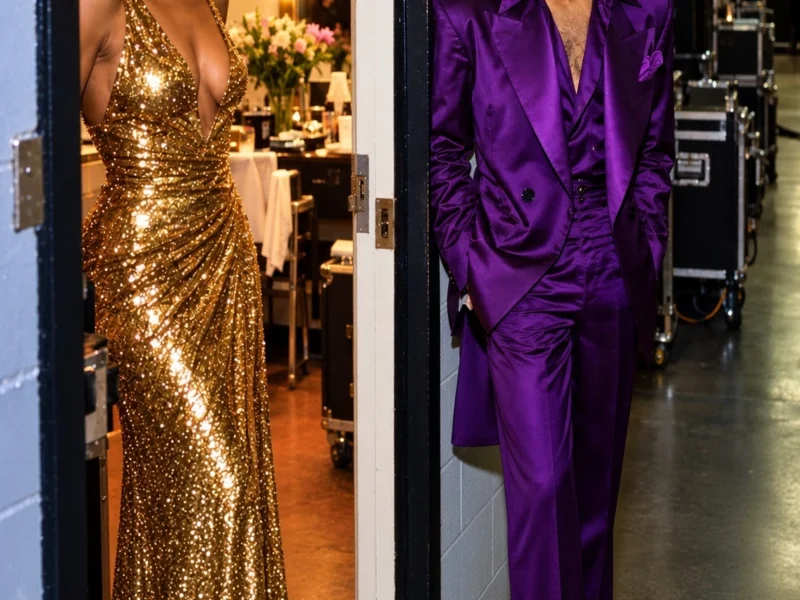
Donna Summer STOPPED Her Tour for Prince — What Happened Backstage Left 8,000 Frozen.
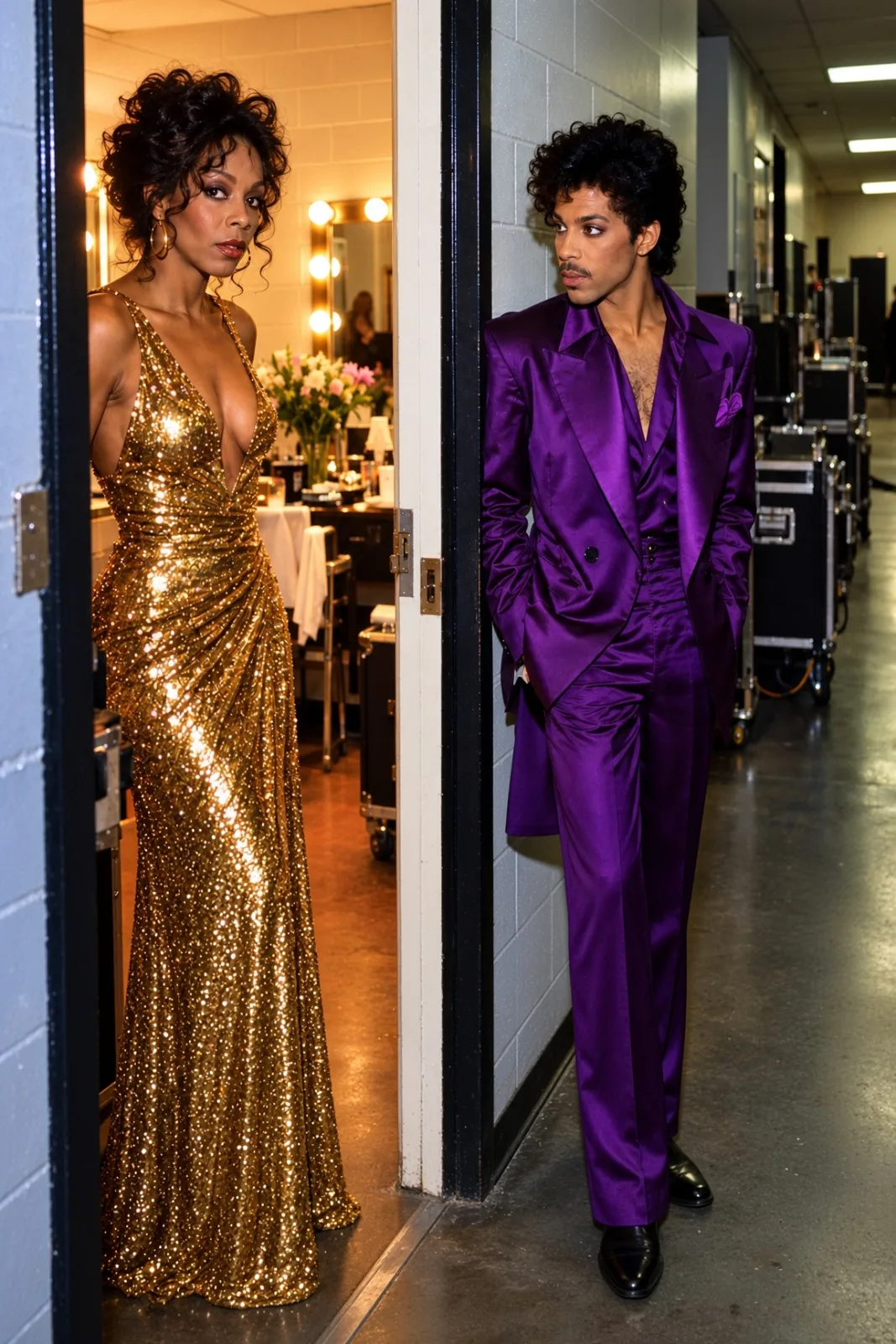
August 19th, 1983.
The Civic Center Music Hall, Oklahoma City.
The house lights were still up.
45 minutes until showtime and the crew had stopped moving.
Not because the rigging was done.
Not because the soundcheck had cleared.
They had stopped because word had just come through the backstage corridor, passed from a stage hand to a monitor engineer to the tour manager in three fast sentences.
That someone was sitting in the third row who was not supposed to be there.
someone who had not been announced, had not called ahead, and had arrived without explanation in a city that nobody in the music business considered worth the detour.
What nobody in that building understood.
What Donna herself wouldn’t fully understand until she was standing in the wings with her in-ear monitors around her neck and her hands not quite steady, was that whoever was sitting in that third row had just made this the most important night of her comeback, and the most dangerous one.
If you have ever walked back into a room where people used to love you, carrying the weight of everything they said when you were gone, you already know how this night started.
They always told it like something they were grateful to have survived.
She had not wanted to do Oklahoma City.
That is the first thing you need to understand about where Donna Summer was in August of 1983.
Not the poster version of Donna Summer.
The sequins and the mirror balls and the voice that could fill an arena-like weather.
The actual woman, 34 years old, born again, carrying a faith that had cost her more than she had budgeted for when she’d found it.
carrying a daughter not yet two years old.
Carrying the weight of what the newspapers have been saying about her for the better part of a year and what the radio programmers had quietly stopped doing and what certain promoters had started saying when they thought she wasn’t an earshot.
The alleged remarks at an Atlantic City concert.
The words that were never fully confirmed, never fully denied, that spread through the gay community like a fever and hit with the force of a betrayal because it felt like one to the people who had given her everything.
Those words were still alive in the air, still being repeated, still being written on the stickers that people left on her albums and record stores.
“This is an anti-gay recording,” the stickers said.
And the people who left them had once been the first ones through the door at her shows.
She was trying to rebuild something that she wasn’t sure could be rebuilt.
She works hard for the money had gone to number three.
That was supposed to be the proof.
The answer to every person who had written her off.
Here is the answer.
Number three.
Here is the answer.
A video with real working women in it.
Women with tired faces and clean dignity and Donna standing among them like she had always understood something the industry had tried to make her forget.
The answer was yes.
She was back.
But the tour felt different.
Empty seats in cities where there had never been empty seats.
Radio stations that played the single and quietly declined the interview.
Promoters who booked her in rooms slightly smaller than the ones she’d played 2 years ago.
And neither of them mentioned it because mentioning it would have required naming what had happened.
Oklahoma City was one of those rooms.
Civic Center Music Hall, 4,500 seats.
3 years ago, she had played rooms twice that size.
Now she was walking the backstage corridor in a building that smelled like every other mid-sized American venue.
Industrial cleaning fluid and old velvet and something fried from the concession stand.
And she was telling herself the same thing she’d been telling herself at every stop on this run.
You are here.
You are present.
You do this.
Stay with me because this is where the whole night turns.
He had arrived in Oklahoma City the previous afternoon.
Nobody on his team had announced it.
Prince Rogers Nelson, 25 years old, did not move through the world on a schedule that press departments managed.
He moved on instinct.
1999 had done what it was going to do.
define a year and announce a man.
And Purple Rain was still being assembled in his mind and a movie studio in Minneapolis that nobody outside his circle knew about yet.
In the space between those two things, he was watching.
What he was watching specifically was Donna Summer.
Not the comeback story, not the controversy.
He was watching The Voice.
He was watching what a woman who had been the architecture of a decade did when that decade was officially over.
and the architecture was still standing, but nobody was sure what to do with it anymore.
He had been in the audience before, other shows, other cities without her knowledge, sitting in whatever seat put him at the right angle to understand how something was built.
Three shows before this one, he had been at the back of the room.
Two shows before this, he had been in the mezzanine.
Tonight, for the first time, he had moved to the third row.
This time, someone had talked.
She was in the dressing room when they told her.
the mirror, the bulb lights, the rolling rack with her costumes hung in order of appearance.
She was sitting in a robe, not yet in costume, and the tour manager, Gerald, who had been with her since the wanderer tour, and who had learned to read her silences like weather, knocked twice and came in.
“Third row,” Gerald said.
“Center, he came alone.”
Donna looked at him in the mirror.
“Which row?”
“Third.”
She picked up a brush and set it down without using it.
Who else knows?
stage crew, monitor engineer, half the front of house by now.
Okay, she said.
Not before the show.
After.
We figure out after when after gets here.
Gerald left.
The makeup artist came in and neither of them said a word for a long time.
In the mirror, Donna’s face was very still.
Not the stillness of calm, the stillness of someone moving very fast on the inside who had learned over a long career to keep that invisible.
Nobody in that building was ready for what happened next.
Nobody.
The thing about Adonna Summer Show in 1983, even in the rebuilt, carefully managed version that the comeback tour had become, was that it was still a Donna Summer Show.
Worth saying clearly, the controversy had not touched the instrument.
The faith that some people experienced as a rejection had not touched what happened when she stood at a microphone and opened her mouth.
The voice was the same voice.
It was, if anything, bigger than it had been.
Grief had a way of doing that to certain instruments.
Donna Summer’s voice was one of them.
She opened with bad girls.
That decision had been made early in the tour, and the reasoning was simple.
If you are walking back into a room that is not entirely sure it still wants you, you walk in with the thing they cannot argue with.
You walk in with the thing that is indisputably, verifiably, historically theirs as much as yours.
You remind them before they have time to decide how they feel.
The 4,500 people in the Civic Center Music Hall responded the way audiences respond to that song.
Immediately, physically, without consulting their opinions about anything, the lights went down.
The band hit the first bar.
4,500 people who had not yet made up their minds about Donna Summer were suddenly no longer thinking about making up their minds.
Prince sat in the third row and did not move.
This is the part that people who were there always described with a particular specificity.
Not the performance.
Everybody in that building was watching the performance.
They described Prince the stillness of him.
While the people around him were on their feet by the second chorus, he sat with his arms folded lightly across his chest and his eyes fixed on the stage and his expression entirely unreadable.
The way certain musicians look when they are not watching a show, but reverse engineering one.
taking it apart, identifying the loadbearing structures.
Seeing the components underneath the surface, she saw him by the third song.
She had known he was there from the moment she walked on stage.
Gerald had confirmed the seat number before she went on, but knowing and seeing are different things, and seeing happened during Hot Stuff.
When the stage lighting caught the third row at a particular angle, and she turned on a vocal run, and the light was there, and he was in it, she did not break stride.
She finished the run.
She crossed to the other side of the stage.
She did not look at the third row again for 11 minutes.
If this story is landing with you, go ahead and hit that like button because what happens in the next 12 minutes is the reason this night still gets told.
She moved through MacArthur Park and into on the radio with the focus of someone who has decided not to decide anything yet.
She was working the room, all of it, not just one seat.
She had always been good at that.
The reading of where the energy was pooling and where it was thinning and how to redirect it without anyone noticing the redirection.
Midway through on the radio, something in the room shifted.
She felt it before she could name it.
Not a thought, but a physical thing.
A change in the pressure between her and the audience.
A signal that something had broken loose from the ordinary physics of a concert.
She had felt it enough times to trust it.
The moments when you feel that shift are also the moments when you have a choice.
Manage it back into the performance.
keep everything on plan or go toward it and see what’s there.
She stopped moving, not the song, the movement.
She planted her feet at center stage and stopped.
And the band played on because the band was professional and had been trained to play through anything.
And Donna stood absolutely still for the length of one full phrase of the song and looked at the third row.
Prince looked back at her.
4,500 people noticed that something had stopped.
They didn’t know what.
The show was still happening.
The music was still playing.
The lights were still moving.
But something had stopped.
And they felt it the way you feel the moment before weather changes.
A collective held breath.
An attention that was different from ordinary audience attention.
Donna sang the next line directly at him.
Not as a performance choice, not a stage craft.
She sang it the way you say something to a specific person when you are not sure whether you are going to say it until it is already leaving your mouth.
He didn’t move.
He didn’t smile.
He watched her with the same steady, unreadable attention.
She finished the song.
The applause was immediate and enormous, bigger than anything in the first half of the set, bigger than the crowd had seemed capable of when she’d first walked out.
And Donna turned and walked to the monitor engineer’s position at the side of the stage and picked up a water bottle.
And Gerald materialized at her elbow, the way Gerald always did at these moments.
and she said something to him that nobody else could hear over the applause.
Gerald went to the third row.
Stick with me.
This next part changes how you understand everything that came before it.
He came backstage during intermission.
That was not a common thing.
Donna did not bring people backstage during intermissions.
The intermission was the 15 minutes in which she reset, rehydrated, and prepared for the second half.
It was protected time.
Gerald had not offered it.
He had been asked for it and he had relayed the request and Donna had said yes.
The corridor outside her dressing room was narrow and fluorescent lit.
Crew members moved through it with equipment and purpose.
And when Prince came through the stage door with one member of his security, a large, quiet man who positioned himself at the entrance and stayed there, the corridor slowed.
People became aware of where they were standing in relation to where he was.
He was wearing purple, barely 5’2 in the boots, and the purple was immaculate.
and he moved through that corridor with the ease of someone who had long since stopped being surprised by the effect he had on rooms.
The dressing room door was open.
Donna was at the mirror doing the specific kind of nothing that means thinking rather than touching anything and she saw him in the reflection before he reached the doorway.
She did not turn around.
She finished whatever thought was finishing itself and then she turned.
You’re a long way from Minneapolis, she said.
He looked at her.
The expression had changed from the third row.
something in it now that was not quite difference and was not quite challenge and sat somewhere between those things in a territory with no clean name.
I’ve been to five of your shows on this run, he said.
Donna looked at him.
Gerald didn’t tell me that.
Gerald didn’t know I wasn’t in the third row the other times.
She processed that.
She turned back to the mirror for a moment, not to do anything to her face, just to have somewhere to look that wasn’t at him.
Why?
She said.
Because I needed to understand something.
And do you?
He was quiet.
Not the pause of someone choosing words.
The pause of someone checking something.
Almost.
He said.
She turned back and looked at him directly.
The mirror lights were harsh and merciless up close, and neither of them looked away.
Almost isn’t an answer, Donna said.
I know what happened last year, he said.
I know what they said about you.
I know what it cost.
Do you?
Yes.
And you drove to Oklahoma City to tell me that.
No, he said.
I drove to Oklahoma City because you’re still doing it.
You’re still standing up there after everything.
You’re still up there making them feel something they didn’t plan on when they walked through the door.
That’s not nothing.
That’s the only thing that matters.
What she said next stopped everything.
And I mean everything.
I know it’s the only thing that matters.
Donna said that’s not the problem.
The problem is I used to know it because I loved it.
Now I know it because I need it.
And I’m trying to figure out if those are the same thing.
The corridor outside was still moving.
Somewhere down the hall, a radio crackled.
Prince stood in the doorway and he was 25 years old and he had come here because he needed to understand something and now he was understanding it and it was not comfortable and he did not look away.
He stepped into the room.
Can I tell you something?
He said, “You’ve already told me several things. One more.”
She gestured at the couch.
He didn’t sit.
He stood near it.
A deliberate choice.
the choice not to make himself at home in a space that was hers.
1999 came out 8 months ago.
He said, “I played 200 dates last year. I know what it is to be in rooms where people are deciding how they feel about you before you’ve played the first note. I know what it is to walk out there carrying something that isn’t finished yet.”
“You’re 25,” Donna said.
“Not unkindly, the way you state a fact. I know. You don’t know what it’s like when they’ve already decided. When the deciding is done and you’re trying to get them to undecide. You don’t know what that costs. No, he said. You’re right. I don’t.”
There it was.
The thing that the people in that room, Gerald standing near the door, the makeup artist reorganizing a kit that didn’t need reorganizing, the crew member in the corridor who had found reasons to stay with an earshot.
The thing all of them carried afterward was not the words.
It was the moment after the words.
Two people in a room with bad lighting in a building nobody had put on any important list.
And the silence between what had been said and what hadn’t been said was so present it was almost audible.
Donna let down something she had been holding.
Not publicly, not dramatically, just quietly.
The way a person sets down something heavy when they think nobody is looking, then realizes someone is and keeps going anyway.
Why are you really here?
She said.
Prince was quiet.
The kind of quiet that means someone is deciding how honest to be and then deciding to be completely honest and then deciding to say it.
Because I’m about to do something that scares me, he said, and I wanted to watch someone who knows what it looks like on the other side of scared.
She didn’t ask what the something was.
Purple Rain was not yet a thing the world knew about.
It was a private architecture he was still building, a movie and an album and a version of himself more exposed than anything he had risked before.
a risk whose size he was still measuring walking the perimeter of in the space between one album and the next.
And what does it look like?
Donna said on the other side.
He thought about it.
Actually thought about it.
She could see him doing it.
The specific quality of attention that meant he was not performing consideration but actually having it.
It looks like what you did tonight.
He said when you stopped in the middle of the song, you stopped and you let the room see you looking at something real.
That’s what it looks like.
The makeup artist had stopped pretending to reorganize the kit.
Donna sat with that for a moment.
I didn’t plan that, she said.
I know.
That’s why it worked.
She looked at him for a long time.
Somewhere in the venue, the house music had started.
The between halves filled that meant the intermission clock was running.
“You have 5 minutes,” Gerald said from the doorway.
Neither of them acknowledged him.
“When it comes out,” Donna said.
Whatever you’re building, when it comes out and people are in the room with it, you’ll feel that shift.
The moment when the room stops managing its feelings and just starts having them, when you feel it, go toward it.
Prince nodded once.
Even when it scares you, he said, “Especially then,” Donna said.
“Especially then.”
She stood up.
She was taller than him in her performance heels.
And for a moment, they were simply two people standing in a small room.
And then Gerald said her name from the doorway and the moment was over and she was picking up her earpiece and she was the show again.
He stepped back into the corridor.
He didn’t say anything else.
He didn’t need to.
The second half of the show was different.
4,500 people came back to their seats and Donna Summer walked back out and something had changed in the way she was standing on that stage.
Not the lights, not the arrangement, not anything the crew had done in 15 minutes.
in her.
She opened with, “She works hard for the money. That had always been the plan.”
But the way she sang it was not the way she had been singing it on this tour.
Not the managed calibrated version the comeback had required.
She sang it the way she had heard it in the car on the way home from the restaurant where she’d found Onetta Johnson asleep in the bathroom.
Raw and plain and expensive sounding in the specific way the truth is expensive.
Because it costs you something to say it where people can hear.
The room felt it.
not all at once.
In waves, starting at the front and rolling back, people straightening.
People who had arrived with reservations, finding they were not available anymore.
This next part is the one nobody in that room saw coming, including Donna.
Prince was back in the third row.
He sat through the second half with the same stillness, arms folded, eyes forward, but the expression had changed.
The reverse engineering quality was gone.
He was watching the way the rest of the audience was watching, without analysis.
without architecture, just watching Donna Summer sing.
By last dance, the room had crossed over into something that no longer required management.
The 4,500 people were no longer deciding how they felt.
They had felt something.
And the feeling had made the decision for them.
She felt it happen.
She always felt that moment when you stopped performing and started existing in the same space as everyone else.
She let it carry her to the end.
And when the last note cleared and the applause came up like a physical force, she stood at the center of the stage and held it.
She did not look at the third row, she didn’t need to.
He was gone by the time she came off.
Gerald met her in the wings with a water bottle.
She reached for it and looked past him toward the corridor, and Gerald understood the look and said, “He left right after the last song. Said to tell you.”
Gerald paused.
He was careful with words that didn’t belong to him.
He said to tell you he understood now.
Donna took the water bottle.
That’s it.
That’s all he said.
She nodded slowly.
She walked back to the dressing room alone.
Gerald found her 15 minutes after the show.
Still at the mirror, still in her performance clothes, not removing her makeup, not doing anything, just sitting the way people sit when something has settled in them and they are giving it the room it needs.
He asked if she needed anything.
He drove to Oklahoma City because he was afraid, she said.
and he sat in the third row and watched me be afraid on stage for two hours.
And somehow that was the most useful thing anybody could have done for him.
I think that’s the kindest thing anybody has done for me in about a year.
She said he didn’t know what to say.
So he said nothing, which was the right choice.
She stood up and started removing her earrings and the night was over.
If you have ever been afraid of something and done it anyway and found out that the doing of it was the proof that you could, that is what happened in Oklahoma City.
Hit that subscribe button because Donna Summer’s story is full of nights like this.
Nights that never made the official account.
Nights where the real thing happened after the show when the lights were down and two people said the truest things they were capable of saying.
6 months later, Purple Rain began filming in Minneapolis.
It changed everything.
The album, the movie, the tour, the position of Prince Rogers Nelson in the permanent story of American music.
It was the thing he had been assembling when he drove to Oklahoma City.
the risk the size of which he had not been ready to name out loud.
He never spoke publicly about those five shows.
He never mentioned the dressing room.
In a 1985 interview, he said something that people who knew the story heard differently than everyone else.
He was asked about the artists who had shaped him.
He gave the expected names.
James Brown, Sly Stone, Joanie Mitchell.
Then he paused and he added one more almost as if he was deciding whether to say it while it was already leaving his mouth.
Donna Summer,” he said, “because she showed me what it looks like when you’re still standing.”
The interviewer moved on to the next question.
The people who were in that dressing room in Oklahoma City heard it and understood.
Donna heard it, too.
She said only that Prince had a way of watching things that made you aware of being watched, and that sometimes being watched by the right person at the right moment was the difference between continuing and not continuing.
She didn’t say more than that.
She didn’t need to.
Donna Summer continued performing until the year she died.
Carrying the things she was always carrying, the faith, the controversy that never fully resolved, the love of a woman who had given herself to audiences for 30 years and understood that the giving was not the sacrifice.
The giving was the reason.
She died on May 17th, 2012.
She had not announced that she was sick.
She performed until she couldn’t anymore.
What Prince had watched in that building in Oklahoma City was not a comeback.
He had watched what it looks like to love something enough to keep doing it when the doing of it is the hardest it has ever been.
The music is still there.
That is the proof.
Donna Summer in her gold sequin dress at the center of a stage in a building that nobody put on the map, carrying everything she was carrying.
opening her mouth.
Still standing.









