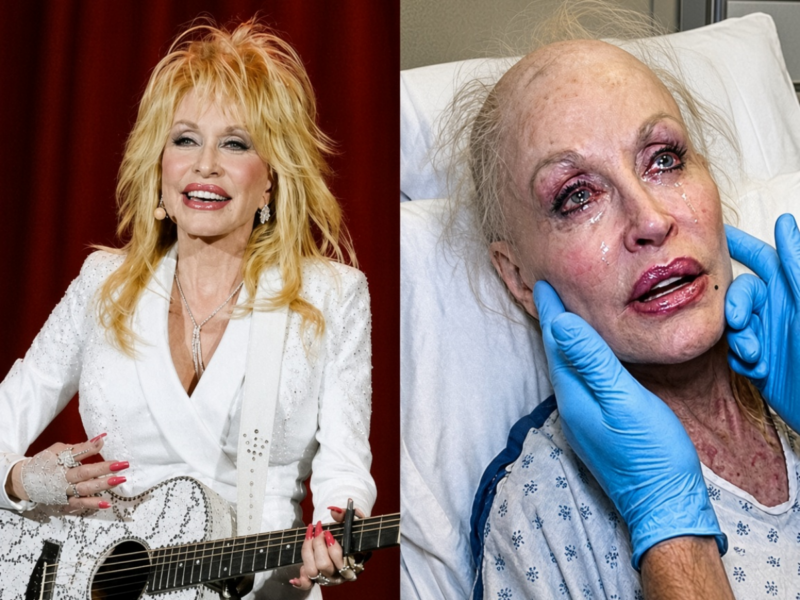
Dolly Parton’s Terrifying Final Day.
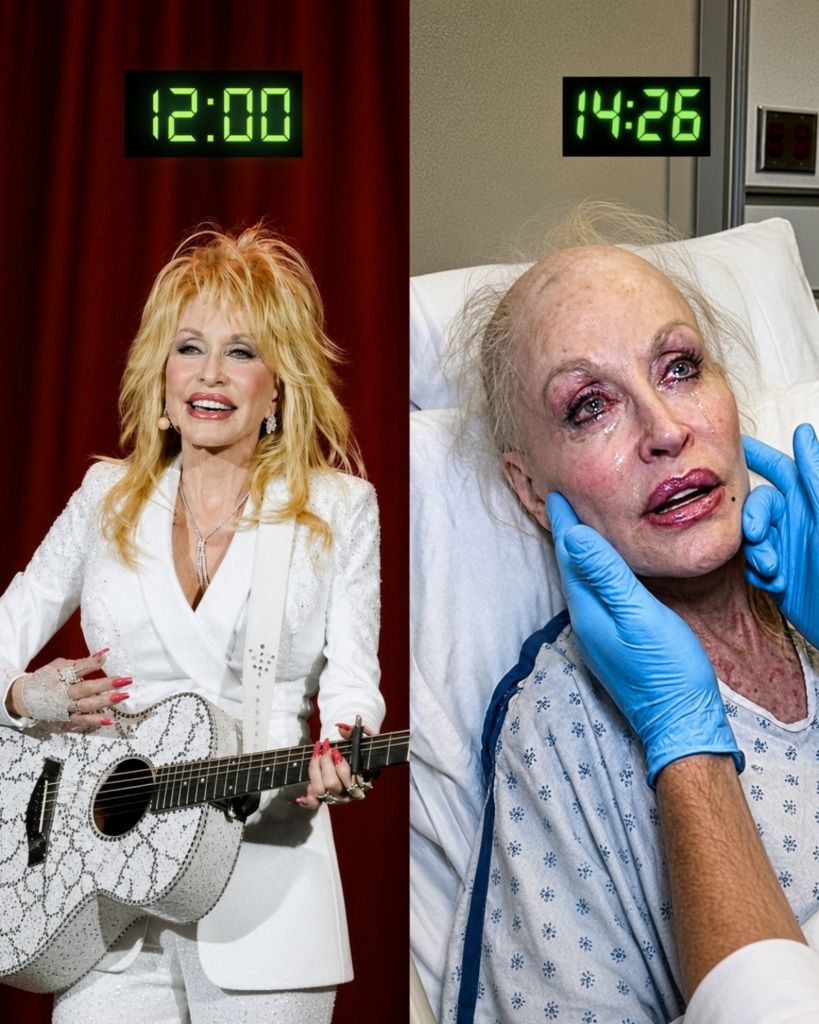
She kept dancing all the way until the lights got dim.
That is the softly sad truth about Dolly Parton’s last year.
She never stopped working.
She never stopped telling fans she would be back on stage soon.
She kept doing that all the way until it was clear she would not be.
To know what Dolly Parton was doing in her final days, you need to go back almost exactly a year.
That was March of 2025.
That was when her husband of sixty years, Carl Dean, passed away at the age of eighty-two.
The two of them had met at a Nashville laundromat.
That was before either of them had money or fame.
By every story, that marriage was the one thing that stayed the same in a life of constant change.
Carl’s death hit her harder than people outside her closest group realized at the time.
She later said in her words that she had spent so much time taking care of him during his long illness that she had stopped taking care of herself.
Once he was gone, the effects of that neglect caught up with her all at once.
Carl rarely showed up in public during their marriage.
He protected his privacy even as his wife became one of the most photographed women in the world.
Their relationship was often described as the one constant behind sixty years of change, tours, businesses, and headlines.
Losing him didn’t just mean losing a husband.
For a woman who had spent decades building an empire in the spotlight, it meant losing the one person who had known her before any of it happened.
By September of 2025, the first sign of a problem came.
Parton said she had to delay a planned Las Vegas performance.
She said it was because of health problems.
Fans started to worry.
Talk online spread beyond what her team was willing to say.
A month later, in October, she tried to calm the worries with a video she posted directly to her social media.
“I know lately everyone thinks I am sicker than I am,” she said, partly joking, partly defending herself.
She asked her followers directly, “Do I look sick to you?”
She explained that the past years spent taking care of Carl as he got worse, and then mourning him, had left her tired in a way she hadn’t understood.
She said she was managing it and had no plans to slow down for good.
Not everyone felt better.
That October, her sister Freda posted an emotional message on Facebook.
She asked the world to pray for Dolly.
She said she had been up all night worried and wanted prayer warriors everywhere to join her.
The message spread fast.
It made people think things were worse than the family was saying.
Freda later said she didn’t mean to say her sister was in trouble.
She just believed in the power of prayer.
For many fans, that moment was the first time they felt the possibility of losing Dolly Parton was real instead of just a guess.
Parton herself knew how fast rumors could spread when family members spoke up.
After that, she tried harder to make sure people knew she was okay.
She posted updates more than usual.
It was as if she was trying to stay ahead of a story that had already started without her.
The postponed Las Vegas dates were eventually rescheduled to September 2026, a year later, giving fans a rough timeline to hold on to through the winter.
That Las Vegas residency had been positioned as a late-career milestone, a rare Vegas stage show from an artist who had spent most of her career touring theaters, arenas, and her own theme park instead of settling into a residency format the way several of her peers had done in their later years.
The postponement, and then the eventual news that she would never perform the rescheduled dates, quietly closed the door on what would have been one of the more unexpected chapters of her final act.
Dolly Parton characteristically kept working in the meantime rather than disappearing from public life.
She did not make another public appearance until March 2026, when she showed up at Dollywood to kick off the theme park’s forty-first season.
Taking the stage in front of fans for the first time in months, she was direct about what had been going on.
“I’ve been doing a lot of things. I’ve not been touring, as you know. I’ve had a little health issues, and we are taking good care of them,” she told the crowd.
She added that she had been worn down and worn out by grief over Carl and needed time to rebuild herself spiritually, emotionally, and physically.
She insisted it had not slowed her down.
And in Dolly Parton fashion, she found a way to joke about the whole thing, telling fans that if she showed up at the pearly gates with anybody else on her arm, Carl would be furious, demanding to know who the little rascal was standing next to his wife.
Two months later, in May 2026, she posted a detailed video update, framing it the way she framed most hard news throughout her career.
Good news wrapped around the bad.
“I have some news and a little bad news,” she said.
“The good news is I am responding well to meds and treatments and I am improving every day. Now, the bad news is it will take me a while before I am up to stage performance level.”
She explained that her immune and digestive systems had gotten all out of whack over the past few years and that ongoing kidney stone issues were part of what she was working through, along with some medications that left her feeling, in her words, “a little bit swimmy-headed, as my grandma used to say.”
It was Dolly Parton’s style.
Specific enough to feel honest, vague enough to keep the details private, and delivered with enough humor to keep anyone from panicking.
Even while managing all of that, she kept adding to a staggering workload.
She had completed work on a Broadway musical based on her life, scheduled to debut at the end of 2026.
She launched Dolly’s Cup of Ambition, a coffee brand set to hit store shelves that September.
The name was a nod to “9 to 5,” one of her signature songs, and the branding leaned heavily into the working-class, self-made image she had cultivated from the very beginning.
She was reportedly deep into planning for a Nashville show built around an avatar of herself, along with a biopic and a documentary series meant to carry her story forward for years to come.
None of these were passion projects she could easily walk away from.
And by all accounts, she had no intention of doing so, treating her declining health as an obstacle to work around rather than a reason to stop.
Alongside those ventures, she kept tending to the causes that had defined her public image for decades.
The Imagination Library, the no-cost book initiative she launched in 1995 to honor her father, who could not read, kept growing right through her health battles, bringing on additional regional partners and surpassing fresh distribution records in 2025 and 2026 with no interruption connected to her personal difficulties.
When Hurricane Helene ripped through areas of Appalachia in the fall of 2024, she gave $1 million toward relief work and added another million to the My People Fund, the wildfire relief effort she had first established in 2016 to address continuing community needs in Sevier County.
Her giving never tapered off as her health worsened.
In fact, friends and colleagues who talked with reporters following her passing hinted at just the reverse, portraying a person who appeared to regard her charitable obligations as beyond question, regardless of health crisis.
That resolve met its limits in August 2026.
On August 14th, merely eleven days before she died, Parton could not be present for the debut of a new attraction at Dollywood, the park she had constructed from the ground up and personally guided for forty years.
For a woman who had appeared at that park through mourning, through health crisis, through practically every form of personal adversity one could imagine, skipping that opening amounted to a subdued yet undeniable indication that something had shifted.
Seven days afterward, on August 21st, she gave what proved to be among her last interviews, stating candidly to People magazine that she was dealing with “some health issues that I just didn’t pay attention to when I was watching over Carl.”
In that same exchange, she added that there were “so many things I want to achieve.”
Words that, looking back, sound like someone who still assumed she had time remaining, even while her body was signaling otherwise.
Friends interviewed by reporters in the days following her death portrayed her as typically cheerful, even during that last interview, keener on discussing forthcoming projects than on focusing on her symptoms.
A habit that had shaped how she talked about her health ever since the first concert dates were postponed the previous September.
Only days after that interview, according to several reports, Parton was checked into Nashville’s Vanderbilt University Medical Center for treatment of kidney and autoimmune problems.
The precise events of those last days in the hospital have never been entirely disclosed, and her family has kept the majority of the medical specifics confidential, in keeping with how she had approached her health throughout the whole experience.
What is established is that she was transferred to, or already being cared for at, Vanderbilt-Ingram Cancer Center, and that she passed away there on the morning of Tuesday, August 25th, 2026, with loved ones at her side.
Her publicist, Marcel Pariseau, disclosed that her official cause of death was a short battle with cancer.
A diagnosis that, astonishingly, had never been made public before that day.
For close to a year, fans had heard about kidney stones, autoimmune complications, grief, and fatigue.
The term cancer entered the narrative only after everything had already ended.
Once the news emerged, the distance between the account fans had received for nearly a year and the one disclosed only after her death prompted its own subdued wave of reflection, with a number of commentators observing that Parton had essentially controlled the narrative of her own decline until the very end, deciding precisely how much the public would learn and precisely when they would learn it, just as she had controlled almost everything else throughout her career.
The world did not learn the news through an official press release, but from her family.
Her nephew, Bryan Seaver, who had spent over twenty years as her head of security, the very position his father had filled before him, shared a video on her official Instagram account to announce the news personally.
He recounted that Dolly had asked him years before to be the one to share that message when the moment arrived.
An idea he confessed he had never truly taken in as something that could actually happen until he found himself speaking the words on camera.
“Dolly has lived in the light and is in the arms of Jesus, surely met by Carl, her parents, and countless others who have watched her and longed for her to meet them in heaven,” he said.
A statement that cast her passing less as an ending and more as a reunion long overdue.
Seaver’s ties to the family ran deeper than any job title.
He had grown up within Parton’s inner circle, taking on a role his father had once occupied, and the emotional burden of being the person chosen to share that particular message was plainly visible in the video, which was captured in one largely unedited take.
True to a quiet, private final chapter, her family confirmed that, as she had requested, only a small gathering for immediate family would take place, with no public funeral or large memorial service planned.
She was buried at Woodlawn Memorial Park in Nashville next to Carl Dean, the man she had promised decades before that she would grow old beside.
Later reports noted that she had specifically requested to be buried in a cotton dress, resting on soft cotton, and wearing her trademark high heels.
A small but revealing detail from a woman who spent sixty years in sequins and platinum wigs, opting for something plain and gentle at the very end.
Rather than flowers, her family asked that anyone wanting to honor her make a donation to the Imagination Library, which meant that even her last public wish was, in its own way, about putting books in children’s hands.
Fans and fellow artists mostly honored the family’s wish for privacy, and even the biggest tributes avoided speculation about the funeral itself, turning attention instead toward donations, streaming her music, and sharing personal memories rather than trying to glimpse a service that was never going to be open to the public.
In its own fashion, it was one last display of the same control she had wielded over every other aspect of her image.
Generous.
Intentional.
And wholly on her own terms.
Of course, none of this happened in isolation.
Dolly Parton’s final years were not solely about health and quiet goodbyes.
They also involved a body of work and a public persona that had endured its share of controversy along the way, though she navigated almost all of it with the same disarming grace that marked the rest of her career.
The clearest example goes back to 2018, when she renamed her long-running dinner show attraction from Dolly Parton’s Dixie Stampede to simply Dolly Parton’s Stampede, removing the word Dixie because of its Confederate associations, especially in the wake of the 2017 Charlottesville rally.
The choice provoked criticism from both sides.
Some fans and local politicians accused her of giving in to what they described as political correctness, and one local mayor publicly voiced disappointment that she had yielded to pressure.
Others noted that the show itself, which centered on a friendly North versus South competition, had long been faulted by historians and cultural commentators as a soft-focus, plantation-adjacent spectacle that ignored slavery altogether.
Parton herself later addressed the decision with her usual directness, telling Billboard in 2020 that she had been guilty of what she termed “innocent ignorance,” and that once she grasped that the word was causing people pain, the solution was clear.
“As soon as you realize that something is a problem, you should fix it,” she said.
“Don’t be a dumbass.”
That same year, during the George Floyd protests, Parton broke with her decades-long habit of avoiding political statements and openly expressed support for the Black Lives Matter movement.
She told interviewers that she understood why people felt the need to make themselves visible and heard, adding that, “of course, Black Lives Matter.”
For an entertainer who had carefully built a career by staying above political battles and avoiding alienating either side of a divided country, the statement was significant enough to become news on its own.
It also brought criticism from some longtime fans who believed she was moving away from the neutral image they had always associated with her.
Still, Parton did not completely abandon her long-held dislike of political confrontations.
Around the same time, she declined to join other performers who used award show stages to openly criticize sitting politicians, continuing the careful balancing act she had maintained throughout most of her career.
Her response was also consistent with the public image she had carefully protected for years.
Speak honestly when necessary, but avoid turning every disagreement into a lasting political or personal battle.
Throughout it all, a different and somewhat unusual controversy emerged in 2022, when Parton was nominated for the Rock and Roll Hall of Fame.
She initially rejected the nomination, explaining that she did not feel she belonged in a rock institution because she had spent her career as a country artist.
She also said she did not want to take a place that could instead go to rock performers she considered more deserving.
The hall kept her nomination on the ballot, however, explaining that rock and roll itself grew partly from rhythm and blues and country music.
Voters eventually inducted her despite her original objection.
Parton accepted the honor with good humor and decided to turn the unexpected situation into a challenge rather than simply collect the award.
In 2023, she released her first rock album, Rockstar, featuring collaborations with major artists from the genre.
It became another example of how she often responded to criticism or unexpected obstacles.
Take them seriously.
Find some humor in the situation.
Turn the experience into something constructive.
That habit of transforming resistance into a project instead of holding on to resentment appeared repeatedly throughout her career, helping explain why she left behind remarkably few major feuds despite working in an industry famous for them.
None of these incidents caused lasting damage to her public image, largely because Parton approached each one directly and without becoming defensive, often using humor to soften the tension.
That was one reason the tributes following her death, including those from people who disagreed with particular decisions she had made during more than six decades in public life, focused far more on her generosity and authenticity than on old disagreements.
Even many of her strongest critics rarely questioned whether she genuinely believed what she said.
That reputation for honesty made the events of her final year particularly unsettling for longtime fans watching them unfold.
Parton had spent decades being unusually open about her business decisions, plastic surgery, financial priorities, and personal beliefs.
Yet, for the first time, there seemed to be a noticeable difference between what she was telling the public and what was happening within her body.
It was not exactly dishonesty, since nothing she said during that period was technically untrue.
However, the things she left unsaid became important.
And after the cancer diagnosis became public, several entertainment reporters revisited her earlier comments and pointed out how carefully some had been phrased, remaining technically accurate while leaving out the one piece of information that would have completely changed how the public viewed the situation.
What stands out most when reflecting on those last eighteen months is how much of that time Dolly Parton devoted to the same activities she’d engaged in for the prior sixty years.
Laboring.
Making light of her own mortality instead of evading it.
And seeking out opportunities to continue giving even as her health visibly deteriorated.
She started a coffee brand while managing kidney and autoimmune problems she wouldn’t completely elaborate on.
She completed a Broadway musical based on her life while discreetly coping with a cancer diagnosis she kept hidden from the public.
In eleven years of nearly flawless attendance, she missed one Dollywood opening, and that felt notable solely because it was so unlike her.
Her last recorded message to the world was not a goodbye.
It was a compilation of activities she still desired to pursue.
That, more than any individual statement or interview, may offer the most accurate depiction of what Dolly Parton was engaged in during her last hours.
Continually creating.
Consistently strategizing.
And firmly believing there was still time.
Until suddenly there wasn’t.
Ultimately, the difference between the Dolly Parton recognized by the public until August 25th and the one who had secretly battled cancer privately reflects less on deception and more on a lifetime of choosing, intentionally and on her own terms, precisely what she allowed the world to witness.
She managed her name, her music, her business, and her image with a skill that few performers ever achieved.
It’s not surprising that she applied that same control to the narrative of her own conclusion, opting for honesty regarding the aspects she was open to sharing and secrecy about the single detail she never revealed.









