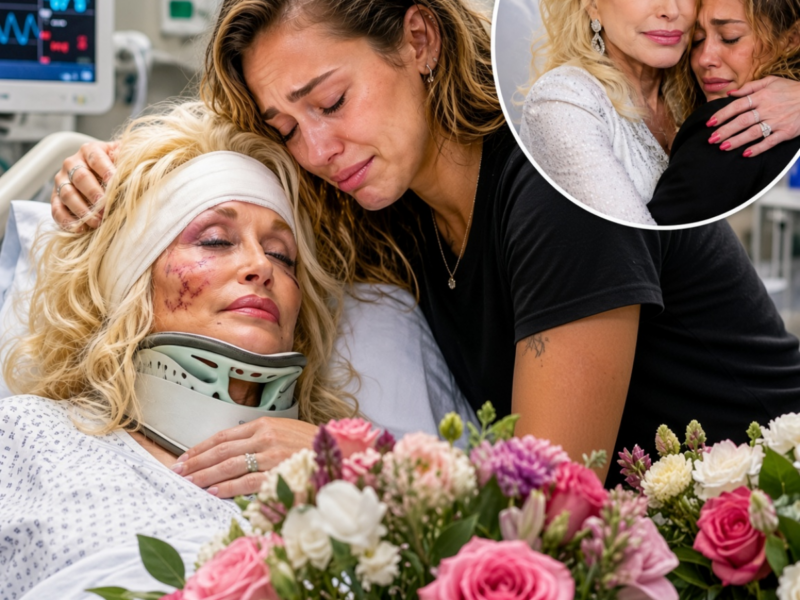
Dolly Parton’s Legacy: Miley Cyrus’s Secret Promise.
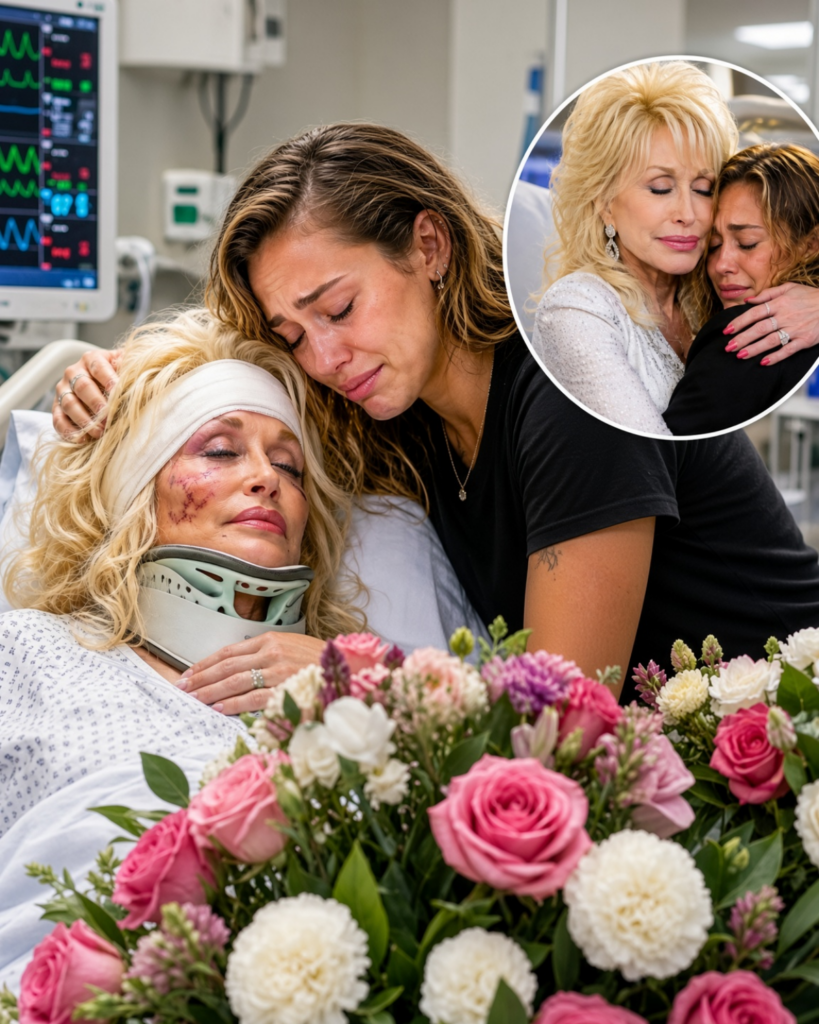
The call came on a Tuesday.
On August 25th, 2026, in Nashville, Tennessee, Dolly Parton died peacefully at the age of 80 after quietly facing cancer for months.
For a woman who had spent over half a century convincing the world she was invincible, sequins and all, the end came the way she reportedly wanted it to: calm, surrounded by people who loved her, and utterly, completely final.
Her family confirmed the news through a statement and through a video from her nephew.
“My name is Bryan Seaver, and I’m representing the Parton and Owens family today announcing the passing of my aunt Dolly Rebecca Parton Dean.”
Bryan Seaver, a man who had spent years standing close enough to Dolly to guard her from the world, and who now had to be the one to tell the world she was gone.
The statement described her as a rhinestone life that shone bright enough for everyone to see.
It talked about her music, her wit, her warmth.
It said simply that she had died surrounded by love.
For most of the planet, this was a celebrity headline, a trending topic, a flood of black and white photos, and end of an era captions.
But for one woman in particular, it wasn’t a headline at all.
It was the kind of call you never let yourself imagine getting, and then suddenly you’re getting it.
“I decided to release Used to Be Young on August 25th because this particular date historically has been important to me personally and in my career.”
Miley Cyrus had known Dolly Parton her entire life.
Not since she became famous, not since Hannah Montana, since before she could talk.
And when the news broke that Dolly was gone, Miley didn’t respond like someone processing the death of an icon.
She responded like someone whose whole childhood had just lost one of its foundations.
The next day she posted a tribute on Instagram, a black and white photo of Dolly, and underneath it words that read less like a celebrity statement and more like a diary entry somebody wasn’t supposed to see.
She wrote about grief that felt indescribable.
She said the most sacred moments between them would stay private, tucked away behind the glitter, kept between their hearts.
That single line told you everything about what this relationship actually was.
Miley shared something else in that post, something that felt almost too intimate to be public.
She said that one of her last real conversations with Dolly had been about music, and about change, and about what it means to keep moving even when everything in you wants to stop.
She said Dolly wouldn’t want her falling apart.
She said Dolly would want her to sit in the pain, write about it, and keep going.
And then she said the line that fans keep returning to over and over since the day she posted it: that she has an angel beside her, that she always has.
Read that again.
Not she will always be with me.
Always have, present tense stretched backward like Miley is saying this presence didn’t start the day Dolly died.
It had been there her whole life.
Dolly wasn’t becoming her guardian angel.
She’d been playing that role since before Miley Cyrus was old enough to know what the word meant.
On social media, away from the long, careful paragraph on Instagram, Miley’s grief came out in short, raw bursts.
On X, she wrote that she couldn’t believe the world had just lost one of the purest souls it had.
She said her heart was broken.
Simple words, no performance in them, the kind of thing you type with shaking hands at 2 in the morning, not the kind of thing a publicist drafts for you.
And then Miley did something that told the world more than any caption could.
One day after Dolly Parton’s death, she was photographed in Los Angeles dressed in black, her eyes red, her face carrying the particular kind of exhaustion that only comes from crying and not sleeping.
She wasn’t at an event.
She wasn’t at a tribute.
She was walking into a recording studio.
Think about what that means.
In the rawest, earliest hours of losing someone who had shaped your entire life, most people would understandably disappear, cancel everything, sit in the dark.
Miley went to work, but not the kind of work that pulls you away from grief, the kind that pulls you straight through the center of it.
Because Dolly herself had spent her whole life turning pain into songs, losing her father, losing her husband, Carl Dean, just the year before.
Every hard chapter of Dolly’s life eventually became a melody.
And in her final conversation with her goddaughter, she’d apparently told Miley to do exactly the same thing.
Write it down, don’t run from it, let it become something.
So Miley walked into that studio not to escape the loss, but to honor it in the only language Dolly ever really trusted: music.
It’s almost impossible not to see it as Miley keeping a promise she made in real time, hours after finding out the person who shaped her had a limited number of days left to matter in this world.
Too many celebrity deaths, the internet mourns for 48 hours and then moves past.
This one comes with weight most people never see.
Dolly Parton wasn’t simply admired by Miley Cyrus from a distance.
She wasn’t a mentor Miley met on a red carpet or bonded with over one lucky collaboration.
She had been present in some form for every version of Miley Cyrus that has ever existed.
The child, the Disney star, the controversial pop provocateur, the Grammy winner — every single one of those women had Dolly somewhere nearby, whether the cameras were rolling or not.
Which raises the real question underneath all of this.
Not simply, how do you say goodbye to Dolly Parton?
Because millions of people are doing that right now in their own private ways with their own memories of her music playing somewhere in the background.
The real question is much heavier.
How do you say goodbye to somebody who was there before you were born, who helped decide who you’d become, and who leaves behind a silence in the exact shape of everything she used to fill?
To understand why Miley’s grief runs this deep, why this loss feels less like losing a legend and more like losing a mother, you have to go back.
Back before Hannah Montana.
Back before the world knew the name Miley Cyrus at all.
Back to a friendship between two country musicians on a tour bus in the early 1990s.
One of them already a legend, and one of them about to become a father to a little girl who didn’t exist yet.
That friendship is where all of this actually begins.
Before there was a Miley Cyrus, there was a friendship.
And it started, of all places, on a tour bus in the early 1990s between a Kentucky boy who just set the country on fire with one song and a Tennessee woman who’d already spent two decades becoming a legend.
Billy Ray Cyrus was riding the wave of Achy Breaky Heart when he found himself opening for Dolly Parton on tour.
They were both country to the bone.
Both raised on the same kind of dirt road, small town upbringing that shapes how you talk, how you laugh, and what you find funny at 2:00 in the morning on a bus somewhere between cities.
Dolly has said the two of them simply got along easily and naturally, the way people do when they recognize their own roots in somebody else.
He was a Kentucky boy.
She was a Tennessee girl.
That was basically all the explanation either of them ever needed.
But this wasn’t just two artists being friendly between sets.
They worked together.
Dolly wrote a song called Romeo and she brought Billy Ray in to appear in the music video for it.
He turned up on some of her shows.
They spent long stretches of time on the road together touring, performing, and talking the kind of talk that only happens when you’re stuck in close quarters with someone for months at a time.
It’s the kind of closeness that either destroys a friendship or forges it into something unbreakable.
For Dolly and Billy Ray, it became the second thing.
Of course, put a hugely famous man and a hugely famous woman in that much proximity and the tabloids are going to do what tabloids do.
By 1992, rumors were spreading that the two of them were secretly involved romantically.
Billy Ray, by most accounts, was mortified.
He reportedly felt he owed Dolly an apology just for the stories existing.
Dolly’s response is the kind of thing that tells you everything you need to know about who she really was underneath the wigs and the rhinestones.
She wasn’t angry.
She wasn’t embarrassed.
She simply told him, “Honey, this trash sells records.”
In other words, this is the business we chose and gossip is the tax you pay for fame.
Don’t let it touch what’s real.
That single moment of grace seems to have deepened Billy Ray’s respect for her rather than damaging their friendship.
He’d go on to describe their bond as something closer to family than to former tourmates, calling her a longtime friend who had been, in his words, “a genuinely good influence on his life and his household.”
And then, in 1992, that friendship crossed into something permanent.
Billy Ray and his wife, Tish, were expecting their first daughter together.
And somewhere along the way, on that tour, in that friendship built out of long drives and shared roots, Billy Ray asked Dolly if she would be the baby’s godmother.
Dolly said yes.
What almost nobody talks about is what that yes actually meant to Dolly personally.
Because behind that decision was a private ache that most of her fans didn’t know about until much later in her life.
Dolly Parton had wanted children of her own, badly.
Early in her marriage to Carl Dean, the two of them had talked about starting a family the way young couples do, even picking out a name, Carla, for a daughter they imagined they’d have one day.
But endometriosis, a painful condition that can severely affect fertility, had other plans.
The health complications eventually led to a partial hysterectomy when Dolly was just 36 years old, closing the door on ever carrying a biological child.
Dolly later admitted she carried a quiet what if about that for years.
She wondered every so often whether her life would have looked different with children in it.
And knowing her own nature, she suspected she would have thrown herself into motherhood completely, maybe even felt guilty every time she left home to tour.
In her mind, the career she built and the family she couldn’t have were tangled up together, two paths that likely couldn’t have coexisted the way her actual life had unfolded.
Rather than let that what if harden into bitterness, Dolly eventually reframed it into something almost spiritual.
She came to believe that maybe she wasn’t meant to have children of her own so that, in her words, everybody’s children could be hers instead.
She poured that love into nieces, nephews, the kids in her extended family circle, and most famously into the Imagination Library, the book program that would go on to reach hundreds of millions of children around the world.
But long before Imagination Library became a global phenomenon, that same redirected love found a much smaller, much more personal outlet.
One baby girl born into a family Dolly already adored, who she now had a lifelong role in.
Being a godmother, on paper, can be a fairly symbolic title, a name on a document, a photo at a christening.
For most people, it doesn’t ask for much beyond a nice birthday card now and then.
That is not what it became for Dolly and Miley.
From the moment Miley Cyrus was born, Dolly Parton entered her life not as a distant celebrity family friend, but as someone genuinely present.
Someone who showed up.
Someone who, by every account from both women over the following decades, behaved less like an honorary godmother and more like a second mother, quietly filling in a role that ran in parallel with Miley’s actual parents.
Miley grew up hearing about Dolly, watching Dolly, being around Dolly, in a way that most children only experience with their own extended family.
She grew up inside the world of country music, tour buses, and backstage stories, with the image of a woman who had clawed her way up from poverty in the Tennessee mountains to become one of the most beloved entertainers alive, and who somehow never lost her warmth or her sense of humor in the process.
That was the Dolly that little Miley Cyrus got to know, not the version the rest of the world saw through a television screen, but the version who actually showed up.
And that presence didn’t stay in the background for long.
Because when Miley Cyrus finally got her own turn in the spotlight, when Hannah Montana turned an ordinary Tennessee girl into a household name almost overnight, Dolly wasn’t watching from a distance.
She stepped directly into that new chapter of Miley’s life, playing the role fans would come to know and love as Aunt Dolly, blurring the line between the godmother Miley had grown up with off camera and the woman about to become part of her story on camera, too.
That’s where things start to get complicated in the best possible way.
Because once the cameras turned on and once Miley’s own fame began to eclipse anything a normal childhood could prepare her for, the real test of what Dolly meant to her was just getting started.
By the time Hannah Montana premiered on Disney Channel in 2006, Miley Cyrus was no longer just the daughter of a country star with a famous godmother tucked somewhere in her family tree.
She was becoming a phenomenon in her own right.
And in the middle of that whirlwind, Dolly Parton did something that could have gone very differently for a legend of her stature.
She showed up on the show playing Aunt Dolly, Hannah Montana’s larger-than-life relative who pops in with advice, humor, and just enough glitter to remind everyone whose world this really was.
On paper, it was a fun cameo, a country icon lending some star power to a Disney hit.
But anyone who actually knew the history behind it understood it was something else entirely.
Dolly wasn’t playing pretend.
She was playing a version of a role she’d already been living for over a decade.
The affection audiences saw between Aunt Dolly and her television niece wasn’t written by a team of Disney screenwriters trying to manufacture chemistry.
It was already there off camera years before anyone handed them a script.
That distinction matters because it explains what came next.
Most child stars eventually outgrow the adults who guided their early fame or clash with them or quietly drift apart once the cameras find someone new to follow.
Dolly and Miley did neither.
As Hannah Montana ended and Miley began the difficult, very public process of figuring out who she was without that character attached to her name, Dolly didn’t try to hold on to the girl she remembered.
She didn’t try to keep Miley small, safe, or frozen in the image the world had fallen in love with.
Instead, she let her go.
Dolly never tried to reshape Miley into a smaller version of herself, and she never publicly pushed back against the more controversial turns Miley’s career took as she searched for her own artistic identity.
That restraint might not sound like much, but for someone in Dolly’s position, a beloved American icon whose reputation had taken decades to build, it was a real risk.
Every time Miley made headlines for pushing boundaries, for shedding the wholesome Disney image piece by piece, there would have been an easy, safe move available to Dolly: distance herself, stay quiet, let the association fade a little until the noise died down.
She did the opposite.
In 2014, during one of the loudest stretches of criticism Miley ever faced, with much of the public openly questioning her choices and her image, Dolly went on record defending her.
She told Time magazine that Miley knew exactly what she was doing, that she wasn’t worried about her, and that she believed in just how smart and talented her goddaughter actually was.
Read that again in context.
This wasn’t a passing compliment.
This was Dolly Parton at the height of her own untouchable public reputation choosing to stake a piece of that reputation on defending a young woman the entire internet seemed to be tearing apart.
That kind of loyalty doesn’t come from admiration.
It comes from love.
Billy Ray Cyrus once summed up the two of them as two peas in a pod, kindred spirits who shared strong personalities, real talent, and the same sharp sense of humor.
It’s easy to read that as a nice quote from a proud father, but it also captures something true about why this bond worked the way it did.
Dolly never saw a fragile young star who needed protecting from herself.
She saw a reflection of her own stubborn independence, the same refusal to let anyone else write the story of who she was allowed to become.
Dolly had lived that fight herself decades earlier, breaking away from Porter Wagoner’s shadow to build a solo career nobody thought a pretty little girl singer could pull off.
She recognized the same fire in Miley immediately because she’d carried it herself.
That understanding didn’t stay behind closed doors.
It showed up in the music.
Miley covered Jolene, one of the most iconic songs Dolly ever wrote, carrying it into a new generation of listeners who’d grown up on Miley’s voice more than Dolly’s.
And in 2017, the two of them went a step further, co-writing and recording an original song together called Rainbow Land for Miley’s album Younger Now.
Miley later described the song as something she created with her, in her words, fairy godmother Dolly, built around the idea of embracing differences and coming together to create something positive.
It wasn’t a novelty duet between a legend and a younger star looking for credibility.
It was two people who genuinely understood each other putting that understanding into a melody.
They kept finding reasons to share a stage.
In 2019, Miley joined Dolly at the Grammys for a tribute performance of Jolene, standing alongside a lineup of major artists there to honor Dolly’s legacy while she was still very much alive to see it.
Three years later, Dolly turned up on Miley’s New Year’s Eve special, and the two performed together again, trading songs the way family trades stories at a holiday table.
None of these moments were treated by either woman as a big career milestone or a strategic collaboration.
They were treated the way you’d expect two people who genuinely loved each other to treat a chance to be on stage together.
And underneath all of it, Dolly kept doing the quieter work, too.
Miley has said that Dolly consistently pushed her to keep changing, to keep growing, and to never let herself get trapped inside an old version of who she used to be.
It’s easy advice to give.
It’s much harder to actually mean it, especially when the person you’re saying it to keeps making choices you don’t fully understand yet.
Dolly meant it every time.
So when you step back and look at the full shape of this relationship, from a Disney Channel cameo built on real affection, through a defense delivered at the exact moment Miley needed someone powerful in her corner, through songs written together and stages shared for the pure joy of it, one thing becomes impossible to ignore.
Dolly Parton wasn’t simply present for Miley Cyrus’s rise.
She was actively, consistently, deliberately there for it, in a way that had nothing to do with publicity and everything to do with love.
That’s what makes the loss cut as deep as it does, because the person the world is calling a legend, an icon, a music industry giant, was also, quietly and without much fanfare, the one adult who never once tried to change Miley Cyrus into someone easier to manage.
She simply let her be herself and stood beside her while she figured out exactly who that was.
Which is why what came next, in Dolly’s final wishes for how she wanted to leave this world, and in what Miley chose to do in the hours after finding out she was gone, says so much about what 30 years of that kind of love actually built.
For a woman who spent more than six decades living in front of cameras, wrapped in sequins, wigs, and a persona bigger than almost anyone else in American music history, Dolly Parton chose to leave this world the exact opposite way she lived in it.
Quietly, privately, on her own terms.
Her family confirmed that Dolly’s wish was for a small, private funeral attended only by close family.
No public memorial, no televised send-off, no stadium full of mourners singing her songs back to an empty stage.
For a global icon whose face and voice belonged to literally billions of people who never met her, the choice says something.
Dolly Parton understood better than almost anyone alive what it meant to belong to the public.
And in the end, she made sure that one moment, the last one, belonged only to the people who actually knew her as a sister, an aunt, a wife, a friend.
That instinct to protect the personal from the public wasn’t new.
It’s the same instinct that led her years earlier to reveal the song she wanted played at her own funeral.
Not I Will Always Love You, the song most associated with her name across the entire world.
Instead, she chose the old country gospel hymn If We Never Meet Again, a song that had been a favorite of her father, Lee Parton, and one that had also been performed at his funeral.
That detail alone tells you where Dolly’s heart actually sat underneath the fame.
Given the choice of any song to define her final goodbye, she chose the one that tied her back to her father, not the one that made her famous.
There’s also the quieter, more personal request her family shared afterward, that Dolly had once said she simply wanted to be laid to rest somewhere soft and peaceful.
A small, human detail from a woman who spent a lifetime in glittering dresses and towering wigs under stage lights.
Behind the persona was always someone who, in the end, just wanted rest.
And then there’s Carl Dean, Dolly’s husband of nearly 60 years, who passed away in March of 2025.
The two of them had built one of the most quietly enduring marriages in American entertainment, largely by keeping it almost entirely out of the public eye.
If Dolly is ultimately laid to rest near him in Nashville, it closes a love story that she spent decades deliberately shielding from the same spotlight that made her famous.
Even in death, she seemed determined to protect what was actually hers.
But perhaps the detail that says the most about who Dolly Parton really was has nothing to do with the funeral at all.
Her family didn’t ask the world for flowers.
They asked for donations to Dolly Parton’s Imagination Library, the program she built to put free books into the hands of children who might never otherwise have them.
That request is, in a way, the entire story of her life compressed into a single sentence.
Even at the moment people most wanted to grieve her, to send something in her memory, Dolly’s family redirected that love toward children she would never personally meet.
It’s the same instinct that drove her decades earlier to take the ache of never being able to have biological children of her own and turn it into a mission that ultimately reached hundreds of millions of kids around the world.
The Imagination Library didn’t start as a headline-grabbing philanthropic gesture.
It started, quite literally, as Dolly trying to give other children the gift of reading that her own father never had.
By the time of her death, that small idea had grown into one of the largest children’s literacy programs on the planet, and her family has made clear they intend for it to keep growing long after she’s gone.
That’s the pattern of Dolly Parton’s entire legacy, really.
Almost everything she built was designed to keep existing without her standing behind it.
Dollywood will keep welcoming visitors to the corner of Tennessee she never forgot, the same hills she grew up poor in, now transformed into jobs, tourism, and opportunity for the community that raised her.
Her songs, Jolene, 9 to 5, Coat of Many Colors, and the ballad that became a global phenomenon through Whitney Houston’s voice, I Will Always Love You, will keep getting covered, streamed, and passed down to people who never got the chance to see her perform live.
None of it needs Dolly physically present to keep functioning.
She built it that way on purpose.
And that brings the story back, finally, to Miley Cyrus.
Because everything Dolly Parton represented, the music, the philanthropy, the fierce loyalty, the refusal to let fame turn her into someone unrecognizable to herself, all of that lived first, and most personally, inside the relationship she had with her goddaughter.
Long before millions of strangers learned to love Dolly through a song on the radio, one little girl in Tennessee got to know her as something far simpler and far more permanent: family.
When Miley wrote that she has an angel beside her, that she always has, she wasn’t just describing grief.
She was describing 30 years of a bond that never needed cameras or headlines to be real.
A friendship between two country musicians on a tour bus in the early ’90s turned into a godmother’s promise, and that promise turned into a second mother, and now, in the hardest way possible, it’s turned into a permanent kind of presence Miley will carry with her into every song she writes from here forward.
Dolly Parton is gone, that much is certain, and nothing about it can be undone.
But if her entire life’s work says anything, it’s that she never believed presence had to end just because a person did.
She said it herself in her own way years ago, that everybody’s children could be hers.
Now, in the wake of her death, it feels fitting that the goddaughter she loved like a daughter is the one carrying her forward, one song, one studio session, one quiet act of grief turned into art at a time.
That’s the goodbye Dolly Parton actually prepared for.
Not an ending — a handoff.









