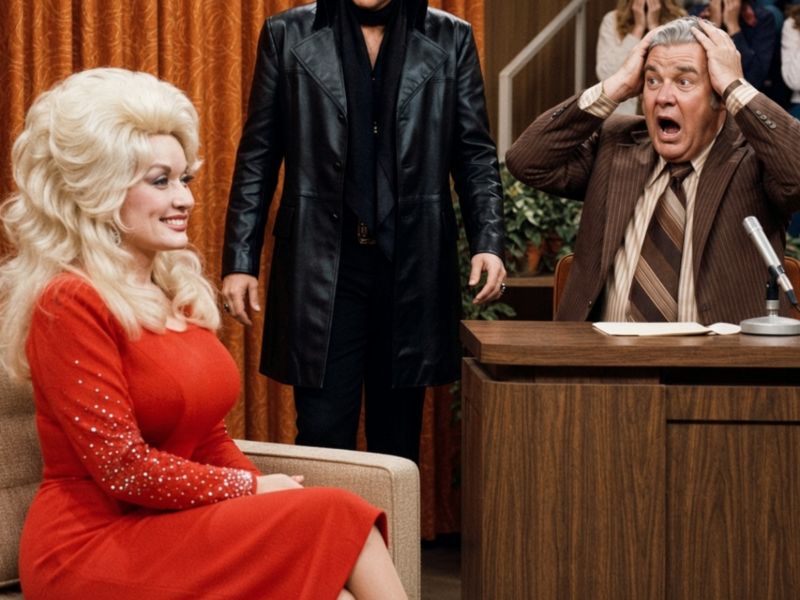
Dolly Parton Told the TRUTH About Elvis Presley on TV—Elvis Walked On Stage Did The Unexpected.
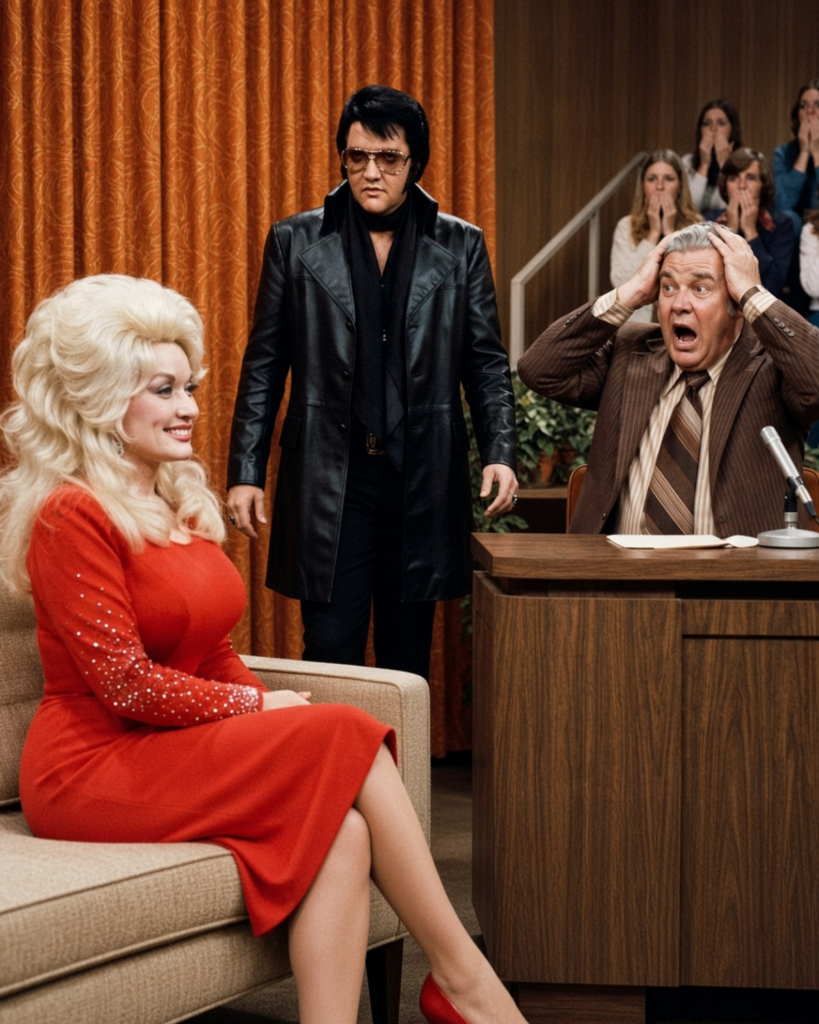
Somewhere in Nashville for a few weeks in November of 1976, there was a reel of two-inch videotape sitting on a shelf in the back of a television studio with a strip of masking tape across the front of its box.
Written on that masking tape in thick black marker were five words: Do not air, destroy, Parker.
The tape was from a talk show taping on a Tuesday night.
It ran a little over forty minutes, and the few dozen people who were in that studio audience have spent the rest of their lives trying to describe what was on it.
Because on that tape, Dolly Parton, thirty years old and about to become one of the biggest stars in America, sat on a talk show couch and told the truth about Elvis Presley.
She didn’t mean any harm by it.
She said it the way she said everything: warmly, honestly, with a laugh in her voice.
But she said it.
And what nobody in that studio knew was that two floors above them, in an office with a small television monitor in the corner, Elvis Presley was watching every word.
Fifteen minutes later, he walked out onto that stage.
What he said to her and what she said back and the song that came out of that conversation is the reason Colonel Tom Parker wanted that tape destroyed.
And it’s the reason that sixteen years later, a song Dolly Parton once refused to give away would earn her more money than she ever dreamed of.
But to understand any of it, you have to know about the promise Elvis Presley asked her to make in a hallway at the end of that night.
The story really starts two years earlier, in 1974, with a song.
Dolly Parton had written it in 1973 on the same night, legend has it, that she wrote another song called “Jolene.”
She wrote it as a goodbye.
For seven years, she had been the girl singer on the Porter Wagoner Show, the most popular country music program on television, standing beside Porter in her big blonde wig and her rhinestones, singing duets, smiling, playing the part.
Porter had given her the platform that made her famous, and she had outgrown it.
She knew it, and he didn’t want to hear it.
Every time she tried to tell him she needed to leave, it turned into an argument.
So she did what she always did when she couldn’t find the words out loud.
She went home and wrote them down.
It was a song about leaving someone you still love and wishing them well and meaning it.
And the next morning, she walked into Porter’s office and sang it to him.
He cried, and he let her go.
The song was called “I Will Always Love You.”
In June of 1974, it went to number one on the country charts.
And somewhere in Memphis, Elvis Presley heard it on the radio and loved it.
He loved it so much that he told his people he wanted to record it.
It was exactly his kind of song: a ballad, a goodbye, something with real feeling in it, at a time in his life when his own marriage had ended and he was carrying more loneliness than almost anybody around him understood.
When Dolly found out, she was over the moon.
She said later it was one of the happiest days of her life.
Elvis Presley was going to sing her song.
She told everyone.
She called her family back in the Smoky Mountains.
She couldn’t sleep.
And then the day before the session, her phone rang.
It was Colonel Tom Parker, Elvis’s manager, and he explained very politely, the way he explained everything, how things worked.
Elvis didn’t record songs unless his organization got half of the publishing rights, half of the songwriter share, forever.
It was standard, he said.
Everybody did it.
It was the price of having Elvis Presley sing your song.
Dolly Parton was twenty-eight years old.
She had grown up in a one-room cabin in the mountains of East Tennessee, the fourth of twelve children in a family so poor that her daddy paid the doctor who delivered her with a sack of cornmeal.
And the one thing she had learned from the people who’d come before her in Nashville, the one thing she held on to harder than anything, was that you never ever give away your songs.
The songs were the only thing that was truly yours.
So she said no.
She said it politely.
She said she was honored and that she loved Elvis and that she would be thrilled if he recorded it, but she would not sign over half of her song, not to anybody.
And the colonel said very politely that in that case, Elvis would not be recording it.
Dolly said later that she cried all night.
Not because she regretted saying no, because she didn’t.
She cried because she’d wanted so badly to hear him sing it, and she knew she never would.
Here’s the part of the story that matters most for what happened in 1976.
Dolly never knew whether Elvis knew.
She never knew whether he’d been told why.
For all she knew, someone had told him she’d simply turned him down.
That some girl singer from Tennessee had looked at an offer from Elvis Presley and said, “No thanks.”
She didn’t know, and she never had the chance to ask him.
Two years went by, and by November of 1976, both of their lives had changed enormously.
Dolly’s had changed on purpose.
She had left Porter Wagoner.
She had fired her old band.
She had signed with a Los Angeles management firm, the kind that handled movie stars.
And she had told anyone who’d listen that she wasn’t leaving country music.
She was taking country music with her to everybody else.
She had her own syndicated television show.
Hollywood was calling, and a lot of people in Nashville were not happy about it.
The old guard thought she was abandoning them.
The papers were full of it.
Is Dolly going Hollywood?
Is she selling out?
Is she going to end up like all the others who left?
Elvis’s life had changed, too, but not on purpose.
He was forty-one years old.
He was still touring constantly, still selling out arenas, still putting on the white jumpsuits with the jewels and the high collars and the capes, still walking out to that thundering opening from “2001: A Space Odyssey.”
But he was tired.
He was heavier.
He was not well, though almost nobody outside his inner circle knew how unwell.
And some of the reviews had started to turn.
Critics who had once called him a revolution were now calling him a Las Vegas act, a costume, a spectacle.
Some nights he gave everything he had.
Some nights people said he seemed to be somewhere else entirely.
And in November of 1976, for reasons that had nothing to do with Dolly Parton, they both ended up in the same building in Nashville on the same night.
The building was a television and office complex on the edge of Music Row.
On the ground floor was a studio where a syndicated late-night talk show called Nashville After Dark taped its episodes in front of a small live audience, about eighty people on folding bleachers.
The host was a big, easygoing radio veteran named Hal Brewer, who had been interviewing country stars for twenty years and who had a reputation for being friendly right up until the moment he wasn’t.
His show aired on a few dozen stations around the South.
It was not glamorous.
But in November of 1976, every country singer in Nashville knew that if you wanted to say something that would get talked about in the morning, Hal Brewer’s couch was where you said it.
On the third floor of the same building were offices, and on that particular Tuesday evening, one of them had been borrowed by a couple of executives from RCA Records, Elvis’s label for twenty years, for a private, unofficial, very quiet meeting.
RCA wanted Elvis to record again properly, in a real studio, with real musicians, the way he used to.
His last few sessions had been recorded at home in Memphis, in the den at Graceland, because he no longer wanted to go anywhere else.
The label was worried.
Somebody had come up with the idea that if they could just get him back to Nashville, back to the old RCA studio where he’d recorded so many of his greatest records, he might find something again.
So they’d flown in, and he’d driven up from Memphis late that afternoon with his old friend Charlie Hodge and his road manager Joe Esposito.
And they’d come in through a loading dock at the back of the building so nobody would see him.
The meeting started late and went slowly.
The executives talked.
Elvis listened and said very little.
At some point, one of the RCA men got up to make a phone call, and Charlie Hodge, who was bored, reached over and switched on the little television monitor in the corner of the office.
It was hooked up to the studio feed downstairs.
It was the only thing it could show.
And on the screen, Hal Brewer was introducing his next guest.
“Ladies and gentlemen, the pride of Sevier County, Tennessee, Miss Dolly Parton.”
Elvis looked up.
Charlie went to switch it off, and Elvis said, “No, leave it.”
Dolly walked out in a bright red dress with rhinestones down the sleeves and her hair piled up about a foot over her head, and the eighty people in the bleachers went crazy.
She sat down on the couch and laughed at something Hal said.
And for the first few minutes, it was exactly the kind of interview she’d done a hundred times.
Her new television show, her new album, her family, her famous line about how it costs a lot of money to look this cheap.
The audience loved her.
Up on the third floor, Elvis was smiling at the screen.
And then Hal Brewer leaned forward, and his voice changed a little, and he said, “Dolly, I’ve got to ask you about the thing everybody in this town is talking about.”
“Oh Lord,” Dolly said. “Here we go.”
“Folks say you’re going Hollywood. New managers out in Los Angeles. Talk about movies, talk about pop records. And they say, ‘Well, we’ve seen this before. We’ve seen a Southern singer leave home, get famous, get swallowed up by the machine, and come back a different person.'”
He paused.
“They say you’re going to end up just like Elvis.”
The audience laughed a little nervously.
Dolly laughed, too.
And then she said something that nobody expected, least of all the man watching on the third floor.
“Well, honey, I sure hope not.”
The laughter in the bleachers kind of died away.
Hal raised his eyebrows.
“Now, what does that mean?”
Dolly thought about it for a moment.
You could see her deciding whether to say it.
And then, because she was Dolly Parton and because she’d never been very good at saying anything except what she meant, she said it.
“I love Elvis,” she said.
“I want to say that first. I have loved Elvis Presley since I was ten years old, and I’ll love him till the day I die. That boy had the best voice God ever put in a man. I mean that.”
“But?” Hal said.
“But I think he got lost in all of it,” Dolly said.
“I think they built a great big machine around him. The jumpsuits and the capes and the jewels and the karate and that big old space movie music when he walks out. And somewhere in the middle of all that, I think they lost the boy from Tupelo who used to sit on a porch and sing gospel songs with a guitar. I haven’t heard that boy in years. I don’t know if anybody has.”
Up on the third floor, Elvis wasn’t smiling anymore.
“That’s a strong thing to say,” Hal said.
“It’s not meant to be mean,” Dolly said.
“It’s meant to be sad. Because I think he’s still in there. I just think he’s hiding. You put on enough rhinestones, nobody can see your face. I ought to know.”
She pointed at her own dress, and the audience laughed.
But it was a different kind of laugh now, a careful one.
“You think Elvis Presley is hiding?”
“I think he’s surrounded,” Dolly said.
“Every time I see him now, it’s the big show. The band, the strings, the backup singers, the lights. It’s wonderful. It’s the biggest show in the world. But I’d give anything to hear him sit down on a stool with one guitar and sing something plain, something with a little dirt on its boots, and just let you hear him breathe. I don’t think they’d let him. I don’t think he’s done it in so long he’d remember how.”
One of the RCA executives in the office on the third floor said very quietly, “Elvis, maybe we should turn that off.”
Elvis didn’t answer.
He was leaning forward in his chair with his elbows on his knees, staring at the little screen.
And down in the studio, Hal Brewer, who had been doing this for twenty years and could smell a story when it walked into the room, asked one more question.
“Now, I heard a rumor once that Elvis wanted to record one of your songs and you turned him down. Is that true?”
Dolly’s whole face changed.
For the first time all night, she didn’t have a joke ready.
“It’s true he wanted to,” she said.
“It’s not true I turned him down.”
“Then what happened?”
And Dolly looked down at her hands for a second.
And then she said, “That’s between me and Elvis, and I’ve never had the chance to tell him.”
Up on the third floor, Elvis Presley stood up.
Joe Esposito knew that look.
He’d been with Elvis since the Army.
He got up, too, fast, and said, “Elvis, whatever you’re thinking, don’t.”
“I’m going down there.”
“You can’t go down there. It’s a television show. You don’t do television shows. The colonel will have a heart attack. You have never sat on a talk show couch in your life, and you’re not starting tonight in Nashville on a show nobody’s ever heard of.”
“I’m not going on the show,” Elvis said.
“I’m going to go see a lady who just told eighty people and a camera that I’ve forgotten how to sing, and then told them she’s got something to tell me about my own song that I never heard. I’d like to hear it.”
“Then call her tomorrow.”
“She said it tonight,” Elvis said, “in front of all of them. She can say the rest of it in front of me.”
Charlie Hodge said later that it was the angriest he’d seen Elvis in a long time.
Not loud angry.
Quiet angry.
The kind where his voice got very soft and very Mississippi, and his jaw hardly moved.
Because what Elvis had heard on that monitor, all he had heard, really, was the part that hurt.
Hiding.
Lost.
Forgot how to sing.
He didn’t hear the love in it.
People rarely do the first time.
And under the hurt, there was something else that Charlie couldn’t name yet.
Something about that song.
The RCA executives were on their feet now, too, saying things about contracts and appearances and the colonel.
And Elvis walked right past all of them and out the door and down the back stairwell with Joe and Charlie running behind him.
Down in the studio, the show had gone to a commercial break.
Dolly turned to Hal the second the red light went off and said, “Did I go too far? Tell me the truth.”
Hal said, “Honey, you said what half this town’s been thinking for five years. You just said it nicer.”
Dolly shook her head.
She said, “I didn’t say it to be nice. I said it because I miss him. I miss the boy on the radio.”
She asked one of the crew for a glass of water, and her hand, the stagehand noticed, wasn’t quite steady when she took it.
Hal was making small talk with her after that, trying to lighten the mood.
The audience was chattering about what she’d said.
And then the stage manager, a young man in a headset named Danny Pruitt, came walking very quickly across the floor toward the host’s chair with a look on his face like he’d just seen a ghost.
He leaned down and whispered something in Hal’s ear.
Hal Brewer laughed.
He said, “Come on.”
And the stage manager said, loud enough that the first row heard him, “I am not kidding you, Hal. He’s standing behind the curtain right now.”
Hal turned around in his chair and looked toward the back of the set.
And then he turned back around, and every bit of color had gone out of his face.
Dolly said, “Who? Who’s back there?”
Hal looked at her for a long moment, and he said, “Honey, I think you’re about to get your chance to tell him.”
What happened next took about ten seconds, and the people in those bleachers described it for the rest of their lives.
The music came back up out of the break.
Hal Brewer, who had interviewed every star in Nashville for twenty years and had never once been at a loss for words on the air, stood up from his desk, looked at the camera, opened his mouth, and nothing came out.
He tried again, and then he just said, “Ladies and gentlemen, I don’t know how this is happening, but, uh, Elvis Presley.”
And the curtain at the back of the set moved, and Elvis Presley walked out onto it.
He wasn’t in a jumpsuit.
He was in dark slacks and a high-collared dark shirt and a long black leather coat.
And he was wearing tinted glasses.
And he was heavier than the man on his album covers.
But there was no mistaking him.
Nobody in that room had ever been more than fifty feet from him before.
And now he was fifteen.
The audience didn’t scream.
That’s the thing every one of them remembered.
They didn’t scream.
Eighty people gasped all at once and then went completely silent, because they could see his face.
And his face was not the face of a man who had come out to say hello.
Dolly stood up off the couch.
She didn’t know what else to do.
She said, “Elvis.”
And it came out almost as a whisper.
He didn’t hug her.
He didn’t take her hand.
He walked to the end of the couch and stood there.
And he took off his glasses and he said very quietly, “Miss Parton, I was upstairs. I heard what you said about me.”
“I meant every bit of it kindly,” Dolly said.
“Didn’t sound kind from where I was sitting.”
Hal Brewer, standing behind his desk, had the presence of mind to gesture at the camera operators to keep rolling.
Of course he did.
He’d been in the business twenty years.
He knew exactly what he was looking at.
“Sit down,” Elvis said to Dolly.
“Please.”
And she sat.
And he sat down on the other end of the couch, close enough to touch, in front of eighty people and a camera, on a talk show, something he had never once done in his entire career.
And the first thing he said was, “You told these people I’m hiding.”
“I did.”
“You told them I’ve forgotten how to sing.”
“No,” Dolly said. “I said I don’t think they let you. That’s a different thing.”
“You told them I’m lost.”
He leaned toward her.
“Miss Parton, I’ve been singing since I was ten years old. I sang in church before I could read. I sang in the projects in Memphis. I sang on the back of a flatbed truck. I’ve sung for more people than live in this whole state. I sing two shows a night when I’m out, every night, till I can’t stand up. And you sit here on television and tell folks I’m hiding behind a cape.”
The audience was frozen.
Somebody in the back row had both hands over their mouth.
Dolly didn’t back down.
That’s what everyone remembered about her that night.
She was half his size and thirty years old and sitting next to the most famous man in the world, and she looked him straight in the eye and said, “Elvis, when’s the last time you sang something with nothing around you? No band, no strings, no lights. Just you.”
He opened his mouth to answer, and he didn’t.
“That’s all I’m asking,” Dolly said, much more gently.
“Now, I’m not saying you can’t. I’ve never once said you can’t. I’m saying I don’t think anybody’s asked you to in a very long time. And I think that’s a shame, because the best thing I ever heard in my life was you singing a gospel song on the radio when I was a little girl, and there wasn’t a rhinestone anywhere near it.”
Elvis sat back.
Charlie, watching from the wings, said you could see the fight go out of his shoulders just a little bit.
Not all the way.
But a little.
And then Elvis said the thing he had really come downstairs to say.
“What about the song?”
The room went very quiet again.
“You told this man,” he said, nodding at Hal, “that it’s not true you turned me down. That you never got the chance to tell me what happened. I’ve been told for two years that I asked to record your song and you said no. I was told you didn’t want me to have it, that you’d rather keep it for yourself.”
His voice cracked just a little on the last few words.
“So I’m sitting right here. Tell me.”
Dolly Parton looked at him for a long moment.
Then she looked at the camera.
Then she looked back at him, and she said, “Are you sure you want me to say it out here?”
“I’m sure.”
So she told him all of it.
The radio in the spring of 1974, hearing that Elvis Presley wanted her song and calling her mama and not sleeping for two nights.
And then the phone call the day before the session.
The colonel’s voice, polite and smooth.
Half the publishing forever.
That’s how it works.
That’s the price.
And I said no.
Dolly said, “Not to you. I never said no to you. I said no to giving away half of the only thing I’ve got that’s truly mine. My daddy couldn’t read or write, Elvis. Everything my family ever had, somebody else owned. The land, the house, the store we owed money to. The one thing I ever made in my whole life that nobody could take from me was my songs. And I’d have given you that song in a heartbeat for nothing. I’d have paid you to sing it. I just couldn’t give it to him.”
She stopped.
Her eyes were wet.
“I cried all night,” she said.
“Not because I was sorry. Because I knew I’d never get to hear you sing it.”
Elvis Presley didn’t say anything at all for what the audience later swore was at least ten seconds.
Ten seconds of dead air on a television show is an eternity.
Hal Brewer didn’t move.
The camera operators didn’t move.
Eighty people in the bleachers didn’t move.
Elvis was looking at Dolly, and then he wasn’t looking at anything.
He was looking down at the floor between his boots.
And then he said, so quietly that the microphones barely caught it, “Nobody told me.”
“I figured,” Dolly said.
“They told me you didn’t want me to have it.”
He shook his head slowly.
“For two years. Every time that song came on the radio, I’d turn it off because I figured some little girl singer from Tennessee thought she was too good for me. That’s what I thought of you, Miss Parton. For two years. And I was wrong.”
“You couldn’t have known.”
“I should have asked,” Elvis said.
“That’s the thing. I should have picked up the phone and asked you myself. That’s what a man does. But I don’t pick up the phone. Somebody else picks up the phone. Somebody else makes the deals. Somebody else decides what I sing and where I sing it and who gets paid. I just show up and put on the suit.”
He laughed.
But there was nothing funny in it.
“You’re right. You know what you said before, about the machine—”
“Elvis, I didn’t mean—”
“You did,” he said.
“And you were right. I came down here to tell you you were wrong. And you weren’t. That’s the worst part.”
He looked up at the audience then, for the first time.
Eighty strangers on folding bleachers.
And he said, “I don’t remember the last time I sang a song all by myself. I truly don’t. Isn’t that something?”
Nobody in the room knew what to do.
And Dolly Parton did the only thing she could think of.
She reached across that couch and took his hand, and she held it right there on camera, the way you’d hold the hand of a family member in a hospital waiting room.
And she said very softly, “Then sing one now.”
He looked at her.
“No band,” she said.
“No strings. Nobody’s paying for anything. Nobody owns anything. Just you.”
Elvis looked over toward the corner of the set where Hal’s house band was sitting behind their instruments.
Four Nashville session players who had stopped pretending to look at their sheet music ten minutes ago.
The guitar player, an older man with a gray crew cut named Lonnie Haskins, saw Elvis looking, and without a word, he stood up, unplugged his acoustic guitar from the amplifier, walked across the stage, and held it out.
Elvis took it.
He turned it over in his hands.
He tuned it, one string, then another, slowly, the way you do when you’re buying yourself time.
Somebody brought out a wooden stool.
He sat on it, and then he looked at Dolly and said, “I don’t know all the words.”
And Dolly Parton said, “I do.”
So she sat down on the edge of the stage at his feet, close enough that he could hear her.
And she gave him the first line, very quietly, almost speaking it, and he found the chord, and he sang it.
He sang “I Will Always Love You” on a borrowed guitar, on a wooden stool, on a little talk show in Nashville that nobody outside the South had ever heard of, to the woman who wrote it, with no band, no strings, no lights except the ones that were already there.
When he lost a line, she gave it to him softly from the floor.
When she couldn’t hold her voice steady, he sang a little louder to cover her.
It was slow, much slower than her record.
It was plain.
And the voice that came out of him that night, the people in that room said, was not the Las Vegas voice.
It wasn’t the voice from the arena shows with the big operatic endings and the band crashing in underneath.
It was the other one.
The young one.
The one from the radio in 1954.
Soft and low and a little rough at the edges, a voice that sounded like a man singing on a porch after dark when he thinks nobody’s listening.
The stage manager, Danny Pruitt, said years later that he looked over at Hal Brewer during the second verse, and Hal was standing behind his desk with tears running down his face, and he didn’t even seem to know it.
On the last line, Elvis stopped playing.
He didn’t hit a big ending.
He just let the guitar go quiet and sang the last few words by themselves, barely above a whisper.
And Dolly, sitting at his feet, sang them with him.
And then it was silent.
And then the bleachers came apart.
Eighty people on their feet, crying, clapping, holding on to each other.
A woman in the front row kept saying, “Oh my God, oh my God,” over and over.
The house band was standing up behind their instruments, applauding.
Lonnie Haskins, the guitar player, had sat down on his amplifier with his face in his hands.
And on the stage, Elvis Presley handed the guitar back, stood up off the stool, reached down, and pulled Dolly Parton up off the floor and into the biggest hug that anybody in that room had ever seen.
She disappeared into it, rhinestones and hair and all.
He held her for a long time, and when he let go, he said something to her that the microphones didn’t catch, and she laughed through her tears and swatted him on the arm.
Hal Brewer finally found his voice.
He turned to the camera, wiped his face with the back of his hand, and said, “Folks, I’ve been doing this twenty years. I’ve never seen anything like that, and I don’t expect I ever will again.”
Upstairs in the borrowed office on the third floor, the phone had been ringing for ten minutes.
Joe Esposito had gone back up the stairs during the song because he knew exactly what was going to happen and he wanted to be the one to answer it.
Word travels fast in Nashville.
Somebody at RCA had already called somebody in Memphis, and somebody in Memphis had called Palm Springs.
And by the time Elvis finished singing, Colonel Tom Parker was on the line, and he was not polite anymore.
Joe said later that he held the receiver about six inches from his ear for most of that call.
The colonel wanted to know what in God’s name Elvis was doing on a talk show.
He wanted to know who had authorized it.
He wanted to know what had been said.
And when Joe very carefully told him what had been said, including the part about the song and the phone call in 1974 and the publishing, there was a long, cold silence on the line.
And then the colonel said, in a voice Joe had heard only a handful of times in all his years, “That tape does not air. Ever. You tell whoever owns that show that if one frame of it goes out, I will have lawyers in that building by breakfast. And then I want it destroyed.”
By the time Elvis came off the stage, there were already two men in suits from the syndication company standing in the hallway outside the studio, talking to Hal Brewer in low voices.
Hal was shaking his head.
He was arguing.
It didn’t matter.
That night, after the audience had gone home, a reel of two-inch videotape was taken out of the recording deck, put back in its box, and set on a shelf in the tape room with a strip of masking tape across the front and five words written on it in black marker: Do not air, destroy, Parker.
But before any of that, there was the hallway.
After the show, Elvis waited for Dolly by the back stairwell, near the loading dock where he’d come in.
Charlie Hodge was there, standing a little way off.
He’s the only reason anyone knows what was said.
Dolly came out of her dressing room with her coat on and her makeup still streaked, and she walked up to Elvis and just stood there for a moment, and neither one of them seemed to know how to start.
Finally, Elvis said, “I owe you an apology.”
“No, you don’t.”
“Yes, ma’am, I do. For two years, I thought bad of you, and you never did one thing to deserve it. And then I walked out on that stage tonight and talked to you like you were a stranger who’d insulted my mama. I was wrong. I’m sorry.”
Dolly said, “Elvis, I’m the one who went on television and said you were hiding.”
“You were right, though,” he said.
“That’s what’s so hard about it. Nobody’s told me the truth to my face in a long time. Everybody around me tells me what I want to hear. They get paid to. You didn’t have to say any of it. And you said it anyway.”
He shook his head.
“You know what the worst part is? I haven’t felt like I did on that stool tonight in about fifteen years. Just me and a guitar and a song somebody wrote because they meant it. I forgot what that felt like. You reminded me.”
And then he asked her for something.
Charlie said he’d never heard Elvis ask anybody for anything in quite that voice.
He said, “I want you to promise me something.”
“Anything.”
“That song. Don’t you ever sign it away. Not half of it. Not a piece of it. Not to him. Not to me. Not to anybody. Not ever. I don’t care who asks or how much they offer or how famous they are. Someday somebody’s going to sing that song, and the whole world is going to hear it. And when that happens, I want every single penny of it to be yours. You hear me? Every penny. Promise me.”
Before she answered, she asked him something she’d been wondering about since the hug.
She asked what he’d said to her out there, the thing the microphones didn’t catch.
And Elvis smiled for the first time since he’d walked off the stage and said, “I said, ‘Now I’ve sung it. Nobody can ever tell me I didn’t.'”
Dolly laughed a little through the tears and said, “Elvis, nobody’s ever going to make a fortune off that little song. Promise me anyway.”
And she did.
She put her hand on his arm and she promised.
And then he kissed her on the cheek, put his tinted glasses back on, and walked out through the loading dock into the cold November dark and climbed into the back of a car and was gone.
She never saw him again.
Charlie Hodge said the drive back to Memphis that night took almost four hours.
And for the first hour, Elvis didn’t say a word.
Then somewhere past Jackson, he asked Charlie if there was a radio station still on the air that might play country records at that hour.
Charlie found one, and around two in the morning, as if somebody up there had arranged it, the disc jockey played Dolly Parton’s record of “I Will Always Love You.”
Charlie reached over to turn it off, the way Elvis always made him, and Elvis put his hand on Charlie’s arm and said, “Leave it.”
He listened to the whole thing with his head against the window.
When it was over, he said, “She sings it better than I did.”
And Charlie said, “No, she doesn’t.”
And Elvis laughed and closed his eyes and slept the rest of the way home.
The tape sat on that shelf for about three weeks.
Hal Brewer went into the tape room more than once and stood looking at it.
People who worked at the studio said he even took it down one night after everyone had left and played it through once, alone, on a monitor in an edit bay, start to finish.
And then, in early December, the syndication company sent someone to make sure the order had been carried out.
In those days, two-inch videotape was expensive, and studios erased and reused it all the time.
The reel was wiped.
A few weeks later, it was used to record a regional bowling tournament.
Whatever had been on it was gone.
Lonnie Haskins, the guitar player who’d handed over his acoustic that night, kept that guitar for the rest of his life.
He played it on hundreds of sessions afterward, and he never once told anyone at those sessions why he wouldn’t let them borrow it.
When his grandson asked him about it many years later, Lonnie said only that a man had played it once who’d been hiding for a long time.
And for one song, he wasn’t.
Elvis Presley died at Graceland on August 16th, 1977, nine months after that night in Nashville.
He was forty-two years old.
He never recorded “I Will Always Love You.”
As far as anybody knows, he never sang it again for anyone, anywhere.
Dolly Parton kept her promise.
In 1982, she recorded the song again for the movie The Best Little Whorehouse in Texas, and it went to number one on the country charts for a second time.
Over the years, plenty of people asked about it.
Plenty of people made offers.
She never signed away a piece of it.
And then, in 1992, Whitney Houston recorded it for a movie called The Bodyguard.
Her version spent fourteen weeks at number one on the American pop charts.
It became one of the best-selling singles of all time.
It was played at weddings and funerals and graduations in every country on Earth.
And every penny of the songwriter’s share went to the girl from the one-room cabin in the Smoky Mountains who had said no to Colonel Tom Parker in 1974.
Hal Brewer heard Whitney’s record for the first time in a diner outside Nashville, an old man by then, long retired.
The waitress said he put his coffee down and sat there without moving until the song ended.
Then he paid, left a twenty-dollar tip on a three-dollar check, and told her, “I heard it sung better once. Nobody will ever believe me.”
Dolly has joked over the years that she made so much money from that song that she could have bought Graceland with it.
People always laugh when she says it.
Almost none of them know why it might mean a little more to her than a joke.
People who are close to her say that when the subject of Elvis comes up, she’ll sometimes get quiet and tell them that the best version of that song she ever heard was never released and never will be.
It was sung on a borrowed guitar, on a wooden stool, on a little talk show in Nashville, by a man who’d forgotten what his own voice sounded like with nothing around it.
And for about four minutes, one night in November of 1976, he remembered.
Here’s what that night really teaches, if you strip away the famous names.
Elvis Presley walked onto that stage to defend himself.
He walked off it having heard the truth.
Sometimes the person who hurts our pride is the only one in the room who actually cares enough to tell us what we need to hear.
And sometimes the bravest thing a man can do isn’t to win the argument.
It’s to sit down on a stool, pick up a guitar, and prove them right.









