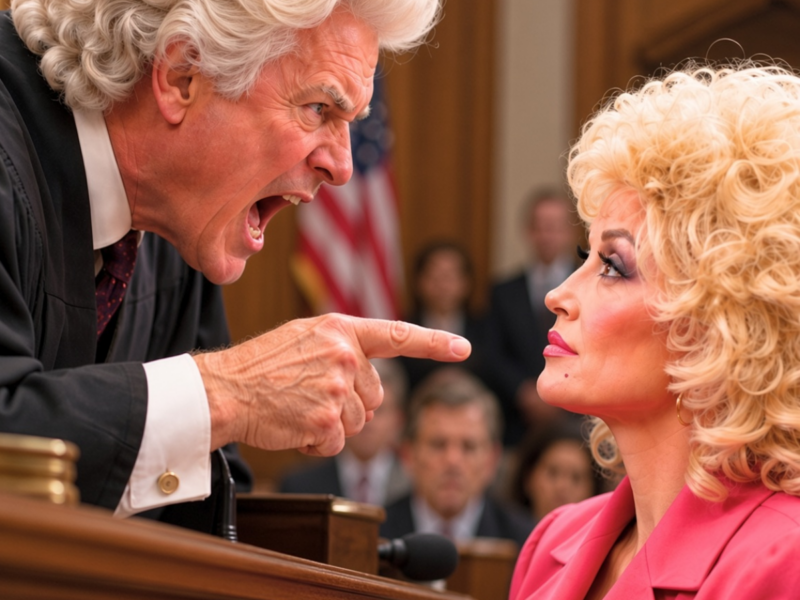
Dolly Parton REFUSED to Leave That Courtroom, What She Said Silenced Everyone!
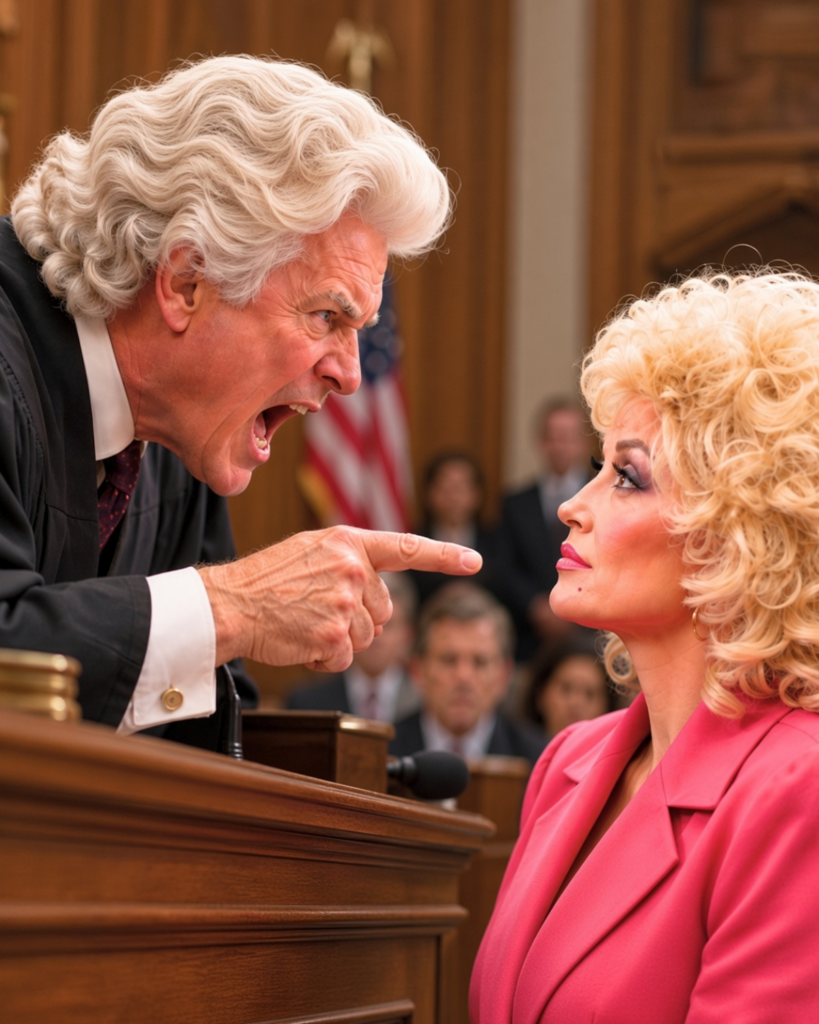
The most powerful man in Nashville told Dolly Parton to sit down, shut up, and let the real artists have the room.
What she said next left every lawyer, executive, and witness in that courtroom completely speechless and changed the music industry forever.
It was March 7th, 1983, and the marble corridors of the Davidson County Circuit Court in Nashville, Tennessee, were buzzing with attention that had nothing to do with an ordinary Tuesday morning.
Word had spread fast through Music Row the night before.
Dolly Parton—the woman who had turned “Jolene” and “I Will Always Love You” into cultural monuments—was going to court.
Not to attend.
Not to testify as a footnote.
Dolly Parton was the plaintiff, and she was sitting at the table herself.
The case on the docket was Parton versus Consolidated Sound Group, a contract dispute over the master recording rights to seven of Dolly’s albums recorded between 1974 and 1979.
In the language of the law, it was a commercial disagreement between a recording artist and a production consortium.
In the language of Music Row, it was something much larger.
It was a woman refusing to be owned.
The courtroom that morning held forty-three people.
There were lawyers on both sides, Dolly’s small team of two led by a soft-spoken Nashville attorney named Raymond Hodge, and a wall of six pinstripe suits representing Consolidated Sound Group.
There were journalists in the gallery—three of them—kept back behind the low wooden railing.
There were clerks and stenographers and a bailiff who looked like he hadn’t slept.
And there, at the head of the defense table, sat the man at the center of it all: Gerald Warren Blythe.
Gerald Warren Blythe was fifty-one years old that morning, and he had had thirty of those years building an empire.
He was not a musician.
He had never been a musician.
What Gerald Blythe was, was a dealmaker—the kind of man who could spot talent from across a room, sign it to a contract before it understood what the contract said, and profit from it for decades.
He had done this with blues singers in the 1960s, with country acts in the early 1970s, and now with the crossover pop-country wave that was reshaping Nashville.
Gerald Blythe’s name was on seventeen gold records displayed in the lobby of his office building on Music Row.
Not one of those records had his voice on it.
Every single one of them had someone else’s.
He was broad-shouldered, gray-haired, and entirely accustomed to getting what he wanted.
He had never lost a contract dispute in thirty years of business.
His attorney, a sharp-edged man named Davis Trailer, had a win rate in commercial litigation that bordered on mythological.
When Gerald Blythe walked into a room—any room—the room reorganized itself around him.
That was simply how things worked.
He had not expected this morning to be any different.
Dolly arrived at 8:47, thirteen minutes before proceedings were scheduled to begin.
She walked in alone, ahead of her legal team, carrying a single manila folder and wearing a pale cream suit that her dresser had pressed three times the night before because Dolly had insisted it needed to be right.
Her hair was exactly as it always was—high, blonde, and deliberate.
Her heels clicked on the courtroom floor with a quiet, steady rhythm.
Several people in the gallery turned to look, the way you always turn to look at Dolly Parton.
Not because she demanded it, but because she simply had a quality that made looking away feel like missing something.
She sat down, set her folder on the table, folded her hands on top of it, and waited.
Raymond Hodge leaned over and whispered something.
Dolly shook her head just slightly, with the calm of someone who had already decided how the day was going to go.
Gerald Blythe, from the other table, did not look at her.
The opening statements were procedural and dry.
Raymond Hodge laid out the core of Dolly’s claim with careful precision.
That the original 1974 recording agreement had contained a reversion clause, meaning that if Consolidated Sound Group failed to commercially exploit the recordings within a defined window, the master rights would revert to the artist.
Blythe’s company had allowed three of those albums to fall out of distribution entirely between 1980 and 1982, effectively sitting on the masters while preventing Dolly from recording new versions, licensing the songs, or profiting from her own work.
Raymond’s voice was steady and methodical.
He spoke like a man who believed the facts were enough.
Davis Trailer’s opening statement was something else entirely.
He was on his feet for twenty-two minutes.
He talked about the music industry’s standard practices.
He talked about the complexity of distribution networks.
He talked about how artists, however gifted, rarely understood the commercial realities of the business that sustained them.
And then, toward the end, in a tone that the court stenographer would later describe as conversational, he said something that made the room go still.
He said—and this is documented in the court record—that the plaintiff’s claims rested on a fundamental misunderstanding of her own agreements.
Agreements she had signed, he noted, without full comprehension of their commercial implications.
He said that the music industry had long operated on the goodwill of the men who built its infrastructure, and that artists who benefited from that infrastructure would do well to show appropriate appreciation rather than seek to dismantle arrangements they had been more than happy to accept when the royalty checks were arriving.
Then Davis Trailer paused, gathered his papers, and sat down.
Gerald Blythe, at the defense table, allowed himself a small, satisfied nod.
Raymond Hodge started to rise, but Dolly had already placed a hand on his arm—gently, firmly, the way you stop a door from swinging before it can do any damage.
Raymond looked at her.
The judge, a heavy-set man named Herschel Boone, who had been on the Davidson County bench for nineteen years and thought he had heard everything, looked at her, too.
Gerald Blythe, for the first time that morning, looked at her.
Dolly Parton picked up her manila folder, opened it, and set a single sheet of paper on the table in front of her.
She did not stand.
She spoke from her chair in a voice that did not shake, did not rise above a normal conversational register, and carried to every corner of that courtroom with absolute clarity.
She said, “Your Honor, if I may speak briefly to something Mr. Trailer just said.”
Judge Boone nodded slowly.
“Mr. Trailer suggested that I signed these agreements without fully understanding them,” Dolly said.
“I want to address that directly. I grew up in a two-room cabin in Locust Ridge, Tennessee. My family didn’t have running water until I was twelve. I wore dresses made from flour sacks. When I was eight years old, I wrote a song in that cabin, and I knew even then that it was worth something. I have written over three thousand songs in my career. Every one of them myself. Not because someone told me to, but because I understood from the time I was a child that the thing I made with my own mind and my own hands belonged to me.”
“Mr. Trailer says I didn’t understand what I signed. I understood every word of it. I just trusted that the men across the table understood it, too, and intended to honor it. That turned out to be the mistake.”
She paused—not for effect, simply because she had finished that thought and was moving to the next.
“I also want to address the suggestion that artists ought to show appropriate appreciation for the infrastructure of this industry. I am grateful for a great many things in my life and in my career. I am grateful for the musicians who played on my records and the engineers who stayed up all night getting the sound right. And the radio stations that gave my music a home. I am not grateful for a contract that was designed to ensure I could never own the thing I made. And I don’t believe gratitude is something that can be required of a person in exchange for being treated fairly under the law.”
The room was completely silent.
The court stenographer had stopped typing for two seconds—which was the only time she stopped typing during the entire three-day proceeding.
Davis Trailer had a pen in his hand.
He was not writing anything.
Gerald Blythe was looking at the table in front of him.
Dolly closed her folder, set her hands on top of it again, and looked at Judge Boone.
“That’s all I wanted to say, Your Honor. I’ll let Mr. Hodge handle the rest. He’s very good at this.”
Raymond Hodge later recalled that moment in an interview with the Nashville Scene.
He said he had handled commercial litigation for sixteen years before that morning, and he had never seen a courtroom go that quiet without a gavel.
He said that when Dolly finished speaking, the only sound was the building’s ventilation system, and that it seemed somehow louder than it had been before she started.
What followed over the next two days was a meticulous dismantling of Consolidated Sound Group’s defense, document by document, clause by clause.
The reversion clause was there, in plain language.
The distribution records showed the gaps.
The legal argument was, as Raymond Hodge had known from the beginning, a strong one.
But the turning point of the case was not a piece of evidence.
The turning point was the moment on the morning of March 7th when Gerald Warren Blythe had looked down at the table in front of him rather than across the room at the woman he had expected to be diminished by the room she was sitting in.
On March 9th, 1983, Judge Herschel Boone ruled in favor of Dolly Parton.
The master recording rights to all seven albums were returned to her.
Consolidated Sound Group was ordered to pay court costs and a licensing settlement of three hundred forty thousand dollars for the commercial use of the recordings during the period of disputed ownership.
Gerald Blythe did not comment publicly on the verdict.
Davis Trailer released a statement saying that his client respected the court’s decision.
That was all.
Dolly walked out of the Davidson County Circuit Court on March 9th into a gray Nashville afternoon.
A small group of people were gathered on the steps—not a crowd, just a handful of reporters and a few bystanders who had heard something was happening.
One of the reporters asked her how she felt.
Dolly paused on the top step, looked out at Second Avenue, and smiled.
“About the same as I felt walking in,” she said.
“I knew what was right. I just needed the right people in the right room to agree with me.”
She held up the manila folder—the same one she had carried in, the same one she had set on the table that first morning with her hands folded on top of it.
“I’ve been carrying these documents for two years,” she said.
“I’m going to go home and file them where they belong now. Under my name.”
She walked down the steps, got into a car, and was gone.
The sheet of paper she had set on the table that first morning—the single page she had removed from the folder before Raymond Hodge gave his opening statement—was a handwritten copy of the original reversion clause from her 1974 agreement.
She had copied it out herself, by hand, the night before the trial.
Not because she needed it, but because she wanted to hold it.
She wanted to feel the words under her fingers and know exactly what she was fighting for.
That piece of paper is still in her possession.
She has mentioned it in interviews.
She does not keep it in a filing cabinet or a box.
She keeps it in the drawer of the writing desk in her home studio in Brentwood, Tennessee, next to the notebooks where she writes new songs, because she believes that the things worth fighting for and the things worth creating belong in the same place.
The Parton versus Consolidated Sound Group ruling became a quiet landmark in music industry contract law.
It was not a splashy precedent-setter in the way some cases are.
It did not make national headlines outside of the industry press, but among entertainment lawyers in Nashville and Los Angeles, it was cited in contract negotiations for years afterward.
Artists’ representatives began pushing harder for clearly worded reversion clauses.
Some labels pushed back.
More of them than you might expect eventually relented, because the alternative was the kind of morning Gerald Blythe had experienced in courtroom four of the Davidson County Circuit Court, and nobody in the business wanted that.
A music industry attorney who specialized in artist rights, speaking to Billboard magazine in 1987, described the case this way.
“Dolly Parton walked into that courtroom as a client with a legitimate contract dispute. She walked out as something more complicated. She walked out as proof that the argument that artists don’t understand their own agreements was never really about understanding. It was about power. And when an artist refuses to pretend she doesn’t have any, the whole argument falls apart.”
Dolly herself has spoken about that period of her career in the years since, though never in a way that invites drama.
She tends to move past it quickly, the way she moves past most things that cost her.
Not because she doesn’t remember the cost, but because she has places to be and songs to write and a great deal more living to do.
But in a 1991 interview, when asked about the moment she knew the music industry was going to have to take her seriously on her own terms, she gave an answer that stopped the interviewer mid-question.
She said, “The day I stopped being grateful for things I was owed.”
And then she smiled that smile—the one that makes you think you might have missed something—and moved on.
The story of Dolly Parton in courtroom four is not a story about a singer who happened to win a lawsuit.
It is a story about a woman who understood, from the time she was a little girl writing songs in a two-room cabin in the mountains of Tennessee, that what she made was hers.
That the value in her work was not something the industry had given her.
It was something she had arrived with.
There are people in every room who will use the size of the room itself as an argument.
They will arrange the furniture in ways that are designed to make you feel small.
They will speak in language that assumes their authority over your choices.
And they will look at the table when they realize that the authority they assumed was never actually theirs.
Dolly Parton looked at the table.
She saw a surface to put her folder on.
She folded her hands.
She waited.
And when it was time, she said what was true.
That’s all she did.
And it was more than enough.









