Dolly Parton Married Carl Dean Before Fame — 59 Years Later, He Was Still a Mystery.
For nearly 60 years, Dolly Parton became more visible while the man she married remained almost invisible.
She stepped into television studios, movie sets, concert halls, award shows, Dollywood, and eventually the history books.
Carl Dean stayed intensely private.
They met in 1964, married in 1966, and remained husband and wife until his death in 2025.
The mystery was not whether he existed.
The mystery was how one of America’s most public lives could remain tied to one of its most private marriages for almost 59 years.
To understand why Carl Dean became such an unusual figure in Dolly’s story, the clock has to move back to 1964.
Before the rhinestones became armor.
Before the platinum hair became an international symbol.
Before television carried Dolly Parton into millions of homes.
She was eighteen and newly out of high school when she moved to Nashville.
She had grown up in a poor Appalachian family in Tennessee, the fourth of twelve children, surrounded by church music, mountain storytelling, family loyalty, and the hard mathematics of making very little stretch far enough.
She had already written songs, appeared on local radio and television as a child, and performed at the Grand Ole Opry as a teenager.
Nashville was not a fantasy trip.
It was the next step in a plan she had been building for years.
And on the day she arrived, she met Carl Dean.
That timing matters.
Carl did not meet a movie star, a theme park owner, a Hall of Fame icon, or the woman whose songs would one day move from vinyl to cassette, CD, download, and streaming.
He met a young songwriter at the beginning of the climb.
Two years later, on May 30th, 1966, they married.
The date is simple.
What followed was not.
Within a year, Dolly’s professional world changed dramatically.
In 1967, she joined the Porter Wagoner Show, one of country television’s most important platforms.
For viewers who remember that era, the atmosphere is easy to picture.
Hot studio lamps.
Fixed cameras.
Sponsor breaks.
Polished western suits.
Pedal steel.
Guitar.
Applause arriving through a television speaker.
And a weekly rhythm that carried country performers directly into American living rooms.
There was no social media feed waiting after the broadcast.
There was no smartphone camera in every hand.
Television visibility was concentrated, powerful, and hard to ignore.
The Porter Wagoner Show gave Dolly an enormous platform.
It also created the first great contrast of her marriage.
As Dolly’s public image grew, Carl’s did not.
He rarely appeared.
He did not build a second career out of being Dolly Parton’s husband.
He did not become a permanent figure beside her at the edge of every camera frame.
And over time, that distance from celebrity became almost as recognizable as Dolly’s willingness to be seen.
The easy version of the story says Dolly loved attention while Carl hated it, and that opposites simply attracted.
But that explanation is too small for a marriage that lasted almost six decades.
The more interesting question is what their radically different public roles allowed to remain separate.
Dolly’s career accelerated quickly.
She became a familiar television presence, a recording artist, a songwriter with growing authority, and eventually a solo star strong enough to move beyond Porter Wagoner’s shadow.
“Joshua” reached number one on the country chart in 1971.
“Coat of Many Colors” turned childhood poverty and family love into one of her defining songs.
Then came “Jolene,” and suddenly the private husband few fans saw became connected to one of the most famous jealousy songs ever written.
But first, there is an important distinction.
The jealousy story and the name did come from the same woman.
Dolly said the song’s jealous tension was inspired by a red-haired bank employee who showed interest in Carl.
The name “Jolene” came from a young fan Dolly had met.
Those two elements fused into a song so vivid that later listeners often treated it as if it were a literal transcript of one private event.
It was not.
The distinction is more than trivia.
It shows how Dolly could take something connected to private life and turn it into art without converting the entire marriage into public evidence.
The song became public.
The marriage stayed mostly private.
That pattern would repeat for decades.
As the 1970s moved forward, Dolly’s image grew brighter and more deliberate.
Her hair became higher.
The rhinestones became more dazzling.
Long acrylic nails.
High heels.
Wigs.
Makeup.
Humor.
And exaggerated femininity became part of a public persona she openly understood and controlled.
She could joke about the artificiality because the joke belonged to her.
Yet the person closest to her remained largely outside the frame.
The contrast invited speculation.
When a celebrity spouse is constantly photographed, people often confuse visibility with intimacy.
When a spouse is rarely seen, they can confuse absence with trouble.
Dolly and Carl complicated both assumptions.
The public had relatively little visual material from which to build the usual celebrity couple story.
That lack of access created mystery, and mystery created rumors.
Some people even wondered whether Carl was real.
The verified facts make that myth unnecessary.
He was real.
They married in 1966.
And they remained married until his death in 2025.
What is more revealing is that fame never forced him into the role audiences expected.
By the mid-1970s, Dolly’s career was becoming more independent.
Her separation from Porter Wagoner and the success of “I Will Always Love You” showed she could carry a career under her own name.
“Jolene” had become a signature song.
Her songwriting was traveling farther.
Carl still did not follow her into public life.
That was not a brief phase.
It became the structure.
Then the 1980s made the contrast even wider.
In 1980, Dolly starred in “9 to 5” with Jane Fonda and Lily Tomlin, moving from country television into mainstream film.
The title song became one of the defining pop cultural sounds of the decade.
In 1983, “Islands in the Stream” with Kenny Rogers became another crossover milestone.
Her face was on television.
Her voice was on radio.
Her films moved through theaters and later home video.
And her public image fit an era that rewarded bigger hair, brighter clothes, and larger performances.
Carl’s public role barely changed.
This does not mean he was unimportant.
It means importance and visibility were not the same thing.
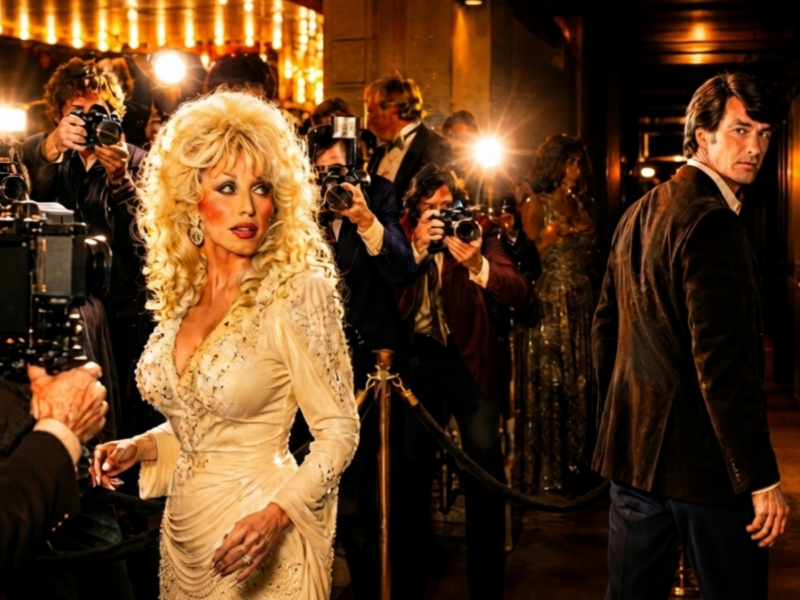
The contrast became especially visible in the rituals of fame itself.
Award shows and premieres increasingly turned couples into part of the entertainment.
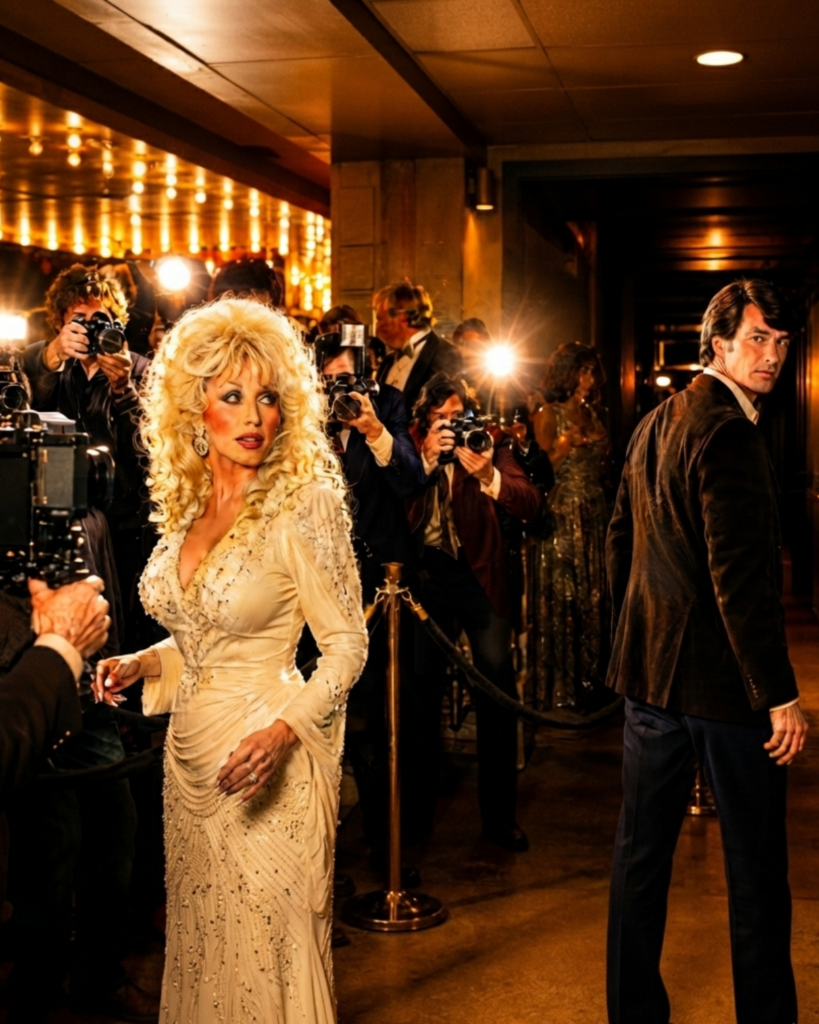
Photographers waited at entrances.
Television hosts wanted reaction shots.
Magazines wanted photographs that could turn a marriage into a visual story.
Dolly’s career naturally placed her inside those rituals.
But Carl remained largely outside them.
That created an odd effect.
The more celebrity culture trained audiences to expect a spouse beside every famous person, the more noticeable his absence became.
Yet the marriage did not need to produce a matching public image.
Dolly could walk into a room built for cameras without bringing the entire private structure of her life with her.
For viewers who grew up with glossy magazines on coffee tables and entertainment programs in the evening, that distinction would become increasingly unusual as the decades passed.
A star could once be known through records and television appearances while home remained mostly offstage.
By the end of the century, that separation was becoming harder to maintain.
Carl maintained it anyway.
And the result was a strange reversal.
The less the public saw of him, the more curious people became about the man who apparently had no interest in turning curiosity into fame.
The public record is uneven because Dolly’s career produced mountains of footage while Carl remained intensely private.
That imbalance itself tells part of the story.
He did not turn proximity to one of America’s biggest entertainers into a celebrity identity of his own.
And that gave their marriage something increasingly rare.
A life that did not have to be documented every time Dolly’s career reached a new peak.
But privacy did not remove ordinary human themes from the relationship.
“Jolene” proves that jealousy could still enter Dolly’s songwriting through real life.
Their decision not to have children also became a subject the public returned to again and again.
Dolly and Carl had no biological or adopted children.
Over the years, Dolly explained that not having children had allowed her to devote more time to her career, her extended family, and work that would eventually reach children on a much larger scale.
That should not be turned into a hidden tragedy the sources do not support.
The documented point is simpler.
Their life took one path, and Dolly later connected that path to the time and attention she was able to give elsewhere.
Years later, children would become one of the largest parts of her legacy, but not in the way people might have expected.
In 1995, Dolly launched the Imagination Library, inspired by her father’s inability to read and write.
What began as a literacy project rooted in family experience eventually expanded on an enormous scale, distributing hundreds of millions of books over the decades.
The woman who had no children of her own built a public legacy tied to children across generations.
Carl’s name did not become the face of that mission.
Again, Dolly’s public reach expanded while he remained outside the machinery around it.
By then, Dollywood had also become a major symbol of Dolly’s connection to East Tennessee.
She was no longer simply a singer.
She was a businesswoman, actor, philanthropist, cultural figure, and eventually something close to an American institution.
The public version of Dolly Parton became almost architectural.
Songs, films, television appearances, a theme park, charities, interviews, costumes, jokes, causes, and a catalog that kept returning to new generations.
Carl’s public footprint remained remarkably light.
That difference is one reason the marriage still fascinates people who watched celebrity culture turn relationships into entertainment products.
There were no weekly relationship updates.
No constant couple branding.
No requirement that Carl appear beside every trophy as proof that the marriage still existed.
For the forty-five-to-sixty-year-old audience who watched media culture change across decades, that contrast is especially striking.
They remember a world before every private dinner could become a photograph, before anniversaries were expected to become posts, before fans could demand daily access through social media.
Dolly and Carl’s relationship began in 1964, when fame traveled through records, radio, television, newspapers, and magazines.
Then the culture surrounding celebrity changed almost beyond recognition.
The marriage continued.
In the 1990s, Whitney Houston’s version of “I Will Always Love You” carried Dolly’s songwriting into another global era.
CDs replaced much of the old vinyl and cassette ritual.
Music television made images move faster.
Celebrity coverage became more aggressive.
Dolly entered the Country Music Hall of Fame in 1999.
In later decades, younger generations rediscovered “Jolene,” the Imagination Library expanded, and Dolly’s openness about wigs, cosmetic surgery, and the manufactured side of her appearance made her feel newly modern.
She could be remarkably candid about some parts of herself while still leaving other parts outside public reach.
Openness was not the same as total access.
There was another contrast inside Dolly herself.
She could be unusually open about the manufactured parts of her appearance.
She talked about wigs instead of pretending every strand was natural.
She joked about cosmetic procedures instead of acting embarrassed by them.
She acknowledged the theatricality of the clothes, the heels, the nails, and the makeup.
That openness made the private silence around Carl even more striking.
The public received plenty of Dolly Parton.
But it did not receive every category of Dolly Parton.
She could volunteer one truth and still protect another.
That is a more precise way to understand the marriage than saying she was simply public and he was simply private.
Dolly controlled the terms of exposure.
Carl limited his participation in it.
Their lives overlapped without becoming one public product.
And because those choices remained visible across decades, the marriage became part of a larger pattern in Dolly’s career.
She repeatedly gave audiences access to the work without giving them unrestricted access to everything behind the work.
Carl’s continued distance from celebrity left much of their private life outside the story the audience could consume.
And then time began adding weight in a way publicity never could.
Ten years became twenty.
Twenty became thirty.
Country radio changed.
VHS faded.
CDs gave way to downloads.
Downloads gave way to streaming.
Social media arrived.
Younger artists who had grown up listening to Dolly began appearing beside her.
Through all of it, Carl remained rare in public.
Every decade made the same fact more unusual.
The marriage was still there, while the culture around it became more invasive.
The passage of time made that pattern easier to see.
A television audience in the late 1960s encountered Dolly once a week through a fixed set, a scheduled broadcast, and a few controlled images.
A fan in the 1980s could buy a cassette, rent a movie on VHS, and watch an interview when it aired.
By the 2000s, clips could circulate endlessly.
By the 2010s, celebrities were expected to speak directly to audiences through phones and social platforms.
And spouses who once might have stayed comfortably anonymous could become visible through a single photograph.
Carl had begun his marriage in a media world built around scarcity and lived long enough to see a culture built around constant access.
His public behavior remained remarkably consistent across that transition.
That consistency is more revealing than any romantic slogan because it can be observed without inventing his private reasoning.
He stayed mostly out of view when remaining out of view became harder than it had been when the marriage began.
This is where the title of the story needs one important clarification.
“For 59 years, he refused the spotlight” does not mean Carl literally hid from every camera for fifty-nine years.
It means he remained exceptionally private and rarely allowed himself to become part of Dolly’s celebrity machinery.
That distinction makes the story stronger, not weaker.
He did not have to disappear completely for the contrast to be remarkable.
He only had to remain intensely private while the woman he married became impossible for America to ignore.
Dolly’s public career kept finding new peaks.
She performed before enormous festival audiences, entered the Rock and Roll Hall of Fame in 2022, and released the rock album “Rockstar” in 2023.
But those later milestones matter here for one reason.
Each one made Carl’s continued distance from the public stage more striking.
The bigger Dolly became, the less useful the usual celebrity marriage template became.
He was not the co-star of the brand.
He was her husband.
Then came March 3rd, 2025.
Carl Dean died at eighty-two.
The marriage that had begun before national television fame, before “Jolene,” before “I Will Always Love You,” before “9 to 5,” before Dollywood, before the Imagination Library, before CDs, streaming, and social media ended after almost fifty-nine years.
Suddenly, the privacy that had made Carl mysterious for decades carried a different emotional weight.
There would be no late chapter in which he suddenly became a public personality.
The man who had stayed outside most of Dolly’s fame left the public story much as he had lived inside it.
Privately.
Dolly’s grief became part of the context of her final years, but there is no need to invent bedroom scenes, imagined last conversations, secret letters, or dramatic promises.
The verified timeline is enough.
He had been there before the fame.
He had been there through the rise.
He had been there through the songs, films, businesses, awards, reinventions, and generational changes.
Then he was gone.
Carl’s death also changed the emotional meaning of old photographs and old stories.
Details that once seemed amusing or mysterious suddenly became the limited public record of a life that would produce no new appearances.
The scarcity could no longer be temporary.
Dolly had spent decades answering questions about the husband people rarely saw, and now the timeline had closed.
Yet even here, the responsible story has to resist the temptation to fill silence with invented intimacy.
A marriage lasting from 1966 to 2025 contains thousands of private days that the public does not know.
That lack of access is not a hole that a biographical script is entitled to fill.
It is part of the subject.
Carl’s story inside Dolly’s life is powerful precisely because the public record remains smaller than the relationship itself.
And Dolly kept working.
In 2026, at eighty, she was still recording, still connected to major projects, still receiving new international sales certifications, and still preparing the next chapter of her story for Broadway.
Her public life had always held opposing forces together.
Appalachian roots and global scale.
Artificial glamour and emotional directness.
Humor and grief.
Visibility and privacy.
Carl’s absence now occupied the private side of that balance in a way no camera could fully document.
On August 25th, 2026, Dolly Parton died in Nashville at eighty.
The family statement did not initially specify a cause, while later reporting cited her spokesperson describing a brief battle with cancer.
Less than eighteen months separated Carl’s death from Dolly’s.
That fact can tempt storytellers to turn chronology into romance and imply that one death somehow caused the other.
The evidence does not support that.
The documented timeline already carries enough emotional force.
They married in 1966, remained married until his death in 2025, and Dolly lived on into 2026, still working and still carrying the public legacy that had made their marriage so unusual from the beginning.
Their story also challenges a modern instinct to measure love by evidence.
Photographs.
Interviews.
Anniversary posts.
Red carpet appearances.
Public declarations designed for an audience.
Dolly and Carl’s marriage began before those things became daily expectations and lasted long enough to survive the culture that made them seem normal.
That does not prove privacy was the secret to their longevity.
No honest biography can reduce a marriage of nearly six decades to one formula.
What it does prove is simpler.
Constant visibility was not required for the marriage to endure.
The public could hear Dolly sing about love, jealousy, departure, family, and endurance without receiving a documentary record of every private moment behind those emotions.
Even “Jolene,” the song most obviously connected to marital jealousy, demonstrates the pattern.
The audience got the fear, the melody, the vulnerability, and the unforgettable name.
It did not get complete access to the marriage.
Decades later, younger listeners could still feel the song because its emotional truth never depended on exposing every private fact.
In that sense, Carl’s distance from celebrity did not remove him from Dolly Parton’s legacy.
It placed him in a different part of it.
Porter Wagoner belonged to the television years.
Elvis Presley belonged to the publishing story that never became a recording.
Jane Fonda and Lily Tomlin belonged to the film breakthrough of “9 to 5.”
Kenny Rogers belonged to one of country pop’s most enduring duets.
Whitney Houston carried Dolly’s songwriting into another global generation.
Carl Dean belonged to the continuity underneath all of them.
He was connected not to one performance, one award, or one era, but to the private life that had begun before nearly everything the public now remembers.
That is why the chronology matters.
Carl did not arrive after success to join an established image.
He was there before the image.
Before Porter.
Before the first country number one.
Before “Jolene.”
Before “I Will Always Love You.”
Before Hollywood.
Before Dollywood.
Before the Hall of Fame honors.
Before millions of children received books through the Imagination Library.
Every later version of Dolly Parton came after the marriage had already begun.
The public watched the star evolve.
Carl was connected to the timeline from the other direction.
The end of the story, therefore, returns to the question that followed him for decades.
Why did he remain so far from the spotlight?
The sources support the fact of his intense privacy much more strongly than they support one simple psychological explanation.
It would be easy to invent a sentence and pretend it solved him.
Maybe he disliked fame.
Maybe he preferred an ordinary routine.
Maybe distance made public pressure easier to manage.
But unless a claim is grounded in a verified statement, it belongs to speculation.
What can be said with confidence is what he did.
He rarely appeared publicly.
He did not turn Dolly’s fame into his own entertainment identity.
He remained married to her as her celebrity grew from country television to global icon status.
And that pattern remained remarkably consistent.
It shows that their marriage did not require them to occupy the same public role.
Dolly could become larger than life outside the home without Carl becoming larger than life beside her.
He could remain private while her career became public on a global scale.
Their difference was not erased.
It was accommodated.
That is more interesting than pretending two people had to become identical in order to stay together.
Celebrity culture usually rewards proximity.
Stand beside a star and cameras arrive.
Marry a star and curiosity becomes permanent.
Stay with a star for decades and the public begins to feel entitled to proof.
Carl gave very little of that proof.
Dolly gave the world almost everything else.
Songs.
Stories.
Jokes.
Costumes.
Performances.
Businesses.
Causes.
Memories.
And eventually a legacy spanning more than seven decades.
But not everything.
That may be the deepest thread connecting Carl Dean to the rest of Dolly Parton’s life.
She repeatedly distinguished between sharing something and surrendering all of it.
She shared childhood memories in “Coat of Many Colors,” but the family did not become a permanent public spectacle.
She transformed jealousy into “Jolene,” but the marriage did not become an open file.
She turned professional separation into “I Will Always Love You,” but did not need to destroy Porter Wagoner to explain leaving him.
She shared her image with the world, even exaggerated it, while parts of her private life remained outside public reach.
Carl stood closer to that private side than almost anyone.
And because he did, he became one of the strangest paradoxes in her biography.
One of the least visible major people in the life of one of the most visible women in American entertainment.
The public saw Dolly’s hair change, her costumes change, the technology around her change, the size of her audiences change, and the meaning of her songs change as new generations claimed them.
Carl’s public role changed very little.
He remained the husband who was rarely in the photograph.
The man people heard about more often than they saw.
The private constant inside a public life built on reinvention.
That is why his absence became a kind of presence.
Every decade the marriage continued, the myth mattered less than the fact.
He was real.
The marriage was real.
The privacy was real.
And the years kept accumulating.
Almost fifty-nine of them, from 1966 to 2025.
From early Nashville to global fame.
From the age of fixed television cameras to the age of streaming.
Dolly Parton spent a lifetime being seen.
Carl Dean spent most of that same lifetime outside the frame.
Their marriage became proof that love did not have to be constantly performed for an audience in order to last.
Carl never became part of the show.
And that is exactly why, after all those years, he became such an unforgettable part of the story.









