Dolly Parton Found A Girl Saving $19 For Her Mama’s Headstone In 1977 — Then She Bought The Stone.
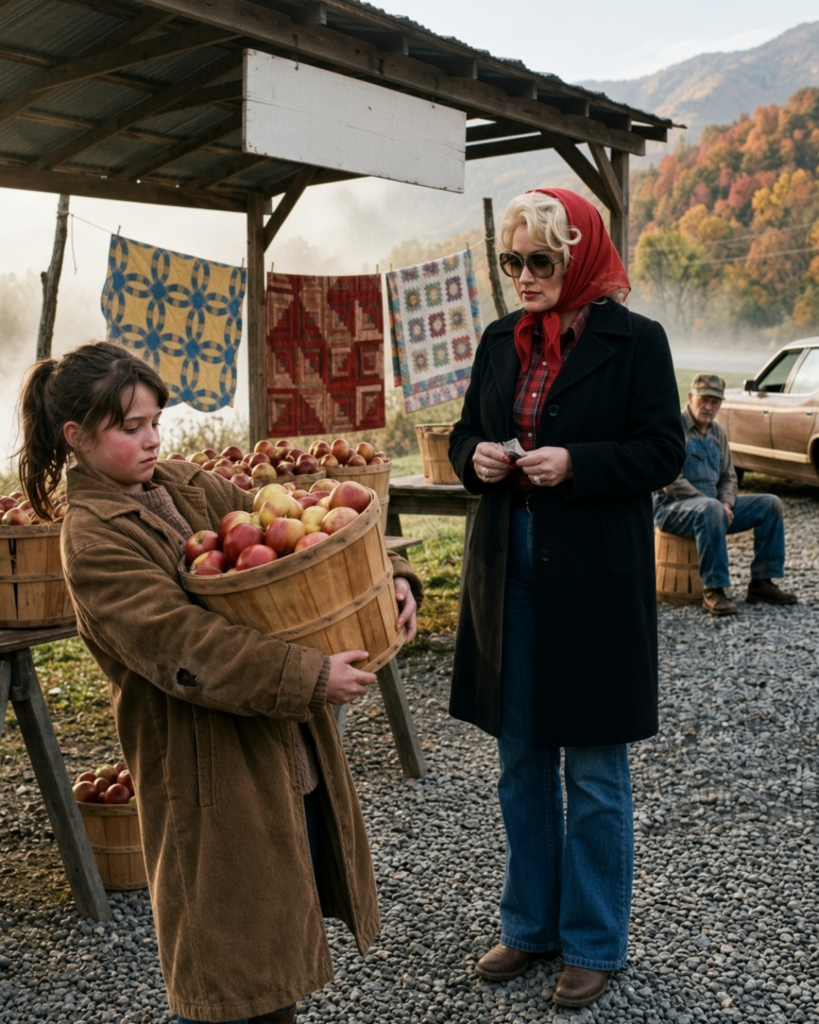
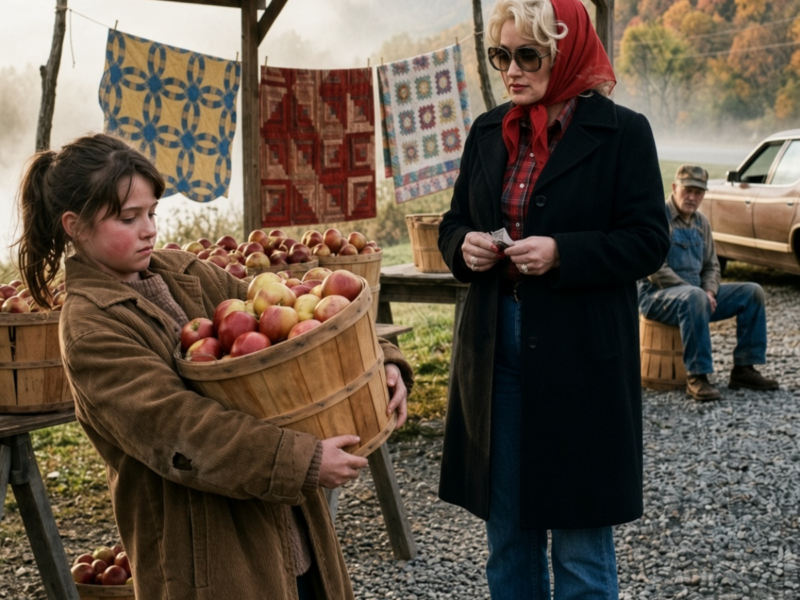
October 1977, a little roadside stand on Highway 441, a few miles south of Sevierville, Tennessee, where the road starts climbing toward the Smoky Mountains.
It is a quarter to seven in the morning.
The fog is still lying in the bottoms along the Little Pigeon River, thick as milk, and a 10-year-old girl is already at work.
Her name is Josie Holt.
She is setting out apples, bushel baskets of them, Winesaps and Rome Beauties and Staymans lined up on two sawhorse tables under a tin roof her daddy nailed together out of an old barn.
Behind the apples there are jars of sorghum molasses with handwritten labels and a row of apple butter.
And on a clothesline strung between two posts at the back of the stand, there are three quilts hanging in the morning damp.
Over the front of the stand on a board painted white in red letters that are starting to fade, it says Ellen’s Apples Quilts Sorghum.
Ellen was her mama.
Ellen Holt had painted that sign herself eight years ago, standing on a ladder with a brush in her teeth.
And 13 months ago, on a cold morning in September, she had come down with a cough that turned into pneumonia, and she had died in the hospital in Knoxville in four days.
She was 34.
Josie is too young to be doing what she is doing.
She is lining up apples in rows by color the way her mama taught her.
Reds in the front, yellows in the back, because a pretty stand sells more than an ugly one.
She is wiping the dew off the jars with the hem of her sweater.
She is counting the change in the cigar box because her daddy is at the sawmill until 3:00 and somebody has to open the stand and there is nobody else.
And in the pocket of her corduroy jacket folded into a tiny square is the real reason Josie Holt gets up before the sun.
In about four hours, a woman in a headscarf and dark glasses is going to pull over at this stand in a dusty old station wagon.
Josie is not going to recognize her.
Nobody is.
And that woman is going to find out what is in that pocket.
If this story is already pulling you in, go ahead and hit that subscribe button right now.
Here is the story.
Ellen Holt was a mountain girl from Wears Valley who could make anything with her hands.
She could make a quilt out of feed sacks that would make you cry.
She could make sorghum molasses the old way, boiling the cane juice down in a long copper pan over a wood fire all day until it turned the color of an old penny.
She could make apple butter that people drove from Knoxville for.
And she had wanted exactly one thing out of life, which was to have a little something of her own on the road where she could sell the things she made and talk to people and watch the mountains change color every fall.
She married Wade Holt, a quiet logger with big hands and a soft voice, in 1966.
They saved for three years.
And in 1969, they put everything they had down on two acres of land on Highway 441 with an old apple orchard on the hill behind it and a little frame house, and Ellen built her stand.
Josie had been born two years before, in March of 1967.
She grew up under that tin roof.
She took her naps in an apple crate lined with a quilt.
She learned to count by counting change.
She learned her colors from apples.
Ellen loved two things more than anything in the world.
That girl and that stand.
And she taught Josie everything the way a mother teaches when she figures she has 30 years to finish.
How to tell a Winesap from a Stayman by the smell.
How to boil sorghum without scorching it.
How to make a running stitch so small you couldn’t see it.
How to talk to tourists from Ohio who thought everybody in Tennessee was barefoot.
And how to tell just by looking which family stopping at the stand couldn’t really afford the apples they wanted so you could throw in a few extra and not say a word about it.
“Make it pretty, Josie,” Ellen used to say, holding up a quilt square to the light.
“And make it last. Anything worth doing, do it so it’ll still be here when you’re gone.”
They buried her in the little churchyard at Shiloh, up the hollow, under the big oak, next to Ellen’s own mama and daddy.
There had been no money for anything but the burying.
The stand ran close to the bone the way all the little stands on that road did.
Wade Holt had taken a second shift at the sawmill to pay the hospital in Knoxville, and it still wasn’t enough.
And so Ellen Holt, who had made a hundred quilts so pretty they’d make you cry, was put in the ground under a marker made of two pieces of white oak that Wade had cut and nailed into a cross himself and lettered with a woodburning tool because there was nothing else.
Ellen Holt. Mama.
It was supposed to be temporary.
Everybody at Shiloh said so.
You got the wooden one first and then you got the stone when you could.
Thirteen months went by and there was never any “when you could.”
Wade kept the stand open because it was all they had and it had been everything Ellen wanted.
But he couldn’t work it.
He was at the sawmill from 6:00 in the morning until 3:00 and back again some nights.
And he came home so tired he fell asleep at the supper table with his fork in his hand.
So, Josie Holt, 10 years old, small for her age with her mama’s dark hair and her mama’s quick hands, appointed herself the one who ran the stand.
Nobody asked her to.
She just started.
She was up before her daddy some mornings.
She set out the apples.
She learned to make change for a $20 in her head.
She learned to talk to the tour buses.
She did her homework sitting on an upside-down bushel basket between customers.
And she did it well, because her teacher at Pittman Center School said so.
And when the school bus dropped her at the end of the road at 3:30, she went straight to the stand and stayed till dark.
She did not complain, not once, because her mama had told her that anything worth doing, you do it so it lasts.
And that stand had been worth doing to her mama.
So Josie was going to make it last.
The regulars loved her.
The truckers who came down 441 hauling lumber loved her.
The old women from the churches loved her.
They bought more apples than they needed.
And when they paid, they’d tell her to keep the change, nickels, dimes, sometimes a quarter.
And Josie took every coin and didn’t spend a single one.
She carried them home in her pocket.
She put them in a mason jar on the windowsill of her bedroom, the one that looked out on the orchard.
And every Sunday night, she sat on her bed and poured the jar out on the quilt and counted it and wrote the number on a strip of masking tape on the lid in pencil and crossed out the old number.
She never told her daddy what the jar was for.
She had a feeling, the way children do, that if he knew, he’d try to put money toward it.
And there wasn’t any, and it would only put one more weight on a man who was already carrying all he could.
So, it stayed her secret, hers and the mason jar’s.
On the bad nights, when the stand had been slow and her hands were cold and she missed her mama so bad it felt like something sitting on her chest, she’d take the jar down off the windowsill and count it by the light of the lamp.
$19. $19.20.
One Sunday night that October, her daddy came in from the mill late and saw the light under her door and opened it a crack.
Josie had the coins spread out on the quilt in little stacks, quarters and dimes and nickels, and she was writing a number on the lid.
She threw a pillow over the whole thing so fast she knocked the jar off the bed.
Wade stood in the doorway.
He didn’t ask.
He was too tired to ask and too smart.
He just said, “Don’t stay up too late, Josie girl,” and closed the door.
And Josie lay there in the dark with her heart pounding, listening to him walk down the hall and then listening to him sit down heavy at the kitchen table.
And after a while, she heard a sound she had only heard once before, the night of the funeral.
Her daddy crying very quietly with his hand over his mouth so she wouldn’t hear.
She never told him she heard, and she never told him what the jar was for.
And somehow the counting helped, because every coin in that jar was a coin closer to her mama having her name on something that wouldn’t rot in the rain.
And in a year when there was so much that Josie couldn’t do, that was one thing she could.
Here’s a question before we go on.
Tell us in the comments: have you ever watched a child carry a grown-up’s load without a word of complaint?
Maybe it was you.
Maybe it was someone in your family.
Tell us about them and tell us where you’re watching from.
And if you’re enjoying this story, hit that like button before we continue.
There was just one thing wrong at Ellen’s that fall.
One thing besides the missing mama.
His name was Harlon Puit.
In 1977, the little road between Sevierville and Gatlinburg was changing.
The tourists were coming in bigger numbers every year.
Pigeon Forge was turning from a sleepy little town with a grist mill into a string of motels and gift shops and pancake houses and go-kart tracks.
And men like Harlon Puit had figured out that every acre of land along Highway 441 was going to be worth a fortune.
Puit owned three souvenir shops already.
He wanted a fourth.
And he had decided that the little apple stand with the faded sign was a widow’s place that would fold by spring.
He had been coming around for months making Wade Holt low offers for the two acres, and he’d been getting a little plainer each time about how a man working double shifts at a sawmill couldn’t keep a stand open forever with a 10-year-old girl running it, and he really ought to sell to somebody who could do something with the land.
He was not cruel, exactly.
He was just a man who looked at a hand-built stand with a dead woman’s name painted on it and a tired logger and a little girl stacking apples and saw a parking lot.
When he came by, he talked over Josie’s head.
He picked up apples and put them back bruised.
He called her “sister” and snapped his fingers when he wanted something.
And Josie brought him what he wanted, polite as Sunday, without a word, because her mama had taught her that too, that you are kind to people even when they haven’t earned it, because you never do know what they’re carrying.
It was a bright, cold Saturday morning in late October when the station wagon pulled over.
The woman driving it had almost gone right on by.
She had been on that road a thousand times, but at the last second, she saw the sign.
Ellen’s. Apples. Quilts. Sorghum.
And she saw the quilts on the clothesline behind the stand moving a little in the wind, red and blue and yellow, and something made her foot come off the gas.
Her own mama had made quilts like that out of feed sacks and flour sacks and the good parts of worn-out dresses.
When she was a little girl, there were 12 children sleeping three and four to a bed in a two-room cabin.
And the only thing that made that cabin warm in January was her mama’s quilts.
She could still remember the feel of them, heavy and soft, smelling like wood smoke.
She could still remember lying under them, listening to her mama sing.
She pulled over on the gravel without quite deciding to.
It was an old one, a brown Ford with wood paneling down the sides and a dent in the back bumper and Tennessee plates, and it was covered in dust like it had come a long way on back roads.
A woman got out.
She was small.
She had on blue jeans and a man’s flannel shirt and a plain wool coat and a red headscarf tied under her chin and a big pair of dark sunglasses.
She looked like anybody’s aunt on her way to visit somebody.
She walked up to the stand slowly, the way people do when they’re in no hurry at all, and looked at the apples and the sorghum and the quilts on the clothesline.
She looked at the quilts for a long time.
And then mostly what she looked at was the girl.
She watched Josie Holt, 10 years old, sell a bushel of Winesaps to a family from Indiana and make their change from a $20 without a stumble.
She watched her carry a full bushel basket to their car, leaning sideways with the weight of it, and refuse their help.
She watched her wipe down the jars of sorghum and straighten the rows of apples, reds in front, yellows in back.
And she watched Harlon Puit pull up in a shiny Lincoln and get out and pick up three apples and drop them back on the pile and snap his fingers at Josie and say, “Sister, go get your daddy.”
And she watched Josie say, “He’s at the mill, sir,” polite and quiet without a flicker.
And the woman in the headscarf did not say anything.
But something happened in her face.
Something got very still.
When Puit drove off and the stand was empty for a minute, the woman caught Josie’s eye and smiled.
“Honey, do you run this whole thing by yourself?”
“My daddy helps on Sundays,” Josie said. “But mostly it’s me. It was my mama’s.”
She said it plain, the way a child says a thing she’s had to say a hundred times.
“She died last year. That’s her name on the sign.”
“I saw that.” The woman looked up at the faded red letters.
Then she looked back at the girl.
“Well, Ellen raised herself a good one. I’ve been to a lot of stands on a lot of roads, and I don’t believe I ever saw one run better.”
Josie smiled for the first time.
“You must be saving up for something real nice,” the woman said. “The way you hustle. A new bicycle, a record player.”
And the girl’s face did something then.
It went careful.
The way a face goes when it’s guarding something.
“No, ma’am,” Josie said. “Not a bicycle.”
She looked down at the apples.
And then, because there was something in the woman’s voice that made it all right, something warm and mountain and familiar, like a voice she’d heard somewhere before, she reached into the pocket of her corduroy jacket and took out the tiny folded square of paper, and opened it up and smoothed it flat on top of a basket of Romes.
It was a page torn out of a catalog, a monument company in Knoxville, and on it was a picture of a headstone, gray granite, plain and solid, with a rounded top, and a price printed underneath.
$120.
“My mama’s got a wooden one,” Josie said.
She was looking at the picture and not at the woman.
“Up at Shiloh. Daddy made it. It was just supposed to be till we got the real one, but there’s never enough after everything.”
She touched the picture with one finger.
“So, I’ve been saving. A person ought to have their name on something that lasts. Mama always said that. Make it pretty and make it last.”
She folded the page back up carefully along the worn creases.
“I’ve got $19.20. I count it every Sunday. I figure if the apples sell good, maybe by the time I’m 14.”
She put the paper back in her pocket.
And then this 10-year-old girl who got up in the dark to save dimes for her dead mother’s headstone looked up at the woman and said, “Would you like a sorghum stick? They’re free. Mama always gave folks one.”
And she held out a little twist of wax paper with a piece of hard sorghum candy in it.
The woman took it.
She stood there at that apple stand with the candy in her hand and she turned around and looked out at the road for a long moment at the mountains going red and gold in the morning sun, and she took off her sunglasses just for a second and wiped her eyes with the back of her hand and then she put the sunglasses back on.
Where are you watching from tonight?
Drop your state or your country in the comments.
I want to see how far this story reaches.
And if this story is touching your heart, take a second to like the video and subscribe because there’s a lot more of it to come.
The woman bought a bushel of Winesaps and a quart of sorghum and a jar of apple butter.
And then she pointed at the quilts on the clothesline in the back and asked if they were for sale.
“Those were mama’s,” Josie said. “Daddy said we have to sell them. We need to—” she swallowed. “They’re $40.”
The woman walked back and looked at them closely, all three of them.
She ran her fingers over the stitching.
A double wedding ring in blue and yellow feed sack.
A log cabin in reds and browns.
And a grandmother’s flower garden, all hexagons, hundreds of them in every color of calico you could think of.
Every one of them stitched by hand.
“Your mama made these?”
“Every stitch.”
“These are the finest quilts I ever saw in my life,” the woman said quietly. “And I grew up with a mama who made quilts. I’ll take the flower garden.”
She paid with two $20 bills.
And then for the apples and the sorghum and the apple butter, she put a $50 bill in the cigar box and closed the lid before Josie could see what it was and said, “Keep the change, sugar.”
Then she walked back to the old station wagon and drove off south toward the mountains.
She was not gone long.
She drove about two miles up the road.
Then she pulled over on the shoulder by the river and turned off the engine and sat there with her hands on the steering wheel and cried for about 10 minutes.
Then she wiped her face on the sleeve of the flannel shirt and started the car and turned around and drove back to Sevierville.
She had been in a hurry that morning.
She’d been on her way home to see her mama and daddy, who still lived up on the mountain, for one quiet day before she had to go back on the road.
She had driven herself in her brother’s old station wagon in a headscarf so nobody would know.
She didn’t go see her mama and daddy that morning.
First, she drove up the hollow to Shiloh.
It wasn’t hard to find.
Everybody in that part of the county knew where Shiloh was.
A little white frame church with a tin roof and a bell in a wooden tower and a graveyard on the hill behind it under a big old oak tree that was turning gold.
She parked the station wagon by the fence and walked up through the leaves.
She found it right away.
It was the only grave in that whole churchyard with a wooden marker.
Two pieces of white oak nailed into a cross, already starting to gray in the weather.
And the letters burned into the wood, a little crooked, by a man who had never done any lettering before in his life and had done his very best.
Ellen Holt. Mama.
Somebody had set a mason jar at the foot of it with wildflowers in it.
Goldenrod and purple asters, fresh-picked that week.
She knew who.
She stood there a long time.
Then she took a little notebook out of her coat pocket, the kind she always carried for writing down songs, and wrote down what the cross said.
And then she went down the hill to the little church where the preacher’s wife was sweeping the steps and asked very politely from behind her sunglasses if the church kept a register of who was buried in the yard.
The preacher’s wife brought out a big ledger book, and there it was in the preacher’s handwriting.
Ellen Marie Holt, born April 1942, died September 1976.
Beloved wife and mother.
She wrote that down, too.
She thanked the preacher’s wife, and she left a $20 bill in the offering box by the door on her way out, the way her granddaddy always taught her to.
Then she went to the bank.
Now, here is something nobody at that apple stand knew.
In the summer of 1955, when that woman in the headscarf was nine years old, her mama had a baby boy.
His name was Larry.
In a big mountain family, each of the older children got to claim one of the babies as their own to help carry and rock and look after.
And that little girl had claimed Larry.
He was going to be hers.
He only lived a few days.
They buried him up on the mountain.
And for a long time, there was only a little wooden marker because there was no money for anything else.
And she remembered standing at that little grave when she was nine years old in a hand-me-down dress, looking at that piece of wood with her baby brother’s name on it, and thinking that when she grew up, nobody she loved was ever going to have just a piece of wood.
She had never forgotten it.
That evening, when she finally got up the mountain to her mama and daddy’s house, she sat at the kitchen table with her mama while her daddy dozed in his chair by the stove.
And she told her mama about the girl at the apple stand, about the mason jar, about the wooden cross at Shiloh and the goldenrod in the jar at the foot of it.
Her mama listened to the whole thing without saying a word, the way she always did.
Then she reached over and took her daughter’s hand.
“You did that for Larry,” her mama said. “It wasn’t a question.”
“I did it for Ellen,” the daughter said. “And for that little girl.”
“I know you did, honey.” Her mama squeezed her hand. “But you did it for Larry, too. You’ve been carrying that little wooden marker around in your heart for 22 years. It’s all right to set it down now.”
And the famous woman put her face down on her mama’s kitchen table on the oilcloth with the faded cherries on it and cried like she was nine years old again.
One more question before we keep going.
Be honest: what would you have done if you had been that woman at the apple stand?
Would you have said something to the girl right there?
Or would you have done what she did?
Tell us in the comments.
And if you’re enjoying this story, like the video, subscribe, and stay with us because what arrived at that stand three days later is the part people in Sevier County still talk about.
It was the following Tuesday afternoon.
Josie had just gotten off the school bus.
She was walking up the road toward the stand with her book satchel when she saw it.
A flatbed truck from the Monument Company in Knoxville was pulled up on the gravel in front of Ellen’s.
Two men in work clothes were standing beside it waiting.
And on the bed of the truck, wrapped in a moving blanket, strapped down with chains, was something big and gray.
Josie dropped her satchel in the road.
One of the men saw her coming and took his cap off.
“Are you Josie Holt?”
She couldn’t answer.
She just nodded.
“We’ve got a delivery for you, miss. It’s already been paid for. We’re supposed to take it up to Shiloh and set it whenever you and your daddy are ready. But the lady said we had to show you first.”
He pulled back the moving blanket.
It was the stone, the one from the catalog.
Gray granite, plain and solid, with a rounded top.
The good one, already cut, already lettered, and the lettering was deep and clean.
And it said: Ellen Holt. 1942 to 1976. Mama.
She made it pretty and she made it last.
Josie stood in the gravel and put both hands over her mouth.
The man handed her an envelope.
It was thick.
Her name was written on the front in a round, quick, curly handwriting in blue ink.
“For the boss of Ellen’s.”
Inside there was a note on a plain piece of paper.
It said, “Take it up to her. It’s paid for. A person ought to have her name on something that lasts.”
And underneath that, in the same round hand, a second line.
“The rest of this is your back pay. You’ve done a grown woman’s work for a year. A girl ought to get to be a girl. Go climb a tree.”
And folded inside the note, there were five $20 bills.
$100, more money than Josie Holt had ever seen in one place in her life.
There was no name signed.
Just a single curly letter at the bottom.
D.
Wade Holt came home from the sawmill at 3:20 that afternoon and found his daughter sitting on the tailgate of a Monument Company truck with $100 in her lap, crying so hard she couldn’t tell him what had happened.
One of the men had to tell him.
Wade stood there in the gravel with his lunch pail in his hand and read the note three times.
Then he sat down on the tailgate next to his girl and put his arm around her and didn’t say anything at all for a long time.
But the woman in the headscarf had done more than that.
Though Wade Holt would not find out the whole of it for another week.
On that Saturday morning, after she’d cried by the river, she had driven straight to the bank in Sevierville.
And she had walked up to the president’s desk, still in the headscarf, and taken off the sunglasses, and the bank president, a man who had known her since she was a skinny little thing singing on the radio in Knoxville, had nearly fallen out of his chair.
She asked him a few quiet questions, and she found out that Wade Holt still owed $1,100 on the note for those two acres on Highway 441 and $400 more to the hospital in Knoxville, and that he was three months behind.
That was the rope around Wade’s neck.
That was why there was never any “when you could.”
That was why Harlon Puit kept coming around.
She paid all of it.
Every dime.
She wrote the check right there on the bank president’s desk.
And then she asked the bank president to do one more thing, to make sure, in that quiet way that bankers in small towns have, that a certain Harlon Puit understood that the Holt place on Highway 441 was spoken for.
That it would not be coming up for sale, not that year and not any year, and that Mr. Puit might do well to build his fourth souvenir shop somewhere else.
“And sir,” she said as she stood up to go, “my name doesn’t go on any of it. Not on the check stub, not on the note, not in the paper. If Wade Holt asks, you tell him a friend of Ellen’s did it. Because that’s true. I am a friend of Ellen’s now. I’ve got her quilt in my car.”
Harlon Puit came into that bank the following Monday morning to talk about a loan for his fourth souvenir shop.
The bank president asked him to sit down.
Then he told him, very quietly, as one businessman to another, that the Holt property on 441 had been paid free and clear by a party who wished to remain anonymous, that the party in question was in fact one of the bank’s very largest depositors, and that the party had expressed a strong personal interest in that particular apple stand staying exactly where it was for as long as there was a Holt who wanted to run it.
Puit asked who the party was.
The bank president smiled and said that he couldn’t possibly say, but he did mention that the party had grown up about 20 miles up the road and had a great many friends in Sevier County and a very long memory.
Harlon Puit was not a stupid man.
He went a little pale.
He built his fourth souvenir shop in Gatlinburg, and he never once stopped at Ellen’s again.
When Wade Holt finally put it all together, the stone, the $100, the note paid off at the bank, the hospital bill marked paid in full, and Harlon Puit’s shiny Lincoln never once pulling up at the stand again, he went and stood in the empty stand at closing time under the tin roof Ellen had made him build, and he cried because there was nobody to say thank you to.
The bank president would only say that the person had asked that her name be kept out of it.
It was old Floyd Ogle who said it first.
Floyd was 81 years old and had been coming down to Ellen’s every Saturday morning for eight years to buy one apple and sit on a bushel basket and talk.
He had been sitting there that Saturday, half asleep in the sun, when the station wagon pulled over.
He hadn’t paid much attention, but a couple of weeks later, Wade was telling him the whole story, and Floyd got a funny look on his face, and he set his apple down on the basket very slowly.
“Wade,” he said. “That woman in the red headscarf, the one that bought the flower garden quilt. What about her?”
“When Josie handed her that sorghum stick, she laughed.”
Floyd shook his head slowly like he could hardly believe what he was about to say.
“Wade, I’ve heard that laugh on the radio every day for 15 years. There ain’t another laugh like it in the world. That was Dolly Parton. I’d swear to it on the Bible.”
Have you ever watched a child carry a load that was too heavy for her and watch somebody lift it off her shoulders and set it down and tell her to go be a child again?
It’s a hard thing to watch dry-eyed.
The folks who were at Ellen’s that fall told the story for the rest of their lives.
They took the stone up to Shiloh on a Sunday afternoon in November.
Wade and Josie and Floyd and the preacher and a handful of women from the church.
The men from the monument company set it at the head of Ellen Holt’s grave under the big oak where the white oak cross had been.
Wade took the cross home.
He hung it on the wall of the little frame house over the fireplace where it stayed for the rest of his life.
And Josie knelt down in the leaves and ran her hand over the letters cut into the granite, her mama’s name, on something that would last.
And for the first time since the September morning her mama went to Knoxville in the back of a neighbor’s car and didn’t come home, that girl let herself cry.
And her daddy knelt down beside her and held her.
And it was the good kind of crying, the kind that is the end of something heavy.
Wade knelt there in the leaves at Shiloh with his arm around his girl, reading his wife’s name cut deep in the gray stone.
She made it pretty and she made it last.
And he understood something.
Whoever that woman had been, she hadn’t simply bought a piece of granite.
She had reached into the worst year of their lives and found the one wound that mattered most to a 10-year-old girl.
Not the debt, not the bank, not the long days at the stand.
The bare wooden cross up on her mama’s grave.
And she had healed that one first.
A person would have to be paying very close attention, Wade thought, to know which wound that was.
A person would have to be the kind who stands at an apple stand and truly watches.
Or a person who had stood at a little wooden marker herself once when she was nine.
Josie Holt got to be 10 after that, and then 11 and 12 and a girl again.
She kept her mason jar, but now it had other things in it.
A bicycle, a record player, a trip to the Tennessee Valley Fair in Knoxville with her best friend, the way it ought to have been.
She climbed a lot of trees, and she grew up at Ellen’s.
She never wanted to be anything else but what her mama had been.
She learned to make sorghum the old way in the long copper pan.
She learned to quilt with stitches so small you couldn’t see them.
And when she was grown, she took over the stand from her daddy.
And she kept the name on the sign: Ellen’s.
And every few years, she climbed up on a ladder with a brush in her teeth and repainted the red letters in her mama’s hand.
That woman in the red headscarf went on to her own life.
She made her records and her movies and built her businesses.
And she never once spoke of the girl at the apple stand on Highway 441.
Not to a reporter, not in an interview, not in any of her books.
It got out the way these things get out in the mountains, from an old man on a bushel basket.
And that is most of how anybody ever knew it all.
But that is not quite the end of the story.
Eighteen years later, in 1995, Josie Holt was 28 years old, married with a baby boy of her own, living in a little house just up the hill from the stand.
That year, a new program started up in Sevier County.
Every child in the county from the day they were born until they turned five would get a brand new book in the mailbox every single month for free, no matter how poor their family was, no matter what.
The woman who started it said she had done it because her own daddy never learned to read.
And she wanted every child in the county where she grew up to have books of their own.
She called it the Imagination Library.
One afternoon that fall, Josie walked down to the mailbox at the end of the road and found a package with her son’s name on it.
Inside was his very first book, The Little Engine That Could.
She sat down on the porch steps and opened it.
And on the inside of the front cover, there was a bookplate with a little note to the child.
And at the bottom of the note, printed in a round, quick, curly handwriting, was a signature.
Josie stared at it.
Then she got up and went inside and went to the cedar chest at the foot of her bed, where she kept her mama’s quilting needles and her daddy’s wooden cross and the things that mattered.
And at the very bottom, in an envelope gone soft with age, she found a plain piece of paper that said, “Go climb a tree,” with a single curly letter at the bottom.
She held the note next to the book.
It was the same D, the very same, the same loop at the top, the same little tail, the same round, quick hand that had written her mama’s name on the order for a gray granite stone 18 years before.
Josie Holt sat on the edge of her bed with a baby book in one hand and a faded note in the other and laughed and cried and laughed again.
Then she went out on the porch and put her baby in her lap and read him The Little Engine That Could out loud twice.
The stand is still there.
If you drive Highway 441 south out of Sevierville in the fall, past the pancake houses and the go-kart tracks and the big signs, you’ll come on it.
A little stand under a tin roof with bushel baskets of Winesaps and Rome Beauties and jars of sorghum with handwritten labels and quilts hanging on a clothesline in the back.
And over the front on a board painted white in red letters: Ellen’s.
And up the hollow at Shiloh under the big oak there is a gray granite stone gone a little soft at the edges now with the weather, with a name and two dates and nine words cut deep into it.
She made it pretty and she made it last.
There is nothing on that stone anywhere to say who paid for it.
The woman would not let her name be put down.
But there is a girl’s whole heart in it.
And there is the quiet of a stranger in a red headscarf who stood at an apple stand one October morning and watched that girl work and could not drive away.
In a house high on a hill about 30 miles from that churchyard, there was a quilt, a grandmother’s flower garden, all hexagons, hundreds of them, in every color of calico you can imagine, every one stitched by hand.
For 49 years, it lay folded across the foot of the same bed.
People who visited that house sometimes asked about it, who made it, where it came from.
And the woman who owned it would just smile and run her hand over the stitches and say, “A friend of mine named Ellen made it. She made it pretty, and she made it last.”
This year, that woman went home, too.
And somewhere up the hollow, if you believe in that kind of thing, there’s a little stand under a tin roof with the apples set out in rows, reds in the front and yellows in the back.
And a mountain girl from Wears Valley is handing a sorghum stick to a mountain girl from Locust Ridge.
And the two of them are laughing about something.
And neither one of them has to save for anything ever again.









