Dolly Parton and Freddie Mercury Being Accidentally Funny for 14 Minutes Straight.
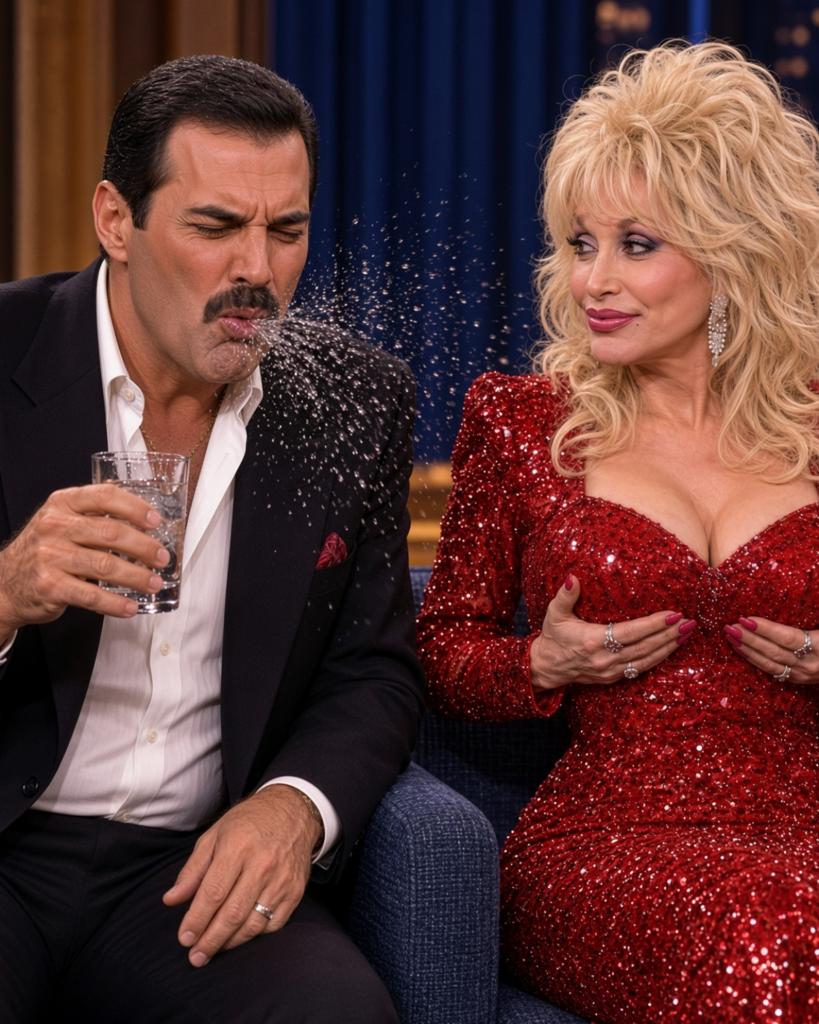
Imagine if you hired a Dolly Parton impersonator and that showed up.
You would be so annoyed.
“Good money.”
“Please.”
And then at the bottom there’s Kenny Rogers.
“Yeah, Kenny’s great.”
“And you think you’re going to get to heaven? No, I don’t want to.”
“You don’t want to?”
“No, hell is much better. Look at the interesting people that you’re going to meet down there.”
“You’re going to be there, too, you?”
“And here I come walking across the stage and I got the least applause. I didn’t win anything. So, I’ve always said it’s terrible when you lose a Dolly Parton look-alike.”
“Get your hands off me, you drag queen. Well, you need a razor.”
What would happen if Dolly Parton suddenly came face-to-face with someone who looked almost exactly like her?
The hair.
The makeup.
The sparkling clothes.
Even the unmistakable smile.
“Oh, do tell. Oh, hi Dolly.”
“Oh, hi Dolly. What have you got in there, your sisters? I mean, I want you to just take off my hair and I want you to stop impersonating my body. We’ll be right back with more.”
“Some people, you’ll be right back with less.”
For a moment, it could be almost impossible to tell who was the real Dolly.
And that’s what makes Dolly Parton look-alikes so fascinating.
Some performers have spent years studying every detail of Dolly’s legendary appearance, transforming themselves into one of the most recognizable women in entertainment.
“Like this is Dolly. Dolly’s amazing. It’s not only how she looks, she’s an amazing songwriter, she’s a singer, she’s an actress, she’s a businesswoman, she’s a humanitarian, she’s a philanthropist, she is incredibly generous, and she’s basically one of the world’s best humans.”
“‘Cause I hate them.”
“Why?”
“I just hate them. I hate talking to people I don’t—I don’t really know.”
“Are you very, very rich?”
“Um, I’m extremely rich.”
“Do you like being rich?”
“Of course.”
“What do you do with your money?”
“I spend it.”
If there was anyone in history, living or dead, that you could meet and speak with, who would that be, and what would you talk about?
“Living or dead? The only person I wish I had met was John Lennon. ‘Cause he’s—he’s the one that I—I did idolize, and I just thought he was just a very beautiful human being. And, um, it’s sad to say that I didn’t get to meet him. He’s the only one.”
And is there any historical figure that’s outside of music?
“Outside of music? Oh, Marie Antoinette.”
What would you talk with Marie Antoinette about?
“Jewels.”
“Thank you, friend.”
How would you describe yourself as an artist? Would you say that you’re a very organized person, a very spontaneous person, or how would you say?
“No, myself as an artist. I’m just a musical.”
Not many people know this, but Freddie Mercury as a kid was called Bucky.
“Oh, is that right?”
“Yeah.”
“That’s mean.”
“That was pretty mean.”
“And which one is you?”
“You can—brimstone and he thought I was Jezebel. They thought I was going to hell in a handbasket. You know, they thought I was running around with the boys, and I thought, ‘No, ain’t no way I’m sleeping with no boys, ’cause I don’t want nobody mess up my makeup.’ They’ll smear my lipstick.”
Most talk show hosts make the same fatal mistake.
They think they’re the ones running the conversation until Dolly Parton sits down across from them.
With just one ordinary question, she can completely flip the script with an answer that has the audience rolling with laughter while the interviewer is left speechless.
“And of course, I look cheaper then than I even do now. But anyway, and Judy didn’t look any better. So we checked in this hotel and they thought we were hookers. So we went out looking around in the city.”
“Do you exercise?”
“Not much. I’m lazy.”
“What kind of exercise would you do if you were going to exercise? Do you run? Do you play golf? Do you—uh—”
“I can’t run very well. But I have tendencies to black my eyes. But, uh, and, uh, I used to—oh, I wanted those walking, talking dolls so bad. But see, we always had our own babies, and we had one brother—”
Altogether, there were what? A dozen?
“There’s twelve kids born in—in our family. And six girls and six boys. And we had a little brother, Randy, that was born around Christmas, and Mama—”
“Or in a hospital?”
“Well, six of us were born at home and six were born in a hospital. This little boy—this Randy—was born in the hospital. Mama had problems. So we were all crying ’cause Mama wasn’t home for Christmas, and Daddy hitched a ride, took us all to Knoxville to see Mama. And then our other cousins had money to buy dolls. And my cousin had a walking, talking doll. And I wanted it so bad, and—and Daddy felt bad ’cause—’cause we couldn’t have toys. He said, ‘Oh, come in here. We got something a lot better than that. We got a real doll that cries and laughs and pees for real.'”
What she—Dolly never tries to be funny.
She’s just simply being herself.
Blunt, unfiltered, and razor-sharp.
That’s exactly why almost no one can keep up with her comedic timing.
“We were having our—our meal and this old man came over to our table. So that old man had come over and kind of scammed us. And so I said, ‘That wasn’t my—not my grandpa, but I paid—’ it, of course. So when we left, I walked down the street and he was standing there at the light. You know, ‘to have paid your—your bill.’ You know, I said, ‘But, uh—but then you tell me you’re my grandpa.’ And he took his walking stick—”
“What—what—what—what—what happened?”
“What do you mean, what happened? These two big lumps came up and they never did go down. Got you. Audio glamour.”
“Well, we were always bunched up at the top.”
“Well, I’ve always had biggins, but, uh—but I’ve had a little help lately.”
“You have?”
“Like—yeah, well, I was putting—my husband said, ‘Let me see your boobs.’ And had to put my skirt up. I thought I better do it. I don’t know if I could or not, but Arnold taught me how to do that. Uh, when we was doing, he let me see now. I—I—I don’t know if I can get them going. They clam up on me.”
“Lasted this long. Well, that’s why you stayed together for this long.”
“Now, I think we kind of underneath it all, we kind of like each other, and we like the music we make. That’s basically it. I mean, I mean, if we—uh—if we didn’t like the music that we’ve been making, we’d—we’d—we’d, you know, we’d say goodbye to each other, ’cause I mean, no, there’s nothing else left.”
“If it is a woman who did things with Mike like that, they’d ban her. Say this is sexist. And you think, ‘God, he’s sexy.'”
“Freddie had died, uh, the day before I found out that my partner was HIV positive. So the—the coincidence of that was horrible. Uh, and then on the actual day—the—the day itself, um—”
“He had such an incredible mind and was one of the funniest people I’d ever met.”
“Brian could play guitar as well.”
“He’s the governor, you know. He’s the best pop—pop-type-oriented guitar player there is, really.”
“Do you get intimidated by the size of that crowd?”
“No, the bigger the better. In everything.”
They’re recreating an image Dolly herself helped turn into a cultural icon.
“Is that a regret?”
“No, I never regretted it. I mean, it was a choice. So, you make your choices, you make your sacrifices, and I never look back.”
Dolly isn’t just a singer.
She is such a complete icon that people can copy her.
The hair.
The voice.
The shape.
The smile.
Even the way she talks.
“That’s not—that’s a man.”
She didn’t just accept being imitated.
She enjoyed it.
That’s why videos about look-alikes surprising Dolly Parton are more interesting than they first appear.
It isn’t always the look-alike shocking Dolly.
Sometimes Dolly is the one—superstar commanding the stage in front of 80,000 fans at Live Aid was a completely different person.
Extremely funny.
Genuine.
And someone who quietly lifted up other artists little by little.
“What about the—the actual work in the studio when you four come together and everybody wants to—to bring his side of songs?”
“Yeah, that happens all the time, yeah.”
“It sounds like having also—”
“It’s like a cockfight, isn’t it?”
“Yeah.”
“Yeah, well, we’ve—we’ve four fighting.”
“Oh, it’s getting nice, this.”
“What?”
“When that happens, it’s magical. It’s crazy. It gives you a whole new belief in life and the human race and—”
“I don’t think I’d ever met anybody like Freddie, um, who was larger than life, so funny, so gifted, so talented in what he wanted to do. I mean, his videos, his—you know, used ballet dancing, and he—he had such an incredible mind and was one of the funniest people I’d ever met and was so wonderful to spend time with. Hanging out with him was pleasure. There was no attitude, it was just a laugh.”
“I don’t know if they want us to go. Do you want us to go?”
“I have Freddie—the engine will be running in half an hour.”
“Half an hour?”
“Half a minute.”
“Half a minute.”
“I’ve been a Dolly fan for decades, and this is like a fantasy for me.”
“Ladies and gentlemen, Dolly Parton.”
“Well, howdy, Ruth. Takes a lot of money to look that cheap, and I should know. It can be exhausting being so nice all the time. I’m so nice I agreed to do this video.”
Dolly herself has never taken the whole look-alike phenomenon too seriously.
In fact, she once joked about losing a Dolly Parton look-alike contest.
So today, we’re taking a closer look at the people who tried to become Dolly Parton and the surprising reactions that made these moments unforgettable.
Can you tell the real Dolly apart from the impersonator?
Comment one.
“But I wish them the best, and I really appreciate them doing Kenny and Dolly so well for so long.”
“Lots of people dress up as you, don’t they?”
“Oh, yeah, all the time. Boys and girls.”
“Yeah.”
“Yeah, and I bet you get weird looking at—”
“No, I think it’s fun. I think it’s a great compliment. Because if I hadn’t have been a girl, I’d have been a drag queen. I would.”
“A really good one.”
“Once I dressed as a—as a Dolly, over-exaggerated Dolly, in LA. I was out there working, and there’s a gay bar down on Santa Monica close to my house, and they had a Dolly Parton look-alike contest. So me and a bunch of friends decided we’d go down there. It’d be fun, ’cause we were all dressed up, and me—uh—being Dolly. So, they had—so, they had these big drag queens. I mean, they would look great, too. They were prettier than I could ever dream of being. But anyway, when they walked across the stage, if they applauded, you—you kind of got—you won the contest by the amount of applause, I guess. You got free drinks or something. So, all these beautiful guys were walking across, these Dollys. They’re all Dolly Partons like this tall. And here I come walking across the stage, and I got the least applause of anybody. So, I’ve always said it’s terrible when you lose a Dolly Parton look-alike.”
A great impersonator has to capture the entire character.
The voice.
The expressions.
The movements.
The humor.
And that larger-than-life personality.
That’s where the real challenge begins.
“Well, I’m just so happy because it means now that I can just keep working 9 to 5. What a way to make a living. So, we’re all so happy.”
“What about the trains? Should we tell them to shut up?”
“If I should stay, well, I would only be—”
“I didn’t get married and divorced by that time.”
“Shoot, David.”
In 1991, the music world suffered an irreplaceable loss.
But even when exhausted by the merciless disease of AIDS, Freddie still chose to give his final notes to prove one thing.
The show must go on.
“‘Cause I hate them.”
“Why?”
“I just hate them. I hate talking to people I don’t really know.”
“Are you very, very rich?”
“Oh, I’m extremely rich.”
“Do you like being rich?”
“Of course.”
“What do you do with your money?”
“I flaunt it.”
“What do you do with your money?”
“I spend it.”
If there was anyone in history, living or dead, that you could meet and speak with, who would that be, and what would you talk about?
“Yeah, and that, um—the only person I wish I had met was John Lennon. ‘Cause he’s—he’s the one that I—I did idolize, and I just thought he was just a very beautiful human being. And, um, I’m sad to say that I didn’t get to meet him. He’s the only one.”
And is there any historical figure that’s outside of music?
“Outside of music? Oh, Marie Antoinette.”
What would you talk with Marie Antoinette about?
“Clothes.”
“Thank you, Freddie.”
How would you describe yourself as an artist? Would you say that you are a very organized person, a very spontaneous person, or how would you say?
“No, my sp—”
“I don’t have a date. Is there a hairy-legged boy that I could go with? How about you?”
“Two girls are loving, drinking, and having a—party. Party. But two doors down, they’re not invited to the party. Over here, I am just crying my heart out, feeling sorry for myself. They’re having a party, just two doors down. So, I think I’ll dry these useless tears and get myself together. And I think I’ll mosey down the hall and have a look around. ‘Cause I can’t stand inside this lousy room and cry forever. I think I’d really rather join them—two doors down. I would go—”









