Cookie Johnson’s Marriage Was Much Nastier Than You Thought.
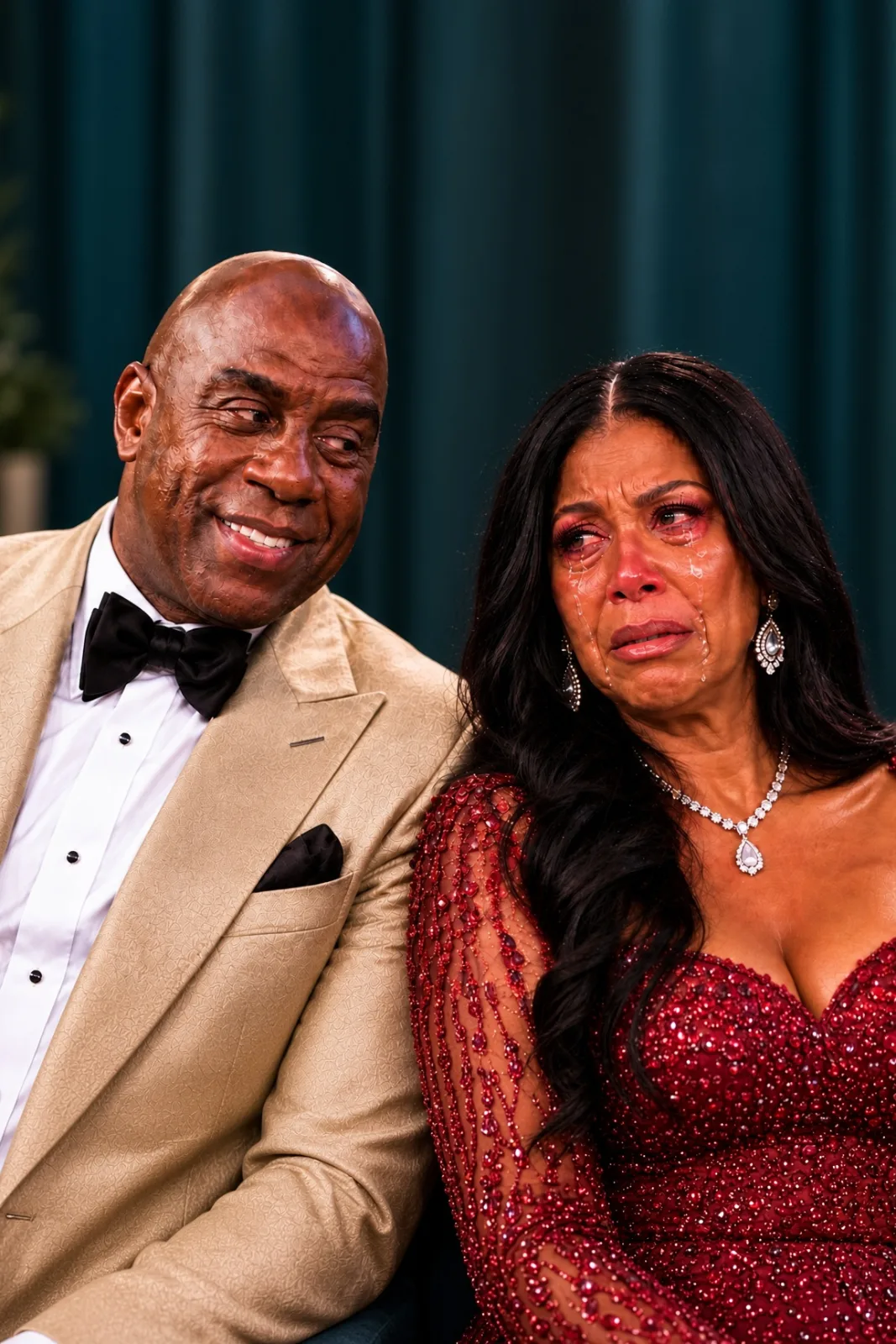
You know that photograph?
November 7th, 1991.
The press room at the Forum in Inglewood.
Cookie Johnson sitting beside the husband who had just announced he was HIV positive.
The perfect Christian wife forever frozen in loyalty.
America decided that image was the entire marriage.
It was not.
Magic Johnson had dated others before.
Cookie had spent 13 years proving she was worthy of the man who, by her own words in her memoir, had broken off their engagement three times.
She had buried his betrayals to survive her marriage.
And that serene wife everyone admired ended up holding the only thing the public begged for and could never touch.
Everything began at a campus party.
December 1978.
Michigan State University, right before Christmas break.
Earvin Kelly, 19 years old, a freshman majoring in textiles and clothing, was dancing in a crowd of students.
People called her Cookie.
A nickname she had given herself before first grade because she could not stand being called Cookie.
She was born in Huntsville, Alabama on January 20th, 1959.
Moved to Detroit with her family at age six and was now on the dance floor of a university where rumors about the star basketball player traveled faster than he did.
The man the rumors were about was Earvin Johnson, Jr.
Nicknamed Magic.
A freshman, 19 years old, already named by Midwest sports media before he had played his first official game for the Spartans.
That night he was in the room.
And according to Cookie’s own account years later in an interview with Mocha Man Style while promoting her memoir, he did not say a single word to her the entire evening.
He just sat and watched.
When the lights came on and the crowd dispersed, Cookie started to walk past where he was sitting.
She said hello.
According to her, Magic’s reply was, “Give me your phone number, by the way.”
Both of them were heading home for the holidays the next day, and that was all he did the entire party.
Watch, then ask for the number.
Cookie gave it.
Throughout that Christmas break, they talked on the phone nearly every day.
When students returned to campus in January 1979, they officially started dating.
On paper, this was the beginning of one of the most publicly celebrated love stories in NBA history.
In reality, it was the start of 13 years of waiting.
Keep that number in mind.
13 years.
Because the entire rest of this story is only variations on a single question.
Why did a woman betrayed from the third month stay another 12 years and 9 months?
The first crack came around March or April 1979.
Only 3 months after they officially began dating.
Cookie went to Magic’s dorm room.
According to her own words in her memoir Believing in Magic, published in 2016, she opened the door and saw another girl standing in the room wearing Magic’s slippers, wearing Magic’s bathrobe.
According to Cookie, that girl stood there, quote, “as if she paid the rent, as if this was her house, and she was his girlfriend.”
Those were the words of a 19-year-old freshman seeing herself replaced for the first time by a stranger in the very place she had just considered theirs.
It was not a confession, not a mature conversation.
It was a girl in a bathrobe standing there as if Cookie was the intruder.
Cookie left.
According to the memoir, Magic later justified it the way most 19-year-old men justify things.
According to Cookie’s own chronology, she forgave him, stayed, kept dating.
And that brings us the second incident, which later biographers called the Delta Ball affair.
In 1979, Magic was invited to the Delta Ball, an exclusive event of the Delta Sigma Theta Sorority.
He went, but he did not take Cookie.
According to Cookie in the memoir, Magic took another girl.
When Cookie confronted him, Magic’s reply is recorded verbatim in the book.
He was like he had to take her.
She was just a friend.
It turned out, according to Cookie’s own account, Magic was actually dating that girl.
And not long after, he broke up with Cookie to be with her.
Notice the sequence.
Betrayed in the third month, lied to about a friend at the Delta Ball, broken up with for that very friend, within less than 6 months of the first Christmas phone call.
And all of this happened in the same semester.
There is one more detail Cookie recorded from that period.
While still in school, she found a photograph in Magic’s car.
The photo showed Magic and another woman, this time dressed up, at a formal occasion.
Magic claimed this girl was also just a friend.
This detail comes from a Tea Served Cold report in 2016, citing the memoir.
Rank it with the two previous incidents.
The girl in the bathrobe, the girl at the Delta Ball, the girl in the photograph.
Three times in one school year.
And this was only the first season.
Summer 1979 arrived, and with it came the first geological shift in the relationship.
Magic Johnson, having just finished his sophomore year with the Spartans, left school early to enter the NBA draft.
On June 25th, 1979, the Los Angeles Lakers selected him with the number one overall pick.
He moved to Los Angeles, 20 years old, a $500,000 a year contract, the largest any NBA rookie had signed up to that point.
Cookie stayed at Michigan State to finish her bachelor’s degree.
2,300 miles separated them.
And from that moment on, their future marriage was no longer shaped by two individuals.
Los Angeles in 1979 was not a city.
It was a system.
And that system had a name.
Showtime.
Jerry Buss bought the Lakers that year, paying nearly $67 million for ownership of the team, and turned the Forum in Inglewood into an address where Hollywood stars, models, and Laker Girls appeared as often as the players.
Magic Johnson did not just join a basketball team, he joined an entertainment machine designed to turn young athletes into icons.
And in that machine, girls were not the exception.
Girls were part of the infrastructure.
According to Magic’s own chronicle in his autobiography My Life, published in 1992, he described his lifestyle during the Lakers decade with his own word as promiscuous.
He did not hide it.
In an interview with Sports Illustrated after announcing the HIV diagnosis, he said straight out that he had tried, quote, to accommodate all the women wherever he could.
Those were his own words.
That was also the context Cookie Johnson had to survive in.
2,300 miles from Lansing to Los Angeles.
Geographic distance became the buffer between their two realities.
Cookie was a senior.
Magic became Rookie of the Year, won the NBA championship in his first season in 1980, and was named Finals MVP when he was only 20.
While he raised the Larry O’Brien Trophy in Philadelphia, Cookie was sitting in a Michigan State dorm room.
This was no longer a relationship between two students.
This was a relationship between a superstar and an outsider.
And biographers record that Magic began handling Cookie the way he handled everything else in this period.
According to need.
According to his schedule.
According to his terms.
In the summer of 1980, during one of their breakups, Magic began dating a woman named Melissa Mitchell.
This was a short-term relationship.
According to Celebrity Net Worth, it took place during the time Magic and Cookie were apart.
But its result was not short-term.
On February 20th, 1981, Melissa Mitchell gave birth to a baby boy named Andre Johnson.
This was Magic’s first son.
Not with Cookie.
According to Parade magazine in 2024, Magic has three children, but only two with Cookie.
Andre was the first.
Notice the gap.
Cookie and Magic began dating in January 1979.
Two years later, Magic had a child with another woman.
During that time, they broke up.
Then got back together.
According to the formula they would repeat throughout the decade.
And Cookie, when she returned, accepted Andre.
According to Cookie in many later interviews, she treated Andre as her own.
No public complaints.
No ultimatums.
No demand that Magic explain why in the brief time they were apart, he had been quick enough to have a child with someone else.
This was Cookie’s first survival rule.
Silence about the irreversible betrayals.
According to the same pattern, there was an event biographers called a second Delta Ball.
Though exact timing details vary by source.
According to Tea Served Cold, citing Cookie’s memoir, there was an occasion when Magic took another girl to a formal event, the same girl he eventually left Cookie for.
And there was the photograph in the car.
Again, that girl.
Or another girl.
The memoir is not entirely clear.
But the pattern is clear.
Every year in the first decade, another woman entered the story.
And Cookie returned to Michigan to finish her bachelor’s degree in textiles and clothing.
In 1982, the Lakers won the NBA championship for the second time with Magic.
In 1983, they reached the finals and lost to the Philadelphia 76ers.
In 1984, the historic finals between the Lakers and Celtics began, which Larry Bird won.
In 1985, the Lakers took revenge and won the title.
Throughout those four seasons, Cookie and Magic repeatedly broke up and got back together.
According to Celebrity Net Worth, they maintained an on-again, off-again relationship for more than a decade.
Dating other people when they were not dating each other.
Read that sentence again.
Dating other people when they were not dating each other.
That was a system, not a romance.
And Cookie, in this period, began building her own survival infrastructure.
According to her own words in the memoir and interviews with Guideposts in 2016, she relied on her Christian faith to endure.
Her mother, Cora Kelly, had raised her in a strict Baptist tradition.
Cookie carried that faith to Michigan State.
And after graduating, to Los Angeles, when she finally moved there to work for a sportswear company.
Faith became the framework.
When Magic betrayed her, she prayed.
When he broke up, she prayed.
When he had a child with someone else, she prayed.
This was a coping mechanism.
But it was also a form of self-silencing.
Because Cookie’s faith taught her that going straight to God, as she herself said in an interview with Beliefnet, was better than trying to handle it herself.
Translated into ordinary language, it meant not confronting your future husband.
There is one more detail from this period worth noting.
According to Cookie in the memoir, she had thought about never marrying Magic.
There were years she wanted to leave.
There were years she dated other men, exactly as she told it.
There were years she believed this relationship would never lead anywhere.
But each time, Magic came back.
According to the pattern later biographers called strategic withdrawal.
When Cookie began to truly distance herself, Magic suddenly increased his attention.
When she dated others, he found a way back.
When she seemed ready to end it, he proposed.
This was a control pattern that relationship experts call by many names.
In this case, it was effective enough to keep Cookie in Magic’s orbit for more than a decade, and the asymmetry is recorded in Cookie’s own memoir.
She worshipped him, he did not.
In her own words.
And that led to the first official proposal in the late 1980s.
The first of three to come.
The first proposal came around the late 1980s.
Sources differ on the exact year, but according to Cookie in the Apple TV documentary series They Call Me Magic, released in 2022, she described it as a moment she had waited nearly a decade for.
Finally, Magic got down on one knee.
Cookie said yes.
For a few weeks, she was the happiest woman in Los Angeles.
Then the phone rang.
According to Cookie’s own chronicle in the Apple TV documentary, Magic called her.
His voice changed.
He said, according to her exact recounting, that he could not do it.
That he wanted to call off the engagement.
The reason he gave, in the way she put it in the memoir, was cold feet.
Stop at that sentence.
A man who had made a woman wait 10 years.
And the reason he gave for canceling the proposal he himself had made was cold feet.
According to Cookie in the documentary, her reaction was brief and decisive.
She told him, quote, “If you’re going to call off the wedding, we’re done.”
This was not a threat.
This was a statement.
According to Cookie herself, she had thought, “After everything we have been through, this is unacceptable.”
And she hung up.
For an unspecified period, they were separated.
But the pattern repeated.
Magic came back.
According to Essentially Sports citing the Apple TV series, Magic made a grand gesture to make amends.
He rented out an entire restaurant, the whole restaurant, for a dinner for just the two of them, and proposed again.
The second time, Cookie said yes the second time.
And the second time, Magic canceled again.
Exact details about the reason for the second cancellation were not made public by Cookie in the memoir with the same level of detail as the first.
But Essentially Sports confirms that, quote, “The marriage was called off a second time as well.”
Count them.
Two cancellations.
Two times Cookie said yes.
Two times Magic withdrew.
And she still stayed.
The third came in the summer of 1991.
By then, Magic was 32 years old, had won five NBA championships with the Lakers, had achieved every individual honor.
Cookie was 32 years old, had waited 12 years, had accepted Andre, had endured three documented betrayal incidents, and who knows how many undocumented ones.
The third proposal was accepted.
The wedding date was set.
September 14th, 1991.
A church in Lansing, Michigan, Magic’s hometown.
Then the pool party happened.
This is one of the darkest parts of the memoir.
According to Cookie’s own writing in Believing in Magic and detailed by Tea Served Cold, Magic maintained an annual tradition during the Lakers years, a pool party at his house.
The guest list, according to Cookie, consisted only of NBA players and strippers.
No wives, no girlfriends, only men and girls hired for entertainment.
Cookie knew about this party.
According to her, the wives of other Lakers players had called her to raise the alarm.
They wanted her to intervene to stop it.
And in the summer of 1991, only weeks before the scheduled wedding, Cookie did exactly that.
She called Magic.
She asked him to cancel that year’s party.
According to Cookie in the memoir, Magic’s reaction is recorded verbatim as follows.
“Get off the phone, Cookie. I’m having my party. Would you just shut up?”
Literal translation, “Hang up, Cookie. I’m having my party. Can you just be quiet?”
These were the words of a man who had proposed three times said to the woman he was about to marry in less than two months to be quiet so he could continue the party with strippers.
According to Cookie in the memoir, she issued an ultimatum.
“The party or me.”
Magic chose the party and hung up.
According to the book itself, she tried calling back.
He did not pick up.
Days passed.
Cookie did not know whether the party took place or not.
The memoir does not confirm, but the silence stretched.
And in those few days, the third cancellation happened.
Not an official declaration from Magic, just absence.
Eventually, according to Tea Served Cold, citing the memoir, Magic called back and apologized.
The details of the apology were not made public, but the result was, Cookie took him back.
The third time, the wedding returned to the calendar, and September 14th, 1991 still took place as planned.
Look at the numbers again.
12 years of dating, three cancellations, each time Cookie said yes.
Each time Magic withdrew.
Each time Cookie took him back.
This was not a hesitant man.
This was a control pattern.
And later biographers have pointed this out.
But there is one more detail from August 1991 that the public did not know until years later.
According to a Newsweek report in 1992, a woman in Michigan wrote a letter to Magic Johnson.
The date on the letter was August 29th, 1991.
Read that date again.
August 29th, 1991, 16 days before the wedding.
The woman, whom Newsweek only called Jane Doe, but who was later identified in court records as Waymer Moore, alleged that she had been infected with HIV.
And she wrote in the letter that, according to Newsweek, the only source from which she could have been infected was Magic Johnson.
Caution is needed here.
The primary source for the existence of this letter is the Newsweek report, and the letter was a document produced by Waymer Moore, not confirmed by Magic.
The lawsuit she later filed in 1992 was dismissed in December 1993 after the two sides settled privately, according to the Associated Press.
But the timeline of the letter is confirmed by Newsweek.
16 days, and the wedding still took place.
We do not know what Magic did with the letter.
We do not know if he read it.
We do not know if he showed it to Cookie.
What we know is that on September 14th, 1991, at St. Mary’s Church in Lansing, Michigan, the two exchanged vows.
Small, private, exactly as Magic wanted.
According to Celebrity Net Worth, the wedding was in Magic’s hometown in a small ceremony.
Cookie had waited 12 years and 9 months for this moment.
And in the groom’s jacket pocket, or in some mailbox he had opened, there was a letter from a woman saying she had been infected with HIV by him.
Cookie Johnson’s marriage began like that.
Not in happiness, in a letter whose existence she did not know.
45 days.
That was the time from September 14th, 1991, to the moment Magic Johnson sat in a doctor’s office in Los Angeles and heard three words that would define the rest of his marriage.
Context.
The Lakers were preparing for the new season.
According to the schedule, there was a preseason exhibition game in Salt Lake City, Utah.
Magic flew to the hotel.
According to Magic’s own account on Oprah’s Next Chapter in 2012, he was sitting in the hotel in Utah preparing for the game.
He was not sick.
He had no symptoms.
Just a routine blood test for life insurance.
Then the phone rang.
According to Magic in the same interview with Oprah, he flew back to Los Angeles immediately.
He went to the doctor’s office and he sat down.
According to his own words, quote, “The doctor started talking about the test. And the physical results were he had HIV.”
Stop at that sentence.
1991, HIV.
For anyone who heard those three words in 1991, it meant a death sentence.
AZT was the only FDA-approved drug.
Average life expectancy after diagnosis was measured in years, not decades.
According to Magic himself, the doctors told him he had 3 years to live.
According to the Christian Post citing the memoir, Magic left the clinic in a state of shock.
On the way home, he thought about Cookie because Cookie at that point was 6 weeks pregnant.
According to Magic on the Jennifer Hudson show in 2025, his first concern was not himself but Cookie.
Quote, he said, he was not as worried about himself as he was about Cookie.
She was pregnant with our son EJ and how it would affect her.
He went home.
According to both Magic and Cookie in their versions of the story, he called first.
According to Atlanta Black Star citing the memoir, Magic told his wife, “I’m coming home early because I have something to tell you. I have to talk to you, but I’m going to the doctor’s office.”
“What are you going to tell me when you get home, Cookie?”
According to Cookie’s own writing in the memoir, those whispered words, quote, sent a chill through my heart.
Then she said a sentence she herself did not understand why she said at that moment.
Quote, she asked, “What is it? Do you have AIDS?”
Stop.
This was the question of a woman who had lived 13 years inside the Showtime Lakers system.
This was the question of a wife of 45 days who knew that what happened in the dark eventually came to light.
According to the book, Magic did not answer on the phone.
He hung up and drove.
According to Cookie in the memoir, quote, “My husband walked toward me, took my hand, and slowly led me back to the family room. The two of us sat at the foot of the huge couch and I held my breath. Then he said it.”
According to both versions of the story, Cookie’s physical reaction was to collapse to her knees.
According to her on Good Morning America in 2016, quote, “It scared me to death. I collapsed. We both collapsed and we started crying.”
Then, according to Magic himself on Oprah’s Next Chapter, Cookie did something no one expected.
Quote from Magic, she hit me on the head and said, “We’re going to get through this together. Let’s get down on our knees and pray.”
And that is what we did.
After praying, Magic stood up and he walked into another room.
According to Posey, citing the memoir, Magic locked the door.
And he called all the women he had been intimate with.
Or, as the memoir writes more precisely, all the ones he could still reach.
Picture Cookie, 32 years old, 6 weeks pregnant, marriage less than 2 months old, having just learned her husband was HIV-positive, sitting in the outer room, hearing her husband’s voice through the door speaking to one person after another that he had HIV, that they needed to get tested.
She did not know how many.
She did not know the names.
According to the memoir, Magic did not tell her.
She just sat and listened.
According to ABC News in 2016, Cookie described this as, quote, “a hard day.”
This is how a Midwestern Christian woman described the evening her husband called former lovers to inform them of his HIV diagnosis.
Hard.
Then came 12 days.
According to Cookie herself in the memoir and cited by Atlanta Black Star, Cookie had to wait 12 days for the results of her own test and the fetus’s.
She described that period, quote, “as my personal hell of silence and darkness, numbness.”
Continuing, “Every morning I woke up in panic fearing that I too might be HIV-positive and die. Or worse, that my child would be sick and not make it. The tension flowed through my veins like a poison.”
12 days later the results came.
She was negative.
The fetus was negative.
E.J., born on June 4th, 1992, was also negative.
According to Magic on the Jennifer Hudson show, quote, “I don’t know what would have happened if I had gotten the news that she was positive, too.”
But before those 12 days, a decision had to be made, public or hidden.
According to POZ, before the press conference on November 7th, 1991, Cookie had met AIDS activist Elizabeth Glaser.
Glaser, who had been infected with HIV through a blood transfusion during childbirth, persuaded Magic to become the public face of the disease.
Cookie, according to her own words in the memoir, initially opposed it.
She wanted to hide it.
She wanted to protect the family.
But eventually, she agreed.
And on November 7th, 1991, 45 days after the wedding, Magic Johnson stood before the cameras at the Great Western Forum in Inglewood.
Cookie stood beside him, 6 weeks pregnant, dressed in white, face serene.
That was the photograph, but the story was not over.
One year later, in 1992, Waymer Moore filed a lawsuit against Magic Johnson in federal court in Michigan.
She sought $2 million dollars.
According to the Associated Press, she alleged Magic had had unprotected sex with her in June 1990, knowing or should have known he was at risk of HIV.
Magic’s attorney, Howard Weitzman, admitted one encounter with Moore.
According to the Seattle Times, on December 10th, 1993, Judge Richard Enslen dismissed the case after the two sides settled privately.
No financial details were made public.
Quote from Weitzman, “The parties will go on with their lives.”
But Cookie could not.
She had won the man and lost the marriage in the same autumn.
After the press conference, Cookie Johnson disappeared from the public story, literally.
For nearly 25 years, she wrote no memoir, sat for no exclusive interviews about her husband’s diagnosis, appeared on no television programs retelling the story.
According to Guideposts magazine in 2016, she waited exactly 25 years from the anniversary of Magic’s HIV diagnosis to tell her story.
Notice that number.
25 years.
That was not coincidence.
That was strategy.
While the public was fed the image of the steadfast Christian wife, Cookie was building something else.
In 1995, she and Magic adopted a little girl named Elisa.
According to Nicki Swift, the public read this as a blessing, a symbol of family recovery.
Privately, it came in a period when Cookie had spent 3 years watching her husband be celebrated as a hero, while she carried the weight of everything he had done before and after the wedding.
And then EJ grew up.
According to Cookie herself on Red Table Talk in 2018 with Jada Pinkett Smith, she began to realize EJ was different from when the boy was only 3 years old.
Quote from her, “That was when he started wanting to wear princess clothes to school.”
She also said the boy wore his mother’s shoes, paid attention to his grandmother’s clothes, and picked flowers in the yard while playing baseball.
According to Cookie on the same show, there was a trip to Hawaii when EJ was about 15.
She sat behind the boy and his friend’s boyfriend on the beach.
When girls in swimsuits walked by, silent reaction.
When the boys walked by, quote, “They were like, whoa.”
Cookie knew, and she began talking privately with EJ.
According to her own words on Red Table Talk, her first reaction had a notable sentence.
She told EJ, “You can be happy in your room, but don’t let dad see.”
Read that sentence again.
A Christian mother told her son that he could be himself but had to hide it from his father.
Around 2006, when EJ was 15, they sat down to talk with Magic.
According to Cookie on Red Table Talk, Magic’s reaction is recorded in one sentence.
“Everything clicked in his head. He just let it all out.”
And in that torrent of words, there was a sentence Magic said that both Cookie and EJ later quoted.
“This is not what I wanted for my son.”
This was a man who had gone through an HIV diagnosis, had publicly survived a disease considered a death sentence, had become the global face of resilience.
And this was his first reaction when his son came out.
That night, according to Cookie herself on Red Table Talk, she pulled Magic aside.
Quote from her, “I told him, your reaction is not right.”
Notice this moment.
This was the first time in nearly three decades Cookie overrode Magic in a documented way.
Not in marital matters, in matters of the children.
And she won.
According to EJ on the same show, the next day Magic walked into the boy’s room.
Quote, “Dad said, we’re going to get through this. Dad just needs time.”
And they both cried.
EJ moved to New York to attend New York University not long after.
According to LGBTQ Nation in 2022, it was this distance that gave Magic time to change.
Two months later, when Magic visited, EJ recounted in an interview with Variety, “Dad hugged him so hard that quote, he almost broke my back.”
But Cookie’s story was not finished.
In 2001, the marriage nearly broke again.
According to HuffPost in 2016, Cookie revealed a secret 2-week separation.
No tabloid knew.
No media reported it.
The reason, according to Cookie herself, quote, “I wasn’t working at the time, so I was giving everything to being a mother. On his side, he was building the business. It was getting bigger, bigger, and his ego was getting bigger, too.”
The tipping point, according to HuffPost, came at a Hollywood party after Magic was added to the Hollywood Walk of Fame that same year.
Cookie approached her husband and asked him to dance.
Quote of Magic’s reaction, according to Cookie, he was like, “I don’t want to dance with you. I want to dance with those other people.”
Cookie left the party.
2 weeks later, they reconciled, and no one knew.
Then 2013, TMZ publicly outed EJ through a photo of him holding hands with his boyfriend.
And Cookie, instead of hiding, sat with Oprah.
According to News 1 in 2016, she said, quote, “This child is innocent. He has been like this since he was little. It can’t be wrong.”
And she ended with the sentence, quote, “God said, the greatest gift is love.”
But the official archive came in 2016.
On September 20th, 2016, Simon & Schuster published “Believing in Magic: My Story of Love, Overcoming Adversity, and Keeping the Faith.”
The memoir, Cookie’s version of her own story, in the order she wanted, with the details she wanted public, and the details she wanted to keep.
According to The Christian Post, the book revealed deeper details than any previous source about the marriage, about the three cancellations, about the pool party, about the 12 days waiting for test results.
But notice what the book does not include.
It does not name all the women Magic called that night.
It does not detail the Waymer Moore lawsuit.
It does not disclose the settlement amount.
It does not name the other lovers.
Every choice was Cookie’s.
In 2022, Apple TV Plus released the documentary series They Call Me Magic.
According to Soap Central, the series was made with the full cooperation of the family.
Cookie appeared.
She recounted the cancellations in a tone polished over 6 years since the memoir’s release.
Every word of hers, every moment, every pause, her version.
In an interview with US Weekly in 2025, Magic praised his wife.
Quote, “She is my best friend in addition to being my wife. Cookie is the caretaker.”
And the headlines ran that sentence as proof of the love story.
Notice who is writing the story.
Look at the photograph again.
November 7th, 1991.
The Forum in Inglewood.
Cookie Johnson sitting beside her husband, dressed in white, hand resting on the 6-week pregnant belly, face serene.
For 35 years, America read that serenity as loyalty.
The perfect Christian wife frozen in the moment of forgiveness.
But follow what that hand did later.
It wrote the memoir.
It decided which chapters appeared and which were left out.
It managed the Apple TV Plus documentary.
It decided the women Magic called that night would never have names.
It decided the Waymer Moore lawsuit would never be detailed.
It decided the pool party would be told with the focus on the apology, not the choice.
Cookie Johnson had learned one skill before learning anything else.
How to survive a man who had betrayed her for 13 years before the vows.
And how to bury that in a version the public was ready to believe.
Magic Johnson has HIV.
Cookie has the archive, and the archive, not the marriage, is the thing she never let anyone touch.









