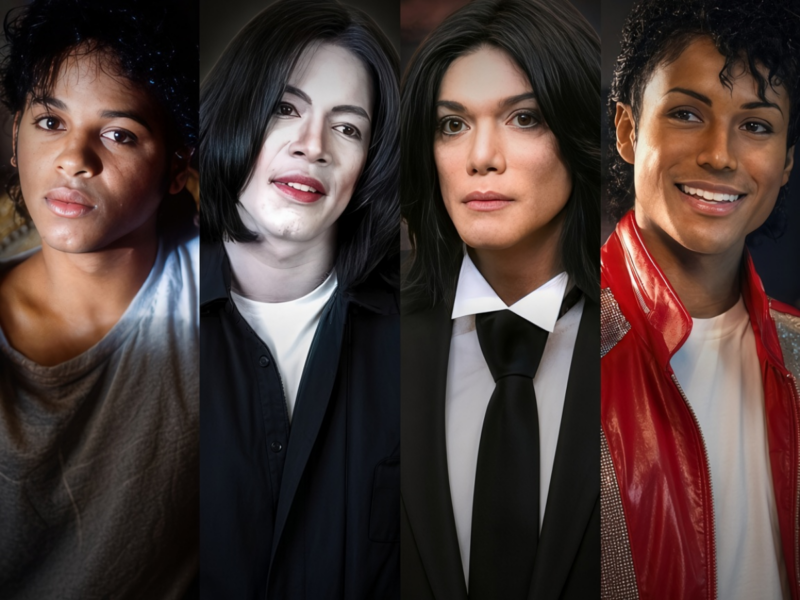
Comparing Every Michael Jackson Biopic Ever Made.

It’s a feat rarely attempted in Hollywood, trying to tell the story of Michael Jackson.
A life so extensively documented, yet a man still so deeply misunderstood.
His story was simply too expansive, and his image constantly evolving, both physically and culturally.
Because Michael Jackson was never just a celebrity.
He was a constantly shifting cultural figure.
Child star, musical genius, global phenomenon, tabloid obsession, accused criminal, tragic recluse, nostalgia icon, and now, once again, a pop culture event for an entirely new generation.
But what’s fascinating is that every time Michael Jackson’s life has been portrayed on screen, it has revealed just as much about the era in which it was made as it does about Michael Jackson himself.
From the family-approved nostalgia of The Jacksons: An American Dream in 1992, to the scandal-driven collapse depicted in Man in the Mirror during Michael Jackson’s criminal trial, to the sympathetic isolation of Searching for Neverland following his death, and finally, to the enormous estate-backed spectacle of 2026’s Michael, each project reflects a completely different version of who Michael Jackson was in the public imagination at that exact moment in history.
Some tried to protect his image.
Others attempted to profit from his downfall.
Some were shaped directly by the Jackson family and estate, while others were made entirely without their consent.
Some wanted to celebrate Michael Jackson.
Others wanted audiences to understand him.
And a couple simply wanted you to stare at the spectacle.
Because Michael Jackson’s story has become something larger than biography.
It has become mythology, constantly rewritten depending on the fears, fascinations, controversies, and cultural conversations of the time.
And nowhere is that more obvious than with the recent release and extraordinary success of Michael.
Audiences packed cinemas.
Younger generations discovered Michael Jackson’s music through social media, and streaming numbers surged to some of the highest levels of his entire career.
More than sixteen years after his death, Michael Jackson once again became one of the biggest cultural talking points in the world.
So, in this video, we’re going to explore every major Michael Jackson biopic ever made, not just how accurate they were, but who was controlling the narrative behind them, and what each one reveals about Michael Jackson’s constantly changing public image across more than three decades.
The first major attempt to dramatize the life story of superstar pop icon Michael Jackson came with the release of The Jacksons: An American Dream, a five-hour ABC mini-series broadcast across two nights in November 1992.
The series traced the Jackson family’s rise from Katherine and Joseph Jackson’s early relationship and the children’s upbringing in Gary, Indiana, through the explosive success of The Jackson 5, the Motown years, the move to Epic Records, Michael Jackson’s emergence as a global solo superstar, the Pepsi accident, Motown 25, and ultimately the family reuniting for the Victory Tour.
At the time, it was one of the most ambitious television portrayals of a music family ever attempted.
What was extraordinary was the level of involvement and cooperation from the Jackson family itself.
The mini-series was based primarily on Katherine Jackson’s autobiography, My Family, while Jermaine Jackson served as one of the project’s producers.
Crucially, legendary Motown executive Suzanne de Passe, who had played a genuine role in the Jackson 5’s rise during the Motown years, was heavily involved in the production, giving the series an added sense of authenticity and insider credibility.
For arguably the first time on such a large scale, the Jackson family had the opportunity to tell their own story in their own words, with access to the music, imagery, performances, and emotional beats that outsiders simply could not authentically recreate, rather than relying entirely on tabloid mythology or media speculation.
The series presented a version of the Jackson story shaped by the people who had actually lived it.
Although Michael Jackson himself was not formally credited as a producer or writer on the project, he was still involved behind the scenes and reportedly approved certain aspects of the production, including casting decisions and key scenes depicting his life.
Michael is said to have personally approved Angela Bassett’s casting as Katherine Jackson, while also supporting elements of the portrayal of his younger self.
That involvement matters because Michael Jackson had become so distant from the public that almost every public image of him was increasingly filtered through sensationalism, parody, or speculation.
Michael Jackson’s commitment to maintaining an air of mystique, coupled with his reluctance to publicly explain himself, allowed his story to be increasingly manipulated through sensationalism and speculation by a tabloid press often driven by its own dubious intentions.
An American Dream offered something very different, a rare attempt to contextualize Michael Jackson as a human being living within the world of extreme fame that had shaped much of his existence.
By 1992, the Jackson family occupied a strange and increasingly fractured place in popular culture.
Michael Jackson was still technically the biggest entertainer in the world following the recent release of Dangerous and his embarking on its accompanying world tour, while sister Janet had in her own right also become one of the highest-paid and most successful female artists on the planet.
Yet despite their extraordinary success, public perception of the family had shifted dramatically from the warmth and relatability associated with the Jackson 5 years.
For over a decade, Michael Jackson had rarely given interviews, and his increasingly changing physical appearance and growing isolation had turned him into an object of endless tabloid fascination and speculation.
Stories surrounding cosmetic surgery, skin color changes, eccentric behavior, and emotional instability increasingly dominated coverage of Michael, often overshadowing his chart-topping musical feats.
At the same time, the Jackson family image was becoming increasingly associated with dysfunction and division.
La Toya Jackson had publicly broken away from the family, posed for Playboy, and was making allegations of physical and sexual abuse against her father, reigniting public scrutiny surrounding the family’s moral standing.
Ironically, An American Dream producer Jermaine Jackson had himself contributed to the family’s deteriorating image the previous year by publicly criticizing Michael on the supposedly leaked diss track “Word to the Badd.”
In the song, Jermaine accused his brother of turning his back on reality, his family, and even his race, further exposing the growing tensions and fractures within the Jackson family itself.
By 1992, the Jacksons were no longer universally viewed as the aspirational musical family America had embraced during the 1970s.
Increasingly, they were perceived as fractured, controlling, emotionally damaged, out of touch, and consumed by fame.
In that context, The Jacksons: An American Dream feels less like simple entertainment and more like a carefully timed attempt to reclaim and humanize the Jackson family story.
The mini-series deliberately returns audiences to Gary, Indiana, to the cramped house, the three-tiered bunk beds, the rehearsals, the poverty, the family struggle, and the innocence of the children before global fame transformed them forever.
It reframes the Jacksons not as untouchable superstars, but as a hardworking Black American family whose extraordinary success came through discipline, sacrifice, talent, and perseverance.
Even the title itself, An American Dream, feels deliberate, positioning the family as relatable symbols of ambition and survival, rather than the bizarre tabloid caricatures they were increasingly becoming in the public imagination.
The Jacksons: An American Dream turned out to be not just a major television event, but a genuine ratings phenomenon.
Across its two-night broadcast, the mini-series became one of the most successful music biography dramas of the decade, with its second half watched by over 38 million viewers and ranking as the highest-rated program of its week.
The awards response was strong, too.
The series received four Emmy nominations, with Michael Peters winning the Emmy for outstanding individual achievement in choreography.
An American Dream capitalized during the beginning of a wider nostalgia wave surrounding the earlier Jacksons era.
Mariah Carey had just taken “I’ll Be There” back to number one earlier in the year, while hip-hop and R&B artists increasingly sampled Jackson 5 records throughout the early 1990s.
Jackson’s projects like 1989’s 2300 Jackson Street had already attempted to reconnect the family to that legacy commercially, but An American Dream succeeded where other projects struggled because it rebuilt emotional attachment through storytelling.
However, critically, the response was more mixed.
The performances were the main thing reviewers praised, especially Angela Bassett as Katherine Jackson and Lawrence Hilton-Jacobs as Joseph Jackson.
Bassett in particular seemed to give the series emotional weight, helping Katherine become the moral center of the story rather than just a background figure.
Criticism for the mini-series was not that it was poorly made.
Rather, it was that it was carefully controlled.
Variety described it as somewhat bland, especially in the first part, but still called it a commendable effort at approximating the truth.
Entertainment Weekly was more critical, giving it a C+ and arguing that the series bent the Jackson story into the shape of a celebratory TV biopic.
To its credit, the production did attempt to explore some of the darker aspects of the Jackson family story, particularly the long-reported accounts of abuse at the hands of patriarch Joseph Jackson.
It explored the tension, pressure, and emotional pain within the family, but always within the relatively safe boundaries of a network television framework.
The series confronted Joe’s cruelty, Michael’s loneliness, and the emotional cost of fame, yet it stopped short of fully interrogating the family’s deeper dysfunctions or the more uncomfortable contradictions surrounding them.
Perhaps the clearest example of this comes in the mini-series ending.
The story concludes with the Victory Tour presented as an emotional family reunion in triumphant celebration of the Jackson legacy, with little suggestion of the explosive tensions, internal power struggles, and lasting resentment the tour ultimately created between Michael and the rest of the family.
By ending at the self-constructed emotional high point, the series avoids confronting the darker final years that had already begun to emerge publicly by 1992.
The controversies, the public feuding, Michael Jackson’s dramatically changing appearance, and his growing isolation and detachment from the family structure itself.
The result was a production that was emotional, polished, and often genuinely powerful, but also highly selective in what it chose to show.
It revealed the pain behind the success, though only within the limits of what the Jackson family themselves were prepared to present publicly.
That tension is part of what makes The Jacksons: An American Dream so fascinating today.
It exists simultaneously as both a revealing portrait of the family and a carefully managed act of image-making during this crucial period in their history.
Man in the Mirror: The Michael Jackson Story arrived in 2004 as the next major dramatized attempt to tell Michael Jackson’s life story on television.
Produced for VH1, directed by Allan Moyle, written by Claudia Salter, and starring Flex Alexander as Michael Jackson, the film aired on August 6th, 2004, just months before Jackson was due to stand trial on child molestation charges in early 2005.
It functioned almost like an unofficial continuation of The Jacksons: An American Dream.
Where An American Dream ended around the Victory Tour era, presenting the Jackson family at a carefully constructed emotional high point, Man in the Mirror picked up the story in the aftermath, focusing on the solo superstardom, isolation, plastic surgery, Neverland, marriages, children, allegations, and public downfall that the earlier mini-series had avoided.
But unlike An American Dream, this was not a family-approved production.
It had no meaningful involvement from Michael Jackson or the Jackson family.
And because it was unauthorized, it also lacked one of the most essential ingredients in any Michael Jackson story.
The music.
None of Jackson’s original songs were used in the film, which immediately made the project feel strangely hollow.
The timing of the film was also crucial.
Since the early 2000s, Michael Jackson had once again become one of the most talked-about figures on television, but largely for reasons outside his music.
Bizarre public antics, dramatic fallouts with his record label, dangerously erratic behavior, rumors of financial ruin, and his disheveled appearance further fueled speculation of an addiction to plastic surgery, led many to question what exactly happened to a figure who was once one of the richest, most successful, and most celebrated icons in popular music, only to fall so dramatically from grace as his personal struggles played out in the headlines in full view of the world.
The Martin Bashir documentary Living with Michael Jackson aired in 2003 and became a huge ratings event, drawing massive audiences in both the UK and the US, while also reigniting public scrutiny over Jackson’s relationship with children, his parenting, his appearance, and his life at Neverland.
Jackson’s rebuttal special, The Footage You Were Never Meant to See, also drew major interest, proving that Michael Jackson remained a huge television draw even when the coverage was sensational or damaging.
So, in that sense, Man in the Mirror feels less like a carefully considered biographical drama and more like an attempt to capitalize on the public fascination surrounding Jackson at one of the lowest and most vulnerable points of his life.
By August 2004, Jackson was not simply a famous entertainer with a controversial public image.
He was a man awaiting a criminal trial that, if it had ended in conviction, could have permanently defined the second and final chapter of his life.
The film tries to humanize him by portraying him as damaged, lonely, childlike, misunderstood, and shaped by trauma.
But the problem is that it often reduces Michael to a one-dimensional figure.
Naive, emotionally stunted, easily manipulated, and almost foolish in his inability to understand how the world sees him.
Rather than capturing the contradiction of Michael Jackson, the genius, the strategist, the businessman, the perfectionist, the showman, and the deeply wounded man, it leans heavily into the familiar tabloid version of him.
The plastic surgery, the oxygen chamber-style mythology, Neverland, Elizabeth Taylor, Lisa Marie Presley, the children, the masks, the allegations, and the sense of a superstar losing touch with reality.
That was also the core of much of the criticism.
Reviewers did not simply object to the fact that the film was critical of Jackson.
They objected to how thin, cheap, and exploitative it felt.
The Seattle Post-Intelligencer described the film as a tastelessly timed work trying to draw sympathy from Jackson’s situation, while PopMatters noted that VH1 aired it as part of a wider Michael Jackson programming package that also included An American Dream and Bashir’s documentary.
Flex Alexander’s performance also became one of the most criticized parts of the film.
The issue was not only that he looked nothing like Michael Jackson, but that the makeup, voice, movement, and overall characterization often pushed the portrayal close to caricature.
Instead of feeling like a credible depiction, it often felt like someone impersonating the tabloid idea of who Michael Jackson was.
Even sympathetic viewers often found it distracting because Michael’s face, voice, and physicality were so specific that a weak imitation immediately broke the illusion.
The film’s reception was overwhelmingly poor.
Rotten Tomatoes currently lists it with a very low audience response.
Also compared with the huge cultural footprint of An American Dream and the massive audiences for the Bashir era special, Man in the Mirror clearly failed to become a respected or defining Michael Jackson screen portrayal.
Perhaps the clearest indication of how disconnected Man in the Mirror was from the real Jackson family came in Michael Jackson’s own response to the film.
Shortly after the VH1 biopic aired, Michael Jackson released a strongly worded statement condemning the portrayal and accusing the media more broadly of continuously humiliating and misrepresenting both him and his family.
Because of the restrictive gag order surrounding his upcoming 2005 criminal trial, Jackson had to seek permission from Judge Rodney Melville before publicly commenting at all, which makes the statement even more notable.
Rather than addressing the legal case directly, Michael instead focused on what he saw as years of media distortion and sensationalism surrounding his image.
In the statement, Jackson argued that despite his family dedicating their lives to spreading unity and peace to the world through music, the public depiction of the Jacksons had become increasingly hostile and detached from reality.
He specifically criticized the biopic by saying, “Man in the Mirror in no way, shape, or form represents who we are as a family.”
He also condemned the broader media treatment he had endured throughout the previous two decades, referencing the endless tabloid caricatures and mocking labels attached to him, including “Wacko Jacko.”
What is interesting about Michael’s response is that it reveals exactly why the film failed to resonate in the same way An American Dream had.
An American Dream may have been selective and carefully controlled, but it still felt emotionally authentic because the family themselves were shaping the narrative.
Man in the Mirror, by contrast, often feels like an outsider attempting to reconstruct Michael Jackson purely through the lens of scandal-era media coverage, without Michael’s music, his creative input, or the emotional grounding provided by the family perspective.
Man in the Mirror became, in Michael’s eyes, yet another example of the entertainment industry profiting from a distorted public fascination with his downfall, rather than attempting to understand the complexities of his life and the real human being living in between the sensationalized headlines.
Searching for Neverland premiered in 2017 as the third major dramatized portrayal of Michael Jackson’s life.
But unlike both The Jacksons: An American Dream and Man in the Mirror, this film arrived in a completely different cultural climate.
Produced nearly eight years after Michael Jackson’s untimely death, the project emerged during a period in which public perception of Jackson had shifted dramatically once again.
Following his passing in 2009, Michael Jackson experienced one of the most extraordinary posthumous career resurgences in modern entertainment history.
His music returned to the top of charts worldwide.
Documentaries and tribute specials dominated television.
This Is It became a massive box office success, and a younger generation rediscovered him less as the controversial figure of the 2000s and more as a tragic, isolated genius consumed by fame.
In death, much of the hostility and ridicule that had defined the final years of his life softened into fascination, sympathy, and nostalgia.
In many ways, Searching for Neverland feels like a direct reaction against the tone of Man in the Mirror.
Where the 2004 VH1 biopic leaned heavily into tabloid spectacle, caricature, and public scandal, Searching for Neverland attempts to move inward.
Rather than focusing primarily on Michael Jackson as a bizarre media figure, the film tries to portray him as a vulnerable and deeply lonely human being struggling to navigate the collapse of his career, finances, privacy, and emotional stability in the years following the 2005 trial.
Ironically, this biopic once again picks up almost exactly where the last one left off.
It focuses specifically on the period after Jackson’s acquittal, when he largely retreated from public life and lived an increasingly transient and isolated existence away from his Neverland estate.
That setting is important because Michael Jackson’s final years became one of the most mythologized and speculated-about periods of his life.
After the trial, Michael virtually disappeared from the public eye for extended periods, moving between Bahrain, Ireland, Las Vegas, and rented mansions in Los Angeles, while rumors about his finances, addictions, health, children, and mental state continuously circulated through the media.
After his 2009 death, there suddenly was an enormous public fascination surrounding what Michael Jackson’s final years were actually like behind closed doors.
Searching for Neverland was clearly attempting to answer that question by presenting a more intimate portrait of Michael not as a performer, but as a father, employer, friend, and emotionally exhausted man trying to survive the aftermath of global humiliation.
The film was based on the book Remember the Time: Protecting Michael Jackson in His Final Days, written by Jackson’s former bodyguards, Bill Whitfield and Javon Beard.
That source material immediately gave the project a sense of authenticity that Man in the Mirror arguably lacked.
Rather than being constructed primarily around tabloid headlines and media speculation, the film was rooted in first-hand accounts from people who had physically lived alongside Jackson during his final years.
Even though the Jackson family did not officially approve or cooperate with the production, the involvement of individuals from Michael’s real inner circle gave the project a degree of credibility and emotional grounding.
Casting also played a major role in how the film was received.
Rather than hiring a conventional actor attempting a broad impersonation, the production cast Navi, a Michael Jackson impersonator who had actually known Michael personally and had even performed for him.
That decision gave the portrayal a noticeably different tone from Flex Alexander’s performance in Man in the Mirror.
While Navi obviously still could not fully replicate Michael Jackson, his understanding of Jackson’s voice, body language, mannerisms, and emotional fragility often made the performance feel more restrained and human.
The film consciously avoids turning Michael into a parody.
Instead, it portrays him as soft-spoken, anxious, childlike, emotionally dependent, and deeply fearful of betrayal and exposure.
That said, the film still received mixed reviews.
Critics generally acknowledged that Searching for Neverland was more sympathetic and less exploitative than previous portrayals, but many also argued that it lacked dramatic tension and often presented Michael through an overly sanitized lens.
Some reviewers felt the film bordered on hagiography, portraying Jackson almost entirely as a misunderstood victim, while avoiding deeper interrogation of the controversies and contradictions that surrounded him.
Others criticized the low-budget television aesthetic and the limitations of the performances, though many still considered it a far more respectful and emotionally believable portrayal than Man in the Mirror.
What makes Searching for Neverland fascinating culturally is that it reflects the wider rehabilitation of Michael Jackson’s image that took place in the years following his death.
By 2017, the dominant public conversation surrounding Michael was no longer centered entirely on scandal and ridicule, but increasingly on tragedy, exploitation, loneliness, and the psychological cost of lifelong fame.
The film fits squarely within that shift.
It attempts to humanize Michael Jackson, not by mythologizing his superstardom as An American Dream did, nor by sensationalizing his collapse as Man in the Mirror often did, but by presenting him as a vulnerable and emotionally damaged man searching for peace during the final chapter of his life.
In many ways, that is why the film exists at all.
It was produced during a period when audiences had become increasingly interested in understanding Michael Jackson privately rather than publicly.
The spectacle of Michael Jackson had already been endlessly documented.
What remained mysterious and commercially compelling was the man hiding behind the image constructed for him.
Michael, released in 2026, represents the most ambitious and commercially significant attempt yet to dramatize the life of Michael Jackson.
Unlike previous attempts, this time the pop icon story was finally given the scale needed to match the enormity of his life, transforming it for the first time into a truly cinematic experience.
Directed by Antoine Fuqua and produced by Graham King, the Academy Award-winning producer behind Bohemian Rhapsody, the film was developed with the full cooperation of the estate of Michael Jackson and with the approval and involvement of several Jackson family members.
As a result, the production was granted access to the immense emotional and cultural power of Michael Jackson’s full music catalog, with the film setting out to extensively use his original recordings while recreating many of his most iconic performances on a scale never before attempted in a Jackson biopic.
That alone immediately separated it from productions such as Man in the Mirror and Searching for Neverland, both of which struggled without the instant gravitas Michael’s music carries within the public imagination.
In many ways, Michael was conceived as the definitive cinematic statement on Michael Jackson’s life, the Jackson equivalent of blockbuster hits like Elvis, Rocketman, and Bohemian Rhapsody.
By the late 2010s and early 2020s, music biopics had become one of Hollywood’s most commercially reliable genres, capable of generating enormous box office success while simultaneously reigniting streaming numbers, catalog sales, and public fascination surrounding legacy artists.
The Michael Jackson estate clearly understood that no artist arguably possessed greater untapped cinematic potential than Michael Jackson.
His life already contained all the elements of a Hollywood epic.
Childhood stardom, family pressure, racial barrier-breaking, unprecedented fame, creative genius, loneliness, scandal, and tragedy.
But the timing of the project was also deeply significant.
The film was officially announced only months after the release of Leaving Neverland, the explosive HBO documentary that reignited allegations of child sexual abuse against Michael Jackson and dramatically shifted public conversation surrounding his legacy.
Prior to Leaving Neverland, much of the public scrutiny surrounding the allegations had softened in the years following Michael’s death.
Public memory had increasingly centered on his artistry, his music, and the tragedy of his life, rather than the controversies that had consumed his final years.
Leaving Neverland fundamentally disrupted that rehabilitation by forcing the allegations back into mainstream discussion in a way not seen since the 1990s and early 2000s.
In that context, Michael immediately became controversial long before cameras even rolled.
Critics questioned whether a fully estate-approved Michael Jackson biopic could ever truly be objective, arguing that the film risked becoming little more than a sanitized piece of legacy management designed to rehabilitate Jackson’s image in the wake of renewed scrutiny.
The estate and filmmakers strongly pushed back against that perception.
Early statements surrounding the production repeatedly emphasized that the film would not simply be a puff piece, but rather an honest portrayal of Michael Jackson’s life, contradictions, and struggles.
There were suggestions early in development that the film intended to address the allegations and the broader controversy surrounding Jackson directly as part of presenting the whole story.
However, those ambitions reportedly became heavily restricted by legal realities surrounding the estate and the allegations themselves.
As the production evolved, it became increasingly clear that the film would avoid fully dramatizing or deeply interrogating the accusations against Jackson in any substantive way.
One of the clearest signs of family support for the project was the casting of Jaafar Jackson, Jermaine Jackson’s son and Michael Jackson’s real-life nephew, in the lead role itself.
That decision became one of the film’s strongest selling points and perhaps its greatest source of emotional authenticity in the eyes of many viewers.
Unlike previous portrayals that relied on impersonation or prosthetics alone, Michael could market itself around the idea that someone biologically connected to Michael Jackson was now attempting to embody him on screen.
The physical similarities, vocal tone, movement, and family resemblance immediately became a major talking point online.
In a story so heavily shaped by disputes over ownership, exploitation, and public interpretation, Jaafar’s casting almost acted as a seal of legitimacy, a visual signal that the family themselves were standing behind this version of Michael’s story.
While several Jackson family members participated in or supported the production, others reportedly distanced themselves from it.
Randy and Janet Jackson were unsupportive and refused to have their likeness portrayed on screen, while Paris Jackson, Michael’s daughter, publicly expressed discomfort in previous years regarding how the estate managed aspects of Michael Jackson’s image and legacy.
While Paris never outright positioned herself against the film, there was a lingering sense surrounding her comments and public attitude that no Hollywood production, no matter how well-intentioned, could ever fully capture the reality of who Michael Jackson actually was as a father or as a human being.
This reinforced the larger tension sitting beneath the film itself.
Who actually controls the story of Michael Jackson?
The family?
The estate?
The media?
Or the audience themselves?
Structurally, the film ultimately resembles The Jacksons: An American Dream far more than the marketing initially suggested.
Although framed as an intimate portrait of Michael Jackson himself, much of the emotional core of the film revolves around family dynamics, particularly Michael’s struggle to separate himself creatively and psychologically from the Jackson family machine as he attempts to emerge as a solo artist.
The relationship with Joseph Jackson once again becomes central, with the film largely continuing the familiar portrayal of Joseph as the domineering patriarch whose abuse and pressure shaped Michael’s trauma and perfectionism.
Yet critics argued that, much like An American Dream, the film simplifies many of the deeper dysfunctions and contradictions within the family itself.
The broader emotional complexity of the Jackson family, sibling rivalries, enabling, financial dependency, emotional manipulation, resentment toward Michael’s fame, and the family’s increasingly fractured internal relationships, remain unexplored.
Instead, the narrative often falls back into a clearer hero versus patriarch dynamic that is easier for mainstream audiences to emotionally process.
A criticism that followed the film throughout its release is that Michael was ultimately designed more for fans than for the truth itself.
Critics argued that the film often presented a version of Michael Jackson that audiences wanted to believe in.
The tortured genius, misunderstood artist, and self-sacrificing family man, while smoothing over many of the darker contradictions and unresolved controversies surrounding his life.
And yet, despite those criticisms, the response from audiences was overwhelming.
While critical reviews were mixed to negative, many accusing the film of whitewashing or simplifying aspects of Michael Jackson’s life, fans embraced it passionately.
Audiences turned out globally in enormous numbers, not simply to watch a movie, but to participate in something larger, a shared cultural event centered around Michael Jackson’s music, image, and legacy.
The film became more than a biopic.
It became a moment in an era where media consumption is increasingly fragmented and isolated through streaming algorithms and short-form content.
Michael achieved something genuinely rare.
It brought multiple generations together into physical spaces around the world through a shared emotional connection to music and memory, while social media became flooded with recreations, dance trends, and renewed fascination surrounding Michael Jackson’s artistry.
Older audiences who had lived through Michael Jackson’s fame sat alongside younger viewers who had only discovered him recently through viral TikTok clips, YouTube compilations, and trending playlists.
For the estate of Michael Jackson, the result was almost impossible to ignore.
Whatever criticisms existed surrounding the film’s handling of controversy, the project succeeded in exactly what it set out to do, reigniting Michael Jackson as a living cultural force for a new generation.
In the week following the film’s release, Michael Jackson experienced some of the highest streaming figures of his career.
And in doing so, the estate achieved yet another groundbreaking feat for their artist, simultaneously holding the world’s number one movie and the world’s number one streaming song at the same time.
It became obvious the movie was going to achieve upwards of $1 billion at the box office, thus igniting immediate plans for a sequel.
More than sixteen years after his death, Michael demonstrated that few artists in modern history still possess the ability to create a truly global cultural moment, one capable of uniting audiences through nostalgia, spectacle, music, and collective memory all at once.
That broader strategy is important.
Unlike earlier biopics, Michael was not simply a television drama attempting to retell a life story.
It was a modern multimedia legacy project designed for the streaming era, one built not only to tell Michael Jackson’s story, but to actively reinsert him into contemporary popular culture once again.









