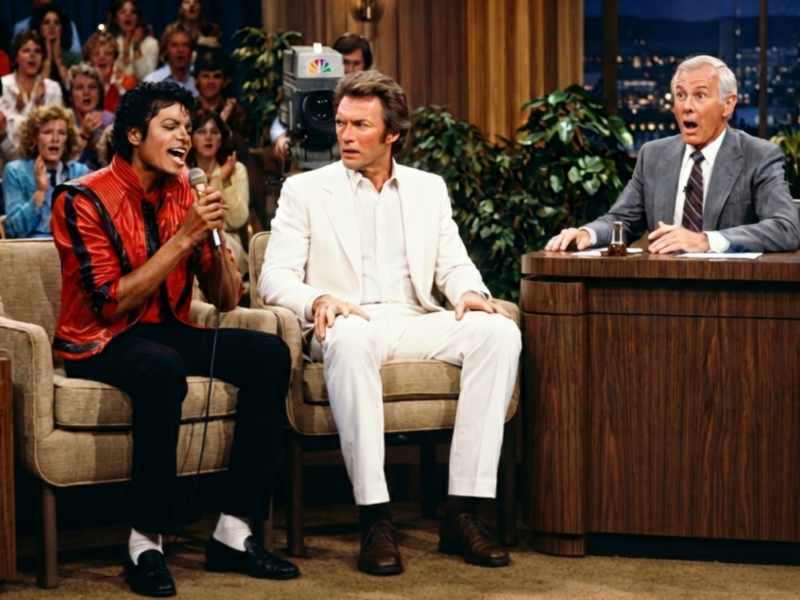
Clint Eastwood Called Michael Jackson’s Voice ‘Fake’—Then One Note Silenced the Entire Studio.
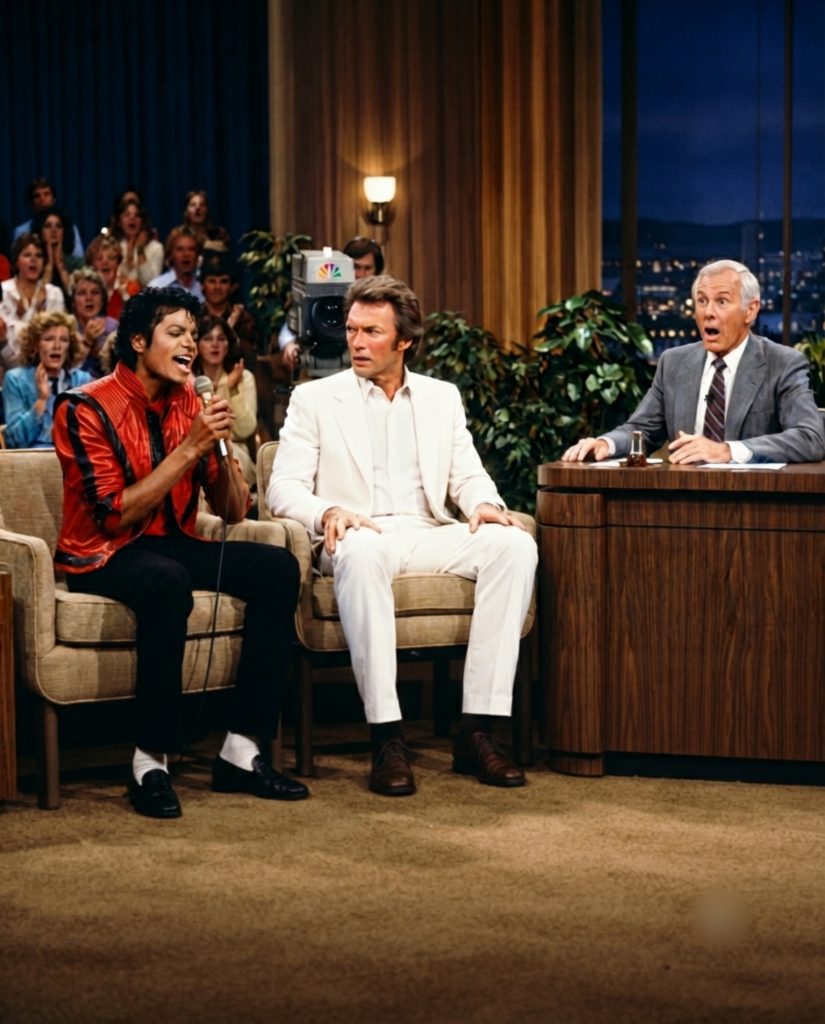
The red light above Camera 2 blinked on and twenty million Americans were watching when Johnny Carson leaned across his desk, smiled at Michael Jackson, and asked whether he’d sing something for the studio.
Completely live, no track, no safety net, just his voice and a microphone.
The audience applauded before Michael could even answer.
He opened his mouth to say yes, and Clint Eastwood laughed first.
A short, cold sound that made two of the musicians in the band turn their heads.
“Live,” Clint said, looking Michael over—the sequined jacket, the single glove, the carefully engineered curl of hair.
“Without the studio tricks, I’m honestly not sure how much of that voice is real.”
The applause collapsed into nervous laughter.
Johnny’s smile flickered and held.
Michael went very still, his hands folded in his lap, though anyone looking closely would have seen his fingers tighten against each other.
Clint leaned back in his chair.
“Anybody can sound like a miracle after an engineer’s fixed every note in the booth.”
A woman in the third row gasped audibly.
Johnny glanced toward the control room where his producer was already dragging one finger across his own throat, the universal signal for cut to commercial.
Get out of this now.
But Michael slowly rose from the guest chair instead, unclipped the single sequined glove from his right hand, and set it on the corner of Johnny’s desk.
The small sound it made against the polished wood seemed in the sudden quiet impossibly loud.
He looked at Clint directly.
“Where I grew up, Mr. Eastwood,” he said, his voice soft but perfectly clear, “we didn’t have studio tricks.”
“Some weeks we didn’t have much of anything at all.”
He reached for the handheld microphone on its stand at center stage.
The studio went completely silent.
Clint’s smile weakened by a fraction, though he covered it quickly.
He hadn’t expected the glove to come off.
He hadn’t expected any of what he just watched.
The sudden stillness, the deliberate placement of that small piece of costume on Johnny’s desk, like a man setting down a weapon before a duel.
He had walked into that segment with a specific, well-rehearsed opinion about manufactured stardom.
An opinion he’d carried for months, sharpened by magazine profiles and studio gossip and his own private conviction that an entire generation of young performers had been packaged more carefully than they’d been trained.
He had not expected to feel, this early into the evening, the first small crack of doubt about whether his opinion had actually been built on anything solid.
What nobody in that room knew was that Michael had spent the twenty minutes before the show alone in a stairwell behind the set, listening to a cassette tape on a small handheld player, a recording of his own family rehearsing in a cramped Gary, Indiana living room two decades earlier, his father counting time with a belt buckle against a chair rail.
Nobody knew that the song he was about to sing had never once been performed outside that family, or that the reason his hands had gone so still in his lap wasn’t fear of Clint Eastwood’s insult.
It was the sudden vivid nearness of a memory he usually kept carefully sealed away.
Before the final note faded that night, Johnny Carson would rise from behind his own desk without meaning to.
The band would sit with their instruments untouched in their laps, and Clint Eastwood would discover that the voice he just called fake was carrying something considerably heavier than a vocal performance.
To understand exactly what Michael was carrying into that microphone, it helps to go back nearly two decades to a two-bedroom house on Jackson Street in Gary, Indiana, a steel town that had already begun its long decline by the time Michael was old enough to notice the smoke from the mills hanging low over the neighborhood most mornings.
His father, Joseph, worked a crane at the mill and moonlighted in a local R&B outfit on weekends, close enough to real musical ambition to recognize it in his own sons, and hard enough, shaped by his own difficult upbringing, to drive that ambition with a discipline that bordered on cruelty.
Rehearsals in the Jackson living room ran for hours after school, repeated until every step landed exactly where Joseph wanted it.
Mistakes answered with a level of physical correction none of the boys ever spoke about publicly until decades later, when it had already cost all of them something they could never fully name.
Michael’s mother, Catherine, offered the counterweight to all of that.
A devout Jehovah’s Witness who filled the house with gospel records and hymns sung low around the kitchen table.
Her own voice untrained but full of a warmth that had nothing to do with performance and everything to do with survival.
It was Catherine, not any producer or vocal coach, who first taught Michael that a voice’s value had nothing to do with its polish.
She sang while she cooked, while she cleaned, while the household’s meager grocery budget stretched thinner than she ever let the children see.
And Michael grew up absorbing the lesson that music was the family’s actual safety net, the thing that turned hunger into something survivable for one more night.
Earlier that evening, Michael had arrived through the studio’s rear entrance in a car with tinted windows, and the usual small army had surrounded him within seconds of stepping out.
Someone adjusting the fit of his jacket, someone else checking the angle of a single sequined glove, a production assistant walking backward in front of him, reciting camera positions and blocking cues.
Everyone around him saw a phenomenon, a man who had rewritten what a pop star was allowed to be.
Michael, moving through the center of all that attention, mostly saw the outline of a shy, watchful boy who had learned to perform before he’d learned much of anything else.
He thought, as he often did before a big appearance, of the house on Jackson Street.
Five brothers sharing two bedrooms, his father working double shifts at the steel mill, and coming home just angry enough some nights that music became the family’s only reliable form of peace.
His mother sang around the house constantly, gospel mostly, her voice untrained but warm, carrying through thin walls into whichever room the children were trying to sleep in.
She was the one who’d first taught Michael that a voice didn’t need to be perfect to mean something.
It needed only to be true, offered without reservation in a room that needed it.
His father had taught him something else entirely, a brutal, exacting rehearsal discipline that had made the Jackson brothers into professionals before most of them had finished elementary school.
Michael carried both lessons in him simultaneously, and by the 1980s, standing at the absolute peak of a career that had made him one of the most recognized human beings on the planet, he had still never fully reconciled them.
Certain critics, and there were more of them than the fan magazines ever printed, had spent years suggesting that his voice, his whole persona, was an engineered product, a studio confection built by producers and vocal coaches and echo chambers rather than a real instrument that had come up singing in a church basement and a cramped living room in Gary.
It was, in its own way, the oldest insult in the business, dressed up in new language, aimed at a Black performer whose success had grown too large for some people to explain any other way except by insisting it wasn’t fully earned.
By the time Michael was eleven, the Jackson 5 had a record deal with the most important Black-owned label in the country.
And by thirteen, he was one of the most famous children in America.
A status that came with a particular corrosive side effect he would spend the rest of his life trying to metabolize.
Executives who’d built careers on packaging young talent looked at an astonishingly gifted Black child from a steel town and saw, more often than any of them would have admitted aloud, a product to be shaped rather than an artist to be nurtured.
Vocal coaches were brought in not to develop what was already extraordinary, but to smooth it into something more commercially predictable.
Choreographers drilled precision into routines until the drilling itself became indistinguishable, in the press coverage of the era, from the raw talent underneath it.
By the time Michael was an adult with complete creative control over his own records, a certain kind of critic had already decided permanently that whatever came out of his mouth owed more to the machine around him than to anything innate.
And no number of platinum records ever seemed to fully dislodge that assumption from the culture.
Michael understood, with a clarity that had cost him more than he ever discussed publicly, exactly how much of that assumption traced back to something older and uglier than simple skepticism about pop music.
He had watched interviewers ask his white contemporaries about their creative process with genuine curiosity while asking him again and again some version of the same underlying question.
How much of this is actually you?
It was a question white rock stars with considerably less technical range rarely faced.
He had learned to answer it with patience, with humor when he could manage it, and increasingly, as the years went on, with silence, letting the record speak in a language critics seemed unable to fully hear.
A knock sounded at his dressing room door.
“Five minutes.”
Michael put the cassette player back into his bag, checked his reflection once without really seeing it, and summoned the composed, otherworldly calm the cameras expected of him.
If you’re new to this channel, we tell the true bones of showbiz history, dressed up with the color nobody caught on camera that night.
The conversations that happened just off to the side.
If that’s your kind of story, go ahead and hit subscribe, because tonight’s is one of the best we’ve told.
When he walked out onto the set, the audience gave him the kind of ovation reserved for only the biggest handful of stars alive, and Johnny stood to greet him warmly.
Clint, already seated on the couch, gave a small, unreadable nod.
The interview began easily.
Johnny asked about the record-breaking album, about the moonwalk that had stopped the country cold a year earlier, about the sheer physical discipline behind routines that made other performers look like they were standing still.
Michael answered everything in that famously soft, careful voice, funny in small, surprising bursts, serious underneath it in a way that made Johnny lean in rather than move on.
Clint had arrived at the studio that afternoon carrying his own complicated relationship with the year’s cultural conversation.
His most recent picture, a hard-edged police thriller, had drawn the same accusation from critics for months, that the persona on screen was more calculated image than genuine artistry, a marketable type rather than a considered creative choice.
He had shrugged the criticism off in public every time it came up.
But privately, it had lodged somewhere he didn’t examine too closely, and if he was honest with himself, which he tried to be more often than his reputation suggested, some of what he’d said to Michael in the first few minutes of that segment had less to do with Michael Jackson specifically and more to do with a defensive instinct.
Clint hadn’t fully untangled from his own insecurities about being taken seriously as more than a marketable face.
Clint mostly listened, arms crossed, his expression giving away very little.
Then Johnny turned the conversation toward the future of the music business, toward the technology reshaping how records got made.
And before Michael could finish his answer, Clint cut in.
“Technology’s gotten very good at helping people sell an image,” he said, “when the raw talent underneath it maybe isn’t quite as bottomless as the marketing suggests.”
The temperature in the room dropped several degrees.
Johnny tried to smooth it over.
“Clint, I think Michael’s catalog speaks for itself at this point.”
“I’m sure the catalog’s real,” Clint said.
“I’m wondering whether the voice on it survives without a room full of engineers standing between him and the microphone.”
Michael kept smiling, the practiced, patient smile the cameras had watched him wear through a thousand indignities already, small and large, over the years.
Underneath it, the comment landed on an old bruise.
Executives who’d looked at a Black child prodigy and seen a commodity to be shaped and marketed rather than an artist to be developed.
Writers who’d spent a decade questioning whether any part of his success was truly his own rather than the product of his father’s discipline or Berry Gordy’s machine or later Quincy Jones’s studio wizardry.
Before we continue, tell us in the comments, have you ever been judged completely wrong by someone who hadn’t taken the time to actually understand you?
And if you believe talent eventually speaks for itself, go ahead and subscribe, because what happens next carries a lesson well past music.
Johnny, sensing the room needed somewhere safe to go, gestured toward the band.
“Maybe the simplest answer here is a song.”
The pianist lifted his hands toward the keys.
Clint raised one hand, stopping him before he played a note.
“No band,” Clint said.
A startled murmur moved through the audience.
Clint gestured toward the small cluster of backing vocalists positioned near the rear of the stage.
“No harmony either. No hidden support. Let’s actually hear it.”
“This isn’t an interrogation,” Johnny said, an edge entering his usually unshakable voice.
But Michael had already noticed something else entirely.
A young stagehand named Denise standing near Camera 3, one hand pressed flat against her own mouth, visibly fighting back tears.
He’d met her only briefly backstage an hour earlier, when she’d nearly dropped a stack of cue cards, bringing him a bottle of water, apologizing so profusely that he’d stopped and asked gently whether she was all right.
She wasn’t, she’d admitted. Not really.
Her younger brother had been shot two weeks earlier in a robbery outside a Los Angeles convenience store, still in intensive care, still unconscious.
And she’d taken this shift because the family needed the money more than she needed to be sitting in a hospital waiting room feeling helpless.
Michael had said very little in response, only that he was sorry, and that he hoped her brother came home soon.
Denise had grown up not far from where Michael himself had started, a working-class neighborhood in South Los Angeles where good union jobs had grown scarcer every year, and she’d taken the production assistant job at the network six months earlier, hoping it might eventually lead somewhere more stable than the string of temp positions that had carried her through her early twenties.
Her younger brother, Marcus, nineteen and studying to become an electrician, had been walking home from a night class when two men attempted to rob the convenience store on his corner.
He’d been the only customer inside.
The details Denise had were still thin, secondhand from a phone call with their mother that morning, fragments about a struggle, a single gunshot, an ambulance that had taken twenty minutes to arrive in a neighborhood where the response times never seemed to favor.
She had debated calling in sick all day and had ultimately decided against it.
Not out of any particular loyalty to the job, but because the hourly wage from one more shift meant one more day her mother wouldn’t have to choose between the hospital parking garage and groceries.
Now, looking out across the bright lights at her standing rigid and struggling behind the camera, something in Michael settled into a different kind of clarity.
Johnny stepped out from behind his desk.
“You don’t have to prove anything to anybody, Michael.”
Michael looked at Clint, then found Denise’s eyes across the studio floor.
“I’m not doing this to prove him wrong,” he said quietly.
He rose and crossed toward the center of the stage.
“I’m doing it because somebody in this building needs to hear it more than he needs to be corrected.”
Denise’s composure broke completely.
The band’s stage lights dimmed.
The backing singers stepped back from their microphones.
One by one, every layer of production protecting Michael’s voice fell away until a single warm spotlight held him alone at center stage, smaller somehow without the elaborate lighting rig behind him, closer to the shy boy from Gary than to the phenomenon the world had built around him.
He lowered the microphone slightly.
“My mother used to sing in a kitchen that didn’t always have enough in the cupboards,” he said.
“Not because things were easy, because they weren’t.”
“She taught me a song isn’t something you hide behind. Sometimes it’s the only thing holding a family together on a bad night.”
He looked toward Denise.
“This one’s for a young woman standing right over there whose brother is fighting for his life across town tonight, and who came to work anyway because somebody had to pay the bills.”
Johnny lowered his cue cards.
Clint went completely still.
Michael closed his eyes.
For several long seconds, nothing happened at all.
The specific dead air that makes control room producers reach frantically for the emergency music cue.
Johnny raised one hand, holding the room in place.
Then Michael inhaled, and the first note arrived so softly that four hundred people leaned forward at once to catch it.
We’re right at the hinge of this whole story, and it’s about to turn fast.
If you don’t want to miss what happens next, this is a good time to subscribe.
The note was unpolished in a way Michael Jackson’s recorded voice almost never was, unprotected, carrying an old, plain ache that had nothing to do with vocal technique and everything to do with a memory he’d kept mostly private for twenty years.
It reached the front row, moved through the silent studio, and settled over the audience like the opening line of something closer to a prayer than a performance.
Clint’s arms slowly uncrossed.
Whatever he had expected walking into that segment, it had not been this.
Michael moved into the first verse of a song that had no official title, a melody his mother had built out of almost nothing on a hard winter night in Gary, when there hadn’t been enough in the house and the children were too hungry to fall asleep easily.
He had carried that tune with him from a cramped Indiana living room through every stage the world had since given him, had woven fragments of it, disguised, into songs the whole planet already knew by heart, but had never once performed it whole, exactly as she’d first sung it, in public.
Tonight, it no longer belonged only to his own memory.
It belonged to Denise, and to whatever was happening in a hospital room across the city while her brother’s monitors beeped steadily on.
Clint shifted forward in his seat.
He had expected, if anything, a display of vocal power, the kind of technical showmanship that might prove a point and settle an argument.
Instead, Michael barely raised his volume at all, his eyes fixed somewhere past the cameras, and the plainness of it, the total absence of spectacle, unsettled Clint more than any high note could have.
By the second verse, Michael’s voice had opened slightly, still controlled, still careful, but carrying an unmistakable rawness underneath the famous smoothness.
And for one brief phrase, it cracked just slightly on a word about a mother staying up past midnight so nobody else in the house would have to.
He didn’t correct it.
He let the fracture stay exactly where it landed, and the small imperfection did something no flawless take ever could.
It made the studio feel like it was inside the memory with him rather than merely watching it performed.
In the fourth row, an older session musician who’d played on dozens of Motown records over the years found himself gripping the arm of his seat, recognizing in the phrasing something he hadn’t heard from Michael on any commercial release, an unguarded looseness in the timing that studio perfectionism usually sanded away.
He would tell colleagues for years afterward that the version of Michael Jackson he’d watched that night bore almost no resemblance to the meticulously engineered pop star the tabloids liked to argue about.
That what he’d actually witnessed was closer to a church solo than a chart performance.
The kind of singing that happens when a person stops trying to sound good and starts trying to tell the truth instead.
Near the back of the studio, a stagehand who’d worked the show for six years and considered himself thoroughly unmoved by celebrity after everything he’d witnessed in that building found his own eyes stinging without warning.
And he later admitted he hadn’t fully understood why until he thought about his own mother, three thousand miles away in Ohio, who had raised four children largely alone on a school cafeteria worker’s salary and had never once let any of them see how close to the edge that budget actually ran.
If a story like this is the kind you want more of, drop a like before we get to the part everybody still talks about.
It helps more people find these stories.
Denise pressed both hands to her face now, no longer hiding the tears at all.
Across town, in a dim hospital room lit mostly by monitor screens, a nurse had left a small television playing quietly on a rolling cart beside the bed where Denise’s brother lay unconscious, machines charting his slow, uncertain progress.
She had turned the volume up out of habit more than purpose, background noise for a long night shift, and she noticed, without quite understanding why, that the boy’s hand had shifted slightly against the sheet the moment Michael’s voice entered the room.
Back in the studio, Michael reached toward the chorus, his voice climbing, not with force, but with the accumulated weight of everything underneath it.
Three generations of a family finding a way to survive on very little, more than once, by turning hardship directly into sound.
Clint looked down at his own hands for a long moment.
He remembered, distantly, his own early years scraping by on odd jobs and rejected screen tests.
The particular sting of being dismissed by people who’d never bothered to look past the surface.
He had just done the same thing to the man standing under that spotlight, and the recognition of it moved through him slowly, uncomfortably, the way true things often do.
Johnny, watching from behind his desk with the particular stillness of a man who understood he was witnessing something no amount of pre-show planning could have produced, felt his own throat tighten in a way that surprised him after two decades of live television.
He had interviewed thousands of performers by that point in his career, had developed an almost clinical sense for which segments would simply coast on charm and which, on the rarer occasions, would produce something that mattered beyond the hour it aired in.
This one had crossed that line somewhere in the first verse, and every professional instinct in him said to let it run, whatever the control room was signaling about time.
Michael’s voice dropped low for the bridge, nearly a whisper, and the whole studio leaned toward him to catch it.
“My mother used to say,” he said quietly between phrases, “that a voice doesn’t have to be loud to be honest.”
“Sometimes the quiet ones carry the most truth.”
He looked toward Denise again.
“She’d want you to know your brother isn’t fighting alone tonight, even from all the way over here.”
A telephone rang faintly near the control booth.
Nobody answered it at first.
It rang again, and a stage manager finally picked it up, listening for only a few seconds before the color left his face.
He looked toward Denise, but she was watching Michael and hadn’t noticed.
He covered the receiver and murmured something urgent to Johnny’s producer, who went very still.
Michael was approaching the final chorus.
Clint noticed the exchange near the booth and, for the first time all evening, rose from his seat without seeking any attention for it, crossing quietly to hear what the stage manager had to say.
He listened, closed his eyes briefly, and when he turned back around, whatever hardness had been in his face at the start of the night had gone out of it completely.
Denise finally caught sight of the stage manager’s expression and took an uncertain step toward the phone.
Clint reached her first.
“Your brother’s stable,” he said quietly.
“The doctors think he’s going to make it. His vitals started improving about ten minutes ago, right around the time Michael started singing.”
Denise’s knees nearly buckled.
Michael, still holding the final note, opened his eyes and found her across the studio floor, and something passed between them that the cameras caught without needing a single word of explanation.
The last phrase came almost inaudibly, barely more than breath, no triumphant final note, no demand for applause, only the plain sound of someone singing a family through to the other side of a hard night.
Then it faded entirely, and the studio held its silence for a long moment afterward.
The particular hush of an audience that understood it had witnessed something it hadn’t fully expected to receive.
Johnny stood slowly behind his desk, eyes bright.
The band sat with their instruments untouched in their laps.
A cameraman pulled off his headset and wiped his face against his sleeve without any attempt to hide it.
Clint looked at Michael the way a person looks at something they badly misjudged and were only now finally seeing clearly.
Nobody applauded immediately.
When it finally came, it wasn’t the reflexive ovation of a room following cue.
It rose slowly from the front rows backward until the entire studio was on its feet.
Michael didn’t bow.
He turned and pointed toward Denise instead.
“That one belongs to her family,” he said.
“Not to me.”
Denise crossed the stage and Michael wrapped both arms around her while the applause kept building.
Not a superstar comforting an assistant so much as one person holding another up through the middle of an impossibly hard night.
Clint remained standing near the abandoned guest chair.
Johnny waited for the noise to settle, then looked directly at him.
“Clint, you asked whether that voice was real.”
The studio went quiet, waiting.
Clint could have deflected with a joke, could have blamed the pressure of live television, could have simply let the moment pass without comment.
Instead, he crossed the stage, stopped in front of Michael, and spoke plainly enough that every microphone caught it.
“I came in here tonight assuming the image was covering for something thin underneath it,” he said.
“I was wrong about that. In about the worst way a man can be wrong about somebody.”
He extended his hand.
“I owe you a real apology, not a television one.”
Michael studied the offered hand for a moment before taking it.
“A voice doesn’t prove itself by beating somebody,” he said.
“It proves itself by reaching somebody. Tonight, it reached the person who needed it most. That’s enough for me.”
“I’m sorry,” Clint said again. Quieter this time.
“Then let it change something,” Michael said.
“After tonight, once the cameras are off and nobody’s watching to see whether you mean it.”
Johnny, once the applause had settled enough to be heard over, looked between his two guests with something like wonder still visible on his face.
“In all my years hosting this program,” he said, “I don’t believe I’ve witnessed anything quite like what just happened on this stage.”
He turned to Denise, still wrapped in Michael’s arms a few feet away.
“How’s your brother doing tonight, young lady? I think the whole country would like to know.”
Denise, wiping her face, managed a small, unsteady laugh.
“The doctors think he’s going to pull through,” she said.
“I still can’t quite believe the timing of it all.”
“Sometimes,” Johnny said, “the timing isn’t something any of us are meant to fully explain. Some nights, television just gets out of its own way and lets something real happen.”
He looked back at Clint.
“I don’t think I’ve ever watched a guest change his mind on this stage as completely or as publicly as you just did.”
“I don’t imagine I have either,” Clint said quietly.
The studio audience, still on its feet, began a second wave of applause, and this time it carried a different quality than the first, less astonishment now than something closer to gratitude.
The specific sound of several hundred people thanking two men for showing them something honest rather than merely entertaining.
Backstage after the broadcast, Clint found Michael near the exit before either man left for the night.
Michael was quiet for a moment before responding, studying Clint’s face as if double-checking that the apology was as genuine as it sounded.
Satisfied, he offered a small, tired smile, the particular exhaustion of a performer who had just given more of himself in four minutes than most audiences ever realized a live broadcast could ask for.
“I mean it,” Clint said.
“What you did out there, singing straight through an insult instead of arguing with it, that’s a rarer kind of strength than I gave you credit for.”
“I’ve had a lot of practice,” Michael said.
“People have been underestimating what’s underneath the persona since I was about nine years old. You get used to letting the work answer instead of your mouth.”
“Still,” Clint said, “I made this about proving a point instead of actually watching who was in front of me.”
“You corrected course once you actually looked,” Michael said.
“That matters more than most people manage.”
They stood together for a moment in the quiet corridor, the last of the broadcast adrenaline finally draining out of the building.
“I’d like to understand more of what shaped that,” Clint said.
“Not for a camera, just for myself.”
“Anytime you want to actually talk,” Michael said, “you know where to find me.”
“Can I ask you something?” Clint said.
“That song. Where did it actually come from?”
Michael considered the question for a moment before answering.
“My mother,” he said.
“A cold winter in Gary when I was maybe six or seven. There wasn’t much in the cupboards that year. She used to gather all of us around her while she made whatever she could out of almost nothing, and she’d sing to keep us from noticing how little was actually in the pot. I’ve carried that melody every day since, longer than I’ve carried almost anything else. Tonight was the first time I ever let it all the way out in front of anyone outside my own family.”
“Why tonight?” Clint asked.
“Why not on a record with all the resources you’ve got access to now?”
“Some things don’t belong on a record,” Michael said.
“Some things are only true the first time, in the room where they’re actually needed. Tonight, that room had a young woman in it whose brother might not make it through the night. My mother’s song didn’t belong to me at that point. It belonged to her.”
Clint nodded slowly, turning that over.
“I think I understand something now I didn’t understand walking in here tonight,” he said.
“The difference between a performance built to impress somebody and one built to actually reach somebody. I’ve spent a career mostly doing the first kind without fully noticing there was a second kind at all.”
“Most people don’t notice,” Michael said, “until somebody makes them sit still long enough to feel the difference.”
Word of that broadcast spread through the entertainment press within days, most of the early coverage fixating on the surface drama, a feud, an insult, a spectacular comeback, without ever quite capturing the quieter story underneath it.
A young stagehand’s family, a song that had never been sung outside one house in Gary, Indiana, and a hardened critic who had, on live television, actually changed his mind in real time rather than doubling down the way public figures so rarely do.
A wire photographer had captured a single usable frame of the embrace between Michael and Denise, and that image ran in dozens of papers over the following week, almost always stripped of the actual context that had produced it, reduced in most captions to a vague line about an emotional moment on a late-night program.
It would take a longer magazine profile, published nearly a month later, to properly untangle what had actually happened that night, and by the time it ran, much of the initial press cycle had already moved on to other stories, the way entertainment news always does, leaving the fuller truth to travel mostly by word of mouth among people who’d actually been in that studio or had watched closely enough to understand what they were seeing.
A television critic who had, like Clint, spent considerable ink over the preceding year questioning whether Michael’s artistry was more manufactured than organic, watched a bootleg recording of the segment several times before writing a follow-up column under the headline, “I Was Wrong About Him.”
He didn’t retract every criticism he’d ever leveled, but he admitted in print that he had never once considered the possibility that the polish surrounding Michael’s public image might be a choice rather than a substitute for substance, a professional discipline layered protectively over something far more vulnerable underneath.
It was, for a critic of his stature, about as close to a full apology as the profession typically allowed.
The tape of the performance itself became something of a legend among serious collectors in the years before home video made such things easy to trade freely.
NBC never released the full segment commercially, and the network’s own archival copy sat largely unrequested for years, occasionally pulled for a retrospective special but never given the kind of prominent rebroadcast that might have cemented it more firmly in the wider public memory the way some other famous unscripted television moments eventually were.
Bootleg audio recordings, made by viewers taping the broadcast off their home televisions, circulated quietly through fan circles for over a decade, the specific hiss and pop of secondhand cassette copies becoming, in its own strange way, part of the recording’s mystique.
Michael, asked about the incident weeks later, gave a characteristically brief answer.
“People think I went out there to prove something to him,” he said.
“I didn’t. I went out there because somebody needed to hear it, and it turned out he needed to hear it too. Sometimes the same song does both jobs at once.”
Clint, asked separately, offered his own short reflection.
“Sometimes the honest thing isn’t defending your first impression,” he said.
“Sometimes it’s admitting in front of everybody that you got it wrong and meaning it enough to actually change how you look at the next person.”
He returned to that idea more than once in later years, notably during a long career retrospective interview where a journalist asked him to name a professional moment that had genuinely changed how he approached his own work.
He didn’t cite an award or a box office record.
He described, briefly and without much embellishment, a night on a talk show couch when he’d been certain about something and had been proven completely, publicly wrong, and said the experience had left him permanently more cautious about voicing a strong opinion on anyone’s talent before he’d actually taken the time to look closely at the person behind it.
“I’ve been in this business a long time,” he said.
“You learn a lot of lessons the easy way, through good advice or good luck. That one I learned the hard way, in front of twenty million people. I can’t say I recommend the method, but I can say it worked.”
Denise’s brother recovered fully over the following months, though the road there was longer and harder than the single dramatic turning point of that broadcast night suggested.
Two more surgeries, a lengthy stretch of physical therapy to regain full use of his left arm, and a recovery bill that, even with the hospital’s charity program covering a portion of it, left the family in debt for years afterward.
Denise never spoke publicly about whether Michael’s people had quietly helped with any of that.
She would only say, when colleagues pressed her gently for details years later, that her family had received more support than they’d expected from people who never wanted their names attached to it, and that she’d learned to stop asking too many questions about where certain generosity actually came from.
She left the production assistant job about eighteen months later to attend nursing school, a decision she credited, in later interviews given long after she’d become a respected ICU nurse in her own right, directly to that night, to watching up close what it meant to show up for a stranger with nothing to gain from it.
She said she’d spent years afterward chasing some version of the feeling she’d had standing behind that camera, the specific overwhelming relief of being seen and helped by someone who had every reason in the world not to bother.
Years later, working as a nurse herself, she would occasionally tell colleagues about the strange, impossible night her brother’s vitals had steadied while a legend sang across town for a stranger who’d once handed her a bottle of water and asked if she was all right.
She never fully explained the coincidence to anyone’s satisfaction, including her own.
She simply said that music had reached somewhere medicine hadn’t quite gotten to yet, and left it there.
Clint and Michael spoke privately several more times over the years that followed, though neither man ever gave a full public account of what those conversations covered.
A mutual acquaintance who worked in the industry for both of them said the two developed a genuine, low-key respect that outlasted the initial headlines by decades, the kind of relationship neither felt any particular need to publicize or explain.
Clint, in a handful of later interviews touching on the broadcast, always described the evening with a mixture of embarrassment and gratitude.
Embarrassment at how quickly he’d been willing to judge a performer sight unseen, gratitude that the correction had happened in front of an audience large enough to make the lesson stick for good.
Michael, for his part, rarely discussed the evening in detail either, though a longtime member of his creative team recalled him mentioning it once, unprompted, while explaining to a group of younger collaborators why he insisted on keeping a small, private list of songs he never intended to release commercially.
He said some music existed purely to be given away in the moment it was needed, not packaged, not sold, not analyzed by critics looking for evidence of authenticity, simply offered once to whoever needed it most and then allowed to return to memory where it had started.
A music historian writing decades later about pivotal moments in live television history singled out that broadcast as a rare case study in how quickly public opinion could pivot when an audience was given something to witness rather than merely something to consume.
The piece noted that ratings for Carson’s program spiked noticeably in the weeks following the broadcast, not because of any single follow-up segment, but because word of mouth about that one unscripted night had reached corners of the country the show’s usual advertising never touched.
More than four decades later, people who study the history of live television still point to that broadcast as one of the rare instances where an unscripted, unplanned moment produced something considerably more valuable than entertainment.
A hardened skeptic changing his mind in public in real time, and a performer proving that the deepest part of his gift had never needed an engineer’s help at all.
Catherine Jackson, told a simplified version of what had happened on the broadcast by one of Michael’s assistants the following week, reportedly said very little at first, only that she remembered that particular winter in Gary better than she remembered most of the good years that came after it, and that she was glad, after everything, the song had finally found somewhere useful to go.
She never watched the tape herself, as far as anyone in the family ever confirmed publicly, saying she preferred to keep that particular memory exactly as she’d lived it rather than watch it handed back to her secondhand through a television screen.









