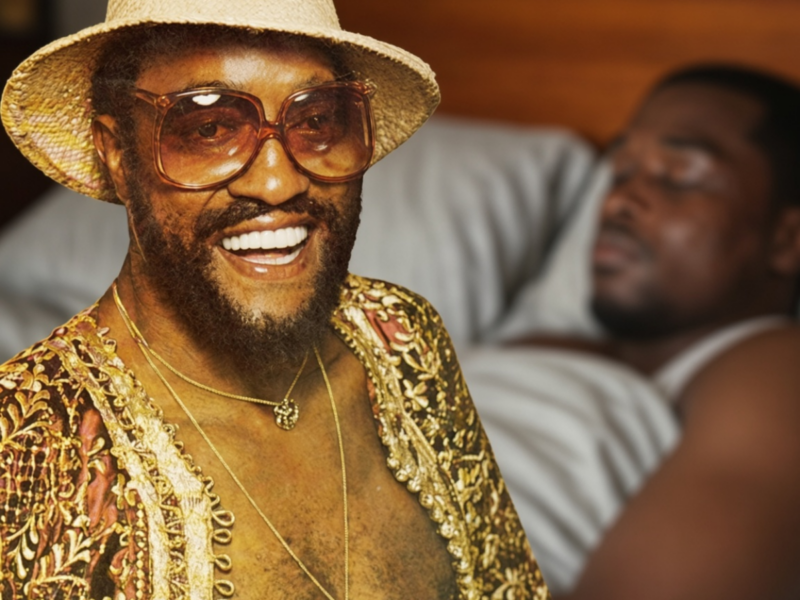
Billy Paul Names The 7 Gay Artists He Dated In Secret.
It’s about a guy cheating, and he meets this lady before he goes home to his wife at night.
Seven names, seven secrets, seven seismic revelations that shook the global music scene, and the one to expose them all is Billy Paul.
Marvin Gaye and Teddy Pendergrass—two titans whose soulful ballads melted hearts—were merely two pieces in a chain of affections Billy meticulously concealed throughout his life.
But that’s not all.
Beyond the dazzling stage lights, there were five other names, never dared to be spoken, never even conceived of.
And each name holds a deadly enigma.
Who was the first love?
Who was the final heartbreak?
Who was the one who forced Billy into decades of silence?
This isn’t just a love story.
This is a battle for survival, for fame, for hearts bound by fear and fierce passion.
Billy Paul doesn’t just tell stories; he deciphers an entire era.
Want to know who those seven names are?
You must watch until the very end.
It is said that Marvin Gaye, a legendary name in soul history, was not only Billy Paul’s companion during all-night performances but also someone with whom he shared the most intimate moments.
Marvin Gaye is not just the first name on the list of artists Billy was deeply connected with, but also a symbol of a friendship—or perhaps something more profound—kept hidden for many years.
Rumors circulated that during the vibrant days of Philadelphia soul, the two were closer than people imagined.
Insiders recounted that they could sit for hours in silence, listening to the music emanating from the piano, as if music was the only language that allowed them to truly be themselves.
There was no confirmation from Billy or Marvin about this, but the stories persist, lingering in the memories of those who witnessed them.
To understand why these rumors spark such curiosity, one must look at how Billy lived.
He was the kind of person who carried a deep melancholy in his eyes, always speaking in a low, gentle voice, as if whispering stories he didn’t want anyone to hear clearly.
People said that in an era where his skin color alone was a barrier, his personal relationships had to be guarded as vital secrets.
In a few little-known anecdotes, some people reportedly encountered him and Marvin in a small recording studio—dim lights and laughter intertwined with music, both seemingly oblivious to the outside world.
But all of it remained mere hearsay.
No one dared to confirm.
Billy Paul’s career was never just about singing.
It was a silent battle to protect his heart.
He never publicly disclosed these matters because he understood the harshness of the public eye.
At that time, the public not only demanded that an artist sing well but also live according to the molds they constructed.
Billy was someone who disliked being confined, but he chose silence—not because he was cowardly, but because he knew speaking out could cost him the most precious thing: the respect of his audience.
Marvin Gaye, during his nascent days of finding his footing, perhaps found a pillar of support in Billy.
People said Marvin always carried deep, unhealed emotional wounds, and Billy was one of the rare few who understood those wounds.
Some who worked at Philadelphia International Records recounted that when everyone had left the studio, Billy and Marvin often lingered, conversing at length about things no one else mentioned.
“We were just two souls trying to breathe in a world that barely gave us space,” someone reportedly heard Marvin whisper after a performance.
Perhaps that’s why the story between Billy and Marvin always carried an air of mystery.
It wasn’t strictly a love affair, nor was it merely a friendship.
It lay somewhere on the boundary between the two, where only those involved truly knew.
The truth has never been confirmed, but their silence only made everything heavier.
For someone like Billy, emotions were not easily shared.
He once said in a rare interview, “Music is where I hide my secrets.”
And perhaps that is all he left—secrets embedded in every lyric, every soul melody seemingly written with pain and unspoken memories.
The story of Marvin Gaye is just the tip of the iceberg in Billy Paul’s life.
It not only sparks curiosity but also touches upon a greater sorrow: the sorrow of individuals who couldn’t live authentically.
And looking back, we realize that their music wasn’t just love songs.
It was a sigh—things they couldn’t express in words.
Therefore, every time we listen to Billy’s voice, we don’t just hear music.
We hear a wounded soul still yearning for love and freedom.
Teddy Pendergrass, a name that commands respect from any soul music lover, always possessed an allure as if born to grace the stage.
People remember him for songs that felt like whispers from the heart—husky yet fiery, gentle yet profoundly impactful.
Billy Paul, on the other hand, was a storyteller through music.
His voice, smooth yet deeply rooted in life, didn’t require much technical embellishment but was enough to bring people to tears.
Thus, when these two souls met in the heart of Philadelphia, the capital of soul music at the time, people believed there had to be something deeper than mere performances—something unseen beneath the stage lights.
This is not an easy story to tell.
It lies within fragmented pieces that only those who lived through that era truly understand.
There were nights after performances when the hall was empty and the music echoed softly through the vacant seats.
Billy and Teddy would still linger.
They spoke little, often just in silence, sometimes with a glass of pale wine and a sigh.
Some musicians who played with them recounted that at times, the two would look at each other across a melody as if no words were needed, all their confidences conveyed through the music.
Rumors emerged from such small moments—fragments of memories from witnesses, stories never officially confirmed yet possessing incredible weight.
The music industry at that time was unforgiving.
If a Black artist stepped outside the mold the public wished to see, they could lose their entire career in an instant.
Billy and Teddy understood this better than anyone.
So if there was anything deeper between them than an artistic friendship, it was a secret buried deep.
Someone in the Philadelphia production scene once recounted that in 1975 and 1976, when Teddy began to separate from Harold Melvin and the Blue Notes to build his solo career, Billy was one of those who consistently encouraged him, shared experiences, and even on late nights, the two would go to a small studio to listen to new demos.
A sound engineer who worked at Sigma Sound Studio recalled seeing them both leaning against a wall, not saying a word, just listening to the music as if finding empathy in those very silences.
But all that people heard remained at the level of “rumors say,” with no concrete evidence, no acknowledgment from Billy or Teddy themselves.
What makes this story haunting is not just that it’s linked to two great soul voices but also because it reflects a harsh reality at that time.
A Black artist had to struggle not only to survive in a music industry full of barriers but also to protect what was uniquely theirs.
If any truth were exposed, they could be viewed with even harsher judgment.
That’s why everything between Billy and Teddy, if anything existed, always remained at the level of whispers and melodies.
Because sometimes the most genuine feelings are only allowed to exist in music, where they don’t need to pretend, don’t need to speak.
Teddy Pendergrass was also a person with many hidden facets that few truly understood.
Behind his strong, elegant exterior, he had moments of great vulnerability.
People said that in the late hours of the night, Teddy would often call a few close friends just to chat idly, sometimes just to hear someone’s breath on the other end of the line.
A sound technician once said that Billy was one of the rare people Teddy could talk to for hours, from professional matters to personal life to the weariness he couldn’t express to anyone else.
These snippets of stories, when pieced together, formed persistent rumors over the years, as if a truth was hidden beneath that soaring soul music.
But what makes people cherish Billy and Teddy is not these rumors, but how they confronted the loneliness of an artist.
Both, according to accounts, at times just wanted to disappear from the limelight, find a quiet corner to breathe, to be themselves.
Those who witnessed them sitting backstage holding a warm cup of tea instead of alcohol, eyes gazing into the distance, would understand that behind the fame and money were vulnerable souls.
Kenny Gamble was not the type to seek ostentation, but it was precisely his quiet demeanor that made the story surrounding him more enigmatic.
Amidst the cigarette smoke and the perpetually lit recording studios, with mixes blaring from old speakers, Billy Paul and Kenny Gamble once sat across from each other, speaking little but understanding much.
Music bound them like two inseparable currents.
And their professional closeness led many in the industry to quietly whisper rumors of a relationship extending beyond professional boundaries.
No one confirmed it, nor was there any clear evidence.
But once a rumor takes root in the artistic atmosphere, it becomes a story no one wants to mention but also cannot forget.
Those who worked at Philadelphia International Records recounted that Billy and Kenny often had all-night sessions.
Once, an old musician recalled returning to the studio at 3:00 a.m. and seeing Billy leaning back in a chair while Kenny quietly tapped a rhythm on the piano.
Not a word exchanged, only music flowing through the space, like a confessional.
“Their music was like a conversation without words,” he said.
It was these very silences that made people feel there was something deeper, something hard to name.
However, the reality of that era did not allow them to live differently.
Kenny Gamble was an icon, a producer behind the success of an entire generation of soul artists.
And Billy Paul, with “Me and Mrs. Jones,” had become the irreplaceable voice of Philadelphia soul.
Placing these two talented individuals side by side, coupled with their inherent reserve, rumors were bound to emerge sooner or later.
But to this day, everything remains at the level of “it is said,” like corridor stories that perhaps even those involved would prefer not to address.
Many years later, looking back, some who worked on the production team still vividly remember Billy and Kenny standing together on the studio balcony, looking down at the Philadelphia streets at night.
They weren’t the type to easily share private stories.
But perhaps that very silence was how they dealt with a life that was inherently difficult for Black artists at the time.
The harshness of the audience, the pressure to always be perfect, and invisible standards transformed all private matters into something that could not be openly expressed.
What makes this story even more poignant is not the romantic rumors, but the relationship—both intimate and fragile—between a singer and a producer.
Kenny Gamble once spoke a profound truth in a 1977 interview: “Music is the only place where I can tell the truth.”
Billy also shared a similar sentiment, that music was where he left all the deepest parts of his soul.
When two such individuals met, music became a language that the outside world could not decipher.
And perhaps if this story is just a rumor, it is not at all unreasonable.
Because by simply listening again to Billy Paul’s songs produced by Gamble and Huff, one can easily feel a very real, very personal emotion.
There are lyrics that seem to be sung just for someone specific to hear—a kind of musical code.
And sometimes it is precisely what remains unsaid that makes people believe a secret is being kept.
Billy Paul and Kenny Gamble, two Black men, two souls who navigated years where every step forward in music was also a step beyond prejudice.
If any affection existed between them, it certainly wasn’t what people typically imagine.
It was like a jazz piece—incomplete, full of improvisation, but every note containing sincerity.
And perhaps that is what makes people continue to speak of that secret bond, even though no one knows where the real answer lies.
There are stories no one dares to tell aloud because even a small detail is enough for listeners to sense what lies hidden within.
People often recall a night in New York when the stage lights had just dimmed.
Billy Paul stepped backstage, sweat still on his forehead, and at the end of the hallway, a familiar figure stood waiting—a figure associated with gospel-infused soul ballads.
Al Green.
No one knows what they said to each other during those few minutes of silence.
They were simply seen leaving together quietly, as if they had never been there.
This story later became a buzzing topic backstage.
People rumored that there was a connection beyond the stage.
In the 1970s, Al Green and Billy Paul both lived in a context where every private matter was scrutinized.
A Black artist at that time had to contend with both the audience’s harshness and invisible prejudices.
A close friendship, if even slightly too intimate, would be torn apart into all sorts of stories.
It is said that once in an old recording studio in Memphis, the two sat together until dawn trying to sing an impromptu section over a jazz background.
No one but the technical crew was present that day, and one of them later recounted, “They sang to each other as if whispering secrets no one could understand.”
But all of it remained mere rumors, with no evidence or confirmation.
Billy Paul never directly mentioned a special connection with Al Green, and Al also remained silent, as if those stories were just a part of the mist in the music world.
Perhaps because both understood that the most genuine emotions often don’t need to be spoken.
In a 1976 interview, Al Green once said something that sounded like a hint: “Sometimes the quietest moments are the ones that stay with you forever.”
Listeners of that quote always wondered, “Was he thinking of someone?”
This story becomes haunting not because it is true or not, but because it evokes the loneliness of those at the pinnacle of glory.
When the lights go out, when the applause fades, they are left with only themselves.
Billy Paul was the type of person who lived more by quiet moments than by the glitz outside.
Al Green carried a different wound, one that led him back to gospel as a form of salvation.
When the two met, no one knew what they found in each other’s eyes, but there must have been something very personal that only they understood.
Perhaps those rumors were just the world’s way of trying to explain the extraordinarily strange bond between two artistic souls.
But if one listens carefully to some of Billy’s live performances and Al Green’s softest songs, a strange harmony emerges, as if both are singing for the same story, the same person.
Sylvester, with his soaring falsetto and flamboyant style, epitomized the free spirit of 1970s disco.
Billy Paul, in stark contrast, lived a more measured life, imbued with the profound depth of one who had truly absorbed life’s pain and fluctuations.
When these two appeared together in a few unannounced performances, rumors ignited like wildfire.
It’s said that in San Francisco, at a small club never featured in major newspapers, Billy unexpectedly stood backstage while Sylvester sang “You Make Me Feel (Mighty Real),” a song that would later become a living declaration for Sylvester.
No one knew why Billy was there.
Some recounted that after that performance, the two sat in a secluded corner all night, conversing endlessly.
An old musician once said, “I couldn’t hear their entire conversation, but I knew it was something profoundly meaningful because the look in both their eyes suggested they had just unburdened a heavy weight from their hearts.”
Of course, these were merely fleeting accounts without any concrete evidence.
Sylvester was the type of artist who lived unreservedly.
He wore dazzling outfits, sported makeup, laughed boisterously in crowds, and wasn’t afraid to let the world know who he was.
Billy Paul, conversely, chose discretion.
When these two extremes collided, they created a peculiar space where music became the sole thread connecting all their deepest confidences.
Many within the industry believed that Sylvester himself showed Billy another facet of freedom—a kind of liberation only understood by those who had faced thousands of scrutinizing eyes.
Billy once remarked in a rare interview, “Freedom is not about what you show, but what you dare to keep alive inside.”
That statement led many to believe he was referring to his private relationships as part of that very freedom.
The shadow of disco during that era was far from easy.
It wasn’t just about discrimination or unseen pressures, but also intense competition and harsh judgment for anyone who dared to defy the mainstream.
Sylvester chose to conquer audiences with his audacity, with a voice that transcended all boundaries, while Billy Paul gravitated toward quiet emotion.
Their intersection, if it truly existed, was like a rare lunar eclipse in the night—infrequent, astonishing, but unforgettable.
Some witnesses in Philadelphia reportedly rumored having seen the two together in a recording studio after a 1978 performance, but no images or confirmations exist.
All that remains are fragmented memories from those who observed from a distance.
The pain of Black artists back then was often inexpressible.
They not only had to fight for their music to be heard but also had to conceal the most profound parts of themselves for fear of judgment.
In that context, relationships like the one between Billy and Sylvester were not just emotional stories but also a quest for a safe haven amidst public storms.
The way Sylvester stood on stage, singing his heart out, then turned and walked off without another word to the audience was something Billy greatly admired.
Perhaps it was that very courage that led Billy to never deny the rumors of their closeness, yet never to confirm them either.
He left it in silence, like an unfinished melody.
People still speak of the single instance the two appeared in a New York recording studio with an unreleased demo tape.
That tape is said to be a trial recording by Sylvester and Billy set to disco-jazz where their two voices overlapped, sounding both strangely unique and profoundly poignant.
To this day, no one has confirmed whether that recording still exists.
But the mere story of it is enough to make music lovers ponder.
Sometimes stories are not meant to be proven.
They are meant to be felt.
A music journalist once wrote when referring to this connection: “There are encounters in music that defy rational explanation, like two notes unexpectedly harmonizing, creating a chord that silences the entire room.”
Fred Hersch and Billy Paul, though hailing from different realms of jazz and soul, are believed to have shared such a moment.
Fred Hersch, with his gentle yet commanding hands on the keyboard, always gave listeners the feeling he was narrating a personal story with every note.
Billy Paul, with his husky, warm voice like a winter fire, once melted countless hearts.
When these two artists sat together, not under the dazzling stage lights, speculation began to smolder like an ember of unknown origin.
In the jazz world, Fred Hersch is a symbol of courage—not only for his talent but also for openly living authentically at a time when such openness was still rare.
Billy Paul, in contrast, chose discretion as a way to shield himself from the tumultuous waves of public opinion.
It’s said they met at a jam session backstage at a jazz festival in New York in the late ’80s when Billy was trying to find a new direction for his love songs.
A saxophone player who worked with Fred Hersch recounted, “I remember them sitting at that piano for quite a while, not saying much, just playing music. I couldn’t clearly hear the melody, but the exchange in their eyes was enough for me to understand there was something special.”
However, there has been no confirmation from either of them.
Billy Paul never directly mentioned Fred Hersch throughout his life, and Hersch never spoke about Billy in the press.
All that exists are fragments woven together by industry insiders, music enthusiasts, and the curious.
But sometimes these speculations imbue the story with a new hue, making it more haunting than a clear truth.
Sometimes the notes that are not played are the ones that linger.
Fred Hersch once said about music, “This statement, whether intentionally or not, led many to contemplate what remained unsaid between him and Billy.”
Fred Hersch was unlike any other pianist.
The way he touched the keys felt like a caress, gentle yet profound, transforming ballads into whispers.
Billy Paul, conversely, was a voice of power mingled with pain, the kind of voice that made one want to both embrace and weep.
This contrast, when placed side by side, could create a melody so breathtakingly beautiful.
It’s said that Fred and Billy met privately several times to experiment with unusual arrangements where soul vocals blended with jazz piano.
But these meetings were never publicized.
Fred himself in a 2001 interview made an enigmatic remark: “There are songs that remain unfinished, but they live in you forever.”
Stories like these always stir audiences, not just out of curiosity but also because they reveal a part of the suffering endured by Black artists in earlier eras.
They faced immense pressure, not only regarding their music but also concerning the preservation of their image to avoid scrutiny.
For Billy Paul, it was a silent struggle to prevent his music from being overshadowed by peripheral narratives.
For Fred Hersch, it was a journey of acceptance and living authentically—a journey far from easy in the jazz world of that time.
There’s a little-known anecdote: in 1992, when Fred Hersch performed at a small club in Philadelphia, Billy Paul was reportedly seen quietly in the back row.
A few members of Fred’s band said they saw Billy congratulate Fred after the performance with a long embrace and a simple compliment: “Your music breathes, man.”
That remark was later incidentally recounted by a journalist in an article about Fred, further spreading rumors of a connection between the two.
Of course, these are all merely anecdotal accounts.
Perhaps what truly captivates the audience is not the factual truth of this relationship but what it evokes—a sense of beautiful things difficult to express.
Of the silent connection between two artistic souls, Fred Hersch and Billy Paul, whether they experienced intimate moments beyond the spotlight or not, have left a peculiar resonance in the hearts of music lovers.
When one listens again to Billy’s voice and Fred’s piano, one senses music that not only echoes in the ear but also pulsates in the heart.
Sometimes relationships in music transcend professional boundaries, becoming like invisible threads connecting two souls already weary of the external limelight.
Billy Paul and Leon Huff, on the surface, were simply two figures in a powerful trio of Philly soul, along with Kenny Gamble, forging an immortal musical empire.
But behind those glittering albums, there are stories whispered among insiders—stories that exist only as hushed tones, enough to create an enigma that will never be fully resolved.
Leon Huff was not boisterous.
He was the type of person who sat quietly behind the piano, letting Kenny Gamble take the public spotlight while he silently constructed the framework for songs that would become legendary.
Billy Paul often referred to Huff in interviews as an inspirational collaborator, someone who always knew how to listen and elicit emotional depths that even Billy hadn’t known he possessed.
“Leon didn’t just play chords; he painted emotions,” Billy once remarked.
And that statement later became a highlight in many articles about their collaboration.
It is rumored that it was during those all-night sessions at Sigma Sound Studio in Philadelphia, amidst cigarette smoke and impromptu piano melodies, that a private bond formed between them.
A trumpet player who once performed with Billy Paul recounted in a little-known interview, “They had a way of looking at each other, a way of conversing, as if there was something beyond music. I dare not confirm anything, but I sensed a very peculiar connection.”
That wasn’t proof—merely a recalled memory.
But it is precisely such memories that have fueled these rumors for decades.
Leon Huff was famously reserved.
Even at major press conferences for Philadelphia International Records, he would often just offer a slight smile, deferring speeches to Kenny Gamble and Billy Paul.
Yet in the studio, Huff was entirely different.
He was vibrant, incredibly creative, and possessed an energy that was irresistibly captivating.
Billy once shared in an interview, “Working with Leon felt like being on the edge of something real. He made me sing like I was confessing my heart.”
Such statements to the audience were both a professional tribute and an evocation of a deeper connection than mere work.
Soul and R&B enthusiasts have frequently discussed the relationship between Billy Paul, Kenny Gamble, and Leon Huff, seeing it as an intimately close creative triangle.
Many in the Philadelphia music scene at the time said that Billy and Huff shared an inexplicable empathy, sometimes understanding each other even better than with Gamble.
The rumors stemmed from Huff and Billy frequently working together privately during unusual hours, experimenting with unofficial arrangements, recordings that were never released to the public.
A studio technician once shared, “I heard them play a ballad in 1974 while the album War of the Gods was being recorded. It wasn’t on the official track list, but I swear it was one of the most beautiful things I’ve ever heard.”
However, neither Leon Huff nor Billy Paul ever commented on these rumors.
Huff to this day has maintained a quiet profile, rarely sharing personal details.
Billy Paul, in his later years, when asked about close collaborators, simply stated, “Leon was a brother to me. He understood my silence.”
Perhaps it is this very silence that amplified public curiosity.
For sometimes what remains unspoken contains more emotion than a thousand explanations.
What makes this story unique is its context.
The 1970s were not an easy period for Black artists.
They had to overcome not only musical prejudices but also severe societal pressures.
Billy Paul faced harsh scrutiny not just for his distinctive voice but for how he blurred the lines between soul and jazz.
Leon Huff, who always remained behind the scenes, also endured pressure to maintain the image of a conventional musician in an industry rife with prejudice.
When two such individuals found a profound empathy, even if only through music, it was enough to spark speculation about a deeper connection.
There is a little-mentioned anecdote: in 1977, during a European tour, someone reportedly saw Huff and Billy together visiting a small recording studio in Paris to try out an unusual arrangement.
This arrangement was never released, but it’s said to have resembled a silent conversation between two souls—an untitled song, yet full of emotion.
The speculation about their special connection partly originated from such moments.
Ultimately, though no one knows the complete truth of the story, fans still feel something profound.
Leon Huff and Billy Paul created timeless works together.
And within those melodies, emotions that were never spoken may well exist.
Sometimes it is the uncertainty that makes a story most memorable.
Billy Paul, a soul vocalist who left an indelible mark not only through his immortal songs but also through fascinating behind-the-scenes narratives—the seven names mentioned, from Marvin Gaye onward, whether mere rumors or recounted by insiders, still spark immense curiosity about the deeply human facets behind the dazzling limelight.
Perhaps the full truth will forever remain elusive.
But it is precisely these ambiguous spaces that create a singular allure for a legend where music, emotion, and intricate relationships intertwine, crafting melodies that profoundly touch the listener’s heart.









