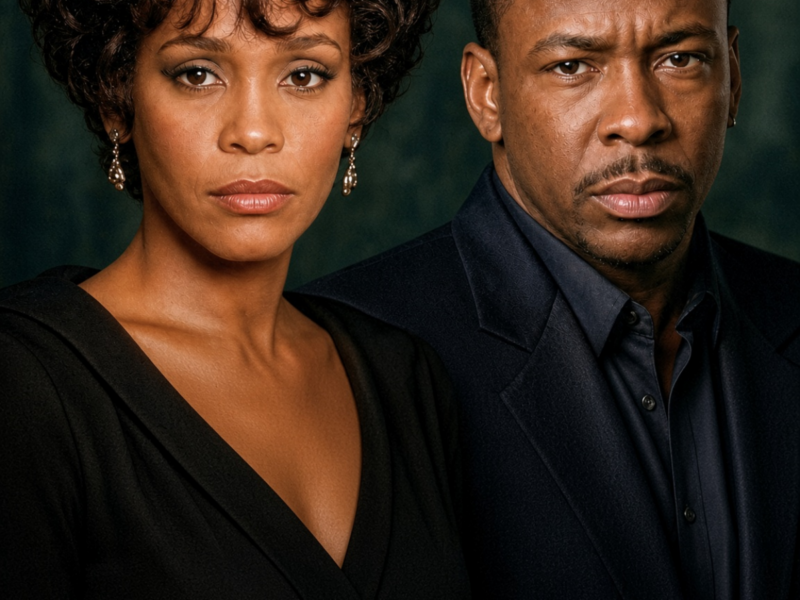
Before She Died, Whitney Houston Finally Exposed The SHOCKING Truth About Bobby Brown.
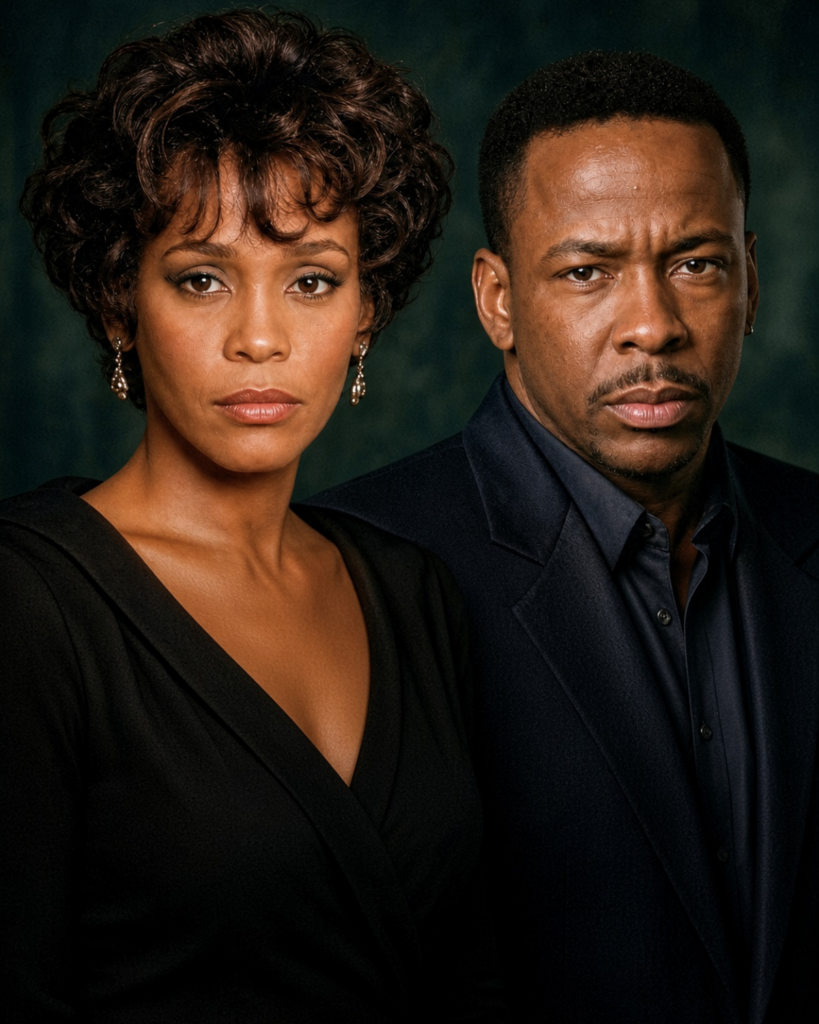
On December 7th, 2003, Whitney Houston called the police on her husband.
According to the report, Bobby Brown told her he was going to beat her ass, then struck her with an open right hand.
Three days later, he turned himself in.
The woman walking in beside him was Whitney Houston.
And that is not the strangest part.
There is a wall covered in painted eyes.
There is a trip to the store for sugar and milk.
And there is something her daughter saw from the stairs.
Six years after that night—two and a half years before she died—Whitney finally told her side on national television.
Bobby Brown has given different accounts over the years.
The 2003 charge was dismissed, and he was never convicted.
So we are going to do this carefully, one record at a time, starting with the night they met.
It was April 13th, 1989, at the Soul Train Music Awards in Los Angeles.
Whitney Houston was twenty-five, and she was already the biggest female voice in the world.
Bobby Brown was twenty—the bad boy who had left New Edition and was selling millions of records on his own.
He tells the story like this: she was sitting behind him, and she kept bumping into the back of his seat.
“And finally, I asked her why,” he said years later. “And she was like, ‘Because I want to.'”
On paper, it made no sense.
She was the church girl from Newark—the daughter of gospel singer Cissy Houston, the cousin of Dionne Warwick.
He was the kid from the Orchard Park projects in Boston who had been fined in Georgia for dancing too suggestively on stage.
Her family noticed the difference right away.
Her mother, Cissy, would later write that she found him childish and impulsive, hot-tempered and jealous of his wife’s success.
Whitney’s closest friend at the time, Robyn Crawford, would write that on the wedding day itself, Eddie Murphy called to say she was making a mistake.
Whitney married him anyway.
The wedding took place on July 18th, 1992, at her estate in Mendham, New Jersey.
By most accounts, there were about 800 guests. Robyn Crawford was her maid of honor.
Seventeen years later, sitting across from Oprah Winfrey, Whitney would sum up that wedding in five words: “Glad I signed that prenup, though.”
In 1992, nobody was thinking about prenups.
That same year, The Bodyguard came out, and “I Will Always Love You” became one of the bestselling singles in history.
On March 4th, 1993, their daughter was born. They named her Bobbi Kristina.
From the outside, it looked like the fairy tale had worked.
It took less than three years for the first police report.
In April 1995, Bobby Brown was arrested after a fight at a nightclub at Walt Disney World in Orlando.
According to the police, a man there had part of his ear cut by a broken bottle.
Brown, his publicist, and his bodyguard were charged with aggravated battery.
Those charges were later dropped after a settlement out of court.
The next year, in August 1996, he crashed Whitney’s Porsche in Hollywood, Florida.
His blood alcohol level was reported at nearly three times the legal limit.
He was convicted in January 1998 and spent five days in jail.
Whitney stood by him through all of it.
Then came the summer of 1997 and a story that has four different versions.
In July of that year, the couple was on a yacht off the island of Capri in Italy.
Whitney ended up at the local hospital with a small but deep cut on her left cheek. She needed stitches.
The first version came from Whitney herself. She said she had hit a rock while swimming—but a crew member told the Italian police it had happened on the boat.
The second version came from her publicist. Whitney had slipped at lunch, the publicist said, and a broken plate had cut her face.
“I feel like such a klutz,” Whitney was quoted as saying.
The third version came sixteen years later, from her mother.
Cissy Houston wrote that Bobby slammed his hand down on a table, a plate broke, and a piece of china flew up and cut her daughter.
“She seemed sadder after that,” Cissy wrote, “like something had been taken away from her.”
The fourth version came from Robyn Crawford.
Whitney told her that she had thrown a glass against a wall herself. Crawford did not believe it.
“Flying glass doesn’t do that,” she said. “But I never pressed her.”
Four people told four different stories about one scar.
Nobody has ever settled which one is true, and we won’t pretend to either.
What we can say is that by the year 2000, the problems were no longer private.
On January 11th, 2000, airport security in Hawaii found about half an ounce of marijuana in Whitney’s handbag.
Bobby was traveling with her. The two of them boarded their flight before the police arrived.
Four months after Hawaii, it was Bobby’s turn.
He was arrested at Newark airport on a warrant for violating his probation in Florida.
In June 2000, he stood in front of a judge and said this to my fans: “I do have a disease. I am an addict. I am an alcoholic.”
He was sentenced to seventy-five days.
When he walked out of the North Broward Detention Center that July, Whitney was waiting for him—along with the comedian Chris Rock.
So far, Bobby had been the one in the headlines. In 2002, that changed.
In December of that year, Whitney sat down with Diane Sawyer on ABC.
She was painfully thin, and the country had been whispering for months.
Sawyer asked her about crack cocaine.
“Crack is cheap,” Whitney said. “I make too much money to ever smoke crack. Let’s get that straight, okay? We don’t do crack. We don’t do that. Crack is whack.”
That line became a joke that followed her for the rest of her life.
But in the same interview, she admitted to alcohol, marijuana, cocaine, and pills at different times.
“I partied a lot,” she told Sawyer. “Trust me, I partied my tail off.”
Bobby went back to jail twice more in 2003. Whitney was still at his side.
And a year after the Sawyer interview, the police were at their door.
We started with that night. So let’s go back to it now, with everything else in place.
It was a Sunday—December 7th, 2003—around 8:30 in the evening at their house outside Atlanta.
Whitney made the call herself.
By the time officers arrived, Bobby was gone.
Here is how the police report puts it, as quoted by CNN: “Upon arrival, officers spoke with Miss Houston, who said Brown confronted her and stated he was going to beat her ass. Shortly thereafter, Mr. Brown struck her with an open right hand.”
The officers recorded a visible bruise on her left cheek and a cut inside her upper lip.
Under Georgia law, the state can bring a domestic violence charge whether or not the victim wants one.
On Wednesday, December 10th, Bobby Brown was charged with one count of battery.
He turned himself in—and Whitney went with him.
His publicist released a statement: “Bobby Brown is very apologetic about what happened and hopes his wife forgives him.”
Whitney’s own lawyer said she was trying to resolve the matter privately.
A few months later, Bobby gave his version. He called it a little spat. He called it slapboxing.
And then he said something that was meant as a defense: “I got big hands, man. I would hurt her. It would be more than just a little cut on the lip.”
In February 2004, he went back to jail—sixty days this time—for breaking the terms of his probation. The battery charge was one of the violations on the list.
The judge could have given him 120 days. “Since you did complete most of the original conditions,” he told Bobby, “I don’t feel obliged to sentence you to 120 days.”
That same spring, Whitney checked into a rehab program. A year later, in March 2005, she went back in.
Her publicist said she thanked everyone for their support and prayers.
In May 2004, another judge ruled there was enough evidence for Bobby to stand trial on the battery charge.
There never was one.
In December 2005, prosecutors dropped the case. The reason they gave was short: they were unable to contact the victim.
Bobby Brown was never convicted of hitting Whitney Houston. That is part of the record, too, and it matters.
But by the time the case was dropped, America had seen Inside the House for itself—and Whitney had signed up for it.
On June 30th, 2005, Bravo premiered a reality show called Being Bobby Brown.
The show picked up with Bobby just out of jail after another probation violation.
Whitney had come out of rehab only a few months before, and she agreed to be in almost every episode.
For the network, it was a hit. At the time, it was the best-rated ongoing series Bravo had ever had.
Viewers followed the couple to London and to restaurant tables and heard them joke about their private life in front of the crew.
Whitney’s line from the show—”Hell to the no”—became a catchphrase.
This was the voice of “I Will Always Love You.” The woman who had sung the national anthem at the Super Bowl in 1991.
Now she was a cast member on a reality show about her husband.
Bravo wanted a second season. Whitney said no.
Because what the cameras never showed was about to come out. It was happening in the house outside Atlanta.
In her memoir, Cissy Houston describes a visit to her daughter’s home around that time.
She walked in and found the walls and doors spray-painted with big, glaring eyes and strange faces.
In one framed family picture, someone had cut Whitney’s face out.
Cissy called it beyond disturbing.
She left the house, and then she came back with a court order and two sheriff’s deputies, and she got her daughter to a hospital.
Whitney confirmed the eyes later. She told Oprah there were evil eyes that were looking at every point in the room.
She said she stood there thinking, “Lord, what’s really going on here?”
Then she said the part that explains what came next: “I was getting scared because I felt something was going to blow. Something was going to give.”
Something did give—and it was her patience with him.
She told Oprah how she left. She had prayed for one day of strength.
“If you give me one day of strength,” she said, “I will go out that door and I will not look back.”
The day came. She told Bobby she was going out.
“I’m going out for some sugar and some milk,” she told him. “And I’ll be back.”
“I knew it,” she said later. “I never came back.”
In September 2006, her publicist announced that Whitney had filed for legal separation.
A month later, she filed for divorce in Orange County, California.
The final hearing was in April 2007. The judge was deciding custody of Bobbi Kristina, who was fourteen by then.
Bobby did not come to court.
Whitney testified that she did not need child support or spousal support.
The judge gave her full custody.
Asked about Bobby, she said it simply: “He’s unreliable. If he says he’s going to come, sometimes he does. Usually, he doesn’t.”
The divorce was final on April 24th, 2007—fourteen years and nine months after the wedding in Mendham.
It still wasn’t over.
A few weeks later, Bobby went back to court to challenge the terms.
In his filing, he described what his life looked like after the separation: “After Whitney and I separated, I had nowhere to go and very little money to live on. I was, for all intents and purposes, homeless.”
He said Whitney had assured him they could get back together.
The hearing on his request was set for January 2008. He did not show up for that one either, and the motion was denied.
For two years, Whitney said almost nothing about the marriage.
The words people still remember were still ahead, and she chose to say them on national television.
Hold on to that staircase I mentioned at the start. We are about to get there.
For years in public, she had stood beside him. She walked into a police station with him. She let cameras follow them for a whole season.
Then in September 2009—two years after the divorce—she finally told her side.
She sat down with Oprah Winfrey for the season premiere of The Oprah Winfrey Show. It ran over two days, and it is the closest thing we have to her own account.
She talked about the drugs first. She described lacing marijuana with cocaine.
“You put your marijuana, you lace it, you roll it up, and you smoke it.”
And she said something about Bobby that tells you more than any police report: “He was my drug. I didn’t do anything without him.”
She said the money had changed what she cared about. “I had so much money and so much access to what I wanted.”
She told Oprah, “I didn’t think about the singing part anymore.”
She described a man who wanted to be in charge at home. “At home, he was very much the father. He was very much the man.”
She said he was very much in control. “I liked that.”
And she admitted how little she could resist him. “I was so weak to him. I was so weak to the love.”
Then she tried to explain why it turned. “I think somewhere inside something happens to a man when a woman has that much control.”
Then Oprah asked about abuse.
Whitney was careful. She did not say Bobby beat her. She said he had slapped her once and that she hit him back over the head.
As Newsweek quoted her: “I was raised with two boys and I’ll fight you back.”
And then she told the story that made the headlines the next morning.
“He spit on me,” she said. “He spit on me. He actually spit on me. And my daughter was coming down the stairs and she saw that.”
That was what her daughter saw from the stairs.
Whitney said she grabbed a phone and hit him over the head with it.
That same week, Bobby answered in a television interview.
“I think we corrupted each other,” he said. “I don’t think she hurt me or I hurt her. I just think we had a 14-year marriage that had its ups and downs, and not many people understood it.”
Two and a half years later, on February 11th, 2012, Whitney Houston was found in the bathtub of her room at the Beverly Hilton Hotel the night before the Grammys.
She was forty-eight.
The Los Angeles County Coroner ruled it an accidental drowning, with heart disease and cocaine use as contributing factors.
The coroner’s office said the tests showed she had been a chronic cocaine user.
The police found no evidence of wrongdoing.
Her funeral was held on February 18th at New Hope Baptist Church in Newark—the church where she had first sung as a child.
Bobby Brown came. He stayed only a few minutes.
He explained why in a statement: “My children and I were invited to the funeral of my ex-wife Whitney Houston. We were seated by security and then subsequently asked to move on three separate occasions.”
He said security then kept him from reaching his daughter.
“In light of the events, I gave a kiss to the casket of my ex-wife and departed as I refused to create a scene. I doubt Whitney would have wanted this to occur.”
By his account, even at her funeral, he was kept apart from her family.
The next year, Cissy Houston published her book about her daughter.
She did not hold back about the man Whitney had married.
“I do believe her life would have turned out differently,” she wrote. “It would have been easier for her to get sober and stay sober. Instead, she was with someone who, like her, wanted to party.”
And more plainly: “To me, he never seemed to be a help to her in the way she needed.”
She wrote that when the divorce came through, she was extremely relieved, and that she was thanking God so much, “I’m sure nobody else could get a prayer in.”
On keeping him away from the family, she put it as a question: “How would you like it if he had anything to do with your daughter?”
But Cissy’s own son said something on Oprah that same year that complicates the family’s story.
Michael Houston, Whitney’s brother, admitted he had used drugs with her, too.
“I feel responsible,” he said. “I let it go so far.”
And then: “If you do drugs, you do that together, too.”
Robyn Crawford, in her own book, went further back.
She wrote that Whitney told her she was fourteen the first time she tried cocaine.
That was years before she ever met Bobby Brown.
So the easy version—the one where the bad boy ruined the church girl—does not survive the record.
Both of them used. Both of them said so. The people closest to Whitney say it started before him.
What the record does show is how Bobby’s own account of the marriage kept changing.
In 2004, to the Atlanta Journal-Constitution, it was slapboxing and a little spat.
In 2009, he said, “I don’t think she hurt me or I hurt her.”
In 2016, he published a memoir called Every Little Step and sat down with ABC’s 20/20.
Asked whether he was the one who got Whitney into drugs, he said, “It wasn’t me.”
He described the first time he saw her use: “It only made me love her and want to protect her more.”
In that same interview, asked whether he had ever hit her, he said, “I did.”
He explained it by saying he was trying to stay sober and she was not. “It was rough,” he said.
But in the same interview, he also said this: “They said that I’ve harmed Whitney, that I was violent towards her. It was just lies. I’ve never been a violent man towards a woman ever.”
In that 2016 interview, he also said the line I keep coming back to: “We should have been better. We could have been better.”
And in July 2018, promoting a TV movie about his life, he was asked about it again.
“There were no violent incidents between me and Whitney,” he said.
Told there was a 911 call and a police report, he answered, “The public record is wrong.”
We are not going to tell you which of his other statements to believe. They are all his. You can put them side by side yourself.
There is one more chapter, and it is the hardest one.
On January 31st, 2015—three years after her mother—Bobbi Kristina Brown was found unresponsive in a bathtub at a townhouse near Atlanta.
She never woke up. She died on July 26th, 2015. She was twenty-two.
The medical examiner found drug intoxication and immersion in water, and could not say whether it was an accident.
No criminal charges were ever filed against anyone.
A year later, a civil court in Georgia found her partner, Nick Gordon, liable by default and ordered him to pay about $36 million to her estate. Gordon denied the allegations.
So what was the truth she finally told?
Put her words next to the record.
Here is what the documents say: a police report with a bruise and a cut lip. A charge that was dropped because the victim could not be reached. A husband who went to jail more than once while married to the most famous voice in the world. A reality show she agreed to and then ended. A wall of painted eyes. A spit in front of a child, described by the woman it hit.
And here is what the documents also say: he was never convicted. She told Oprah he slapped her once, and most of what she described was about control. They used drugs together, and she was using before she met him. Her own brother said he was part of it, too.
My own reading is that Whitney Houston spent fourteen years trying to protect two things at once.
One was Bobby. The other was the woman America thought it knew—the one who sang “I Will Always Love You” at the end of The Bodyguard.
Keeping both of them safe cost her more than anyone saw.
On the night of December 7th, 2003, she picked up the phone and called the police on her husband.
Three days later, she walked into the station beside him.
Three years after that, she told him she was going out for sugar and milk.
That time, she kept walking.









