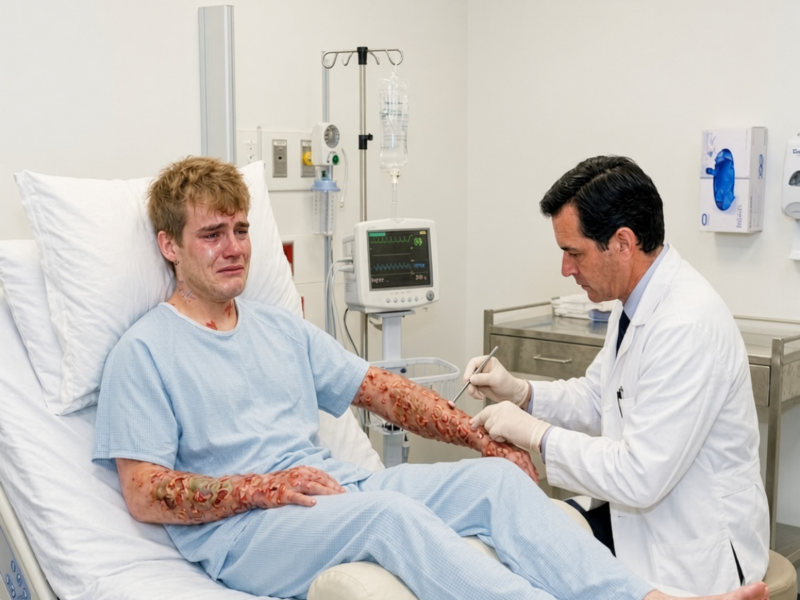
Before His Death, Presley Gerber Went Through Something Nobody Should Have to Face Alone.
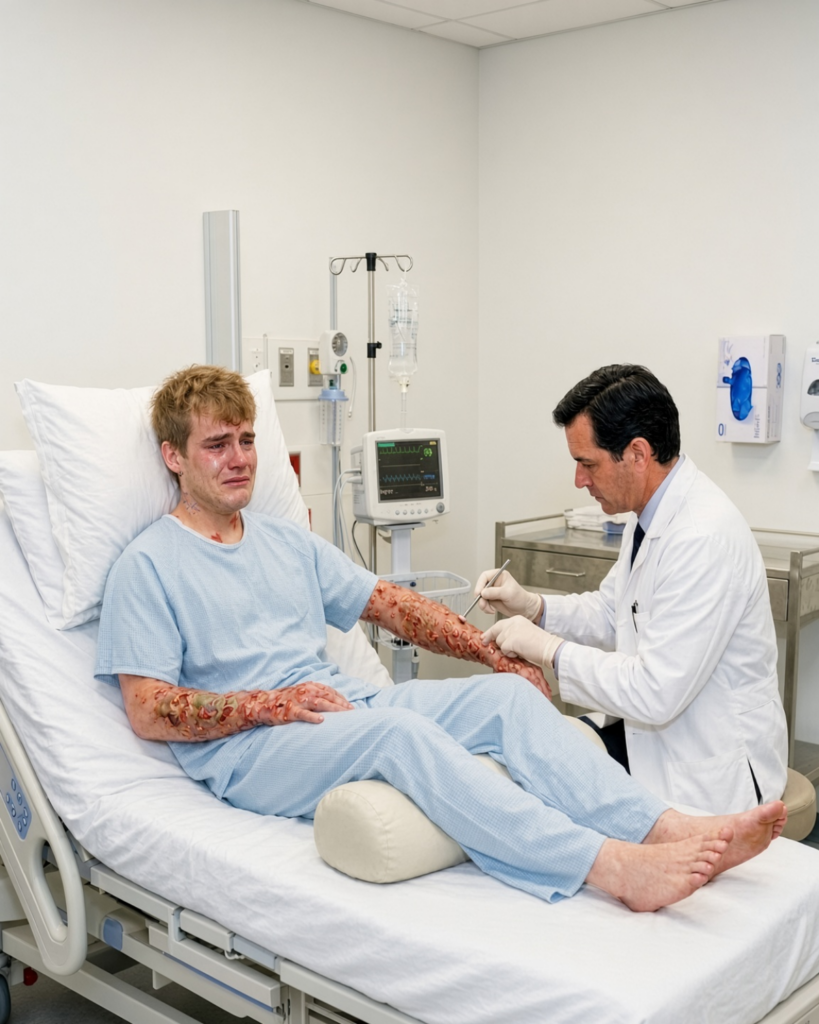
Quiet moment before everything changed.
That is how Presley Gerber began the caption of a video he posted on Instagram on March 26th, 2026.
In the clip, he was about to undergo a treatment he had traveled across a border to receive.
He was frightened.
He said so, and then he shared it with everyone who followed him because he believed that telling the truth was the only way forward.
Six months later, on Sunday, September 20th, he died at a sober living residence in Santa Monica, California.
He was 27 years old.
Between those two dates lies the story of a young man who spent years narrating his own recovery in public.
He posted videos about his medications.
He posted videos about his fears.
He asked strangers for help.
And on the last Saturday night of his life, he turned the camera on himself one more time.
This is the story of those videos, and of the man who made them.
Presley Walker Gerber was born on July 2nd, 1999, the first child of Cindy Crawford and Rande Gerber.
His sister Kaia arrived two years later.
He grew up in the public eye.
According to ABC News, he was signed by IMG Models at 15.
By his late teens, he had walked runways for Moschino and Dolce & Gabbana and appeared in a campaign for Calvin Klein.
Think about that.
A teenager in a world where every photograph is judged and every flaw is magnified.
In 2019, when he was 19, he was charged with driving under the influence.
ABC News notes that he later spoke openly about seeking treatment.
In 2020, he drew attention for a face tattoo that read “Misunderstood.”
Fox News reported that he fired back at critics online.
Misunderstood.
It is a word that comes back again and again when you look at the years that followed.
A young man who felt the world saw only the surface.
A young man who little by little decided to show the rest.
Let us line up the moments because together they form a pattern.
In 2019, a DUI charge.
In 2020, a face tattoo and a wave of online mockery.
In 2024, a weekly series about mental health.
In December, a video about his medication and a request for help.
In March, a video before a treatment he feared.
In June, an appearance in Malibu.
On August 6th, an ordinary fashion post.
In August, a sister spoke about him to Vogue.
And on a Saturday in September, one last clip.
It is the arc of a young man who moved slowly and imperfectly from hiding to speaking.
In 2024, he began a series on Instagram called Mental Health Mondays.
ABC News reports that he used it to speak about his own experience with addiction and mental health.
It was not polished.
It was not a campaign.
It was a person looking into a phone and describing what was happening inside him.
Week after week, he said out loud the things most people only say to a therapist or to no one at all.
And one of those videos, posted in December, became one of the most talked about.
According to a report in AOL, he sat in front of the camera and explained the medication he was taking: 1 milligram of buprenorphine twice a day.
Buprenorphine is a medication used to treat opioid use disorder and pain.
He said he felt a lack of direction from doctors.
That is a frustration many patients describe, and he said it plainly.
He did not say what he thought he needed.
He said what he felt he was missing.
He said he was trying to find a better community.
He said he had grown up in Hollywood and that there were people around him he loved, but that right now he tried not to be around them.
And he said something that sounded like hope.
On a good note, he told viewers he had stopped drinking after his birthday in July because it was no longer serving him.
He ended with a request.
He hoped he would find people who were willing to help or who knew someone who could.
The caption read, “Here’s some clarity for you. The truth will set you free. Hopefully. Haha.”
Read that again.
A person in the middle of a struggle writing the word “hopefully” and following it with a laugh.
It is the sound of someone trying to stay light while carrying something heavy.
The response from his family was immediate.
Under the video, his mother, Cindy Crawford, wrote a short message.
People reported it.
She told him that they loved him and that he was not alone.
A source told Page Six that Cindy was extremely involved in everything while Kaia and Presley were growing up.
Whatever else was happening, that is the picture of a mother who stayed close.
That is what a parent says.
Not a lecture, not a plan.
Only the one thing that matters most when someone is fighting: You are not alone.
And the message was public.
Anyone could read it.
It said to every other young person watching who might be struggling in silence that this was what support could look like.
That is the quiet power of what Presley did.
Videos like his tend to do something for the people who watch them.
They make it a little easier for someone else to say the same words out loud.
He did not call himself an advocate, but in those moments he was one.
Think about why that matters.
Addiction survives in secrecy.
It tells a person that what he is going through is shameful and that no one else could understand.
Every honest video undermines that lie, even a little.
Every viewer who thinks “he is saying what I could not” is one step closer to saying it too.
Now we come to March.
On March 26th, Presley posted the video that people described as one of his final social media posts.
In it, he was shown before undergoing what he called an ibogaine flood dose.
Ibogaine, according to Stanford Medicine, is a naturally occurring psychedelic that comes from the root bark of a shrub native to central West Africa.
It has been explored as a way to help people with addiction.
It is not approved in the United States, and people who seek it often travel abroad.
The addiction specialist Dr. Drew Pinsky, speaking to Fox News after Presley’s death, said ibogaine is a compound studied for substance use disorders but not approved by the FDA and urged families to look for licensed facilities that use evidence-based medications.
That is one expert’s view, and the subject is debated.
People who seek ibogaine often do so because they feel they have run out of other options.
The caption began with the words we heard at the start: “Quiet moment before everything changed.”
He wrote that he was absolutely terrified.
He wrote that he knew he would be terrified again if he ever had to face something like it.
And then he wrote about what came after.
He said that he faced what he had been running from and that somewhere in the process he began finding his way back to himself.
He thanked the team that cared for him and he said he had made some good friends there.
There is one sentence that has been repeated more than any other.
According to People and others, he wrote that he was praying it was the last time he would have to come back.
Come back.
Think about those two words.
They suggest a person who had been to the edge of treatment many times before.
Someone who had left, returned, left again.
Someone who was tired of the cycle and who wanted more than anything for it to end.
The family answered with love.
People report that his relatives filled the comments with messages of pride and support.
Let us look closely at that video.
It was not an advertisement for a treatment.
It was not a victory lap.
He did not say he was cured.
He said he was afraid.
He said he hoped.
He said he was praying.
That is the language of recovery as most people who live it describe it.
Not a straight line, not a single moment of triumph, a series of attempts, each one braver than the last.
And he shared it knowing that millions of people would see it and that some of them would be unkind.
We should remember that he had been mocked online as a young man.
He had been judged for years for his face, his name, his tattoos, his choices.
And still he decided to show the world a moment of fear.
That takes a particular kind of courage.
It is the courage to be seen at your lowest because you believe someone else might need to see it.
The months after March were quieter online.
According to IB Times, his final Instagram post came on August 6th.
It was a series of outdoor photos of him modeling a VORI outfit.
He did not write a caption.
He only tagged the brand.
Paris Hilton left a comment.
It was an ordinary post, the kind a working model shares, and it suggests that in public at least, he was continuing to work.
In June, according to Extra, he attended an event in Malibu.
A sentence from that period has been shared widely.
He reportedly said that the most free he had ever felt was when he finally became honest with himself.
And in August, his sister Kaia spoke to Vogue about the family’s long experience with his addiction.
She described it as a decade-long struggle.
She said that when something like that happens in a family, it levels everyone.
And she said that trying to hide something makes a person feel you are ashamed of them.
That was a month before he died.
Read that again.
His sister speaking to the world, saying that the family was done hiding.
Then came last weekend.
Sources told Page Six that Presley checked into Resolutions Living, a sober living residence in Santa Monica, during the weekend of his death and that he had been struggling in the days before his admission.
And on that Saturday night, he made one more video.
This one was different.
It was never posted by him.
Page Six obtained it exclusively and TMZ reported that it had obtained the footage as well.
Two sources told Page Six that it was recorded on Saturday night.
In the clip, Presley films himself.
He is wearing a white tank top, a silver chain, and black glasses.
His tattoos are visible.
Then he turns the camera toward the room.
It is a shared bedroom with several beds.
There is a balcony.
There is a bathroom.
There are views of the property and of the city beyond it.
That is all that has been described.
No dramatic words, no farewell, a man, a phone, a bedroom, and a view.
The residence itself, according to NBC News, appeared to operate as a sober living home, which is not required to be licensed by the California agency that regulates substance use treatment centers.
In general, sober living houses are described as drug-free shared residences for people in recovery.
They are meant to be a place to live while rebuilding a life.
A shared bedroom with several beds fits that description.
Think about what that is.
A person who had spent years documenting his life in public, doing it once more out of habit, perhaps out of a wish to show his family and friends where he was.
We do not know, and no one has said.
The Gerber family has not commented on the video.
A video shows a few seconds of a person’s life.
It cannot show what he was feeling, what he needed, or what happened next.
It is a fragment.
And fragments, when they are shared widely, tend to be read as if they were the whole story.
It is not.
According to reports, the video does not establish how he died.
The official cause and manner of death have not been determined.
What the clip offers instead is something simpler, a moment of presence.
A man alive on a Saturday night in a room he hoped would help him.
That matters because recovery for most people is not a single decision.
It is a long series of attempts.
Many people try, stumble, and try again.
And the stumbles are part of the road, not proof that the effort was wasted.
Presley’s videos show exactly that kind of road.
A person who kept trying in public for years.
In the weeks since, much of the conversation has been about the last hours.
It is easy to forget that before that there were 27 years.
27 years of a person becoming himself in front of everyone.
A single bedroom on a weekend cannot hold all of that.
It was only the last room he walked through.
The rooms that mattered more were the ones where he told the truth.
A phone held at arm’s length.
A caption written in the middle of fear.
A short message from his mother underneath.
Those rooms are still open to anyone who wants to look, and they tell a gentler story than the last one.
Put the last day together and it is small.
On Saturday night, a young man films a bedroom.
On Sunday morning, an emergency call is made.
Ten minutes later, he is pronounced dead.
There is a stretch of hours in between that has not been publicly explained, and there is a clip at the start of it and a family at the end.
Now, let us talk about Sunday morning.
According to People, a call reporting a cardiac arrest was placed to emergency services at 9:35 a.m. on September 20th.
As the response began, it was suspected to be an overdose.
Paramedics pronounced him dead at 9:45.
The Santa Monica Police Department said it was investigating the death as a suspected overdose and that there was no indication of foul play.
The Los Angeles County Medical Examiner said the cause and manner of death were deferred pending additional testing.
ABC News reports that the office said deferred cases can take a few months.
So, the official answer is not here yet.
Toxicology is pending.
The investigation is open.
His body, according to the Page Six reporting, was cremated.
The family is reportedly planning a private memorial, and the family statement was short.
They asked for privacy during a very difficult and painful time.
There is one more voice from that reporting, and it comes from someone close to him.
A source told Page Six, “Kaia and Presley were insanely close.”
The source said they did not know how Kaia would go on without him.
They said the two were much more than brother and sister.
Remember what Kaia said in Vogue?
That she had decided as a child to be the easy one.
That she had never wanted to ask for help.
And that her brother had become the teacher who showed her that you cannot hide from the world.
She learned that from him, from the same man who made the videos.
And now she is living through his death while the world watches her.
TMZ reported that she was seen out in public wearing dark sunglasses.
It was a small moment of normal life in the middle of an unbearable one.
We should leave her alone.
We should leave the whole family alone.
They did not choose this attention.
They are grieving.
There is a way of honoring someone that does not involve watching.
It involves living a little differently because of what they said.
If his videos taught anything, it is that the people who love us would rather hear the hard truth than watch us carry it alone.
There is one last question worth asking, and it is about us.
How should we watch the videos of someone who has died?
With respect, first, we can watch them as testimony and not as evidence.
We can let him speak for himself in the words and the tone he chose.
And we can avoid the temptation to treat a private moment leaked to the press as entertainment.
The Saturday clip was not made for an audience.
The videos he posted were.
That difference matters, and it is worth remembering when we decide which ones to share.
Let us talk about what we do not know, because there is a great deal.
We do not know the cause of death.
It is deferred.
We do not know the manner of death.
It is also deferred.
We do not know what was in his system, or whether anything was.
Toxicology is pending.
We do not know why he made the Saturday video or who shared it with the media.
The family has not said.
We do not know what happened in the hours between that clip and the morning.
And we do not know what he was feeling.
Only he did.
What we know is what he told us himself.
That he was afraid.
That he was trying.
That he hoped.
That he asked for accountability and for help and for community.
Those are not small things.
They are, in fact, the whole shape of a recovery.
If you want to act on what he said, start small.
Tell one person the truth about how you are doing.
Ask one person how they are really doing and wait for the answer.
Find out which treatment programs near you are licensed and what they require.
Keep a number saved in your phone in case someone you love needs it at 2 in the morning.
If you are reading this or watching this and you are fighting something of your own, we want to say something directly.
You do not have to hide it, and you do not have to do it alone.
If you are in the United States, the SAMHSA National Helpline is 1-800-662-4357.
It is free, confidential, and open every day of the year.
If you are in emotional distress, you can call or text 988 or chat at 988lifeline.org at any hour.
If you are outside the United States, findahelpline.com can help you find a service in your country.
If someone is in immediate danger, please contact your local emergency number.
And if you love someone who is struggling, do what Cindy Crawford did in that comment.
Tell them you love them.
Tell them they are not alone.
Then keep showing up.
So let us go back to where we began.
A man, a phone, a caption: quiet moment before everything changed.
He recorded many of those moments.
A conversation about medication, a confession of fear, a prayer that it would be the last time, a final look around a bedroom on a Saturday night.
Each of them was an act of honesty.
And honesty in the middle of addiction is one of the hardest things there is.
It would be easy to remember only the end, to let a bedroom and a balcony stand for a whole life.
But that is not who he was.
He was a son who was told in public that he was not alone.
He was a brother who taught his sister how to stop hiding.
He was a young man who asked over and over for people willing to help.
He did not get to finish the story he was telling.
He did not get to say whether the last time was really the last.
But he left the rest.
The videos are still there.
The honesty is still there.
And somewhere, someone watching them tonight might feel a little less alone and a little more willing to ask for help.
That is the part of his story that is still moving.
And that is the part worth carrying forward.
There is something else worth saying about final posts.
When someone dies, we read their last words and last images as if they were messages.
We search them for meaning.
But most of what people share is simply life.
A photo of an outfit, a caption left blank, a video made on a Saturday night because that is what you do with a phone.
The real messages are the ones he made on purpose over years with his own words.
Those are the ones worth hearing.









