
Before His Death, Michael Jackson Once Called These 7 Bands ‘Talentless’ – Here’s Why.
Some musical pieces once hailed as legendary were merely hollow echoes in Michael Jackson’s own ears.
The only legend audacious enough to venture into forbidden territory, forthright enough to utter a truth no one dared to speak.
They lacked talent.
It wasn’t hatred.
Rather, it was a profound regret witnessing bands that once captivated an entire generation, choosing the spotlight over genuine heart.
The Beatles, too, were once praised by him, only to later be met with skepticism.
Some groups he had even sung with.
Some individuals were once his own idols.
Yet, he eventually viewed them as wax figures, glittering on the outside, empty within.
This isn’t a tale of criticism.
This is an unraveling of the most stringent standards in music.
It’s a cold yet sincere perspective from the planet’s most solitary artist.
And it’s also the reason why Michael, even to this day, remains irreplaceable.
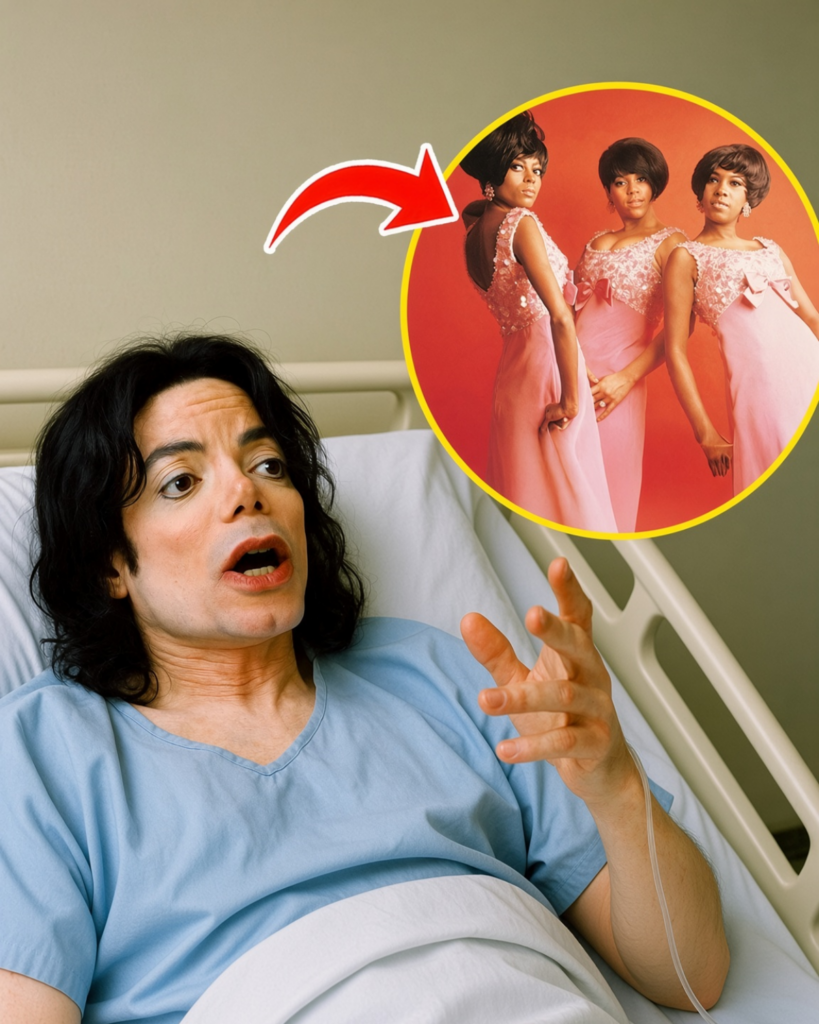
Michael Jackson, then at his zenith, sat hunched in a velvet upholstered chair, silently watching a playback of the Supremes’ performance clip.
He didn’t smile, didn’t nod.
He merely furrowed his brow and uttered a near whisper: “They were packaged by producers, not born singers.”
Everyone present heard clearly.
No one spoke, for they knew he was speaking from his deepest, most genuine emotions without pretense.
Perhaps today’s audience finds it hard to imagine.
But in the past, Michael knew every dance move of Diana Ross.
He mouthed every lyric with Mary Wilson.
To him, the Supremes weren’t just a musical group.
They were an emblem, the aspiration of a ten-year-old Black boy standing in the streets of Gary, Indiana, so impoverished he had to use shoelaces as a belt.
But then everything changed.
The deeper he delved into the music industry, the clearer one truth became: not everyone sang from their heart.
The Supremes achieved resounding success, as everyone knows.
But the more famous they became, the further they drifted from their original raw emotions.
Everything was pre-arranged: the lighting, the staging, even the introductions.
To Michael, there was nothing inherently wrong with that, but it made him feel disconnected.
He once recounted to a relative, “I stood watching them and felt nothing. It was like watching models perform a song rather than singers truly inhabiting it.”
Some believed Michael was envious, but those who truly understood him knew he wasn’t envious.
He was regretful because he once believed they embodied freedom.
But then he discovered they too were products of a system.
A system he spent his entire life resisting, transforming Black artists into the most marketable archetypes possible.
The Supremes were the first Black female group to achieve phenomenal success in the white market.
But what was the cost?
It was the erosion of individuality, the standardization of voices, and the replacement of powerful, soulful songs with easy-listening, consumable tracks.
He once spoke of Diana Ross as a sister.
But in his eyes, Diana was also trapped within that system, compelled to be flawless, polished, impeccable, and that alienated her from the very people who had once loved her for her authenticity.
Michael once saw himself in the Supremes, and precisely for that reason, upon realizing they were merely a part of a meticulously staged performance, he felt betrayed.
He feared he would become, like them, beautiful but hollow.
Their music was like the soundtrack to a movie everyone watched, but no one cried.
He once told a close industry friend, “I don’t want to be like that.”
To him, singing wasn’t about others seeing your beauty.
It was about them seeing themselves in you, and the Supremes after a time no longer retained that essence.
During a behind-the-scenes recording, when a reporter asked if he had learned anything from them, he remained silent for a long moment.
Then he simply replied, “I learned not to become a product.”
He didn’t despise them, but he refused to become their replica.
That’s why he constantly innovated, constantly transformed.
He didn’t want to be packaged by anyone.
The Supremes were a beautiful chapter in Motown music.
But for Michael, it was also a stark warning.
If you don’t preserve your identity, this industry will color you, package you, and sell you off as a beautiful but soulless commodity.
And that perhaps was the greatest sorrow, when a legend must learn to embrace a past that once fueled his dreams, but with clearer eyes and a heart that knows not all light is genuine.
Too experimental but missing heart.
Not everyone dared to utter this, especially concerning a group like the Beatles.
But Michael Jackson did, not with disdain, but with disappointment.
That emotion only experienced when you’ve loved something profoundly, and then it transforms beyond recognition.
Michael called the Beatles his childhood idols.
Those who made a young Black boy in the impoverished streets of Gary, Indiana dream of British stages where one could sing, create, and truly be oneself.
A Hard Day’s Night was not just an album to him.
It was a dream compressed into thirteen tracks, each a pure slice of pop, concise, memorable, and most importantly, authentic.
But then he grew up, and so did the Beatles.
When the group shifted toward psychedelia, when songs began featuring sitars, tape loops, and aimless structures, Michael remained silent.
At times he tried to listen again, as if to convince himself that this was the pinnacle of creativity.
But no, what he felt was only a disconnect, a layer of artistic veneer covering emotions that were once so intimate.
He didn’t deny their mastery.
In fact, he admired John Lennon’s courage to write “God” and George Harrison’s ability to bring Eastern influences to the Beatles.
But the problem for him was that they allowed technical creative layers to obscure the core emotion.
Michael always believed if a song couldn’t be sung naked with just a raw voice and raw emotion, then it wasn’t authentic enough.
And many tracks on the White Album or Magical Mystery Tour left him feeling adrift.
“They sound like ideas, not feelings,” he once shared, half truth, half regret.
It was truly bitter that the very people who inspired him became symbols of something he resisted: artistic embellishment to conceal emotional emptiness.
Many believed he spoke thus out of envy because the Beatles were an untouchable pinnacle.
But they forgot that in 1985, Michael purchased the group’s entire music catalog, not to gain control, but because he didn’t want their music to fall into the hands of those who didn’t love them as he once did.
It was that deep affection that sharpened his disappointment.
For Michael, when the Beatles abandoned “I Want to Hold Your Hand” to chase “Revolution 9,” they traded light for darkness.
They chose complexity over connection.
And in his world, that was tantamount to abandoning the listener.
This sadness wasn’t merely aesthetic.
It was also a sign of a deeper chasm between white and Black artists.
Because when the Beatles embraced psychedelia, they were hailed as pioneers.
But when a Black artist experimented with unusual sounds, they were deemed too niche or incomprehensible.
Michael understood that invisible boundary clearly, and he chose not to cross it.
To him, music had to be a bridge, not a labyrinth.
He once confided in the studio with Quincy Jones, “They started playing as if they only wanted to impress each other, no longer singing for anyone.”
And that’s what pained him, because he knew well the feeling of being left behind.
To the end of his life, Michael kept old Beatles records on his personal music player, but he never added their later tracks.
He once told his manager, “Some songs remind me of who I wanted to be. Others remind me of who I didn’t want to become.”
The Beatles once taught him how to dream, but they also taught him a profound lesson: when music ceases to move others, all innovation is merely an illusion.
And that, not envy, was why he turned away.
They once sat side by side in a small room cluttered with medicine boxes, paper cups, and the scent of sweat from two unparalleled geniuses.
On one side was Freddie Mercury, boisterous, fiery, uninhibited.
On the other was Michael Jackson, reserved, sharp, as if everything had to pass through his private and very unique inner filter.
Both wore white, but only one carried an indescribable emotion.
And when Freddie began singing the demo of “There Must Be More to Life Than This,” Michael turned away.
Not because he disliked it, but because he felt pain.
Michael once told his assistant, “Freddie’s voice is like a crack in a luxurious wall. You hear it and know something’s amiss, but it’s still beautiful.”
He loved Queen for that, for their exuberance, their wildness, yet still imbued with rich melody.
“Bohemian Rhapsody” was like a journey without a map, yet never lost for a moment.
But then came Hot Space, that period where, according to rumors, Michael merely shrugged and repeated just once in the studio to the producer, “It’s theatrical, but the melody is getting lost.”
He said no more, but the light in his eyes had dimmed, as if he was withdrawing from an old friend.
The game in Hot Space marked a different Queen: less heartfelt rhythm, more theatrical display.
Songs like “Body Language,” though an interesting experiment, made Michael feel uneasy because he knew Freddie could do more.
Queen didn’t need cheap sex appeal.
They once brought Wembley to tears with just a few piano notes.
To Michael, music was soul, not a facade.
And when Queen began playing as if they were trying to prove they were still cool, still relevant, still keeping up with funk or disco, he felt a sense of loss.
He never spoke ill of them directly.
But during an internal meeting for the Bad tour, when someone suggested, “Let’s do something Queen-ish,” he offered a faint smile and shook his head.
“We don’t need to hide behind the lights.”
That statement was unforgettable to everyone.
Freddie and Michael once attempted to collaborate, but the recording sessions quickly reached an impasse.
Freddie couldn’t tolerate Michael’s obsessive attention to detail, and Michael was annoyed by Freddie’s constant smoking and bringing a small camel into the studio.
Truly, a toy camel, but it was enough to distract him.
A broken friendship, unfinished music.
But perhaps what truly troubled Michael wasn’t the failed collaboration, but the feeling of loss.
An artist who once reached where few dared, now circling back to theatrical concepts, to latex outfits and showy dance moves.
Freddie still sang, still burned with passion.
But Michael no longer heard his heart in it.
“Queen doesn’t need costumes to prove their worth,” Michael once said. “They’re already royalty. Why dress like clowns?”
The remark sounds harsh, but if you understood Michael, you’d know it wasn’t a judgment.
It was a lament, a gentle reminder that the greater an artist becomes, the more they should preserve their most tender essence.
He once confided in a close friend at the label, “I fear the day I too will become like that, a grand stage full of effects, but no one truly listening to me sing anymore.”
Michael didn’t despise Queen.
He loved them, but he loved their original image.
He loved a Freddie sitting at the piano, unadorned, just singing “Love of My Life” with that very trembling voice.
But when music became overly ostentatious, he withdrew, as if staying would mean losing the authentic part of himself.
Neither of them harbored animosity, but they understood some trajectories no longer intersect.
And when Queen entered their experimental pop-funk-electro phase, Michael, despite creating Thriller, an album full of dance and technical prowess, chose to retain the purest emotional core for himself.
He once said, “I dance, but my heart remains still.”
And perhaps in his eyes, Queen at that time was doing the opposite.
Michael stood still, his hand resting on the mixer’s lid, his gaze not exactly displeased, but rather filled with a deep sense of regret.
The music blared from the state-of-the-art JBL speakers, crystal clear and note-perfect.
Yet, precisely for that reason, to him, it left no room for the heart to breathe.
“It sounds like robots singing about love,” he murmured, just loud enough for the sound engineer to hear.
The song playing was ABBA’s “Gimme! Gimme! Gimme!”
A massive hit.
Undeniably, its neat melodies, thick synth layers, and infectious catchiness were enough to ignite any dance floor.
But for Michael Jackson, who always prioritized emotion, this wasn’t music.
It was technique.
It was product.
It was a beautiful shell.
“Tunes too polished, too mechanical.”
That’s what he uttered to an American producer after hearing a series of ABBA demos in the late ’70s.
A somewhat cold critique, but on closer inspection, it exposed a silent apprehension within his soul at the time: music was transforming into something too predictable, too precise, and therefore too empty.
Michael once cherished ABBA during their “Fernando” era, when the acoustic guitar still had a raw edge and Agnetha’s voice wasn’t completely enveloped by synth.
He admired how they told stories through music, with layers, depth, and a carefully nurtured melancholy.
But as time progressed, that sadness became so perfectly packaged that the human element within was lost.
He told Quincy Jones in the studio, “They’ve got the lyrics, but I can’t feel them breathing.”
Quincy didn’t respond, merely shrugging, perhaps because he, too, understood.
Michael didn’t dislike ABBA.
He feared he would become them.
At that time, Michael was preparing for Off the Wall, a major transformation, and also when he became obsessed with a simple question: how could pop music retain its soul when everything around it was being homogenized into a formula?
ABBA, with their global impact, their powerful choruses, their chart dominance, were the clearest embodiment of programmed pop.
Nothing wrong with it.
But for Michael, it couldn’t be called a beating heart.
It was a prefabricated heart.
Specifically, he felt unable to connect with the human element in ABBA’s recordings.
“They sound like they don’t get tired, like they don’t hurt.”
He said that to a reporter, but it was never published.
His voice then wasn’t critical, but rather hollow, like a child unable to understand why a singing voice carried no tears.
Nonetheless, Michael held a certain respect for ABBA’s lyrics.
He once wrote in his personal notebook, “‘The Winner Takes It All.’ That’s good storytelling. Cold, but honest.”
He didn’t despise them, but he never wanted to become like them.
So, while ABBA embraced technology, synthesizers, and gleaming studios, Michael quietly recorded his voice onto cassettes in his bedroom to ensure that his breaths, his inflections, his tremors were preserved.
This wasn’t just art.
It was survival.
Amidst the vibrant 1980s, he chose to retain the human voice in his music, and in the neon glow, in a world where every song was meticulously crafted like a showroom product, he left gaps, places where the audience could weep.
His critique of ABBA wasn’t born of envy, much less resentment.
It was an internal alarm.
When Michael saw them increasingly becoming what the music industry desired, beautiful, pristine, flawless, he witnessed the very thing he loathed most: the human obscured by the product.
He once exclaimed upon hearing “Voulez-Vous,” “It’s dancing, but it’s not pain, and people don’t only dance when they’re happy.”
He was often described as a perfectionist.
But few understood that what he truly sought perfection in was the truth within music.
A truth that was imperfect, unpolished, but alive and capable of feeling sorrow.
ABBA, in his view, chose a different path.
A path that wasn’t wrong, but left no room for imperfections.
And Michael knew it’s precisely through the imperfections that the light shines in.
One night, the studio lights flickered dimly due to a power surge.
Michael was listening to a rough mix when Jimmy Page’s guitar soared from the speakers, a solo stretching nearly two minutes, screeching like metal tearing through the air.
He frowned, saying nothing.
Then he quietly reached out and turned the volume down.
“It’s volume over voice,” he mumbled almost to himself.
It wasn’t that he didn’t understand rock, nor had he never belted along to searing riffs, but there was something about Led Zeppelin that made him feel detached, as if that roaring sound came from a world he didn’t belong to, where ostentation was acquainted with greatness, and emotion was buried beneath layers upon layers of effects.
Michael Jackson, despite bearing the title King of Pop, possessed a soul deeply aligned with old blues.
He loved the simplicity, the deliberate fragility in Otis Redding’s voice or Muddy Waters’s unadorned guitar.
To him, music didn’t need to shout to be heard.
It needed to say something true.
Led Zeppelin was different.
They embodied an era where rock music had to dominate space, had to shake everything.
They pushed the volume to the extreme, turning guitars into weapons and the stage into a shrine to the artist’s ego.
And that very aspect made Michael wary.
He felt as though everything was trying to prove something, but had forgotten the initial reason anyone picked up an instrument.
Rumor has it that during a private meeting with music producers in the early ’80s, Michael once said, “They got the fire, but where’s the heart?”
He wasn’t criticizing.
He was questioning.
A question stemming from his inability to find a human presence in those extended solos where everything seemed to be a contest rather than a conversation with the audience.
For Michael, music wasn’t a venue to showcase technical prowess.
It was a space to lay bare one’s solitude.
He once told a close friend, “When I sing, I want others to know how abandoned I’ve been.”
And perhaps because of that, when listening to Led Zeppelin, he felt left behind.
Undeniably, he held a certain respect for Zeppelin’s achievements.
He knew they were legends, pillars of an entire generation.
But he also knew very well that he didn’t belong in that world.
In a rare conversation about them, Michael once remarked, “They’re warriors, but I sing for the wounded.”
The surging, overflowing sounds, the riffs that felt like blows to the chest.
To him, they were like a slamming door.
Beautiful, powerful, but without an invitation to enter.
One night, he sat watching a Zeppelin concert clip on TV, the stage lights flickering chaotically like an electrical storm.
He remained silent for a long time, then told his assistant, “They play as if they’re trying to win something back.”
The assistant didn’t understand, but to Michael it was clear.
He sensed the underlying aggression in that rock.
Not the scream of freedom, but the shout of assertion.
And that saddened him.
Because music in his eyes was a means to heal, not to conquer.
For Black artists like him, music was once a lifeline in a world that refused to listen.
It was the only place they could raise their voice, not to surpass anyone, but to exist.
And when he saw bands like Zeppelin wielding music like a weapon, he worried that its true soul was being compromised.
Michael never publicly declared that opinion.
He didn’t want to create enmity, much less be misunderstood.
But in his personal diary, there was a line written in faint script, almost faded with time: “Louder doesn’t mean closer. Sometimes it just means you’re screaming across a wall.”
To him, Led Zeppelin was an icon, but not a sanctuary.
They represented something intense, ferocious, yet also profoundly solitary.
And for a soul always seeking connection like Michael’s, music, no matter how quiet, still needed to offer a hand.
Not to win, but to be held.
“They sound too made in Sweden, not made in soul.”
That remark wasn’t uttered in anger, not during an interview, nor on stage.
Rather, it was when Michael sat pensive by the studio window in Los Angeles, golden light spilling onto a face still glistening with sweat after a rehearsal.
A young technician had just played a demo from a European rock set, a booming duo from Sweden.
The track hadn’t even finished when he frowned.
“Too perfect,” he said softly, his eyes distant. “They sound too made in Sweden, not made in soul.”
To others, it might have been a fleeting observation.
But for Michael Jackson, who was once profoundly moved by Smokey Robinson’s harmonies, who trembled at a sustained note in a Motown recording, music was not a place for smoothness, not a place where everything clicked together like clockwork.
He didn’t deny Roxette’s talent.
On the contrary, he once said that Marie had a voice sharp like glass, but missing heat.
He liked how their songs were catchy, how the hooks seemed molded to embed directly into the listener’s mind without permission.
But precisely for that reason, he felt uneasy.
To him, catchiness was a double-edged sword.
It could be a tool for connection, but also a facade.
He once said, “A true song isn’t meant to be sung, but to be lived through.”
And that’s what he didn’t find in “It Must Have Been Love,” a love song so meticulously polished that he could no longer feel the heart hidden behind each word.
Backstage at a strategic meeting with the record label, when an executive suggested collaborating with some Scandinavian pop-style producers, Michael merely offered a faint smile.
He didn’t say no, but he also didn’t nod.
“I don’t want my music to feel like it came from a factory,” he said.
His hands still toying with a glass of water, his gaze fixed on the ceiling.
They thought he was joking.
But in truth, he was in pain.
For an artist like him, a Black man raised in an industry where Black artistry was often marginalized, borrowed, then sanitized with a white label, truth in music wasn’t a privilege.
It was the only thing that kept him alive.
He didn’t have the option to make music merely because it was trendy.
Every time he held a mic, it was a moment to prove: I deserve to be heard.
And precisely for that reason, when he saw the effortless perfection of European pop infiltrating the American market, he worried, not out of envy, but from the fear that if music became a formula, voices born from wounds like his own would no longer have a place to be heard.
He once wrote in his notebook, “They make songs that shine like mirrors. I want mine to bruise like skin.”
The obsession with authenticity permeated every artistic decision he made.
That’s why he often canceled recordings at the last minute.
Why a song could take three years to complete.
Because if there wasn’t genuine emotion, if there wasn’t a bleeding heart behind every chorus, then to him the song was meaningless.
And although he never publicly criticized Roxette, those around him knew very well he respected them, but he didn’t trust them, as if he were standing before a glittering ice castle, beautiful, sparkling, but unable to warm a hand.
Some called Michael too strict.
Some called him selfish for demanding that music always bear its imperfections.
But looking back at his past, from the times he was denied airplay simply because of his skin color, from the songs edited to fit the white market, that strictness wasn’t arrogance, but a mechanism of self-preservation.
To him, music had to come from flesh and blood, from memory, from pain with no place to hide.
It couldn’t be molded.
It couldn’t be assembled.
And if a song was born in the lab of commerce instead of the bedroom of solitude, then it, no matter how catchy, was merely an empty shell.
And so he refused such collaborations.
Not because he hated Roxette, but because he feared that if he followed that path, his own soul would be sculpted, would be smoothed out, would lose the scars that made him who he was.
They were once his everything, his family, his stage, the reason the world came to know Michael Jackson.
But they, too, the Jackson 5, were the first gilded cage he ever inhabited.
Throughout his youth, a cage glittering with stage lights, smelling of cheap perfume from backstage, echoing with the screams of fan girls and the mechanical rhythms dictated by the managers behind the scenes.
Michael once said late one night backstage during his first solo tour to a trusted former assistant, “Those days, it was stage sparkle without soul depth.”
It wasn’t that he disdained the Jackson 5, but rather it was then that he finally dared to admit most of the time he wasn’t allowed to be himself.
The five young Black boys from Gary, Indiana, were molded to become America’s perfect teen idols.
Straightened hair, shimmering vests, practiced smiles, soaring voices before they broke.
They were a marketable dream.
And Michael, the child with the most natural talent, was also the one placed under the harshest spotlight.
He was no longer permitted to sing like a Black child raised on gospel.
He had to sing adorably.
Had to become cute.
He had to become the face that would soothe white America’s anxieties about Black culture.
He once said, “People clapped for me before I even knew who I was.”
And that’s what terrified him.
Once he became the King of Pop, he looked back at his years with the group with both reverence and anguish.
Reverence because without the Jackson 5, he wouldn’t have existed in the industry, but anguish because he didn’t choose that path.
Others chose for him.
Others shaped his emotions for him.
And in that dazzling stage light, he saw himself as merely a shadow, singing words others wrote, smiling to rhythms others commanded.
Behind the lights were the times his father scolded him if he didn’t dance correctly.
The ceaseless rumble of the tour bus.
The hotel rooms filled with mirrors where he dared not look himself in the eye.
He saw a child transformed into a product.
And a product isn’t allowed to have depth.
A product doesn’t need a soul, it just needs to sell well.
Someone at the record label recounted that when listening to the “ABC” recording later in life, Michael didn’t smile, didn’t sway, didn’t sing along.
He just nodded slowly.
“Catchy. Very catchy. But it wasn’t me.”
That statement wasn’t a denial of their achievement, but a farewell to the child who once tried to please everyone, who once thought if he sang high enough, smiled brightly enough, everything would be all right.
Many years later, in a rare interview, when asked about the Jackson 5, he simply said, “Without them, I’d be nowhere.”
But his eyes conveyed the rest.
That gaze wasn’t that of a star reminiscing about past glory, but of a survivor, remembering the first mask he ever wore.
This contradiction, loving but unable to return, grateful yet carrying sorrow, is what made his artistic maturation perpetually solitary.
He couldn’t sing in the Jackson 5 style with carefree abandon anymore.
Couldn’t wear that suit again, dance those moves again without feeling he was regressing toward a replica of himself instead of progressing toward his true self.
When he wrote “Childhood,” he didn’t speak of poverty.
He didn’t speak of the beatings.
He wrote about being forced to grow up before understanding who he was.
And the Jackson 5, though foundational, was also the period when he had no right to ask, “What do I want to become?”
No one denied the group’s talent.
They were a phenomenon.
They paved the way for young Black artists to enter the mainstream.
But if you asked who Michael Jackson truly was, he wasn’t the boy in the fedora singing “I Want You Back.”
He was the man who transcended all of that to write, to create, to breathe as a true artist.
And he understood clearly: glamour cannot nourish the soul.
It cannot preserve childhood.
It cannot replace emotion.
It’s merely a layer of powder, beautiful, bright, but it will wash away when the stage lights fade.
Precisely for that reason, Michael Jackson never forgot the Jackson 5, but also for that reason, he never returned.
Michael Jackson was never the kind of artist who spoke idly.
Every word he uttered, whether praise or critique, contained a deep, sometimes painful layer of thought.
When he called once-legendary bands lacking talent, it wasn’t sarcasm, but a statement from someone who sacrificed his childhood in pursuit of perfection.
For MJ, talent wasn’t just about catchy melodies or dazzling stages.
It was about depth, authentic emotion, the soul hidden behind every note.
His seemingly harsh remarks actually reflected a musical world that was gradually drifting away from authenticity.









