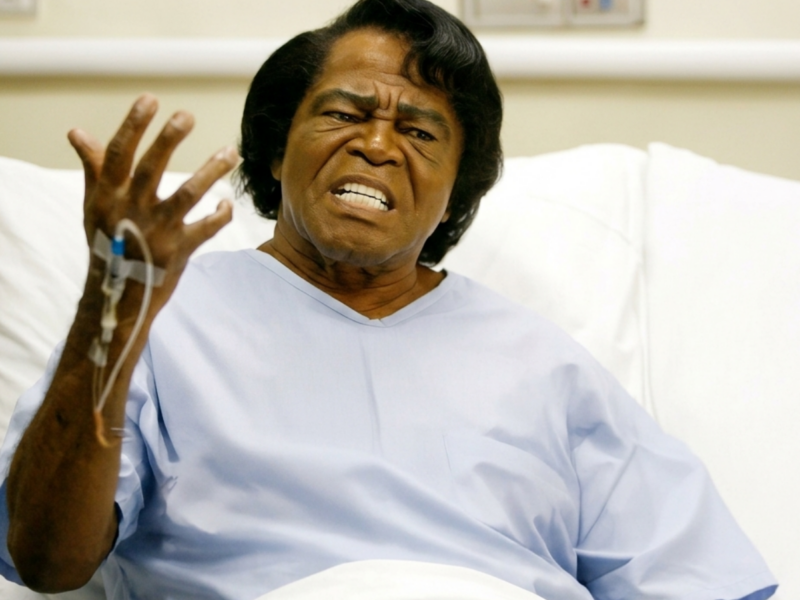
Before His Death, James Brown Finally Names The 10 Musicians He Hated.
The night in Macon, Georgia, still hangs in the air like cigarette smoke in a closed room.
Only the very old and the very quiet dare to speak of it now, and when they do, their voices drop to a whisper, as if the Godfather of Soul himself might lean in from somewhere beyond the grave to listen.
It was 1960, backstage at a soul revue, and James Brown was not yet the legend the world would come to know.
He was a hungry young man from Barnwell, South Carolina, who had spent his childhood in poverty, who had been sent away by relatives, who had learned that the only way to survive was to grip the microphone like a lifeline and never let go.
That night, a crowd of performers milled around the cramped dressing room, the air thick with hair grease and sweat and the nervous energy that comes before a show.
And then Joe Tex walked in.
He had the smug demeanor of someone who could silence a room without singing a single note, and he looked at James Brown the way a man looks at his own reflection in a mirror he did not ask for.
No one remembers exactly what was said, but everyone remembers the crash.
Something flew across the mirror.
Someone screamed.
The story dissipated like smoke after the show, but those who witnessed it still carry it with them, recounting it in hushed tones, because that was the night James Brown stopped trusting anyone.
What the world never understood is that James Brown did not hate many people, but once he did, he hated them to his very core.
He never publicly admitted it, but before his passing in 2006, he left behind an unexpected list, ten names he never forgave, and most of them were legends revered by the entire world.
He left no will, no farewell message, but quietly bequeathed a list, a painful, stark list, where names once called brother became daggers plunged into the heart of the Godfather of Soul.
This isn’t just James Brown’s story.
This is a truth the entire showbiz world is trying to conceal.
And if you are living amidst effusive praise and backstabbing, then this story is a mirror.
Not everyone knows about that list.
Only the very old and the very quiet dare to speak of it, and they speak of it the way they speak of the Macon night, with the same hush, the same careful glance over the shoulder, because the names on that list are the names that built the soundtrack of the twentieth century, and the man who wrote them down was the hardest working man in show business, a man who believed that absolute control was the only way to avoid losing everything.
The list itself was never published, but it was whispered about in the industry for years, a piece of paper that passed through the hands of a few trusted associates, a document that James Brown reportedly kept in a drawer in his home in Beech Island, South Carolina, near the golf carts and the fur coats and the photographs of himself with presidents and kings.
The names were not written in anger, but in a kind of cold, deliberate accounting, the way a man balances a ledger he has been keeping for decades.
And the first name on that ledger was Joe Tex.
Joe Tex had the smug demeanor of someone who could walk into a room and silence everyone without singing a single note, but what James Brown couldn’t endure was that Joe Tex was too much like him, frighteningly similar.
They sang almost the same genre with the same inflections, the same growling, moaning style that female audiences adored.
But the most painful thing for James was that Joe Tex once sang a track he considered his own, “Baby, You’re Right.”
James re-recorded that song with slight lyrical changes, turning it into a hit, and Joe felt he had been played.
From then on, the game was no longer amusing.
The tension wasn’t in the song, but in Joe Tex’s eyes every time they were both backstage at a show.
Joe looked at James as if he were watching someone impersonate him without permission.
Promoters reveled in it.
They knew the two hated each other, and that very conflict sold tickets.
But for James Brown, this wasn’t about the stage.
This was about the survival of a man who had once had to sing behind the curtain, who had been made to wait until midnight just to hold a microphone.
It was rumored that on a summer night in 1963, after Joe Tex mimicked his dance moves and delivered a friendly, sarcastic remark on stage, a rather ill-intentioned greeting, James Brown entered the dressing room with a look that was no longer amused.
Someone in the room screamed.
There was a crash.
Something flew across the mirror.
The story dissipated like smoke after the show, but those who witnessed it still remembered, recounting it in hushed tones, that was the night James Brown stopped trusting anyone.
People called Brown the Godfather of Soul, but that man was still a dark-skinned child who grew up in poverty, twisted by the world to such an extent that only music could save him.
When you live in an era where if your skin isn’t light enough, no matter how well you dance or sing, people still relegate you to the back of the program, fame wasn’t joy, it was a weapon for survival.
And when Joe Tex, a man who was your spitting image, appeared, taking your style, taking your song, and then explicitly stating into the mic, “You keep her,” referring to James’s former lover, that was no longer a conflict between two artists.
That was a battle for identity.
Joe Tex never apologized, and James Brown never forgot.
In his final years, when asked about people he disliked, he didn’t mention Tex’s name, but in his eyes, in his breath, in his deliberate pause after the word “he,” people knew.
He didn’t need to speak because everyone knew he was talking about Joe.
Behind that animosity wasn’t just a copied performance, but a life gradually stripped away from the spotlight to his pride.
James Brown didn’t resent being robbed.
He resented being unable to reclaim it.
And because the one who robbed him had also had to sing backup, had also had to bow before life just like him, and perhaps that was the most painful part.
The second name on that ledger was Michael Jackson.
James Brown didn’t care for Michael Jackson, not because Michael lacked talent, nor because he had ever done anything malicious, but because Michael did it too well, so well that it made James feel diminished.
From the 1970s, when the Jackson 5 began dominating television stages, James sensed something was amiss.
That boy, dark-skinned, bright-eyed, with a thin yet resonant voice, danced as if devouring the music with his feet.
Not like a copy, not like an apprentice, like a younger, smoother, and more beloved version of himself.
Michael once called James his inspiration.
On television, in interviews, at awards ceremonies, he always mentioned Mr. Brown, but James never felt comfortable hearing that.
Because every time Michael called him inspiration, all he heard was, “I’ve learned everything from you. Now it’s my turn to do it better.”
Everything became clearer when Michael entered his solo phase, from Off the Wall, then Thriller, every step he took was a step that pushed James further into the shadows.
He still performed, still commanded respect, but he was no longer the first name people thought of when discussing moves or groove.
Michael was now the one who could ignite an audience with just a tilt of his body.
Backstage gossip in the entertainment industry buzzed about James’s jealousy.
Although he publicly acknowledged Michael, those close to him clearly saw his discomfort when someone inadvertently compared the two.
Once in a waiting room, when a young dancer accidentally said Michael elevated James’s style, he simply turned away, muttering, “He’s got moves, but don’t forget who invented them.”
That discomfort wasn’t merely a rivalry for fame.
It ran deeper.
James grew up in a time when every door was closed to black people.
He had to sing behind curtains, was rejected for not fitting the image.
He fought for every minute on stage, every recording in a closed studio, and then one day, there was a young boy, also black, but with a bright face, a gentle voice, a scholarly demeanor, welcomed as a musical savior.
James didn’t say it, but he felt replaced without being consulted.
Not that Michael intended it, but the way the world embraced him easily, completely, suddenly, made all of James’s efforts feel heavy, antiquated.
Despite this, James never publicly contradicted Michael.
He kept everything to himself, partly out of pride, partly knowing that if he spoke out, he would appear petty.
But in every glance, every indifferent nod, whenever Michael’s name was mentioned, people understood.
James passed away in 2006.
When Michael died three years later, many recalled his words calling James his Godfather.
But discerning individuals knew between the two, it was never a father-son relationship.
It was a subtle, persistent, unspoken rivalry.
And it was something James carried with him throughout his final years, like a question no one ever answered.
Ultimately, who truly made history?
The third name was Bootsy Collins, and James Brown couldn’t stand anyone who was too talented yet wouldn’t obey.
From the first time Bootsy walked into the studio with him, just a young man with a bright red bass guitar, like a stage light, James knew something was going to happen.
Not normal trouble, but the uncontrollable genius kind.
And James, who regarded everything in his band as clockwork gears, had no room for anything out of sync.
Bootsy didn’t just play bass, he transformed music into something wilder, more daring, even when playing the right notes, the right rhythm.
There was something in Bootsy’s style that made James feel he was losing control.
In his eyes, the young man wasn’t just a musician, he was an imminent explosion.
On stage, Bootsy blazed, swayed, innovated, capturing every gaze.
For James, that was a threat.
The audience’s admiration for Bootsy grew clearer with each performance.
They cheered for his riffs, his out-of-the-box solos, something James always considered unforgivable.
He believed in discipline.
Bootsy believed in freedom.
Rumors claim that during a performance in Boston, James cut Bootsy’s pay backstage simply because he dared to extend his playing by exactly four seconds.
Everyone thought he was joking, but he didn’t smile.
Bootsy still smiled, as always, but behind it was a simmering hurt.
James once told his manager after that night, “He played like a genius, but acted like a child.”
Bootsy eventually left.
No arguments, no disputes.
He simply departed James Brown’s band and followed the call of George Clinton, where funk was no longer confined by uniforms, schedules, or rules.
That’s when Bootsy became part of Parliament Funkadelic, becoming an icon of future funk music that refused to be bound.
And that was precisely what James never forgave.
Not because Bootsy was talented, but because Bootsy chose freedom over loyalty.
In his eyes, it was an unspoken betrayal, a stab in the back from someone he once believed would inherit true funk.
Later, when asked about Bootsy, James didn’t avoid the topic, but he wasn’t warm, either.
He always maintained a distance, always conveying a sense of regret mixed with bitterness.
Those close to him recounted that once, he watched Bootsy perform on a large stage on TV, only to sigh and quietly say, just loud enough for himself to hear, “That funk used to be mine.”
For James, Bootsy was a missed opportunity.
A lesson about being unable to contain a fire with mere rules.
The first crack in a system he once thought could never waver.
And deeper still, the pain he never acknowledged, that some of the young talents he had molded eventually grew up, broke free from his grasp, and created their own world to which he no longer belonged.
The fourth name was Prince, and what infuriated James wasn’t Prince’s talent.
It was the fact that no one, not even he, could control him.
From the first time he saw Prince emerge publicly with his oddly shaped guitar, like a half-hearted answer, James’s lips tightened.
Not out of hatred, but out of discomfort.
That unique way of playing music, dressing like a dream, moving with no discernible rules, and that perpetually serene face made him feel like he was looking at a future version of himself, but one without him in it.
One day backstage, someone asked James what he thought of Prince.
He shrugged.
“He takes all the soul out of funk.”
At the time, it seemed like a casual remark.
But no.
For James, funk was sweat, the trembling rhythm from the soles of his feet to his temples.
It was back pain from a wrong move.
It was discipline.
Prince, however, seemed to conjure music effortlessly, without forcing himself.
Prince’s talent obscured the struggle, the tension that James considered essential, and that made him question, did this young man truly understand funk?
One night in 1983, Brown invited both Michael Jackson and Prince onto the stage.
Everything started civilly.
Michael was gentle, polite, but Prince erupted into chaos.
He climbed the lighting rig, threw his guitar, danced a segment no one understood.
The audience roared.
James stood backstage, his eyes unblinking.
The next day, James said nothing.
No mention, no praise, no criticism.
But his assistant vividly remembered him repeating a single sentence on the car ride back to the hotel.
“That’s not funk, that’s a circus act.”
That irritation wasn’t loud.
It seeped in.
As time went on and Prince rose as a cultural icon, the distance between them grew colder.
James still respected Prince in a few interviews.
But discerning individuals would notice he never called him a successor as he had once referred to Michael.
And Prince, too, never offered any clear words of gratitude, as if two parallel lines passed each other without needing to touch.
There were no fights between them, no public feuds, but James’s gaze whenever someone played Prince’s music was enough to reveal he didn’t like it.
He didn’t like a young man who played music as if floating, sang as if whispering something others didn’t need to understand.
He didn’t like that the whole world called him a genius but failed to mention funk in the way James had built it with his very being.
Once during a band rehearsal, a young guitarist dared to play a few Prince-esque riffs.
James immediately growled, “Play in time. Play with feeling. Don’t get too dreamy.”
And that made it clear Prince didn’t need James to shine.
And James, throughout his final years, never acknowledged Prince as part of what he called the legend.
No animosity, but utterly estranged.
The fifth name was Maceo Parker, and James most despised the feeling of being betrayed by someone he once considered family.
James didn’t shy away from competition in life, but with Maceo, who had stood beside him for thousands of performances, that rift left a deep, unhealable wound.
Because it came from the very person who had breathed life into James’s second soul, the sound of the saxophone.
The day Maceo first joined the band, James called him a child prodigy.
Maceo didn’t smile much, but every time he played the sax, it was as if both a church and the streets resonated simultaneously.
James adored that timbre, powerful, raw, yet with a touch of grace.
A part of his funk soul was inextricably linked to that sax sound.
But then that very sax sound began to irritate him.
Because people started praising Maceo too much.
At first, it was after shows, a few female fans asking for Maceo’s autograph even before James’s.
Later, in the press, Maceo’s solo stole the night.
“Parker outshines Brown in new live set.”
James didn’t read those words, but his people brought them directly to him.
Once during a performance, James signaled for Maceo to stop.
Maceo didn’t stop immediately.
James trembled with rage.
Afterward, he punished Maceo by directly deducting his pay.
As per the unwritten band rule, anyone who steals my spotlight will lose their share.
Maceo remained silent.
He didn’t argue, but he no longer blazed as brightly as before.
Then he left the first time.
Then he returned.
Then he left again.
Three times in total.
Each time he returned, James gave him a chance, but never trusted him as he once had.
Band members recounted for many long years, James didn’t speak a word to Maceo.
Communication went through assistants.
A cold nod when a sax solo began.
Once on tour, when the whole band was having dinner, James walked out simply because he didn’t want to sit at the same table as that sax player.
To outsiders this seemed illogical, but James once stated bluntly backstage, “I taught him how to walk onto the stage. I taught him when to pull back, when to step forward, and now he plays as if he’s the center.”
Maceo, however, never publicly criticized James.
He was polite, courteous, but if one paid attention in interviews about James, Maceo always spoke in terms of “I learned a lot from him, both what to do and what not to do.”
The two never fought, never cursed at each other.
But no one dared to let them sit together for too long.
The silence between them resonated louder than the music.
The sad truth is both were right.
James was a king of the stage and he would not tolerate anyone usurping his throne.
Maceo, a true artist, needed to breathe in his own way.
But on James’s stage only one rhythm was allowed to resonate, his own.
Many years later, in a moment of reflection, James simply said, “He was the best, but he forgot whose show it was.”
And in those words, though there was no anger, there was no forgiveness either.
Only a distance as long as a sax solo that never ended.
The sixth name was Jackie Wilson, and no one truly resents another simply for being exceptional, but if that person is hailed as a legend while you are consistently overshadowed, then resentment becomes almost inevitable.
For James Brown, Jackie Wilson was a persistent irritant throughout his career.
Not because he personally disliked Jackie, but because Jackie consistently appeared as a distorted mirror reflecting James’s grandest ambition to become the greatest performer of all time.
Ironically, while James was still opening acts in small clubs, Jackie Wilson was already Mr. Excitement, the name that made girls scream and club owners pay without haggling.
Wilson stepped onto the stage with a radiant smile, a perfectly fitted suit, a masterfully skilled voice, and effortlessly smooth dance moves.
James observed it all, and he remembered every detail.
On one occasion, in the late 1950s, James performed on the same bill as Jackie.
That night, according to a band member, James stood backstage throughout Wilson’s entire performance, his eyes unblinking.
When Jackie stepped off, Brown simply uttered, “They’re cheering for the jacket, not for the soul.”
James believed he possessed more, more soul, more fire.
But the audience at that time still chose Wilson.
And every time he saw someone else hailed as the king of the stage, James felt a sharp prick in his heart.
This rivalry wasn’t boisterous.
They didn’t publicly argue, nor did they clash in the newspapers.
But in every performance, every solo, every knee drop to the floor, James seemed to be screaming, “I am the one who truly bleeds for the audience.”
They met many times.
Handshakes were exchanged.
Smiles were always polite.
But deep in their eyes was a guardedness.
Those in the industry called it a respectful rivalry, a competition cloaked in deference.
But James himself later remarked backstage to a fan, “They call him Mr. Excitement, but I got more heat.”
James never acknowledged Jackie Wilson as the superior artist.
In his mind, there was only one throne, and whoever sat upon it first did not necessarily mean they were more deserving.
Years later, when Jackie Wilson’s star had faded, Brown maintained his distance.
No consoling statements, no mocking remarks.
Only once did he mention Wilson during a band rehearsal.
“He danced with grace, I danced with pain, that’s the difference.”
That was the distinction James always believed in.
Jackie brought joy to audiences.
James stirred their very core.
But what he didn’t articulate was that pain, the agony of someone who constantly had to prove himself, never truly dissipated.
Wilson was the shadow James never wanted to mention, yet couldn’t forget.
Perhaps it was Jackie who fueled James’s intensity, his relentless drive and his unwavering determination.
So much so that in the end, though unspoken, he implicitly admitted only those who have been relegated to second place truly understand the value of being at the forefront.
The seventh name was Fred Wesley, and in James Brown’s band, disobedience was an absolute taboo.
A mere glance from Brown could alter an entire tour schedule.
A single stomp out of rhythm meant losing all bonuses.
James didn’t need a band, he needed an army.
And Fred Wesley, with his trombone and exceptional leadership skills, was once the most loyal conductor in that army.
They were once a perfect duo.
Fred understood how James thought even before he issued a command.
He orchestrated the rhythm, arranged the brass section, and kept the funk groove perpetually tight like a taut string.
But there was one thing James couldn’t control in Fred, his directness.
It all began when the band started earning substantial money.
They toured nationwide, sold out stadiums, and their records climbed the charts.
Yet Fred, who was responsible for almost the entire musical arrangement, still received a fixed salary like a regular brass player.
He didn’t demand much, just fairness.
But to James, simply broaching the subject was an act of rebellion.
Brown didn’t erupt in anger immediately, but those who had worked with him for a long time knew James’s silence was more terrifying than any shout.
A week later, Fred was replaced at a show in Chicago without any prior notice.
Fred knew he was no longer valued, and so he left, quietly but decisively.
He followed George Clinton to a different funk world, one that was freer, less controlled.
With Clinton, Wesley could be a musician, not just a pawn in a system.
Years later, when asked about his departure, Fred simply stated, “I needed music to breathe, not to march.”
James never forgave him.
During a European tour, when asked about Fred, Brown merely shook his head.
“He didn’t quit, he betrayed. Big difference.”
It was rumored he once told those close to him, “Fred is the true traitor.”
Not because Fred was the one who left, but because he was the only person James truly trusted who then turned his back.
But looking deeper, it wasn’t just anger, it was the wound of a soul perpetually afraid of being abandoned.
James grew up in poverty, was deserted by relatives, and believed that absolute control was the only way to avoid losing everything.
And Fred, who understood him best, was precisely the one who dared to step away first.
That betrayal didn’t just damage his reputation, it struck directly at his trust.
Strangely enough, Fred never spoke ill of James.
In an interview near the end of his life, Wesley simply smiled when asked about their relationship.
“He needed control, I needed space. We were just different planets orbiting the same groove.”
Perhaps in James’s heart, Fred was never truly an enemy, just a loved one who refused to stay.
And sometimes, wounds like that run deeper than any animosity.
The eighth name was Elvis Presley, and Elvis never had to use the back entrance James had to his entire life.
This wasn’t a private matter.
It was something that festered in James’s chest for years, an unnamed feeling that grew with every instance he saw Elvis’s face plastered across charts, television screens, and magazine covers performing moves James had done long before anyone took notice.
“The King of Rock and Roll,” they called him, but in James Brown’s eyes, that always tasted bitter.
“They call him the king, well, I must be the ghost he borrowed from,” he once uttered backstage, his voice not angry, just heavy.
No one said Elvis lacked talent.
James never denied that.
But he knew well, when he danced, audiences called it wild.
When Elvis did exactly the same, people called it the musical revolution, and he knew why.
For James, Elvis wasn’t just an artist, he was a symbol of the injustice James fought against his entire life.
He once told friends, “He sings with a black voice, dances like a black person, sings songs written from the pain of black people, but just because he’s white, he becomes a global star.”
The tension between them didn’t explode.
It didn’t need to.
It was quieter, more subdued, like an unspoken war on the surface.
James still called Elvis a great showman.
They never publicly insulted each other, but what lay beneath the spotlight was the real story.
In the industry, a saying of James’s circulated, uttered while he was intoxicated backstage during a European tour.
“He’s a packaged product, neatly wrapped, but he ain’t the real thing.”
That statement spread, unconfirmed by anyone, but it endured because it was true.
True in the way James felt it, that everything he created, from dance moves, rhythms, performance styles, was borrowed by those with more privilege, and then glorified by the world.
And Elvis was the most prominent face of that reality.
The comparison between the two persisted.
One was the American dream, white, perfectly coiffed, performing music that once belonged to black people.
The other was the American reality, stubborn, pained, yet endlessly creative.
And both bore grand titles, king and godfather.
When Elvis passed away, James still offered him a tribute, no sarcasm, no bitterness, just a simple statement.
“He was a good performer. He opened doors, but remember who built the stage.”
People like to create beautiful stories that there was mutual respect between them, perhaps true on the surface, but underneath, in James Brown’s heart, Elvis’s shadow wasn’t what he feared, it was what he couldn’t forgive.
Not because Elvis was bad, but because the world consistently chose to honor a more palatable image, and that was more painful than any betrayal.
For James, Elvis was never an enemy, just a mirror reflecting what he could never possess, a ready-made, clean path without barriers, and standing at the center of that stage was not James Brown.
The ninth name was Aretha Franklin, and Aretha never bowed, and James never learned to yield.
Two individuals, a self-proclaimed king, a revered queen, stood at opposite ends of a bridge that was never built.
Not for lack of opportunity, but because neither would take the first step.
They once recorded together, stood in the same room, even signed contracts under Atlantic, but shared a stage?
No, not once.
Not for lack of invitations, but because their egos were too immense, rendering every invitation meaningless.
James disliked calling anyone a queen unless he was their king.
Aretha, however, needed no one to confer a title.
She ascended her throne with her powerful voice, both a prayer and a command.
To James, that was a challenge.
To Aretha, his gaze was a competition she had no interest in engaging in.
They once stood backstage at a ceremony honoring veteran artists.
James watched Aretha enter, a fur coat draped over her shoulders, her eyes proud, and muttered to someone beside him, “She walks like she owns the genre.”
And Aretha, without needing to hear him, still knew precisely what he was saying.
She once told her personal assistant, “I don’t work with men who need the spotlight to breathe.”
No one confirmed it, but rumors persisted that Aretha once declined a soul medley performance with James because he doesn’t know how to yield to anyone but himself.
And conversely, James once called her a queen without a throne, a remark both jesting and cutting.
For decades, they coexisted in parallel, two authentic soul icons.
Yet neither ever took a step back to move closer to the other.
Despite their commonalities, impoverished childhoods, the church as their first singing ground, and musical voices that broke all boundaries, their personalities clashed too severely.
In industry circles, during a soul music conference, James was once asked, “If you had to choose a single person to represent soul, who would it be?”
He leaned back in his chair, frowning as if contemplating, then said quietly, almost a whisper, “Otis, or maybe Sam. Aretha, she’s gospel in diamonds.”
A compliment, perhaps, a dismissal, also true.
Some relationships don’t need to erupt to become tense.
Between James and Aretha was a silence that lasted over forty years, where both knew each other’s positions, but neither wished to step into the other’s territory.
When Aretha sang at Rosa Parks’ funeral, James was absent.
No one asked why.
When James passed away, Aretha sent flowers but did not attend the farewell.
No public condolences, not a single farewell message, and no one blamed her because everyone understood respect doesn’t necessarily come with closeness.
And for these two icons, the existence of the other was the clearest mirror reflecting their own power, though neither would bow their head to look directly.
The tenth name was Clyde Stubblefield, and without Clyde’s rhythm, James would never have created the emphatic punch that made the world sway with his every hip shake.
Yet he forgot the man who kept him in perfect time.
Funky Drummer.
Just those two words and any musician’s heart beats faster.
Clyde Stubblefield’s break, less than twenty seconds long in that song, has been cut, looped, chopped, extended thousands of times over decades.
Rap, pop, funk, commercials, films, that drum sound is heard everywhere.
But in the copyright notes, Clyde’s name is nowhere to be found.
The bitterness didn’t stem from monetary issues.
Clyde wasn’t the type to live and die for a few numbers.
But the pain lay in the fact that after years of contributing rhythm to the soul funk legacy, his name seemed to be erased from the very track where he laid down the first beat.
Band members recounted that Clyde once directly asked James backstage at a show in Cleveland, “Will I get credited, at least for the drum break?”
James smirked, not looking directly, and simply replied, “You work for me, not with me.”
Just one sentence, enough to silence Clyde for the next ten years.
Brown controlled everything from costumes, lighting, to the band’s break times.
But with Clyde, that control went further.
Rumors circulated among musicians, Brown once ordered Clyde to refrain from giving interviews about Funky Drummer unless he was present.
“Drummer doesn’t talk first,” he told his press manager.
“I do.”
Clyde didn’t explode in anger.
He quietly left the group, then returned as if trying to survive within the very machine he helped operate.
No indignation, no defiance, just the drum beats growing heavier after each return.
When hip hop exploded in the 1980s, producers scrambled through music archives for samples, and no sound was more ubiquitous than the drum break in Funky Drummer.
Public Enemy, NWA, Run DMC, Beastie Boys, even George Michael, everyone borrowed Clyde’s rhythm, and everyone thought it was Brown’s rhythm.
Many even mistook Clyde for a sound technician, because even when that drum segment became the foundation for an entire culture, James never mentioned its creator.
In 2000, in a brief interview, Clyde offered a sad smile when asked about the copyright issue.
He simply said, “The beat is mine, the silence is his.”
Clyde’s story isn’t about being forgotten, but about being deliberately overlooked.
And nothing is more painful than standing in the shadows your entire life, when you were the one who lit the light.
James Brown, with all his brilliance, once called himself the hardest working man in show business.
Perhaps true, but Clyde Stubblefield was the man who kept the rhythm for that tireless effort.
And until the end of his life, he remained the unforgiven, not for his own mistakes, but for reminding others of his own contribution.
James Brown was a true genius.
No one denies that.
But behind the dazzling aura of the Godfather of Soul lay a series of fractured relationships, overlooked talents, unspoken praises, and never-made handshakes.
From Joe Tex, Michael Jackson, to Prince, Aretha, and Clyde Stubblefield, they were all part of music history, but also pieces in the complex tapestry of conflict named James Brown.
His greatness stemmed not only from his music, but also from the confrontations that reshaped the entire soul funk culture.
In the brilliant light of the stage, there is a shadow, and sometimes it is that very shadow that tells the true story.
The list of ten names was never meant for the public.
It was a private ledger, a reckoning kept in a drawer in Beech Island, a document that surfaced only in whispers after his death in 2006, when the world was busy mourning the man and not yet ready to examine the wounds he had carried.
But the wounds were there, in every deducted paycheck, in every cold nod, in every silence that lasted longer than a sax solo.
The hidden corners always need to be recounted, because that’s where the truest emotions live on.
The Godfather of Soul is gone, but the ledger remains, and the names on it are the names that built the soundtrack of our lives, whether he forgave them or not.









