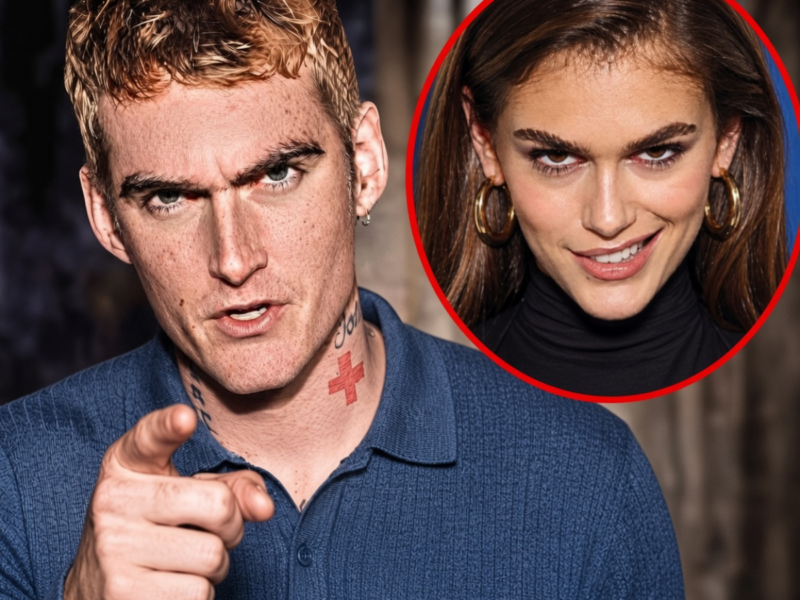
Before His Death, Cindy Crawford’s Son Breaks Silence On His Own Sister.
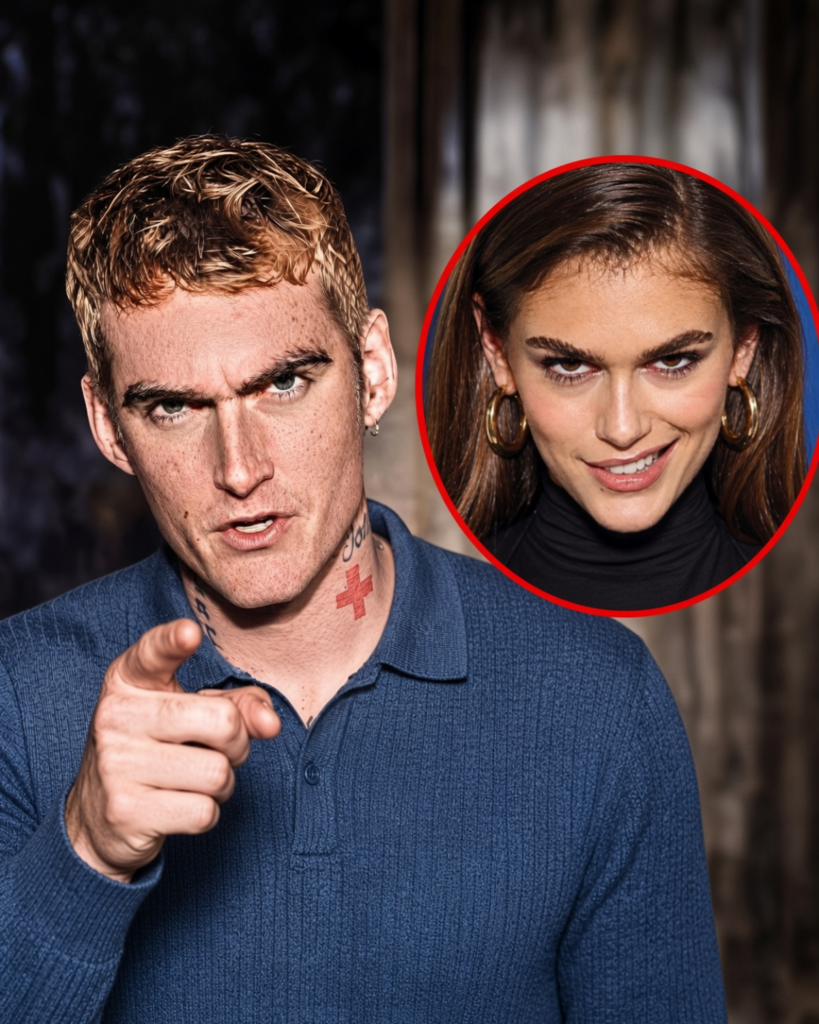
The last time people heard Presley Gerber talk for a long time, it wasn’t about fashion.
He was not talking about fame.
He was not talking about the advantages that came with his last name.
He started with his sister, not in a dramatic way, not in a way designed for headlines, but in a quiet, steady voice that suggested something deeper than most people realized.
To the public, Presley was the son of Cindy Crawford, the brother of Kaia, the face in the campaigns, the boy who grew up on the cover of magazines he was too young to read.
But to his family, he was something else entirely.
He was the one who surfed before school, the one who walked into class barefoot, still in his wetsuit, carrying his board under his arm, the one who turned his pain into a public conversation when most people would have hidden it.
And in the months before he died at age 27, he was honest about more than just his addiction and mental health.
He was also honest about the person who had been there for him through it all.
His sister.
What nobody knew was how much that bond had carried him, how much it had saved him, and how even when he felt like he was losing everything, he still had her.
Presley Walker Gerber entered the world on July 2nd, 1999, into a life that most people could only imagine.
His mother, Cindy Crawford, was one of the most recognizable faces on the planet.
His father, Rande Gerber, was a former model turned successful entrepreneur with ventures in nightlife, hospitality, and spirits.
By the time Presley was 15, he had signed with IMG Models.
By 16, he had made his runway debut for Moschino.
Campaigns for major brands followed.
Fashion weeks in Milan, Paris, and New York became part of his routine.
To the public, the Gerber name represented beauty, wealth, and access.
Family moments were sometimes photographed.
Vacations appeared online.
The children grew up in the spotlight, but with the kind of protection that money and influence can buy.
Cindy had built an empire that extended far beyond the runway, including skincare lines, home collections, and business ventures.
Rande co-founded Casamigos Tequila with George Clooney and built a portfolio across entertainment and hospitality.
The family lived in Malibu for most of Presley and Kaia’s childhood, a beachside home where the sound of the ocean was part of the daily routine.
Cindy and Rande coordinated their schedules so that at least one parent was always home.
They tried, by every measure available to them, to give their children a grounded upbringing despite the fame that surrounded them.
On social media, the picture was polished.
Siblings at fashion events.
Parents celebrating graduations.
Report cards posted with pride.
But beneath that image, something else was unfolding.
Presley and Kaia were born into a world most people could not imagine.
Their mother was a supermodel whose face was on magazine covers around the globe.
Their father was a businessman with connections across entertainment, hospitality, and spirits.
They lived in a seven-figure home on the Pacific Coast Highway with the ocean as their backyard.
But their childhood, in many ways, was ordinary.
Kaia later described their upbringing in a small coastal community where everyone knew everyone.
“You’re with the same kids from preschool to when you graduate,” she said in a Vogue interview published just weeks before Presley’s death.
Presley surfed before school.
He walked up to Malibu High School in his wetsuit, barefoot, carrying his surfboard.
He participated in team sports like water polo and swimming and grew up with the ocean as a constant.
He and Kaia were honor roll students.
Their father once posted both of their report cards online, a small proud father moment in a life that was often documented in far grander ways.
Presley graduated from high school but did not go on to attend university.
Instead, he pursued a career in modeling, balancing professional assignments with the demands of growing up in the public eye.
His work took him between Los Angeles and major fashion capitals as he tried to maintain some sense of normalcy while building a career of his own.
In interviews as teenagers, they spoke about being close.
“We’re a close family, especially me and my sister, so it’s definitely cool,” Presley told People in a joint interview with Kaia in 2018.
“We get to travel together half of the time, so it makes it a lot less lonely,” he added.
Kaia even then took on a protective role.
She described introducing Presley to people in the industry, explaining who designers were, and helping him navigate a world she was already beginning to understand.
“I love it because I just see him doing so well,” she said at the time. “He doesn’t really know much about the industry, so I get to teach him.”
To the world, they were the golden children of a supermodel.
Two kids from Malibu trying to figure out who they were when everyone else thought they knew.
To each other, they were just brother and sister.
Presley did not ease into modeling.
He was pulled in quickly, with little time to adjust.
In a February 2023 appearance on the Studio 22 podcast, he described the experience in blunt terms.
“Definitely getting thrown into the modeling industry,” he said. “It’s like you sink or swim. That’s the bottom line.”
He recalled the speed of the transition.
“I remember within the first week of signing, I’m like in New York. People are taking pictures of me with my shirt off,” he told the podcast host. “Like just my whole life changed within a month. And it was just a very profound experience because I had to grow up quickly.”
The work came fast.
Campaigns.
Runway shows.
Travel.
The constant pressure to look a certain way, to be a certain person, to fit into an industry that did not always prioritize mental health.
Presley spoke about the isolation that could come with the job, even when surrounded by people.
He said having Kaia in the same industry made it a lot less lonely.
But the loneliness was still there.
The pressure was still there.
And the coping mechanisms that began to form were not always healthy.
The first public sign that something was wrong came earlier than many realized.
In January 2019, at 19, Presley was arrested in Beverly Hills and charged with driving under the influence.
He failed a field sobriety test after a December 2018 incident and later pleaded no contest to a misdemeanor DUI charge.
He was sentenced to three years probation, ordered to complete a DUI program, and given two days of community service.
If you looked back at the time, you might have thought it was just a young adult mistake made by a rich kid.
But looking back, those close to him would later describe it as one of the first visible markers of a much longer struggle.
What nobody saw were the years that followed.
According to reporting after his death, Presley’s battle with drugs stretched across roughly a decade.
He later spoke of severe opioid addiction and a near-fatal fentanyl overdose that left him in a coma for days, an event he said happened in 2024.
He began to talk about it publicly, first in fragments, then in a more structured way.
In 2024, Presley launched a series on Instagram he called Mental Health Mondays.
The goal, he wrote, was to spark real conversations about the stuff most people hide.
In those videos, he described medications he had been prescribed over the years, the cycle of treatment and relapse, and the feeling of being trapped.
“It’s a trap, and they want you in the trap. They want you in the cycle,” he said in an April 2025 video, referring to the systems that he felt kept people dependent rather than healed.
He described mental health as a 24/7 job.
He spoke about the exhaustion of constantly managing his condition, the frustration of trying different treatments, and the sense that progress was always just out of reach.
In November 2025, after a short hiatus from social media, he posted, “It’s been a minute since I’ve posted. I had to step back and take care of my own mental health for a bit, but I’m coming back soon, stronger, clearer, and more intentional than ever.”
He went on, “When I started Mental Health Mondays, the goal was to spark real conversations about the stuff most people hide. It’s been incredible seeing how far that message has spread and how many people it’s helped. I’m proud that something I created has inspired others and started a bigger movement around openness and healing.”
To millions of followers, he was being brave.
To his family, he was being honest in a way that terrified them and gave them hope at the same time.
In December 2025, Presley shared an Instagram video, which he later deleted, speaking out about the medications he was taking while discussing his panic attacks and recovery.
“I feel like honesty is the best policy,” he said.
Before cataloging his current regimen, he described taking 1 milligram of buprenorphine twice a day, an opioid medication used to treat opioid use disorder.
He spoke about fluctuating doses of benzodiazepines and a small amount of Xanax when panic attacks struck “really, really bad.”
He told followers on Instagram that he also took Valium, though as he admitted with frank exhaustion, “I don’t know if it’s a little bit or a lot. Who knows anymore.”
“Unfortunately, I’ve had a lot of loss in many different forms recently. So that is not an excuse, but it’s the reason why I am where I’m at now,” he said in the video.
He said he wanted to reach people in many ways.
He wanted to help one person or a hundred.
That goal, simple, human, almost quiet, would later be repeated by his family after he was gone.
While Presley was fighting in public, Kaia was fighting in private.
In the September 2026 cover story of Vogue, published just a month before his death, Kaia spoke candidly about what his addiction had done to their family and to her.
She described their parents as having been “very, very private” for most of their lives.
“And now we have this absolute teacher, my brother, who says, ‘I’m going to be very human for everyone,'” she said.
That word would later have a meaning that no one could have imagined.
Kaia explained that watching Presley’s struggle changed the way she saw her own role in the family.
“When something like that happens in a family, it kind of levels everyone,” she told Vogue. “I think that’s also why I started to self-identify as the easy one and never wanted to ask for help.”
She had seen how much energy her brother’s crisis demanded.
She had seen her parents stretch themselves to support him.
And so, in her own way, she tried not to add to the burden.
But that did not mean she stepped away from him.
Sources after his death described Kaia and Presley as “insanely close,” more like best friends than siblings.
They had grown up together in the same small community, gone through the same schools, entered the same industry, and navigated the same pressures.
Kaia publicly celebrated his progress when he shared it.
She defended his choice to be open about his struggles.
And she described him, again and again, not as a cautionary tale, but as someone who had taught their entire family how to be more honest.
In the same Vogue interview, she talked about everyday things from their childhood, like going surfing, wearing wetsuits, and walking to school.
Small memories that, after his death, would read like fragments of a life that was far more fragile than it looked.
By mid-2026, Presley’s public posts had become less frequent.
He had spoken about being sober since July 2025, but the path was not linear.
There were setbacks.
There were moments of hope.
There were stretches of silence.
In May 2025, he and Kaia had appeared with their mother on Today, speaking about growing up with Cindy Crawford as their mother.
It was one of the last major joint interviews they would do together.
Behind the scenes, the struggle continued.
According to reporting after his death, Presley had voluntarily entered a rehabilitation facility in Santa Monica the weekend before he died.
The facility was Resolutions Living, a 7-bedroom, 9-bath mental health recovery residence.
It described itself as offering partial hospitalization and intensive outpatient treatment for depression, trauma, addiction, and co-occurring disorders.
Though it operated in a regulatory gray area and was not licensed to provide medical care, treatment there could cost between $5,000 and $15,000 a month, depending on the plan.
Presley checked in the night before his death.
A source later said he knew he needed help and had not been doing well.
On the evening of September 19th, 2026, he filmed a short video inside the facility showing his living quarters.
It would be one of the last pieces of footage anyone would see of him alive.
The morning of September 20th, 2026, began like any other at Resolutions Living.
At approximately 9:35 a.m., Santa Monica police received a call reporting a cardiac arrest.
Another call came in reporting an overdose.
Officers arrived at the residence on Berkeley Street in Santa Monica.
They found Presley unresponsive in one of the bedrooms.
He was pronounced dead at the scene at 9:45 a.m.
Santa Monica police said detectives were investigating his death as a suspected overdose and that there was no indication of foul play.
The Los Angeles County Medical Examiner later indicated that he had died at the rehabilitation facility, but an official cause and manner of death had not yet been determined at the time of initial reporting.
Detectives began trying to trace the supplier of the drugs he had taken.
State regulators later launched an inquiry into whether the facility was illegally providing services that required a state license.
The family released a brief statement through their representative.
“The family is asking for privacy during this very difficult and painful time.”
Cindy and Rande began planning a small private memorial service in Southern California.
Presley’s remains were cremated at Rose Family Funeral Home, and the family planned to keep his ashes at their Malibu home.
In the days that followed, Kaia did not post immediately.
Sources said she was struggling to cope with the loss and heartbroken.
Those who knew them described the siblings as “insanely close,” with a bond that went far beyond typical brother-sister dynamics.
But she had already said something, something that now carried a different weight.
She had talked about how his willingness to be vulnerable had changed their family, how his honesty had forced them all to confront things they might otherwise have avoided.
“When something like this occurs within a family, it tends to impact everyone equally,” she said.
She had also revealed her own coping mechanism, becoming the child who did not ask for help, who tried not to add to the strain.
After his death, those words read differently.
They were no longer just reflections on a difficult period.
They were a record of how deeply his struggle had shaped her and how much she had loved him through it.
A source later told People that Cindy had said, just months before Presley’s death, that she was so proud her kids love each other.
That pride now carried a grief no parent should have to bear.
In the weeks after Presley’s death, attention turned to the place where he died.
Resolutions Living, the Santa Monica facility where Presley spent his final hours, came under investigation by California state regulators.
The California Department of Health Care Services launched an inquiry into whether the residence was illegally providing services that required a state license.
The facility operated as a mental health recovery residence but was not authorized to provide medical care.
Detectives were trying to trace the supplier of the drugs Presley had taken.
The investigation would continue for weeks, with no immediate public updates on findings.
The facility’s operators, Dr. Raza Nabavei and Dr. Miam Akbar, faced questions about their practices and the level of care provided to residents.
Friends of the doctors expressed concern about the scrutiny, while others raised alarms about the regulatory gray area in which the home operated.
For the Gerber family, the investigation was secondary to their grief.
They focused on planning a private memorial away from media attention.
Presley Gerber did not want to be remembered only as a tragedy.
He wanted to be remembered as someone who tried.
Someone who spoke when it would have been easier to stay silent.
Someone who used his platform not just to sell products or pose for photos, but to say, “This is hard, and you are not alone.”
“When I started Mental Health Mondays, the goal was to spark real conversations about the stuff most people hide,” he had written. “It’s been incredible seeing how far that message has spread and how many people it’s helped. I’m proud that something I created has inspired others and started a bigger movement around openness and healing.”
He did not know, when he wrote those words, how soon they would be read in the past tense.
He did not know that his sister would repeat them in spirit when she honored his memory.
He did not know that his parents would stand over his ashes in Malibu with the ocean still rolling in the background.
The same ocean he had surfed before school.
The same beach that had been part of his life from the beginning.
In the end, that is the story Presley told.
Not a story of fame or tragedy alone, but a story of a brother and a sister trying to be human in a world that wanted them to be perfect.
He wanted help.
He wanted answers.
He wanted a way out.
And through it all, he had her.









