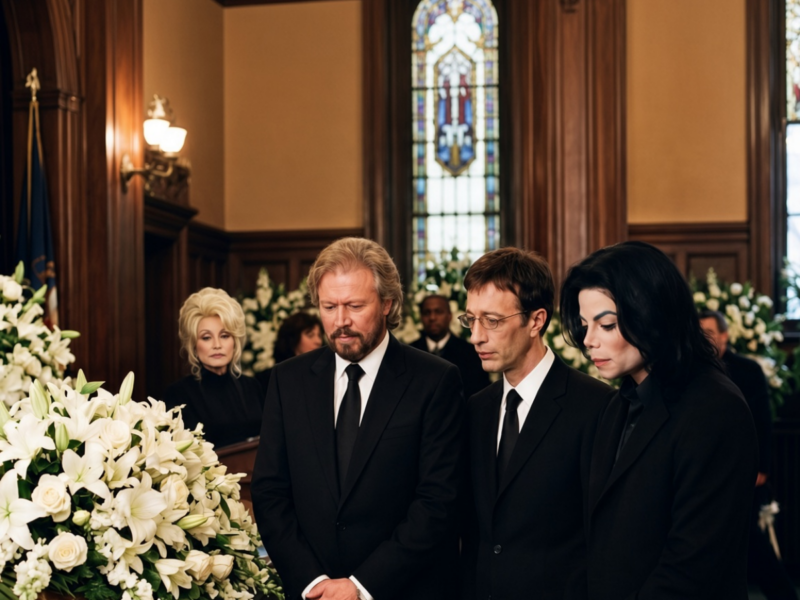
Barry Gibb and Michael Jackson Stood at Maurice’s Casket — What Barry Said Crushed Michael and Robin.
Maurice Gibb died on January 12th, 2003, in a Miami hospital from complications following surgery on a strangulated intestine.
He was 53 years old.
The surgery had been called routine in the way that surgeries are sometimes called routine before something goes wrong.
And something went wrong in the early hours of that Sunday morning, quietly, without warning, the way the worst things always seem to go.
His heart stopped.
The doctors could not bring it back.
And with it, something at the center of the Bee Gees stopped, too.
Something that had been beating since three boys from the Isle of Man sang together in a row house in Manchester and decided, without anyone asking them to decide anything, that music was what they were for.
Barry Gibb found out by telephone.
He was 56 years old, and he had known Maurice his entire life.
They had shared rooms and stages and studios and arguments and decades.
And the voice on the phone told him now that Maurice was gone.
He sat with it the way you sit with something that cannot possibly be true but is.
The silence in the room after he hung up was a different kind of silence than any he had known before.
It was the silence of a world that had just become permanently smaller, and there was nothing he could do to change its size.
Robin Gibb was 53, the same age as the brother he had just lost.
Born 14 months after Maurice in December 1949, he received the news on the same morning and in the same way, a telephone call that rearranged the rest of his life in the space of a sentence.
Robin and Maurice had been the twins of the group in every sense except the literal one.
Closest in age.
Closest in temperament.
The two younger brothers who had always run slightly behind Barry in birth order but never in anything else.
To lose Maurice was to lose the person who had shared his exact experience of the world in a way no one else had or ever could.
They had grown up side by side.
They had competed and quarreled and harmonized and forgiven and carried one another across five decades of a shared life.
And now half of that life had simply gone.
The days between January 12th and January 15th passed the way such days pass, in arrangements and details and an endless stream of people wanting to say something useful when nothing useful could be said.
The Riverside Funeral Chapel in Miami Beach was chosen because the Gibb family had made their life in Miami, had built their American story there across the long run of decades since they had first arrived from Australia in the late 1960s.
Maurice was being returned to the city where so much of his best work had been made, where the Saturday Night Fever sessions had unfolded in the Criteria Studios on Northwest 183rd Street, where the sound that had briefly colonized the entire popular world had been assembled note by note from the particular chemistry of three brothers who had been making music together since childhood.
People came from everywhere.
It was that kind of life Maurice had led, warm and wide, and without particular regard for the distinctions that matter to most people in the entertainment industry.
He had been the silent third of the trio for so long, the one the cameras found last and the interviewers reached for when Barry and Robin had already spoken.
But the people who had worked with him knew the truth.
The thing holding the Bee Gees together had always been Maurice.
He was the middle son, the mediator, the one who could find the key change nobody else heard and could calm a room that Barry’s intensity and Robin’s emotion had pushed to its edge.
His absence would leave a gap that no amount of rearranging would fill.
Michael Jackson arrived at the Riverside Funeral Chapel on the morning of January 15th in the way Michael Jackson arrived at places in 2003.
Quietly, but not invisibly, with a weight of presence that the room adjusted around without quite knowing it was doing so.
He was 44 years old and wearing a black formal suit, his dark hair framing the pale face that had become one of the most recognizable in the world.
He and the Bee Gees went back to the years when both of them had been at the absolute center of popular music.
The late 1970s, the era of Saturday Night Fever and Off the Wall, the era when the world had been briefly and entirely reorganized around a particular combination of rhythm and melody and the human voice.
He came because Maurice had been his friend.
He came because Barry was his friend.
He came because there are moments that exist entirely outside of whatever difficulty the world has placed between people, and this was one of them.
Dolly Parton came because she had known all three brothers for years.
And because she understood grief the way people who have survived it understand it, not as something to manage or contain, but as something to sit beside without flinching.
She arrived in black, her blonde hair bright against the dark fabric of her dress, and she moved through the chapel with the grace of someone who has learned how to hold enormous sorrow without being taken apart by it.
She found Robin near the entrance and held both his hands in hers and said nothing for a long moment.
Robin looked at her, and something in him recognized that the nothing was the right thing.
The only thing that was genuinely equal to what the morning required.
The service was what such services are.
Music, because there could hardly be anything else.
And words that tried to contain a life and could not, because lives cannot be contained.
There were tributes that were honest and tributes that were formal and a silence in the chapel that arrived and stayed and did not leave when the words were finished.
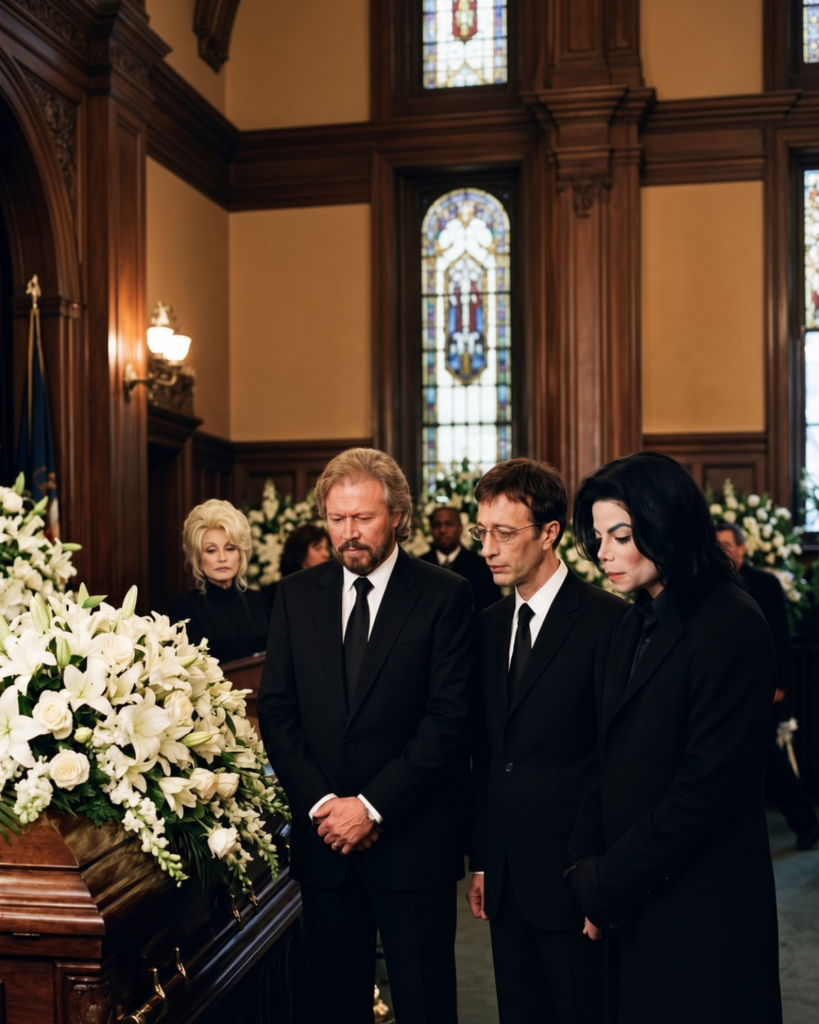
Maurice’s casket stood at the front of the room in the particular stillness that such rooms hold.
And the people who had loved him and worked with him and built careers alongside his sat in the dark wood pews and did what human beings have always done in such places.
They tried to understand what it meant that a person was simply no longer there.
And they found, as people always find in such rooms, that understanding was not something the room could provide.
Afterward, when the formal service had concluded and the room had shifted into the quieter movement of people finding one another, Barry and Michael Jackson came to stand at the casket together.
It had not been arranged.
It was not part of any order of service or plan.
Barry had been moving through the morning in the careful, controlled way of a man who has decided that holding himself together is what is currently required of him, speaking when spoken to, accepting the condolences that came in waves, maintaining the composed surface that was the only thing standing between the morning and something he would not be able to walk back from.
Michael had been near him for most of it, close without crowding, present without demanding anything.
And at some point they were both at the front of the chapel, and they were both looking at Maurice, and neither of them was saying anything.
Robin was behind them.
He had been watching Barry all morning with the particular attention of a younger brother who knows an older one is not all right and cannot do much about it except stay close.
He had positioned himself within reach without intruding, three feet behind the two men at the casket, and he waited.
The way people wait when they sense something is about to be said.
What Barry said, he said quietly.
He did not announce it or turn to Michael with the posture of a man about to unburden himself.
He kept his eyes on Maurice, and he spoke in the voice of someone saying a thing they have been carrying since the moment the phone rang three days ago and can no longer carry alone.
He said that in the months before Maurice got sick, the two of them had not been talking much.
He said there had been a distance between them, the kind of distance that grows in the way distances grow between people who are busy and slightly hurt and not quite sure how to begin the conversation that would close it.
He had told himself there was time.
There was always time.
The call could be made next week.
The unspoken thing could be spoken when the moment felt right.
The moment had not come.
Maurice had gone to the hospital, and then he had died, and the conversation had never happened, and now it never would.
And he did not know how to live with that.
Michael Jackson listened without speaking.
He was standing close enough to Barry that their shoulders were nearly touching, both of them facing the casket.
And he listened the way he listened when something real was being said.
Completely.
Without interruption.
Without the slight flinching that most people do when the weight of what they are hearing becomes too close.
He understood what Barry was telling him, not merely as a piece of information, but as the specific texture of what it felt like.
The bomb knowledge that the last version of a relationship was not the version you would have chosen.
That the person you loved had known you last in a moment of distance rather than closeness.
That the chance to close that distance had been postponed one too many times.
He said quietly, “I know what that is.”
Robin heard every word.
He was three feet behind them, and he heard it all.
And the thing that happened to his face was not surprise.
It was recognition.
And recognition was almost harder than surprise would have been.
Because Robin had known.
He had watched the distance between Barry and Maurice form and grow and had not known how to close it from the outside, had not known how to be the bridge between his two brothers without making the distance more visible than it already was.
Now Maurice was in a casket in front of all of them, and the conversation had not happened, and none of them could change that.
Robin did not speak.
He put his hand on Barry’s shoulder from behind and left it there.
Barry stood at the casket for a long time after that, long enough that the room gradually emptied around them.
Long enough that the other mourners had moved to the corridor, and the light had changed through the chapel windows, and the three Gibb brothers, two of them standing and one of them not, were nearly alone in the room.
He looked at Maurice and tried to memorize the face, which is what people do when they understand they are seeing something for the last time.
He tried to find inside it the brother who had sat beside him in recording studios for 40 years.
The one who always heard the chord before anyone else did.
The one who could locate the exact harmony in the space between Barry’s voice and Robin’s and hold it there without anyone asking him to.
The words Barry said at the casket stayed between him and Michael for a long time.
Michael never spoke publicly about what he heard that morning, which was the kind of kindness that said something about what he understood friendship to mean.
Robin never spoke publicly about having been there either, which said something about what he understood brotherhood to require.
Barry carried what he had said, and what he had failed to say while Maurice was still alive to hear it, as the weight that does not lift.
He has spoken in interviews over the years about hearing Maurice in the music, about reaching for a harmony that is no longer there, about the particular silence where the middle voice used to be.
He has said that he still expects sometimes to pick up the phone and find Maurice on the other end of it.
He has said that the years since January 2003 have had a different quality than the years before, not worse in every way, but fundamentally altered.
The way a room is altered when something load-bearing is removed.
The Bee Gees did not reconvene.
Barry and Robin made music together in the years that followed and maintained what could be maintained and kept performing and kept recording.
And in public they kept alive the professional entity that 40 years of shared work had built.
But the group as a living thing, as the specific three-voiced creature that had made Saturday Night Fever and How Deep Is Your Love and the 60 years of music that preceded and followed those years, ended in a Miami hospital in the early hours of January 12th, 2003, when Maurice Gibb’s heart stopped.
Robin Gibb died nine years later in May of 2012 from kidney failure following a long illness.
Barry was at his bedside.
Whatever the last things were that passed between them, they were not words left unspoken.
Barry had learned in the Riverside Funeral Chapel on a January morning in 2003 what it cost to leave things unspoken.
He had said it aloud to Michael Jackson with his hand resting on his brother’s casket, in a voice that did not ask for anything except to be heard.
And Michael had heard it, and Robin had heard it, and the room had held it.
The way rooms hold the things that are said inside them when there is no one left to say them.









