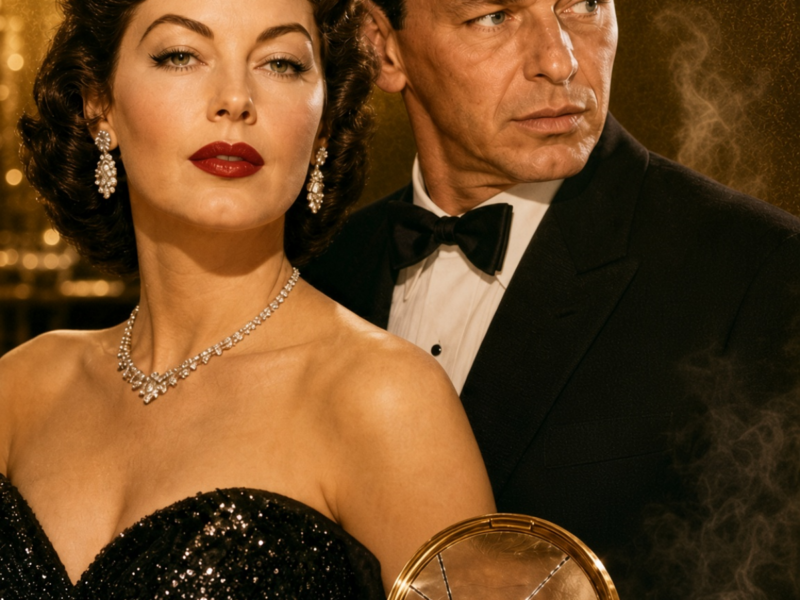
Ava Gardner’s Marriage To Frank Sinatra Was Much Nastier Than You Thought.
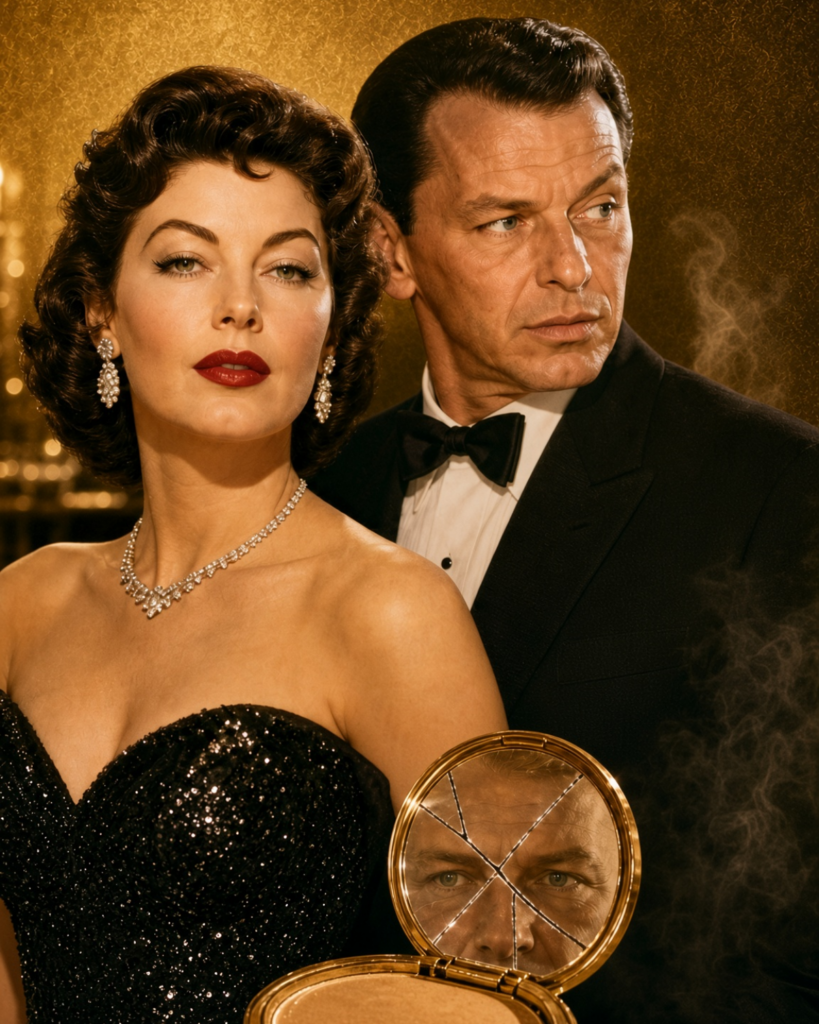
You know the face.
The most beautiful woman in the world, they called her—and for once the studio publicity might have been telling the truth.
Ava Gardner. The barefoot contessa. The femme fatale. The green-eyed girl from nowhere who ended up on the arm of the most famous singer alive.
And you know the couple. Frank and Ava—the great romance of the century, the way old Hollywood told it.
Two gorgeous, doomed people who loved each other too much to make it work.
That’s the postcard. It leaves a lot out.
It leaves out the drinking and the public brawls and the night the police were called to a hotel because a gun had gone off.
It leaves out the fact that when they married, his career was finished and his bank account was empty—and it was her money and her name that carried them both.
It leaves out what she gave up to be with him, and what it cost her body and her life.
And it leaves out the strangest part of all—the part that makes this more than a tragic love story.
That the woman everyone remembers as Sinatra’s greatest heartbreak was the one who saved him.
Keep that in mind. We come back to it.
This didn’t start in Hollywood, or in a nightclub, or on a red carpet.
It started on a dirt-poor tobacco farm in North Carolina with a barefoot girl who was never even supposed to leave.
Her name was Ava Lavinia Gardner, born in 1922 in a place called Grabtown, North Carolina, near towns with names like Pine Level and Four Oaks.
She was the seventh and youngest child of Jonas and Molly Gardner.
Her father was a quiet, gentle man who farmed tobacco and cotton and loved his daughter deeply.
The poverty was real, and it defined her early life.
When Ava was very young, the bank took the family’s farm and their home.
Her father was reduced to working as a sharecropper on land he no longer owned, and her mother ran a boarding house to keep the family fed.
When Ava was sixteen, the anchor of her childhood was pulled away.
Her father died.
The girl who felt safe only in his company was on her own.
She had almost no education. By her own admission, by the time she was grown, she had read exactly two books: the Bible and Gone with the Wind.
She was studying to become a secretary, expecting a small and ordinary life, when a photograph changed everything.
Her brother-in-law, a photographer, put a portrait of her in his studio window in New York.
An MGM talent scout walked past, saw the face, and the machine of Hollywood swallowed her whole.
They signed her in 1941.
They fixed her North Carolina accent with a voice coach. They taught her to walk and pose and photograph like a goddess.
And she said something about that later that tells you she was never fooled by any of it. Listen.
She said none of the kids who came out of MGM were really actors. They were just good to look at.
She knew exactly what she was to them.
For five years, they barely used her—bit parts, one-line roles, a beautiful face in the background of other people’s pictures.
And then, in 1946, a film called The Killers changed her life.
Playing a femme fatale opposite Burt Lancaster in a hard-shadowed film noir built from a Hemingway story, Ava Gardner walked on screen and the whole country stopped.
The film was a smash. Overnight, she was a star.
Notice the date. 1946.
That is years before Frank Sinatra was anything to her.
Whatever you have been told about her being some singer’s beautiful accessory, the timeline says the opposite.
She made her own name on her own work, and everything that came later happened to a woman who was already famous in her own right.
By the time Frank Sinatra got serious about her, Ava Gardner had already been married twice, and both had taught her something hard.
She married the MGM star Mickey Rooney at nineteen.
He was the biggest box office draw in the country, and by her account, a serial cheat.
It lasted barely a year.
But watch what she did on the way out, because it is pure Ava.
She divorced him for his adultery, and then she agreed not to make the reason public, so that the scandal wouldn’t damage his career.
Sit with that.
Twenty years old, wronged, and already choosing to control the story herself, rather than let it be a weapon.
She protected the man who’d hurt her on her own terms, because the narrative was hers to give or withhold.
Then came the bandleader Artie Shaw—a brilliant, domineering man who treated her, she felt, like an uneducated child, and that lasted about a year, too.
Two divorces before she was twenty-five.
She would say later she kept trying to find the kind of steady, secure love her quiet father had given her, and kept not finding it.
She was looking for safety. She kept marrying storms.
And then came the biggest storm of them all.
She had first met Frank Sinatra back in the 1940s, when she was still married to Rooney, and Frank was married to Nancy—his childhood sweetheart and the mother of his three children.
She remembered it vividly decades later for her memoir.
Frank came over to their table in the studio commissary, and in her words, he was like a god in those days, if gods can be sexy. A cocky god. He reeked of sex.
He said something to her about how if he’d seen her first, he’d have married her himself.
She paid it no attention. He was married. He had kids. Nothing happened then. Not yet.
But by 1949, when they met again at a party, the fuse was lit, and it did not matter to either of them who else was standing in the room.
Their first date became legend.
They fled the party, drove drunk into the desert, and shot out the streetlights.
Frank was still a married man with three children, and his own publicist warned him the public would turn on him if the affair got out.
It got out.
The public blamed Ava.
She said she received stacks of letters calling her a scarlet woman, and worse.
And here is the detail that tells you what this marriage was before it even began.
The day before the wedding, Ava received a letter.
It was from another woman who claimed Frank had been involved with her for months while he was with Ava.
Read that again.
The night before she married him, she was handed proof—or at least accusation—that he was already unfaithful.
She was consumed with rage and jealousy, and she married him anyway the next day.
She walked in already knowing, on some level, exactly who he was.
That is not a fairy tale beginning. That is a woman marrying a storm with her eyes open.
Watch how this began, because it is exactly how it would end.
It began with a marriage being torn up.
Frank dragged his feet leaving Nancy—so much so that at one point Ava made him telephone Nancy in front of her to confirm he’d actually asked for the divorce.
Nancy, who did not want it, finally gave in.
Frank’s divorce came through in 1951, and days later, on November 7th, Ava married him.
It was her third wedding and her last.
By the early ’50s, Ava Gardner was at the absolute summit.
The publicity machine called her the most beautiful animal in the world, and audiences seemed to agree.
She was pulling down star money, headlining major pictures, her face on magazine covers across the globe.
She was, in every measurable way, a bigger name than the man she was about to marry.
And here is what almost no one remembers about the year they married.
Frank Sinatra was finished.
It’s hard to picture now, when the name means the whole American century, but in 1951, Sinatra’s career had collapsed.
The bobby-soxers had grown up. His voice had faltered. His records weren’t selling. His film contract was dropped. His agent let him go.
He was broke.
And the man who was supposed to be the big catch was, in fact, the one who needed rescuing.
Ava was the one who helped pull him back from it.
She was, at that moment, one of the biggest stars in the world, and she had the fame and the money that he no longer did.
When they were together and he wanted to buy her gifts, he sometimes had to charge them to her account, because the money was hers.
When she went to Africa to film Mogambo in 1953, Frank could not afford a plane ticket to come see her, and she bought it for him.
Picture that for a second.
The most famous, swaggering man in show business, unable to pay his own airfare, flown to his movie star wife on her dime.
And she did something bigger than money.
When the part of Maggio came up in From Here to Eternity—the role everyone knew could put Frank back on the map—it was Ava who used her own Hollywood power to press the studio to give it to him.
He got the role. He won the Academy Award for it in 1953.
His career roared back to life, bigger than it had ever been.
Read that carefully, because it is the buried heart of this whole story.
One of the most celebrated comebacks in the history of American entertainment, and his wife helped push it into being.
Plenty of other hands were on it, too—his agents, the studio, the producers who took the gamble.
But she was one of them, and she is the one history forgot to credit.
She spent her fame on him. She spent her money on him.
And the moment his career came back to life, the marriage began to die.
Because success didn’t calm Frank Sinatra. It freed him.
The better his career got, the worse the marriage got.
It is one of the oldest, saddest patterns there is: while he needed her, they clung together. Once he didn’t, the balance broke.
Both of them drank hard. Both had tempers that could level a room.
They loved, by every account, as fiercely as two people can love, and then they fought just as fiercely—in public, in hotels, in restaurants, on film sets—until the fighting was most of what there was.
Friends described a couple who adored each other and could not be in a room together for long without it catching fire.
One writer who knew the story put it simply: if she loved him, she also hated him.
Frank wanted to own her, to possess her completely, and possession was the one thing Ava Gardner would never allow.
She had run from it her whole life. She ran from it in him, too.
The jealousy ran in both directions and it was constant.
There was one night at the famous Copacabana nightclub, in front of a packed room, when Ava had a blazing argument with Frank, stormed out, and went straight to the apartment of her ex-husband Artie Shaw—precisely because she knew it would drive Frank wild with jealousy.
It worked.
That was the game they played with each other, and neither of them could stop playing it.
They used other people as weapons. They used the press as a weapon.
They knew exactly where each other’s wounds were, and they pressed.
And the drinking poured over all of it, making everything louder and sharper and harder to take back.
Frank himself, looking back years later, put it with a rueful kind of honesty.
He said he should have known from the start that anything that burned that hot was bound to burn out.
But, he added, while it was going on, he was having a ball.
That was the marriage in one line: a thing too hot to survive that neither of them would have traded while it lasted.
But the thrill had a cost, and the cost fell on her.
The deepest wound of the marriage is one that has to be handled with care, because it was hers to carry.
During these years, Ava became pregnant more than once and chose to end the pregnancies.
She said in her own words that she did not believe the marriage could give a child the stable home it deserved.
Think about what that admission contains.
A woman in an unstable, volatile marriage making a wrenching private decision because she could see clearly what her own life was, even while she was still inside it.
That is not a tabloid detail. That is the clearest possible measure of how much this marriage cost her.
The trust was breaking, too.
For Ava, the problem she could never get past was that she could never fully trust Frank.
She said in her memoir that a phone call from him telling her he was in bed with another woman was the moment something in her finally closed.
That was the end.
They announced their separation in 1953, barely two years into the marriage.
What came next has been reported for decades, and it needs the same care.
In the wreck of the separation, Frank was in terrible shape.
It was reported that in his despair he harmed himself, and on another night he telephoned Ava saying he wanted to end his life, and a shot was heard down the line.
Ava rushed to his hotel. People there called the police.
When she and the officers arrived, they found he had fired into his own mattress.
Whatever that was—a genuine collapse or a desperate performance to pull her back—it tells you the temperature of this marriage.
This was not glamour. This was two people who could not live together and could not quite let go, exhausting themselves against each other.
She was the one who filed.
That matters, so let’s be exact about it, because the easy version of this story makes her the woman who was left.
She wasn’t.
Ava Gardner filed for the divorce in 1954. She was the one who decided.
The marriage was effectively over in 1953, though the divorce itself would not be finalized until 1957, dragging on for years across two continents while she rebuilt her life in Europe.
And here is where her whole character comes clear.
She did not fall apart into the role of the tragic discarded wife.
She packed up and left the country.
In 1955, she moved to Madrid at thirty-three to escape the American press and simply live.
What people mistook in her for coldness was really a refusal to be anyone’s victim.
She’d grown up watching the bank take her father’s land and reduce that gentleman to nothing.
And she had decided long ago that the world would not simply happen to her.
Look at what that life was.
She danced flamenco until dawn.
She befriended Ernest Hemingway, who had personally pushed to get her cast in his films, and stayed at his home in Cuba—where, the story goes, she swam naked in his pool and he ordered the staff never to drain the water.
She took up with Spain’s most famous bullfighters.
When a director asked her about John Ford, who directed her in Mogambo, she called him the meanest man on Earth, thoroughly evil, and said she adored him.
That was Ava. Sharp, funny, afraid of no one.
And the film that defined this stretch of her life carries an irony almost too perfect.
In 1954, she starred in The Barefoot Contessa, playing Maria Vargas—a Spanish dancer who claws her way up to become a world-famous film star, a fiercely independent woman who refuses to be owned by any of the powerful men circling her.
The studio marketed Ava in that very film as the world’s most beautiful animal.
Set those two things side by side.
On screen, she was playing a woman who would not be possessed. Off screen, they were selling her as a beautiful creature to be looked at.
She spent her whole life in the gap between those two ideas, and she chose the first one.
Now, here is the part that turns a stormy divorce into something stranger and truer.
They never really let go of each other, not for the rest of their lives.
Even after the divorce, Frank kept a photograph of Ava taped inside his dressing room wherever he performed, for years.
She called him, more than once, the love of her life.
He went on managing pieces of her financial affairs into the 1970s, long after any obligation to.
When she had a stroke in 1986 and her health began to fail, it was Frank who quietly stepped in.
He wanted her seen by a specialist, and he arranged and paid for a medically staffed private plane—though she could have paid for it herself.
He called her hospital room.
When she died in 1990, he mourned her privately and hard.
And still, she never sugared it.
Her last years were not gentle.
Two strokes in 1986 left her partly paralyzed, and she spent her final stretch largely a recluse in her London apartment.
Her closest companions: her longtime housekeeper and her Welsh corgi.
The woman the whole world had called the most beautiful alive, alone now in a quiet flat, her body failing her while she was still only in her early sixties.
And it was then, short of money and short of time, that she decided to tell her own story.
She put the choice in the bluntest terms she could: either she wrote the book or she sold the jewels.
She wrote the book.
She sat for hours of recorded conversations about her whole life—Frank included—and told it unsoftened, unflattering to herself where it needed to be.
A barely schooled girl from a failed tobacco farm who by her own count had read exactly two books as a young woman, spent the last of her strength making sure the story of her life would be heard.
She had spent her whole career being looked at. At the end, she insisted on being heard.
She died in London in 1990 at sixty-seven, of pneumonia.
Her housekeeper took her body home to North Carolina, and she was buried near her parents—near the ground where the tobacco farm had been—laid down at last beside the gentle man whose company was the only place she’d ever felt safe.
Both things were true all the way through.
She called him the love of her life, and she divorced him, and she meant it.
He worshipped her, and he made her miserable.
She never once pretended it was simple, and that refusal is the most honest thing in the whole story.
So go back to Grabtown—the barefoot seventh child on the failing tobacco farm, the girl who felt safe only next to her quiet father, who read two books and expected to be a secretary.
Look at how the story was supposed to go, and at what actually happened, because they are opposites three times over.
She was supposed to be the one who needed Frank Sinatra.
In truth, when they married, it was Sinatra who needed her—her fame, her money, her power to hand him back a career.
She was supposed to be the woman Frank Sinatra destroyed, the tragic beauty broken by loving him.
In truth, she survived him.
She left, she rebuilt, she lived on her own terms, while he became the legend the world now knows—in part because of what she did for him.
And Sinatra was supposed to be the legend, the one whose version of things would last.
In truth, it was Ava—the barely schooled farm girl—who kept the memory of what actually happened, and who sat down at the end of her life and told it in her own words.
He got to keep the legend.
She kept the truth of how it was really built.
Ask which one of those is worth more.









