
At 94, Michael Jackson’s Mother Reveals The DARK Truth.
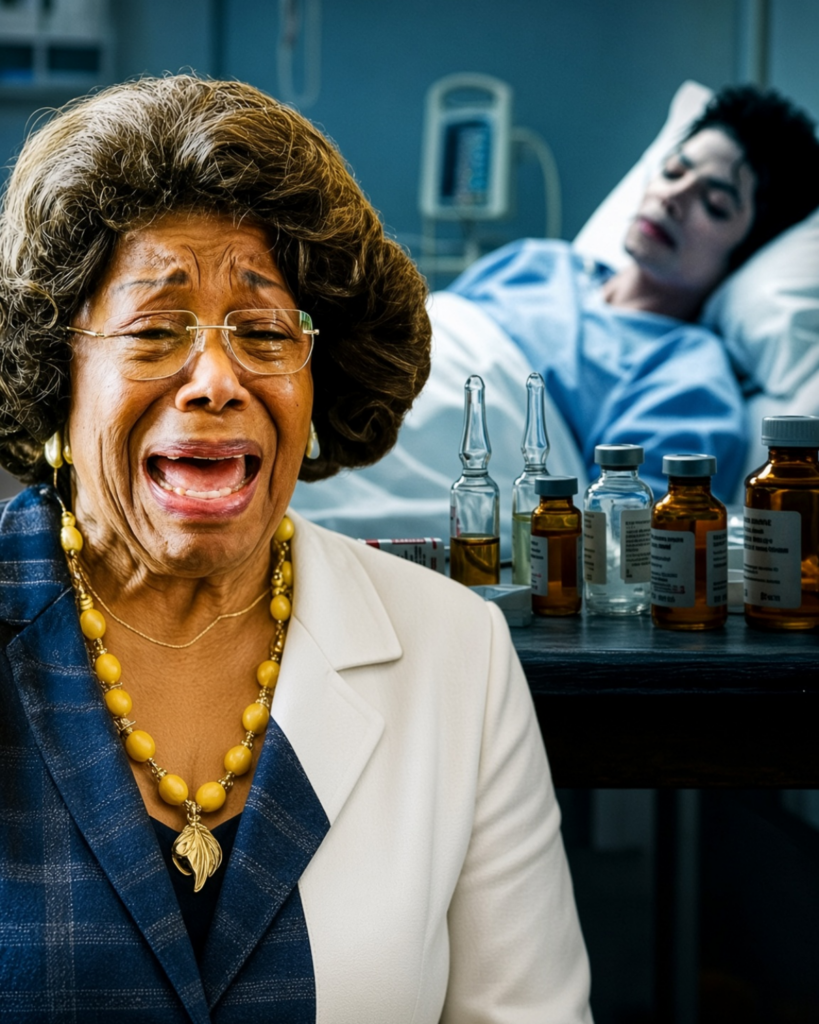
It was the worst day of my life.
Never had that feeling before.
Michael Jackson was not merely a legend.
He was a living testament to the brutal cost that fame can exact.
When the lights dimmed, what remained was not applause, but a man huddled in a locked room, his face covered by a blanket, terrified of the world’s very gaze.
And then, his mother, Katherine Jackson, tore open the stage curtain, revealing a truth that had been deliberately overlooked for decades.
He didn’t live in the light.
He was consumed by it.
Every word she spoke was a sharp incision into the entertainment industry’s polished facade.
From a childhood under strict control to endless sleepless nights, from the white patches on his skin to the masks covering his children.
Everything was unveiled by her with a tenderness that was piercingly, heartbreakingly sharp.
People saw the bright lights.
She saw the deep marks on her son’s shoulders.
They called him the King of Pop, but she only saw a frail son huddled in the recording studio all night, not out of passion, but out of fear of not being good enough.
When Michael stepped onto the stage, the world erupted.
But Katherine Jackson, at home, clenched her hands and sighed, knowing that each moment pulled him further away from himself.
No one spoke of the price of becoming a legend at just eight years old.
Michael once cried in his mother’s arms after a performance everyone thought was transcendent.
She recounted, her voice slow: “He was exhausted, but he didn’t know how to stop. They wouldn’t let him.”
“They”—she didn’t specify, but listeners understood enough.
It was the contracts, the market, the expectations as heavy as boulders.
It was everything placed upon the shoulders of a dark-skinned boy in an industry that once found it difficult to accept such an artist shining too brightly.
She didn’t speak much about skin color, but it was always present, quietly like a shadow.
From the beginning, she felt something was unfair.
Michael sang beautifully, danced gracefully, but always had to do double, triple the effort to be recognized.
She vividly remembered one time he was nominated for a major award, but they dared not broadcast his performance during prime time.
When she asked why, they evaded.
Michael just smiled, but his eyes were distant.
“He just accepted things,” she said, “even when it wasn’t fair.”
Strangely, the more famous he became, the more he withdrew.
No longer the mischievous boy in the backyard, the later Michael stayed only in the studio, his private room, or the hospital.
Once, he told her: “Mom, I can’t go to the grocery store. I can’t walk in the park. They look at me like I’m not real.”
That wasn’t arrogance, but the feeling of being disconnected from ordinary life, from a world every normal child had the right to experience.
She remembered him asking, “Why can’t I just be normal?”
She couldn’t answer.
Michael’s greatest paradox was this: he craved love, but the more he received, the more afraid he became.
The cheers, the crowds, the camera flashes—they were like waves sweeping him away.
Not gentle waves, but a raging torrent pushing him further from inner peace.
“He wanted peace, not applause.”
That was a phrase Katherine repeated like a persistent, aching refrain.
There’s a little-known fact.
Michael once had a small area in his home he called his quiet corner.
Just an armchair, an old bookshelf, a few scented candles.
There, he didn’t sing, didn’t dance, didn’t transform.
He just sat.
No background music, no fans.
And she, each time she passed by, would quietly close the door, allowing her son to simply be himself, if only for a moment.
The world remembers Michael as a dazzling image.
But Katherine Jackson, at 94, still remembers him in dim light, wrapped in a thin blanket, trying to find sleep.
When everyone cheered, she only wished for his peace—not in memory, but in his living days.
But that life, from very early on, was no longer his own.
It belonged to the stage, to the tours, to millions of people—everyone except himself.
Fathers often teach their children with love.
Joe taught with a gaze as cold as steel and heavy leather shoes.
On some afternoons, as the sun set behind the backyard of their Gary, Indiana home, the Jackson children didn’t run or laugh.
They tensed up, they fell silent, just because they heard the car door close outside.
He was home.
Katherine never called Joe evil.
She wasn’t one to assign blame.
But she recounted it in the steady voice of someone who had lived with memories for too long.
Joe believed fear was the path to greatness.
Well, he was right in a way.
From a noisy, dusty steel mill, he trained a teenage band that became world famous.
But she also wondered countless times: was that price worth the lost childhood?
Michael never said, “I hate you, Dad,” even when his eyes were red and his hands trembled from practicing dance too long.
The boy never dared to complain, but his mother saw everything.
Michael’s tiny feet swinging under the dinner table, constantly shaking with anxiety.
When he heard Joe clear his throat in the next room, he would jump.
One day, Michael, only seven years old, said: “Mom, I don’t want to mess up. If I do, he’ll know.”
It was strange, because even when Michael became a man celebrated by the entire planet, Joe’s shadow remained.
Once Katherine caught her son, then over thirty years old, huddled alone after a performance.
He said nothing, just gripped her hand tightly.
She asked what was wrong.
Michael just shook his head, then whispered, “I can still hear his footsteps.”
That statement, like a small needle, pierced unimaginably deep.
Joe didn’t drink, didn’t wander.
He was serious.
The only thing was, in his mind, every child was a project, an opportunity to rise above.
He believed if his children were soft, they would never escape poverty.
Katherine once told Joe, “You’re too hard on them.”
But he replied coldly, “Soft kids don’t make it out of Gary.”
The Jackson 5 succeeded immensely.
But Katherine remembered there were times Michael stood before a mirror, not to adjust his hair, but to practice the perfect smile.
Not out of joy, but because he had to make others happy.
That smile—partly talent, partly armor—shielding him against the piercing gazes of a father who had programmed his son’s every movement.
It was rumored that Michael once prevented Joe from getting close to his own children when he had his family.
No one confirmed it, but close associates said he was very firm about that.
Perhaps not out of hatred, but out of fear that his children would also have to learn how to become great through trembling.
Katherine said nothing about it, only nodded slightly when someone mentioned it, as if she understood too well but needed no confirmation.
To Katherine, Joe was not a bad person, but he didn’t know how to love gently.
His love was discipline, compulsion, prioritizing goals over emotions.
It was a love that forced the recipient to brace themselves to accept it—like embracing a rough piece of wood, sturdy, but never warm.
Michael once told her, “Tell him I forgive him, but I wish he knew another way.”
And Katherine could only nod.
Not because she forgave Joe, but because she had once wished the same.
Not everyone understood.
They ridiculed him, called him peculiar, even eccentric.
But they didn’t know the masks Michael Jackson’s children wore in public were not a joke.
They were the final barrier between peace and a world that had once devoured his own childhood in a storm of camera flashes.
Katherine Jackson vividly remembered the first time Michael said he wouldn’t reveal his children’s faces.
She was startled.
“Michael, aren’t you going too far?”
He just shook his head, hunched by the window, watching the continuous flashes from the paparazzi fence outside.
“They took my childhood. I won’t let them take my kids.”
His voice was soft as a breeze, but cold as a vow.
For Michael, the media wasn’t just articles.
It was the memory of times he was surrounded to the point of suffocation.
It was the feeling of being trapped in a glass box where every gaze was a microscope.
He grew up amidst crowds, but never had a single moment to be himself.
So, as a father, he did the only thing a child who had been exposed could do: shield them.
People scoffed when they saw Blanket, Paris, and Prince walking beside him wearing masks, scarves, even costumes.
They said Michael was obsessive.
True, but they didn’t know where that obsession came from.
Katherine recounted that Michael once discovered a paparazzo infiltrating their property, following the car that took his children to school.
He wasn’t angry.
He just held his children silent for the entire afternoon.
His eyes were distant, unfocused.
She had never seen that look in her son’s eyes before—both cold and pained.
Another time, when Paris asked, “Why do we have to hide our faces, Dad?”
Michael replied with a sentence that choked Katherine when she heard it recounted: “Because your smile belongs to you, not to the world.”
That wasn’t a prohibition.
It was a gentle reminder of the right to live privately—something Michael, throughout his life, had never possessed.
It was recounted that every night before bed, Michael would read stories to his children in his distinctive deep, husky singing voice.
In the chaotic world outside, he created a small bubble where there was father, children, laughter, and no one taking pictures.
In that bubble, he wasn’t the King of Pop.
He was just a father, folding blankets, making milk, teaching his children the names of the stars.
And Katherine, the elderly mother who had seen too many things crumble, also sat outside, guarding that fragile peace like a ritual.
Michael once wrote in his notebook: “I want them to know love before the world teaches them fear.”
Not fear of others, but fear of the very light that had shone directly on him, blinding him throughout his youth.
A light that never dimmed, even in sleep.
The day Michael passed away, the media descended again.
But Katherine maintained her old habit.
Whenever the children stepped out of the car, she would check if they were still covering their faces.
Not out of habit, but because in her heart, the image of those tiny children was always linked to the mask.
Not to hide them, but to preserve something for themselves in a world that never knew when to stop.
People kept discussing Michael Jackson’s skin color as if it were a fashion choice, but Katherine knew—and she witnessed—that it wasn’t a choice, much less a magic trick.
It was a silent devastation, causing no physical pain, but tearing away his self-esteem piece by piece.
Vitiligo.
The name sounded medical, but to Michael, it was an unpronounced sentence, forcing him to live as a stranger in his own skin.
Not everyone knows that the condition appeared very early.
When he was young, Michael used to grin widely when someone called him caramel-skinned.
He was proud—not of his skin color, but because it made him feel he belonged.
But then, white patches began to appear on his hands, on his neck, then on his face.
They didn’t hurt, didn’t itch, but they tormented him like tiny needles pricking his self-worth.
Katherine recounted that Michael once stood before a mirror for over two hours, saying nothing.
His hand held a makeup brush, but he did nothing.
Just looked.
One side of his face was still even-toned, the other mottled.
She approached intending to help, but he gently pushed her hand away and whispered, almost inaudibly, “They’ll laugh if they see me like this.”
It wasn’t fear of his art being judged, but the obsession that with just one ill-timed photo, the whole world would turn its back.
There’s a detail few people know.
Michael once hired a lighting expert specifically to find ways to avoid angles that reflected the uneven skin on stage.
Not to look better, but to conceal it.
He wasn’t ashamed of being different, but pained that the world couldn’t accept it without speculation.
Katherine stated clearly: “He never tried to be someone else. He just tried not to be ridiculed.”
The media, as usual, showed no mercy.
They wrote that he wanted to be white.
They speculated that he didn’t accept his skin color.
They didn’t ask, didn’t verify, just sensationalized.
But Katherine was there in his private room, witnessing her son cry after each makeup session.
Each layer of cream was not confidence, but another layer of concealing pain.
Not because he wanted to transform into someone else, but because he didn’t dare let others see him slowly being eroded by something medical science couldn’t control.
Michael never publicly complained about vitiligo.
That was the part he chose to keep to himself, like how people hide scars beneath their clothes.
But within the family, when the door was closed, he couldn’t hide it.
One night, Katherine heard the faint rustle of curtains, then a sigh.
She entered the room, finding him wearing gloves, though no one else was there.
Only a mirror and a man trying to reclaim a part of himself that was lost.
The world only saw white gloves, thick layers of cream, wide-brimmed hats.
But Katherine, at an age where everything had receded into the past, saw only one thing.
Her son never dared to look in the mirror for more than a minute because there he didn’t see the King of Pop.
He only saw a man who was once a boy singing like an angel, now looking at himself as someone slowly fading from his own identity.
No hit song can save a sleepless soul.
People refer to Thriller as an unassailable peak—the best-selling album of all time, music videos like cinematic films, every dance move becoming legendary.
The whole world applauded.
But in the silent room in Encino, California, Katherine Jackson watched her son emerge from the recording studio after sleepless nights.
His face gaunt, his eyes vacant, and knew that that pinnacle, however brilliant, was slowly consuming Michael from within like a silent erosion.
“He didn’t sleep like you and I do. He begged for silence,” she recounted, her voice free of blame or pity, only the utter exhaustion of a mother who couldn’t prevent her child from falling into a deep chasm, even if it was paved with gold.
After Thriller, everything had to be more—had to sell more, dance better, ideas grander, no repetition, no mediocrity.
Michael once exclaimed, “If I don’t outdo myself, they’ll think I’ve lost it.”
But who were “they”?
The audience?
The press?
Or was it the echo in his own mind of expectations sown into his heart since he was five?
Katherine said, “Michael no longer enjoyed music as he once did. He produced every note as if it were a bomb that could explode if not perfectly timed.”
Some nights he would call her just to say one thing.
“Mom, they don’t let me breathe.”
But who was “they”?
His managers?
The company?
Or was it them—an entire world accustomed to Michael Jackson always being number one, always perfect, always leaving everyone awestruck.
That pressure didn’t erupt like fireworks.
It seeped like an unhealing wound.
Katherine once passed Michael’s room, seeing him sitting amidst three instruments.
The lights soft, but his eyes devoid of spirit.
On the table was a list of demands for the next album.
People demanded a second Thriller.
But how could there be a copy of a miracle?
And even if he could achieve it, Michael knew he was slowly draining himself to live.
People often wondered why Michael depended on sleeping medication.
They speculated, they criticized, they assigned all sorts of reasons.
But Katherine knew clearly: it wasn’t a habit, but a means of survival.
She recounted that some nights Michael would pace his room like a ghost.
Not eating, not speaking.
Just one phrase repeated: “I want to shut it all off.”
Not to turn off the lights, but to silence all the sounds within.
The music, the deadlines, the urgings in his mind.
Once she asked, “Do you want to take a break for a while?”
He shook his head.
“If I stop, I disappear.”
That statement wasn’t just about his career.
It was a confession that Michael no longer knew who he was outside the spotlight.
Rest, to him, meant losing the only identity the world accepted.
To outsiders, Thriller was a miracle.
To Michael, it was a real curse.
Afterward, he was no longer an exploring artist, but someone fleeing his own shadow.
Katherine didn’t blame her son.
She only regretted—regretted that while the whole world listened to “Billie Jean,” “Beat It,” “Wanna Be Startin’ Somethin'” for entertainment, Michael only heard them as a reminder: Do well or vanish.
No one knew exactly when Michael began to envision Neverland in his mind.
Perhaps it was during a weary evening when the stage lights had dimmed, but the cheers still lingered in his ears.
Or perhaps it was when he saw a child playing on a merry-go-round in a park—a luxury his own childhood never touched.
But Katherine knew well.
Neverland was more than just a vast estate.
It was the patchwork dream of a boy who was never truly allowed to be a child.
When Michael first took her on a tour, he smiled like a child who had just finished assembling a toy train set.
“Look, Mom, the kids will love this place.”
There, he didn’t speak of albums, awards, or million-dollar contracts.
He only spoke of trains, popcorn, elephants, and monkeys, and movie screenings in the woods.
Every corner was designed not for display, but to fill a void—the emptiness named childhood.
He was building a world that loved him unconditionally.
But the real world kept knocking.
Katherine said that not to evoke sympathy.
She was simply recounting the truth gently.
For she knew, even as Michael tried to create a paradise for himself and other children, what lay beyond Neverland’s gates was still the world that had once utterly drained him.
People didn’t understand, or didn’t want to.
They viewed Neverland as an eccentric, detached construct.
They attached rumors, assumptions, and suspicions to it.
And so, a place once built with pure affection was transformed into a symbol of controversy.
Katherine remembered the days the press swarmed the gates.
Sometimes Michael would sit for hours in the movie theater, not watching anything, just sitting—as if waiting for a dream to return.
She once asked, “Do you regret building this place?”
Michael shook his head.
“If I hadn’t, I don’t know who I would be.”
To the world, he was a star.
To Neverland, he was just a child—thin, fragile, and desperate to play.
There’s a little-known detail.
Michael once dedicated a room called the Room of Silence, with no toys, no technology, just an empty space with natural light, a few low chairs, and a bookshelf full of children’s stories.
He told Katherine that it was a place to listen to himself again.
No one cheering, no new songs, only the sound of the wind and his own heart.
But even that peaceful place couldn’t escape reality.
The world Michael tried to shut out relentlessly knocked at the door—through the media, through investigations, through scrutiny, through cold judgments that left no room for dreams.
Neverland, no matter how beautiful, wasn’t enough to withstand a world that always doubted purity.
Katherine didn’t say Neverland was paradise.
She also didn’t deny that it was caught in a whirlwind of misunderstandings.
But she affirmed there was never a day Michael didn’t think about how to make it warmer for the children.
Not for his image, but because in his eyes, every child deserved a place where no one yelled, no one taught them to be better, more mature—a place simply to be happy, to be themselves.
Something he never had, even when he was the most famous person on the planet.
And perhaps that’s why Neverland was never truly a home.
It was a dream that refused to grow up, a temporary refuge to escape the noise, the camera flashes, the memory of being required to be perfect since the age of four.
It was the security blanket of a man still bearing the wounds from his early years.
A gentle illusion, but not real enough to shelter him from the storms.
Silence is not always consent.
Sometimes it is helplessness.
Sometimes it is a mother’s way of trying to preserve what little peace remains for a child who could no longer defend himself.
For Katherine Jackson, the years Michael faced severe allegations were not just a wound for the family, but a long, deep cut searing into her trust and memories every single day.
She never believed the things people said about her son.
Not because she was his mother, but because she had lived long enough to see through the eyes of the honest and the eyes of the deceitful.
“Michael was incapable of doing such things,” she said, her voice even as if recounting yesterday’s lunch, but her eyes weary as if she had cried too much to cry anymore.
“He trusted people too easily. He thought everyone was like him—loving children, loving what is fragile. He saw good in people who didn’t deserve it.”
Michael was not fearless, but he feared hurting others more than he feared being hurt himself.
That was the tragedy.
The times he invited people to visit, helped them, gave them opportunities—most of it stemmed from an unguarded soul.
And it was that very unguardedness that made him an easy target.
Not because he was at fault, but because he had too much that others wanted to snatch away.
Katherine vividly remembered the first time Michael was dragged into a lawsuit.
He didn’t understand what was happening.
“I just wanted to help them,” he said—not angrily, just bewildered.
Each time she saw him slip a little further from the real world.
Less trusting, less going out, less talking, less smiling.
The price of believing in beautiful things is that when they crumble, they drag down your self-trust.
She didn’t defend Michael by attacking others, nor did she try to erase the rumors.
She simply reiterated one thing: “I know my son.”
At her age, after all those years as a mother, a wife, a witness to Michael’s every step—from a boy in a family band to a legend—her faith was no longer easily shaken.
Outsiders might look at the lawsuits, the newspaper headlines, and rush to conclusions.
But for Katherine, the truth wasn’t on paper.
It was in her son’s eyes each time he came home asking if she had cooked something he liked.
In the way he hugged his children—not for the cameras, but out of fear they too would grow up amidst lies.
In the way he looked at his mother after every storm, as if she was the only place he could be a normal person.
Katherine didn’t deny that Michael was peculiar, but she believed this world was not kind to those who were different.
“If he wasn’t famous, not rich, not living under pressure every minute, would anyone accuse him?” she asked—not for an answer, but for people to reflect on the unconscious judgment they had cast upon a human being.
At 94, she no longer sought to justify.
She simply wanted to recount gently that there are people who live their entire lives just to love, and sometimes that very quality makes them the most vulnerable.
Not everyone who takes medication is trying to escape reality.
Some are simply trying to quiet something too loud in their head.
For Michael, Katherine recounted, medication wasn’t about getting high, but about achieving silence—a pocket of quietness his life rarely permitted.
No dazzling fame comes with an instruction manual.
And being as famous as Michael Jackson meant being famous in a way no one could ever prepare for.
She once walked into his room in the middle of the night, finding Michael sitting blankly in the darkness.
No music, no dancing, just the prolonged weariness in his eyes.
“I can’t sleep, Mom,” he said.
“I hear everything. Every sound, every thought. I can’t stop.”
Awareness, for him, was a form of agony.
It gave him no rest, not even in dreams.
Silence scared him, but noise hurt him.
A statement that seems contradictory at first, but for Michael, it was a stark truth.
Silence forced him to confront loneliness with unanswered questions from his childhood.
But noise—the cheers, the screams, the judgments—was no more pleasant.
Everything was overwhelming, and in the midst of it all, he just tried to keep himself from being swept away.
Katherine didn’t know the exact names of all the medications her son used.
She only knew that every time he went on tour, Michael would return with heavy eyes, his voice sounding as if it dragged his entire body.
He never said, “I’m tired.”
But she knew.
A mother always knows.
“Do you need anything?”
“Just for everything to stop for a little while, Mom.”
Whenever the stage lights went out, Michael didn’t retreat to a vacation mansion.
He retreated into himself—a darker, deeper place where no one else could enter.
The pills, initially a short-term solution, gradually became his only lifeline amidst a sea of pressure.
People thought he was weak, but Katherine saw it differently.
“He tried so hard. He endured more than anyone I’ve ever known.”
Katherine recalled his final days.
Michael no longer had many long conversations as before.
He would hug his mother longer, more silently.
Sometimes he would say, “You’re the only person in this world who never needs anything from me.”
That statement made her both proud and pained, because among the millions who called him the King of Pop, how many truly understood he was just a boy who once longed to hear a lullaby?
No one in the family encouraged the medication, but Katherine also didn’t condemn it.
When someone has lived their whole life being watched, judged, demanded from, asked of—you can’t tell them to try a little harder.
Some nights, silence was too great a luxury.
And medication, though no miracle, was the only thing that made everything slow down, if only for a moment.
People often remember Michael by the camera flashes, by the unimaginable dance moves, by the music that shook the world.
But Katherine only remembers her son as someone who once sat silently by the window, waiting for a night when he could sleep soundly without needing any pills.
The whole world called it “This Is It.”
The glorious return, the ultimate rebirth after years of absence.
But for Michael, it was never a resurrection.
Katherine vividly remembered the moment he tilted his head, half joking, half serious.
“This isn’t a ‘Heal the World, come back to her, Mom.’ This is a polite goodbye.”
He didn’t dream of reclaiming his throne.
He simply wanted to bow gracefully and leave the stage—quietly and with sufficient peace.
People sold tickets, ran media campaigns, created images of an invincible Michael Jackson.
But the elderly mother knew that behind the scenes was a man who was weary.
Not weary from no longer loving the stage, but because his body could no longer keep pace with his ever-burning soul.
“He told me, ‘I want to leave this world with dignity, not drama.'”
She heard it and felt a lump in her throat.
Because in those words was a premonition—light as a breeze, but heavy as a stone pressing on her chest.
Many thought he feared failure, feared not reaching his former heights.
But no—Michael never feared that.
What he feared was losing the human part within him.
The part that still knew sadness, knew weariness, knew how to cherish simple things like a day without a schedule, without a spotlight, without anyone watching and expecting the impossible.
“This Is It” was not a beginning.
It was an ending he wrote with love for his fans—not with a desire to prove anything.
A polite, kind, and meticulous ending, just as he lived his entire life.
But then, destiny, as always, chose a different path—a path no one foresaw, not even himself.
Katherine didn’t want to discuss what happened afterward.
She only remembered their last conversation.
Michael holding her for a long time, then saying, “Don’t worry, Mom. This time I’m doing it for me, not for anyone else.”
Perhaps that time he truly felt at peace.
Perhaps in that brief moment he felt free—the freedom he sought his entire life, but rarely touched.
When people speak of Michael Jackson, they speak of numbers.
Hundreds of millions of albums.
Billions of views.
Countless awards.
But for Katherine, her son was not a musical monument.
He was a man who knew how to humble himself.
“He didn’t want statues, he wanted smiles,” she said, her voice calm, but her eyes alight with pride.
Not pride for gold trophies or platinum records, but for his loving heart and quiet generosity.
Few know that Michael secretly supported over thirty-nine charities throughout his life.
From children’s hospitals to homeless shelters, from scholarships for needy students to emergency surgeries for strangers.
He never boasted, never asked for recognition.
He did it because he felt it was necessary.
That’s all.
Katherine recounted once asking, “Why don’t you let people know so they understand you better?”
Michael smiled, shook his head.
“If they need to know to believe I’m good, then they wouldn’t have believed it in the first place.”
A gentle statement that touched the mother’s deepest heart.
She knew her son lived in a world where every good deed was often doubted first, yet he still chose to do what was right—silently and persistently.
Once a severely ill girl in Africa sent Michael a thank-you letter after he supported her treatment.
He finished reading it, said nothing.
He just held the letter, folded it carefully, and placed it against his chest.
Katherine saw his eyes glow then—not the light of the stage, but the light of a person feeling useful.
For Katherine, that was the true legacy.
The music was brilliant, but kindness is what endures.
She believed that while his songs might fade with time, the smiles he brought to the world would live longer than any chart.
And if one day someone asked her who Michael Jackson was, she wouldn’t talk about Thriller, wouldn’t mention record-breaking tours, but simply say: “He was someone who didn’t let anyone cry alone.”
Michael Jackson—an icon of brilliance, but also its silent victim.
Through the words of his mother, Katherine Jackson, it becomes clear that behind the cheers lay sighs.
And after every triumph came a moment of solitude.
He left behind not only music, but also profound lessons on compassion, the value of empathy, and the true cost of fame.
This is not a story for admiration or regret.
This is a reminder: even those who seem to have everything sometimes are the ones who need to be embraced the most.









