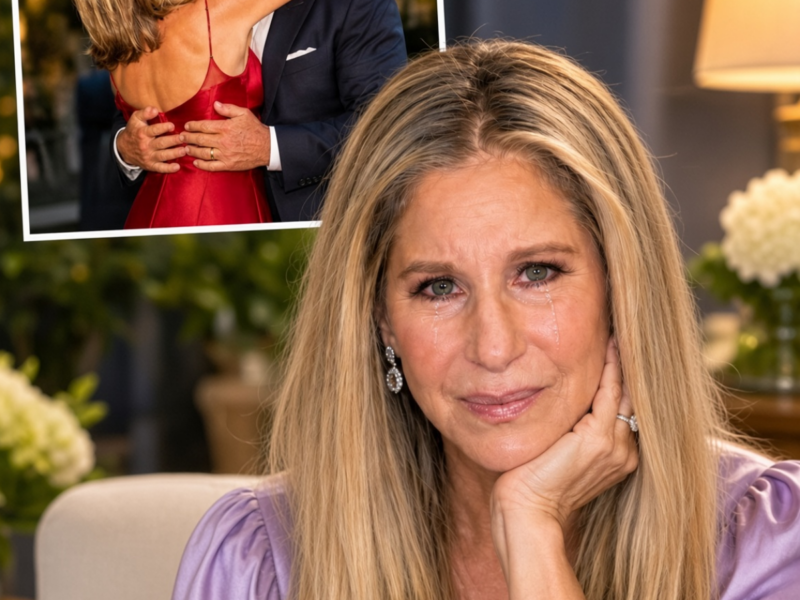
At 84, Barbra Streisand Breaks Her Silence on James Brolin—The Marriage That Took Her From Hollywood.
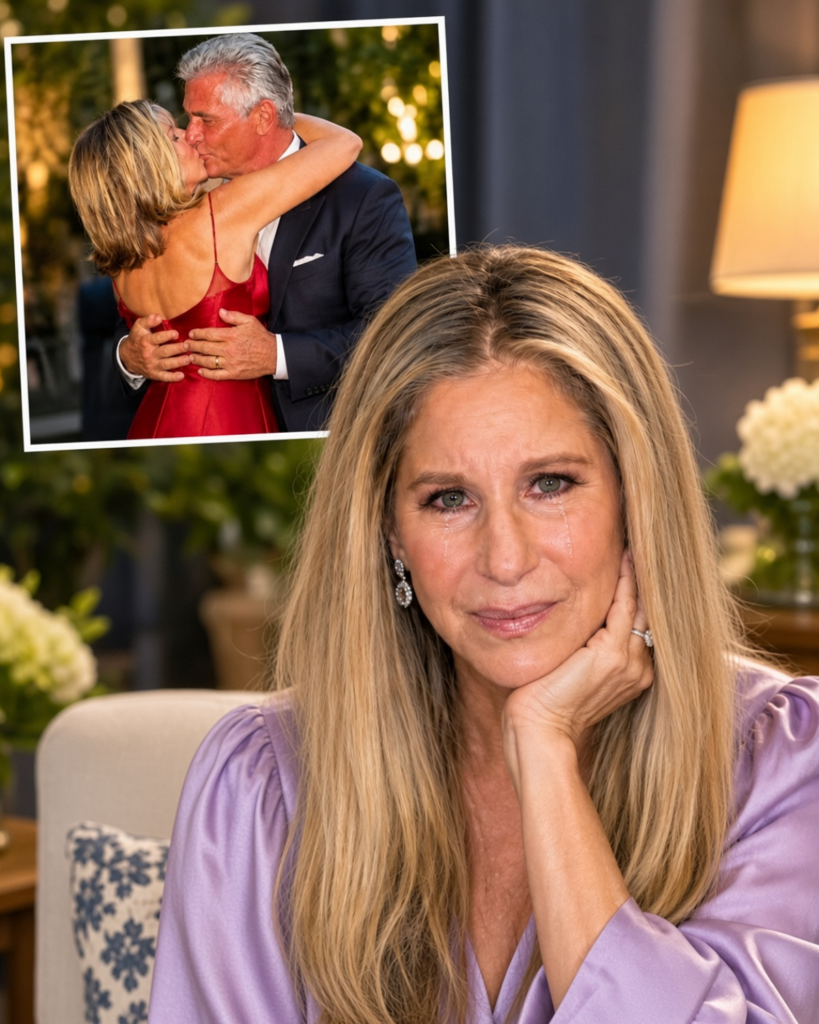
On May 17, 2026, Barbra Streisand sent word that she would not be going to Cannes.
She was due to receive an honorary Palme d’Or at the closing ceremony on May 23, and she had been looking forward to it.
But she was recovering from a knee injury, and her doctors advised her to stay home.
“I am deeply honored to receive the honorary Palme d’Or,” she said, and she sent her warmest wishes to the filmmakers who would be there.
At 84, the woman who once refused to walk onto a stage for 27 years was staying home for a very different reason.
This time, it was not fear.
It was a knee, a doctor’s advice, and a house in Malibu where someone was waiting for her at the end of the day.
That someone was James Brolin, her husband of 28 years.
For years, Hollywood told a simple story about Streisand’s quieter years.
She was past her prime, people said, or she was too difficult, or she was afraid of the stage.
Those stories were never the whole truth.
And they do not match the Barbra Streisand of 2026.
In March, she appeared at the Oscars in a tribute to Robert Redford.
In August, she announced her first children’s picture book.
She has not vanished from the spotlight, she has simply changed how she stands in it.
So what changed?
Did one of the greatest icons in entertainment choose love over the glare of fame?
The answer begins with a little girl in Brooklyn and ends with a question about a man’s haircut.
To understand it, we have to go back to the beginning.
Barbara Joan Streisand was born on April 24, 1942, in Brooklyn, with a loss at the center of her life that she would spend decades trying to fill.
Her father, Emanuel Streisand, was a high school teacher, described as gentle and intelligent, with a master’s degree in education from Columbia University.
He died on August 4, 1943, from complications after a seizure, when Barbra was only 15 months old.
She has no memory of him, not a voice, not a hug, only old black-and-white photographs and stories other people told.
In her memoir, My Name Is Barbra, published on November 7, 2023, she described her father’s death as the first wound, one she spent a lifetime trying to heal.
Her mother, Diana, worked as a secretary in the New York public school system and was practical to the point of coldness.
Barbra came to believe that love was something you had to earn, not something you were given.
When she said she wanted to be an actress, her mother did not encourage her.
She has said her mother told her she was not pretty enough, a sentence no child should hear.
In 1949, when Barbra was 7, Diana remarried Louis Kind.
By Barbra’s account, her stepfather was hot-tempered and abusive, and the way he treated her left scars that took decades to name in public.
Diana and Kind had another daughter, Roslyn, born in 1951, and they divorced in 1956.
In the memoir, Barbra does not go into much detail about this period, but the lines she wrote are heavy enough to show that her childhood was not a fairy tale.
It was a survival story.
Perhaps that is why she ran to the stage, not because she loved the lights, but because the stage was the only place where someone listened to her.
In the 1950s, as a teenager, she saw The Diary of Anne Frank on Broadway and decided that acting would be her path.
She graduated from Erasmus Hall High School in Brooklyn in 1959 with a 93 average and moved to Manhattan.
She began auditioning all over the city, but few doors opened.
She had no agent, no connections, and no money for formal acting school.
The only thing she had was her voice, so she sang.
In 1960, when she was only 18, she began performing in small Greenwich Village nightclubs, in places such as The Lion and The Bon Soir.
She sang because the clubs paid enough for rent and food.
But when she sang, the room went silent.
People forgot the cocktails in their hands.
Her voice was the only weapon she had, the only thing no one could take from her, and it worked.
In 1961, Columbia Records took notice, and Barbra did something almost no young artist dared to do.
She demanded artistic control.
She would choose the songs, decide the arrangements, and approve the album cover.
She was 19, and she set the rules for the next six decades: control everything, and let no one decide for her.
Later, people called her a perfectionist to an unbearable degree.
But if you grew up in a house where no one let you choose anything, control is not a personality trait, it is a survival mechanism.
And it produced results.
Her debut album, The Barbra Streisand Album, was released in February 1963 and won two Grammys, including Album of the Year.
Then Broadway called.
Funny Girl opened on March 26, 1964, at the Winter Garden Theatre and ran for 1,348 performances.
She became the biggest stage star of her generation, and then came film.
In 1968, she played Fanny Brice in the movie version of Funny Girl and won the Oscar for Best Actress, sharing the award with Katharine Hepburn in one of the rare ties in history.
It was her first role on the big screen, and her first Oscar.
She did not climb to the top, she appeared there.
In 1970, she received a special Tony Award as Star of the Decade.
Over her career, she would win five Emmys, 10 Grammys, two Oscars, and a special Tony, and sell more than 150 million records worldwide.
But here is what few people realize.
Beneath the awards, she has described a deep fear of not being good enough.
Fear of being abandoned.
Fear that if she lost control for even a second, everything would collapse, and she would be the little girl in Brooklyn no one wanted to look at.
She built an empire so she would never have to feel small again.
But an empire does not keep you warm at night.
She thought she had found what was missing in 1962, on the stage of the Broadway musical I Can Get It for You Wholesale at the Shubert Theatre.
The young man was Elliott Gould, 23 years old, starring in the show.
Barbra had a supporting role, the secretary Miss Marmelstein.
But the young woman from Brooklyn took the stage in a way no one could explain.
She sang a secondary number, and the audience remembered her more than the lead.
Gould fell for her almost immediately.
They started dating, moved in together, and married on September 21, 1963, in Carson City, Nevada.
Barbra has said that at first she did not want to get married, and then she changed her mind on impulse.
No big party, no crowded guest list, just two young people who thought love was strong enough to hold everything together.
In the first few years, it seemed to be true.
Gould supported her career and endured her punishing work schedule.
But Barbra was rising at a dizzying speed.
Funny Girl opened on Broadway in March 1964 and made her a phenomenon.
Her first television special, My Name Is Barbra, aired in April 1965 and won her an Emmy at 23.
Meanwhile, Gould’s career stayed solid but did not explode.
The gap between them was not only professional, it was in how they lived.
Barbra worked long hours and controlled every detail, from camera angles to how the flowers were arranged.
Gould wanted a more ordinary life, with dinners out, movies, and time for each other.
But for Barbra, time was something she poured into work.
Their son, Jason Emanuel Gould, was born on December 29, 1966.
She has said that for years she thought she might not be able to have children.
To have the baby, she reportedly cancelled a major tour worth more than $1 million, an enormous sum at the time.
She chose the child, but even then she did not know how to stop.
A few months after Jason was born, she went back into the studio, then back to the film set, then back to the stage.
The distance grew.
They separated in 1969, when Jason was only two, and the divorce became official in 1971.
Barbra was 29, already holding an Oscar, an Emmy, a Grammy, a special Tony, a son, and a broken marriage.
It was the first time a pattern showed itself: love fiercely, control everything, and then lose it.
After Gould, Barbra had a relationship with Jon Peters, a hairdresser who became a film producer, that lasted from the mid-1970s into the early 1980s.
Peters was Gould’s opposite, bold and hot-tempered, and he was not afraid to confront her.
During that time, he co-produced the 1976 film A Star Is Born.
The film brought Barbra her second Oscar, for the song “Evergreen,” which she co-wrote, making her the first woman in history to win the Oscar for Best Original Song as a composer.
But the relationship was also full of storms.
Two people used to controlling everything collided, and they finally broke apart.
Over the years, she was also linked to other men, including Don Johnson, Richard Baskin, and Pierre Trudeau, the Canadian prime minister.
Every romance, it seemed, began with fire and ended in ash.
Through all of it, Barbra kept working.
She directed Yentl in 1983, becoming the first woman to write, produce, direct, and star in a major Hollywood film.
She directed The Prince of Tides in 1991, which received seven Oscar nominations, but she was not nominated for Best Director, an omission many people attributed to gender bias.
She directed The Mirror Has Two Faces in 1996.
She recorded albums, she toured, and she made television specials.
She established The Streisand Foundation in 1986 and supported many charities.
She was politically active, backing the Democratic Party, women’s rights, LGBTQ+ rights, and environmental protection.
She received France’s Legion of Honor in 2007, a Kennedy Center Honor in 2008, and the Presidential Medal of Freedom in 2015.
She had every award, every title, every number.
But in the mid-1990s, there was still a space no award could fill.
The Malibu house was vast, and the quiet inside it could be deafening.
Then, in the summer of 1996, a mutual friend called.
The friend thought Barbra and an actor named James Brolin might be a match.
There was no special reason, just a hunch.
A dinner was arranged at Jon Peters’s house, yes, the house of the former partner.
On July 1, 1996, Barbra arrived early but was too shy to sit down at the table right away.
Instead, she went downstairs and played with the children until dinner began.
She expected to meet a mountain-man type, with the brown beard and curly hair she knew from the series Hotel, which Brolin starred in from 1983 to 1988.
But when she looked across the room, she saw a 56-year-old man who had shaved off his beard and cut his hair short, dyed an odd color with uneven silver showing at the roots.
And in that moment, something began that Barbra Streisand had never anticipated.
She walked across the room toward the stranger, and instead of greeting him politely the way any famous woman would at an elegant dinner, she put her hand on his head, ran it over the uneven hair, and asked who had ruined it.
No handshake, no introduction, just a blunt question from a woman used to controlling every situation.
Perhaps it was a defense, a way of putting the other person off balance so she could take the lead.
Brolin looked at her, smiled, and did not step back.
That night, according to both of their accounts, he told her he was drawn to her immediately.
He said it straight, with no circling around and no playing the push-and-pull game Hollywood teaches everyone to play.
Barbra took a few days to decide, she has said.
For a woman who had always known immediately what she wanted, that was new.
She had decided fast with Gould and fast with Peters, and she had loved fiercely.
With Brolin, she hesitated, and she left space.
James Brolin, born on July 18, 1940, in Los Angeles, was not the kind of A-list star the press expected to stand beside Barbra Streisand.
He had a long, steady career, winning an Emmy in 1970 for Marcus Welby, M.D. and starring in Hotel for five seasons.
He also had three children from two earlier marriages, including his son Josh, born in 1968.
He did not need Barbra to make him more famous, and he did not try to rescue her.
He was just there, calm, steady, and not afraid of her.
That was something she had never encountered in a man.
Gould had been afraid of losing her, and Peters had been afraid of being outshone, but Brolin stood on neither side of that line.
After the first evening, they started dating.
They dated for two years, and on July 1, 1998, exactly two years after they met, they married at Barbra’s private estate in Malibu.
It was not a lavish Hollywood wedding, but it was beautiful and private enough for the people who were there to remember it forever.
And unlike the first time, when she married Elliott Gould on impulse, this time Barbra knew exactly what she was doing.
She was 56, and he was 58.
Both had been through enough to know that love is not a roaring fire, but a candle you keep for each other through a long night.
Brolin brought three children into the marriage, and Barbra brought Jason, then 31.
Jason had grown up in the shadow of a gigantic mother, a woman the whole world knew by name, and that pressure is not an easy thing to carry.
Gradually, this blended family found its own rhythm, not perfect, but real.
Barbra became a grandmother to children who were not her own blood, and she has said, “I love being ‘Gamma Barbra’ to my three beautiful grandchildren.”
The woman who controlled every note and every camera angle was now happy to sit on the floor and play with a small child.
Brolin has said that the secret to a long marriage is patience, negotiation, and knowing when to talk and when to be quiet.
He has also said that when they argue, they each take a walk and a deep breath.
Barbra has said that the secret is listening.
Listening and taking a walk are two ways of saying the same thing.
Respect the distance, give each other space to be angry without destroying anything, and give each other the right to be wrong without being punished.
It sounds simple, but for a woman who spent decades controlling everything around her, it may have been the biggest inner revolution of her life.
And there was another fear that had shadowed her for years.
The woman who sold more than 150 million records and whose voice could make a hall hold its breath suffered from stage fright so severe that she avoided live performance for 27 years.
From 1967 to 1994, 27 years, not 27 days, not 27 months.
It began at a free concert in Central Park in 1967, before about 135,000 people, when she forgot the lyrics in the middle of a song.
It was only a few seconds, and no one in the audience noticed, but Barbra noticed.
The fear took root and turned every walk onto a stage into an inner battle the audience never saw.
It was not humility, it was real fear, the kind many people today would call imposter syndrome, the fear of being found out as a fraud.
She returned to the stage in 1994, two years before she met Brolin.
What he seems to have offered her was something she had rarely been given: the sense that she did not have to prove anything more.
No one in Hollywood had said that to her, because Hollywood wanted her to keep producing, performing, and being the star it was used to.
But something in Barbra began to loosen, slowly, like a fist clenched for 50 years opening one finger at a time.
Control born of fear and control born of love are two completely different things.
Before Brolin, she controlled by holding on to everything.
After Brolin, she began controlling by letting go, by keeping certain things for herself, not because she was afraid, but because she wanted to.
That brings the story back to 2026, and it is not the story of a woman who stepped away.
The Cannes Film Festival named Barbra Streisand one of three honorary Palme d’Or recipients this year, alongside Peter Jackson and John Travolta.
It was an award for a lifetime, for more than six decades of working across several fields of entertainment at once.
When her knee injury kept her at home, the festival said it would honor her anyway.
For a woman who spent a lifetime controlling every public appearance, saying plainly that her body would not let her do what she wanted was a kind of honesty the earlier Barbra might never have allowed.
The recognition that matters most may not come from a stage at all.
It may come from the person who sits at breakfast with you every morning for 28 years.
In March, she had stood on the Oscars stage in a tribute to Robert Redford.
In August, she announced a new kind of project.
Her first children’s picture book, And by the Way…, will be published on March 30, 2027, with illustrations by Paige Keiser.
The book follows a grandparent and a grandchild on a dazzling day as they play, splash, and think about life’s most important truths.
She has said the title comes from an expression she uses all the time, because there always seems to be one more thing to say.
She has also said its message is one of discovery, self-expression, self-reliance, and love.
This is not a memoir of more than 900 pages full of battles with Hollywood and broken love affairs.
It is gentle, warm, and simple enough that it is almost hard to believe it came from the same woman who directed Yentl and fought a studio system to keep control of her work.
But perhaps that is the point.
At 20, Barbra sang in small clubs to be heard.
At 40, she directed a film about a woman fighting for the right to be heard.
At 81, she wrote a memoir to tell it all.
And at 84, she is writing a picture book for her grandchildren.
That creative curve is not a decline.
It goes inward, from the crowd to one child, from the world to the living room, from proving to giving.
For years, the world’s reaction to her quieter years was not understanding, it was judgment.
She was arrogant, people said, or too difficult to work with, or afraid of the stage, or past her prime.
Those rumors ran like background music that no one bothered to turn off, because Hollywood needed an explanation for her absence, and the easiest explanation was to blame the person who was not in the room.
No one stopped to ask whether she had lost something, or found something.
There is a strange irony here.
In 2003, Barbra Streisand accidentally created a term named after herself, the Streisand effect.
It began when she sued photographer Kenneth Adelman over an aerial photograph of her Malibu home that was part of a project documenting the California coastline.
Before she sued, the photograph had been downloaded only six times, two of them by her own lawyers.
After she sued, more than 420,000 people visited the website in the first month.
The more she tried to hide it, the more the world wanted to see.
That is the Streisand effect, and it became an official term, used around the world for the way an attempt to hide information makes it spread farther.
But it is also the story of her life.
For six decades, Barbra tried to control her image, from every camera angle to every interview, and the world responded by becoming more curious.
Then she did the opposite.
She wrote a memoir, My Name Is Barbra, published on November 7, 2023, and it debuted at number two on The New York Times best-seller list.
It told the whole story, from the little girl in Brooklyn who was told she was not pretty enough to the woman who won an Oscar in her first role to the evening she touched a stranger’s badly cut hair.
And when she stopped controlling the story, the world did not attack her.
Many readers saw for the first time that her difficulty was not simply a flaw, but a scar, and that control was not only power, but fear.
The real Streisand effect is that when she stopped hiding, the world finally saw her.
So the question changes.
It is no longer why she left Hollywood, because she never really left.
It is what she found along the way.
The answer is not complicated.
She found James Brolin, a man who was not afraid of her, who did not try to change her, and who was simply there every morning when she woke up and every night when she went to sleep.
She found a blended family with grandchildren who call her Gamma Barbra.
She found the right to be ordinary, to sit on the floor with a child without a camera in the room, and to say to her doctors and her fans that her knee hurts too much to travel.
No Oscar confers those rights, no Grammy records them, and no magazine puts them on a cover.
But for a woman who spent the first 50 years of her life running from the feeling of not being good enough, the right to be ordinary may be the rarest luxury there is.
Now look at her legacy and you see two of them side by side.
The first is the career: more than 150 million records, five Emmys, 10 Grammys, two Oscars, a special Tony, the Presidential Medal of Freedom, and now the honorary Palme d’Or.
The second is the marriage: 28 years with the same man, with no scandal, no separation, and no anonymous sources.
Which legacy is larger?
The question may be wrong from the start, because the two are not separate.
Brolin did not take her away from Hollywood.
He helped her see that Hollywood was the stage she had built to run away from Brooklyn.
And once she had a real home, a real person, and a real love, she no longer needed that stage to feel that she existed.
She still sings, still writes, and still accepts honors, but she does it because she wants to, not because she is afraid that if she stops, she will disappear.
That is the difference 28 years made.
He did not change her, he gave her the space to change herself.
He gave her what her father did not live long enough to give, what her mother held back, and what Hollywood promised and never delivered: acceptance she did not have to win.
Barbra Streisand spent a lifetime searching for perfection, in every note, every frame, and every word on the page.
But what has kept her warm for 28 years is not perfection.
It is a man who arrived at dinner with a bad haircut and let the most powerful woman in Hollywood touch his head without stepping back.
If her story teaches one thing, it may be this.
Leaving a stage is not failure, and sometimes it is the only way to find the road home.
Sometimes home is not the place where thousands of people shout your name.
Sometimes home is only a quiet room where someone sits beside you, saying nothing and needing nothing, just being there.
When the lights go out and the applause becomes memory, the person who stays in that room with you is the real award.









