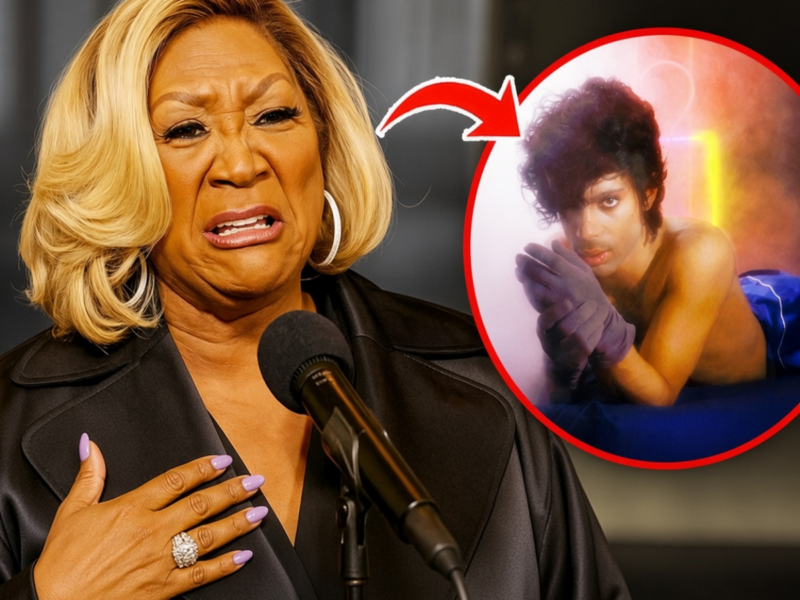
At 81, Patti LaBelle Finally Names The 10 Musicians She Hated.
Singers out there, but they have to have—it’s like a package.
Music isn’t always about harmony.
Sometimes it’s a battleground of egos too grand to coexist.
And this time, Patti LaBelle isn’t holding back.
She’s calling out ten artists she couldn’t tolerate—those she clashed with, those who turned their backs, those with whom she silently severed ties.
Names that will stun audiences.
Quincy Jones, thought to be a soulmate—turns out he wasn’t.
Prince, the solitary legend, and an unspoken disappointment.
And that’s just the beginning.
The rest of the list is like a cold blade slicing through the illusion that showbiz is all glamour.
Unannounced rejections, unfinished recordings, silent studios behind closed doors.
This isn’t a side story.
This is the truth no one dared touch until Patti herself broke the silence.
You won’t believe who’s next.
And don’t forget to like, comment, and subscribe if you’re brave enough to listen on.
Some people are so exceptionally talented, they never need to look back at anyone.
Patti LaBelle met such a person, and that name is no stranger: Quincy Jones.
Truthfully, this isn’t a boisterous tale.
No explosive anger or fiery public spat as the media often craves.
It was merely a prolonged silence, a persistent wait, a phone call that never arrived.
And that void for Patti was larger than any word like hate could describe.
Patti was once the very soul of LaBelle—burning brightly, rebellious, fierce, unlike anyone else.
But after the triumph of “Lady Marmalade,” she needed a transformation.
She needed a producer who believed in her raw yet formidable voice.
And when Quincy said, “We should do something real,” she believed she had found that person.
Perhaps he was just being polite.
Perhaps he was sincere.
But the truth is, she believed him.
Believed that Quincy Jones, with his golden ear and a heart that had moved the world, would understand what her voice needed.
No effects, no polish, just to be heard.
But then Michael Jackson arrived.
No one blames Michael.
He was a genius.
Patti once said, “Michael was like a little star born to shine.”
And Off the Wall was a pinnacle.
Everyone saw it.
But to reach that peak, someone had to be left at the foot of the mountain.
Not because she lacked talent, but simply because Quincy looked in another direction.
Patti once recounted, half jokingly, half seriously, that “I waited for that phone call so long I had to make my own album.”
The remark was light, but anyone who has ever waited for something from someone they trusted will understand it was far from light.
The music industry at that time was not gentle with Black women, especially when they refused to conform to what the market desired.
Patti wasn’t as soft as Diana Ross, not as melancholic as Aretha Franklin.
She was fierce, direct, and sometimes too real—and too real often made people wary.
An assistant once whispered, “Quincy said Patti’s voice wasn’t suitable for release.”
She heard it, but she didn’t react.
She was too accustomed to such remarks, to rejections rationalized by market demands instead of confronting true emotions.
She didn’t go to the press.
No resentment.
But after that incident, she never mentioned Quincy’s name with warmth again.
No affectionate gaze, no sweet memories—just a silence.
A blank page with nothing more written.
Once, when asked who disappointed her most in her career, she simply said, “Some people are too grand to hear my small call.”
People laughed, thinking it was fleeting sorrow, but the truth was it was deeply sad and profoundly real.
It wasn’t that she despised Quincy Jones.
It was just that in a certain moment of her life, she needed someone to believe in her, and he didn’t.
She still sang, still smiled, still remained strong, as Black women always had to be to survive.
But sometimes, amidst the applause, amidst the saxophone echoing backstage, she still remembered that phone call that never came and the brilliant man who chose to look in another direction.
And sometimes that alone is enough to chill a heart forever.
They were once the pride of the same city, growing up from streets fragrant with incense and dreams sung from small living rooms.
Patti LaBelle and Kenny Gamble were once names spoken with admiration as Philadelphia royalty, the city’s musical aristocracy.
But that relationship, seemingly destined for kinship, ultimately froze as if it had never warmed.
Patti never equivocated about the reason.
She once said in a tired voice during a backstage conversation, “I don’t need a manager telling me what song to sing or what color dress to wear.”
And indeed, that was the case.
She refused to sign with Philadelphia International Records, the label founded by Kenny and Leon Huff, when offered, simply because she didn’t want to be molded.
For many artists, declining a collaboration offer is just business.
But for Kenny Gamble, it was a rejection of pride, because he wasn’t just the label founder.
He was the architect of an entire genre: Philadelphia soul.
A musical empire with its own distinct character, its own rhythm, its own flavor.
And he believed anyone outside it was outside the very soul of the city.
From the moment Patti chose her own path, independent of factory-like production teams, unbound by crews or market directions, Kenny’s attitude shifted entirely.
He no longer shook her hand backstage at major TV shows as he did initially.
No more friendly glances or warm compliments.
Only a cold silence remained—the kind of silence only insiders truly perceive.
Industry insiders recounted once that Patti was nominated for a major project, a tribute album dedicated to Philadelphia icons.
Everything seemed to be going smoothly.
But then she was removed from the list of participating artists.
No explanation, no clear refusal—simply not chosen.
Rumors began to spread.
People whispered that Kenny himself had intervened.
There was no proof.
But everyone implicitly understood: in the music world, little needs to be said to ensure something doesn’t happen.
Patti never directly accused him, but she couldn’t hide her disappointment either.
Once, during a local radio interview, she uttered a brief sentence: “Some people just can’t accept that you won’t walk in their shadow.”
She didn’t name names, but to those in the know, the statement was as clear as stage lights.
The story with Kenny Gamble wasn’t a scandal.
There were no arguments, no media uproar, but precisely because of that, it felt heavier.
Everything unfolded in silence—the kind of silence often found between people who once knew each other too well but no longer wish to share a space.
What pained Patti wasn’t the lack of collaboration.
It was the fact that someone from her hometown, someone who started alongside her, became estranged simply because she chose to maintain her individuality.
The individuality of a Black woman in a high-pressure industry where everything from voice to attire could be bent to fit some framework drawn by others.
She once recounted when performing in Europe, people asked, “Why do you never sing Kenny Gamble’s songs?”
She just smiled, because not every song from Philadelphia is his.
That smile held no anger, only a touch of sadness and a self-respect that needed no explanation.
Prince didn’t overtly dislike anyone, and that’s what truly unnerved Patti.
She once said, “There are some people whose silence feels colder than when they scream in your face.”
With Prince, there were no rejections, no conflicts clear enough to name, but also no connection whatsoever—just an invisible wall she could never breach.
In the late ’80s, when her star was still shining brightly, Patti was invited to Paisley Park, the legendary stronghold where Prince built his own world.
No one knew why Prince truly invited her, and no one understood what transpired inside that room.
Only Patti was the one who entered and emerged with an indescribable feeling.
“I don’t know who I just met. A genius or a ghost,” she recounted.
Throughout the entire session, Prince barely spoke.
He just watched.
Just nodded.
Sometimes he would disappear for a few minutes without explanation.
No customary greetings.
Not a single “Patti, I admire you.”
No flicker of interest or curiosity—just a hazy, cold, and distant presence that made the person opposite wonder, was he truly present?
Patti left without anger or disappointment.
But she carried a lingering sense of unease that lasted for years afterward.
Perhaps because she wasn’t accustomed to being treated as invisible, unaccustomed to a silence that wasn’t clearly disdain or simply indifference.
And perhaps that silence touched a very personal place within her where Black artists like her always had to fight to be seen, to be heard, to exist fully in an industry that had not always favored them.
For Patti, Prince’s inscrutability wasn’t charming.
It made her feel unworthy of entering his world.
And that hurt in a way that was hard to define.
Not everyone can accept being ignored by a genius, because in that silence there is always a kind of negation that one cannot respond to.
After that meeting, Patti never mentioned wanting to collaborate with Prince.
Although he wrote music for many female artists—Sheila E, Chaka Khan, and even Madonna—Patti was not on that list.
She never mentioned Prince with the same joy as she did Michael or Aretha.
Just a brief touch, then a retreat, as if the chill still lingered around her neck.
People often associate Prince with the image of a surreal musical deity, an endearing eccentric, an unapproachable genius.
But for Patti, he was simply someone she couldn’t fathom.
Not because he was too complex, but because he opened no doors for others to enter.
She once whispered to her close assistant, “He doesn’t hate me. I know that. But what hurts is that he doesn’t even need me to exist.”
And that perhaps is the most bitter kind of rejection in an artist’s life.
Not being cast aside, but being quietly overlooked.
In later years, when everyone constantly referred to Prince as an icon, Patti always maintained a very measured distance when speaking of him.
No animosity whatsoever, but also never any closeness.
Only one thing was certain.
She never wanted to return to Paisley Park again.
After just twenty minutes, Patti stood up, pulled out her earphones, took off her high heels, and left the recording studio without looking back.
She didn’t bother to say goodbye.
No need for politeness, no need for a confrontation.
Everything in her eyes at that moment was already loud enough.
Inside that room, Rick James was still swaying, grinning as if nothing was more important than the pounding drum that was pulverizing the entire space.
A few others sprawled on the sofas.
Some more danced as if they were in a nightclub at 2:00 a.m.
No one cared that a legendary voice had just walked out.
Perhaps they didn’t even realize she had ever entered.
Patti wasn’t angry with Rick.
She was just fed up.
Fed up with the type of man who thinks he’s the center of the universe but is actually drifting in a chaotic mess of sounds with no clear beginning.
She once said—not recorded, not on TV, just recounted by a close assistant—Rick James, the king of dirty funk, who lived as if every recording session was an endless party.
The music he made could set a dance floor ablaze, but his studio made Patti want to flee.
In 1983, Rick proactively reached out saying he wanted to do a duet.
At that time, Patti was in the midst of reasserting herself after the LaBelle era.
So she agreed to try—but only once, because once was enough to know that some people are compatible on stage but cannot coexist in the same space.
Patti entered the studio with a professional mindset.
Rick, however, brought ten friends, two flashing lights, and music so loud that engineers had to shout into each other’s ears to communicate.
She only needed to hear one beat cycle.
See how Rick toyed with the song.
Then sat down and immediately stood up.
“I cannot sing in chaos,” she stated directly.
The sting here wasn’t because Rick insulted her, but because after that session, he uttered a remark that felt as chilling as pouring ice down her spine.
“She’s too clean to play dirty funk with me.”
It sounded like a jest, but it felt like a label.
And Patti never accepted being labeled that way.
To many in the industry, Rick embodied artistic freedom—an artist who never apologized for what he did.
But for Patti, that freedom sometimes was just an excuse for a lack of respect for others.
After that, they no longer interacted.
No rumors, no public confrontations, just a distinct silence.
In later interviews when asked about Rick, she always offered a strange smile, then changed the subject.
There was only one time she spoke directly.
“Funk is not to blame, but people often use funk to cover up their own disarray.”
Years later, people still regretted that Patti and Rick never truly collaborated.
They imagined a fierce funk ballad, Patti’s voice echoing like thunder alongside Rick’s playful moans.
But that would forever remain an unfulfilled fantasy, because some people don’t dislike each other but cannot be on the same rhythm.
Patti had no regrets.
She didn’t need a hit with someone who didn’t understand the sanctity of music.
And Rick, perhaps he didn’t care either.
They passed through each other’s lives like two trains on opposite tracks, whistling once and then disappearing.
No words needed.
Just a glance at the lights.
When an artist is singing and the stage lights dim, it’s not a technical glitch.
Someone gave an order.
In 1974, Patti LaBelle stood on the same stage as James Brown—the legend, known nationwide as the Godfather of Soul, an icon, an unquenchable flame.
But that day, a small incident occurred, so small that no one in the audience noticed.
But for Patti, it was a moment she’d remember forever.
The stage lights illuminating her suddenly faded.
No one said anything.
No one explained.
But those backstage knew well that switch didn’t dim itself.
James didn’t shout, didn’t show his face, but his crew understood their boss’s gaze perfectly.
Patti was singing so well she was overshadowing him, and that didn’t fit the musical history he was building.
Patti knew it instantly.
She wasn’t new to this, nor was she naive enough to believe in absolute fairness among artists.
But the way the lights dimmed due to the presence of an ego, it awakened her.
Later, in a small conversation backstage at a TV show, Patti once said, “He was great. But greatness doesn’t mean you’re allowed to step on someone else’s light.”
That was the only time she revisited the old story without bitterness, without criticism—just a statement clear enough for the listener to understand.
James Brown was a unique case.
He lived with the conviction that he was the center of every game and all eyes should be on him.
Many who collaborated with him recounted that if someone sang better or danced more captivatingly, there would immediately be changes on stage—either the microphone would malfunction or the spotlight would stray.
Patti wasn’t surprised, but she was disappointed.
She had grown up with James Brown’s music, dancing to “Sex Machine” while still wearing her church uniform.
For her, James was a pioneer, a bridge between traditional music and modern funk.
But seeing a great man unwilling to share the stage firsthand, she realized true greatness lies not in fame but in the ability to step back when others shine.
As many times before in her life, Patti chose silence.
No attacks, no demands for the spotlight back.
She continued to sing even if no one could clearly see her face in the frame anymore.
But the sound remained, and the audience still listened.
What she retained afterward was not fleeting fame but an uncompromising self-respect.
After that performance, Patti never accepted an invitation to perform with James again.
Not out of hatred, but because she knew there were places, there were people who didn’t need her light and didn’t deserve it.
The music world may have many kings, queens, princesses, or masters.
But true greatness is when you don’t need anyone else to shrink for you to grow larger.
And Patti didn’t shrink.
Not then, not ever.
“Try a little rap. Something like Missy Elliott. Wyclef Jean,” he chuckled, adding a beat to his mixer.
But on the other side of the studio glass, Patti LaBelle didn’t return his smile.
She simply looked at him, tilted her head slightly, and uttered a single word.
“No.”
No raised voice, no reprimand, no haughty refusal—just a concise, definitive no.
A stark punctuation mark to a collaboration that felt misaligned from the outset.
In 2001, Wyclef was at his creative zenith, emerging from the Fugees.
He became a master of blending genres from reggae and rap to funk and pop.
He invited Patti to record an experimental track, hoping her seasoned vocals would meld with contemporary hip-hop rhythms.
It sounded intriguing.
Yet the disconnect wasn’t in the genre but in the fact that they weren’t hearing the same music in their minds.
Patti arrived at the studio as always—punctual, without an entourage, without pretense.
Wyclef, by contrast, had a motley crew of guests, boisterous chatter, the scent of fast food, and beats blasting as if it were a party.
She wasn’t enthused.
Still, she entered the booth and attempted a few vocal takes until Wyclef told her to drop a rap, much like Lauryn Hill had done in “Killing Me Softly.”
Patti wasn’t annoyed, nor did she react explosively.
She simply shook her head.
“I don’t do that.”
No one spoke another word after that moment.
The recording session ended as if it had never begun.
No tracks were kept.
No further plans were made.
Wyclef didn’t text.
Patti didn’t call back.
That session, seemingly minor, left Patti with a lingering coolness in her heart.
Not because the young artist was impolite or lacked talent, but because he didn’t understand her.
He didn’t grasp that she hailed from a different era, a different musical language, a storytelling that didn’t require rhymes, rhythmic thigh slapping, or dropping the beat.
She had collaborated with numerous younger artists—from Mariah Carey to Mary J. Blige to Alicia Keys.
She never confined herself to the past, but she also never changed merely to fit the times.
That boundary she guarded carefully, not out of stubbornness but because she profoundly understood the essence she preserved within her voice.
And Wyclef, he continued to achieve success with his own projects.
But for Patti, his name always remained outside any musical narrative she recounted.
No anger, no blame—just that when someone doesn’t truly listen to you, singing for them loses its meaning.
Sometimes a no requires no explanation and no need for reconciliation.
In the intricate world of music, where everything can be technically adjusted and tailored to taste, the most formidable challenge remains preserving one’s authentic identity.
Patti LaBelle didn’t rap that day, not because she couldn’t, but because she refused to do anything that would force her voice into a framework that wasn’t authentically hers.
She chose to depart, as she had many times in her life, in silence, yet never losing her voice.
The most unsettling kind of silence is the one that diminishes one’s self-worth.
No rejection, no acceptance—just an unaddressed void.
As if you had never spoken.
As if you weren’t significant enough to warrant a reply.
Patti LaBelle understood that feeling profoundly.
And the person who made her feel that way was Babyface—someone she had once believed would understand her most.
She was no stranger to waiting in show business.
Someone reading but not replying was as common as stage light malfunctions.
But with Babyface, it wasn’t just waiting.
It was a deep disappointment, because she hadn’t sent a mere collaboration inquiry.
She had stated her interest clearly in multiple interviews, even having an intermediary relay her message.
And that person had said, “He likes the idea. He says he’ll consider it.”
Then nothing happened.
Initially, Patti consoled herself that Babyface might be busy at the time.
He was the hottest producer working with everyone from Toni Braxton and Whitney to Boyz II Men.
Everyone wanted his touch on their album.
Patti understood that.
But three months passed, six months, a year.
No one mentioned it again.
She stopped asking.
When a reporter later brought it up, she just offered a wry smile.
“Perhaps I wasn’t light enough for him to hear my voice.”
The joke sounded humorous, but beneath it simmered a quiet indignation.
In a world where many Black female artists had been overlooked, Patti never imagined she would become one of them—especially from a fellow Black artist who had also risen from hardship and had experienced being chosen over.
But life often unfolds unfairly in very subtle ways.
No one does anything overtly wrong.
Yet everyone causes subtle hurt—and most terrifyingly, when that hurt cannot be articulated, cannot be blamed, and has no resolution.
Once she sat with a young musician, recounting this old story without naming names.
He innocently asked, “So why didn’t you ask him again, Grandma?”
She burst out laughing.
“He didn’t even answer me the first time. Do you think he’d answer a second?”
Her voice wasn’t bitter.
It was more like a weary acknowledgement that there are some things you don’t need to hold on to.
Not because you don’t need them, but because they simply aren’t worth it.
Years later, Babyface mentioned Patti in a talk show, calling her a legend.
But that word at that moment held no meaning.
She had wanted to be a collaborator, not a legacy.
She had wanted to sing a love song he wrote, not to be honored by a belated remark.
Perhaps to outsiders, this was just an unfulfilled relationship.
But for Patti, it was a profound chapter in her professional life—a chapter without bloodshed, yet still acutely painful.
Not because she was rejected, but because she was never truly heard.
Nile Rodgers is the type who cannot conceal his feelings of rejection, especially when he believes he’s offering something exceptional.
And Patti LaBelle, she’s the type who cannot feign enjoyment of something just to maintain harmony.
So when these two formidable personalities collided, the consequence was decades of enduring silence.
No scandal, no commotion, yet a chill so profound it became irreparable.
The story began when Nile sent Patti a demo in the early 1980s, a time when disco was fading and soul was beginning to rediscover its roots.
Within the industry, Nile was still the wizard of the dance floor.
But Patti was searching for something deeper.
Music that didn’t just make people sway but made them pause and truly listen.
The demo Nile sent, according to Patti, sounded like an extended loop.
Of course, Nile’s technical prowess was undeniable.
The beat was solid, the bass smooth.
But for her, it lacked soul.
There was no emotional anchor, no moments of quiet reflection.
She listened to the entire track, set down the headphones, and told her assistant, “I can’t sing this. I don’t hear myself in it.”
The feedback was returned—brief, polite, and honest.
The problem was that Nile wasn’t accustomed to rejection, especially from someone whose voice could ignite an entire auditorium.
He believed Patti would feel honored.
He was convinced he could redefine her image.
But she had never needed anyone to do that for her.
After that incident, neither said anything further.
No reminders, no follow-ups, no remixes.
Subsequent encounters backstage or at award ceremonies involved only brief, empty nods of polite acknowledgement.
Someone once asked Patti why she had never worked with Nile Rodgers.
She just shook her head, saying nothing.
But the other day, in a rare interview, she opened up.
“Nile is a master at making music that moves the body, but I need something that stirs a different part inside a person.”
That remark, though seemingly gentle, was a sharp incision, and she knew it.
But for Patti, music was about truth.
If she couldn’t feel it, no matter how popular it became, it held no meaning.
What makes this story most regrettable isn’t the dissolution of a potential collaboration.
It’s the squandered historical moment where two legends from two disparate worlds had the chance to intersect.
A diva with a gospel soul.
A producer born from funk and disco.
Had they blended, they might have created something bizarre, chaotic, yet profoundly deep.
But they couldn’t, and neither wished to try again.
Nile once recounted in one of his books that “there was a diva I always admired but couldn’t collaborate with because I couldn’t understand her.”
He didn’t mention her name, but Patti knew.
She heard about it through others, and she simply nodded, then said, “Frankly, I didn’t understand him either.”
Patti detested the feeling of losing control, and George Clinton—the king of improvisation, of all things delightfully chaotic—was her absolute antithesis.
The tour invitation arrived one afternoon in the mid-1980s when George’s funk psychedelia was sweeping the nation.
Parliament-Funkadelic was a visual and sonic storm, and George stood at its center like an extraterrestrial wizard conducting his own universe.
For many artists, an invitation from him was a distinct privilege.
For Patti, it was a genuine internal struggle.
“He’s a genius, no doubt,” she stated, “but I couldn’t bear the constant atmosphere of chaos, as if three shows were happening simultaneously.”
She had seen George perform live.
The entire band would take the stage with no one knowing which song would be played.
Sometimes a sax solo would stretch for eight minutes.
Sometimes the lead singer would vanish backstage to change into a neon fur outfit.
Anything could happen, and nothing was ever announced.
Patti required structure.
She needed clear markers.
She needed to know when to hit a high note, when to yield to the background vocals.
With George, everything was instinctual.
A rehearsal was a fluid concept, and the set list could change the moment he stepped on stage simply because he felt like it.
She declined the invitation directly but gently.
George wasn’t offended.
He wasn’t one to hold grudges.
But from then on, he never extended the offer again.
In a later interview, he laughed, saying, “Patti doesn’t fit into my outer space. She needs more level ground.”
The remark carried a touch of humor but also a quiet admission: they inhabited two worlds that would never truly meet.
They still greeted each other at awards ceremonies, maintaining a minimum level of respect between two seasoned veterans, but no further offers, no more attempts were made.
Patti once remarked, “If I were to step onto George’s stage, I’d fall from the first minute because I wouldn’t know where the rhythm was.”
That statement, amusing as it sounds, actually encapsulates her entire philosophy of life.
George epitomized groundbreaking innovation.
Patti symbolized meticulous artistry.
Both grew up with funk but followed entirely different trajectories.
One considered freedom the means to create art.
The other believed that discipline preserved the soul of the music.
Many years later, when Patti was asked if she ever regretted not accepting George’s tour invitation, she smiled.
“No, I think I’d still choose the same. Even now, every artist has their own planet. I just don’t fit on Jupiter.”
That answer gently closed a chapter that never opened between two icons who both loved funk but simply couldn’t play to the same rhythm.
“I don’t need to be edited. I need to be felt.”
That statement wasn’t a suggestion.
It was a reverberating counterpunch that stunned the entire studio.
Tension was palpable between them after just fifteen minutes of recording.
No one shouted, no one slammed tables, but the silence following that declaration was as heavy as an irrevocable severance.
Teddy Riley, an icon, an innovator, the mastermind behind countless hits that swept the American music scene in the ’90s, the one who elevated autotune to an art form.
When he invited Patti LaBelle, he believed he was standing before a historic opportunity to meld the profound soul of a previous generation with the modern pulse of electronic R&B.
But some elements, no matter how blended, simply refuse to dissolve.
The demo began with a crisp, fluid beat, smooth as freshly paved asphalt.
And then Patti’s voice soared—rich, profound.
But less than halfway through the first line, her voice was subtly coated with a light autotune layer.
Teddy adjusted a few knobs, smiling as if polishing a precious gem.
Patti stood motionless, her eyes fixed on the glass partition.
She said nothing, but the feeling was that she was recoiling, as if being forced into a skin that wasn’t her own.
When Teddy requested a second time to soften that vocal run with the machine, she could no longer tolerate it.
She removed her headphones, her voice calm yet every word distinct.
“I don’t need my voice corrected. I need a microphone and a heart.”
Teddy was momentarily taken aback but offered no apology.
He simply stepped back, crossed his arms, and gave a slight nod.
No one spoke another word.
The entire session concluded less than ten minutes later.
Later, in an interview, Teddy maintained his polite demeanor.
“I think Patti is a formidable personality, but sometimes to move forward, you have to be willing to change.”
And Patti, she never mentioned his name in any of her projects.
When asked about autotune, she merely smiled gently.
“I come from a different world where people cherish the beautiful imperfections in a voice, not seek to conceal them.”
That recording session was never released.
There was no public controversy, no sarcastic social media posts or attacks, but both icons—a digital R&B legend and a soul legend—quietly struck each other from all future plans.
Sometimes what shatters a collaboration isn’t a loud argument.
It’s the moment people realize they don’t speak the same language even when they’re both talking about music.
Despite being towering figures in music, Patti LaBelle and many other artists simply couldn’t find a shared rhythm.
This wasn’t because one was superior to the other, but because their core values were profoundly different.
Each name on this list represents an era, a spirit, a distinct definition of music.
And it is precisely these encounters, even conflicts, that vividly showcase Patti’s remarkable fortitude and unwavering principles—her absolute refusal to compromise on what she didn’t genuinely believe in.
Music, like life, isn’t always about seamless collaboration.
But these imperfect narratives are what paint the vibrant and emotionally rich tapestry of an entire generation.









