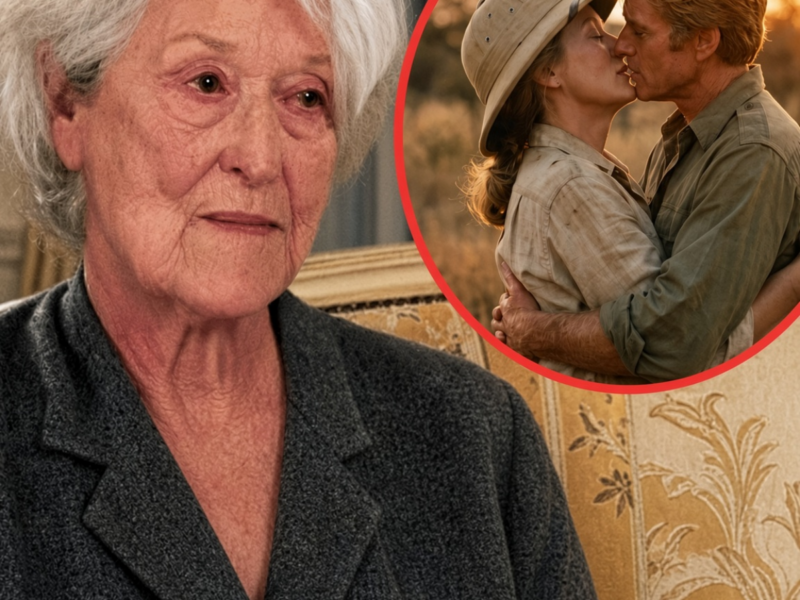
At 77, Meryl Streep Finally Speaks Up about Robert Redford.
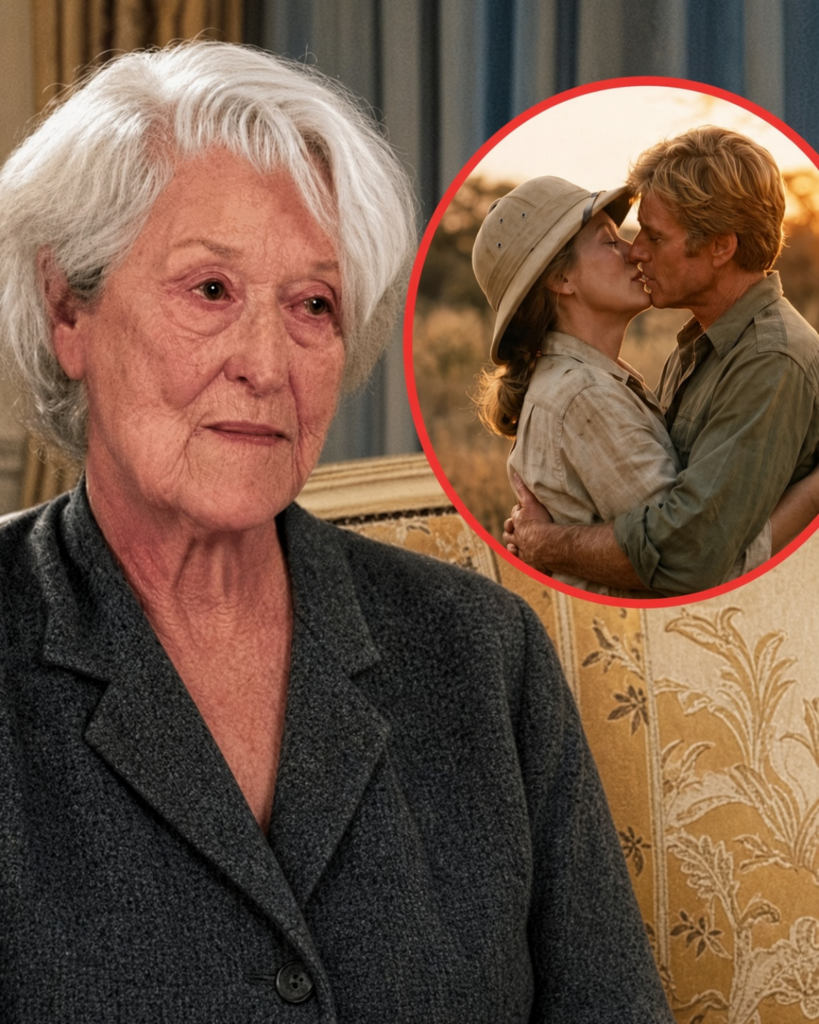
In 1985, a film crew spent 101 days in the Kenyan heat, and two of its stars formed a bond that neither would ever fully explain.
One of them was Meryl Streep, an actress who has spent nearly fifty years building a wall around her private life.
The other was Robert Redford.
For roughly four decades, the story goes, that connection stayed behind the wall.
Now, at 76, Streep has begun to speak about it.
And what she describes is not what the legend of the ice queen would lead you to expect.
To understand why it mattered so much to her, you have to go back to the beginning and to the question of how a woman so guarded became one of the most revealing performers in the history of film.
Mary Louise Streep was born in Summit, New Jersey in 1949.
Her mother was her first and most influential mentor, and she repeated one idea until it took root: her daughter could do anything she committed her mind to.
In high school, Meryl was a cheerleader and a homecoming queen.
Her real education, though, was happening somewhere less visible.
At twelve, she began opera lessons.
She quit after four years, and her reason shaped everything that followed.
She had realized she was singing things she did not feel.
From that point, her art would have one requirement, and it was truth.
Truth, however, did not pay tuition.
At the Yale School of Drama, Streep waited tables and worked as a typist while appearing in dozens of productions a year.
The pace gave her ulcers.
She came close to leaving acting for law school, and it was the stage that refused to let her go.
In 1975, she moved to New York and met Hollywood’s obsession with appearances head-on.
At an audition for King Kong, the producer, Dino De Laurentiis, looked at her and said in Italian to his son, “This is so ugly. Why did you bring me this?”
He did not know that Streep understood every word.
She answered him in his own language: “I’m sorry I’m not as beautiful as I should be, but this is what you get.”
The deepest formative experience of those years had nothing to do with the industry.
In 1976, during a production of Measure for Measure, she met the actor John Cazale and the two became inseparable.
When Cazale was diagnosed with terminal lung cancer, Streep took what she called a “stock girlfriend part” in The Deer Hunter.
For one reason: it kept her at his side during the final months of his filming.
She nursed him to the end.
To pay his enormous medical bills, she accepted a role in the miniseries Holocaust.
It earned her an Emmy, and it meant nothing to her because the man she loved was already gone.
By 1979, the industry saw a technical marvel.
Her peers saw a woman who would not be pushed around.
On the set of Kramer vs. Kramer, she clashed hard with Dustin Hoffman, who by some accounts hated her at the time, and in one scene slapped her to provoke a reaction.
Streep did not flinch.
She demanded that the script be rewritten, refusing to play the evil wife the writers had drafted.
She insisted the character be given a human reason for her choices.
The performance won her her first Oscar, and she placed the statue on the back of a toilet in the ladies’ room after her speech.
It tells you where she kept her priorities.
The 1980s turned a respected actress into something larger.
Newsweek put her on its cover under the headline “A Star for the ’80s,” and critics wrote about a primal unease vibrating just under her skin.
A sense that ordinary behavior in her hands looked like a mask.
Her first test of the decade was The French Lieutenant’s Woman, in which she played a modern actress playing a Victorian heroine and delivered a British accent that made natives do a double take.
Even then, the performer others called untouchable admitted to a very human thought: “I couldn’t help wishing that I were more beautiful.”
Hollywood, as it turned out, did not need a beauty.
It needed a chameleon.
The summit of her technical powers came in 1982 with Sophie’s Choice.
To play a survivor of Auschwitz, she mastered Polish and German.
The film’s defining scene, in which her character is forced to decide which of her children will live and which will die, was shot exactly once.
Streep refused to do it again.
The pain, she said, was too exhausting and too real to reproduce.
Roger Ebert described the performance as the most unaffected and natural he could imagine.
She won the Oscar.
A few critics complained that she had “decorporealized” herself.
But most of the world saw a woman who had become, in every sense, untouchable.
She did not stay in the realm of invention.
In 1983, she played Karen Silkwood, the nuclear whistleblower who died in a suspicious car crash.
She did not want to portray a myth.
She hunted for every scrap of information she could find, trying to understand Silkwood from the inside.
It was a quiet, clinical success, and it showed she could carry the weight of a real life.
Then came Africa.
In 1985, the director Sydney Pollack was casting Out of Africa, the story of the writer Karen Blixen.
He had doubts.
He wondered whether Streep was sexy enough for the role, and he even considered Jane Seymour.
But Streep walked into the room and dismantled those doubts with plain honesty.
Pollack later admitted what the meeting had been like: “There was no shielding between her and me.”
What happened over the following 101 days in Kenya is the center of this story.
By Streep’s account, she and Robert Redford developed an unspoken understanding, one that passed over the noise of the industry.
Redford, she has said, was the first leading man who did not try to outshine her.
He simply stood in the scene and believed in her.
The famous hair-washing scene, one of the most remembered in the film, is often cited as the clearest expression of that trust, and the experience stayed with her.
It became a standard of artistic respect that she would spend the next four decades trying to find again in other partners.
The film won Best Picture and Streep earned yet another nomination, praised for acting at the highest level in film.
By the end of the decade, she was pushing accents to their limit.
In Evil Angels, she played Lindy Chamberlain, the Australian mother who cried out, “The dingoes got my baby.”
She collected awards from Cannes to New York, moving from Italian to Spanish to Australian as easily as changing clothes.
And then the ground shifted.
The early 1990s arrived like a slamming door.
Hollywood keeps what might be called a ledger of expiration for women.
And as Streep turned forty, the industry began treating one of the most gifted actresses alive like a depreciating asset.
The scripts thinned out.
She understood that in a town fixated on teenage audiences and summer blockbusters, a woman in her prime had become a misfit.
She did not retreat.
In 1990, she stood before the Screen Actors Guild and criticized the industry for undervaluing women on screen and in the paycheck.
She also tried to adapt.
She turned to comedy with Postcards from the Edge and Death Becomes Her, hoping to show a lighter, more accessible side.
But Death Becomes Her was a seven-month ordeal of special effects and what she called “wicked witch routines.”
She was allergic to the cosmetics and bored by the computer effects.
Acting against a green screen, she realized, felt like singing in a language she did not feel.
And that was precisely what she had walked away from as a girl.
She vowed never again to let technology choke the soul out of a performance.
By 1995, the industry seemed ready to write her professional obituary.
Then Clint Eastwood called about The Bridges of Madison County.
Streep did not even like the novel, but she saw a rare chance to speak for every woman the industry had decided was past her prime.
She gained weight to capture what she described as the voluptuous grace of Sophia Loren, and she turned a sentimental story into something elegant.
The film earned $70 million and it showed that a woman’s heart can be most interesting after it has been through a few storms.
She spent the rest of the decade stripping away the technical mask.
In One True Thing, she played a mother dying of cancer with such raw, instinctive honesty that the critics who had called her cold and technical went quiet.
She was no longer hitting marks.
She was working in the words used about her on “flights of inspiration.”
By 1999, the queen had reclaimed her throne as Roberta Guaspari in Music of the Heart.
She earned nominations for an Academy Award, a Golden Globe, and a Screen Actors Guild Award.
The new millennium brought something Hollywood tends to treat as unforgivable in a woman in her fifties: she became a global box office force.
She opened the decade on stage in The Seagull and then took four different roles in the six-hour epic Angels in America.
Emmys and Golden Globes arrived like routine paperwork.
But the real explosion came in 2006 when she stepped into the designer heels of Miranda Priestly in The Devil Wears Prada.
She turned a demanding fashion editor into an imperious portrait of power, one that made corporate titans across America look twice.
It was her biggest commercial success to that point and it earned a record fourteenth Oscar nomination.
She was no longer only a technical marvel.
She was a pop culture icon who could sell tickets as fast as she changed accents.
The following year, she crossed paths with Robert Redford once more.
In 2007, she appeared in Lions for Lambs, a film he directed.
The critics were lukewarm.
For Streep, though, it was a return to what has been called the silent frequency they had found in Kenya twenty years earlier.
Some reviewers called Redford’s own performance forced.
Streep, by contrast, was described as natural, unforced, and quietly powerful.
Then came the ABBA songs.
In 2008, she traded designer suits for denim overalls in Mamma Mia!
Critics were stunned and audiences were electrified.
A woman who had mastered Polish, trauma, and nuclear whistleblowing was now dancing on a Greek pier, belting out pop hits with raw, unforced energy.
The film brought in $600 million.
One critic wrote that the greatest actor in American movies had finally become a movie star.
She followed that joy with Doubt, in which her Sister Aloysius was so rigid and pale that she was called the scariest nun of all time.
In 2011, she took on what she called the daunting and exciting challenge of Margaret Thatcher in The Iron Lady.
She spent hours in the House of Commons studying the prime minister’s elocution and the exact pitch of her voice.
The film divided opinion in Britain, but Streep’s performance did not.
It earned her a third Oscar and confirmed her standing as the industry’s sovereign.
She then moved from the culinary warmth of Julia Child to the wicked witch routine of a grieving matriarch in August: Osage County.
In the following decade, she became Katharine Graham, the first female newspaper publisher in America, in Spielberg’s The Post, a portrait of a woman liberating herself that felt acutely moving.
In 2019, she moved into television, joining Big Little Lies as a passive-aggressive grandmother.
For the first time in her fifty-year career, she accepted a part without reading a single page of the script.
She trusted the story.
Streep has always guarded the line between the studio and the sanctuary of her home.
For more than forty-five years, she and the sculptor Don Gummer stood as a rare symbol of stability in a town known for temporary vows.
She is the mother of four children: Henry Wolfe, who is a musician, along with Mamie Gummer, Grace Gummer, and Louisa Jacobson, each of whom pursues an artistic path of her or his own.
They often appear together at major occasions, carrying on their mother’s legacy without being overshadowed by it.
In 2023, a quiet fact emerged.
Meryl and Don had been living separate lives for more than six years.
There had been no scandal and no public friction.
They had simply entered a new chapter with the same poise that had defined their marriage.
Today she is delighting audiences as Loretta Durkin, a struggling but hopeful character in Only Murders in the Building, a role that has brought her another run of nominations.
She is returning as Miranda Priestly in The Devil Wears Prada 2, and she has signed on to play the musician Joni Mitchell in an upcoming biopic.
She often says that every film is a new chance to say something honest.
By 2026, the name Meryl Streep has become more than a credit on a poster.
It is a benchmark.
She holds twenty-one Academy Award nominations and thirty-two Golden Globe nominations, figures that sound more like myth than résumé.
Her shelf holds the Presidential Medal of Freedom and the AFI Life Achievement Award among nearly every honor a nation can give.
President Obama once said she represents the full range of the human experience, and for fifty years that is what she has given audiences.
She is the chameleon who could speak in any tongue and inhabit any soul.
The woman who took our broken hearts and made them into art.
Which brings us back to Kenya and to the silence.
After decades as the industry’s sovereign, Streep has chosen at 76 to stop performing for critics and to speak for herself.
In the later stage of her career, she has allowed the world a glimpse into the most guarded corner of her life: her bond with Robert Redford.
“Bob was the kind of person who made everyone around him better,” she has said.
To the public, Redford was the hunk, the golden boy whose blue eyes made a generation of women want to live in the America he represented.
Streep looked past that surface.
She saw a man of rare dignity and a quiet, searching intelligence.
On the set of Out of Africa, she now says she did not find a co-star so much as a mirror.
“We had this unspoken understanding on set,” she recalled.
“It was never about scripts or accolades. It was about love of the craft itself.”
She has described how they would spend hours in the tall grass, not running lines, but talking about character, motivation, and the raw truth of the human condition.
From him, she took a lesson no school had taught her: that success is not measured by box office, but by the integrity you carry once the cameras stop rolling.
He was, in her telling, her lion in winter.
Even at the height of her own power, she says she felt a deep sense of safety in his orbit.
He was the only partner who could make the ice queen flinch, who could match her precision with pure, unforced instinct.
She watched him build Sundance, not as a monument to himself, but as a gift to the hundreds of filmmakers who would follow.
And he taught her that an artist’s real legacy is not the trophies on a shelf, but the hearts touched and the causes championed.
There is a specific, aching nostalgia in her voice when she talks about him now.
She remembers the way they were.
Two giants who shared a bond so intense that, as the story tells it, it required forty years of silence to protect.
“He was more than a partner,” she whispered.
“He was the anchor I didn’t know I needed.”
Perhaps that is the real meaning of the silence.
It was never an absence of feeling.
It was a form of respect.
The kind a guarded person offers the one relationship that was never performance.
Streep’s tribute to Robert Redford is not only about a man.
It is about a standard for living.
A reminder that the greatest loves are the ones that change us.
The ones that make us kinder, more honest, and more human.
He was not just a legend of the silver screen.
He was a legend of character.
And at last, after forty years, Meryl Streep has given him the final cut he deserves.









