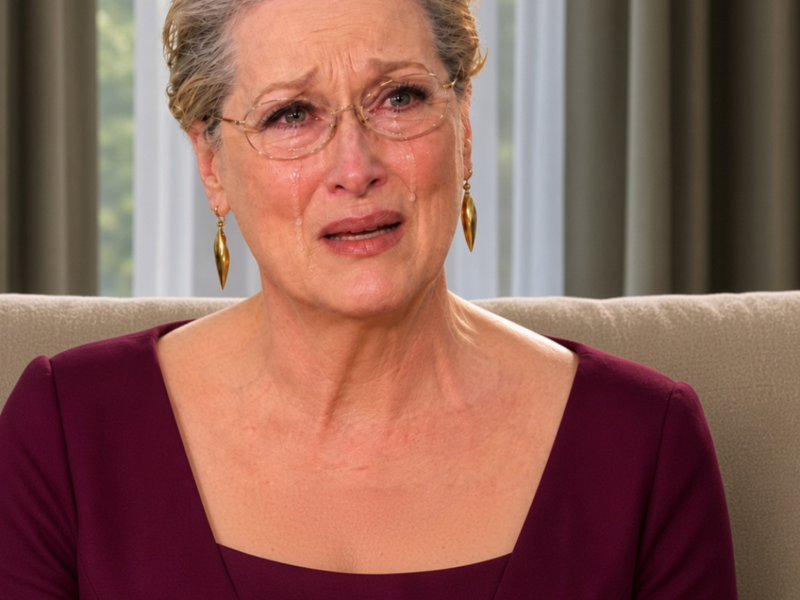
At 77, Meryl Streep FINALLY Confirms The Rumors.
The call came at 6:47 on a Tuesday morning, and it was not a publicist or a studio executive or anyone from the golden machinery of Hollywood that had been circling her name for half a century.
It was the doorman.
“Ma’am, the press is outside again,” he said, his voice carrying the slightly apologetic tone of a man who had worked the building’s front desk for eleven years and had seen Meryl Streep walk through that lobby in everything from a ball gown to rain boots and a baseball cap, and had learned long ago that the woman who always thanked him by name deserved more protection than the tabloid photographers crouched on the sidewalk could possibly understand.
“How many?” she asked, already reaching for her robe, already calculating.
“I count nine,” he said.
“Maybe twelve if you include the ones in the coffee shop pretending to order.”
Meryl stood at the window of the Manhattan apartment she had kept for nearly two decades, a modest place by her standards, a quiet place, and looked down through the sheer curtain at the men and women with cameras who had no idea they were about to be defeated by the simple act of a seventy-seven-year-old woman deciding that she was done hiding.
She had done it for six years.
She had done it with the discipline that had taken her from a suburban bedroom in Summit, New Jersey, where she practiced opera in front of a mirror as a little blonde girl, to three Academy Awards and twenty-one nominations and the universal title of the greatest actress of all time.
And now, in the early light of a morning that would change everything the world believed about her, she understood that the most remarkable performance of her life was about to end.
Not because she had been caught.
Not because she had failed.
But because she had finally chosen to lower the curtain herself.
“Tell them I’ll be down in an hour,” she said.
“And tell them to have coffee.”
“It’s going to be a long day.”
She hung up and turned to the man sitting at her kitchen table, the man who had made her laugh for the first time in years, the man who had been the quietest presence in the loudest room of her life, and she smiled.
“Marty,” she said.
“It’s time.”
For six years, the world had believed that Meryl Streep and Don Gummer were still married, still living under the same roof, still the flawless portrait of Hollywood endurance that everyone had accepted for four decades.
For six years, while the public watched red carpets and award shows and press tours, the woman at the center of all of it had been living a different life entirely, separated from the man she had married not seven months after John Cazale died in her arms, the man who had carried boxes in a Manhattan loft when she had nowhere to go, the man who had stayed home with their four children while she flew to Africa and Germany and Tokyo and back again, the man who had remained in the background for forty-five years while she became the most celebrated actress of her generation.
For six years, nobody had noticed.
And that, perhaps, was the most extraordinary achievement of all.
There was a time when Meryl Streep believed that silence was the greatest power she possessed.
It was a lesson she had learned in her mother’s presence, watching Mary Wolf Wilkinson create commercial illustrations for magazine advertisements, watching her mother negotiate the small and large indignities of a middle-class American life with a composure that never cracked, and understanding that a woman could control the world around her not by raising her voice but by choosing exactly when and how to use it.
By the time she was twelve, rehearsing operatic notes in front of her bedroom mirror, she had already developed the instinct that would define her career, that she could shape the impression she made, refine each note and every expression until she produced the response she wanted, and that this was not manipulation but artistry, the deliberate construction of a moment that would be remembered.
She graduated with honors from Vassar College in 1971 with a degree in drama and costume design, then entered the Yale School of Drama’s Master of Fine Arts program, where she developed the legendary approach to preparing roles that would make her the most respected actor of her time, examining dialects syllable by syllable, watching real people to build imagined characters, rejecting every possible shortcut.
In 1975, she completed her MFA with honors and moved directly onto the Broadway stage, and in the space of three years she made her Broadway debut, earned an Emmy for the miniseries Holocaust, and secured her first Oscar nomination for The Deer Hunter.
The pace of that ascent was almost beyond reason, and yet a close look at how Meryl Streep handled everything, whether a performance or an interview, a red carpet outfit or an acceptance speech, revealed the same unmistakable pattern.
She did not allow things to unfold by chance.
Everything remained under her control, and that characteristic would influence her marriage for the decades ahead in ways that no one, least of all Don Gummer, could have predicted.
Before Don Gummer, however, there was John Cazale, and if the world ever needed proof that Meryl Streep was capable of loving without calculation, of surrendering control in the face of something more powerful than any performance, it needed look no further than the two years she spent beside a man she knew she was going to lose.
John appeared in just five films over his entire career, and every one of those five received a Best Picture nomination, a record that remains unbroken to this day: The Godfather, The Godfather Part II, The Conversation, Dog Day Afternoon, and The Deer Hunter.
Meryl first met John in 1976 while they were performing together in a New York production of Shakespeare, and their love developed almost at once.
Yet there is one detail that few people know, a detail that transforms the story of Meryl Streep from the portrait of a controlled artist into something far more complicated.
At the time, John was already living with terminal lung cancer.
Meryl was aware of it, and she chose to stay.
She went to live with him in a Manhattan loft.
She took him to his chemotherapy appointments, and when exhaustion made it impossible for him to hold the pages of a script, she read scripts aloud to him, her voice filling the room that smelled of cold metal and fresh wood and the faint chemical scent of the hospital.
Part of her reason for accepting The Deer Hunter was director Michael Cimino’s promise to preserve a part for John, despite the insurance company’s refusal to insure an actor who was dying.
Meryl Streep, a woman accustomed to controlling everything, decided to love a man she knew she was going to lose.
There was no control in that.
It was the most agonizing choice of her life.
“I was so young,” she would say decades later, in one of the rare interviews where she allowed herself to speak about him, and her voice would change, just slightly, just enough for the careful listener to hear the door opening onto a room she had kept closed for most of her adult life.
“And he was so brave.”
“I didn’t do anything.”
“He did it.”
“I just stayed.”
On March 12, 1978, John Cazale died at the age of forty-two.
Meryl was twenty-eight.
And almost immediately afterward, another cruel reality confronted her.
The loft was John’s, and his family requested that she leave.
She was without a home.
The man she loved was gone.
She had just witnessed the person closest to her slowly dying, and now she found herself in New York surrounded by cardboard boxes with nowhere she could go.
That was the moment her brother Harry Streep III arrived to help with the packing.
He had brought a friend along.
The friend was named Don Gummer, a young sculptor, tall and reserved, with hands accustomed to handling bronze and steel every day.
His only purpose in coming that day was to carry boxes.
He intended nothing beyond that.
Yet Meryl would later recall that something about Don immediately drew her attention.
It was not an exuberant charm or a stream of flattering words, but his quietness.
He made no effort to get her laughing.
He offered none of the empty comforts people so often give.
He simply moved boxes, wiped down the floor, and occasionally checked whether she would like some water.
During the most disorderly days of Meryl Streep’s life, Don Gummer was the quietest presence in the room, and perhaps he was precisely what she needed.
The hook of that quietness, the small and unremarkable gesture of a man who never asked for anything, would return again and again across the next forty-five years, and its meaning would shift with every season of their life together.
Once the move was over, Don suggested that Meryl rent his SoHo loft since he was about to travel to Pakistan for an extended stay.
She accepted his offer.
She settled into the home of someone she scarcely knew, sleeping in the room where he had worked, among unfinished sketches for sculptures and the scent of fresh wood and cold metal.
Yet something about those surroundings began to ease the emptiness John had left behind, offering a feeling of safety rather than a clamorous presence.
By the time Don came back from Pakistan, things between them had changed.
They began a relationship quietly and away from public view, in keeping with the way each already lived.
On September 30, 1978, not even seven months after John Cazale’s death, Meryl Streep became Don Gummer’s wife.
There was no lavish wedding, no paparazzi, and no magazine cover, only a modest ceremony attended by family and a handful of close friends.
It happened so quietly that almost nobody in the entertainment industry knew about it.
And if you pause at this point, you may wonder: was it genuine love, or was a grieving woman trying to escape her pain?
The answer is unlikely to be so straightforward.
Meryl Streep is hardly somebody who makes impulsive decisions.
She weighs, calculates, and controls everything in her life.
Why then did she marry so quickly?
Perhaps Don Gummer was different from anyone she had encountered in the worlds of film and theater.
He had no need for her to be Meryl Streep.
He had no need for the spotlight.
His world was already his own, built from bronze, steel, aluminum, and glass, a world where people’s value lay in what they made rather than how many nominations came their way.
And perhaps that very quality, Don’s total independence, allowed Meryl to feel secure enough to enter another marriage before the earlier wound had healed.
“He was never impressed by any of it,” she told the Sydney Morning Herald in 2008, and in that sentence there was something she rarely allowed the public to see, a kind of gratitude that had no performance in it.
“He was always pleased to look after the children so that I would feel less guilt when work took me away.”
On the page, those words sounded affectionate, but a slower reading reveals a different undertone.
He was always happy.
Always happy.
Throughout the forty-five-year marriage, Don Gummer was the parent at home while Meryl spent months in Africa filming Out of Africa.
Don stayed home as she immersed herself in Sophie’s Choice and returned emotionally depleted.
Don remained at home while she traveled to Cannes, Berlin, Venice, London, and Tokyo, gathering one award after another.
And he was the person nobody interviewed, nobody questioned, nobody thought to ask what he felt.
Even as the entire world celebrated his wife, he continued producing his art.
He continued showing his work.
Inside his studio, he continued constructing bronze and steel sculptures that stood dozens of feet tall, and all of this happened quietly while Meryl created her art beneath the flashes of thousands of cameras.
For four decades, two careers unfolded alongside one another, but only one attracted the world’s gaze.
The hook of Don’s quietness appeared again in the sculpture studio, where he worked alone for hours, casting molten bronze into molds, grinding steel, producing art whose existence was unknown to most of the world, and it appeared again in the small, unremarkable truth that he had never once asked the world to notice him.
The defining paradox at the heart of their marriage was that they were both artists, both Yale graduates, each approaching a lifetime in art with an almost monastic devotion, and yet one became an international icon while the other receded into shadow.
That was not because Don was without talent, but because sculpture offers no red carpet.
Sculpture has no awards ceremony transmitted live to hundreds of millions of people.
Sculpture has no TMZ, and Don appeared comfortable with that arrangement.
He seemed not merely to accept it, but to choose it.
Donald James Gummer was born on December 12, 1946, in Louisville, Kentucky, into a middle-class household with five brothers.
His childhood was spent in Indianapolis, Indiana.
He attended Indiana University’s Herron School of Art before relocating to Boston to study at the School of the Museum of Fine Arts and Tufts University, and he subsequently enrolled at Yale, earning both a BFA and an MFA at the institution Meryl would attend a few years afterward.
He launched his sculpture career in the early 1970s by making wooden wall reliefs, meticulously layered geometric pieces with a pronounced architectural influence, and his work continued to evolve over the following decades.
He moved into stone, bronze, stainless steel, aluminum, and stained glass, producing large sculptures that stood independently, sometimes reaching dozens of feet into the air and weighing thousands of pounds.
In Indianapolis, Southern Circle rises twenty-five feet and weighs approximately twenty thousand pounds.
Primary Separation at the Massachusetts Museum of Contemporary Art is a permanent installation finished in 2006.
His work can also be found at the Kitakyushu concert hall in Japan and a hospital in Hiroshima, along with two fountains in Rome and a commissioned piece for the U.S. embassy in Moscow completed in 2017.
Don Gummer was never an accessory to somebody else.
He was a committed artist whose career extended over five decades, whose work was exhibited at the Smithsonian, who received recognition from the Butler Institute and earned the Governor’s Arts Award.
Yet that was not what the world noticed.
It noticed only the man beside Meryl Streep in a small number of red carpet photographs and reduced him to three words: Meryl Streep’s husband.
Across hundreds of prominent interviews over her career, Meryl Streep spoke about Don only very rarely.
Instead, she discussed her roles.
She discussed directors.
She discussed feminism, politics, and the craft of acting.
But within her public world, Don was almost absent.
This was not because she felt embarrassed by him.
Perhaps it was because in the public world Meryl Streep had constructed with such care, Don Gummer belonged to the portion she had decided to reserve for herself.
She determined what others were permitted to see, and Don did not belong to the visible portion.
He belonged to what she kept behind a locked door.
The hook of that locked door, of the chambers of her inner home that she had never allowed anybody to enter, would become the key to understanding everything that followed.
Their marriage brought four children into the world.
Henry Wolf Gummer, born in 1979, went on to become a musician.
Mamie Gummer, born in 1983, pursued acting.
Grace Gummer, born in 1986, likewise became an actress.
Louisa Jacobson Gummer, who arrived in 1991, became an actress as well.
Of their four children, three entered their mother’s profession.
Not one entered their father’s.
That need not carry any particular meaning, yet it is not wholly without meaning either.
When one parent is the world’s biggest star and the other is a sculptor creating alone in a studio, a natural gravitational pull draws everything toward the brighter light, and Meryl was always that brighter light.
Don Gummer was no victim.
He was a grown man, an artist with his own determination and a dedicated father.
Yet within the arrangement of their marriage, his role was to safeguard the home, preserve the peace, and maintain the steadiness that allowed Meryl to fly.
And she flew extraordinarily high and extraordinarily far for an extraordinarily long time.
For forty-five years, there was a question nobody voiced: if one person is always flying, what does the person remaining on the ground feel?
To outsiders, the Streep-Gummer household appeared to be one of Hollywood’s few flawless family portraits.
Four children, healthy and accomplished.
No scandals, no drugs, no rehabilitation stays, no tabloid cover stories for unfortunate reasons.
Their eldest son, Henry Wolf, turned to music, composing and performing as Henry Wolfe, far enough away to avoid being engulfed by his mother’s shadow, yet near enough that everyone still knew he was Meryl Streep’s son.
Mamie took up acting at an early stage, debuted on Broadway in 2005, and followed that with numerous television and film appearances.
Her first marriage to actor Benjamin Walker began in 2011 and ended in divorce in 2013.
She married Mehar Sethi in 2019, welcomed two children, and divorced once more in 2025.
Grace also pursued acting, receiving a Theatre World Award for her 2011 Broadway debut before appearing in Mr. Robot and other productions.
In 2021, Grace wed music producer Mark Ronson, the man behind “Uptown Funk,” and the couple now have two children.
The youngest, Louisa, born in 1991, likewise became an actress, appearing in HBO’s The Gilded Age.
Four children, all involved in entertainment, all bearing the Gummer name, but recognized through the Streep name.
None of that is anybody’s fault.
Such is the pull of gravity when your mother has received twenty-one Oscar nominations.
Yet a closer examination of that ideal family portrait reveals fractures that went unnoticed for decades.
They were not noisy fractures, the kind accompanied by broken dishes, yelling, or an affair splashed across TMZ’s front page.
They were quiet fractures, which can be much more dangerous precisely because they make no noise whatsoever.
They expand only with the passage of time, persistently and patiently, until you eventually look beneath you and discover that the ground divided long ago.
The earliest indication, if it deserves that name, was an absence.
From the middle of the 2000s onward, Don Gummer was scarcely ever beside Meryl on a red carpet.
Photographs showing them together at public occasions became fewer.
Then all but disappeared.
Meryl collected her awards on her own.
Meryl attended premieres on her own.
Meryl addressed audiences of thousands about love, resilience, and the greater opportunities women deserved, and when those evenings ended and she went back to her hotel, Don was not there in the lobby awaiting her.
He was in Connecticut, in New York, in his sculpture studio, or somewhere else that was not the place she occupied.
By itself, that is hardly extraordinary.
Plenty of couples who have been married for many years lead lives that run alongside one another.
They feel no hatred for one another.
They are not betraying one another.
They simply inhabit the same marriage in separate spaces, like two planets circling a single sun along orbits that never intersect.
And throughout those years, not one journalist raised the question.
No newspaper published the story.
No friend said a word, because Meryl Streep had created an almost impenetrable division between her private existence and her public one.
Bricks were not what held that wall together.
Reverence was.
Hollywood’s respect for her was so immense that nobody dared pose a personal question she did not wish to answer.
And Don, for his part, never spoke to the press.
He maintained no social media accounts.
He was not a guest on podcasts.
He published no memoir.
He simply remained silent and continued sculpting, casting molten bronze into molds, grinding steel in his studio, and producing art whose existence was unknown to most of the world.
Don Gummer’s quietness was not a sign of surrender.
It was part of his nature.
He had always been sparing with words.
That was true on the first day he helped Meryl carry boxes in that Manhattan loft, and it remained true until the final day they shared a roof.
Within this particular marriage, however, his silence helped prevent anybody from seeing what was unfolding.
The year was 2017, and that was when everything came to an end.
There was no eruption, no enormous argument, and no lengthy letters stained with tears.
Just two people facing each other and understanding that their shared road had reached its end.
Forty-five years, four children, and hundreds of evenings when Don was alone while Meryl was halfway across the globe.
Thousands of occasions when Meryl stepped onto a stage for an award and Don was absent from the front row.
They parted and they did not tell anybody.
There was no announcement, no tip to a journalist, no disclosure by an attorney, an assistant, or a housekeeper.
At a time when a selfie can circle the planet in thirty seconds, these two people protected the greatest secret of their lives for six consecutive years.
Six years.
Pause and consider that figure.
Between 2017 and 2023, Meryl Streep still appeared before the public as a married woman.
Nominations continued to come.
She continued making press tours.
She continued speaking at public events, and whenever journalists inquired about the key to a marriage that lasted in Hollywood, she would smile.
Nothing beyond a smile.
Then she would move the conversation elsewhere.
She never directly told a lie, yet neither did she reveal the truth.
She simply allowed the empty space to linger, leaving others to fill it with whatever they preferred to believe.
That is control in its most refined form.
It is control exercised through silence instead of speech.
During those same six years, Don Gummer remained equally quiet.
He offered no interviews discussing their separation.
He made no appeal for sympathy from the public.
He engaged no public relations team to present his version of events.
He merely carried on with the life he had always led, reserved, patient, unseen by outsiders, yet completely fulfilled within a world belonging to him alone.
Two individuals, two silences, and two different methods of protecting a secret, all producing the same outcome.
The world remained unaware.
And perhaps what is most remarkable is not their ability to keep it hidden, but the complete absence of suspicion.
No tabloid, no blogger, no Instagram fan account examining old pictures and noticing just how long Don had been missing from Meryl’s public appearances.
The reality had been there for everyone to see.
Yet nobody looked, because nobody imagined that Meryl Streep, a symbol of perfection, a symbol of Hollywood, a symbol of enduring marriage, might conceal something so substantial.
And she concealed it for six years until she chose to stop.
October 2023.
Nobody recalls the precise day the report emerged, but everybody recalls the sensation of reading it.
In a statement to People magazine, Meryl Streep’s representative confirmed the news with a brevity that felt almost cold: “Don Gummer and Meryl Streep have been separated for more than six years, and while they will always care for each other, they have chosen lives apart.”
Twenty-seven words, neither more nor fewer.
There was no interview alongside it, no press conference, no Instagram announcement, no tearful YouTube recording, only twenty-seven words sent by email to a journalist and nothing else.
The end of a forty-five-year marriage was announced in a release shorter than a birthday message.
And the most arresting aspect was the wording rather than the statement’s substance.
Look at it once more.
They would always care for one another.
It did not say they still loved one another.
There was no mention of a painful separation or a difficult choice.
Care for one another.
Language selected with the exactness of an attorney.
It offered enough warmth to avoid a scandal.
It maintained enough distance to discourage hopes of reconciliation.
That is Meryl Streep.
Even in closing the longest marriage of her life, she retained command of each word.
The announcement arrived just as Hollywood was becoming accustomed to revelations of separations kept secret.
Only a matter of weeks beforehand, Jada Pinkett Smith had disclosed that she and Will Smith had lived apart since 2016 without anyone knowing.
So Meryl’s announcement produced a hushed shock rather than a frantic one.
The sort that makes you sit down, place your phone on the table, gaze into nothing, and wonder: if Meryl Streep could not hold a marriage together, who possibly could?
Yet that question misses the point.
What we should ask is this: if Meryl Streep concealed a separation for six years in the age of social media without a single person discovering it, how was that possible?
And more significantly, why?
The answer can be found in the way she manages her life.
Meryl Streep does not spend her life on Instagram.
She has no Twitter account.
She shares no family photographs, uploads no stories, and broadcasts no live streams.
Her existence in the digital world is practically non-existent.
And where being online has come to serve as evidence that a person exists, Meryl’s total absence from social media provided the ideal suit of armor.
There was nothing to examine, no earlier and later photographs to set side by side, no captions to revisit in search of hidden meaning.
She simply had no presence in the place where most concealed stories escape.
Don Gummer was no different.
Two people who left no digital tracks, both living at a time when those tracks determine whether others notice you or forget you.
This was more than coincidence.
It was a strategy.
Whether deliberately or otherwise, they established an entirely unlit space between Meryl’s dazzling public existence and the Gummer family’s personal life.
Within that darkness, their secret endured for six years without a beam of light finding its way inside.
Then Martin Short entered the picture, and illumination began to reach it.
Meryl and Martin Short had been acquainted for years through the entertainment industry, but it was season three of Only Murders in the Building that brought real attention to their connection.
Meryl joined the Hulu show in 2023, playing the romantic interest of Short’s character.
The chemistry they shared on screen was so unmistakable that viewers could hardly overlook it.
The real spark, however, came at the Golden Globes in January 2024.
They arrived together, took seats beside one another, and spent the ceremony whispering and laughing with an intimacy that seemed to extend far beyond everyday friendship.
The internet erupted with speculation.
Rumors of a romance traveled more quickly than any official announcement.
And how did each side respond?
With denials.
Speaking to People, Meryl’s representative described them as nothing beyond very close friends.
On Club Random with Bill Maher, Martin Short made his position plain.
They were not a couple.
They were simply very close friends.
And for the time being, the world nodded and went along with it.
Yet people did not really believe those explanations, because certain things are difficult for a camera to disguise.
The manner in which Martin rested a hand on the chair back behind Meryl.
The way she tilted her head toward him while laughing.
The looks they exchanged when they believed nobody was paying attention.
That does not speak the language of an ordinary friendship.
It speaks the language of two people who are in love but have yet to feel ready to let the world in.
Then in 2025, Page Six reported confirmation of a romance between Meryl and Martin Short.
According to a source, Meryl could not stop herself from falling for Martin.
He was a gentleman who continually made her laugh and was an entirely positive presence.
She loved spending time with him.
On this occasion, nobody issued a denial.
Nobody issued a confirmation either.
There was only silence.
The silence of Meryl Streep.
It is a silence that leaves you unsure whether you are hearing acceptance or rejection, because she provides too little information for a conclusion.
She merely suspends the story exactly as she suspended the story of her separation for six years, allowing the world to use its imagination to supply the missing pieces.
Martin Short, meanwhile, stands in complete contrast to Don Gummer.
Where Don embodies quiet, Martin embodies laughter.
Where Don evokes cool bronze and steel, Martin evokes applause and stage lighting.
While Don remained behind Meryl to let her shine, Martin occupies the space beside her in that very same light.
Since he is a star in his own right, he has no need of her to attract attention.
People were already looking at him before they ever met.
Saturday Night Live, Father of the Bride, Only Murders in the Building, and decades spent doing standup comedy.
Three appearances as host of the Oscars.
Martin Short is the man who brings laughter to Meryl Streep.
And anyone familiar with Meryl Streep knows that accomplishing this is no small matter.
She does not laugh merely to be courteous.
She laughs when something truly amuses her.
And Martin, whose wife Nancy Dolman died of ovarian cancer in 2010, knows what it means to lose someone.
He knows the feeling of being lonely amid a crowd.
He knows how it feels to smile before an audience while your heart falls apart.
Perhaps it was that shared understanding that brought them together.
Martin’s lively companionship rather than Don’s silent self-sacrifice.
Two entirely distinct forms of love.
At seventy-seven, Meryl appeared to have embraced the second.
And what of Don Gummer?
While reports about Meryl and Martin set the public talking, Don offered nothing.
Neither a comment nor any outward display of pain or anger.
He remained in his sculpture studio, working with wood and oil paint, and continuing to produce new pieces.
His own website steadily and calmly added “Oil on wood reliefs finished in 2024 and 2025,” as though his personal circumstances had never shifted.
Perhaps as far as Don was concerned, they had not.
He had already been living as he wished for years before outsiders discovered that he and Meryl were separated.
Since 2017, this had been the reality he knew.
It was only the outside world that came to it late.
Yet a late arrival is still an arrival.
And once the world caught up, the question people most wanted answered concerned not the reason for the separation, but Don’s feelings on seeing Meryl with a different man.
A few more years would pass before that answer surfaced.
In May 2026, almost three years after the separation was made public, somebody close to Don Gummer finally expressed what so many had been waiting to hear.
In an article in the Daily Mail, the source explained that his outlook had shifted and that a great deal of time had gone by since they ceased to be a couple.
Then came the expression that may capture everything: Don Gummer was genuinely at peace with Meryl’s relationship with Martin Short.
Genuinely at peace.
This was not a matter of accepting it unwillingly or enduring it through clenched teeth.
He was at peace.
And that word carries more weight than people realize, because peace is not easily reached by a man who spent forty-five years beside another person and raised four children with her.
A man who watched that person become the defining icon of a generation while he remained beyond the edge of the picture.
Peace after an experience like that is not discovered overnight.
Reaching it means passing through years of quiet, countless solitary nights in a sculpture studio, and many mornings in an empty home that once rang with children’s laughter, and Don had made that journey.
The source identified another crucial element in Don’s acceptance: the passage of time.
Since 2017, he and Meryl had not truly lived as husband and wife.
When Meryl and Martin Short began their relationship around 2024, seven years had already elapsed since the marriage’s practical end.
Seven years allow enough time for hurt to become understanding.
Enough time for anger, if anger existed, to soften into acceptance.
Enough time for Don to look back and see a marriage that had ended rather than one that had failed.
Those descriptions do not mean the same thing.
Failure comes when a couple destroys one another as they go.
An ending comes when two people reach the limit of the road they have traveled together and discover that what lies ahead branches in separate directions.
Nobody stumbled and nobody pushed the other away.
They merely took different paths with the same quietness that had marked their forty-five years together.
Perhaps that is the most significant shift in perspective this whole story offers, because the world, the press, the public, and the fans have a habit of treating every separation as a tragedy.
Who was hurt?
Who deserves the blame?
Who suffered betrayal?
Who was first to walk away?
In the story of Meryl Streep and Don Gummer, however, there is no victim, no guilty party, and nobody who betrayed the other.
There are simply two people who shared a very long life, gave a great deal to each other, and eventually needed their own room to breathe.
Place Meryl’s former life with Don alongside her current life with Martin Short, and the difference is almost impossible to miss.
Life with Don was restrained for Meryl.
Everything remained under control.
Each emotion was kept within measure.
Each word was selected with care.
Don occupied the background.
Meryl occupied the foreground.
Such was their unspoken understanding.
And for decades, it served them well.
With Martin, however, the arrangement is different.
A source speaking to InTouch Weekly described it this way: Meryl and Martin share a complicated bond because they don’t refer to one another as boyfriend and girlfriend.
Yet their connection is extraordinarily close and intense, and they will probably share the remainder of their lives in one form or another.
In one form or another.
Not through a wedding band, a ceremony, or a decision to share a home.
Through something only two people at seventy-seven can understand.
A way of loving that requires neither a definition nor a label nor approval from anybody else, because enough years have taught you that those things matter less than having a person who can make you laugh when the day is over.
And Martin Short brings laughter to Meryl Streep.
Source after source returns to that point.
He is a gentleman.
He keeps making her laugh, and his outlook is entirely positive.
She loves spending time around him.
Those words may seem uncomplicated when you read them, but consider the life surrounding them.
Here is a woman who spent forty-five years in a steady yet serious marriage with a decent but reserved man within an existence managed down to the smallest detail.
Now at the age of seventy-seven, she has met somebody who makes her laugh.
Not the laughter of good manners and not the laughter of a performance, but the real thing.
The kind that makes you lose awareness of your surroundings, makes you forget the camera trained on your face, makes you forget you are Meryl Streep with the entire world looking on.
That is far from a trivial detail.
For a woman who spent almost half a century regulating every expression, it amounts to an upheaval within her private self.
In April 2026, as the publicity tour for The Devil Wears Prada 2 got underway, Meryl Streep sent an unequivocal instruction through her communication staff.
Questions about her relationship with Martin Short were off limits.
This was no gentle suggestion.
It was a directive.
Her publicist conveyed the message to every journalist, every presenter, and every network: stay away from that subject if you want to retain access.
Yet during an interview to promote the movie, Meryl herself introduced Martin into the discussion.
She mentioned that she had been talking about it with Marty Short and that they thought doing something together would be fun.
Everyone in the room was taken aback.
Having forbidden the questions, she personally reopened the very door she had closed.
As one source observed, she might not respond directly to a question, but she would guide the narrative in the direction she preferred.
That is precisely how she has operated throughout her life.
No explicit confirmation, no explicit denial, only a firm hand on the movement of information, like a director determining each frame of her own movie.
Released on May 1, 2026, The Devil Wears Prada 2 became a box office sensation.
Worldwide receipts reached $692.8 million, going well beyond all expectations for a sequel released two decades after its predecessor.
Meryl reprised Miranda Priestly, the icy, incisive editor-in-chief of a fashion publication.
This time, Miranda confronted the deterioration of print journalism and a challenge from her former assistant Emily, portrayed again by Emily Blunt, now a powerful executive.
The cast also included Anne Hathaway, Stanley Tucci, Kenneth Branagh, Simone Ashley, Lucy Liu, Justin Theroux, and Lady Gaga.
The international publicity circuit brought Meryl to Mexico City, Tokyo, Seoul, and Shanghai before taking her back to New York and London, and even at seventy-seven, she remained the focal point, the person toward whom every camera swung and whom every journalist hoped to speak with.
As she explained to Harper’s Bazaar, although they understood what the first film had meant two decades earlier, she did not think any of them had been ready for the flood of goodwill and the feverish attention that surrounded them.
Police barricades and measures to control the crowds had been necessary.
That is the Meryl Streep of 2026.
She is neither easing her pace nor withdrawing nor retiring, but still at the center of the storm she set in motion and still directing it.
Yet beyond the box office triumph and the promotional travel, Meryl Streep’s life in 2026 consisted of more than red carpets and cameras.
Some moments were never photographed and never became news, moments when she was neither Miranda Priestly nor an Oscar legend, but simply a woman of seventy-seven discovering how to live anew after the end of the longest marriage she had known.
Martin Short walked that road beside her.
A man with wounds of his own that had yet to heal.
Early in 2026, his family suffered a tragedy when his daughter Katherine Short died.
A short statement from the family confirmed their loss, and the entertainment industry responded with a respectful hush.
And behind closed doors, Meryl was present, neither as a celebrity nor as the romantic figure rumored about in tabloids.
She was there as a person beside another person in his darkest hour.
A source described her support as extraordinary.
She did not make the situation into a headline.
She simply made sure she was there.
She simply made sure she was there.
Those five words communicate more than any declaration of love delivered in public, because being truly present when somebody’s world falls apart demands the willingness to put yourself entirely to one side.
In that moment, Meryl Streep, the woman who manages everything, opted to manage nothing.
She merely came and stayed.
And when you consider it, that is precisely what Don Gummer had done for her over the preceding forty-five years.
He was quietly there, making no demands and requiring no attention.
Following Katherine’s death, speculation about a breakup between Meryl and Martin spread widely.
Many assumed that the tragedy would drive a distance between them.
Yet in May 2026, photographs showed them dining at a London restaurant, seated together on one side of the table and leaning toward one another.
The photographer described a scene filled with laughter and tender gestures.
They did not clasp hands for the camera.
They exchanged no kiss on a busy street, yet they made no attempt to conceal themselves either.
They were simply together in an unforced way, as though millions were not following their every movement.
According to an InTouch Weekly source, once the promotional tour was finished, they intended to withdraw to one of their homes and spend the entire summer in each other’s company.
Meryl would have her time in the spotlight with the movie, after which they could unwind and enjoy being together throughout the summer, the whole summer, at the ages of seventy-seven and seventy-five.
This is not the itinerary of two Hollywood celebrities seeking attention.
It is the wish of two ordinary people to find rest beside each other after experiencing so much loss.
As Meryl entered a fresh chapter, the four children she shared with Don Gummer kept developing chapters of their own.
Grace, now forty, shares her life with husband Mark Ronson and their two young children, attending the 2026 Met Gala with the poise of somebody who has reached the balance her mother spent a lifetime trying to find.
Mamie, forty-two, had recently experienced her second divorce, separating from Mehar Sethi in 2025 after six years and two children.
A reminder that no family inheritance shields anybody from personal hurt.
Henry Wolf stayed on his understated musical path, away from the glare and away from the comparisons.
Louisa Jacobson kept acting and establishing herself one step at a time.
The Streep-Gummer inheritance continues through the next generation.
Yet every child is seeking an individual way to live beyond the enormous shadow of their mother, and that alone is a struggle whose demands few outsiders truly grasp.
At seventy-nine, Don Gummer remains at work in his studio, continuing to sculpt and to produce pieces unknown to much of the world.
The Governor’s Arts Award he received in 2024 offered overdue but well-earned recognition for more than five decades of commitment.
He continues adding new work to his website, continues exhibiting, and continues inhabiting the life he selected before meeting Meryl.
A life he will still inhabit when his name is no longer linked to hers.
Don Gummer has no need for the world to tell him who he is.
He has known all along.
Perhaps that is the greatest strength he possesses.
A strength that even Meryl, for all her three Oscars and twenty-one nominations, may not feel certain she possesses herself.
Public responses to the story have taken several different directions.
Some feel sorry for Don, describing a man who was left behind, overlooked, and supplanted by a more luminous star.
Others stand behind Meryl, believing that she is entitled to happiness at seventy-seven, that after forty-five years nobody remains indebted to anybody, that discovering fresh laughter late in life is something to be grateful for rather than something sinful.
Still others take a broader view and recognize that ending does not turn a forty-five-year marriage into a failure.
Their marriage endured longer than almost anything else in Hollywood.
Longer indeed than almost anything in any place.
From it came four adults, hundreds of artworks, dozens of enduring films, and a treasury of recollections whose worth is truly understood only by the two people who shared them.
To call all that a failure does neither person justice.
Meryl Streep is no ice queen who threw away a faithful husband, and Don Gummer is no casualty deserted after decades of unspoken sacrifice.
They are two people who traveled side by side for an exceptionally long time beyond what most would even dare envision before recognizing that the years remaining to them called for a different way of living.
There was no uproar and no cruelty, only the quietness with which they had always lived.
Perhaps then what this marriage leaves behind is defined less by its forty-five years than by the manner of its ending.
They did not tear one another down.
They did not set fire to the bridge connecting them.
They did not become tabloid enemies displayed on a front page.
They simply turned toward separate paths and carried on with life.
Don carried on sculpting.
Meryl carried on acting.
Each continued to breathe, and amid Hollywood, within an industry sustained by scandal and drama, that comes as near to a good ending as two people can hope to get.
Yet the story is not truly finished, because if Meryl Streep could protect her life’s largest secret for six years while living in an age that exposes everything within seconds, the last question concerns neither her marriage to Don nor her relationship with Martin Short.
What remains to be asked is how much of Meryl Streep’s life has always been beyond our knowledge.
How many chambers of her inner home has she never allowed anybody to enter?
And is the freedom to reserve those chambers for herself, the freedom to remain less than completely visible, something every person deserves, including a legend?
Don Gummer understood that freedom.
His entire life was spent in a room where nobody thought to look, and he remained perfectly all right.
Perhaps after everything, the final lesson of this forty-five-year marriage concerns neither loving nor leaving, but preserving a little sky that belongs to you alone, even as the whole world tries to peer inside.









