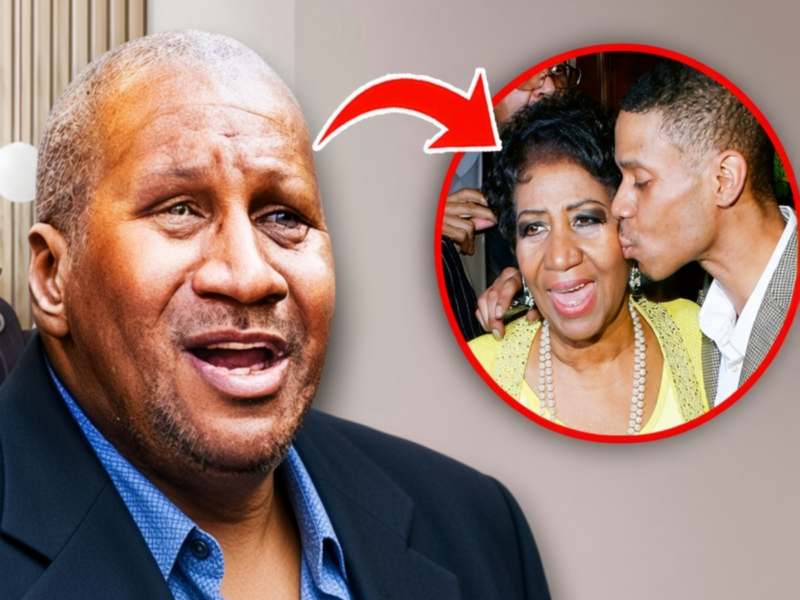
At 69, Aretha Franklin’s Son Exposed His Mother Dirty Behaviour In The Past!
Some people are born into ordinary families and spend their lives trying to become someone.
Others are born into families where someone already happened, and spend their lives trying to become themselves.
That second group is smaller than most people realize, and the public almost never sees them clearly.
They are the adult children of famous artists — the sons and daughters of singers, actors, painters, athletes, and directors whose names are larger than any single life.
They grow up in houses that are also landmarks.
They go to schools where teachers already know the family story.
They walk into rooms where the first thing people think is not their name but their parent’s.
That is the part that gets flattened when the public talks about them.
The tabloids call them spoiled.
The internet calls them ungrateful.
Occasionally a magazine does a sympathetic profile, and the sympathy itself is a form of distance, because it treats them as interesting only in relation to the famous parent.
Almost nobody asks the simpler question: what does it feel like to be the child of someone the world has already decided belongs to it?
Start with the inheritance, because that is the most visible part and also the most misunderstood.
When a famous artist dies, the estate is not just money.
It is a name, a catalog, a set of rights, a public image, and a set of stories the world has already told about itself.
The children become temporary custodians of all of it, whether they want the job or not.
Some of them spend years in probate.
Some of them spend years in litigation with siblings.
Some of them simply try to disappear, and discover that disappearing is harder than it sounds when your last name is on a search engine.
There is a documented pattern here that is worth naming plainly.
When a parent dies without a clear estate plan, the children often end up in court.
When the parent dies with a clear plan, the children often end up in a quieter kind of conflict — not about money, but about who gets to decide what the parent meant, what the parent wanted, what the parent would have thought about a biopic, a tribute album, a documentary, a museum.
The legal questions are answerable.
The other questions are not.
This is where the second cost shows up.
The public wants the children to be a certain kind of person.
The public wants them to be grateful, because the parent gave them so much.
The public wants them to be humble, because the parent was the talent.
The public wants them to be private, because grieving is private, and then the public wants them to explain themselves, because the public paid attention for decades and feels entitled to a conclusion.
That contradiction is almost impossible to satisfy.
If a child of a legend speaks publicly, they are accused of monetizing the name.
If they stay silent, they are accused of hiding something.
If they sell the family home, they are accused of greed.
If they keep it, they are accused of living off the legacy.
Every choice is legible as a betrayal of someone, either the parent or the public or both.
The third cost is quieter and harder to describe, and it is the one that shows up most often in interviews with these children when the interviews are actually honest.
It is the feeling of having been raised by a person who was, at the same time, your parent and a national symbol.
Those two roles do not fit together neatly.
A parent who is also a symbol is often absent in ways that have nothing to do with love.
They are on tour.
They are filming.
They are in the studio at two in the morning.
They are managing a career that employs dozens of people and depends on a public image that has to be protected.
Some of these children describe their famous parent with affection and distance in the same sentence.
That combination is not a contradiction.
It is what it looks like when you love someone you also had to share with the entire world.
There is a fourth cost, and it is the one that gets discussed least.
The children of legends are often asked to carry the parent’s story forward, even when they never chose that job.
They are asked to speak at memorials, approve documentaries, endorse tribute shows, bless reissues, adjudicate between rival biopics, and generally function as the living representatives of a dead artist.
This is not a role anyone trains for.
It is handed to them by circumstance, and it comes with the full weight of public opinion attached.
Some of them embrace it.
Some of them refuse it.
Most of them negotiate it slowly over years, in public, without ever getting to have the private version of the conversation first.
What is striking, when you read enough of these accounts together, is how consistent the emotional shape is.
The specific stories are different, but the underlying themes repeat.
Ambivalence about the name.
Complicated love for the parent.
Frustration with the public.
Weariness about the estate.
A late-life decision to either claim the legacy or step away from it, made by people who are usually in their fifties or sixties by the time they finally say what they actually think.
That late timing is worth noticing.
It suggests that the children of famous artists do not usually get to have their own adulthood on the same schedule as everyone else.
They spend decades being someone’s child in public before they are allowed to be themselves in public.
And by the time they are allowed, they have already lost the years in which most people figure out who they are.
None of this is a scandal, and none of it is a tragedy in the dramatic sense.
It is simply a structural fact about what it means to inherit a name.
The name comes with a house, a catalog, a set of lawyers, a set of journalists, a set of fans, and a set of expectations that never fully goes away.
The person carrying it did not choose it.
They were handed it.
And what they do with it — sell it, keep it, protect it, ignore it, or slowly reinterpret it — is their own decision, made in public, judged in public, and rarely understood in public.
The children of legends are not saints and they are not villains.
They are people who grew up in a particular kind of weather, and who are still standing in it long after the storm the public remembers has passed.
The most honest thing the rest of us can do is stop asking them to be a symbol of their parent, and start letting them be what they actually are: adults with a name that is not entirely their own, trying to live inside it without disappearing.









