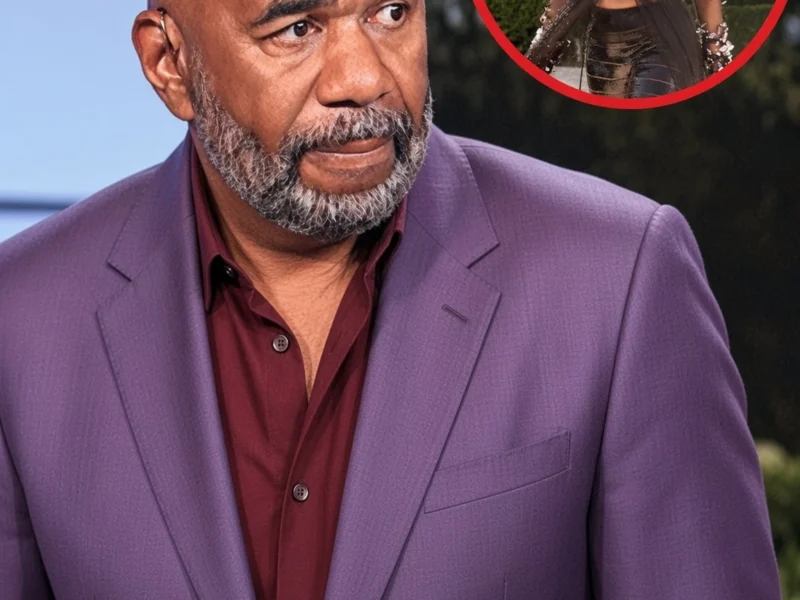
At 68, Steve Harvey Divorced His Wife Immediately After This.
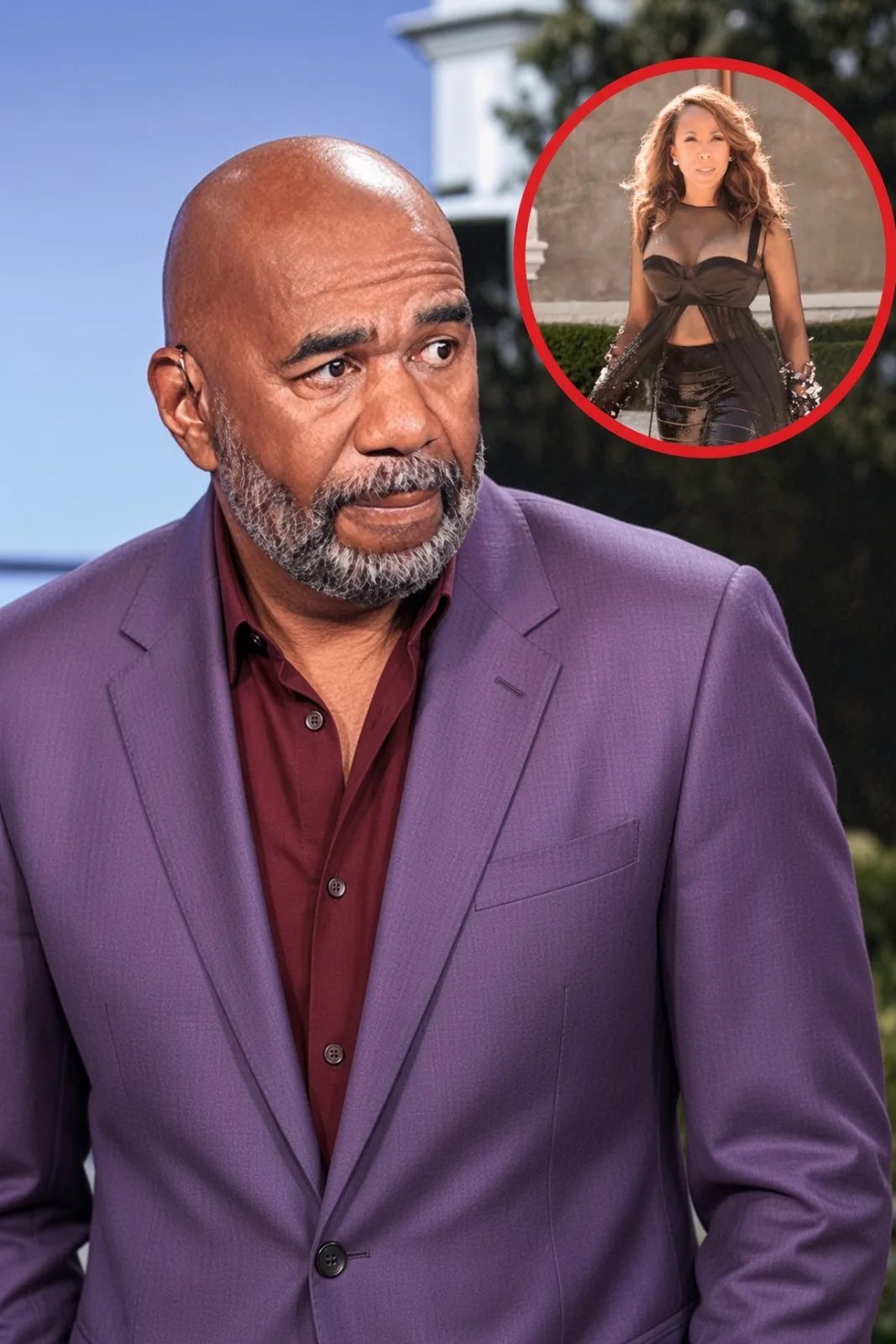
17 years.
That is how long Steve Harvey called Marjorie the woman who saved his life.
He adopted her three children.
He stood up for her in public when it cost him.
He put her name on an empire that now sits on more than $200 million.
Then, at 66 years old, with everything they had been through behind them, the internet decided his marriage was over.
The man who told millions of people that loyalty was everything was suddenly being painted as the man who got betrayed by the people closest to him.
And the reason that story spread so fast is not what you think.
The rumor that would not die.
In the second week of August 2023, a post from an anonymous account jumped from Twitter to YouTube to Facebook, and within hours it was being passed around like confirmed news.
The claim was simple and ugly.
Steve Harvey had supposedly walked in on his wife with two men who worked inside his own home, his bodyguard and his personal chef.
Two men who had been trusted with the most private parts of his life for years.
The bodyguard in the middle of it was William Freeman, known to everyone as Big Boom.
And here is the detail that made the rumor feel almost too perfect to ignore.
Big Boom was not just some hired muscle.
Back in 2005, when Steve and Marjorie had spent years apart, it was Big Boom who pushed them back toward each other.
In a way, he was the reason the marriage existed at all.
The internet saw that irony and ran with it for everything it was worth.
Harvey was in Atlanta at Invest Fest when the noise got too loud to ignore.
He walked out on stage, and instead of going into his prepared remarks, he stopped and looked straight at the crowd.
His voice was calm, but there was something tight underneath it.
He said, “Before I get started, just let me say I’m fine. Marjorie’s fine. I don’t know what y’all are doing, but find something else to do because we’re fine. Lord have mercy. I sure wish I could cuss though.”
The room laughed and clapped.
Marjorie posted a Bible verse on Instagram with a short caption saying she and her husband did not normally stop to answer foolishness and lies.
Then she disappeared from social media for three full months.
A Nigerian senator named Ned Nwoko later said he had spoken to Harvey directly and that the whole story was made up.
It did not matter.
The clips kept circulating on podcasts and in comment sections for months.
What most people missed was the pattern sitting underneath all of it.
Steve Harvey had spent his whole public life building one image, the family man, the relationship expert.
He sold millions of books about love and commitment and he pointed to his own marriage as living proof that a broken man could be rebuilt.
That made him the perfect target.
When you stand on a stage and tell the world you have the answers, the world waits patiently for the day it can say you were wrong.
In November of that same year at the Griot Awards, Harvey picked up an award and his voice cracked when he talked about his wife.
He said, “That woman right there has been down with me like four flat tires. 85% of what you know about me happened after I married that girl right there.”
Nobody watching thought he was acting.
In June of 2025, the couple marked their 18th anniversary with photos from Lake Como in Italy.
But to understand why so many people were ready to believe the worst without a single piece of proof, you have to know what came before Marjorie.
Because long before the world heard her name, Steve had already left behind broken marriages, angry courtrooms, and a $60 million lawsuit that could have swallowed everything he built.
And the woman who filed it was willing to sit in a jail cell rather than stay quiet.
Three marriages, three different men.
Steve Harvey has been married three times and that is not a small detail tucked into his biography.
It is the backbone of everything people love about him and everything people have held against him.
Each marriage shows a different version of the same man, and together they explain why one anonymous post could shake his public image all the way down.
His first wife was Marcia.
They married in 1981, back when Steve was selling insurance and had never stood on a comedy stage in his life.
They had twin daughters, Brandy and Karli, born in August of 1982, and later a son, Broderick Jr., born in 1991.
The marriage fell just as his career started to move.
Comedy asked for everything, nights, weekends, and the kind of presence a young family needs to hold together.
After the divorce was finalized in 1994, Marcia raised all three kids on her own.
Harvey fell so far behind on child support that a judge ordered him to pay more than $36,000 in back payments.
Marcia never gave an interview.
She wrote three self-published books, remarried, and moved on quietly.
The shadow of that first family never fully left his record.
His second wife was Mary Lee Shackelford.
They met in Arlington, Texas in 1989 and married in 1996.
Their son, Wynton, was born in July of 1997.
Years later, Harvey admitted he went into that marriage for the wrong reasons.
He told People magazine, “I was tired of being alone. I have to own that. It was me, not her. But it was bad for a long time.”
The divorce was finalized in November of 2005, citing irreconcilable differences.
Court records showed Mary was awarded $40,000 a month until 2009, a lump sum of $1.5 million, and three properties.
Harvey got primary custody of Wynton.
What came next stretched for more than 10 years and included a jail sentence and one of the most public divorce fights in American entertainment.
In January of 2011, Mary posted videos on YouTube that pulled in more than 200,000 views.
She claimed Harvey had been cheating with Marjorie the whole time they were married and that she had found love letters between them on her own wedding anniversary.
She also described years of bullying from Harvey and the people around him.
His legal team answered by pointing to court filings that contradicted her biggest claims.
She was not homeless and she was not broke.
She had received close to $2 million in cash, three homes, and years of monthly support.
A judge held her in contempt for breaking a gag order again and again and in December of 2013, she was sentenced to 30 days in jail.
From behind bars, she told a Dallas television station, “Am I angry? Yes. I missed 6 years of my son’s life and I cannot get those years back.”
In May of 2017, she filed a $60 million lawsuit in Los Angeles describing what she called soul killer, a mix of torture, deprivation, and brainwashing.
Harvey’s attorney called the case meritless and completely false.
It was thrown out in February of 2018 because the divorce had happened in Texas, not California.
She never filed it again.
Then there is Marjorie Bridges and her story is one most people have never heard in full.
Her first husband was Jim Townsend, a Memphis man who was sentenced to life in federal prison for conspiring to distribute illegal drugs.
Marjorie was looked at by federal investigators but was never charged.
Her next relationship was also tied to a man with a criminal background.
Steve first spotted her in a comedy club in Memphis in the late 1980s.
She came in late and took a seat in the front row.
He stopped his whole act and told the room he was going to marry that woman one day.
She remembered it like this, “He was just staring at me. I thought I was going to become part of the show.”
They dated for a short time and split.
Harvey was broke.
Both of them went on to marry other people.
The reconnection came in 2005 when Big Boom told him straight, “The only time I’ve ever seen you happy was when you were with that woman, Marjorie.”
They married on June 25th, 2007.
Harvey adopted her three children, Morgan, Jason, and Lori.
He told people, “The Lord saved my soul. Marjorie saved my life.”
But a happy ending does not mean a quiet life.
While his marriage was becoming the foundation of everything he was, his career was about to hand him the most humiliating moment in the history of live television.
And the cruelest part is that it was not entirely his fault.
The night the crown moved.
December 20th, 2015, Las Vegas, the Miss Universe pageant at the Axis at Planet Hollywood.
Harvey had wanted a stage this big for years, and he walked out ready, confident.
Then he read the card.
Miss Universe 2015 is Miss Colombia.
Ariadna Gutiérrez was crowned.
The sash went on.
The tiara went on.
For 2 full minutes, a live broadcast reaching more than 190 countries showed a woman celebrating the biggest moment of her life.
Then Harvey walked back out.
He held up the card and said, “I will take responsibility for this. It was my mistake. Miss Universe 2015 is from the Philippines.”
Staff members took the crown off Gutiérrez’s head and placed it on Pia Wurtzbach while the cameras caught every second.
Later, Harvey explained that the scorecard had been redesigned at the last minute, and nobody told him.
The winner’s name sat in the lower right corner, right where his thumb rested while he held it, and the layout made the first runner-up look like the main announcement.
Design critics compared its confusing setup to the butterfly ballot from the 2000 presidential election.
His apology tweet made things worse.
He misspelled both countries, deleted it, and posted a fixed version.
Years later, on Kevin Hart’s podcast, he said, “I had just written on my vision board that I was asking God to increase my global brand. In 48 hours, my name had been Googled 4 billion times.”
Gutiérrez told a Spanish-language network, “In 4 minutes, they destroy your dreams and throw them in the trash.”
By 2020, she had made peace with him completely.
She said, “I love him, and it wasn’t his fault.”
What hardly anyone reported was what happened in the private talks that followed.
Harvey told executives he wanted ownership.
He ended up hosting six more Miss Universe pageants from 2016 through 2021.
The woman whose crown was pulled off in front of the world forgave him faster than the internet ever did.
He took the most viral TV mistake of his generation and turned it into 6 more years of paid work, but something else was building in the background, something far more personal than a misread card.
While Harvey collected awards on giant stages, a group of comedians was getting ready to say on the record that part of what made him famous never belonged to him in the first place.
Bologna, a Ford Tempo, and $50.
On October 8th, 1985, Steve Harvey walked into Hilarities Comedy Club in Cleveland for an amateur open mic night.
He won the contest.
The prize was $50.
He cried the whole way home, not because $50 was a lot of money, but because something had switched on inside him that he had never felt before.
He described it like this, “I won $50, cried all the way home. I said, ‘No, you don’t understand. I was born tonight. I’m going to go do this the rest of my life.'”
The next morning, he quit his insurance job.
He had a wife and baby twins at home.
What came after was 3 years he still calls the hardest of his life.
His first marriage had collapsed.
The comedy gigs were unreliable and paid almost nothing, and he had no place to go.
So, he lived in a 1976 Ford Tempo.
In the backseat sat an Igloo cooler packed with ice, bologna, and cheese.
He hung his suits in the rear window so they would stay pressed enough to wear on stage.
He washed up in gas station bathrooms, hotel lobbies, and public pools.
Some weeks he made as little as $50, and he sent 75% of it to his family.
He stole gas to reach bookings across the state.
In a People magazine interview, he said, “It was so disheartening. A week is really the maximum you can do. This was 3 years. It was rock bottom, but even in my darkest days, I had faith it would turn around.”
He also talked about a voice that came to him in those years.
“If you keep going, I’m going to take you places you’ve never been. Don’t quit. You’re almost there.”
And in another interview, he explained what that time left behind in him for good.
“I’ve been running from poverty so long because I was in it for so long. I guess I am kind of afraid of it going bad.”
That fear never left.
It became the engine running quietly under every business decision he made from then on.
His career got real traction in April of 1990 when he became a finalist in the second annual Johnny Walker National Comedy Search competing against a young Judd Apatow and a stand-up named Ray Romano.
That led to Showtime at the Apollo where he became the permanent host in 1993 and stayed for seven straight years.
The Steve Harvey Show launched on the WB in 1996, ran six seasons and 122 episodes, and won more than a dozen NAACP Image Awards.
In December of 1997, the original Kings of Comedy Tour started with Harvey, Cedric the Entertainer, Bernie Mac, and D.L. Hughley.
It made $37 million over 2 years, the highest-grossing comedy tour in American history at that point.
On August 2nd, 2012, Harvey did his last stand-up show at the MGM Grand in Las Vegas.
Marjorie had told him God was preparing something he could not see yet.
He trusted her and walked away from the stage that had literally saved his life.
He never went back.
That may have been the smartest move he ever made because the world he left behind was about to turn on him in ways no TV rating could protect him from.
The joke that was never his.
On January 3rd, 2024, Cat Williams sat down with Shannon Sharpe on Club Shay Shay and more than 33 million people watched.
Somewhere in that conversation, Williams pointed straight at Steve Harvey and said a big piece of his career was built on material that was not his.
Mark Curry had been saying something similar in public since December of 2019.
Curry starred in ABC’s Hangin’ with Mr. Cooper from 1992 to 1997 playing a black comedian in suits who worked as a vice principal at a school.
Harvey’s sitcom on the WB, which launched in 1996, starred a black comedian in suits who worked as a vice principal at a school.
Curry never treated that as a coincidence.
But the joke at the center of the fight was smaller and more specific.
On his 1999 Comedy Central special, Curry did a Halloween bit about being so poor as a kid that he wore a cardboard UPS box as a costume.
In 2015, a segment with almost the same premise and structure showed up on Harvey’s daytime talk show.
TMZ put the two clips next to each other.
The similarities were very hard to argue away.
In June of 2024, Angela Means, who played Felicia in the movie Friday, said the pattern was real.
She said, “Steve Harvey will steal a joke. It was blatant.”
She described Curry as one of the most gifted improvisers black stand-up has ever had.
Someone whose ideas came so fast that other comedians borrowed from him almost by reflex.
She told Curry to let it go, but she never disputed one thing he said about Harvey.
There is a second accusation and it involves Bernie Mac.
Mac told GQ magazine in 2003 that Harvey, or someone speaking for him, approached the producers of Ocean’s Eleven in 2001 and offered to play Mac’s role for less money so he could take it from him.
In April of 2024, radio host Ed Lover confirmed that Mac had told him the same story personally and had been truly hurt by it.
Harvey’s answers have been broad denials that never deal with the actual footage.
He told TMZ in 2020, “Never stole a joke in 35 years. Come to me like a man.”
At Invest Fest in August of 2024, he made remarks about lions and small dogs that drew instant backlash.
A month later, on the Pivot podcast, he quietly said, “I probably shouldn’t have said anything. We’re not in the same league, dog.”
Here is the part that makes this whole fight so hard to settle.
Joke theft in stand-up has almost no legal remedy because single jokes get barely any copyright protection.
The only real punishment in that world comes from other comedians and Harvey’s move into television hosting put him permanently out of their reach.
The accusations are still unresolved and the footage is still online for anyone to watch.
But before you decide what to think about the comedian, you need to see the empire the comedian turned into because the distance between a 1976 Ford Tempo and $200 million is one of the strangest climbs in American entertainment.
The man who is still running.
Harvey has one line about money that explains almost everything about him.
He said, “I’m running from homelessness. I cannot ever be in that position again. If my show gets canceled, I’ve got three more.”
That is not ambition in the normal sense.
That is survival at the highest level wearing a custom suit.
By 2024, his net worth sat around $200 million.
Family Feud is the anchor.
He has hosted since September of 2010, earns roughly $10 million a season, and is both the longest-running and highest-rated host in the show’s 50-year history.
Under him, it became the first nationally syndicated show to grow its ratings for 7 years in a row.
In 2020, he launched Family Feud Africa, and within two seasons, it was the number one game show in both South Africa and Ghana.
The Steve Harvey Morning Show reaches almost 7 million listeners a week across more than 100 radio stations.
His book, Act Like a Lady, Think Like a Man, sold over 2.8 million copies and spent 64 weeks on the New York Times bestseller list, 23 of them at number one.
The movie version, Think Like a Man, came out in 2012 and made $96 million off a $12 million budget.
In 2017, he started Steve Harvey Global, made early investments in Stripe, SpaceX, Coinbase, and GitHub, and launched a supplement line called Le’Vet U, along with a menswear brand called H by Steve Harvey.
In June of 2020, he bought an Atlanta estate originally built by Tyler Perry for $15 million.
Then there is the giving.
The Steve and Marjorie Harvey Foundation runs a mentoring weekend every Father’s Day for boys growing up without fathers.
The Disney Dreamers Academy has picked 100 high school students every year since 2008 from more than 10,000 applicants, reaching over 1,800 teenagers so far.
He also paid for eight full scholarships to Kent State University worth $736,000 in memory of a student named Devon Moore.
The most divisive chapter of his public life came on January 13th, 2017, when he met President-elect Donald Trump at Trump Tower.
Harvey said the Obama transition team had encouraged the meeting and that he pitched a plan with HUD Secretary Ben Carson to turn closing inner-city schools into STEM learning centers.
The reaction from black communities was harsh and personal.
He told The Hollywood Reporter, “I was being called names I have never been called. Uncle Tom, a sellout.”
Because I went to see this man on his radio show he told listeners, “A lot of y’all hurt me. You really did.”
And then there is the jump speech.
It was filmed on a phone inside a television studio, watched 58 million times, and had not $1 of advertising behind it.
It shows you who he is underneath everything else.
He told that audience, “Every successful person in this world has jumped. You cannot just exist in this life. You have got to try to live. When you first jump, your parachute will not open right away. You’re going to hit them rocks, but eventually the parachute has to open. That is a promise from God.”
He said all of that as a man who had slept in a car, eaten bologna out of a cooler, been dragged through tabloids for 30 years, and announced the wrong winner on live television in front of 200 countries.
The speech did not come from a script or a teleprompter.
It came from the only place anything real ever comes from.
And to understand where that place is, you have to go back to the very beginning.
The boy who wrote it down.
Broderick Stephen Harvey was born on January 17th, 1957 in Welch, West Virginia.
His parents named him after a television actor, Broderick Crawford, the star of a show called Highway Patrol.
Before the boy could say a full sentence, they had already pointed him toward a screen.
His father, Jesse, was a coal miner who later sold insurance.
His mother, Eloise, taught Sunday school.
The family moved to Cleveland, Ohio, and settled on East 112th Street, a block that would be renamed Steve Harvey Way in 2015, long after the kid who grew up there had made every doubter irrelevant.
Young Steve had a stutter so bad that other kids gave him a cruel nickname.
They called him Va-Va-Vroom because his words crashed and stalled before they could get out.
A man who worked at the neighborhood deli quietly taught him to repeat his thoughts silently three times before speaking and to talk on the exhale.
When Steve got it right, the man gave him candy.
That deli counter became an unlikely classroom.
Harvey said later, “A big part of my sense of humor came out of my stuttering. I said, ‘Yes, I stutter, but I can make you laugh.'”
The story that shaped his whole childhood happened in sixth grade.
His teacher asked every student to write down what they wanted to be when they grew up.
Steve wrote that he wanted to be on television.
The teacher read every paper out loud, saved his for last, called him to the front of the room, and humiliated him in front of the entire class.
She told a stuttering boy from a coal-mining family that his dream was not just unrealistic, but embarrassing.
Then she called his parents.
His mother was mortified.
His father was not.
That night, Jesse Harvey walked into Steve’s room and said the words his son has repeated in nearly every major interview since.
“Take your paper, put it in your drawer. Every morning when you get up, read your paper. And every night before you go to bed, read your paper. That’s your paper.”
Jesse Harvey died on April 7th, 2000, from black lung disease.
Eloise died in 1997 after a stroke.
Neither of them lived to see how far that paper would go.
Harvey has said in several interviews that this is a weight he still carries every single day.
After high school, Harvey went to Kent State University, joined a fraternity, studied advertising, and flunked out.
Over nearly a decade, he worked more than 10 different jobs.
He boxed, cleaned carpets, delivered mail, and sold insurance.
General Electric laid him off right before Thanksgiving, and he went home with a turkey and no paycheck.
None of it pointed anywhere useful.
Not yet.
When success finally came, he sent that sixth grade teacher a brand new television every Christmas for the rest of her life.
He told her, “I wanted you to see me.”
She eventually told him she had run out of places to put them and had started giving them to neighbors.
Harvey tells that story with a laugh every time.
The laugh never quite covers what is underneath it.
He is on television 7 days a week, exactly like he told her he would be.
The paper did not lie.
The father who protected that dream never steered him wrong, and the car that should have broken him turned out to be the place where his faith was tested and proven real.
His legacy will never be simple, and it was never going to be.
The man who tells boys to believe in themselves left his first family struggling while he chased his dream.
The man who became America’s relationship expert carried two failed marriages and a $60 million lawsuit into the home he now calls his salvation.
The man who stood on the biggest pageant stage in the world misread one card and turned the fallout into six more years of work.
The man who tells millions to jump is still, by his own admission, running from something.
He is not a saint.
He is not a fraud.
He is something far more interesting than either one.
He is a man who wrote it all down on a piece of paper at 11 years old and refused to stop until every word on that paper came true.
That is the complete story of Steve Harvey.
The parts that made you proud, the parts that made you uncomfortable, and the parts that never make the highlight reels.









