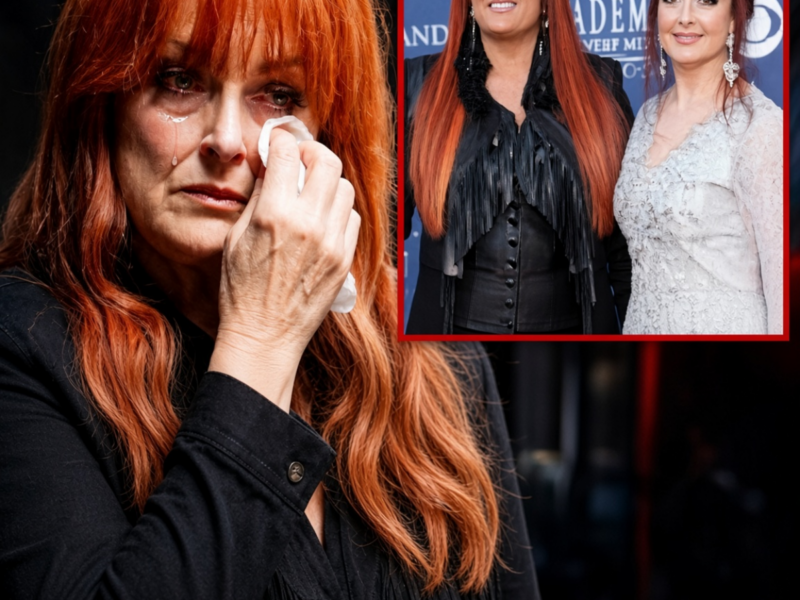
At 62, Wynonna Judd Breaks Her Silence On Her Family.
“Though it’s not physical death. It’s the end.”
“And we don’t talk much. It’s going to take time, I think.”
“And I didn’t expect to cry. I think just because I’m a mom right now and dealing with teenagers.”
Some voices don’t just sing a song—they carry a whole life inside them.
When Wynonna Judd opens her mouth and lets that big, smoky, soulful sound pour out, you can hear the Kentucky hills, the Nashville stages, the arenas, and every hard thing she has walked through to get there.
For more than forty years, millions of people have known that voice.
But for most of those years, very few people knew the story underneath it.
Now, at 62, Wynonna is speaking about her family with a kind of openness she once kept locked away.
Not to shock anyone and not to settle old scores, but because carrying silence for a lifetime is heavy.
And at some point, a person decides to set it down.
In this video, we walk through the story of a girl born into scandal.
A daughter who became half of the most successful mother-daughter act in country music history.
A woman who learned the truth about her own father as an adult.
And a survivor who lost her mother in the most painful way imaginable.
It is a story about family secrets, love, grief, and the slow, stubborn work of healing.
If you love stories like this, stay with us until the end, because the part about what Wynonna has learned may be the most powerful of all.
Wynonna was born on May 30th, 1964 in Ashland, Kentucky, and she arrived with a different name than the one the world would come to know.
She was born Christina Claire Ciminella.
Her mother, Diana Judd, who would later become known as Naomi, was just a teenager when she gave birth in the early 1960s in a small Appalachian town.
That was not simply a private matter.
It was the kind of thing neighbors whispered about, and it shaped the way a young mother was treated and the way her child grew up.
Wynonna’s early childhood was not the picture of a stable home.
Her mother was young, trying to find her footing, and the family she came from had its own tensions.
In the years that followed, Naomi had a second daughter, Ashley, and the family moved around, eventually landing in California for a time before returning to Kentucky and then Tennessee.
For a child, all that movement can feel like the ground never stops shifting.
Wynonna has spoken over the years about feeling like she had to grow up fast—about being the older sister, the helper, the one who tried to keep the peace.
And there was something else.
Something that sat quietly in the middle of it all.
The man Wynonna grew up believing was her father was not her biological father.
Children can sense when an adult is holding something back, even when they don’t have the words for it.
A lot of Wynonna’s early years were lived inside that kind of unspoken tension, in a house where some subjects were simply not talked about.
Like so many people who feel unsettled at home, Wynonna found comfort in sound.
As a teenager, she picked up a guitar, and her mother, who loved to sing, began harmonizing with her.
In the Kentucky and Tennessee years, the two of them would sit together and play.
And something happened when their voices met.
Naomi’s bright, sweet harmonies wrapped around Wynonna’s deep, powerful lead, and the combination was unlike anything else.
Music became more than a hobby.
It was a language the two of them could speak when ordinary conversation felt difficult.
If you want to understand the Judds, you have to understand that their relationship was layered and complicated, full of deep love and real friction.
But when they sang, the friction melted.
The harmony was the one place where they were completely in step.
Naomi trained as a nurse and raised her daughters in a modest home, and the dream of making it in Nashville kept growing.
The family moved to Tennessee, and the two women started chasing the music business with a kind of determination only people with nothing to lose can have.
Naomi has said that she was the one pushing, and Wynonna, still young, was the voice that made the dream possible.
A mother with a vision and a daughter with a gift.
That was the Judds before the world ever heard of them.
The breakthrough came in the early 1980s.
Their audition for RCA Records in Nashville became part of country music legend, and in 1983 they landed a record deal.
Within a short time, the sound of the Judds was everywhere.
Songs like “Mama He’s Crazy” and “Why Not Me” climbed to the top of the country charts, and suddenly the girl from Ashland and her mother were stars.
What followed was a run that very few acts in any genre can match.
Over the next several years, the Judds scored a long string of number one hits, won multiple Grammy Awards, and collected a shelf full of Country Music Association honors.
Fans loved the warmth of “Grandpa, Tell Me About the Good Old Days.”
They loved the feel-good lift of “Rockin’ with the Rhythm of the Rain.”
And when “Love Can Build a Bridge” arrived in 1990, it became a kind of anthem for the duo, a song about hope and connection that would come to mean even more later on.
To the public, it looked like a fairy tale.
A mother and daughter laughing on stage, finishing each other’s harmonies, living the dream together.
But anyone who has ever worked closely with a family member knows how complicated that can be.
Imagine having your mother as your boss, your bandmate, your mentor, and your best friend all at once, with the whole world watching.
The love was real, but so was the pressure.
In 1991, the Judds’ story hit a turning point that no one had planned.
Naomi had been diagnosed with chronic hepatitis, and doctors told her she could no longer keep up the grueling life of touring.
The duo announced a farewell tour, and it turned into one of the biggest events in country music.
Fans packed arenas knowing they were watching something that would not last.
For Wynonna, the end of the Judds meant stepping into the unknown.
Her whole professional life had been built around standing next to her mother.
Now she had to stand alone.
A lot of artists would have stumbled under that pressure.
But Wynonna did something remarkable.
In 1992, she released her first solo album, and it was a massive success.
Hit singles like “She Is His Only Need” and “I Saw the Light” reached the top of the charts, and she proved something to herself and to everyone watching.
That big voice belonged to her, not just the duo.
But success on the outside doesn’t automatically fix what is happening on the inside.
Wynonna has been open in the years since about the emotional cost of that time.
She was a young woman suddenly leading her own career, juggling expectations from the industry and from the public while also dealing with the unresolved things in her family.
Some of the hardest chapters of her life would begin right in the middle of her greatest professional triumphs.
One of the most striking parts of Wynonna’s story is how she learned the truth about her biological father.
For much of her life, she believed that Michael Ciminella was her dad.
It wasn’t until she was an adult and already famous that she discovered the man who raised her was not her biological father.
Her biological father was a man named Charles Jordan, someone from her mother’s past.
Think about what that kind of revelation can do to a person.
Your identity, the story you have told yourself about where you come from, suddenly shifts.
Wynonna has described the experience in interviews and in her writing as deeply unsettling.
A moment that changed how she understood her own history.
It also touched something painful: the sense that the adults around her had known something important for years and that she had been living in the dark.
What makes the story even more poignant is the timing.
This was not a quiet moment of private reflection.
It came while Wynonna was already in the public eye, with a career to run, concerts to perform, and fans who thought they knew her.
She had to process a life-changing truth while still showing up and singing.
That is something many people who have been through family upheaval will recognize.
The world doesn’t pause while you figure out who you are.
As the 1990s moved on, Wynonna’s personal life became as much a topic of conversation as her music.
She became a mother, raising her children, Elijah and Grace, while also managing a demanding career.
Her marriage to Arch Kelley III ended, and she has spoken candidly about how difficult it was to try to hold a family together in the glare of the spotlight.
She also wrote openly about her own struggles.
In her memoir, Coming Home to Myself, she described the pressures of her life, the weight of expectations, and the way she had learned to cope, including her complicated relationship with food and self-image.
In a business that has always been brutal about appearances, she chose to talk about the very things most celebrities would rather hide.
That choice mattered to a lot of fans who saw their own battles reflected in her honesty.
There were bright moments, too.
Wynonna kept releasing music, kept touring, and kept finding new ways to reinvent herself.
She dug into the blues, rock, and Southern soul that had always lived inside her voice.
Years later, she found love again with her husband, drummer Cactus Moser, a partner who would stand beside her through some of the most difficult chapters still to come.
Through it all, there was one constant.
When she sang, the audience felt the truth of every word.
It’s impossible to tell Wynonna’s story without returning again and again to her mother.
Naomi Judd was a force of nature—funny, glamorous, fiercely intelligent, and endlessly driven.
She was also a woman who struggled in ways that were not always visible to the public.
Naomi spoke publicly in later years about living with severe depression and anxiety, and she wrote about it with real courage.
In doing so, she helped many people feel less alone.
But loving someone who is struggling is its own kind of challenge.
Wynonna and Naomi had years of closeness along with years of distance.
They reunited for tours and television appearances.
They stepped back from each other and came together again.
Anyone who has a strong-willed parent will understand how that can go.
You can love someone with your whole heart and still struggle to find the right way to be close to them.
Wynonna has described the relationship as a mix of devotion and difficulty.
There were arguments, there were silences, and there was always music pulling them back together.
In 2022, the two were preparing for what should have been a joyful reunion, with plans for a tour and a celebration of their legacy.
It was supposed to be a new chapter.
Instead, it became the most painful moment in Wynonna’s life.
On April 30th, 2022, Naomi Judd died at the age of 76.
The next day, the Judds were scheduled to be inducted into the Country Music Hall of Fame, one of the highest honors in the genre.
The timing felt almost impossible to bear.
The family later shared that Naomi had died by suicide after a long battle with mental illness.
Her daughters released a statement saying they had lost their beautiful mother to the disease of mental illness.
Wynonna has described that period as a blur of shock, grief, and a strange sense of unreality.
She has talked about feeling caught between two enormous emotions: a heartbreak so deep she could barely stand, and a tribute she knew her mother would have wanted her to honor.
At the Hall of Fame ceremony the very next day, Wynonna and her sister Ashley stood together and accepted the honor on behalf of the family.
Wynonna also sang, and the performance of “Love Can Build a Bridge” became one of the most emotional moments in recent country music history.
For many people watching, it was hard to hold back tears.
Here was a daughter, hours after losing her mother, standing in front of her peers and doing the thing that had always connected them: singing.
It wasn’t a polished, perfect moment.
It was raw and real, and that is exactly why it touched so many hearts.
Losing a parent is hard under any circumstances.
Losing a parent to suicide adds layers of pain that are difficult for outsiders to imagine.
Families often wrestle with unanswered questions, with guilt that has no logical basis, with a haunting thought of “What if I had done something different?”
Mental health experts consistently say that these feelings are common and that they do not reflect the truth.
Suicide is complex, and no single person is responsible for it.
Wynonna has been honest that her grief has not been simple.
In the months and years after Naomi’s death, she has spoken about moving through shock, sadness, anger, and moments of unexpected peace, sometimes all in the same day.
She has also talked about how the loss brought her family’s history rushing back—the old wounds, the old secrets, the things said and unsaid.
When someone you love is gone, you don’t only grieve the person; you grieve the conversations you wanted to have and the version of the relationship that never got finished.
Grief like this also reshapes a family.
Wynonna and Ashley have leaned on each other in a way that is both comforting and difficult, because they are the two people who understand exactly what was lost, and also two people who experience their mother in different ways.
Healing together while each processing their own pain is a delicate process.
But it is also one of the most meaningful parts of Wynonna’s recent story.
After Naomi’s death, many people wondered whether Wynonna would step away from the stage.
Instead, she made a choice that surprised some and inspired many.
She kept going.
Later in 2022, she took the stage for a tour honoring her mother’s memory, singing the songs that had defined their partnership with guest artists joining her night after night.
For fans, those shows were part concert, part memorial, and part group therapy.
There is something profound in the decision to turn grief into music.
Wynonna has said in her own way that the stage is where she feels closest to her mother.
Every time she sings those old harmonies, there is an empty space where Naomi’s voice used to be, and the audience feels it too.
It’s a bittersweet kind of magic: the pain of absence and the comfort of memory sharing the same room.
Her performances in the years since have carried a weight that wasn’t there before.
The voice is still powerful, but it now has an added layer of experience.
The sound of someone who has lived through the unthinkable and is still standing.
Fans often say that hearing her sing today feels like hearing a person who has stopped pretending.
And maybe that is the clearest sign of what breaking the silence has meant for her.
So why is Wynonna talking so openly about her family at 62?
There isn’t a single answer, but the reasons are easy to understand.
Age changes people.
By your 60s, you start to see your life as a whole story rather than a series of urgent moments.
You become less interested in protecting an image and more interested in telling the truth.
Loss changes people, too.
When someone you love dies, the things you were afraid to say suddenly seem less frightening, because you’ve already lived through something far worse.
Silence that once felt like protection begins to feel like a weight.
Wynonna has been through a public career, a private identity shock, a marriage that ended, and the death of her mother.
After all that, being honest about her family may feel less like a risk and more like a relief.
There is also the question of purpose.
Many people who have experienced family secrets, mental illness, or loss in their own homes have looked to Wynonna as someone who could put words to feelings they couldn’t express.
By speaking up, she gives them permission to do the same.
The truth, even when it’s painful, has a way of connecting people.
It tells them they are not the only ones whose family looks perfect from the outside and feels complicated on the inside.
There are a few lessons in Wynonna’s journey that stand out.
The first is that secrets, even well-intentioned ones, tend to leave marks.
Families often hide painful things out of love or fear, thinking they are protecting each other.
But silence has a cost, and it is usually paid by the next generation, who feel the tension without understanding it.
The second lesson is that mental health deserves the same compassion as physical health.
Naomi Judd spent years speaking about her depression, and her daughters have continued that conversation after her death.
If you or someone you know is struggling, please know that help is available.
In the United States, you can call or text 988 to reach the Suicide and Crisis Lifeline.
And if you are elsewhere, local crisis services can connect you with support.
Reaching out is not weakness.
It is one of the bravest things a person can do.
The third lesson is that healing is not a straight line.
Wynonna’s story doesn’t end with a neat, tidy resolution.
There are still hard days.
There are still questions without answers.
But there is also growth, humor, music, and a deep commitment to honoring her mother’s memory by living honestly.
That is what makes her story so human.
She is not a symbol of perfection.
She is a symbol of persistence.
Together, Naomi and Wynonna left a legacy that will be remembered for generations.
Their records still sell, their songs still play on the radio, and their harmonies still give people chills.
They prove that a mother and daughter could build something extraordinary.
And they opened doors for countless women in country music who came after.









