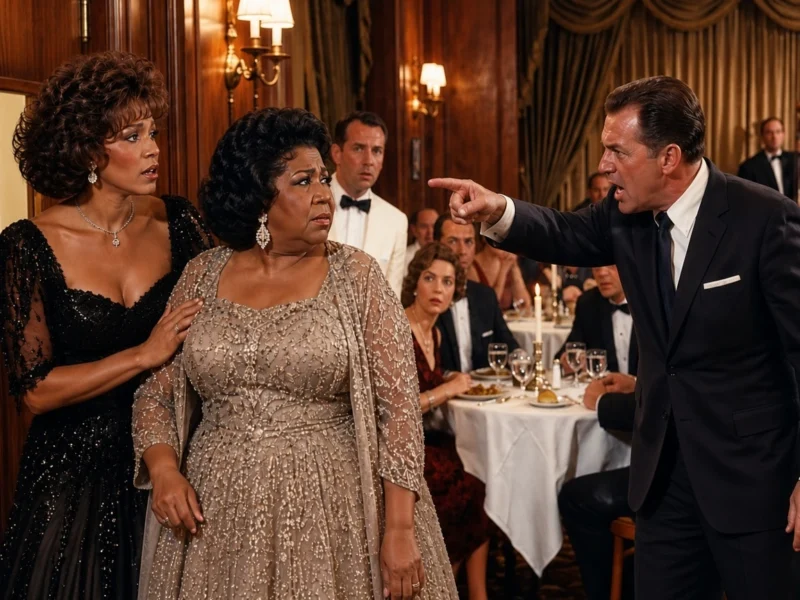
Aretha Franklin Was Banned From a Venue She FILLED — Whitney Changed Everything.
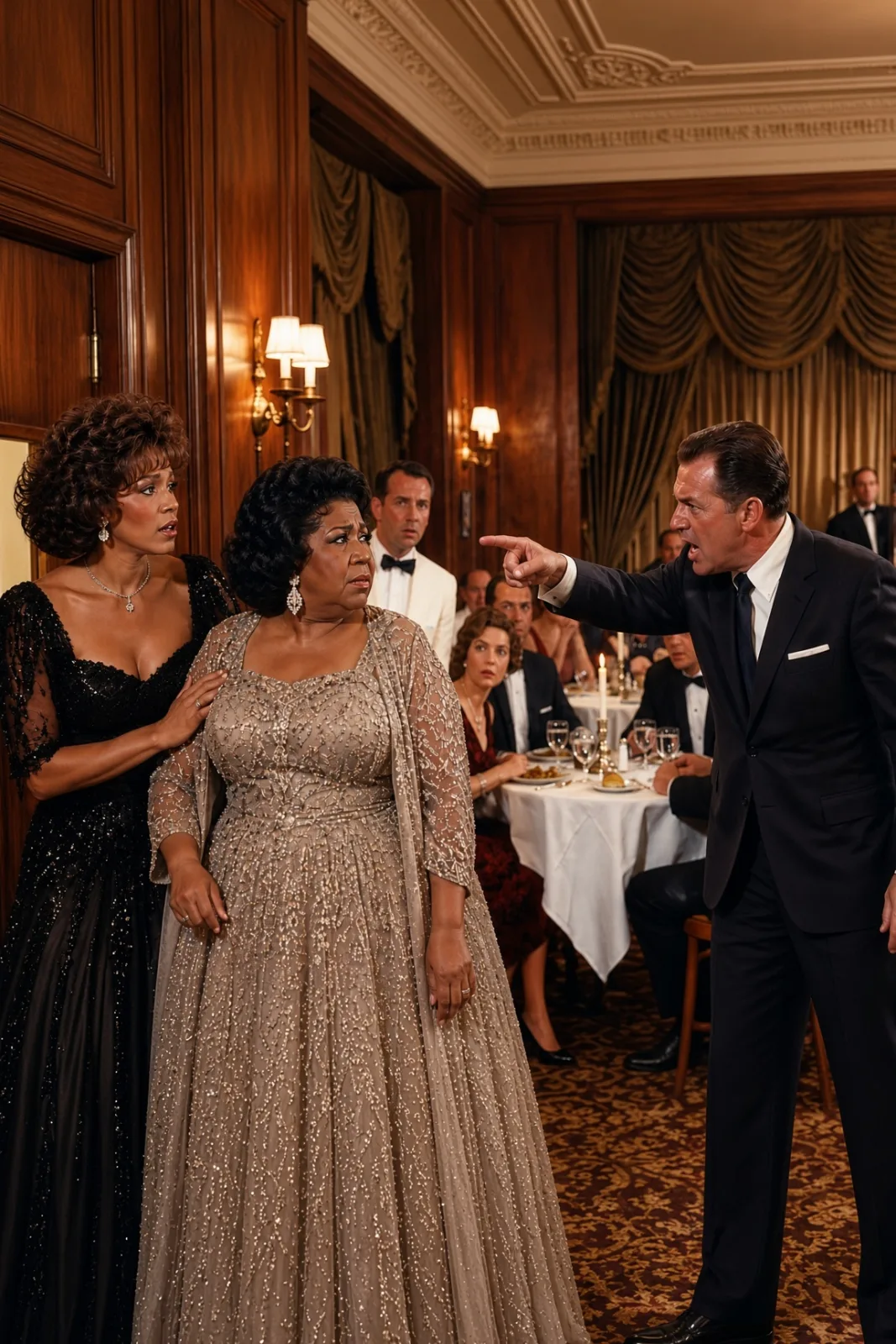
March 14th, 1991.
The Regal Crown Hotel and Casino, Las Vegas, Nevada.
14 minutes before the doors of the Coronet Theatre opened for the final night of a sold-out run.
A woman in a plain gray coat walked past the main marquee carrying her own garment bag.
Above her head, 6-ft lights spelled out her name, Delphine Marsh, 11 nights.
19,000 seats, every one of them gone before the first poster went up.
It was the 31st time she had headlined the Coronet since 1979.
She had never missed a show.
She had never once arrived late.
And in 31 engagements across 12 years, she had never set foot inside the most famous room in the hotel.
The Laurel Room.
The place where the Regal Crown fed its headliners, signed its biggest contracts, and hung their portraits on a wall of dark walnut and brass.
It was 41 steps from her dressing room door.
She knew the number.
She had counted them once years ago and then trained herself to stop.
Tonight, a 27-year-old woman was going to walk down that same corridor and notice what nobody else had been willing to say out loud.
Her name was Tessa Holloway.
And before the sun came up, one of the most powerful men on the Las Vegas strip would learn what happens when you tell the wrong goddaughter the word no.
This is that story.
Now, let’s go back to the afternoon of March 14th.
Disclaimer before we go any further, one quick note.
This is a dramatized fictional story inspired by the legacy of soul music’s great voices.
The characters, the hotel, and the events you’re about to hear are invented.
It is not a documented historical event.
At 4:00 that afternoon, Delphine Marsh was sitting on the edge of a floral couch in the garden villa, a low stucco building at the back of the Regal Crown property, right beside the service road.
A cup of tea with honey was going cold on the table in front of her.
She hadn’t touched it.
The villa was comfortable.
Nobody ever said it wasn’t.
It had a piano, a good bed, a kitchenette stocked with exactly what she liked.
But if she stood at the window, she could see the loading dock.
And if she turned her head the other way, she could see, far across the pool deck, the glass tower where the other headliners stayed, 31 floors up with a view of the whole strip.
Delphine was 49 years old.
She had been born in Birmingham, Alabama, and raised in Cleveland, the daughter of a barber who was also a deacon, in a house where the radio was allowed on only after the dishes were done.
She had learned to sing in the third pew of Mount Calvary Baptist, standing on a hymnal because she was too short to see over the pew in front.
She had 11 albums, nine Grammy Awards.
The newspapers called her the Duchess of Soul.
And she had always told reporters she preferred to be called late for supper by people who loved her.
On the table beside the tea sat a single sheet of paper, a contract renewal delivered to her door that morning in a cream envelope with the hotel’s crest.
Five more years at the Coronet.
The number at the bottom was the biggest she had ever been offered.
Leon Baptiste, her road manager for 22 years, had set it down gently and said nothing.
He didn’t have to.
They both knew what that number meant.
It meant 40 scholarships.
Every fall in a church basement in Cleveland, 40 children from choirs all over Ohio received a check and a letter.
The Arlene Holloway Scholarship for Young Voices.
Voice lessons, sheet music, bus fare to rehearsals.
Delphine had started it 14 years ago with her own money and her own name left off the letterhead.
The Coronet paid for nearly all of it.
And so every March, when the contract came, Delphine did the same arithmetic.
On one side of the scale was what she was owed.
On the other side was 40 children.
The children always won.
There had been a conversation six weeks earlier in a corner of the Coronet’s backstage hallway.
Gordon Price, the hotel’s director of entertainment, had leaned against a road case with a smile like a polished doorknob.
Miss Marché, you know how much the Regal Crown values you.
I know what the ticket sales say.
Gordon, the headliner circle.
It’s something we are very much looking at.
There’s a committee.
These things take time.
It’s been 12 years, Gordon, and you’ve been so patient.
That’s exactly the kind of thing the committee admires.
He had patted the road case as if it were her shoulder.
After this run, I promise you, after this run, we’ll take it up.
She had thanked him.
She had thanked him because she had learned a long time ago that the people who keep a door closed always want to be thanked for the draft they let through the crack.
Now she looked at the contract and the tea, and the loading dock.
And she did what she had done every night for 12 years.
She folded it all into a corner of her heart where it couldn’t reach her voice, and she stood up to warm up.
400 yd away in the glass tower, Tessa Holloway was staring at the ceiling of a suite that was larger than the entire apartment she had grown up in.
She had landed from Los Angeles 2 hours earlier.
Her people had loaded the room with white flowers and a fruit basket the size of a tire.
On the dresser sat a gold-embossed card from the hotel president, Carl Draymore.
Welcome, Ms. Holloway.
We are honored.
A reception had been arranged in her honor at 5:00.
She was 27 years old, six number one records, a debut album that had gone platinum seven times over.
A voice that people said came down from somewhere above the clouds, big and clear and bright.
Magazines had begun to use words like inevitable, and she had never felt so far from the girl she used to be.
She sat up on the edge of the bed and opened her travel bag.
And from the very bottom, wrapped in a green cardigan, she took out a cassette tape with a strip of masking tape across the label.
In faded blue ink in her mother’s handwriting, it said, “MT.”
Calvary Choir, Easter 1974.
She didn’t have to play it.
She knew every second.
Her mother, Arlene Holloway, had been a backup singer.
Not a famous one, a good one, the kind who held up the floor under other people’s voices.
For 6 years, she had toured with Delphine Marsh, standing in the second row of the stage, in a sequined dress that never fit quite right, singing harmony so clean that the audience never knew they were hearing it.
And in the summers, when school was out, she had brought her daughter along.
Tessa remembered one night in particular.
She had been 9 years old in a hotel in Cincinnati.
After the show, the whole tour had been invited to a banquet in the hotel’s main ballroom.
The headliner, the band, the managers, the backup singers had been told politely that there was a buffet set up in the hallway.
She could still see it.
Her mother, in her stage dress, balancing a paper plate of chicken wings on her knee.
Sitting on a folding chair next to the ice machine.
Smiling, always smiling, so her daughter wouldn’t see.
And she remembered what happened next.
Delphine Marsh had come out of the ballroom in her fur-collared coat, looked at the hallway, looked at Arlene’s, and set her glass of champagne on top of the ice machine.
Then she had lowered herself down onto the carpet, right there in front of everybody, crossed her ankles, and taken a chicken wing from Arlene’s plate.
This is where the good company is, she’d said.
Pass the napkins, Arlene.
The banquet manager had come running.
Delphine hadn’t even looked up.
By the end of the night, the whole ballroom had emptied into that hallway.
Arlene Holloway died two winters later when Tessa was 11.
At the funeral, Delphine had knelt in front of her in the front pew, still wearing her gloves, and said something Tessa had carried every day since.
You’ve got two mamas now, baby.
One of them is just sitting up in the balcony.
Tessa held the cassette against her chest for a long moment.
Then she wrapped it back in the cardigan, put it in the bag, and went to get dressed for the reception.
At 5:00, Tessa Holloway stepped out of the elevator on the mezzanine level.
Flanked by two assistants and a publicist with a clipboard, she was wearing a deep green dress.
The doors at the end of the hall were open and a warm gold light fell out of them across the carpet.
Miss Holloway, Gordon Price was already there, hand extended, a smile on his face like a man selling something expensive.
Welcome Welcome to the Laurel Room.
She had heard about this room all her life.
She had read about it in magazines.
Careers had been made at table nine.
Politicians had been photographed here.
Deal makers had said in hushed voices, “We’ll finalize it in the Laurel.”
It was beautiful.
Candles on every table, a pianist in the corner playing something light.
And on the long back wall, rising from the floor to the ceiling in dark walnut frames with a small brass plate under each one, hung the portraits.
The Headliner Circle.
42 of the finest entertainers who have ever graced our stage, Price said proudly.
And now, with your residency, we’re delighted to say there is a space reserved for you.
Tessa smiled.
The practiced smile and let him lead her down the wall.
A crooner with silver hair, a comedian with a cigar, a country star, a rock band, a magician.
Then she stopped.
She walked back to the beginning.
She walked the whole wall again slowly, reading every brass plate.
Twice, Gordon, she said quietly, where’s Miss Delphine?
For one half second, something moved behind his smile.
I’m sorry.
Delphine Marsh.
She’s been headlining this hotel since 1979.
She’s in the building tonight.
Her name is on your marquee.
Tessa turned to face him.
She’s not on this wall.
Uh Price put his hands together.
That Well, the circle is, as you can imagine, a very exclusive honor.
It’s by invitation of a committee.
And Ms. Marsh is being uh very carefully considered.
For how long?
These decisions take time, Gordon.
How long?
He laughed lightly, the way a person laughs when they’d rather not answer.
Ms. Holloway, this is your night.
Let’s not trouble ourselves with Stay with me, because this is the moment the whole story turns.
Tessa didn’t answer him.
She just stood in the middle of the Golden Room.
With the pianist still playing and the guests still murmuring and the candles still burning.
And she understood something.
She understood why in all the years she had been coming to visit Delphine in Las Vegas.
The two of them had always eaten dinner in the Garden Villa.
Why Delphine had always said, with a little laugh, “I like my own kitchen better, baby.”
She excused herself.
She walked out of the Laurel Room, past the bar and the elevators.
And found a payphone in the mezzanine hallway next to the coat check.
She dialed the number of the Coronet’s backstage line from memory.
It rang four times, then a deep, tired voice answered.
Backstage, this is Leon.
Leon, it’s Tessa.
Hey Tess, you in the building?
She’s going to be so Leon, Tessa said, and her voice was very still.
Has Ms. Delphine ever been inside the Laurel Room?
The line went quiet.
She could hear the hum of the dressing room fluorescents behind him.
She could hear a man deciding whether to keep a promise.
Tess, Leon said at last, where are you right now?
I’m standing outside the room.
I’m looking at 42 portraits and none of them are hers.
On the other end, Leon Baptiste let out a breath that sounded 22 years long.
“Don’t move.”
He said, “I’m coming up.”
“And baby, you need to sit down before I tell you the rest.”
They talked in a service stairwell because Leon wouldn’t say it in the lobby.
He was a broad, gray-bearded man in his 60s with a Polaroid camera hanging from his neck that he had carried on every tour since 1969.
He sat down on the third step and Tessa sat beside him in her green dress on concrete with her shoes in her hand.
“First time she asked about the circle was in 1982.”
Leon began.
“Just once, casual, over breakfast.
She said, ‘Leon, I’ve been filling that theater three years.
Is there a place for me on that wall?’
I called Gordon’s predecessor, a man named Hollis.
You know what he told me?
What?
He said the Laurel Room had a clientele.
That the committee worried some of the guests might feel, and I’m quoting him, ‘unprepared that her place was the stage and the stage was an honor.’
Leon shook his head slowly.
She was Delphine Marsh.
She had nine Grammys on a shelf in Cleveland.
And they were telling her she could be the show, but she couldn’t be the guest.
There’s no rule, Tessa said.
“Nobody wrote a rule. That’s the thing, Tess. Nobody ever writes it down. It’s not a sign on a door anymore. It’s a committee. It’s a calendar. It’s a man who pats your shoulder and says, ‘After this run, it’s we’re looking at it for 12 years.’ He turned the Polaroid camera over in his hands. You can’t fight a sign. A sign you can tear down. How do you fight a smile?
Tessa pressed the heel of her hand against her eyes.
“Why didn’t anyone tell me?”
“Because she told us not to.” He said it quietly. “She made me promise. Every time you came to visit, I wanted to say something. And every time she’d look at me, and she’d say, ‘Leon, that girl is carrying enough. She’s got a whole world on her back. I will not hand her mine.'”
For a moment, neither of them spoke.
Somewhere above them, a cart rattled down a hallway.
“The contract’s up for renewal this week.” Leon said. “Five years, the biggest number she’s ever been offered. And Gordon is sitting on a promise that he’ll take the circle to the committee after this run. She’s going to sign it tonight, Tess. She’s going to sign. And she’s going to thank him. Why would she thank him? Because of the scholarship money. Leon said simply, “40 kids, your mother’s name on the check. She’d sit at the kitchen entrance for the rest of her life if it meant those kids kept singing.”
Tessa lowered her hand.
Her eyes were wet, and her jaw was set, and Leon, who had known her since she was nine, had seen that look exactly once before.
It was at her mother’s graveside.
A little girl who had decided that if the world wouldn’t make room, she would.
“Where does she eat dinner, Leon?”
“Every night after the show.”
“Where does she eat?”
Leon almost smiled.
“Funny you ask. There’s a woman named Alberta Dupre, runs the pastry kitchen. 26 years in this hotel. Every night, Alberta sends a plate across the service road to the villa. Fried chicken on Fridays, peach cobbler when she thinks Delphine looks tired. Never once put it on the bill.” He shook his head. “A lot of people in this building have fed that woman. Just none of them upstairs.
Tessa stood.
She smoothed her dress, picked her shoes up off the concrete, and stepped into them one at a time.
“Where are you going?” Leon asked.
“To watch her sing.”
“Tess, listen to me. Whatever you’re about to do, she’s going to tell you not to.”
Tessa looked down at him.
And for the first time that day, she smiled.
It was her mother’s smile, small and crooked and certain.
“I know,” she said. “She told my mama the same thing in Cincinnati.
At 8:02 p.m., the lights in the Coronet Theater went down, and 1,800 people stopped breathing at the same time.
Tessa watched from the wings, standing in the dark between a rope rigging and a stack of amp cases, still in her green dress.
She had seen Delphine Marsh perform more times than she could count.
She had been watching her since she was 9 years old.
From a folding chair beside the stage monitors with a Shirley Temple in a plastic cup.
But tonight, she was watching differently.
She was watching the way a person watches a lighthouse after learning how long it has been standing in the storm.
Delphine walked out in a long midnight blue gown and did not say a word.
She stood at center stage and let the silence ripen.
Then she opened her mouth and sang the first line of a slow, rolling gospel number.
And a sound came out of her that seemed to belong to the building, to the floor, to the dirt under the desert.
It filled the Coronet to the rafters.
It filled the casino beyond the doors.
A blackjack dealer 40 yards away would later say he’d stopped dealing mid-hand without knowing why.
90 minutes later, the The chord hung in the air like smoke.
And the audience stood and kept standing.
And the applause went on so long that Delphine finally raised both palms and mouthed the words, “Thank you. Thank you. Good night.”
She bowed and left the stage the way she always left it.
Quietly through the stage left curtain, never looking back.
Tessa was waiting in the corridor outside the dressing room.
“Baby.” Delphine’s face lit with surprise.
She was still catching her breath, one hand pressed to the side of her ribs.
“You came tonight. Why didn’t you tell me? I’d have saved you the good chair.”
“Miss Delphine.” Tessa said gently. “I need to talk to you.”
Delphine stopped.
She looked at her goddaughter and then past her down the corridor to where Leon was standing with his arms folded and his eyes on the floor.
“Leon.” She said.
“Del.” He said and that was all.
She sighed.
She walked into the dressing room and Tessa followed and the door clicked shut behind them.
The room was small, a vanity with bulbs around the mirror, a single vase of white carnations, a Polaroid of Arlene Holloway tucked into the corner of the glass laughing mid-sentence, 20 years young.
Delphine sat.
She began taking the earrings out one at a time and laying them on a folded tissue.
“I know what you’re going to say.”
“Do you?”
“You went to Gordon’s little reception. You saw the wall. You asked a question.” She set down an earring. “And then you went and found Leon because you’re my goddaughter. And you’ve never in your life accepted a short answer.”
“Why didn’t you tell me?” Tessa’s voice cracked down the middle. “12 years, Miss Delphine. 12 years I’ve been flying out here and we’ve eaten in that little villa. And you said it was because you liked your own kitchen. I do like my own kitchen, don’t Delphine turned on the stool.
In the mirror lights, the lines around her eyes looked deeper than they had on stage.
Tessa Rain, listen to me.
I want you to hear every word.
You are 27.
You are at the top of the mountain and the whole world is putting its hands up to catch you.
I will not let you spend your best years fighting a battle that was mine to fight.
That is not what I did all this for.
What did you do it for?
So you wouldn’t have to.
Neither of them said anything.
Out in the corridor, a stagehand was whistling and dragging a cable across the concrete.
It’s not a battle, Tessa said at last.
It’s a chair.
It’s a chair that comes with a contract.
And a contract that comes with 40 children.
Delphine’s voice was steady.
But her hands weren’t.
You know what that renewal means?
Five years of scholarships, baby.
Five years.
I make one phone call.
I make one speech.
I make a scene on the night before I sign and Gordon Price will find a reason the Coronet needs a fresh direction.
You know how fast I can be replaced.
A week, I’d be a line in a nice article.
And those children would be a line in nothing.
So you sit in the villa.
I sit in the villa.
And I eat Alberta’s chicken and I sing for 1,800 people a night.
And every September 40 kids in Cleveland open an envelope.
She lifted her chin.
That’s not defeat, Tessa.
That’s arithmetic.
Tessa knelt down in front of her.
The green dress pooled on the linoleum.
She took Delphine’s hands.
The same hands that had once picked a chicken wing off a paper plate in a Cincinnati hallway.
I was nine, she said.
I was sitting on the floor by the ice machine.
And my mama was smiling at me so hard I could feel it hurt.
And you came out of that ballroom in your fur collar with your champagne in your hand.
And you put the glass down on the ice machine and you sat on the floor.
Delphine looked away.
You told the banquet manager, “This is where the good company is.”
You told my mother to pass the napkins.
And Miss Delphine, I’ve been trying to say thank you for 18 years and I never found the words because it was too big.
You didn’t give my mother a seat, you gave her a floor and made it a throne.
“That was a hallway.” Delphine whispered. “This is a business.”
“No, ma’am.” Tessa’s grip tightened. “It’s the same hallway. They just built it with better lighting.”
A long moment.
A drop of water slid from the corner of Delphine’s eye and she let it fall.
“Miss Delphine, I’m not asking you to burn anything down. I’m not going to scream or throw a drink at a man in a nice suit. Just let me go to dinner, that’s all. My welcome dinner in the Laurel Room at 9:30 with my guest.”
“Baby, I can’t just You don’t have to do anything. You don’t have to say a word. Just be my guest.”
Delphine was silent so long that Leon outside the door assumed the answer was no.
Then quietly from inside, he heard the sound of a woman laughing, wet and astonished.
The way you laugh at a child who has just said something far older than her years.
“You are your mother’s daughter.” Delphine said. Lord help every man in that room.
By 9:25 p.m., the Laurel Room had been transformed for the dinner.
Long tables draped in ivory linen, silver candelabras, a gleaming grand piano pushed to one side with its lid propped open.
40 guests had been seated.
Record executives, a few television producers, three men from a Tokyo investment group who had flown in specifically to see the future of the Regal Crown.
And at the head of the table, in a charcoal suit and a silver tie, Carl Draymore, the hotel’s president.
He was a big man of 61, broad in the shoulders, with a smile that had been to a lot of expensive dinners.
He stood when Tessa came in and kissed her hand.
“Miss Holloway, a pleasure. A true pleasure. Gordon tells me you’re a bit of a perfectionist.”
“I’m a bit of a lot of things.”
“Mr. Draymore, I like her already.”
He laughed and guided her to a seat at his right hand, and then paused.
“You’re expecting company, I understand.”
“One guest.”
“She’s on her way.”
“Splendid.”
Gordon Price slid in at the other end of the table, hands clasped.
“Though I must mention, Miss Holloway, we’ve set the table for 40, and the seating chart is quite precise.”
“I’m sure we can find a chair somewhere.”
“Somewhere?” Tessa repeated, tasting the word.
Of course, the first course arrived, soup in small white bowls.
The Tokyo investors were polite and curious.
And a young producer from a Los Angeles network was telling a story about a shoot in Cabo.
Tessa smiled in all the right places.
Under the table, her fingers were pressed together so tightly her knuckles had gone pale.
At 20 minutes to 10, Walter Hargrove leaned across the table.
He was the oldest man in the room, 76, chairman of the investment group that held the largest share of the Regal Crown.
White hair, a cane hooked over the arm of his chair, a navy pin on the lapel of a tweed jacket that had seen a few decades.
He mostly listened and when he did speak, people stopped talking.
“Miss Holloway,” he said, “I notice you keep looking at the door.”
“My guest is late, sir.”
“Ah, anyone I’d know?”
Before she could answer, Gordon Price said brightly, “Miss Holloway is bringing a friend from the Coronet.”
“A charming idea. Of course, the Laurel Room is a private function. But perhaps, Mr. Hargrove, perhaps we could make an exception and invite her friend to honor us with a song.”
“We’d all enjoy that as entertainment for the table.”
There was a soft murmur of laughter around the room.
Not cruel, worse than cruel.
Easy.
Tessa put down her spoon.
She did not raise her voice.
She had learned from the woman who raised her that when the stakes are highest, you should speak the lowest.
“Gordon, her name is Delphine Marsh. And she is not entertainment. I only meant she has filled your theater 31 times. You’ve sold more tickets on her name than on any act in the history of this hotel. And she is the only headliner in this building who has never once been invited to sit at this table.”
She turned her eyes to Draymore.
“Mr. Draymore, is that something you knew?”
The president of the Regal Crown opened his mouth.
The smile slipped a few degrees.
“Miss Holloway, I believe there’s been some because I’d like to understand it, sir. I’d like to understand what the committee is looking for. What’s missing from nine Grammys? What’s missing from 31 sold-out engagements? I’d like to know exactly what else she has to do.”
The room had stopped laughing.
“Miss Holloway,” Price said with a smile that was starting to sweat. “This is a very sensitive matter and I really don’t think this is the forum.
“I think,” said a voice from the doorway, “that I’ve been announced.”
Every head in the Laurel Room turned.
Delphine Marsh stood at the entrance in the midnight blue gown she had worn on stage, a wrap of silver-gray silk over her shoulders.
She had not changed.
She had not powdered.
She had come straight from the dressing room, and behind her, in a clean apron over her blouse, holding a dish towel in both hands as if it might steady her, stood a small woman in her late 50s with silver braids pinned up under a white cap.
“Alberta,” Tessa breathed, “Leon said you needed a witness.”
Alberta Dupree said to no one in particular.
“I told him I’d been witnessing in this building for 26 years, and I’d be glad to do it from the front.”
Behind her, Leon Baptiste filled the doorway, his Polaroid camera in his hands.
Delphine stepped into the room.
The candlelight caught the silver in her hair.
She walked past two tables of silent guests, past the piano, past the wall of walnut frames, and she did not look at them.
Not once.
She walked straight to Gordon Price, who had risen halfway out of his chair and stopped an arm’s length away.
“Good evening, Gordon.”
“I understand,” she said in a voice as warm as a fireplace, “that I’ve been requested as entertainment.”
“Miss Marsh, I that was” Price’s mouth moved without producing a sentence. “It was merely a suggestion, a figure of speech. We would never No, no.”
“Don’t take it back.”
She smiled.
It was a lovely smile, and it frightened him more than anger could have.
“I’ve been singing in this hotel for 12 years, Gordon. I’d hate for you to think I couldn’t do it in this room, too.”
She turned to the table.
Mr. Draymore, gentlemen, ladies, here are my terms.
I don’t want a microphone.
I don’t want the band.
I don’t want the lights dimmed.
I’d like every person in this room to put down their fork.
And I’d like it to be so quiet that the ice stops melting in your glasses.
Nobody moved.
That’s the prize.
Take it or I’ll go home and eat my chicken.
Draymore swallowed.
He glanced at Hargrove.
The old man had put his napkin on the table and folded his hands over the head of his cane.
“Madam,” Walter Hargrove said, “I believe we’d all be honored.”
Delphine inclined her head.
Then she walked to the piano where the young pianist had already risen and was standing with his hands at his sides.
Mouth open.
She laid a palm on his shoulder.
“It’s all right, son. Sit with me a minute.”
She did not play.
She sat on the bench, just resting one hand on the closed fallboard, like a woman touching a doorframe in a childhood home.
And she looked at nothing in particular.
And she began to sing.
It was a hymn over 80 years old, the kind of song that church mothers hum over a sink, His Eye Is on the Sparrow.
She did not belt it.
She did not perform it.
She sang it the way her own mother had sung it in a Birmingham kitchen, low and plain, as if she were telling it to a single person across a table.
And the room, which had been built to hold glamour, found out what it felt like to hold something true.
The first verse ended.
In the silence after the last note, a woman at table six had pressed her napkin to her mouth.
One of the Tokyo investors had closed his eyes.
Carl Draymore was staring at his own plate, like a man who had just found a coin he’d lost 30 years ago.
Delphine drew breath for the second verse, and from the head of the table, a second voice came in underneath her.
It was Tessa.
She had risen without realizing it.
She stood at Draymore’s right hand in the green dress, with her palms open at her sides, and she was not singing the melody.
She was singing the line beneath it.
The low alto harmony, warm and exact.
The same part a woman named Arlene Holloway had sung from the second row of a hundred stages.
In a sequin dress that never fit so clean the audience never knew it was there.
Delphine’s voice caught for half a beat.
She turned her head.
Across the length of the Laurel Room, their eyes met.
And the two of them sang the rest of the hymn together.
The Duchess of Soul and the girl she had raised from a folding chair.
One carrying the melody, one carrying the floor beneath it.
No microphone, no band.
No applause.
Just the oldest sound in the world.
A voice holding a door open for another voice.
And the room full of powerful people holding absolutely still.
Alberta Dupree wept openly into her dish towel.
Leon Baptist lowered the Polaroid camera without taking the picture.
And on the long back wall, 42 bronze plates caught the candlelight and said nothing at all.
See, Taif, this scene has stayed with you the way it stayed with that room.
Take a second to like this video and subscribe to Whitney Houston Diaries.
Stories like this deserve to be heard.
When the last note faded, nobody spoke for a very long time.
Then Walter Hargrove put his hands on the table and with the help of his cane, stood up.
Slowly, painfully, all 76 years of him.
One by one, the Tokyo investors rose.
Then the producers, then the record executives.
Then last of all, as if his legs had made the decision without consulting him, Carl Draymore.
40 guests on their feet in a silent room for a woman in a midnight blue gown who had walked in on a dare.
Hargrove cleared his throat.
“Miss Marsh,” he said, and his voice was rough. “I heard you at the Coronet in 1979, the week you opened. I was in the third row with my late wife. She said to me that night, ‘Walter, that woman could sing the paint off a wall.'” He paused. “I have been a shareholder in this hotel for 22 years. I’ve sat in this room a hundred times.”
He turned his head slowly, looking down the length of the walnut wall, one frame after another.
And then he turned back.
“Would somebody please explain to me where your portrait is at the end of the table?”
Gordon Price discovered that he had nothing in his hands to hold on to.
“Mr. Hargrove,” Price began, “the headliner circle is, as I’ve explained to Miss Marsh on a number of occasions, subject to a committee review process. And which committee?”
“The ah the circle committee. Who sits on it?”
Price’s eyes flicked to Draymore, then back.
“It’s um a rotating group of senior management. It convenes as needed.”
“I see.”
Hargrove lowered himself back into his chair, one hand on his cane.
He did not look angry.
He looked like a man preparing to read a long document slowly.
“Then I’d like to see the minutes of the last 12 years of meetings in which Miss Marsh was considered. Tomorrow morning, if you’d be so kind. My group holds 38% of this property, Gordon. And I’d like to understand how my money decides who deserves a wall.
The Laurel Room was so quiet that the flame of a candle could be heard guttering.
“Mr. Hargrove,” Price said, and the smooth voice was gone now, replaced by something dry and thin. “I there may not be formal minutes.”
“No minutes?”
“It’s been It’s more of an informal process, sir.”
“A series of conversations.”
“With whom?”
Price said nothing.
“Gordon.”
Carl Draymore’s voice came from the head of the table, low and flat.
It was the voice of a man doing a very fast calculation.
“Did the committee ever meet?”
A long, terrible pause.
“Carl, I There were discussions with my predecessor.”
“There was a feeling that the Laurel Room had a certain a certain clientele.”
“And Miss Marsh’s audience, her base, is” He faltered. “The decision was It was understood that it was best for everyone, including Miss Marsh herself, that her place at the hotel remain um”
“On the stage, her place.” Tessa said softly.
“Not as a judgment, not personally. It was a matter of brand, Gordon.” Said Delphine Marsh from the piano bench so gently that it was almost kind. “Sit down, baby. You’re about to hurt yourself.”
Price sat.
Walter Hargrove tapped the head of his cane once on the carpet.
“I’ll say this, and then I’ll let the lady go back to her evening. I fought in a war so that men in nice rooms wouldn’t get to decide who was worthy of a chair. I didn’t think I’d need to make the same argument in a hotel I own a third of.” He looked at Delphine. “Forgive an old man for being slow.”
“You were in the third row in 1979, Mr. Hargrove.” Delphine said. “That’s not slow, that’s early.”
Around the table, someone laughed and it broke the spell just enough for people to breathe.
Down the table, the investors from Tokyo exchanged a long look.
One of them leaned toward his translator and whispered.
The translator looked down at his notepad and wrote a single word.
Draymore stood.
For a moment, Tessa thought he would lie.
She had seen that look on executives before.
The look of a man weighing which version of the truth will survive the morning.
Instead, he walked slowly the length of the room.
Past the empty chair that had been set aside for nobody, past 42 portraits.
And he stopped in front of Delphine Marsh.
“Miss Marsh,” he said, “I came up in this business in the ’50s. I started as a bellhop. I’ve watched you walk past this room for 12 years and I never once asked why you didn’t come in. I told myself it was Gordon’s department.” He shook his head. “That isn’t an excuse. It’s a confession. I’m sorry.”
Delphine studied him.
She had spent half her life reading faces across footlights and she let the silence stand for a long moment.
“Thank you, Carl,” she said at last. “I believe you. Tonight, I’d like to have your portrait hung on that wall. The finest frame we have, the finest plate. I’d like the photographer here by morning.”
“No.”
The word landed softly.
Draymore blinked.
“I beg your pardon?”
“I said no, thank you.” She rose from the bench smoothing her gown. “Not tonight. I’ve waited 12 years. I can wait one more week and I’ll tell you why.”
It was past midnight when they left the Laurel Room.
Delphine did not go back to the villa.
Instead, with Tessa on one arm and Alberta DuPree on the other, and Leon trailing behind with his Polaroid.
She walked through the service corridor behind the main kitchen through swinging doors that had never in 26 years been walked through by a guest in an evening gown and into the pastry kitchen at the back of the Regal Crown.
It was a long tiled room smelling of vanilla and burnt sugar and hot steel.
Tall racks of cooling trays, sacks of flour stacked against the wall.
A radio on a shelf turned very low playing a gospel station out of Los Angeles.
Under a pegboard of copper pots, there was a stainless steel prep table with a hand-lettered sign taped to one end that read, “Reserved for Del.”
“You never told me you made a spot for me.” Delphine said.
“You never asked.” Alberta replied. “A woman who doesn’t ask what the table’s for is a woman who’s got no business sitting at it.” She smiled, tired and proud, and reached into a low oven. “I’ve got a cobbler that’s got nobody’s name on it, but I think tonight it might have yours.”
She set it down on the steel table, still bubbling at the edges.
Three spoons, three paper napkins.
Delphine did not sit in a chair.
She stood a moment looking at the floor of the pastry kitchen.
The old white tile scuffed by 26 years of rubber soles.
Then with a long breath and the unselfconsciousness of a woman who has performed in front of kings, she lowered herself down onto the tile in a midnight blue gown and a silver wrap and sat cross-legged against the cabinet.
“Del.” Leon said. “Your dress.”
“It’s only a dress, Leon.”
Tessa laughed and it came out half a sob.
And she sat down on the floor, too, in the green silk, shoulder to shoulder with her godmother.
Alberta lowered herself down with a grunt.
The three women passed the cobbler between them spoon to spoon.
Outside the strip blazed on, a million lights and not one of them looking at this room.
“You know why I said no?” Delphine said after a while.
“To the portrait?”
“I think so.” Tessa licked a spoon. “But tell me anyway.”
“Because it was never about my face on a wall.” She took the dish from Alberta and held it in her lap. “It’s what the wall says. It says that there are people who belong in the room and people who belong in the kitchen.”
“And Carl is a good man, I think.”
“But if I walk in there tomorrow morning and take my plate and thank him for the honor, then the only thing that’s changed is the name on the list.”
“The list is still the list.”
“So, what do you want?”
“I want the list gone.”
“Gone?” Leon repeated.
“Gone, the circle, the committee that never met, all of it.” Delphine set the dish down. “I want a wall that doesn’t pick people, a wall that remembers the folks who made the night work. The second row singers, the dressers, the drivers, the women who run the pastry kitchen and send a plate across a service road for 26 years without a word of thanks.” She turned to Alberta, whose hand had flown to her mouth. “And I want the first plate on that wall to read Alberta Dupree.”
“Del.” Alberta’s voice broke.
“Hush now.”
“Nobody hangs a pastry cook in the Laurel Room.”
“They do now.”
“They won’t.”
“They will.”
“Because I’ve got a godchild with a $20 million residency and a very good lawyer.” Delphine glanced at Tessa. “Don’t I?”
“Ma’am.” Tessa said grinning through tears. “I am going to be so polite about it at a quarter to five with the sky over the strip going the color of weak tea, The the two of them sat on the stoop of the garden villa with a blanket around their shoulders.
The neon had not yet gone out.
Across the pool deck, the glass tower gave back the first thin light.
“I want to ask you something,” Tessa said, “and I want the real answer. Go on. Were you scared? Last night when you came through that door.”
Delphine took her time.
A delivery truck rumbled down the service road, and a man in a cap lifted a hand to her from the cab, and she lifted hers back.
“Terrified,” she said. “I have stood in front of 20,000 people without my knees knocking. But I stood in that doorway last night, and I thought, ‘What if I open my mouth, and they only hear a woman who’s been waiting 12 years to be let in? What if the song comes out sounding like a request?’ It didn’t. No. Because of you.”
She tucked the blanket higher around Tessa’s shoulders, the way she had once tucked a coat around a 9-year-old in the back of a tour bus.
“I couldn’t carry the melody alone. I never could. I only ever sounded as good as the people standing underneath me. Your mother taught me that. She’d hit that low note before I’d even finish the line, and I’d think, ‘Well, now I can fly.’
Tessa leaned her head against her godmother’s shoulder.
“She’d have liked the cobbler. She’d have eaten the whole pan.”
They both laughed.
And then they were quiet.
And in the quiet, something loosened that had been tight in Tessa’s chest for 16 years.
“Miss Delphine, um I think I finally said thank you.”
Delphine kissed the top of her head.
“Baby,” she said, “you said it in the second verse.”
The next morning, Friday, March 15th, 1991, at 8:00 sharp, a A convened in the boardroom on the 31st floor of the Regal Crown Tower.
Carl Draymore, Walter Hargrove, and two members of his group.
Gordon Price, who had not slept in yesterday’s shirt.
And at the end of the table, Delphine Marsh in her gray coat.
Flanked by Tessa and by a lawyer from Los Angeles named Imani Brooks.
Who opened a leather folder and said, “Shall we begin?”
The meeting lasted an hour and 40 minutes.
When it ended, three things had been decided.
The first, the Headliner Circle, as it had existed for 16 years, would be dissolved by the end of the month.
The second, in its place, the hotel would establish a wall in the Laurel Room to be known as the table.
Where every performer who headlined at the Regal Crown would be asked to name one person behind the curtain who had made their work possible.
And that person’s photograph would hang beside theirs.
And the same brass would carry both names.
The third was a quiet matter.
At the bottom of the agenda, in Walter Hargrove’s tidy handwriting, a line item read, “Entertainment directorship, review of conduct.”
Price did not argue.
He had already seen the minutes, or rather the blank space where minutes ought to have been.
By the following Friday, a handsome note of resignation was on Carl Draymore’s desk.
Citing a desire to spend more time with his family.
Nobody pretended to believe it, and nobody said so.
As the meeting broke up, Draymore caught Delphine at the elevator.
“Ms. Marsh, there’s the matter of your contract. I’d like to double the scholarship allocation. Put the hotel’s name on it, and yours, too, if you’ll let us.”
“Leave off my name,” Delphine said. “It’s not mine. It belongs to a woman named Arlene Holloway, who sang the second part so well that nobody ever heard it. Then Arlene’s name and mine underneath as a sponsor, if that’s Underneath is exactly where you belong, Carl.
The elevator opened.
She stepped in, then turned and looked at him with something close to tenderness.
But you were brave last night.
I want you to remember that.
It’s not easy to be wrong in front of 40 people.
The following Sunday evening, March 24th, the Laurel Room was closed to guests.
It was the first of many Sunday nights when it would be.
40 folding chairs had been set up in front of the long walnut wall, and in them sat the people who had never, in the entire history of the Regal Crown, been invited to sit in that room.
The kitchen staff, the stage hands, the room attendants, the valets, the cooks, the cleaners, the sound engineers, the woman who ironed the curtains, in their uniforms, out of their uniforms.
Some had come on their day off.
Alberta Dupree sat in the front row in her church dress with her silver braids pinned up holding Leon Baptiste’s hand because she didn’t know what else to do with her own.
On the wall in the center of the first frame was a black and white portrait of a small woman in a white cap laughing at something outside the picture.
Beneath it, a brass plate, Alberta Dupree, Pastry Kitchen. 1965 to present, the one who fed us.
Beside it hung a second portrait, slightly smaller.
A woman in a sequined stage dress that did not fit, caught mid-song, eyes closed, her mouth just a little open.
The brass beneath it was shorter, Aaliyah E. Holloway, second row.
Tessa had asked for that one.
She’d brought the photograph herself from a shoebox in Newark.
When the curtain over the wall was drawn back, no one clapped.
Alberta put her face in her hands.
Somewhere in the back, a stagehand started to hum, and a dishwasher joined in.
And an old room attendant who hadn’t sung since her church closed in 1971.
Soon the whole Laurel Room was humming the same hymn.
Nobody planned it.
At the far end of the wall, in a plain black frame, there was one more portrait, though not of any celebrity.
It was a Polaroid enlarged, a little grainy.
Three women on the white tile floor of a pastry kitchen in the middle of the night.
One in midnight blue, one in green, one in a white aprons.
They were laughing so hard that the one in the center had a spoon in the air, forgotten.
Leon had taken it at 1:14 on the morning of March 15th.
The brass plate beneath it, in Delphine Marsh’s own words, read, “This is where the good company is.”
The news traveled the way news travels in Las Vegas, quickly, quietly, and with great interest from people who pretended not to be interested.
Within 6 months, three other hotels on the Strip had quietly retired their own unwritten lists of preferred acts.
One closed its VIP rooms to a review.
Another opened its executive lounge to its entire backstage crew on Sunday evenings.
And nobody was ever sure whether anyone would admit to copying anyone.
A trade magazine ran a short paragraph about a changing of the guard in entertainment hospitality.
It did not mention a name.
It did not need to.
The Arlene Holloway Scholarship for young voices grew from 40 recipients to 200 in 5 years.
Every September in a church basement in Cleveland, Delphine would stand by the door and shake the hand of every child who came in.
And every year a girl or a boy would ask her the same question.
Miss Marsh, how did you ever get so good?
And every year she gave them the same answer.
I didn’t, baby.
I just had somebody holding the door.
Tessa Holloway’s residency at the Regal Crown ran for 6 years.
The hotel’s records show she never missed a night.
She never once ate dinner alone, either.
On show nights at 11:00, she walked the service corridor behind the main kitchen to a stainless steel prep table with a sign taped to one end and sat down on the floor with whoever happened to be there.
There is no official record of what happened in the Laurel Room on the night of March 14th, 1991.
The hotel’s ledger for that evening lists a private function, 40 covers, one gratuity.
The minutes of the committee that never met, as you can imagine, do not exist.
Anyone who was there will tell you the same thing.
That nobody wrote it down because nobody needed to.
They simply knew, the way you know the exact weight of a room when the last note stops.
Years later, an interviewer asked Delphine Marsh whether she had ever been angry about the wall.
She thought about it for a long time.
Then she said something that people in Cleveland still repeat at the end of church suppers.
Honey, a door doesn’t open because you walked through it.
It opens because you refused to let it close behind you.
Somebody held it for me.
I held it for her, and one day she’ll hold it for somebody I’ll never meet.
That’s all a legacy is.
It’s just a very long line of people not letting go of the door.
She was asked finally, what she would say to a young singer just starting out.
She laughed, learn the second part, she said, everyone wants the melody.
But the second part is what holds the floor up.
And when somebody finally sits down beside you on that floor, you’ll know exactly who they are.









